
Every line of this episode of Notes from the Edge was transcribed with HappyScribe technology. See also: audio to text.
Ads in this audio differ from the text. Tap the sentence you're hearing to follow along.
Synced: the text now follows the audio.
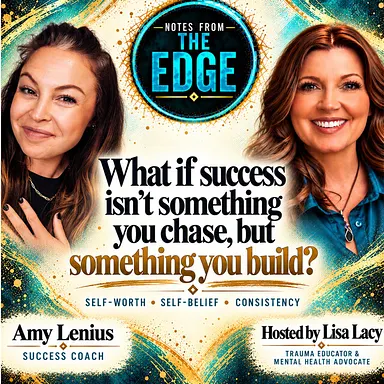
Welcome to Notes from the Edge, where we have the conversations we should have been having all along. We talk about the things that we're not talking about. I'm your host, Lisa Lacey, writer, trauma educator, executive advisor, and author of the upcoming memoir Notes from a Certified Madwoman. Welcome to The Edge. Hey, hey, my friends. Welcome back to another episode of Notes from the Edge. I am your host, Lisa Lacey, and this is the place we have the conversations we should have been having the whole time. Guess what? You ain't talking about it, so we're gonna. And today's special guest is Amy Linnaeus, who is a personal development and success coach, professional speaker, the director of group coaching at Next Level University. She specializes in helping women reconnect with themselves by strengthening self-worth, self-belief, consistency, and intentional daily habits. And we love that word intention in here. Having lived with a chronic illness since childhood, Amy's personal healing journey led her beyond physical wellness into emotional, mental, and spiritual transformation. Through rebuilding her own health and identity, she discovered that Sustainable growth begins from the inside out, not the other way around, my friends. Over the past decade, she has spoken on stages across the personal development and health industries, served as MC for the Next Level Live, and appeared on more than 200 podcasts.
She is known for combining practical coaching— we love that, we like things that work in here— and honest conversations. Go figure, she's on Notes from the Edge. And help people redefine success, reconnect with themselves, and create lives rooted in purpose rather than performance. Amy, welcome to Notes from the Edge. How are you today, my friend?
I'm so well, thank you, Lisa. I'm so excited to be here. I can already tell I love everything about your show.
Well, we love it too. We're having the time of our lives. It does not get better than this. We were having our mini podcast before the podcast, and I I was talking about this being my dream job, talking to brilliant minds who went through some darkness, got to the other side, and have some tools, tips, skills, or resources to help other people just have an easier ride of it. So you have spent much of your life navigating chronic illness before you even thought about stepping into coaching. Looking back now, how did that shape what you do today in terms of where you landed and how you help people today?
Yeah, it's so funny how we can turn pain into, into passion and purpose. And sometimes when you're in it, so when I look back at those years of being really, really sick, I don't think I was thinking this way during that time. But when I look back, and hindsight's always 20/20, you can be like, oh, that shaped everything. That I do, that I believe in, who I help and why the stepping stones I have taken in my career to where I am now all kind of stem from not only the through line of my illness, which is very female related, hormonally driven, and and those kinds of things. But the the identity, the beliefs that were built, the skills that were built, the resilience that was built—that all carried through into just about everything that. I do. And so that's always so fascinating to look back at it from that lens, because when you're in it, it's a disaster. Obviously, you're not thinking about much in this kind of lens. But what it does do is every time you go through something even more, you realize that, oh, this is just another one of those times, another one of those moments.
And because I've gotten out of this, I'm going to get through this. And because these cycles happen so much in life, I'm going to come out the other side believing something new, knowing something new, having this stronger, more just, yeah, strong identity. And that's fascinating too, to be able to keep moving through life with that level of perception.
I love it. I love it. And I think it's an important reminder for everybody to remember that hindsight always comes. Sometimes it takes a few months. Sometimes it takes a few years. Sometimes it takes 10 years, but it will always come to you where you get to pinpoint that moment and go, That's why. That's why it always comes for us. It always comes. So you, my friend, talk often about women's self-worth and, and self-belief. I like that wording— self-belief and consistency as 3 gears of success. So why do those matter more than talent, motivation, achievement, the things we're normally told matter? Why do they matter more?
Yeah, especially talent, to compare them to talent, motivation, and achievement. Talent, I think we're, we're always told we're born with or we don't have it when in reality, we've seen time over time, study after study, that practice is what creates talent. And practice over enough time beats out natural talent every time. So that's, that's neat. And what Self-belief is, if we want to take those 2 on together, self-belief is built through action. Self-belief is your self-efficacy. It's what you believe you're capable of achieving with enough time and effort with external results. So I built a lot of self-belief during my illness because I just kept going. I kept finding new ways to be healthy, be healthier, take that just next step into, okay, maybe this will make me feel a little bit better. Oh, that worked. Let's move on to this one thing. Oh, that didn't work. We're going to try over here now. It's all just trial and error, but continuing to take that action built a lot of self-belief. And high self-belief got me a lot of places. So high self-belief, again, meaning I can do what I believe is possible with enough time and effort.
It doesn't mean I always know how. If you have high self-belief, you don't always know the how, but you believe in your ability to figure it out and then implement. Yeah. You believe you can go learn. and take action. You can ask the right person and apply it to your life. So we don't always have to know, but we have to believe that we're capable of learning and putting in the action. That's what self-belief is.
Well, and what I love that you highlighted is, guess what? If it doesn't work for you, that's okay. Not your fault. Maybe not for your build and design. Move on, right? Yeah. Yeah. Find what does.
There's so much out there when it comes to health, when it comes to success in general, whatever success means to you, that can look like a journey, a love journey with yourself or someone else, relationships. It can look like monetary, absolutely. That's what we deeply believe in in Next Level University is holistic success, holistic self-improvement, health, wealth, and love. Love it. All of those are success journeys in their own right. And when you do something that doesn't help, you're still learning. Everything about success identity is just as much about what does work as learning what doesn't.
Yeah,
so that's just a part of the journey. When someone tells you that it's not and that you should stop, or you feel like, oh, I should stop because I've hit this wall, it's because we haven't been given enough permission, validation, support in the idea that that's absolutely a part of the ride. And when we don't get that kind of knowledge, we typically get off the ride too soon and we blame ourselves or we blame the thing. So everything you need takes time. Everything you want to achieve, we have to give ourselves the grace and gift of time, but we also have to give ourselves ourselves self-belief so that we keep going even when we hit those peaks and valleys. Some of us give up when things are really, really good too. So you need to know that about yourself. Do you give up when it sucks, or do you give up when things are really good and you stop doing the things that got you there? That's a really, really important piece of self-awareness and self-belief.
Yeah, yeah. And that's important to note too, that, yeah, um, self-sabotaging what's good Because you don't feel worthy, you're not used to it. I mean, there's a— there could be a million reasons lying underneath the surface there.
So which brings us to self-worth. So you can have absolute high self-belief, you're an action taker, you get results, but at the end of the day, at some point in time, your level of self-worth is going to come in and either work for or against you.
Yeah.
And in our community, just like myself who was drawn into this community as well, we get a lot of people with high self-belief, we get the achievers, but a lot of us have low self-worth or have come from a place of low self-worth. So, I had built a lot of resilience through my sickness. I had built a lot of, okay, I believe in I can go learn and figure it out. What I started to learn along the way, especially as I got into the realm of Next Level University and the guys and what they know, was, oh, there's a difference between self-belief and self-worth. And, here's where my ceiling is. Self-worth is your standards. It's what you believe you're worthy of achieving, of holding, of doing, becoming. If self-belief is, with enough time and effort, I can build a wonderful house, self-worth is, do I believe I'm worthy of living in it, of taking care of it, of who I allow into the space? Do they keep coming in and spilling red wine on my carpets and I keep inviting them back? That's a low self-worth move. So they go together, But they work either for or against each other, depending on how well they're going.
And we are not born, just like with talent, we're not born with a certain amount of self-belief and self-worth. They can be built. So if you think, oh, I don't have enough self-belief, or I don't have a lot of self-worth, that's okay. Lots of us start there. You can build both. Self-belief is built through action, messy action. Say you're going to do something.
I like that, messy action. It's not always going to be pretty. Guys, but you're gonna be doing it.
Nothing can be done consistently if you expect it to be perfect, ever. Consistency and perfection don't go together, ever. And we want to be consistent, we need to let go of perfection. So progress over perfection, always messy action is the way. And what you need to do when you say you're going to do something, you get it done, whether it's to the best of your ability, or sometimes it's a check-the-box kind of day. That's okay. As long as you get it done, you have your moment of, oh nice, I did the thing. I did what I said I was going to do. Because what that does is not only does it tell you that you deserve credit for all the things that you do, not just the big things that you allow yourself to celebrate, but the things that you do every day that actually compound over time and get you the results that you have. What this does is it builds into the identity. So that when you actually achieve a result, you don't hit imposter syndrome along the way. Who am I to be here? How did I get here? Do they know that I don't know what I'm doing?
It's just because you didn't build it into the identity along the way. You got the results for a reason. But if you're not building into the identity along the way, all of the things that you did to get there, it's going to feel a little funny. So build self-belief through, I say what I'm going to do. I get it done. And then I have the moment of I did it. Nice. Then move on.
I love that. Build the celebration in. So when you hit those mountaintops, right, because for me, it was mountaintop, next goal, mountaintop, next goal, mountaintop, next. It was just, there was, I'd never stopped to go, look what I did. Look how far I made it. Right? There was no time to celebrate. It was just let me just ignore everything and move on to the next goal and the next goal. So I love building these moments of celebration into a checkbox day, you know, I got things off the list and it was a good day.
Yeah, so important. And you build your self-worth when you do that. If you have low self-worth, you struggle to do that self-assigning, that self-celebration moment, because you constantly, you say what you're going to do, you get it done, and then right before you feel like you're going to self-assign, you're like, oh, but I should have done it better. Oh, I should have done more. Oh, you know, whatever it is, you're going to should all over yourself and not give yourself credit. And so we want to be really mindful of that because self-worth Self-worth is, is a little more complex. Self-belief is a simple formula: state, proof, self-assigned. Doesn't always mean it's easy. Self-worth is, is deeper. It's the internal stuff. It's, do you keep the promises you make to yourself? What is your understanding in relationships of boundaries, and how well do you hold them? What is your level of social courage? How authentically you are you? Do you know who that is, and do you live in that often regardless of your situation and who's around you? Do you invest in yourself? And people always think, I don't have the money to do so.
They don't— investment in yourself doesn't have to be monetary. You listening to this right now, this is an investment into you, and you can do little things like this every day. And then of course you can do bigger things once in a while, absolutely. But what are you doing every day to invest in yourself, your health, your knowledge, whatever you value?
Yeah.
That's
whatever you value. So you have to know what you value too. Yeah. Yeah. You have to know what you value. That I was, uh, I was in, uh, inpatient rehabilitation and I, I went in a dual diagnosis center thinking I might have a slight drinking problem and maybe a bad marriage. I don't know. I came out with a chart this thick, but I had a team of 5 of the most brilliant women I've ever met. And they asked me what my wants, needs, and values were. And I thought they were speaking a foreign language. I was like, what? What are those? What are those?
Yes,
because we're not taught it's okay to have them.
No, and to have them as yours that came from you, not those who surround you, those you serve, those who you are someone for.
Yeah,
because that is how women are raised. We are raised that our value is external. Our value is who we can be for other people, how we appear. For others, it's very much external. So when women take that power back and decide where their worth and their values come from, because we can absolutely gain worth from external things. I absolutely gain worth from my career, from being a mother, and all of those things. But I choose those things now from the inside out instead of chase them from the outside in and chase validation from other people. Like tell me I'm a good mom or tell right those kinds of things. It's very, very, very different energy. And so. Increased self-worth absolutely helps you decide what those things are, what you want, who you want to be, who you want to be around, the things you value, and your beliefs. And then you get to sort your beliefs because beliefs are built within us from so many different arenas. We have our own, we have those we were brought up with, and we get to decide, is this belief mine? And then we can let it go.
And we can, especially the ones that aren't serving our goals of who we want to be, the values we hold, that's when we're really struggling is when we have core values and core beliefs in conflict.
Yeah, and I don't want to gloss over the question, is this still serving me? Right? It's a big one.
It's a big one.
It's a simple one to ask, but it's worth asking. Where did it come from? Is it mine? That's a big one too. Is it even mine? No. Oh, it's mom's. Okay, well, we don't need mom's anymore. I'm 50 years old. I think We're good here, you know? So yeah, good questions. We, we say very often in here that we like to ask the better questions to get the more clear answers. Yeah.
The quality of the questions you ask yourselves can really determine the quality of your life. Genuinely. So the better questions you can ask yourselves and the better you get at answering them, the deeper questions you can start to ask. And that's, I mean, self-awareness is a superpower. It really is. And so the more self-aware you can get by asking yourself the right questions, and again, what is even right? You really feel it along the way. Like, this I don't need to know. This I don't care about. This actually isn't serving me. And then the ones that are like, oh, this one hit something. And then you can start asking your questions as a way to leverage your goals. So I have one that I ask myself all the time, which is a deeper layer for sure. We want to start maybe a little bit more up here, but I've gotten to a place where it's like, does this increase or decrease my self-respect? Hmm. Which is this kind of deep layer of self-worth. And typically, and why I say it's a bit of a harder question is because I, I never let myself off the hook.
So, if it's going to decrease my self-respect, the answer is no. If it's gonna increase it, the answer is yes. And here's where it's challenging is the an— the yes answer is always the harder choice. It's never the easier choice. It's always the harder choice. If I skip my workout today, does that increase or decrease my self-respect? Well, darn it, I now have to work out because obviously that's the one that's going to build more self-respect. So it's one that we work into, but you can really start with ones of, is this mine? Is this going to increase or decrease my self-worth? There's so much even within that. But so keeping the promises you make to yourself, boundaries, authentic self, social courage, investing in yourself, and comparison, making sure you're comparing apples to apples. You can compare for inspiration. We want to stop wherever we're comparing to a detriment. All of those things are ways to start building your self-worth.
Yeah, and a lot of what we see is not reality.
No.
Yeah, yeah, nobody's posting their 10% days online. Nobody's posting their 10% days online, guys. I promise you that.
No, they're posting fast, fun, Easy, sexy, abs by Sunday, millionaire by next weekend. It's like,
yeah,
those should all be red flags right there. If someone is telling you that there are not hard days on any journey, red flag. Because again, if you don't know that the hard days are on this journey regardless, you're going to get off the ride too soon. You're going to think there's something wrong with you or there's something wrong with the path that you're on. But in reality, all journeys have downslopes. All journeys have hard days. The thing is, is you need to zoom out and go in on the journey long enough so that when you zoom out, you can see the trend line. It's going to have highs and lows. But if the trend line is going in the right direction, you know you're doing something great. But people again get off way too soon and we're not giving ourselves enough time to be consistent every day to let the compound effect actually work.
Yeah, yeah. Well, and I, I think there's so much out there, out there, um, you know, telling us that, oh, the healing journey is going to be great and it's going to be love and light. And, and yeah, and it doesn't mean life stops. Life is life, and life is, is hard on some days. And sometimes it's just you're at 20% that day, or it's 50% day. It's not 110% day. So it doesn't mean that life stops happening. It means that the ride gets lighter for you, the ride gets a little bit easier, and you certainly manage you more skillfully within it when the stuff does go down for you. So, and hopefully you can remember, like you did, that hindsight from before. Oh yeah, remember that hindsight? Well, this is going to be one of those hindsight moments at some point. in the future where I can look back and go, ah, I remember now why I went through that. So you help so many women build lives based on expectations instead of alignment. How do we know? How do we know when we're living? What's a sign that we might be living according to someone else's expectations?
Yeah. Expectations versus alignment. So expectations, we can put expectations on ourselves or have them come from others, but typically the ones We put on ourselves or have some sort of external influence for sure, until you start doing the work where you're like, okay, this is now a standard for me. That's very different to hold standards that are aligned for you from the work that you have done, like boundaries, like social courage, like things that go against your values versus really hold them. That's setting you know that's you living in your standards that you are building versus living through expectations externally placed on you by. Family, friends, society, especially for women. My goodness. So there's a lot in that. And
I love your word. I don't want to— I don't want to forget building. She said building, guys. It's building. It's a process. So
yeah, it's a process. It's one of those, those mountains that gets higher as you climb it. There are some beautiful stops along the way, and you hit some amazing peaks and things, and there's some valleys There's some valleys, but you can keep climbing. This mountain never ends. Your level of self-awareness, growth, and success can keep going as long as you do.
Oh, there's no ceiling. There's no ceiling.
No. And I think that's another mistake people are making. It's like, well, when do I arrive? I'm like, well, where are we going? We can have, we can have, you know, milestones along the way. Absolutely. Can we reach this milestone? Amazing. What's next? What has this built you into so that you can accomplish the next thing, right? There's always a next level. That's where Next Level University comes from. There's always a next level for anybody, no matter what level you're starting on. And so that— so the expectations versus alignment. Alignment comes again from self-awareness. Self-awareness is a superpower. What are your beliefs? What are your core values? Knowing your core values is amazing. It is a filter or a lens to live your life through. And it just gives you these beautiful guardrails and understanding why some things feel so aligned and so amazing. And why things that you thought maybe sounded like a good idea, and they were a great idea for Susan and Jane and Bob, but it didn't work for you. You're like, why doesn't this feel as good as it feels for them or feel as aligned as it did for me?
It probably is because it's it's going against a core value that you don't know you have.
Hmm. So that's a good time to ask the question. Yeah.
Why didn't this feel as good, as exciting, as fulfilling as it maybe I thought it should have?
Yeah.
Probably goes against a core value. And so finding and discovering your core values again is a journey, a process. But you can go online, you can Google core value lists. I love Brené Brown. So Brené Brown's core value list, hers is extensive. It's amazing. And when you get on there and you start looking, as a female, You're going to start highlighting almost all of them because we love to love all the things. So here's the thing, we don't want 30. We don't want 30 core values. However—
Amy, how many do you recommend to stick to? How many do you recommend to stick to?
3 to 5.
3 to 5 sounds like a good number.
Yeah, if you have to stretch to 5, I will allow it. But typically—
I have to stretch to 5, girl. I have to stretch to 5.
I know, I have my 3 and then I have my other 2.
So you got some 2s hanging out there.
They're there, you know. 1 is too few. 5 can be too many for us because it gives us too many options. It gives us too much confusion. So again, certainty is a superpower as well, but it comes from clarity. Clarity creates certainty. Certainty creates action. Action creates momentum. And so when you have your 30 that you've initially highlighted, I want you to start grouping them together because I guarantee there's a theme for a lot of them. And so when I did this, probably 30 to 35, I was like, I love all of these things. You start to see that, oh, this one, these ones all kind of have a theme. And then you get to choose what the theme is. So mine, my top 3 are freedom, love, and growth.
All right.
And a lot of the things that I highlight, I'm like, oh, this to me falls under this lens of freedom. So I got to name them. them. I got to name what the words were to me, and I was able to group them all into these 3 categories. And then if I had to pick a 4th, it's integrity. I like to weasel that one in when I write about the loved one though, because I feel like I can.
It's actually like 3D.
I love that. Right. And so now when you look back on my life and look at my life now, you can see where like even just the freedom comes in. I homeschool my kids, we live out in the country, I work from home, make my own schedule. I have chickens, things like that. Like just they all things that bring me so much joy and so much passion and purpose and things. And they all, I feel like, fall under that lens. It's like, oh, this is why this makes so much sense to me, why I struggled with these 9-to-5s and why I struggled in this arena and where, you know, this might have seemed like a good idea. But if it's not under freedom, love, which love is, is contribution. It's, it's— there's so much there. Growth as well. Me growing but also helping others. So growing myself and others is such a core value of mine. And when I'm not speaking into the lives of others, helping educate other people or educating myself, I don't feel as fulfilled. That has to be a daily thing for me. And if I miss that, especially the one where I pour into myself, if I miss that, I start to feel a little off.
Because it's a core value of mine. It just is. And so now I have these, these railroad tracks that I can expand and go like this within, but it gives me a lens of, oh, this is going to go against my true self. So I already know I can just say no.
Because yeah, I was gonna say decision-making is so much easier because it's like so much easier to align with my values.
Yes.
And that's actually a great way to say no. Sorry, doesn't align with my values.
Yes, great.
Who's gonna say anything to that, you know, except for maybe mom? I don't know, she might have something to say about that.
They do. They typically do, even if they're like happy, healthy, amazing parents. I have amazing parents. They are— they're the greatest. We have such a good relationship. They're a part of our almost everyday life, my children's life. They're amazing. But we still have different opinions on things, and it's amazing to see it come up. And where I used to appease their beliefs and their opinions versus now standing my own and communicating that to them in, in language like, well, that's just not a priority for Chris and I. And they'll be like, oh, okay.
Yeah.
Oh,
oh, okay.
We're okay. I'm okay.
You're alive. You're alive. You survived. You survived. Just not a value of mine. Oh, okay. I love it. I love it. That's— hey, write that one down, guys. It's just not aligned with my values. Just not a value of mine. Beautiful, beautiful, Amy, way to say no. And a beautiful way to tell without getting all up in your head. Should I go? Should I go? Should I go? Should I not go? Should I say yes? Should I— it doesn't align with your values. So you're right, start with your values. And I love it. It gives you the tracks to go forth on. So Um, talk to me about a little bit more about alignment, because there might be some listeners out there that are— maybe they haven't even done a, a deep excavation yet, right? They, they just know something's off, right, in their life. Maybe it's not a, I'm completely miserable, but I got here and I thought this was going to make me happy, and I'm here now and it's not making me happy. So What does alignment actually look like? Because that's a word that's getting thrown around a lot right now.
Yeah, it is. That's true. I, I see that regularly. And alignment— so we just kind of went on the core value aspect, right? Like you understanding you, your values, your beliefs, those kinds of things. But when we're just in the stages of deciding, well, my life doesn't feel the way I want it to feel. My day-to-day doesn't feel the way I would like it to feel. We need to start just really, really small. Do I actually like this thing? Do I not? Discovering yourself is just as much, as much about discovering what you don't like as much as what you do, what you don't believe in as much as what you do.
Well, and it's a good starting place because if you can figure out what you don't, then it's going to lead you closer to what you do. So it's a great place to start.
Now, I had a, I had a client the other day, she messaged me. She's like, I just learned something about myself. Oh, do tell. She's like, I don't like scary movies. I told someone early on that I liked scary movies to become their friend and appease them, and that's been our thing forever. And she's like, I don't like them. Okay, here we go.
Yay! No more scary movies for you. Yeah.
And she's like, that— even just to say it out loud and acknowledge it has been so freeing and lifting it off my chest and all these things. I said, amazing. Now the next hard part to tell your friend.
Yeah, right.
Like, there's layers to this for sure. And we're always scared of losing love or losing a relationship. Now, not all of us. Some of us, we have— there are some personality types that are amazing with their boundaries and things. It's just wired in them. And then some of us have to really practice. I'm in that category because I'm so scared of losing love from other people. And I've had to learn whose love I actually genuinely want to hold and call cultivate and take care of versus whose I can just— okay, we don't care about that. This person doesn't have to like and love me. I can say I don't like scary movies. It's not gonna ruin my life.
And
we start with those people. Those are the easy ones.
Yeah.
But I love that you said earlier, you know, you didn't die. I— my clients message me that all the time. I did this thing, I didn't die. I know. So proud of you.
It's actually fun. Go figure. This does not have to suck and it does not have to be a drudge, guys. It doesn't. I keep telling you that it does not have to suck. It does not have to be a trudge. But please get a transformational coach, get a mentor, invest in yourself on this journey. That was the game changer for me. Amy, a little bit in my story, I had done all the clinical therapeutic arena acronyms, name an acronym, I did it. And I was still like, oh, I don't know about this. I don't know if I like this or want to be in this. And it was a transformational coach that finally got me moving forward into some forward momentum. And that's why I so highly recommend them and support them and became one myself because I believe so. I know without a doubt in their ability to help give you some forward momentum. So guys, if you're feeling super stuck, always have a mentor and make sure they have something that you want, right? Yeah.
And
if you're listening to the people, Amy, talk to us about listening to the people who don't have the things that we want, and yet we value their opinion so much.
Oh, I am recovering from this as well. So we're covering people pleasers. This one's very tough for us, but— and this is a very stereotypical thing, but this is one, and there's very few that are true across the board, these kind of statement pieces that everyone says, these hype sentences— but this one is really true. Do not take advice from someone you would not trade places with. with. If Uncle Bob has been divorced 6 times and is giving you relationship advice, we need to walk away. Not the man to be giving you relationship advice.
Save your conversation with Uncle Bob.
Yeah. Yeah. Is Bob a good mechanic? Let's talk that. Maybe he can help fix your car. Great. We don't need to be talking to him about marriage, right? Yes. And when you were looking for mentors, coach, influence, Like anything like that, even people you follow on social media, that tip of the iceberg I was saying for self-worth, that comparison. We want to compare apples to apples, AKA does this person have similar values to me? Do they have the results that I would like to see? And how can I be influenced and inspired by them versus just be in detriment because I don't think I could ever have what they have or I'm doing it really unfairly? Like if I were to compare my fitness journey to a woman who is 20, has no children in a gym in her basement, Versus me, who has kids that I homeschool, who likes to work out from home and is pushing 40—not the
same.
Should not be looking at this. I should be looking at someone who's well into her 40s, is crushing fitness, and maybe does home workouts. Absolutely, that's who I want to be looking at. And we want to be doing the same. If you look at someone's life, their lifestyle, and not just the highlight reels on social media and things, but if they have a marriage that you value. A parenting system that you value, a just a success principles, whatever that looks like. Again, success being so subjective. What is your subjective version of success? What are you looking for? And how can you find someone who is ahead in those things? Because anyone who is ahead of you is always going to speak life into you if you are behind them in that journey. They always will. People throw stones up. People don't throw stones back. People who are— Uncle Bob, for example, is going to throw stones at your relationship and try and inject his advice. He's got shit to say. People who are ahead of you in the things that you value, they throw flowers down, they throw ropes, they throw ladders, whatever that looks like, because they know the journey.
They know that it's challenging. They know that it's worth it. And they wish more people put the time and effort in like they did.
And they want you to have an easier ride.
Absolutely.
Yeah. They want it to be less emotional suffering for you.
Yes. And when you're, when you're investing in someone, just like when you invest in a book and a podcast, whatever that looks like, the goal is to condense the time. It takes someone, what, a decade to write a really good book. You can read it in a few hours, a few days, a week, whatever that looks like. And you have condensed their decades of knowledge into what hours? That's the goal. That's what you're investing in. You're investing in shrinking the time that it took them. That's what you're paying for. So like when we help podcasters, for example, so the guys, Next Level University started as a podcast, but they started 9 and a half years ago.
Wow.
Now they have a successful business, a 7-day-a-week podcast, and we do all of this other work in the world, but it was it was grown from a podcast. And so we love to help other podcasters. Again, I'm like you, we love to just support heart-driven people doing great things in the world, putting out a great message. Like, yes, we want to shorten that timeline for you. Let's not do 9 and a half years making all the mistakes that they did. Let's mitigate those mistakes, learn from them, and implement.
Yeah, I love that. We do. We want your ride to be shorter, guys, with way less emotional suffering, because, uh, some of— at least mine was needless. It was needless. I did it to myself. I did it to myself. Um, speaking of emotional suffering and reconnecting with ourselves rather than fixing— oh, fixing ourselves. Um, what's the difference? What's the distinction? And why is one way better than the other in terms of how we talk about and to ourselves?
Yeah, we can fix errors in thinking. We can fix things that are blocking our goal. We call it input, output, measure, adjust. What's the input we're putting in? What's the output? What's the result that we're getting? How do we measure it so we know? And then how do we adjust? That's where the fix comes in. We don't need to fix you as an innate human being.
Yeah.
That's very, very different to talk that kind of language about yourself. Even When I started my fitness journey and things, I had this belief that my body was this broken piece of garbage for valid reasons. Valid reasons. Years and years and years of chronic illness and then feeling okay and then doing too much and kicking up my inflammation and having to start from negative ten, build back up to zero, try again. Like there was so much there, but my belief and my whole thing was well I can't like my body is fit needs fix. It's so broken. What a mistake to talk to myself that way, because in reality, there was always something available to me. There was always something small that I could start and then build upon as my capacity grew. And that is true in any kind of journey— fitness, wellness, wealth, whatever that looks like. And
so— There's that word again, build, building. Yeah, because again, it is a process, and you started small. Right? You started with something that you could actually do.
Yeah.
And what I love about your journey is you didn't stop seeking. As long as we— oh, I'm getting chills— as long as we are seeking, we will eventually find it. But to your point, so many of us are so close, so right around that next little hill, and, and we stop.
Yeah.
With that gnawing in our Still there, right?
And sometimes you're so close, and it's not that you have to do anything different, you just have to keep going longer.
Yeah.
That's where consistency comes in. Self-belief and self-worth. So these are the things I believe I can do. Self-worth— these are the things I believe I'm worthy of doing, being, having. Consistency is, is everything. No one is giving themselves long enough. Everyone wants to know, what was the one thing that got you healthy, Amy? Nothing. It was a bunch of unsexy fundamentals compounded upon for a decade.
I hear you, sister. I hear you.
Yep. And it was worth it. It was challenging. There were wins, there were losses, there was highs, there was lows, but it was worth it.
Yeah. Yeah. I had a gentleman, uh, and it said something about the, the podcast in only 45 days. I was like, no, no, no, no. It's like, this is taken. Decades. Decades. Yeah, yeah. We, we are just now seeing, you know, some of the fruits of, of that, uh, consistent, uh, growth path, whatever that looked like at the time. But it was a, it was a, a gnawing, my friends. If there is a gnawing placed on your heart, it was placed there for a purpose. It's not gonna go away on you, I promise you. So if it's the thing, the, the book, the health journey, the whatever the thing is, it's not there by accident and it's gonna keep at you. So you might as well start letting it come out a little bit more. So, and you've said, Amy, you say growth doesn't always feel good. So how do we tell the difference between like some discomfort because we're getting out of our comfort zone into some things that may be a little uncomfortable at first until they're the new comfort level or something that's telling us, well, this isn't for me. How do we kind of gauge that?
Yeah. And that's hard these days too, because everyone out there, it's all like you said, it's sunshine and rainbows and this journey is just love and light. And it's, you know, you have a hard day, you're like, oh my gosh, I suck so bad. I'm doing this thing wrong. It's like, probably not. You're probably just doing it really, really well. That means it's working because today sucks. And these moments of like looking at your triggers, looking at your core values, looking at your core wound and how not understanding it, what that has cost you in life, what it allowing that to run your life, like when it runs your life unconsciously versus when you pull it conscious and you start dictating what that looks like in life, that hurts for a minute.
Yeah.
It sucks. But the more acceptance you have around that hurt, and then you start just again driving that bus more consciously rather than it driving you, time, effort, absolutely. But it doesn't like feel good all the time. And even the self-worth stuff— self-worth is the poster child of discomfort now for success later. When we're avoiding self-worth work, we're constantly sacrificing discomfort. So what we'll do is we'll choose to avoid short-term discomfort to guarantee that it's more discomfort later. We'll put it aside and stay in comfort. Well, I'm not going to say that thing. I'm not going to hold that boundary. I'm going to laugh when I don't think it's funny because it's not worth it to explain. That's avoiding the discomfort of now and compounding it into lower self-worth later. Whereas if you can take on that self— that discomfort now, the more short-term discomfort that you take on, the, the more long-term success you're going to have.
I love that. I love that. And I always say, you know, I spent 20 years running from dealing with my traumas, dealing with my emotions. I numbed everything with addiction. And turning and facing all of that was one, not so bad. It was kind of like, what? This is what I've been running from this whole time. And now It is fun work to do. I enjoy my alone time. I dig myself as a human. My friends, when you dig who you are as a human, you know how you tick and click. You can articulate that to those that you love, care about, and are of service to. Life changes exponentially for you, but you've got some work to do to get there. And it's not always fun work. Sometimes it's boring work. Sometimes it feels boring. Sometimes peace feels boring. Oh, there's nothing happening. There's no cake. Where'd my chaos go, right? The first piece, even peace, Phil, what is this strange, neutral, nothing's going awfully wrong, unsafe feeling, right? So yes, yes, it's very easy to get stuck in these, these little traps that will make us give up.
Very much so. It's, it's that not everything that feels bad is bad, and not everything that feels good is good.
Mm.
There are some things that are so good but feel so bad at the time. And when your comfort zone is built in chaos, when you are learning to regulate your nervous system out of chaos, that's really challenging to do. It's like, oh, but I just want things to be more peaceful, more simplistic, more flowy. You're going to sabotage yourself the second you get out there because you're regulated for chaos. It takes time. It takes persistence and consistency. You dipping your toe into that constantly. The more you dip your toe out of your comfort zone into this next layer that's called the growth zone, the better. Because the more you're in the growth zone, the more that growth zone is actually going to condense into your comfort zone, and it's going to expand and expand. And what happens though is most people are jumping from their comfort zone into the very outer layer, which is the anxiety zone. They're going from zero to ten, seeing that ten is scary. They're so dysregulated; they don't understand the thing. Themselves, they jump back in their comfort zone and it's like, see, I'm safe here.
Look, I tried it, it didn't work.
Yep, I tried it, it didn't work.
It's me or the thing.
Yeah, it's me or the thing.
I like the toe. Stick a pinky toe in. Pinky toe. Yeah, you don't have to leap in. Just—
no, leaping isn't sustainable and you can't be consistent. Remember I said earlier, perfection— you can't be perfect and consistent at the same time. You also can't be consistent without sustainability. And sustainability takes humility.
Ah, humility. Talk to us about humility.
Self— actual, like, accurate view of self is humility.
Yeah.
No, you're not more important than you think you are. You're not more skilled than you actually are. You don't think you're something that you're not. And you also don't think less of yourself than you actually are. It's, I haven't worked out consistently my entire life, so I'm not going to start at the gym for 3 hours tomorrow and expect myself To be able to do it, that's not humble. That's not humility. That's hey, I've never been able to work out consistently in my life. So we're going to start with 10 minutes tomorrow and we're going to build. And I'm going to do that every day until 10 minutes feels so easy that I'm going to kick it up to fifteen, to twenty, to thirty. Sustainability. So many people look at where they want to go and they try and inject that level of commitment into their daily life now. You don't have that life yet. You can build into it. But if you're not honoring the season that you are in right now, it's like me trying to live. of like when my kids are going to be in their 20s and their 30s, my life is going to look a lot different.
My responsibilities with my career and the things that I'm going to be able to build into will grow more as they need me less. But if I were to inject that level of responsibility in things now, when my children are still young and they need me and I'm homeschooling them, I would be doing my now a disservice, not only to my children and the stage of motherhood I'm in, but it's just not sustainable. I don't have the time. Yeah. I don't have the time, the capacity. 2 little variables, not to mention pets, household, all of the things. Life is so reactive. It's so reactive. There's only so much we can be proactive about. There's only so much we have control over. It's actually very little, to be honest. And so the more we can inject humility and sustainability and give ourselves the gift and grace of time, like I said earlier, the more consistent you're going to be and the more guaranteed you're going to be in the results that you are going for.
I love it. I love it. Humility, sustainability. So, Amy, if somebody's listening and they're feeling disconnected from themselves, maybe burnout, because that's the end result of if you were trying to push at that career level right now while your kids are young— burnout, it's right around the corner. Collapse, burnout. Yeah, for me it was a full mental health collapse. because I was trying to be Superwoman and I didn't have language for what was happening behind the scenes and I didn't have the capacity to say I'm struggling without shame. So if they're feeling burned out, overwhelmed, unsure, like they're looking around going, I feel like a shell of myself, I don't even know who I've become, where would you encourage them to begin today other than finding you? Where would you encourage them to begin?
Ooh, small. And just start taking assessments of your surroundings and how you're feeling. It's tough. And here's where talking on podcasts to a group of people versus one-on-one is very, very challenging. Because if I'm speaking to someone who has really high self-belief, my answer is different than if it's someone with low self-belief. Wow. And that's another thing you see out there, big red flag, when you're looking at the social media industry and the coaching industry, is people think their language is the language of everyone else. People think their thing is the thing that's going to work for others, when in reality, let's say it was affirmations that changed their life. Well, for a certain percentage of the population, affirmations are detrimental. It's not good for them. And so it varies based on self-belief, self-worth, your identity, your core wound, all sorts of different things. So we need to make sure when we're working with someone, they know who we are and help us discover that along the way.
Yeah, and be selective, friends. Make sure your mentor that you choose is a good fit for you. They're a good fit for you, you're a good fit for them. And if you've got to check out a couple, check out a couple. It's just like a therapist. It's a relationship that you're going to be in. So if it doesn't feel aligned, right, with who you are, where you want to go, your values, just move on to the next one. There's plenty of us out here.
Yes, absolutely. And you are more than within your rights to do that.
Yes,
absolutely. Get on the phone with somebody. I guess it's not a phone anymore, it's Zoom. Might have just dated myself a little
bit
there.
I'm with you.
Feel the vibe.
I remember this phone. It's okay.
Feel, feel. Do you feel safe? Do you feel heard? Do you feel understood? And do you feel like you're going to get tangible, actionable That's actually going to move the needle towards your goals. That's what you want. You said that it was a coach that helped you move. It's because they got you to inject action. Action is everything. It's everything. And when you can have someone help you understand what the most aligned action is for you, because so many of us are out here just doing busy work. Talk about getting overwhelmed and burnt out. It's because you are taking in so much of the external world and all of the external opinions and trying all of the things. you're gonna burn out because all of the things are not meant for you. And all of the things are absolutely—
So much noise.
Yeah, so much noise. And how many people are just living in this busyness? We're busy. Oh, how was your weekend? Oh, we were so busy. Or how are the kids? Oh my gosh, they're so busy with all of their stuff. It's like busy is this status symbol. But in reality, if you can get clear on what actually needs to keep you busy for the results and the goals that you want to have, oh my gosh, momentum, results, Lifestyle, the day that you want to experience—it's all in there. And so, yeah, I mean, that's our first call. Kevin Allen and myself, our first calls are always free because we also want to know that you're a good fit for us.
Yeah,
we really struggle with people who don't want to habit track, have humility, to take small action every day, who are going to come in with the idea that things need to build over time and sustainability. If you come in and you want results. Right away. I can say, well, here's what we can for sure help you see right away. But it's not like, you know, you're not going to be a millionaire by next Sunday. It's not going to happen. You're not going to have abs by tomorrow.
I'm sorry. I mean, now you can get t-shirts. There's t-shirts, guys.
Go get an ab t-shirt. For sure. Amazon has great ones. For sure. For sure.
I'm getting an ab shirt.
Absolutely.
I am menopausal and I can't be treated. It's a long story, but yeah, I'm getting a nap t-shirt. I think that might be fun to sleep in. All right, Amy, if people want to get in touch with you, because, you know, maybe they've heard what you've said for the umpteenth time, but you said it and it landed for them, how do they reach you?
Oh, I'm a simple being. It's just @amylenius on Instagram or Facebook. And what I can guarantee is not only if you liked this conversation, what I loved to have a conversation with you. But when you reach out to any one of us on that plat— on those 2 platforms, you get us. We believe in human connection now more than anything. You're not getting an assistant, you're not getting AI on those 2 platforms. You do get directly to us, myself. And like I said, first call is always free, so we can just hash it out.
Yeah, guys, pick up— pick up the phone. Pick up the phone, girl. You got me stuck back in the rotary phone days. We've said how old we are.
They don't do this anymore either. It's this.
On a live. I did that on a live. So guys, you don't have to write any of that down. We're gonna have clickable links for you to reach Amy's socials. And this will be coming out soon. Please, if you're feeling super stuck, um, click the links. Click the links. Is that what we say now? Click the links and, uh, get signed up. It's a free call. It's 20, 30 minutes out of your time to see if a great mentor, uh, might be a good fit for you. It's definitely worth the investment if you're not sure what next steps are. Sometimes it just takes somebody going, you know what, you're looking left over here. If we could just get you looking right, man. Yeah, just a new perspective that sometimes when you're in the inside of it, you just can't see yourself. So that's what I love about transformational coaches. All right, Amy, we always close out with 2 questions for our guests. You ready?
All
right, first question: in your own life, what did you perform just to survive, and what did dropping that role mask or performance do for your life?
Oh, my biggest performance was being whoever others needed me to be. Always. This was my personality for so-and-so. This was my capabilities for this person. This is who I said yes to all the time because I didn't want to— I mean, XYZ. It's the performance I would put on for others, not only to be the person they needed me to be, but my special brand, we either dim or inflate So some of us pretend to be more than so we don't get found out that we're less than, for lack of a better term. Again, that's not the right language, but don't talk to yourself that way. But mine was always to dim, dim and appease.
Make small, make small, make small.
Make small, don't make anyone uncomfortable.
Yeah, yeah. What happened when you stopped that?
Oh my gosh, not only did my social life tank, but Here's—
you're gonna lose some people, but it's a good thing, guys, because it's so worth it. It's kind of like the toxicity just takes itself out.
It does. When you start increasing your self-worth, when you start living in your values, your boundaries, your self-worth, the people who were benefiting from you not being yourself, from not having boundaries, they naturally fall away. They'll either do it silently Or they'll attack and then leave. That one sucks. However, you're not going to die. It's going to be okay. And you're going to realize that they weren't adding to your life. How many people are you adding to that don't add back? Oh my gosh. That's the story of the people pleaser. And so it does, we call it lonely land for a reason. A lot of people go through it on a transformational journey. But again, if you know it's coming and that there is something so worthwhile on the other side, you're not going to get off the ride too soon. And so it It was that. I— my whole life has shifted, and now I just have the best, most inspirational, aligned relationships in my life. It's simple, it's easy, it's growth-oriented. Again, my core value, that third one, is growth. And everything and everyone that comes into my contact and into my life is circling within that because they have that value as well.
And so we're just in this vortex of growth, and it's unbelievable. It's amazing.
And then you grow together, right? And then you grow together. Sure. Yeah. All right. What do you feel like we need to be having more conversations about that we're not talking about?
Oh, I think more women need to talk about self-worth for sure. Self-worth, where it's rooted in their identity and just where it's rooted in womanhood all on its own. There's this, there's shame, there's guilt. There's again, that dim and appease for the sake of so many reasons we've taught. We've been taught that there's just so much safer for us to dim and appease than anything else. There is so much within this conversation that women need to hear and can learn to implement in their own life to start feeling like themselves, start feeling like someone who is in control of their life, the people in it, the things that they do, and their environment. It's, it's such a powerful conversation.
Oh, I'm excited, guys. reach out to Amy because I'm about to ask you, what are you performing in your own life in order to survive? And what might setting down that role, mask, or performance do to improve it or lighten your load just a little bit? I am your host, Lisa Lacey. We have been here with our guest Amy Lenius, and when you find the answer, we will see you on the edge, my friends. Thank you, Amy. Thank you.
What if sustainable success has less to do with talent, motivation, or doing more and more to do with self-worth, self-belief, and consistency?In this episode of Notes From the Edge, Lisa Lacy sits down with Amy Lenius, personal development and success coach, professional speaker, and Director of Group Coaching at Next Level University, for a conversation about redefining success from the inside out.After navigating chronic illness from childhood, Amy began rebuilding not only her physical health but also her identity, beliefs, and relationship with herself. She explains why self-belief is built through action, why self-worth can quietly place a ceiling on achievement, and why sustainable change rarely comes from dramatic overnight transformation.They also explore people-pleasing, burnout, boundaries, perfectionism, nervous-system regulation, and what happens when you stop performing as the person everyone else needs you to be.In this episode:The critical difference between self-belief and self-worthWhy messy action and consistency can matter more than talent or motivationHow people-pleasing, dimming yourself, and weak boundaries can erode self-worthWhy sustainable growth means expanding your comfort zone instead of jumping straight into overwhelmHow small, intentional actions can create lasting success without sacrificing your health, relationships, or identityConnect with Amy LeniusNext Level University Group Coaching: nextleveluniverse.com/group-coachingInstagram: @amyleniusFacebook: Amy Lenius Connect with Lisa LacyInside the Edge: lisalacy.com/inside-the-edgeWhat did you perform in order to survive?Welcome to the Edge.See Privacy Policy at https://art19.com/privacy and California Privacy Notice at https://art19.com/privacy#do-not-sell-my-info.