
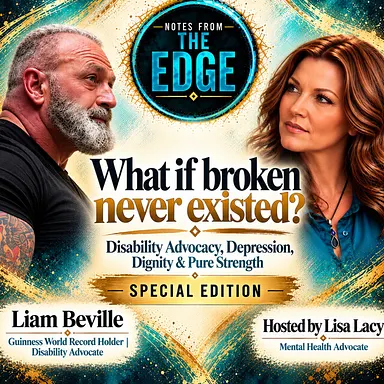
This transcript of “SPECIAL EDITION; The Unbroken Conversation with Liam Beville” from Notes from the Edge was made with HappyScribe’s speech-to-text technology. Related: human and AI transcription.
Ads in this audio differ from the text. Tap the sentence you're hearing to follow along.
Synced: the text now follows the audio.
Every once in a while, a conversation happens at the edge that can't wait. This is one of those conversations. Welcome to a special edition. If you're struggling today, this one's for you. Welcome to Notes from the Edge, where we have the conversations we should have been having all along We talk about the things that we're not talking about. I'm your host, Lisa Lacey, writer, trauma educator, executive advisor, and author of the upcoming memoir Notes from a Certified Madwoman. Welcome to The Edge. Hey, hey, my friends, welcome back to another episode of Notes from the Edge. I am your host, Lisa Lacey, and this is the place we have the conversations we should have been having all along. Guess what? You ain't talking about it. So today we're gonna— with special guest Liam Bevel, and you guys have already missed it because we've had a podcast before the podcast. Today we're talking about what happens when catastrophic injury changes your body, but not your capacity to rebuild, compete, connect, And redefine what strength actually means. So let me tell you a little bit about Liam. He is a Guinness World Record holder, elite powerlifter, speaker, author, and disability advocate from Ireland.
At just 18 years old, he pushed a friend out of the path of a stolen car and took the impact himself, shattering both of his legs, leaving his right knee severely damaged. And he was told the words, you may never walk again. He went on to compete at the highest level of powerlifting, including the 300 kg deadlift and 75 kg bodyweight in 1992. And then in 2022, he set a Guinness World Record with 285 kg conventional deadlift in the MP4 disability category while continuing to compete in able-bodied competition. After a 12-year retirement, he returned to the sport at 52, guys. So listen, we're not done at 50. So stop saying that.
What?
And he remains internationally ranked in his age and weight category. He is the brand ambassador for Active Disability Ireland and a speaker on resilience, disability inclusion, and sustained performance, and has an exciting memoir coming out called Unbroken: The Liam Bevel Story. Liam, welcome to Notes from the Edge, my friend. How are you today?
Thanks, Lisa. That was fantastic. That was the best introduction I've ever heard in my life.
Well, we're done. The podcast is done.
That's it. Yeah, I was just saying to myself there, you know, that's— did I do all that? That's fantastic.
He sounds like an awesome guy.
He does. Yeah, he sounds brilliant altogether. Can I just say, uh, that it was actually 310 kg deadlift. In 1992, and I came back, uh, at 53. Just, just a small correction on that. That's all.
Big difference because that year, that year can feel like a game changer once we, uh—
Yeah, absolutely. Absolutely. Because I'm 61 now and it's, it's, it's much harder. It's, it's like dog years. It's, you know, for every human year, for every dog year, know that I'm going 7 human years. ahead, you know. So I mean, 60 to 61 is really 67 in human years, you know.
That's true. Well, we have a, uh, 21-year-old Italian Greyhound that's still kicking it, so we've had him since he was 3 months old. So Liam, it's Nose from the Edge, so we're just gonna jump right in. And I don't want to jump into the, the moment of the accident. I want to jump into the moment you decided to start powerlifting after you walked again, after being told you would never walk again. Where was the decision to start powerlifting?
Basically, it came down to rehabilitation, just to learn to walk again. No, I spent 6 months in a wheelchair, and I spent, uh, 12 months in plaster casts right up to my hips. So I had the underneath, um, crutches, under— underarm crutches. No, when I decided, you know, it was nearly time, I started to develop my upper body from the crutches and I started to get very good at the crutches. I was going around, I could not even touch the ground, I just put the crutches and just go really fast.
You were just gliding.
It was just gliding, it was just, it was great except that I was on crutches. But, uh, I needed to join the gym to do a bit of rehabilitation. Uh, the plaster casts came off after a year, but when they came off, my legs were still heavily bandaged and they were extremely thin. There was no muscle. There was— so there was nothing to move. I couldn't bend the knees. There was nothing to move the legs. I couldn't raise my legs really, you know. So I said I'd go into the gym. No, I couldn't really do much on the upper body. in, in a gym. But, um, after a time, I started to— as it went on slowly, I started to develop. You know, it was more so for the mind, uh, that I went into the gym. So I focused heavily on my mind rather than my body. But after time, I started to be able to do little things for the legs. And what made me— that was for rehabilitation anyway. So this was in 1984, a year after the accident. And, uh, I met this guy down there. He's, he's a local bodybuilder by the name of Jimmy Butler.
He's a European, um, title holder bodybuilder. And he was in the gym, you know, he was lifting the biggest weights I've ever seen. No, to me, no, there were— it was— this was an impossible task. I mean, this is Herculean. It was just really impossible. and he was, he was doing it at ease, doing reps and just lifting them up. And, and, uh, I just said, I'd like to do a bit of that, you know. So I started to train heavy and upper body. And then as soon as I could, I joined a hardcore gym where, um, I could do legs and, and train. And I still, you know, I still didn't look good. I mean, it came into 1985 and and I am still— my legs were— and they're not enormous, you know, and people would make derogatory comments on them because I looked like an inverted golf club. So I was all upper body and just standing on 2 pins. So I was embarrassed about this. So I needed to develop my legs. So I started working for legs. But to cut a long story short, in 1986, I had my first powerlifting competition.
40 years this year I'm competing in powerlifting. So hopefully, hopefully that answers that part. But having said that, it's still an ongoing process for me, you know. Um, I, I still train, I still train heavy, I still do, um, huge deadlifts, as you probably would see in my website that I, I post now and again. I still do fantastic deadlifts. And at 61 years of age, there's no stopping me, you know. So I'm 40 years competing, 40 years at elite level, ranked number 1 in the world in the deadlift for my age and body weight. And that 310 kg deadlift that I've done at 75 kg body weight, that equaled the GOAT, Ed Coan. he's known as the GOAT in powerlifting, that equaled his best, uh, at 310 kg at 75 kg body weight as well. Now, he went on to do bigger and better things as he gained body weight. I used to move through 4 weight divisions, going up and coming down, uh, from 90 kg right down to 65 kg. I would, um, dice and just took records all over the place. So, uh, Yeah, that's how I got started with powerlifting.
I, I just got the love for it and then never looked back.
I love that. But you know what's important about what you said was it wasn't about your body to begin with.
No, it was about the mind. See, the thing about this is that, um, we all have a, a body-mind connection anyway. You know, they say that if you were to train just your right hand and never trained your left hand, your left hand would grow. You know, it's just the process of doing it. So it has to be the mind connection. So the thing about it, I was aware of this because I couldn't move and because I'd hit the bottoms of depression and I suffer from PTSD from the actual accident itself. I realized that I needed to do something to mind. And even when I came back at 53 years of age, and I'll give you the reason for coming back in a minute, but at 53 years of age, I went to see a hypnotist because I needed that mind connection again that I'd lost over 13 years absence. So I went to see a hypnotist and a sports hypnotist. And what it was, was it's not the voodoo and the chicken in your mouth kind of Don't go on with the watch, look into my eyes, not around my eyes, look into my eyes.
It's not— it's nothing got to do with that. He taught me how to focus, how to visualize, uh, very important for all athletes. You have to, you have to visualize. You'd often see a pole vaulter or a long jumper, you'd often see them going through this routine in their head, so they're actually just going through the whole routine inside their head first, so to get the mind right first, the body will follow. So I always had that, uh, in my head that, you know, if I can get my mind right first, the body will follow. And it did, it did follow, and it followed really successfully. But I did need help along the way, and I did need help with my mind. And, you know, I'll go back to the hospital when I was 18, and I was a very athletic person before the accident, and I was involved in swimming, long-distance swimming, and we have a competition that I was in in 1982, and it was the Torment Mile, they called it. Now, it's a misnomer because it's about 2 or 3 miles of a swim and you're going against currents and it's a really, it's really an endurance swim.
That passed in 1993 when I was in the hospital. Now, the hospital faced the river, and I was sitting out because I asked to be put outside the bed. Everything had to be done for me. I mean, you know, I had no dignity, I had no pride left, and there was no privacy, uh, because I'm talking about even the simple tasks of just going to, you know, to the bathroom. You would have to use a bedpan and a bottle, and the nurses would have to place it onto you. And for your— to preserve your dignity as much as possible, they would pull the curtains. There's no dignity. There's nothing private about that. There's no dignity held in that either. So, I mean, talking about hidden depression. So I was outside, and it was a heat wave as well in the summer of 1983, which made it worse because you're lying in the bed, bedsores, and you have to get everything done for you, and you're just lying in pools of sweat, and there's no air conditioning. We didn't have air conditioning back at that time. Um, you obviously would have had it in Georgia and in America, but we didn't have it in Ireland because it doesn't get those type of, um, severe temperatures that would get.
So, but it was a heat wave and it was bad. And I remember looking down and seeing the swimmers swim past into the river, and I just hit rock bottom. I hit rock bottom. But I always say, and to this day even looking back, I said, you know, if you're standing still, jump. What do you do first when you jump? You lower your body. to spring back up. I said, that was the lowering of my body, that was the lowering of my mind, but I sprang back up and I came back, and I came back stronger, and I came back resilient, and I came back with an unbelievable mindset that anything can be achieved, and I achieved it. So, so far, so far, everything's working out for me.
I get it. Well, what I love that you remind me about is, um, a story. And I've, I've never checked into this study, and I'm, I'm kind of a statistics geek. Um, but he told me once about how important visualization was. And what we were working on for me was controlling my emotions in martial arts.
Yes.
Not wanting to win, not wanting to fight, but, uh, wanting to treat every opponent like my grandmother or baby bird and be very gentle. Right? So he told me the story about the basketball players and a visualization exercise and how some practiced on the court, some just visualized, and the ones that just visualized actually improved as much as the ones who were actually on the court. So that's how important our brains and our minds—
Extremely important. But it even goes beyond that. They've done a study. And, uh, I'm a bit of a geek for these studies as well. No, I can't name the study, but I can name the results of it, that people who just did nothing, only visualize, got the same improvements as people who went to the gym and did it. So what's, what's going to happen if you visualize and didn't go to the gym?
And do it. Yeah.
You know, what's going to happen to you in competition if you can see yourself winning? Because the hypnotist even said to me, just, just think of yourself up there and they're putting the gold medal around your neck and the roar of the crowd and just think yourself in that moment. And I was thinking, I was in that moment and I saw it and then it became real. I saw it first and then it became real. And I do it all the time and it's something I would have done and naturally came to because my father was a brilliant athlete as well. He was rugby player, um, he was a swimmer, long-distance swimmer like myself, he was a diver, a boxer, um, he even played water polo, uh, but the thing about it is he was a quiet man, very stoic man, very quiet man, and, uh, I, I would have learned from him techniques just by watching him really, you know. and it's not something he wouldn't sit down and teach you these things, but you'd learn from observation, and which is even better because, you know, it's less like a schooling than it would be something you want to do.
You want to emulate your father, to imitate him, and just be the best like him. So yeah, these techniques kind of came naturally to me, but in my 13-year absence, I'd lost the ability. And when I came back, anxiety and nervousness took over, whereas once I flourished on a platform, um, for lifting, I just fell apart. And there was a qualifier for the, the World Championships, um, coming up in 2017, and, uh, I, I went in for a deadlift and it was, um, only 210-kilo opener. No, but I was coming back and this, this was a lot to me, you know. I was also losing body weight. My strategy was to go in and take a world record at, uh, 4 different body weights because no one had ever done that before. So I start with the lowest one, you know, I dieted down from 91 kilos, you know, and I weighed in on the day at 65 kilos. So obviously you're going to lose a lot of strength for that. So in, in the competition that I, um, that I had to qualify for, I was up around, maybe around, uh, 80 kilos or 82 kilos.
So, and I saw I was still on my way down. So I was lifting 210 kilos and I missed it. I missed, I missed the lift. First, I didn't get it. 3 red lights, felt terrible. And so the second lift I came in and I says, you know, this is it, I have to do it. But in between was waiting to be called for my second. If you have only 3 attempts, if you fail 3 attempts, you're out of the competition. And the second lift, I just wouldn't let go. It was sheer willpower. My technique was useless, it was all over the place, it was horrible. And, uh, but I got the lift, so I got to 210. No, I had a 3rd attempt, but I was so wasted. I was gone. I was exhausted mentally, uh, emotionally, physically from— I didn't bother with the third attempt, but it didn't matter. I qualified now for the World Championships. So I— but I knew in that process that I needed help with my mind, and that's where I sought out— he's now a friend of mine, Enda Shea. He's living in Galway in, uh, in Ireland, and he practices a hypnotherapy business.
And for athletes. And he taught me how to visualize, or relearn— not taught me, but relearn how to visualize. And I haven't looked back since.
I love that.
I know I'm loving the stage.
I want to know what happened around 50, because a lot of us start writing ourselves off. Oh well, I've hit midlife, I'm, I'm done, I've done all the best years. So What happened between, like, 50 and, and 53 to make you go, I gotta get back in the game?
Well, first of all, um, I don't see— I'm looking at this person here and he's looking at him saying, why have you got this old man looking back at me here? You know, because I don't feel old. You know, I've never felt old. Uh, I've just discussed it earlier today. I had an interview earlier today and I said, I just feel 17. I've always felt 17, you know, and I still do. And, you know, is it impossible to do this when I was 17? No. So the age really doesn't come into it for me. But having said that, what made me come back— because I was retired, I was retired, I had my knee replaced, I had my hip replaced, and I was retired, and I had the boots hung up, but Do you remember that 310 kg deadlift that I did at 75 kg? That, um, was missing from the Open Powerlifting, um, had a resource website that all old lifts and everything, they accumulate and they rank you from it. And that would have made me still the best, um, Irish deadlift since 34 years, but it had disappeared. It wasn't in the record books.
So I contacted, um, Open Powerlifting and I says, look, I've done this, I have all my certs here, uh, to prove it. And he says, well, that's not good enough, you, you need something. Uh, was it in the magazine? Was it— was the results given officially? And it was an international competition, it was an IPF competition. Uh, it was at a time when all the separated powerlifters was weight divisions, like they have different classifications. No, we didn't even have masters. We, we all had to lift— no, I was 27 at the time, but we all had to lift as powerlifters whatever you weighed and under. And, uh, no, I couldn't find anything, couldn't find the article. And, uh, so I said, look, I'm going to come back and set new records, and I'm going to go for 4 weight divisions. I'm going to go for 4 world records held simultaneously over 4 weight divisions, and that will, um, that will make me be happy again, that make me feel happy. There was no chance in my mind that I was ever going to fail, and I didn't fail, you know. So I didn't consider it, just happened that I was 53 at the time, so I started my first world record campaign, and I achieved more because now I have 6 world records, uh, at 4 different body weights, including a Guinness World Record for the heaviest deadlift ever lifted by, um, a disability category.
I've never competed in a disability category, never, and still don't, uh, to this day, uh, but it's recognized now as a disability category. And even in the able-bodied category, that 285, the Guinness World Record kg deadlift. Uh, I, what's it, 500 and 560 or £580 or something like that?
That's an insane amount of weight.
It's, uh, no, £680, something around those. I'm not, I'm not too sure. I deal in kilos. It's 2.2 to every pound. So if someone wants to do the maths out there, feel free.
It's a lot of weight, guys.
It's a lot of weight. Yeah, it's a lot of work, but they eventually— I eventually found an article in the magazine, um, giving my results, 310 kg at 75 kg body weight. No, but this was after I had a few records, um, redone. And I said, look, I'm not finished at full go. I had something like 2 records out of my goal at this. I said, I'm, I'm not doing— there's still a few more to do. So I keep going. So that's what, that's what happened to me. That's what made me come back. But like I said, and I would never have came back because the 310, I was quite happy to sit with that. And 34 years later, it's still unbeaten. It's still the highest WILT score, which is a formula used to determine, um, who's the best lifter. Um, so it's number one as the best lift in Ireland, um, for 34 years and has been unbroken, you know? So I was quite happy with that. but I did a little bit more, and then I got a Guinness World Record I never thought, never thought I would get. They awarded me that in 2025 for the lift I did in 2022.
So of the 285 kg, uh, I had done this, uh, with a right hip replaced, right knee replaced, the left knee needs replacing for the past 8 years. But I just decided I'm not getting that done because I'm enjoying, I'm enjoying everything else around, you know, a white temp face, you know, this could be the one that puts me out. But yeah, like I said, I'm 61 years of age now, Lisa, and I feel the same in my mind, you know, I feel sharp and I feel, I feel good and I feel happy and I feel like any 17-year-old carefree lad would, you know, and I say 17 because it was the year before the accident. Because at 18, I became an old man, but I soon got out of that.
And then you became a young man again.
I became a young man again. So yeah, I love that. It's what the Irish have, is called, um, Tír na nÓg. It's the land of the young, it means in English. And, uh, it's a few fairy tales that, um, they say that if you dropped into the land of Tír na nÓg, that you'll stay forever young. age that you are, but if you come back into the real world, uh, you will age very fast. So that's what happened to me. I came out of Tir na nÓg at 18, and I went back into Tir na nÓg in my later life, and here I remain. So if you see that I'm looking a bit old, you'd look again.
Not a bit, not a bit. You look 17 to me.
Fantastic. Keep going, keep going. I love it. William, what you think of me?
Well, we have so many people that are our listeners that are in midlife, and I'm calling midlife— I mean, some of us start quitting at 40. We're like, well, it's time to wrap it up. I'm 40, and I'm done with all of the things I did when I was youthful. Liam, resilience is a word that you hear a lot right now. For you, what does the word resilience mean to you?
For me, it's the ability to keep going. Uh, it's the ability to keep going when everything is against you. Uh, it's, um, you mightn't have the resources, you mightn't have the younger body that you once had, you mightn't have your full functions that you once had. But if you're going to be listening to people, well, you can't do that, well, you're going to believe them. Resilience is not accepting that label and keep going and keep going. It's, it's— I always say to my own kids, even, you know, just when you feel like giving up, go one more try.
Yes.
Even if it's in, you know, if it's in MMA or you're doing martial arts or or anything like that, and you're in a fight and you just feel like giving up, give it one more push because they feel like giving up too. So, and it's a competition for yourself. It's not about your opponent. It's about what you can do. Resilience, resilience, resilience. Keep going, keep going. Don't stop. Don't stop till you get enough. And that's what Michael Jackson said. We need it. And there's never enough. I'm gonna start singing now and then you're gonna lose all your listeners.
We need an Ilium theme song. We need it. But I love that. What, what we say is in here is always one more try, right? Always one more try. Yeah, one more push. And it could be a baby step, but that, that one baby step will be another baby step and then giant leaps, and then, and then you're, you're where you envisioned yourself to be. But I love the beginning of your opening is it's a mind game first, my friends.
First and foremost.
Yes. And authority bias too. Do not listen to people who tell you you can't. Refuse. Tell them, you know, in, in—
But no one knows you. No one knows you or knows your body or knows your Yes.
Talk to me about that.
Yeah. If you're gonna listen to people saying, well, you can't do that, why are they saying this? Is it out of envy? Is it out of some sort of jealousy? Is it out of because they can't do it? It's a projection, you know, because they're definitely projecting if they say you can't do it, but they don't know you. So how can they make that judgment? How can they make that critical call on you? You know, we talked about resilience here, and you know, you have to let a lot of things slide in life, but you have to believe in yourself, and you have to have that mindset to believe in yourself, and that is true resilience. Uh, the thing is to say, you know, reach for the stars, you just might hit the moon, you know. So go beyond what you think you can do, and you will reach your goals. And then some. You know, it's, it's not about, you know, oh, I don't think— oh, I feel achy today. I don't think I'll do that. I don't think I'll do this. Don't give up. Keep pushing. Hold on for one more day. Who's it to sing that song?
Hold on for one more. Wilson Phillips, was it?
We need a soundtrack. If you come back for round 2, We'll have you on for round 2. We'll have a soundtrack for you. Another point too is what you're talking to is to do it for ourselves first.
Yes, for ourselves. You have no opponent on yourself. Your own mindset, it's, it can be the, the, the, your downfall or it can be your guiding light. Uh, the thing is that there's no one gonna be your greater enemy than yourself. you know, your self-belief. Um, if it's not good, well, then it's terrible. You know, you're going to— you're not going to say good things to yourself if you're feeling low. So, but you have to pick yourself up by the toenails and just raise yourself up. There's no one coming to save you. So you have to believe in yourself. You have to do this yourself. And your mindset is everything. If you look, if you think you can, you're right. If you think you can't, you're right. You know, you're going to be right on both occasions, so why not think you can?
Yeah.
You're going to be right. So, you know, it's trying to find that mind. It's not easy. I'd appreciate that, and everyone has their problems, and everyone has their, you know, their mindsets. It mightn't be the best, and they mightn't be used to it, and they mightn't have a way forward and things like that. But there's always a way forward. You have 2 choices in life: you can live or you can die. So get busy living.
Get busy living. Well, Liam, talk to me about the memoir. When did writing a memoir come into your visual?
Well, see, when, um, there was always a memoir there because the story was always there, but I wouldn't talk about it. I would not talk about it because I, I I, um, to show weakness. If I admitted to myself that I was disabled, I was showing weakness, and I was showing weakness to the world. And I grew up in a poor Irish household, and I know I wouldn't— I didn't know it. I was the youngest of 7 in the family, 7 siblings, 9 including my father and mother. And I— my sister, uh, had Down syndrome and my brother had Down syndrome, but my sister was also severely autistic, non-verbal. And my other sister had polio when she was younger, so she was in an old hospital. So I grew up in a household that was full of disabilities, but we never spoke about it. We just got on with it because, like I said earlier, there was no one coming to save you. There was no, you know, it's no point complaining because no one's listening to you. Everyone has their own problems. So we just got on with it. And got on with that.
And, you know, but I— the resilience that my sister showed taught me. Um, you know, my sister who had polio, and she's 10 years older than me, and she lives now in the UK and has done for over 40 years. And, um, she's married to a doctor, and her daughter is a doctor, and she's doing well for herself in life. But she taught me that resilience, she taught me everything because she had a very lonely life living in hospital. Her education suffered because she was never in school because she had polio and she could barely walk and she had to get a lot of operations and, you know, it just taught me that she was able to drag herself up, she was able to go one more day, she was able to keep going, keep going, keep going and she cut out a nice life for herself now, and she's really my hero. Um, I'd like to mention her name. We call her Dean, uh, Christine. And the reason why we call her Dean is because, um, my brother, who was, um, Down syndrome— who had Down syndrome, uh, wasn't able to pronounce Christine, so he used to say Dean.
And, uh, it's, it's just— it stuck. So we call her Dean, and, uh, she's just a fantastic lady. And a lady she is.
What a, uh, what an amazing, uh, role model that, uh, yeah, she's fantastic, that she gave you. Just keep going. And sometimes life only gives us those 2 choices, right? Keep going or don't.
Yeah, keep going. Well, everything, everything is just 2 choices. Everything in life is 2 choices. Now, from those might branch another 2 choices for each branch. branch. No, it's, it's like a, a fractal pattern. Like a tree is a fractal pattern in that it does a branch and then there's 2 branches branch out and then there's 2 branches branch out of that. But when the basic— if you boil it down to basic choice, you only have 2. No matter what it is, you only have 2. Uh, if someone offers you a third, they're manipulating you. You're being manipulated if you're offered a third. There's a great pricing, um, thing, you know, in marketing. They said, you know, a business will price their product at a low range price, and then they'll price at a fairly high range, uh, price, and then they'll go $10 above that as the third option. Now, no one's going to take the $10 higher than— so they'll come down one. They won't go for the lower price because they think the quality is bad. So So they'll go for it, but what they're really doing is by giving you that third choice is directing you, your choice, to the middle option.
Now the middle option is nearly as dear as the dearest option. So it's— so, but that's 3 choices. So if you get 3 choices in life, think again. You don't have 3 choices. You have 2 choices. They say there's only 2 things you have to do in life: die and pay taxes. No, you don't have to pay taxes either. You might suffer consequences for it, you know, but the only thing you have to do is die. So it's as simple as that. Or you can live in the, in the meantime. We can live. 2 choices. So everything's 2 choices. Yeah. Yeah.
Everything's 2 choices. Live fully. Oh my gosh, my friend. Well, we are definitely gonna have you on for a round 2. Talk to us about where Where we can find— because I know you said the memoir was in, in pre-order, or—
Yeah, uh, right now it's, it's no, um, it's been submitted to publishers, so publishers are going to decide whether they like it or not, whether it's a marketing fit, or, you know, for, for their list fit maybe even. Um, but I, I've had good feedback. Everyone loves the writing, everyone loves the story, everyone loves the way I tell it. And, being Irish, I, I think it comes naturally anyway to me that I can tell a story. But, and, and we, we can word things a little differently, but, you know, it's poetic.
I had to go to school to learn how to tell a good story. So I don't know. I had to wait. I had to go to school for it. So, Liam, where can people go to get on the list to get more information about you and your book? All right. Tell us what that is.
It's www.liambeville.com. That's L-I-A-M-B-E-V-I-L-L-E.com.
Perfect, guys. And we're gonna put that in a clickable link right in show notes. You don't even have to write that down. But Liam, before we let you go, I always ask my guests 2 questions before we close out. Are you ready for the first one?
Yes. Let's go.
Alright. All right, in your own life, what do you feel like you performed or put on the most in order to survive or just get by? And what did setting down that role, mask, or performance do for your life?
I wore a mask all my life, um, performing in, um, weightlifting and powerlifting. like 40 years this year I'm competing, and I've never competed in a disability competition. And it was only in 2025, last year, that Guinness gave me the record for an impairment, a disability, disability impairment. And what I used to do when I was younger, because I wouldn't admit that I had a disability, not to myself. I wouldn't admit it to anybody else either. I used to practice the way I would walk, my gait, so as I wouldn't walk with a limp. Now, my right leg is half an inch shorter than my left leg, and my left leg is probably shorter anyway because it got the brunt of a car that was going about 60 miles an hour. And luckily enough, yeah, luckily enough, I was in the air in the process of trying to dive out the way of the car when it hit me, because had my legs been planted on the ground, I wouldn't be here today talking to you. But, you know, but to cut a long story short again, because I could be on here for another hour and digressing and digressing—
We like rabbit holes on here.
Keep going. Yeah, rabbit holes. Yeah, don't you? But, um, yeah, I used to practice how I would walk to the point where I could walk without that limp. It was a technique I'd use and walk slowly and use more upper body as subterfuge and sleight of hand, you know, uh, so you wouldn't see me because I do have a limp and have a pronounced limp and when I get tired and I get sore and, you know, it's even more pronounced but, um, that was a performance, that was a performance but in my mind I was performing. as well. In my mind, I was, you know, in my body I was disabled, but in my mind I wasn't disabled. And like I said even earlier, I'm 61 years of age, but I don't— I feel in my mind I'm younger because I convince myself I'm younger. And it's a performance, it's always been a performance. Sometimes that's a good thing, sometimes it's not because Reality has to set in at some stage. You know, I mean, I can't shave in front of the mirror because I get afraid of this old man looking back at me, you know?
So, so I have to kinda shave my eyes closed.
Better be careful doing that.
Yeah. Usually I have a beard. Don't do it.
Just don't do it. Well, what I, I love about your story now is you're able to be an advocate for so many people who, um, who are trying to overcome adversity, uh, with their mindset first. So, all right, my friend, last question.
Yes.
What do you want us as human beings to be talking more about that we're not having conversations about?
Talk more to yourself. Talk more to yourself. I think what we do as human beings, we forget that we're actually human beings as well. We expect a lot from people, but we expect more from ourselves. You know, it's okay to fail. It's okay to fail. It's fine. We need to tell ourselves that. We need to have these conversations with ourselves. You know, sometimes you don't get what you want in life. You know, I'd bring up another song though. You Get What You Need, Rolling Stones. You can't always get what you want, but you keep going.
One more try.
Yeah, one more try, you know. Now we're gonna mix up the lyrics.
Well, my husband's a musician. I think he's gonna write you a theme song by the time you come back for round I'll be like, I met the guy because he used to be a powerlifter too. Liam, we have so much more to talk about. I can't wait to welcome you back in another month or so. Um, yeah, this has been such a lovely time, guys. Don't forget, uh, right in the show notes will be a clickable link. Go ahead and get on the list to stay up to date on what's happening with Liam's memoir and check out all about him. And as we close out I'm going to ask you guys the same question. What might you be performing in your own life just to get by or survive? And have you considered what setting that role, mask, or performance down might do to lighten your load just a little bit? When you find the answer to that, I'm your host Lisa Lacey here with our special guest Liam, and we will catch you at the edge. Thank you, Liam.
Thank you.
Why a special edition? Because every once in a while, a conversation happens at the Edge that feels too important to wait its turn on the calendar. This is one of those conversations.At 18 years old, Liam Beville pushed a friend out of the path of a stolen car and took the impact himself. Both of his legs were shattered, his right knee was severely damaged, and he was told he might never walk again.He did more than walk again.Liam became an elite powerlifter, Guinness World Record holder, disability advocate, speaker and author. But underneath the records, the weights and four decades of competition was another story.For years, Liam practiced the way he walked so people would not see his limp.Strength became more than something he demonstrated. It became something he performed.In this special edition of Notes From the Edge, Lisa Lacy and Liam talk about what happens when survival becomes identity, when resilience starts looking like a mask, and what it means to finally acknowledge the parts of ourselves we worked so hard to hide.In this conversation:• Why Liam focused on rebuilding his mind before rebuilding his body after catastrophic injury• The depression, PTSD and loss of dignity that accompanied his recovery• How rehabilitation eventually led him into 40 years of competitive powerlifting• Why Liam spent years hiding his disability, including practicing how he walked so others would not see his limp• What changed when he stopped seeing disability as something that diminished his strength and began allowing it to become part of his storyLiam is a Guinness World Record holder, internationally ranked powerlifter, disability advocate and brand ambassador for Active Disability Ireland. His upcoming memoir, Unbroken: The Liam Beville Story, tells the larger story of survival, performance, identity and resilience.Connect with Liam Beville:https://www.liambeville.comConnect with Lisa Lacy:https://www.lisalacy.comListener’s Note:Resilience is not the absence of pain, disability, fear or limitation. Sometimes the strongest thing we can do is stop performing strength long enough to acknowledge what happened to us.Liam’s story is a reminder that adapting is not surrender, asking for help is not weakness, and accepting the parts of yourself that changed does not erase who you were before. Survival may require a performance for a season. Healing often begins when you realize you no longer have to keep performing it.What did you perform in order to survive?Welcome to the Edge.See Privacy Policy at https://art19.com/privacy and California Privacy Notice at https://art19.com/privacy#do-not-sell-my-info.