
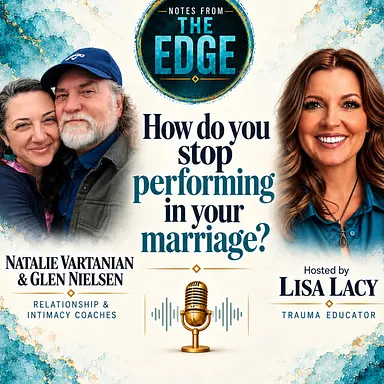
“How do you stop performing in your marriage? Somatic Healing in Intimate Relationships with Natalie Vartanian & Glenn Nielsen” was turned into text by HappyScribe’s speech recognition. Related tool: transcribe meetings automatically.
Ads in this audio differ from the text. Tap the sentence you're hearing to follow along.
Synced: the text now follows the audio.
Welcome to Notes from the Edge, where we have the conversations we should have been having all along. We talk about the things that we're not talking about. I'm your host, Lisa Lacey, writer, trauma educator, executive advisor, and author of the upcoming memoir Notes from a Certified Madwoman. Welcome to The Edge. Hey, hey, my friends. Welcome back to an episode of Notes from The Edge. I am your host, Lisa Lacey, and this is the place we have the conversations we should have been having the entire time. Guess what? You ain't talking about it, so we're gonna. And today we have Natalie Vartenian and Glenn Nielsen. And they are relationship and intimacy coaches who work alongside each other. And I love that to help couples understand not only the stories— we talk about stories a lot in here, guys. They matter. What are you telling yourself that are shaping your relationship? But what is also happening inside your individual nervous systems. So Natalie and Glenn have weathered business collapse, financial strain, family loss, major life transitions, and seasons where they genuinely did question whether their marriage was the problem. So, guys, they're They're not coming at you saying, hey, we had it figured out the whole time.
And that's what we love too. They're being real in here. But what they discovered was that underneath the conflict, they were performing roles they had inherited without consciously choosing. So Natalie was performing the accommodating good wife. We've talked about that a lot, shaped by the years of being the good daughter, while Glenn was carrying the pressure of being the good husband and the provider. until it almost nearly broke him. So today we're exploring what happens when 2 people stop performing at the same time and work on their shit. Natalie and Glenn, welcome in! Welcome to Notes from the Edge, my friends. I'm so excited to have you guys here because I think you guys have the capacity to help so many people out there struggling. How are you guys both doing today?
Doing great. Yeah.
Good.
Well, we always kind of start with the pivotal moment. What was the moment when you both realized, wait a minute, we're replaying like some unconscious patterns here? Did one of you realize it first and share it with the other and it was well received or not well received? How did that kind of roll out for you?
You want to take this? I think you were the one that woke up to it first.
I— yeah, that's true. Um, that's true. Uh, gosh, I know that's such a— because I think the thing I realized, Lisa, is like it just creeps up. It just— it's like a building thing, right? Like little by little by little, and you don't notice that it's happening. Like, yep, I have little moments, but it was just like And Glenn talks about this a lot with the body being the barometer. I also think our emotions are our, like, guiding lights, right? And I just found myself feeling irritated a lot or feeling resentful or feeling heavy. And just like to the point where in the moment it kind of woke up for me where I was just like, oh my God, I don't feel like myself. And I feel like I'm like disappearing in a way.
Yeah.
Disappearing in our relationship, disappearing like with my own visions and dreams. Like I felt like a muted version of myself and I'm a pretty big, boisterous, like, energetic person, you know. So I was just like, what the fuck is happening?
Mm-hmm.
And so that kind of took me down to like, okay, what is happening, you know? And instead of like blaming our situation or blaming this or blaming Glenn or blaming our marriage, you know, because I was just like, something else has to be the problem here, you know, instead of like Oh shit, like I've kind of let myself lose myself. Yeah, in our marriage.
And so that started the seeking. That started the seeking. You felt like, I am not myself, this is not me. So what I love about that, Natalie, is you took a hard look going, I'm not digging this, I'm not gonna play the blame game because there's no healing in the blame game. There's no healing in the blame game. So I love that. So When did you start— when did you both start recognizing, wait a minute, we've been trying to perform roles that aren't ours? They were conditioned probably to us, just handed to us in childhood, and we're just replaying it over and over and over in our own relationship. When did that epiphany come for you?
Well, I think what was, you know, kind of piggybacking on what Natalie was saying, you know, because Coming into the relationship together, we came into it pretty awake, pretty, you know, we had done a lot of work on ourselves over the years. You know, I'd studied as a therapist for the last 30 years while I was a contractor and trauma therapist and somatic therapist doing all these things. We came into it with designing the relationship up front. We knew what we wanted and we were coming into it eyes wide open.
Wow.
And part of that—
And later in life, right?
And later in life.
So lived through multiple relationships before we got here.
Yeah. And so we really, we had an 8-year friendship together before we ever turned it into a romance. We really knew each other well.
That's a solid foundation.
Yeah, it's a really solid foundation, which we're really grateful for. And going into it, we're like, okay, I know who you are, you know who I am, you know, I accept who you are. And we also had the thing— we wanted it all. We— be careful what you ask for.
Yeah, I just asked the universe to teach me what love was.
Well, it's teaching me.
We want it all.
And we also, with the idea idea too, that we wanted each other to be fully expressed inside a committed relationship. And what does that look like, to be fully expressed inside a committed relationship?
Oh, I love that.
I had a dream of owning a retreat center. I found this retreat center by divine intervention. And Natalie was this huge support of it, like so supportive. And it was like, oh my God. And she, she could see it even before I did. She was like, oh my God, Glenn, I see it. I see us working there together. And, and we— I bought the place and we get up here, and the, the awakening for me was probably, I would say, about a year in, year, year and a half in, when I noticed Natalie beginning to lose herself. Like, and I'm like, what's going on?
Yeah.
Like, you know, and I started to take it personal, which is one of the part of our ground rules— nothing's personal. And so I'm trying to keep that in mind. Okay, what's going on here? Because the reactions and the responses we're getting. Like, all of a sudden it's like, oh my God, is this not working for you? You know, like, and then the provider in me, like, oh my God, babe, I bought this for us. Like, this is for us. You know, we're on 30 acres. We're in the forest. We're doing healing work here. We're doing—
Why aren't you happy?
Why aren't you happy? Like, what's the deal? You know? And so that was the awakening point for me. to start going, okay, I gotta, I gotta listen, I gotta lean in, dig deeper, we gotta, we gotta take this deeper, there's something else going on here, you know.
Well, because Glenn was also going through his reckoning around money and finances and business and, you know, starting over in a whole new industry. And, you know, just there was just so much that he was also kind of thrashing around with. Like, we were both personally thrashing around with these things.
Yeah.
But then kind of weirdly like projecting it onto the other person or getting defensive, like when we saw them in their state and just not understanding. Like, I honestly, Lisa, it was just like, it just didn't make sense up here. That was the thing. It just is like, we don't— what's going on? And that's when it was like, okay, there's other stuff happening, trauma stuff. Like, you know, we're in survival mode. Like, it just— there was so much more Like, they need the search.
Natalie and Glenn, I don't want to gloss over that because we can have it up here all day long. We can have it intellectualized all day long. When I did DBT, $25,000 program, 18-month-long program, I had both those books memorized. Marsha Linehan, I still find her to be quite a genius, but not one of those skills was being applied. Not one. And I had it memorized, but not— it was not the mode for me. It just wasn't the modality for me. It didn't fit me. So I wasn't going to be able to apply it in my life. So I'm a big proponent of you got to find what works and who works for you and always have a mentor. Always, always, always. And I'm a big proponent of transformational coaches because that was what finally got me over the hump, was a transformational coach. That's why I became one. That's why I'm such an advocate for them. So, um, you and Natalie, I, I love the fact that you guys talk about being the good wife and the good husband because I think no matter where we're in, in, in the state, In, in this culture, no matter— we have an idea of what the good wife and the good husband is, is no matter religious background, whatever, we have an idea of what that is.
And the minute we try to cram ourselves into that box, it just creates pressure. So talk to me about your epiphanies around the pressure that that was actually creating for you.
Mm-hmm. Well, for me, it was around, it was around the financial stuff. It was around the provider, you know, like I, I was born and raised Mormon, and I'm no longer Mormon, obviously. But I, in that culture, I mean, literally the teaching was if you're not making enough money to support your family so your wife can be at home and raise the kids, get a second job, get another job, do that, you know. I was fortunate enough, I was an electrical contractor for 38, very successful contractor, multi-million dollar business, things like that. And so I felt I'm being the man. I'm doing what I could. Raised 4 girls, put them through college, marriages, you know, you name it, all that kind of stuff. And then in 2022, my business collapsed after 38 years. Wow.
That's a long time.
Yeah. And it was incredibly disorienting because things were happening that were unexplainable.
Well, and everything was disorienting at that time, not to mention just— yeah, yeah, everything was disorienting.
Yeah, everything around us.
Yeah, everything. It was very disorienting. Just, I could not— I mean, I'm like, wow, I'm not new at this. I've been doing this for 38 years. What is going on? I've since come to realize, and let's get a little woo here, that was— it was kind of the divine hand in moving, because this was— this is where I needed to be. And the story of how I came across this thing was just unbelievable. And like, okay, but—
We always know, Glenn. We always— it's just that, that hindsight may come a year from now, it may come 5 years from now, but I Promise you friends out there, it's gonna make sense one day. It's gonna make sense why it went away.
Yeah, it didn't make sense at the time because it was like I had this game plan and here it is, and all of a sudden just the rug gets pulled out, you know.
And you're—
so I spent that year after we moved up here full-time in a pretty disoriented state, you know, trying to figure out what the heck happened and grieving and having my time to grieve and try And also starting a new business, running a retreat center at the same time, you know, doing that. And so—
That's important to let people know, guys. We grieve not just the loss of a human, we grieve the loss of a job, a business, moving, a car even. I mean, you know, everything.
End of a relationship, end of a business partnership.
End of a business partnership of, you know, business partner that I've known since I was 17.
Wow.
You know, things like that, that still infiltrates my dreams. I mean, it's, it was one of those things that it was a real reckoning to go through. I leaned on Natalie pretty hard in those, that first year, because my assumption was she's part of, she, she's a big supporter of this, you know, she and her business skills and all the things that she's done, done, but at the same time, was feeling really less than as a man that You know, like, oh my God, for the first time in my life I'm struggling financially here, and how do I get out of this? And how— what do I do? And what, you know, and feeling, you know, like, do you still love me, babe? You sure you still love me if I'm not this guy that you met? You know, that kind of thing. And yeah, and that was hard, you know. And so it was just— yeah, it was, it was just, it was just that. It was really having to be with all that, you know.
Yeah, that's a lot. That's a lot in a short amount of time. Yeah, yeah.
And I mean, in practicing what we preach, practicing what I was taught, practicing what I teach with my clients and everything else, you know, just— and boy, the universe just putting me in scenario after scenario after scenario that would eventually help my clients.
Yeah.
You know, and help, and, and help the way I wanted, the way I wanted to do, do things. And it was like, oh, and again, looking back, oh, I had to go through that, that I had to go through that fire that initiation to be able to, to do this work, to do the things together. And though, so for me, it was struggling with what it meant to be a husband, what it meant to be a father, what it meant to be a business owner, a partner in a business, you know, and feeling like I was failing, you know, feeling, oh, I'm letting her down, you know.
Yeah.
And, and so it was that. And so she's looking at me like, what's going on? But trying to be as empathetic. She understood I was going through a lot. You know, incredibly supportive. But then I think that's partly where her I should be a good wife thing starts kicking in unconsciously.
I'm over-functioning, I'm over-producing. I'm like, I got it, I got this, I got that, don't worry, don't worry, you know. And I just kept piling more and more onto myself because I want to be supportive, I want to help him, I want to give him the space. But then at the same time, I'm like Can I do all of this by myself? Like, this is also so much, and this is also new for me. It's a new business for me. It's like adjacent to workshops and retreats, but I've never actually owned a physical retreat center. I've never had a physical brick-and-mortar business.
Oh yeah, brick and mortar is a night and day difference. Yeah.
Oh yeah. Hey, and it's like, I mean, I know I'm a good business person, but this is just like, for both of us, we're just like in uncharted territory, you know? And like trying to learn as we go as fast as we can.
And so yeah, just like this Molotov cocktail, you know, like, we better figure it out. We better figure it out.
Yeah.
Okay, so then you carried the role of provider and good husband until the pressure nearly broke you. Um, Natalie, you carried the good wife until it sounds like you were disappearing behind that pressure. So what— how can couples catch this earlier, right? If they're really struggling, how do they know? What are some signs? How can they catch it earlier so they can come to each other and be like, yo, I'm not doing well in this, right? Because those words were the words I never uttered to anybody when I was in high-functioning survival, was I'm struggling. One, I didn't have language for how I was struggling. But 2, I thought it was so shame— because I got told to toughen up, suck it up, man up. So I tried that, and I was the sole financial provider. I was like Superwoman, could do it all, until I eventually had a full mental health collapse. That ended— yeah, that's how that ended. So what are some signs before collapses that people can maybe be on the lookout for in their marriages?
Well, I want to say one thing you said. What could— what they— before we get to what are the signs, you said what we can do, right? And so the one thing that I'm really— we're proud of, and I'm really proud of Natalie because she kind of drove the bus on this, is that when we turned our friendship into a romance and became engaged, she said, I want to do a year before we get married of counseling with our mentor. You know, I want to I want to, I want to look at all these things before we get married. I want to address these things ahead of time, design the relationship. So we did, we did that for, you know, it was for 15 months, you know, 12 months before we got married and 3 months after, of doing this in-depth dive into who we are. And we got— this is where we designed our relationship.
I love that wording, design. You get to design it, guys, ahead of time. Not wake up 7 years in and be like, oh hell, what have I done? Right? Like, yeah, I love that. Design it.
Yeah.
So 15 months is an investment in yourselves.
It is a big investment. So we had, we had that blueprint laid down. We had the ground rules. We had, we had all of this thing there. And so, so what was beneficial was when we started noticing what was happening.
Yeah.
We were able to lean back. on that base that we had created. We were able to lean back on the agreements that we had agreed to back before we got married and all these other things. And so that was a real lifesaver to be able to kind of come back to those things that we had designed in the first place.
Okay, so have your design blueprint. Have your design blueprint.
I love that.
And do you guys work with couples on creating their, their blueprints?
Yep.
I love that.
Yeah, at any stage of the game, because that's the part— it's like you might be 5 years in, 10 years in, you know, and of course Of course, you created the relationship in the way that you assumed it should be, but this is just like, okay, but you can start now and you can get really clear on like, what do you want? What's working? What, what needs to be tweaked? How do we handle conflict? You know, what do we do in those situations? Like, what does it mean for me to be your missing experience, your healing balm for all the wounds that you had growing up and vice versa?
Mm-hmm.
You know, it's just like really making all of the unconscious conscious, being clear, speaking words to them, you know, and then agreeing on them. Like we are agreeing on these things together.
They are agreements.
Yeah. They're agreements.
I love the word agreements.
Yeah.
Yeah. Yeah. And so at any time, at any time, either one of us would remind, could remind ourselves of each other of that. There were times, you know, there were times when I'm down or times where Natalie's down there, something's going on or it's, or things are getting pointed at each other. And we, and we can go, hey babe, remember our agreements. And then we would schedule time, which we still do, you know, together. We would, we would carve out specific time during, during the week to just block out everything and go into, uh, a protected time where we could sit and talk about these things and sit there and share with each other about what's happening, what's happening underneath.
I love that.
Because it's not personal. Because what's underneath the bear that's getting poked is just old trauma. It's old wounding, it's old conditioning, it's old programming. And so—
And it's not so scary when you look at it. That's the thing. I came out of the bottle 20 years later from running from emotions. I turned to face them. I was like, wait a minute, this is what I was scared of the whole time? And then eventually it becomes fun.
Yeah. Well, you see what's on the other side of it because before that is fear, right?
Yeah.
It's, you know, it's the fear of losing the relationship. It's the fear of talking about something that may blow the relationship up, or that's your fear is that something's going to happen. But the complete opposite happens.
Yeah. We promise the complete opposite happens.
Truth comes into the room. Real truth comes into the room with what's going on, where we're at, and what's happening. And for each partner to stay curious with each other, curious as to what this is.
Yeah.
Then we can get down into what it really is. It's Natalie's trauma from childhood, losing her father when she was 9 years old. It's my trauma from coming out of a fundamentalist religion that had things teaching me and things that I'm carrying. And it's all of a sudden you realize, oh, it's not about you. You know, you're just the one poking the bear. You're poking the thing.
Like you're representing those things in some way of all the things that hurt me, right? Like you're kind of weirdly representing that right now. But this is the thing that, you know, it's, we, we always say this to our couples, like it is an advanced level of relating to, to not just coast and not just be okay with what's happening, but to really question it to that level of like, Okay, how can I do my work to heal myself so that I am not projecting all of that pain onto you, right? And waiting for you to confirm my worst fears somehow, instead of feeling like, wow, there's hope here, there's chance here, there's healing, there can be love here. We can do things differently than we've ever done them before.
Oh, there's so much hope in that, because that means It's never too late. It's never too late to have a blueprint.
Yeah.
And I love the language you guys have created around this. I love the language because it's your own. It's unique to what you guys have built, and it's beautiful. It's beautiful language. So, all right, you combine relationship coaching with, with the bodywork, somatic work, right? Because we can't just have it intellectually. Um, What can the body and nervous system reveal about relationship conversations, insight, or, or the traditional talk therapy? I always say is a rite of passage, go through it. So take a look at where you've been. But staying in victim mode and the blame game is not where the healing happens. And at least for me, in my lived experience, it was a transformational coach that finally got me moving forward and looking forward, but I needed to look backwards. to see where I'd come from. But it's the looking forward that really got me, because I had done all the acronyms. You name a therapy acronym, I guarantee I did it, and I was still going, oh, I don't know if I like this very much, right? So yeah, so what can we learn from our bodies, our nervous systems, about relationships?
Everything.
Ah, it is everything.
The body, the body is telling the story. Like, that's the somatic part. Like, that's the body, the muscle memory that it's stored, it's cellular, it's stored in our cells. The body is revealing the story, you know. And somatic therapist, that's what I'm tracking for when I'm working with my clients is what is the body telling? I'm tracking the body.
Yeah.
The body is telling the story. That's trauma. That's the intelligence of trauma. It's trauma trying to heal itself, you know. And so, you know, an example would be somebody was in a car accident, you know, years ago or something like that. And they have, they have leftover trauma from that car. They'd never processed, they never fully, they never fully processed that trauma out of their body. I'll be working with them and all of a sudden I'll start noticing like their right foot kicking out every once in a while, just, you know.
Yeah.
Like the right foot's kind of doing, you know, like hitting the gas.
Yep.
Brake hitting, you know, and you— but, but you're looking for repeated patterns, you're looking for the, you know, it's not just a one-off. It's like, oh, this thing keeps showing up, and it's trying to tell me something.
I love it.
So we start to draw attention to that. Oh, what's happening over there with that leg? And we get you into mindfulness, drop you into a mindful state, be able to like start to track your system and start to— because get out of the head and let's start getting into the body. What is your body trying to tell you? You know, in the situation with that, that's the body trying to tell me there is stored energy here that has never been released, that I need to move and process. That's the physical part of it. Like, you know, the emotional part of it is there too. You know, the emotional part is revealing. That part is revealing the story. There's things that can happen, you know, body movements are doing that are repeated. And all of a sudden, you, once you contact that thing from a mindfulness state, which is what I've learned, you know, from my Hakomi training, my somatic experiencing training, the work of Peter Levine and how we heal trauma and how we release that energy. Once we can contact that, if it's a physical thing, a lot of it is just energy that's needing to be released.
It's like animals in the wilderness don't get traumatized. Domestic animals do. We do. Our neocortex gets in the way and things like that. But, but animals in the wilderness don't. They know, they process it on a natural thing. And it's like, that's what Peter Levine revealed, like, oh, what's happening here? So if it's physically, you know, it's helping that energy move out of the body and completing the movements. Like, once those movements are completed, then that can be released. On the emotional part of it, what usually will come up are memories, emotions, things like that. And if we stay mindful about it—
Can I say something about that too?
Sure.
Because the way that I see it with in a relationship and couples, right, like one of them might disassociate where they they look like they're like not even in their body anymore, you know, they kind of have glazed off and checked out, you know, in a situation, or they're getting really fidgety, and they're getting really nervous and anxious. And, you know, like, you can just tell, or when one's getting angry, and they're getting puffed up, and, you know, they're just like sitting straighter, and they're just like arms are crossed. And like, you can see in the way that they're relating, kind of what they're— like survivor trauma responses are. But that's when, you know, it's like, oh, there's something else happening here, you know, because the body is speaking. The body's speaking. The body is telling us like that they're in some kind of like a survival state where they're in a fighting because they're trying to fight, fight for their survival or fight for their autonomy or their voice or something like that, right? And so it's just, yeah, it's fascinating. tells so much of like what your body wants to do when you're in a conflict with your partner, right?
Like, well, you'll be sitting in couples session and you'll be— they'll be talking about things and they'll start out like this and all of a sudden you start seeing them by the end of the session, they're over here like this, right?
Or they're not looking at each other, they're only looking at the camera.
Like, we're glad you guys are anymore.
Yeah. And so, so what's going on there, right? You know, what is the body protecting itself from? Right.
Yeah.
So it's— we can get into that, you know, and we— and once we start getting into that, that's— those stories can be revealed. Those, those, those, those things can be revealed, you know.
Yeah. So they're not playing out on a, on a suffering loop.
Yeah.
Yeah. I mean, I have a phrase that I, that I learned from one of my mentors, which is, you know, the body is the barometer. So the body is the barometer. So if you learn to tune into your body, it will tell you what's happening. It will tell you what's going on, you know. And so we also know that, like, with couples, when they get into an argument or something, or somebody, somebody does something that's kind of innocuous, you know, you know, whatever it is, like getting pissed that you didn't take out the trash or something like that, or using the last of the coffee creamer, or losing—
just coming up with one doesn't upset me at all.
Exactly right. But yet, but yet you're so activated Like, you know, like this anger, it's ridiculous. The anger coming at your partner isn't— the punishment's not fitting the crime, right?
Right, exactly.
So we invite them in to like, like, look at the level of activation that's happening in your body over the— over this thing, right?
Yeah, it shouldn't be a 10 out of 10 angry. It's like maybe a 3 out of 10 angry, right? Or like a frustration or irritation, but like Rage, like, okay, something else is going on.
It's not about the caramel macchiato. Yeah.
Yeah, definitely. And so, so that's the thing. And so what I like to say is like, the higher level of activation, the more that thing— that thing is really— it's a good chance it has something to do with you, not your partner.
Oh, Glenn, say that again. Because I think that's important.
It's like, It's humbling.
It is.
Because I've caught myself many times where I'm just like, you know, ready to blow. And I'm noticing this activation. And it's because Natalie told me not, you know, critiqued me about something, you know what I mean? About, you know, like not taking the trash out or like, on the cardboard. Yesterday, there was one where now it's like, hey, the cardboard's getting pretty built up out of there, you know, when are you gonna get rid of the cardboard, you know, kind of thing.
And I didn't say it like that. But that's how they hear it. You hear it where you're just like, you piece of shit, I can't believe you can't do the one thing, you know.
I felt the flow of activation in my body there, there on the activation, and I could— it just started to rise. And it's like, oh man, okay, you know, like there it is, right? You know, what is that? It's just an old wound getting poked, right? That's just where, you know, from childhood, an overbearing mom that was controlling me all the time, telling me what to do. When there's a joke with each other, don't tell me what to do, you don't know me, you know, that kind of thing, you know.
Yeah, yeah, yeah.
So it's simple little things like that, but that— those are the micro things. And then the bigger things, you know, obviously. But even the biggest thing, unless you're— unless you're living with an abusive partner, you know what I mean?
Right, guys, we're not talking about that. But chances are, that's, that's where we pull a different place to go find support and help too.
So And we also need to find— we need to look at, okay, why did you call that person in?
Yeah.
It's still not personal because there's still an operating system here that's trying to heal. So you're going to bring in the environments that are going to poke the bear because that's the intelligence of trauma. It's trying to reveal the story and it's trying to tell the story. It's trying to wake you up. And this is where the wake-up or breakup part of our, our website, what Wake Up or Breakup comes from. Yeah, it's either wake up to this thing, wake up to what's happening, to what's yours, to what's yours.
Yes.
Yeah. Yeah. To wake up to what's yours and own it and take responsibility and quit pointing. Because that— because the wounded one is looking for you to screw up. The wounded one's radar is, I know you're going to disappoint me. I— you're going to be like everyone else.
I can't trust you.
I can't trust you. And if you keep operating from that, you will break up. You will end up— or you'll end up in Loveless marriage, a flat, you know, sleeping in different rooms, whatever kind of thing, you know. And so is that really what you want? No, of course not. You didn't get married and come into this relationship to end up like that.
No.
And so it's scary to wake up.
It is, it is. And you guys talk to me about why are we so scared to do this work, but it is— it's because once you do it, it's like, oh, I'm on this path now. Like, this This is the good stuff. This is the juicy stuff. Now, it doesn't mean external factors stop happening. Life does not stop happening, guys. There is no destination to this. It is daily practice, um, and you will have to manage it, you know, depending on what your circumstances are for the rest of your life. But there are aspects that can be fun of doing this work. Why the hell are we so scared of it? What are we afraid we're gonna find?
Well, I would say it's two sides of the coin. That's one, right? Because we don't know what's gonna happen. We don't know what we're gonna go through. We don't know what, like, who we're gonna become. You know, there's some— there is a safety, a comfort of just being the way we've— like, I know this dance basically, right? Like, I know this dance.
Yeah.
I know how to dance with these players. I know how to be with, like, instability. I— it's like I don't know. Yeah, I don't know what to do with like love and healthy. But then I think there's another side that I hear more often from my clients anyway, where it's like, I don't want to have to relive everything that I went through. I don't want to have to re-feel it.
Hmm.
You know, and I think that, you know, and I empathize so much for that because it's true, like, especially someone coming from something that was like totally traumatic through age 9 to even like 12, 14, 15. And that part that's like, I'm done with that, I don't want to have to go back. Yeah, you know, there's something about the, the part of us that's like wanting to protect us from feeling that again.
Yeah, yeah, our bodies are brilliant. Our bodies are brilliant, you guys. So you guys believe the honeymoon does not have to end. I'm liking this, I'm liking this. What does choosing each other again and again actually look like in real life? Like, what does that look like? How, how does that look?
Yeah, yeah, for me, my personal opinion is that it's actually prioritizing the relationship because what we do is we get into life starts happening, work, family, all, all these things, you know, we just kind of get into this like routine, the doingness of things, right? Like there—
Right.
It becomes a task that we have to check off and have we accomplished all the things on our list today? I think even the relationship starts to feel like a task. And for me, it's like you have to kind of create time and space to nurture the relationship as a relationship, as this romantic, energetic, flirty kind of lovership. You know, I've told Glenn sometimes too, of like, I miss our lovership, right?
Mm-hmm.
Like, we're in business partner mode, we're in friend mode, we're in all these different modes together. Your lovership actually needs to be cultivated. It's like a plant. If you don't feed it, if you don't, you know, talk to it, if you don't put fertilizer in it, it's gonna die. You know, it's like our relationship isn't any different than that.
Mm-hmm.
And so it's like carving out time, doing things, going on dates, sitting, talking vulnerably. It's like, what are the things that are gonna actually be fuel or food for the actual romantic part of your relationship is what I would say.
I think you're right, Natalie. I think we, we signed those papers and it's like, okay, it's like, okay, you're gonna be here. All right, I'm off work now.
Yep. Yeah, I can relax.
Taking out the trash. I'm taking out the trash. You see this? I'm taking out the trash.
I got my job. We got your job. We're doing our jobs.
We're done.
We're done courting. We've committed each other for life. I can relax. I've got safety, security now. I don't have to think about it anymore. Yeah, you'll be here, you know.
And it's like, no shade, we all do it. Like, that's not the part. It becomes so automatic. It's like we, we just start coasting. Yeah, you know. And the part of this, the part of Wake Up or Break Up and all that, it's like bringing more intention into it and attention into your actual relationship, right? Because if you don't, you're gonna break up or you're gonna coast. Some more.
Love that. And conscious choices. Love that. Conscious, not autopilot, right? Not survival mode without knowing it, but making the choice every day to— this has inspired me to, um, find more time, prioritize more time. Um, and I love the language that you guys have created around the work that, um, that you do with couples, and sounds like you guys do. You have your blueprint that you started out with. You spent 15 months before— yeah, you had 8 years of a friendship, man. If you are friends and you actually like each other as humans, it goes a long way, guys. Way.
Because I think that's the other part. It's when we've had probably the stickiest times and the times where we literally could not hear each other and we're interpreting everything the other person said through our like trauma story lens, we would just— one or the other would be like, hey, can we get back to the friendship? Like, I miss my friend. Can we actually sit down and talk to each other like we were friends? Like, because we are friends and we were friends, but like, it's just, you know, so that, that part of it, it's like having these things, like Glenn said, that you can go back to that you're like, hey, we agreed on this. Like, we were gonna talk through things like this. We're going to be compassionate, remember? We're going to like really be curious with each other about—
We're not going to take anything personal. Yeah, remember, remember, nothing's intentional. Nobody's doing anything intentionally to piss you off, you know?
Yeah, and nobody twisted your arm. You agreed to it. We have agreements.
Yes, yes, exactly.
Totally. I love that.
Yeah, yeah. And if we need to change the agreements and change the rules, let's do that. And that's the benefit of having check-ins and having time to sit and talk and just still to be like, hey, what's working? What's not working? And sometimes the what's not working is triggering for people, right? Because again, it puts them on defense. So maybe it's like, what's working and what do we want more of? You know what?
I like that.
Yeah, that could enhance this, like take us to the next level.
Because if I tell Brody what's not working, he's gonna be like, I'm doing the best I can. That's gonna be the response.
Yeah, that might not work for some people.
Yeah, it ain't gonna work for him.
No, right, right.
What do we want more of? This is working really well. Give us more of the juiciness. I like that.
I like that. Yeah.
Yeah, it is updating the software every once in a while, you know, to go back and read, you know, do we need to upgrade the agreements? Do we need to add to them? Do we need to change? Because we're human, we're ever evolving. We're not the same person when we first met.
Yeah, thankfully.
Thankfully, right? Hopefully.
Well, and that's the thing, you know, we committed to growing together. And so what does that look like? And how do you— how do you become fully fulfilled? And how am I fully fulfilled inside this committed relationship? What does that look like? And, you know, I want— I want you to have everything you want, babe. I want you to have all that kind of stuff. And those parts that don't believe that, those parts that You know, so it takes nurturing, it takes consciousness, it takes, you know, you got it.
Yeah.
Well, so, okay, thank you for that effort part because this is something that just like gets our goat. Relationships are hard work, blah blah blah, you know, like the way that it's like, it's hard, it's hard, it's hard. It's like, okay, can we reframe that please? Because yes, it is work. Anything good is work. It's worth the effort, right? Like, you build something, it doesn't just appear. Yes, it takes work, but it's like, how are you looking at that work? Why are you looking at it like it's some punishment that you have to like endure to get the thing that you want? Like, there's a different way to look at it. Of course it takes work. It takes work to do your job. It takes work to have a good friendship. It takes work to have a great relationship with your family. Like, of course it takes work, but like, there's this thing— I think it's very destructive, basically. Like, I think it's very destructive to the way we look at doing the work in relationship and why people are like, oh, it's hard work, I don't want to do it, you know? Like, there's—
Then don't be in relationship, you know? Like, I— sorry, you know? Like, I mean, if you want what you want This is Glenn.
He's just like—
Glenn's no BS. He's like, nope, you don't get one. You don't get one.
The Bob Newhart School of Psychology. If it hurts when you do that, stop doing that.
Stop it.
Stop it.
Just stop it.
Just stop it.
Just stop it. Sometimes you do have to tell people just to stop it.
You're, you're like, it's the way you're looking at it. It's not working. Just stop it. Like, can you just have another perspective about this? Can you get curious? Can you look at it like something else is possible here.
Well, Natalie and Glenn, I agree with you guys. I think there's this misnomer that healing from trauma, even not just relationships, but healing from trauma has to be a trudge and it has to take years and it has to suck and it has to be terrible, right? And it doesn't.
It doesn't. It doesn't. It doesn't. It doesn't. And I think This is the other thing that I'll invite everyone listening to. If you actually leaned in fully and you just said yes and you did it, it will actually happen a lot faster and you'll get the goods a lot sooner. But what happens is we resist that so much, right? So we're just doing this like push-pull thing with it. And so it like, it actually just keeps you in an elongated state of uncomfort.
Mm-hmm.
Like, you don't have to be in that state. If you're just like, fuck it, I'm in, I'm going, boom, you know, like, you just— we just pop out faster. That's the human nature. But we don't know that, and so we're just resisting it the whole time. But there's a classic transformational saying: what you resist persists. Like, it will just keep you in that kind of gridlock-like place. But if you accept it, if you fully commit relationships. Fully commit. No back doors, no waffling, no like, I don't know, I'm in, I'm out, you know? Like, close the exits, close the exits. Fully commit. Dive all the way in. Like, man, the magic that happens on the other side and how fast it happens is like mind-blowing.
Oh yeah.
Yay! There's so much hope for couples struggling. Well, you guys, I absolutely love the language that you both have created around healing in our most vital relationship, to be quite honest. And I always say in here that, you know, I've experienced both. I've experienced the most chaotic relationships across the board at the same time that you can imagine. And I've experienced the healthiest relationships of my life. And I'll tell you this, that when they are unhealthy, it becomes all you can think about.
Right?
You're just obsessed on them. But when they're healthy, you can go out and conquer the world because they're there and you know they're there.
Yeah.
So yeah, where can people find you guys? Oh, I'm sorry, Glenn, I didn't mean to interrupt you. Go ahead.
Well, I'm just gonna say real quick, I mean, for again, for those that are listening, like, the promise, like what Natalie is talking about, is it's a level of love you never knew existed. You know, it's, it's, it's beyond what you can imagine, you know, and that's the beauty of it. That's the beauty of it. It's like, yeah, you got to go through these things to learn, to transform, to evolve. But what's on the other side of that, if you can trust it, is is a love that you've never had before.
Oh, I just got chills, Glenn. So good. It's, it's so good, you guys. It's out there for you if you're feeling alone right now, if you're struggling in your relationship right there. It's out there for you. So Glenn and Natalie, where can people find you to start on their blueprint?
Yes, you can go to our website, wakeup orbreakup.com. And if you sign up for the newsletter, we gift you our ground rules. And so you'll already have like this amazing jumping off point, a talking point with your partner, something that can help you come up with your own ground rules. So that we just give. And monthly, Glenn or I write a letter to our people, and then it becomes a blog eventually. But those on the mailing list get like our stories and what we did and what we work through, right? It's— we're very relational, we're very personal, like, we're not gonna, like, talk at you. And so, and then we're literally almost complete with a workbook that couples can purchase so that they can do that process themselves of looking at the patterns, you know, clearing things, visioning, designing, and creating agreements for themselves. So that's like—
I was gonna ask if you have a book yet.
Yeah, yeah, we're writing—
we're working on the big book, but this is like a Yeah, it starts with like a relationship autopsy that you start with, you know, and then we— it steps you through, um, the process, you know.
It's pretty in-depth. And it, you know, if you do it, if you work it, if I— we know that it will open something for you because it'll give you a framework and a guideline and tools and a path that I'm sure most of us— I mean, we didn't know this before, you know, we got into this world either. But once we did, it's just like, it's a game changer. So we're hoping that this will help change the game of release.
What we all want is to be loved in, in that very, very, very—
deepest desire to be seen, heard, and loved.
You know, I love it. All right guys, you don't have to write that down. The clickable link's going to be available. Uh, Natalie and Glenn, if you guys can give me access, uh, to a couple of additional links in addition to your website, the couple links you were talking about, make sure I have those. And, um, we always ask our guests a couple of questions before we close out. Are you guys ready?
Rapid fire.
Yeah, rapid fire, here we go. All right, in your own lives, what did you perform in order to survive, and what did dropping that role mask or performance do to your life?
Can you repeat that?
What did we Perform in order to survive? And what did dropping that role, mask, or performance do to your life or for your life?
I can answer that.
Okay.
I was very much performing the, I'm fine, I got it, I can do everything, I'm independent, I don't need anyone, I just like little self-cleaning oven Just taking care of everything by myself and in order to survive for sure, um, not depending on anyone, not relying on anyone to let me down. And when I broke through that and realized the power of support and asking for help and receiving help and not having to always be the strong one and the capable one in the room, like, I found so much more peace, so much more freedom. Vitality, like actual, like, life force energy, and a feeling of not being alone. Like, it felt finally like, oh my gosh, I have people, they have me, like we can do this together. It just felt like all the burden just like fell off my shoulders.
That's big. And we are really all one, don't we know that?
So yeah.
All right, Glenn, you'll get the last question then. All right, you ready?
Oh, okay. Different question.
Different question. What do you wish we were having more conversations about that we are not talking about? What do we need to be talking more about?
What do you want in life?
Yeah.
You know, like, what, what is that thing that is so scary And so edgy that you've always wanted and were afraid to— were afraid to ask and afraid to look at? You know, what is that thing that's scaring the hell out of you, but you really want?
Oh, chills, Glenn. You're giving me chills this whole time. All right, guys. All right. Oh my gosh, we're gonna send so many people your way. I love the language you've created. Can't wait for your workbook. Make sure I have those links. Friends out there listening, if you hit on the link and you get stuck, you know where Natalie and Glenn are, reach out to them. There is always hope. There is always hope. And there is always the love that you kept telling yourself that you couldn't have. It's out there for you. I promise you that. And I'm going to ask you guys out there the same question. What are you performing in order to survive? And what might dropping that role mask or performance do to improve your life, or at least lighten your load? All right, I'm Lisa Lacey, your host. This has been Natalie and Glenn, our guests. And when you find the answer, we will see you at the edge. Thank you so much, Natalie and Glenn. Thank you.
What happens when the roles you learned to play in relationships start costing you yourself?In this episode of Notes From the Edge, Lisa Lacy sits down with relationship and intimacy coaches Natalie Vartanian and Glenn Nielsen for an honest conversation about marriage, somatic healing, nervous system regulation, inherited relationship roles, and what happens when couples stop blaming each other long enough to look beneath the conflict.Natalie and Glenn share how even after years of personal growth and entering their marriage intentionally, old conditioning began showing up. Natalie found herself becoming a muted version of herself, while Glenn wrestled with the enormous pressure of being the provider after the collapse of a business he had built over decades.Together, they explore why sometimes the intensity of our reaction has more to do with what is happening inside us than what our partner actually did, and how couples can begin creating a relationship based on conscious choice rather than inherited expectations.In this episode:• How the “good wife” and “good husband” roles can quietly create resentment and pressure• Why your nervous system may be reacting to something deeper than the argument in front of you• Somatic awareness and learning to recognize activation in the body• Taking responsibility for your own patterns without turning relationship work into blame• How couples can intentionally create agreements, connection, intimacy, and a relationship that allows both people to fully existConnect with Natalie & Glenn:https://wakeuporbreakup.comConnect with Lisa:https://www.lisalacy.comWhat did you perform in order to survive? Welcome to the Edge.See Privacy Policy at https://art19.com/privacy and California Privacy Notice at https://art19.com/privacy#do-not-sell-my-info.