
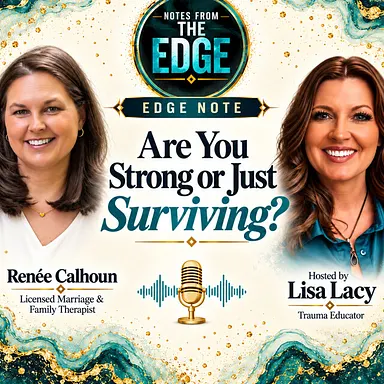
Every line of this episode of Notes from the Edge was transcribed with HappyScribe technology. See also: AI note taker.
Ads in this audio differ from the text. Tap the sentence you're hearing to follow along.
Synced: the text now follows the audio.
Welcome to Notes from the Edge, where we have the conversations we should have been having all along. We talk about the things that we're not talking about. I'm your host, Lisa Lacey, writer, trauma educator, executive advisor, and author of the upcoming memoir Notes from a Certified Madwoman. Welcome to the Edge. Hey, hey, my friends. Welcome back to another episode of Notes from the Edge. I am your host, Lisa Lacey, and this is the place we have the conversations we should have been having this whole time. Guess what? You ain't talking about it, but we're gonna today. And today's guest is Renee Calhoun, and she is a licensed marriage and family therapist, speaker and educator, and she specializes in trauma, addiction, family systems coercion, and human trafficking prevention. She is known for— and we love this in here— translating complex psychological concepts into things that actually work and can be used. Her work explores the overlap between trauma, relationships, nervous system survival responses— we hear the word survival a lot in here— emotional labor— love that word, we'll talk more about it— addiction, and family dynamics. She helps people understand why intelligent, capable individuals often remain stuck in the same unhealthy patterns.
And her mission is simple, but it's a powerful one: let's move beyond the therapy buzzwords and have conversations that actually transform our lives. Renee, you're the perfect guest. Welcome to Notes from the Edge. How are you today, my friend?
I'm well. Thank you so much for having me. I'm excited to be here.
Yeah, I'm excited about this conversation too, because it's something that we talk a lot about in here and something that I actually lived on, on many, many levels. But we're just gonna— we're gonna dive right in, and then we're gonna go down whatever fun rabbit holes we find today. Okay, perfect. So, um, maybe she isn't strong, maybe she's Surviving. Talk to me about that. How do we know the difference between this buzzword, right? You're not a big fan of buzzwords, resilience, and what is actually survival mode? What are some signs that, uh, for somebody like me 20 years ago that was in it, survival mode, and had success on the outside and everybody assumed that was it, I was fine, and, uh, and I absolutely wasn't. So how do we know? How do we know?
Yeah, great question. I think you're nailing it already, right? Society loves success. What does success look like? Right? We've confused endurance with wellness. We see folks holding down, especially women, right? Holding down a career, raising children, taking care of everybody else, volunteering, right? PTA. They're showing up for everybody and everything. And we're like, oh, they're so strong. They're doing it all. But strength and survival are not the same thing.
Yeah.
For me, resilience is bouncing back to your original self. But survival mode is the complete opposite where your nervous system is operating at such high levels and you never give it permission to come back down. So you're always scanning for the next problem. You're looking around and seeing what everybody else's needs are, and you're solving people's emergencies before they happen.
Right.
And again, moms are like, you got to ask me now.
I jump into— you got to ask me now.
Yeah, absolutely. But the tricky part of the survival mode is that it looks really productive. It looks really wonderful. You're the dependable one. You're the one everyone can count on. You're not dropping any balls, right? But you can't remember the last time that you felt at peace. When I ask my clients, when is the last time you felt safe enough to do absolutely nothing and your body believed you, right? Because there are times that we think that we're at rest and we don't have anything on the schedule, so we're like at rest, but your body's always waiting for the next shoe to drop.
Yeah.
And so that's, that's the difference, right? Like, we've mistaken, again, this endurance for healing. But just because someone's functioning doesn't mean that they're actually surviving. And, and like you said, just because someone's functioning doesn't mean that they're not suffering. So your nervous system will always choose what feels familiar long before it chooses Healthy. Yeah.
Well, and I even wanted to add something to what you said is even move on to the next goal, right? See, that was a big one for me. Oh, got there. Okay, next goal. Okay, next goal. There was never any downtime because downtime— I didn't like alone time. I didn't like to be alone. It was too much time to think. Um, but you know, it— but it was never enough. There was always another goal, another mountain to climb. So we'd get there and then I'd be like, great, we're here. And now what's next? No time to celebrate, no downtime to rest.
Right.
Um, and I believe those of us who are on autopilot in survival mode may actually need practice in what rest really is. Talk to us about what rest really is. What is rest?
What does that even mean?
Yeah, right.
Like you just said something about celebration. Like, were we taught to celebrate?
Not ourselves.
No. What were we taught to celebrate? Right.
Yeah. And how we were taught to celebrate the goal, right? The goal, but not ourselves in said goal, especially as women. We're taught to self-sacrifice, right? Yeah.
Right. And like, for a lot of people, I ask them, like, what did your mom do at home? Like, did you see her rest?
Yeah.
And what does that mean? And it was like, oh, well, no, she was always, like, up doing dishes or making lunches or cleaning or whatever. Um, but when it— when did she sit down? And like, to me, I think of rest as recovery.
Mm-hmm.
And I think that that is popularized by the like exercise injury in, um, industry as a rest day for your muscles where you're like allowing them time to recover. But that, that doesn't translate to the rest of the world. It should.
Right.
But when is the last time you sat down and just like took a breath and took care, took care of your body, your heart, what you wanted to do? Maybe rest for some people is exercise. Maybe rest is sitting with a cup of coffee. Maybe it is reading a book. Maybe it's sleeping. Everyone's rest is different. And what your body needs— your body knows what it needs. We just never listen to it.
I love that, that rest can be different for everybody. Well, one of the practices that I had to employ was guilt-free rest. So when I'm having my downtime, it's not, oh, I should be, I need to be, I'm working in my head, because that's not rest either.
I have met so many women that have had to unlearn behavior of, especially if they're sitting down and they hear their partner's car come in the driveway and they're like, oh, I gotta get up and I gotta be doing something so I don't get caught sitting and resting. Like, you're allowed to sit down.
You're allowed.
No, mine knows now.
Sometimes I'll be in bed because there's many reasons why I need to rest, not only for mental and physical health. And I'm like, well, hit a wall. He knows I hit the wall. Sometimes the wall comes at 2, sometimes it comes at 8 at night, sometimes it comes at 5. You just never know. But once I hit it, I know now there's nothing else productive is going to get done. I'll just be exhausting myself further.
And right, I've hit the limit. I've hit the wall, like you said.
Yeah. Yeah.
Yeah. But even you don't have to hit the wall to rest. Yeah.
Very good point. Very good. I'm learning, girl. I'm learning. It's still practice. I'm still learning not to beat myself up while I'm resting.
Right.
That's, that's, we're just there. We're just there. I'll be on your calendar tomorrow. All right, so I love this too. You say— I love this. Oh, you say that trauma sometimes gets mislabeled as personality. Talk to me about that. How can somebody spend years thinking, well, this is, this is just who I am, and it not really be who they uncover themselves to be once they start doing the, the journey towards healing?
Yeah, again, like, our brains are so incredibly good at surviving. People grew up who are walking on eggshells, and they think like, oh, I'm just an anxious kind of person, or they learned how to make everyone be happy or, or to stay safe. And they're, they're just a people pleaser, right? If maybe you had to become like super independent and no one showed up for you, so you just tell yourself like, oh, I don't, I don't need people, I don't need friends, I don't need a partner. Um, they're not personality traits, they're adaptations. Um, just because you've had to do something since you were 6 years old doesn't mean you didn't learn it.
Yeah.
And it starts to feel who you are. But one of the ways that I practice, and I absolutely fell in love with this kind of therapy is called Internal Family Systems work or parts work. Instead of asking, what's wrong with me? Why am I doing this? We start asking, what parts inside of me are responding? A lot of people can relate it to the movie Inside Out from Disney. They talk about emotions in that, and in our— in Internal Family Systems, we call them different parts. So maybe there's a people-pleasing part that believes everyone has to be happy before I can sit down and rest. Maybe there's this overachieving part who thinks that their worth comes from productivity. Maybe there's a hypervigilant part that's constantly scanning for danger because that's what kept you safe. Those parts aren't broken. Those parts are incredibly loyal. They're incredibly protective.
Mm-hmm.
They've been protecting people for years. So healing isn't about getting rid of those parts or getting rid of the people-pleasing part. It's about learning who these parts are, why they've shown up for you, and, um, learning that you can trust your true inner self. And that, I think, is one of the hardest things for people to do, is actually like lean in and trust themselves. So that once they can get there and do that, they just feel this incredible sense of relief. They stop seeing themselves as broken. They start understanding why those parts showed up, and they start actually being grateful that those parts were there to protect them. So the goal isn't to get rid of all of these parts. It's to help them realize that they don't need to be there anymore. They don't need to protect you anymore. That—
Yeah. Is it still serving you? I mean, it might be, you know, you might want to keep it, you know, but is it still serving you or is it a habit?
Yeah.
Yeah. It's, it's worth— and we love better questions in here and a way better question than what is wrong with you is, you know, why, why did this show up to help you survive? And you've mentioned a keyword, uh, 3 times now, and that's the word safety. Which is so foundational. How does safety play a role in your work?
Again, it's a big one. Yeah, it's a big one. And the reason I don't like buzzwords is because they get this, like, ultra meaning.
Yeah.
And they start getting thrown out as garbage and excuses.
And then they mean nothing. Right?
Right. And so I hear a lot of people saying, like, I don't feel safe. I don't feel safe. What does that actually mean? Because someone challenging you and confronting you on your inappropriate behavior, that's not challenging safety, right? It's making you uncomfortable.
Yeah.
And you may not like that, but that's not true safety. Safety is being like concerned that you don't have your bare minimal needs met, right? And so I like to look at Maslow's hierarchy of needs, which is a very fundamental part of any kind of social work, and it talks about the different tiers. And the very bottom layer is physical safety, the psychological needs, physiological needs, right? Am I safe? Um, physiological needs, you know, am I— do I have access to clean air, uh, healthy food, sleep, sex, etc.? And then the next one is safety, right? Do I feel like I'm going to lose my job all the time? Do I feel like I can't perform, and so therefore the health and welfare of my family is at risk? Do I feel emotionally safe in the sense that you're not going to exploit me when I tell you my, my needs? Yeah, that's very different than you not being there for me. And that, that just provides me with more information about what I need to do next in this relationship.
Data, right? It's just data. Yeah, we're just collecting information. Yeah, I love it.
That can make me feel incredibly uncomfortable because you are now gossiping, or you're telling me that I don't need to rest perhaps, or that I'm worthless because when you came home from work I was sitting on the couch. That is data, right?
Right. I love that. I love that. Um, what made you start going, these buzzwords aren't working? What was the— what was the What was the pivot for you? The kind of transition moment where you went, look, this is not working. We've got to make this approachable for people so they have real transformation. What was the shift for you?
I think when I started having clients calling me for specific buzzwords because they were getting educated on, you know, TikTok or Instagram or whatever, which I also love.
Yes. It's a start. It's a start.
Everyone was narcissistic. And it's like, that's not really— like, not everyone has a personality disorder.
No, some people are just assholes. Yeah.
And things that we weren't calling out, like trauma.
Yeah.
That they were— it was getting lost in the buzzwords and not being labeled the appropriate thing, so it was losing its, like, severity. And that was concerning for me.
Gotcha. Okay. Okay. So one of your biggest messages, and I love this because remember I lived it, that, that successful people, intelligent people will stay in unhealthy relationship patterns. It, it has nothing to do with that. So talk to us about that because it's— we all get stuck in them.
Yeah, all of us. And it doesn't have to be a romantic relationship. It can be a relationship with a partner. It can be a relationship with a friend. It can be a relationship with a, with a child or with a parent. Um, relationships are driven by nervous systems, not by logic, right?
Oh, let's talk about that. Go down that one. I want to hear more. Tell me more.
People ask like, oh, why didn't they just leave? Not what made them feel safer. Then like, why? What made them— what made them think that staying there in this relationship was safer than actually leaving? Um, sometimes it's financial, sometimes it's children, sometimes it's fear, sometimes it's trauma, sometimes it's just because chaos feels familiar. And I know, again, those parts, right? I know what to do in this chaos. Um, sometimes our brains think that familiarity is safety, and that's not. Um, we also underestimate hope, like, so much. It's like, why didn't they just leave? Well, because this person is staying because— not because they enjoy being hurt, but because they're holding on to a version of this relationship that maybe that was, that they know is possible, or because that they remember who that person was in the beginning. The smartest people I know can still find themselves in unhealthy relationships because intelligence and logic does not override attachment. You can't logic your way out of something like that your nervous system thinks is crucial for connection.
Yeah.
So understanding why you're there is important. Um, healing the part of you— again, those parts, right— that that thinks love has to be earned, that's where the change happens. You can't think your way out of a relationship that your nervous system still believes is home.
Yeah, I love that. And I love in your work, you take all— not only you take the buzzwords out of it, but you take all the heavy-duty clinical terms and you make them more accessible to people so that they can have— because, you know, I'll give you, for instance, in my DBT program, I had both books memorized. And you know how thick Marsha Linehan's books are, but I was not applying a single one. It just wasn't a good fit for me, wasn't my jam, but I had them all memorized. But the transformation, the change was not happening until I started adding transformational coaching to the work that I was doing. So speaking of work that you do, you work in trauma, addiction, family systems, and human trafficking prevention. What's the common thread that may connect all of those that that we may not see.
Yeah, people are like, wait, what do you do? And it's like so seemingly so varied, right? But right at the core of it all is systems and relationships, right? I'm a marriage and family therapist. I found marriage and family therapy because I— when I read the description, I was like, that's how I already think. I already think in relationships and systems. Um, when we look at, you know, Earlier I was giving a little shade to social media and the buzzwords of it all, right? But long before social media existed, our very first influencers were— was our family system, right? They were teaching us what love looks like. They were teaching us how conflict is handled, whether emotions were safe, um, who was allowed to have needs and who wasn't, what we had to do to, to belong in our family. Every family has unspoken rules and expectations Um, those lessons become the blueprint of all of our relationships. So whether I'm working in addiction or with survivors of trafficking or families in conflict or trauma survivors, um, I ask myself and my clients what happened in this system or in these relationships that made this adaptation, whether it be addiction, basically a coping skill, right?
Like, what happened in this system that made this coping skill make perfect sense. Because once you understand the system, you can usually understand the behaviors. Um, the family systems is, is, is that thread that connects all of the work that I do together.
Um, I love that. And our guest Jeff says toxic relationships are not always with another person. Sometimes they exist in relationship we have with who we used to be. Even shame, self-doubt, and belief that we do not deserve better can become their own form of captivity. I like that word captivity, Jeff. Thank you for for listening. Healing is not pretending the past did not happen. It is learning to have compassion for the person who survived it without allowing that version of us to decide if we are worthy of today. Beautiful job. Thank you.
And thanks. Yeah, mic drop on that one.
Yeah, that— okay, and we're done. Podcast over. Let's jump into that for you. So I think a lot of listeners have become an emotional CEO of everyone else's life. And that's why doing it all, right? Um, I just had a friend down in town and, and we, we went through that. She's going through that, letting go of being the fixer and the people pleaser and doing it all for everybody. She's having some health stuff that requires her to focus on herself. And man, it just takes us so much practice. So, um, how— what's a good warning sign? What's a good warning sign for us to be like, look, we're other-focused, we need to take the finger, focus it inward, and, and be doing our own work? What are some signs that we can look for that maybe we should, uh, be the CEO of our own existence first?
Yeah, well, unfortunately, you are nailing exactly why most women start this journey. It's because something life-altering, you know, our body starts responding to this over-functioning, either with anxiety or panic. Chronic illness, especially autoimmune diseases, are so rampant in females. It's because, again, we reward productivity more with presence and this unspoken message that if you're exhausted, you're probably doing something right.
Oh, wow. We do do that, don't we? Yeah.
Yeah. The warning signs that you're talking about are there long before the anxiety comes in. The problem is we don't ask our bodies or we just push through. So I think—
Suck it up, toughen up, push through. Yep. Just keep going.
Keep going. A million flags. But if you're not looking for them, if you're not paying attention to them, you're not going to see them.
And aren't they going to be different for everybody, for everybody's body, right?
It's like, you know, if you go get a new— if you go get a new car today, you get a new, I don't know, Jeep, all of a sudden you start seeing all the Jeeps on the road.
Yes, right. The Jeeps have always been there, right?
They have always been there. You're just now seeing them. We don't pay attention to them because it doesn't behoove us. It doesn't behoove me to say, wow, I'm really tired the week before my period. I really need to like take that week and just like change my schedule so that I have less on my plate. We don't do that. We're just like, power through, power through. I don't know why. I don't know why I'm so frazzled. I don't know why I have so much brain fog. Um, I'm just gonna keep going, going, going. And then all of a sudden, you know, now I'm bedridden, or now, um, you know, I'm having typically medical— medical issues are typically the reason why women stop.
Yeah, I had a, uh, well, I have a congenital blood disease and I had another near-death scare in January, and my menopause has to be untreated because of it. So you talk about my, my bullshit filter disappearing, it disappeared real fast. People are hearing a lot of nos and I'm rocking the boat and everybody's like, wait, what?
What? I love that for you.
Like, yep, I do too. I do too. I'm really digging these soul yeses and hard nos. They're actually kind of fun. Once you get the hang of them and recognize that not everybody's gonna love them at first, but, uh, they can be a lot of fun for you. Maybe not.
That's also the real, like, strength. It doesn't have to be saying yes to everything. It's really brave to say no to things.
I love that word brave. It is brave to say no. Yeah, because not everybody's gonna love it at first, um, but people adapt.
It's not your job to make sure they love it.
Yeah, yeah, people adapt. Yeah, like you did to get here. So true. Yeah, learn some, learn some new, new skills. I, I, I just, I love the word skills because we were not taught skills.
No.
Um, we were not taught tools. Um, none of the— I mean, uh, most of this boundaries and loving ourselves and you know, taking care of ourselves first as a form of self-service and service to those we love, care about, um, should be taught in school. Really, I believe it really should. So, all right, if somebody is listening and maybe this is the 10th time they've heard it, but you know how sometimes if they hear it from someone else, it becomes their aha moment?
Uh-huh.
So if somebody is listening right now and they realize they've been on autopilot? Because much of these behaviors— let's talk about that first. How much of these behaviors are on autopilot?
Well, again, I think it depends on your family system and what parts were created, right? For most of us, again, we've been living the 6-year-old people pleaser part. It is on autopilot. When's the last time you asked, like, do I actually want to do this thing? Do I actually want to go to the birthday party? Do I want to go to my kid's school and volunteer for this thing?
It can be really hard to say no to a birthday party.
It really can be really hard to say no. I'm not even asking people to make the changes. I just want them to start asking themselves, like, nice, is this what you want? It, you know, change isn't gonna happen overnight. We— it took however many years to get where you are.
Right. I love it. Ask the questions first. Just start observing.
Start being curious about yourself.
Oh, curiosity. We love that word in here. We need to use it so much more. It helps us stay out of that catastrophizing the future, right? And ruminating about the past and just get curious about ourselves. The amount of time, Renee, that it took to get to a place where I enjoy my own company. I like who I am as a human. I spend time alone that I value and need. And, and to think 10 years ago, I would not sit in a room by myself, not even sit in a room by myself, because there was, there was too much that I was not facing and was not ready to face and didn't have the tools, tips, skills, resources.
Very scary.
It's very—
it is.
But then you do it and you're like, what the hell have I been waiting for? I promise you guys out there listening, it's not as terrible as you think.
No.
It's not. It's really not. And actually, eventually it becomes a lot of fun. And when your self-worth starts getting back up to where it feels good, and then your self-respect increases and people start going, whoa, you look different, and you haven't changed anything but just what you're doing on the inside. And then people around you start jumping on the growth path, and the trash kind of— toxic just kind of takes itself out for you. It's really cool experience.
Absolutely.
So if you haven't done it, I promise you, you do it and then you go, oh my good gravy, I cannot believe I have waited, I don't know, 3 decades to do this.
So, yeah.
So what does healing— healing is a big buzzword too. Healing, healing, healing, healing. So what does that actually mean for you in your practice?
For me, healing is learn. First, we have to learn who we want to be or who we were a million years ago before these traumas started, either big T's or little t's. We, again, we have to get really curious with ourselves and meet ourselves with curiosity and non-criticism, right?
Love that.
Instead of asking yourself, like, what's wrong with me? Why am I behaving this way? Start asking yourself, what is my nervous system protecting me from? And then start really, really small. Um, you know, can you notice when your shoulders get tight? Can you notice when you jump in to fix everyone's problems, right? Like, healing is not becoming a different person. It's about helping those protective parts feel safe, right? There it comes again, that word— feel safe enough to step back so that your true and authentic self can can lead the way. And so that, you know, like, it's— again, it's not becoming someone new. It's finally being the person who doesn't need to just survive.
Yeah, it gets better. There's more. There's more, guys. There's more. There's freedom. And there's— and, oh, and look, I'm not saying that life stops happening because it doesn't. And What I've seen in, in my own work and my work with clients is that sometimes life will test you when you start doing this work, and the external factors still happen. So life does not stop for you. Sorry, wish I could say it did, but you get way better at managing yourself through it. You get way better.
Because it's practice, right? You can't do this work without practicing all the time. You can't all of a sudden go to the gym and just be like, I want to be fit and be fit, you need to lift the weights. You need to do the work.
Over and over and over, sometimes with one thought at a time. It took one thought at a time. And for me, it started with the repetitive thought in my head that I'm so stupid. I'm so stupid. I'm such an F-up. I'll never have healthy relationships. That was on a reel. And I'd be stuck in the kitchen looking at the wall, and then I'd be like, how long have I been standing here telling myself I'm so stupid? And so I had to replace it with a statement of fact, which is I'm actually a highly intelligent woman. One thought at a time is how it rolls out, and you eventually end up with a very cool new default. You have a new operating system. And so that thought doesn't, you know, cross my mind now. Some I'm still working on because it is daily practice. Um, but man, this is a fun ride, friends. It's a fun ride. So if people out there are feeling stuck and they want some more information on how you work, how you work with family systems. Where can they find you?
Um, sure, they can access me on my website, which is renee-calhounlmft.com, like licensed marriage and family therapist. I do put out blogs almost every week, and you can sign up for a newsletter on there as well. I am on social media, um, typically Facebook, on a— on my page, Renee Calhoun LMFT.
Love that. And guys, you don't have to write that down. There'll be clickable links right here in the episode for you. Uh, we'll make sure you have that info. Uh, Renee, before we let any of our guests go, we always ask them a couple of questions. Are you ready for yours?
I'm ready. Rapid fire.
All right, here we go. In your own life, what did you perform in order to survive, and what did setting down that role, mask, or performance do for you?
People pleaser. Okay, for sure.
Gotcha.
It took me a long time to realize that's what I was doing.
Um, and I didn't realize you were doing it.
Yes. And it still, um, sets me back when I realize that I'm doing it.
Yeah.
Um, what was the second part of the question?
Uh, what has it done When you decided to put it down? Yeah, put it down. Yeah.
First of all, it's made me a much better person in the way that I show up in my relationship with other people.
Because that is a bonus.
Yeah. Then I can really, again, get curious about other people.
Explain. Will you elaborate on that a little bit more?
Yeah, because I'm not so worried about what they're going to say and how I'm going to react. I can actually listen and be present into Into what they want to tell me.
Makes perfect sense. I'm not trying to think about what you're gonna need next. I'm actually here with you listening to you, which is actually what they probably need. Isn't that the irony?
Exactly. Yeah.
Yeah, it's actually probably what they need. They didn't need us to do the dish for them or whatever, whatever the thing is. All right, Renee, what do you think we need to be having conversations about that we're not talking about more often.
We need to get curious about everybody and everything rather than talking about people without them.
Yeah, that's mean. Yeah.
Or it's like they're surveying everyone else. Well, I don't know why my husband is struggling with work. Well, did you ask him? Well, no. Like, what do you mean?
Just get curious.
You need to be having conversations about everything with, with the people that are— we're in relationship with.
I love it. Sit in curiosity. Ask better questions. Ask the question. Ask me a question. Yeah. Ask me a question.
With genuine curiosity, not because you want to hear certain things.
All right. Homework from Renee. Ask a better question than you've been asking if you wanna know the answer. Now that's the key too, because then, you know, If you're going to have boundaries for yourself, other people get boundaries too. So it works both ways. That was a tough one. I was like, oh wait, they— wait, I have boundaries, but wait, they have boundaries? Because I was stepping all over everybody else's boundaries and had none for myself, which is typically how it goes.
Right.
But I was like, oh wait, they get to say no too?
Oh, I don't know if that's—
I don't like that. All right, friends, listen, if you are feeling stuck, And you feel like you are on a cycle of repeating the same patterns over and over and over, and you're not sure why, I think Renee may be the person to reach out to. So we'll have all her contact info here. Renee, thank you so much. And guests out there listening, we're going to offer you the invitation to consider the same question: what might you be performing in order to survive? and what, what may shutting down the role mask or performance do in your own life. It's worth considering. And I'm your host, Lisa Lacey. This has been our guest, Renee Calhoun. And when you find the answer, we will see you on the edge. Thank you, Renee.
Thank you.
Licensed marriage and family therapist and educator Renée Calhoun joins Lisa Lacy to unpack a deceptively simple question: when does “being strong” stop being resilience and start becoming survival mode?In this conversation, Renée and Lisa explore why highly capable people can look successful on the outside while their nervous systems remain stuck on high alert. They talk about guilt-free rest, people pleasing, overfunctioning, emotional safety, family systems, toxic relationship patterns, and the ways trauma adaptations can become so familiar that we mistake them for personality. Renée also explains why intelligence alone can’t logic us out of relationships or behaviors our nervous systems still associate with connection and safety.In this episode:Trauma and nervous system survival responsesThe difference between resilience and survival modeWhy high-functioning people can still be sufferingPeople pleasing, overfunctioning and emotional laborWhy rest can feel unsafe or uncomfortableWhen trauma adaptations get mistaken for personality traitsInternal Family Systems and parts workEmotional safety versus emotional discomfortToxic relationships and repeated relationship patternsHow family systems shape our earliest ideas about love and belongingBoundaries, self-worth and learning to say noMoving from autopilot into curiosity and conscious choiceWhy healing isn’t becoming someone new, but discovering who you are when you no longer have to surviveConnect with Renée Calhoun:https://reneecalhounlmft.comConnect with Lisa Lacy:https://lisalacy.comWhat did you perform in order to survive? Welcome to the Edge.See Privacy Policy at https://art19.com/privacy and California Privacy Notice at https://art19.com/privacy#do-not-sell-my-info.