
Every line of this episode of Notes from the Edge was transcribed with HappyScribe technology. See also: video to text.
Ads in this audio differ from the text. Tap the sentence you're hearing to follow along.
Synced: the text now follows the audio.
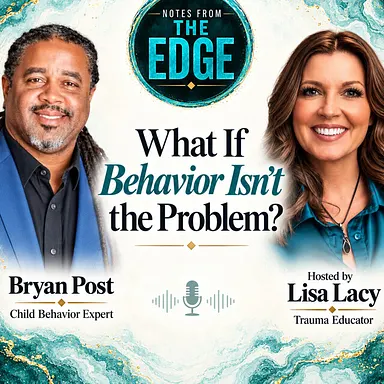
Welcome to Notes from the Edge, where we have the conversations we should have been having all along. We talk about the things that we're not talking about. I'm your host, Lisa Lacey, writer, trauma educator, executive advisor, and author of the upcoming memoir Notes from a Certified Madwoman. Welcome to The Edge. Hey, hey, my friends. Welcome back to another episode of Notes from The Edge. I am your host, Lisa Lacey, and this is the place we have the conversations we should have been having all along. You're not talking about it. So today we're gonna— and today we are looking at childhood trauma, adoption, parenting, and nervous system regulation with Brian Post. So we're talking about what happens when we stop treating difficult behavior as something to control and start asking what fear, stress, trauma, and unmet needs might be underneath them in children. My guest today is Brian Post. He's a renowned child behavior expert, adoptive parent, therapist, speaker, bestselling author, and creator of the Fear to Love method. He began his own life as an adoptee and foster child, and those experiences shaped the last 25 years of his life helping children and families impacted by trauma, adoption, and foster care.
So his work challenges parents to see behavior differently, guys, a new perspective here. Look at difficult behavior not as defiance and something that needs to be corrected, but a communication a form of communication. In his book From Fear to Love, he has sold more than a million copies and his work has reached families around the world. Brian also works with high-achieving men and fathers around emotional healing, stronger relationships, and becoming more present in their own lives if they're dealing with some of that stuff that happened when they were kids. Brian, welcome to Notes from the Edge. How are you today, my friend?
Thank you so much, Lisa. Super excited to be here with your audience and with yourself.
Thank you. Yeah, I'm really excited about this one too. And I'd opened up with, I think if we can hammer this little piece out, then a lot of us adults would suffer less emotionally. So you teach— we're going to dive right in. It's Notes from the Edge. We're going to go to the core of what you do. You teach that difficult behavior is a stress response, not a character flaw, not something to be Punished. So how can parents recognize what looks like defiance sometimes and actually a nervous system that's in distress or hurting or has what you say in all your work, unmet needs?
Well, Lisa, we see behavior for one specific reason. We see, we see negative behavior for one specific reason, and that is because our amygdala, our brain's fear receptor, sees it as a threat, judges it as a threat, and that's actually a reaction. So behavior is a reaction. It's not even a response. A reaction is automatic. It's unconscious, and it's all emotional. It doesn't have any thought connected to it because it's driven by the neurophysiology of stress. And so that neurophysiology of stress is actually an energetic state. We have love and fear. We have surviving and thriving. but it's all just an energy for the body. Those are all just labels we put on an energy. And that energy, especially when you've come from hard circumstances, from traumas, had struggling, had painful experiences, have struggled early in your life, those experiences are oftentimes stored in your body as an, as an energy that has not been integrated, as one that's fragmented. So when we get stressed, we That emotional experience, which converts to fear, is what drives behavior. And we've been conditioned for generations to see negative behavior. We judge it. We've been conditioned to label it and to perceive it as a threat.
And we don't even realize that we see it as a threat. But when you talk about a child who's being defiant, the first thing that is wired into our framework of understanding is that defiance is a sign of disrespect. Which means if my child is disrespecting me, then my child is actually threatening me. Therefore, as soon as I feel threatened by my child, I have a stress reaction. I go into defensive posturing and I have to get them out of that defiance. And I always say, you know, you're operating from stress when, when, when in the presence of a behavior, you want to control it, you want to suppress it, or you want to change it, because that's all the amygdala wants to do, because the amygdala is wired for survival. So we are just classically Conditioned to view negative behaviors as— we're classically conditioned to view behaviors as negative. And then when we view them as negative, when we view them as a threat, we have a reaction to that.
Yeah. And what I love about what you're pointing out is, so your child gets stressed and you get stressed, and then they're feeding off of your stress. So if it's an energetic state, right? and we can work on our own energetic state, then that can go a really long way. Yeah. It can go—
it can go— not only can it go a really long ways, it starts to rewire the brain. That's how the brain gets rewired. And that is exactly why children grow older and don't grow better, because our dominant approaches to them are just expanding the stress. And when you're just expanding the stress, the brain can't learn anything different. So we're so— we're in our state of stress, which Joseph Ledoux says in times of stress, your thinking's confused and distorted and your short-term memory is suppressed, which is really the linchpin to how this continues to grow and exacerbate. But in our state of stress, all we're doing is generating a more stressful vibration. So the brain of our children can only receive that stress. They can't receive soothing. And if they can't receive soothing, then their oxytocin response can't turn on. And therefore they have an overwhelming state of stress and their thinking stays confused and distorted and their short-term memory stays suppressed. So guess what? We're like 7-year-olds on a bicycle with training wheels over a mud puddle, and all we're doing is spinning our wheels and all the mud is coming up our back.
We are a bunch of 7-year-olds walking around sometimes, aren't we?
Yeah, if not 7, then 13.
Well, and You know, the idea of control and, and not looking at children like individual human beings, and they are, they're these little human beings. So talk to me about that, the desire to, to control.
Well, the desire to control comes from fear. It comes from our amygdala. All your amygdala wants to do is keep you safe. It just wants to survive. That's for us as adults. So anytime we see something that is stressful or anytime we see something that is abnormal, or, or neurodivergent. Our amygdala has a stress reaction because we're not wired to seek understanding. And when we have that stress reaction, we're no longer thinking clearly. We don't have short-term memory. So you see your 7-year-old or your 10-year-old or your 15-year-old, and all you see is an individual who is threatening you.
Right.
Because we've not been conditioned to take a deep breath, slow down, reflect on what we're feeling, realize we're not going to die. And instead of seeing our children as threats, see them as the hurt, wounded, sad, overwhelmed souls that most likely they are because they've grown up experiencing things that most children should never have to experience and having to go through a crazy world, grow up in a great— in a crazy world that's full of stress with parents who are doing the best that they can, but they're stressed out too. They're overwhelmed too. They've never grieved their pains and their losses and their sadness. So then what you have— what, what happens is that we're all growing up and living in this world where grief, the failure to express grief, is one of the most pervasive forms of trauma that exists. It keeps us separate because all wired down into the brain, wired down into your brain, is that feelings are not safe.
Hmm.
That's, that's, that's the energy that is wired into our brains. And that comes from generations, from generations of imprinting that says if someone has feelings because it makes me feel uncomfortable, that is not safe and I have to control it, suppress it, or change it. And then we have all these dominant parenting models, which are just models of control and, and being, being over— overpowering someone else, force, dominance. All these models define our parenting approaches to the point that people will try to rationalize and justify having been mistreated as children. Well, look at me, I turned out okay. It's— that's classical generational conditioning. We've been brainwashed. And so when you've been brainwashed at this level, your brain has changed to think that these things are normal and acceptable. But you realize if you keep doing them, you keep getting the same result. And Einstein called that insanity. What most people don't realize is that the bottom of insanity is stress and fear.
Yeah, you know, you brought up, uh, as you were talking, 2 things came to mind is if If we as adults are trying to improve our children's behavior, especially in the moment, we have to know how to soothe ourselves first, right?
A stressed-out parent cannot calm a stressed-out child. And ultimately, the responsibility is on the adults. A stressed-out teacher cannot calm a stressed-out child in her classroom. But the biggest challenge to that is that we don't realize That stress is the culprit. And we don't realize that stress on a cellular level causes you to constrict into survival. And that energy is the energy of fear. And that fear is what drives our behavior. And then if your thinking is confused and distorted and your short-term memory suppressed, you don't remember that you did the same thing an hour ago or a day ago or a week ago. So when stress sets in, you're doing the same thing, expecting a different result. And it can't. It can't happen for children because they are looking to us to be models. Children learn the majority of the time through modeling, and that modeling isn't just physical modeling, it's emotional modeling, it's vibratory modeling, it's the mirror neurons. Children learn through modeling because their neurons are mirroring us, and if we're all pissed off and upset, guess what? Our children are gonna be pissed off and upset.
Yeah, and, and what you're talking about is so layered because you've got the energetic level, right? You've got the neurobiological level, and then you've got the cellular biology level, right? So there's all this stuff going on. So, you know, educating ourselves, recognizing when it happens. So when you, when you talk to, when you work with people, what's kind of your First advice to parents, um, to, to one, gain a new perspective about what's happening, right?
Yeah, I think my first— my first— instead of my first advice, it's my first acknowledgment. My first acknowledgment is that this is hard work. Parenting is hard work. Parenting constantly puts you in your, in your survival brain because you're being in your survival brain You always are afraid of not being good enough. You're always afraid that you're not gonna do what you're supposed to do for your child so that they can survive. And if they don't survive, you may die. Because that's the worst, that's the most painful thing in the world for us as parents to imagine is that something would happen to our children. And I have 7 children and 3 grandchildren, and it doesn't go away because they turn 18.
Yeah.
It's just gonna continue. And so the first thing is just to help them to recognize and to honor That this is a struggle and stress is normal. We're supposed to be stressed. We're supposed to be scared. Sometimes we're supposed to do crazy things because we are human beings. We're human beings. We're doing the best that we can in any given moment. But then after that, the very first most important thing I can teach any adult or any parent to do is to train themselves. And I mean train yourself to become a breathing machine. When stress sets in, the first thing you have to do is you have to start breathing because breathing is the one proven way to interrupt our stress physiology. It's the one proven way. Herbert Benson wrote about it in the 1970s. He was a Harvard physiologist. It was the relaxation response. You have to breathe. If you do not breathe, cortisol overwhelms your limbic system. It overwhelms your hypothalamus and your hippocampus. It shuts down your hypothalamus, which is responsible for releasing oxytocin, which is your brain's anti-stress hormone. As layered as all this stuff is, Lisa, it's actually very basic.
I mean, it's very basic. I always say everything I— everything that I teach and everything that I talk about is really simple. It's just not easy because then you're going up against a society and generations of conditioning that think and feel just the opposite. We don't— we've not been trained to— when in all of any of your education did an adult say to you, let's breathe?
Yeah, no, it doesn't happen in middle school.
It doesn't happen. It doesn't happen. It doesn't happen. Parents are not aware.
Well, and so many of us— it's so accessible, right? What a quick tool that is. It's so accessible, and we hold our breaths all day long.
All day long. Yeah, all day long.
Especially if we had boatloads of trauma that we haven't dealt with, right?
That's right. Then you have to, because your physiology makes you feel like you're gonna die. Yeah, and 99% of the time, you are not going to die.
Yeah, that's a really scared state.
It's, it's a terrifying state. And so I use those words all the time. I say to, I say to parents, take a deep breath, take 3 to 10 deep breaths and tell yourself, I'm not gonna die. And then you tell your child, you're not gonna die, we're gonna be okay. I just need a moment. I just need a little space to allow love to slip in there. So that love can then grow and push out all that fear, because love and fear don't coexist. So we get so overwrought by fear. And here's, here's something that I like to talk about. When we're gonna pass out, we don't die. You don't die like right away. You lose consciousness. Consciousness. When you hold your breath and you pass out, you lose consciousness. When you're stressed in the day-to-day and something bad's happening and you're holding your breath and not breathing, you lose conscious access.
Hmm.
When you breathe, when you breathe, you are literally breathing in consciousness, which means you are literally infusing your cells with consciousness, with love, and with God. When you are breathing, you are infusing yourself with the power of God. When you are holding your breath, you are disconnecting and losing power. Breathing is so essential to how we show up in relationships and how we're able to remain present and understanding and loving and kind. And it is not easy because that little fear receptor in your brain called your amygdala Is waiting to emotionally hijack you at every instance.
So we have to train ourselves differently.
Have to. And it just takes, it just takes conscious effort. It just takes a willingness to slow down. Bruce Lee said the most, the most important lesson you can ever learn in life is the ability to master how to stay calm. To master how to stay calm. In order to master to stay calm, you have to breathe. It is just such an important component. It is. And the thing is, is we get hijacked, we stop breathing, and we're focused on that behavior. You're focused on the behavior, not because mom and dad said your child shouldn't act like that, act like that. Not because grandma and grandpa said it. Not because great-grandma or great-grandpa said it. Not because preacher man said it. You're focused on that child's behavior because your amygdala is in survival and seeing not that child, but that behavior and judging it as a threat. So until you train yourself to breathe, you cannot access that prefrontal cortex. You cannot turn on that oxytocin. You cannot engage that short-term memory system to let you know and to remind you that everything's going to be okay. No one's going to die. So we have to be able to do that.
Talk to us about how important oxytocin is. What is it? Because not everybody knows that's listening. And how, how important is that? Because you just told— you just explained to us that we have that, a burst of that, accessible to us at any point in time, right?
Any, any point in time you can turn on your brain's oxytocin receptors. And oxytocin is not only your brain's anti-stress hormone. It's not only is it your brain's anti-stress hormone, but oxytocin is the hormone through which love is possible. Oxytocin is the love hormone. Cortisol is the fear hormone. Here's the thing. Cortisol, because it comes from your amygdala, is automatic. So because stress is important to, to living, it's the stress is the fuel of life. But it's when that stress is overwhelming, unpredictable, uninterrupted, that it can damage the rest of your brain. Oxytocin, on the other hand, is a learned experience. So you're not just, you're not just born with the ability to turn on oxytocin. It has to be taught to you by having kind, loving, attentive, consistent, predictable care figures in your life. Because in order to be kind and loving and understanding and predictable and consistent, You have to be able to have an oxytocin experience. And if you, if you're unable to have that oxytocin experience, then what you're communicating is a stress and fear experience.
Yeah, it's pretty important. I would say it's critical. Pretty important.
Yeah.
So why? Okay, let's talk about that. Let's talk about the other side of the spectrum before we get to fear to love. Um, what can traditional parenting styles built around punishment, consequences, and control— how— why is that making it worse for our children, especially around trauma, abandonment, and disruptive attachment issues?
It's so simple because all of those parenting practices have as the common denominator An expression of stress and fear. None of those parenting practices— and this is what we've been led to believe, we've been misled to believe, we've been misled to believe— that those parenting practices, which are the most common— consequences, spanking, yelling, shaming, behavior modification, restraint, timeout— we've been led to believe that we do those for our children, but we're not doing them for our children. We're doing them to our children.
Mm-hmm.
And what happens is we exacerbate the stress and the fear that our child is already experiencing. And then you just keep doing that. The child— then you wonder why the child isn't getting better. It's because no one around the child is creating an opportunity for them to feel loved, For them to be able to calm down, for them to be able to feel understood, for them to be able to, to have shared grief experiences if they need to. And you mentioned attachment, disrupted attachment. Attachment— the definition of attachment is the dyadic regulation of emotion. That is the definition of attachment. If 2 people cannot regulate emotion together, You can't have secure attachment.
You said something that I think, um, is so hard for a lot of us when we are under stress, and that was the word consistency. How important is being consistent in our own behavior to our children?
Well, let me tell you why consistency is important. Consistency is important because it allows our children to predict. And when your child has the ability to predict, then they don't have to be stressed out wondering if something bad's going to happen. They don't have to be worried if a threat is going to occur. When they can predict because you are consistent, their brain can settle. And when their brain can settle, all the good stuff turns on. But if, if the parenting is inconsistent, then the child can't predict. And if the child can't predict, they will stay in a heightened state of cortisol arousal.
And what does that do for us in adulthood if we're never able to let our brains calm down, let our bodies calm down, feel that love, feel that attachment? Is it just that we repeat the patterns?
It causes— It causes our thermostat to get stuck. And so when your thermostat gets stuck, you can't respond like you would if you could be loving in the midst of a stressful situation. So when your thermostat is stuck and a situation happens, you're stuck. So all you can do is react to that stuckness. You can't respond because that activates your blueprints. Because when we encounter a stressful experience, we have this neural circuitry in our amygdala which runs all the way down into our heart, into our gut. But before it gets there, it goes into the brainstem. The brainstem is the source of all experiences. It's the source of all memory. So everything you've ever experienced from the time you were in utero is stored at your brainstem. And so the higher the stress, the deeper into the brainstem the stress stirs, looking for old memories and experiences to be able to define how it should react to any given situation. So when you don't have that consistent— and you see it throughout our world. I mean, when you don't have that consistent loving experience and environment to give you those repetitions, of safety and security, then you see the world as a threat.
You see relationships as a threat. Because the other thing we don't consider is that many of these things which happen to us as children happen in the context of human behavior. So if it happens in the context of human behavior, guess what happens when we get stressed and we drop down into that brainstem? The brainstem says, oh, human, human interaction. Not safe, not safe, not safe. And so then we react accordingly and then we wonder why we continue to stay stuck.
And disconnected.
And disconnected because you have to. You disconnect because your cellular system constricts into survival. So when you get stressed, you constrict into survival. If you can't breathe and calm that down. And let me tell you, the longer you go with that compounded experience, the harder it is to be able to turn that off. So we constrict into survival, and that's the root of disconnection. We're energetically disconnecting because we go into survival. The only way you can be open to connection is you have to calm your, your neurosensory system down. You have to give your cellular system an opportunity to realize it's not going to die. You're going to be okay, and this person can be safe, and it's not the end of the world, and we're going to be able to work through this, and we're going to be able to move on. Bruce Perry says the brain always returns to the way the event was handled the last time. That's, that's really important. So if you have an experience, if you have a negative experience between you and your child or you and your partner or whoever, then your brain, the next time a negative experience comes up, is going to return to that same past experience to inform you on how you're supposed to feel and how you're supposed to act, how you're supposed to think or not think.
And so the other thing he said is that anytime we encounter a novel event, we perceive that event as a threat until deemed otherwise. So you have— not only are you, are you encountering novel events because everything can be new and your brain's automatically perceiving that as a threat, but it's also returning to the way that event was handled the last time. And if that event was handled the last time in a negative overwhelming, unsatisfactory way. Now the automatic threat that you experience from encountering the novel event, the new event, is now compounded on that old past experience.
Wow, Brian. So basically what you're saying is we're all a bunch of scared 12-year-olds on repeat.
Oh, listen, listen, listen to this. When you, when you stress, you regress. An acting out child or an adult is a stressed out child or an adult is a regressed child or an adult. So it doesn't matter what your chronological age is. If you get stressed out, you're going to regress to an earlier emotional age.
Oh, I'm laughing at myself. I think I was, I think I was about a 12-year-old. I owe my husband an apology for something I said this morning. This is bringing it up.
I'm like, all right, how old was I acting? Dang it.
I've got to give one of those apologies as soon as he gets home. So yeah, I get it. All right, so let's talk about— let's talk about the way forward, and that's through love. Tell— talk to us about love, because we hear that word, we hear that word all the time. I think we don't understand what it means, honestly.
Well, we, we don't understand what it means because most of us have been raised in environments experiencing fear disguised as love. So what we, what we think was love was not love at all. It was actually fear. And so then we label, we label our behaviors, and we call it love. But it's not love. It's driven by our own fear. It's driven by our own need to feel safe. It's driven by our own need to be in control, because we feel afraid and we feel scared. The significance of love is that as soon as you put a word on it, as soon as you put a label on it, it's not that thing. That's a, that's That's a psychological framework. Love is an energy. Love exists. Love is the most powerful healing force in the universe. All you have to do to access love is take a deep breath. That's all you have to do to access love. But the single greatest challenge is when we're stressed, we're not breathing.
So then we're not thinking.
We're not, we're not, we're not thinking. We're not remembering.
Yeah. Yeah. So you also, you, so you also, in addition to helping parents, to helping children, and I love this, you also work with successful men and fathers.
Yes.
Now, how do you see the adults using these survival strategies that protected them as boys, but is no longer serving them? And the bigger question, how do you work with people to kind of help them out of those patterns?
Oh, those are excellent questions, Lisa. And the first part of that question is, I see it everywhere, all the time, because we have not been given relationships and environments that help us grieve through painful things we've experienced. So we grow up with these fragmented emotional experiences that we've never been able to heal because no one's ever given us permission to grieve. And men certainly are not given permission to grieve. So they carry these old wounds that are constantly getting ripped. The scabs are constantly getting ripped off, and they're constantly reacting to that. And we've just come to define that as the male experience. That doesn't have to be the male experience. You know, we, we're— and I just, you know, I like working with men because I know they've not gotten this environment. And the way I help them work through it is I have some very simple, simple processes and understanding. One, one of them is the behavior is not the problem, it's the opportunity. And the second is the healing is through the feeling. Before you can heal something, you got to be able to feel it. So I just create opportunities and spaces for men to be able to feel through their pain so they can heal their pain.
To feel through it. which is oftentimes unconscious. I mean, a lot of times I can take a, an individual who's been struggling with something. Say I'm struggling with something at 45 in the, in the, in the day, something that brings me to Brian's, um, intensive experience. So I, you know, I'm, I'm having problems in my marriage, right? So we'll start at the problems in the marriage. What's going on in the marriage? And then as he starts to narrate what's going on in the, in the marriage, I just wait for what I call the emotional invitation, whether it's anger, whether it's sadness. And as soon as I get the emotional invitation, I'll ask the individual to pause. I said, hold that right there. Let's breathe into that. Breathe into that feeling. And this is so powerful, but it's so simple. Breathe into that feeling that you're having right now. And I'll get them to slow down and I'll get them to breathe into it and they're feeling it. And then I'll say the magic words, when have you experienced that feeling before? And man, oh, so now we start going down the rabbit hole.
Mm-hmm.
Okay, I experienced that when I was 17 with my dad who was an alcoholic. When was the first time that started? Oh, it's— oh my God, that's been as far back as I can remember, as early as 3. So now we're way down in the rabbit hole. And now I said, let's take that 3-year-old. What was that 3-year-old feeling? And then I'll take him into his body and I'll help him find that 3-year-old experience and I'll help him hold it. And then I'll give him permission to honor it with his feelings. Give that 3-year-old permission to have those feelings. And let me tell you, it takes some work. I've been doing this. For almost 3 decades. I feel so old when I say that.
You did just date yourself, but it's okay. Yeah, we're holding up great. We're holding up great.
I'm 53 years old and I've been doing this work since I was 25. And, and I just take the, the, the, the individual into that experience of honoring and grieving that 3-year-old. And when you can honor and you can grieve for that 3-year-old, and let me tell you, and I, I tell everyone in my seminars, whether it's therapists or coaches or dads or moms or families or kids, we'll have, we'll have Kleenex everywhere. And I'll tell them, Kleenex are not for tears. Kleenex are for snot. That's the level of crying I want to get to. I want to get to the snot bubble cry. If we're not in the snot bubble experience, then we're just scraping the surface. I want to get into the I want to get into the gut. I want to, I want to hit up against that wall where you feel like if you let that go, you might die, because that is the bottom of the pain. And then if we can hit up against that wall and I can love on you and support you and hold you and be present for you and give you permission to just walk right through that wall, you will have a deeply somatic healing experience.
And that's where we find love. Because all the fear and all the threat and all the overwhelm, all the things that we use to try to keep us safe melts away. And we can go into that experience and it takes 5 minutes, 10 minutes, 20 minutes, and then we come out of it and then we can talk about it. But you can't heal something, at least until you feel it. And, and this is the biggest problem I have with mental health, especially when it comes to trauma. We are always trying to talk to people about their trauma. Trauma is not cognitive. Trauma is emotional. It is emotional. And so many mental health professionals are afraid of their own emotions. They're afraid, they're afraid of their own shadow. So when someone else starts to have emotion or starts to tip into that shadow self, they all of a sudden want to go cognitive with them. Don't go cognitive. This person needs to be able to heal at the root. They need to be able to grieve. Grieve with them. Feel with them. Go into those dark places with them and let them know that they're going to be able to come out of it and they're going to be okay and they're not going to die.
And they're going to feel like they're going to die for just a moment. It's just a moment because it's just a cell. It's just a cell holding an energy and you can't even see the cell. But the cell is holding the energy of an experience, and all you got to do is pop that cell. And right before you pop that cell, you feel like you're going to die. But once that cell pops and all those feelings come out and that expression comes out and that deep healing cry comes out, or that deep healing yell, Mm-hmm. then you realize you're going to be okay, and you let all that energy go. Because at the end of the day, it's all That's all it is. It's all energy and vibration and frequency. That's all it is. You let that go. And when you let that go, you give that back to the universe. You give that back to God because that's not yours to carry. We were not made to be fearful. We were made to be loving. And the opportunity for us is always to be loveful. But there's so much fear and so much negative conditioning that it's so hard for us to get to that place.
Yeah, it's absolutely fascinating, Brian, that you just said you were 53. I'm 50, and if we're holding on to something that happened to us since we were 3, that's 5 decades. And it's fascinating how we as humans can absolutely do that.
Yeah.
We can hang on to something for that long. But what I love about where you go is it can, it can be released Very quickly sometimes.
Oh yeah, absolutely.
If you get to the root.
Absolutely. Yeah. And all you're doing when you get to the root is— it's what Carl Jung said— you shine the light of consciousness on what was unconscious. And when you shine the light of consciousness on what was unconscious, now you have a framework. So this 45-year-old successful man Goes back home. And not only does he most likely apologize to his wife and his kids, but he now has a framework that says, when I start feeling that way, it's because of this. It's not because of that. And I just have to take responsibility and be willing to breathe through that and honor that and hold that 3-year-old, because that 3-year-old may still be trying to be heard. Well, you still got to feel— you got to, you got to give them a space to be heard. And that's the process for healing. The process for healing is mindfulness. It's, it's self-growth. It's self— deeper self-awareness and understanding. And that doesn't mean any of us are, are perfect, because we're not. We're not. We're going to struggle. We're going to mess up. We're going to make mistakes. But you know what we do? It's just like what you just said.
You go apologize. And when you go apologize, you're owning that. You're taking responsibility. You're not making your feelings someone else's fault. That is, and that's, that's what we've been taught throughout society. We've been taught to look outside of us for the answers, and that's why there's so much chaos, because we've not been taught to look inside of us. They don't want us to look inside of us, Lisa, because if you start get— if you start looking inside of yourself and you start healing those wounds and you start breathing and you start getting more conscious and you start getting more infused with love and you start getting more infused with the power of God, you will become a force to be reckoned with. And they don't want forces to be reckoned with. They want us to be stressed out and, and controlling one another and hurting one another and, and killing one another. And then, and then using drugs and, and all other kind of mechanisms— Netflix to self-soothe, fast food to self-soothe, cigarettes to fat to self-soothe. That's what they really want. They want separation because we're easier to control when we can be separate.
Yeah, because we're not fully here and aware.
That's right. We're not here. We're not here. Yeah, we're not here. We're up here in this confused, distorted place with no short-term memory, and we're disconnected from our hearts. And we got to get back to our heart, and we got to get back to our gut. But the only way we do that is through the pathway of breathing and self-reflection and taking responsibility.
And going into those feelings. Well, as we, as we come toward the end, I want to circle back to something you said because I think it's a beautiful way to end. And then I can't let you go without asking you a few more questions. But, uh, um, you, you said that, um, what was it going back to? It was really important, a way to close out. Oh, look at our children's behavior as opportunity.
Yes, behaviors— behavior is not a problem, it's an opportunity. And let me, let me tell you why. Again, I, I cite Bruce Perry because I've been citing him for almost 3 decades. When children are having behavioral challenges, we have to remember that there are 2 ways to change the brain. Repetition and emotional impact. So when they're, when they're having behavior issues, they have to experience the repetition of regulation, which is the repetition of a calm adult. It's the repetition of a strong adult, a loving adult, a compassionate and empathetic adult. They have to have that repetition, and that's every single day, because that's how you're rewiring the brain. But the other side of that is the emotional impact. And the emotional impact, oh my gosh, that is the sweet spot. And we have been told that that is bad, that we don't want children having behaviors. We got to medicate it. We got to control them. But we're missing it. We're missing it.
Yeah.
Because when the child is in the midst of the behavior, that's when their brainstem Is fully open and available. And the brainstem is where all that pain is held. So when they're in the midst of that behavior, oh, they are giving us the greatest gift possible to just see them in that behavior and to see that pain that's driving that behavior and see that sadness that's driving that behavior. And then to get so attuned That we reconnect with all that pain they come from, all that suffering they come from, and we just meet them with our heartfelt just sadness and connection and understanding. And we let them feel the presence of love in the midst of all their fear and their terror. And when you let that child feel the presence and power of love in the midst of all of their terror and all these All these crazy behaviors. And instead of saying, don't yell at me like that, you say, oh my gosh, give me that. I want that. I need it. Because I know that the feeling is the path to the healing. And when I know that and you're in the midst of your behaviors, I want those behaviors more than anything because I want to give your brainstem a new experience.
I want to give your brainstem a spiritual experience. I want to, I want to get so deep in that brainstem and I want to grab that fear with so much passion and so much compassion and so much love that you can't do anything except let that trauma unravel. And when that trauma and that pain unravels, that behavior dissipates. It dissipates. And people are always, they're always— can I give you one story?
Absolutely. It's Notes from the Edge. We like rabbit holes, remember?
I teach, I teach this, this, this formula called Reflect, Relate, and Regulate. And anytime you see a negative behavior, you have to reflect. You reflect on yourself, you take 3 to 10 deep breaths, and you ask yourself, how am I feeling right now? You see the behavior, You're asking yourself, how am I feeling right now? And then you get in touch with that feeling. And then when you get in that touch with that feeling, you relate by saying, hey, I'm feeling really stressed out or really scared. How are you feeling? Now, a lot of times a child can't do that, but because you've reflected and you've taken those 3 to 10 deep breaths, you've started calming your cortisol vibration and turning on your oxytocin vibration, which gives the child a new vibration. See, this, this whole thing. And I, I'm not telling the story yet. This whole thing is not about getting children to stop experiencing what they're experiencing. It's about giving them a loving environment, a strong environment that they can work through those feelings to get to the other side, to the healing. And so I had a mom in one of my lectures heard me tell that, teach that, and she said, I'm going to go home.
I've had, I've had my daughter who's 9 years old. She struggled with taking a shower for the last 5 years. It's like every night it is a battle to get her to take a shower. So she said, I heard you. And she emailed me 2 weeks after the seminar. She said, I heard you tell that story. So I thought, I'm going to go home and I'm going to try this. So she said that night before it was time for a shower, I started breathing. I started breathing. I got myself calm. I went upstairs. I said to my daughter, honey, it's time to take a shower. Sure enough, she started rolling her eyes and huffing and puffing and talking back like she always does. But this time I said, if you need anything, I'll be right there. And she said, my daughter went and got in the shower. She said, I couldn't believe it. But she gets in the shower and she does what she always does. Mom, the water's too hot. It's too cold. I don't like this towel. I don't like this soap. I don't like this shampoo. Mom said, usually bugs the heck out of me.
But this time— and this has all started because Mom's reflecting, she's breathing— this time I went in the bathroom, I got what she needed, and I said— and this is the mom coming up with her own solutions— she said, honey, if you need anything else, I'll be right here. She said, I just sat there in the bathroom while she finished her shower. That was the best shower we'd had in 5 years. So I thought I'd go for a home run. So my 9-year-old gets out of the shower, has the towel wrapped around her. We go in her bedroom, we sit on the bed. I put my arm around her and I said, honey, that was the best shower we've had in 9 years. What's scary— And I get emotional. And I've been telling this story for 15 years and I still get emotional because I, I understand the power of this and the pain that goes into all of this. The mom puts her arm around her little 9-year-old. She says, honey, that was the best shower we've had in 5 years. What scares you so much about taking a shower? She said, my 9-year-old daughter looked up at me and said, Mom, the guy who sexually molested me made me take a shower with him.
And Mom knew about the molestation. It happened at daycare when the little girl was 4 years old, but she didn't know about the shower. And the mom, without missing a beat, without missing a beat, she said, honey— see, this is the emotional impact— honey, you don't have to take a shower, you can take a bath. And she said, 2 weeks after, 2 weeks after I heard you and I did this, I'm emailing you to let you know that my daughter now gets in and out of the bath and I don't even have to tell her. It took 5 minutes to resolve 5 years of struggle for that mother and that daughter just by asking, slowing down, breathing, reflecting, getting herself calm, calm enough so that her thinking can come online and she could ask her daughter, daughter, what scares you so much about taking a shower?
And be there for the answer.
That's it.
Yeah, that's it. And be present for the answer and change what they're doing to support her. And what happened in that story too is that mother-daughter bond just got so much—
100%.
Deeper, definitely, for the long haul.
That's right. Yeah, parenting is lifelong. Doesn't end at 18.
I thought it did. I thought it did. I really did, Brian. I don't know what I was thinking.
Don't we all? Don't we all want it to end at 18?
I kind of did a happy dance for a minute there. I was like, oh, messed that one up. Okay, well, we're done. No, no, it is lifelong. And you know You know what?
You hit it.
It's the hardest job we're ever going to do, and we're always going to feel like we're failing at it.
That's right.
Yeah. And if we don't feel like we're failing at it, I don't think we're trying to do it. Do it. So absolutely, my friend. Well, thank you so much for giving us a new way to see first so we can figure out a new way to be and how to stay connected. How can people find you? How can they find the book? Where's the best place for them to go?
Um, either feartolove.com, which is our— one of our websites, or Brian Post Official on Instagram. We post so many videos all the time, and I just tell people, just watch a video a day. Watch a video a day. And then I also have an app called Bondify where you can actually ask it questions and I answer you. My AI—
Oh, I love that. Yeah, what a great resource. What a great tool. All right, Brian, before we let everybody go, I always ask a couple more questions. You ready for one? All right, in your own life, what did you perform in order to survive, and what did setting that role, mask, or performance do for your life?
I performed being the best that I could be because there was so much conflict in my home that excelling and excelling just within myself and for my, for my own self, not for my parents' approval or anyone else's approval. Whether it was academically or whether it was on the football field, I performed being the best that I could be because that helped shield me against all the negativity and the overwhelm and the things I felt inside as an adopted child Yeah.
Yeah. How did it, how did it change your life when you let go of some of that pressure?
Well, it just brought me more freedom again. And let me tell you, that only, that has only come about probably in the last 5 to 6 years, and I'm 50.
Oh, I know this journey.
Yeah. You know, 53. And let me tell you, it, it, that doesn't want to go away without a bit of a struggle, without some acknowledgment, without some acceptance. But as soon as I can relax that, I can really step more into wisdom, wisdom and maturity and feel so much more peaceful. But it jumps up all the time.
Yeah. Thank you, Brian, today for teaching us to have compassion for ourselves. Last question for you. What do you want us as humans to be conversing more about? What should we be talking about that we're not? Hmm.
We should be talking more about how stress impacts every level of our health and how stress shows up every day and how the things that we consume create stress, how the things that we're taught create stress, how our jobs create stress. And then asking ourselves, what are things that we can do? What are 3 things we can do to reduce stress? And what are 3 things that we can do to increase joy? And do less of those things that are increasing stress and do more of those things that are creating joy.
A little at a time.
That's right.
A little at a time. All right, my friends out there, I'm going to ask you the same thing. What might you be performing in order to just get by? And what would setting that role mask or performance down do to lighten your load just a little bit? I'm your host, Lisa Lacey, here with my guest Brian. And when you find the answer to that, we will both see you at the edge. Thank you, Brian.
My pleasure.
What if the behavior we’re trying to stop is actually trying to tell us something?Bryan Post is a child behavior expert and creator of the Fear to Love Method whose work challenges parents to see difficult behavior not as defiance, but as communication from a nervous system experiencing stress, fear or unmet needs. In this conversation, Bryan and Lisa explore what changes when adults stop trying to control behavior and start looking underneath it. They unpack why a stressed parent cannot regulate a stressed child, how consistency creates safety, and why the feelings we learned to suppress in childhood can continue driving our reactions decades later. Bryan also shares his “Reflect, Relate and Regulate” approach and a powerful story illustrating what can happen when a parent gets curious about the fear beneath a child’s behavior instead of immediately trying to correct it. In this episode:Childhood trauma and nervous system regulationTrauma-informed parenting and difficult behaviorAdoption, attachment and emotional safetyWhy punishment and control can intensify stressParent self-regulation and co-regulationHow childhood survival patterns follow us into adulthoodGrief, emotional healing and unresolved traumaReflect, Relate and RegulateMoving from fear-based reactions toward connectionWhy behavior can be an opportunity rather than a problem Connect with Bryan:www.feartolove.comConnect with Lisa:www.lisalacy.comWhat did you perform in order to survive?Welcome to the Edge.See Privacy Policy at https://art19.com/privacy and California Privacy Notice at https://art19.com/privacy#do-not-sell-my-info.