
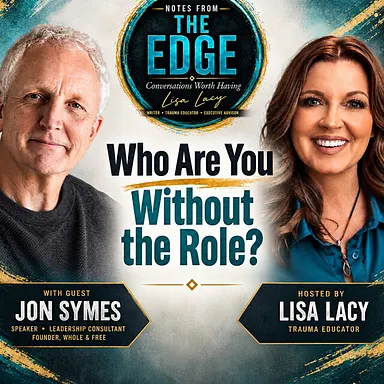
“Who Are You Without the Role? Survival Performance, Masculinity, Midlife Reinvention & Narrative Liberation with Jon Symes” was turned into text by HappyScribe’s speech recognition. Related tool: Zoom transcription.
Ads in this audio differ from the text. Tap the sentence you're hearing to follow along.
Synced: the text now follows the audio.
Welcome to Notes from the Edge, where we have the conversations we should have been having all along. We talk about the things that we're not talking about. I'm your host, Lisa Lacey, writer, trauma educator, executive advisor, and author of the upcoming memoir Notes from a Certified Madwoman. Welcome to The Edge.
We should have been having the whole time. Guess what? You ain't talking about it. So we're gonna today with our guest, John Symes, and he is a speaker, leadership consultant, founder of Whole and Free, and creator of Narrative Leadership Frameworks. For more than 20 years, he has helped leaders, executives, and people in transition— such important times for us because I think we're all in transition right now— uncover the invisible stories driving our decisions, relationships, and identities. And you know we love that word in here. His newest book, The Stories That Are Killing Us, challenges the idea that we are broken. Instead, he suggests that we have simply made survival performance our identity. So this conversation is not just about trauma. It's about leadership, success, masculinity, relationships, identity, and what happens when the story underneath our lives, the surface, quietly begins running everything without us making conscious choices.
John, welcome to Notes from the Edge. How are you today, my friend?
Lisa, I am so excited to be here. I just— I love the scope of the show already. And happy to. Let's, let's dive in and find out.
Well, let's dive in. It's Nose from the Edge, so we jump right in.
Your message, when I saw it, I was like, that is the heartbeat of the show, which was so cool.
But when you ask people, when you're working with people and you ask them, hey, look at the story underneath your life, why are we so scared to go there? Why do you think? What have you uncovered there?
Well, there are 2 responses. To start with, some people don't even realize that they're running a story in their life.
Yes.
That's just how it is. And that's how it is, is a story— is it tells us that a story has become embedded in the unconscious and we don't see it as a story. We just think that's reality.
Yeah.
So for some people, the idea that they might be living out a story is itself news. For the people that recognize that and then want to look underneath and see, well, what is the story? The fear comes up that without the story, I don't know who I am.
Exactly.
And it comes back to something you said in the intro there. We have become so used to performing stories that they become our identity. I'm the good guy. I'm the guy that helps. Or I'm the smart one around here. Or it could be, I'm the person that supports other people's success. It can be any of those. None of them are good or better or worse. They are just the stories that we've learned unconsciously and started to live out unconsciously.
Yeah.
What, John, what happens when we're on autopilot? I know what happened for me was total mental collapse.
That was just my lived experience.
But what happens when we are operating these stories that may be, you know, self-abusive stories? I mean, it depends on what our situation is, but what happens when we're on autopilot in our lives?
Well, there's a period— I believe there's a period when that actually serves us. And I think about it sometimes in terms of age and Think about coming into adulthood, age, let's say, 18, 20. And throughout our childhood and our teen years, we've been struggling to form an identity. And then we actually get to walk out in the world. And we get to walk out in the world with the stories that we think will serve us.
Mm-hmm.
Typically, that's a collection of stories that we have had some hand in the design of. So this is how— this is the career I want to choose, this is how I'm— I want to be seen. But there's also in there this huge mix of the unconscious stories that we can't even see. And so we get then in those first adult years to walk inside the stories that, that are that combination. And it takes some time usually for us to see the efficacy or the utility of those stories. And it might be that we pretty quickly realize that they can serve us, and if I keep doing what I'm doing, I'm going to keep being met with success, however we define success. It might be climbing a career ladder, it might be enlarging a family, who knows. So sometimes we get the feedback that says do more of it, and then there will come a point, there will come a point, and I'm pretty sure In everybody's life, there is a point when the stories stop working. I've come to see, Lisa, that that's what we have often described as midlife. And so we have this idea of midlife crisis.
And, you know, I'm from the UK originally. You know, over there, the story would be that age 40, I'm going to go and buy a motorbike.
Exactly. You hear so much about that. Yeah, I did.
I did buy that motorbike. It was a Corvette.
Cat, not motorcycle. Oh my God, that's crazy.
I ended up buying a motorbike, which I'd never owned a motorbike in my life before. Um, now the, the, the reason that people do strange things in midlife is because we have— we've been living a while inside those stories, and they served us for a while.
Yes.
And then they didn't.
Yes.
And, and that— and so that, that period in which they served us could be 2 years, it could be 40 years. We might hit midlife before we're 30, and we might not. We might still be having midlife reinterpretation when we're in our 70s.
Oh, I like that, midlife reinterpretation, because we do. And I think it's so important to ask us ourselves the question, because it might be— for some people, it might still be serving them. Great, live that out. Wonderful. But for some of us, Some of us, we get to the place of, oh, this is not me. I'm not digging any of this. What the hell am I going to do with it now?
Yeah.
And that, I think, is most often because to live in a story which isn't our authentic self, we have to give up a part of ourselves.
Oh, there's grief involved in that.
There's grief, there's loss, there's, there's some anger splashed in a little bit. Yes, it can come out in all sorts of different ways. But, uh, and, and I've been exploring this. I've been exploring it in my own life. I'm exploring how it then— how that— how I may be typical of men generally in our culture, and, and, and what are the stories that men inhabit. Um, I'm fascinated by that for a couple of reasons. One is because a lot of men need help.
Yes, and, and can't say it. There's shame and stigma around needing support and struggling. Yeah.
That's part of the male story. I do it myself, you know.
Yeah.
But also, I'm looking at it, and we might come back to this as well, I'm looking at it because male behavior has such a large influence in the world. In a culture that's patriarchal in nature, it is the way men see the world, the way men choose to act in the world, that has more influence. And so if we look at the stories that men are living inside of, then we get clues as to the stories that we're living in. as a culture. Um, so I've been exploring all of, all, all of this and, and seeing how, you know, the stories that I learned about, um, being a man have cost me something. And I can— I give you an example.
It's Nose from the Edge, it's your show.
Go, go!
Of course we like examples and stories.
I can remember as a boy, I must have been 9 or 10 years old, I remember one, and I remember all the detail of this so vividly. I was walking to church one day and I, I, I suddenly heard the sound of new corduroy trousers rubbing between my legs, you know, as you walk.
Yes.
Yeah, and corduroy makes a noise when you I have some on, actually.
They're orange.
I haven't worn corduroy since this story, but that's— I hear this noise, and to my 9, 10-year-old mind, I'm, I'm, I'm terrified that anybody else hearing that noise will mistake me as gay.
Oh wow.
And, and it— I didn't realize that. I didn't realize how I responded to that fear until somebody told me, must have been nearly 20 years later. They asked me why I walked around bow-legged.
Wow.
They said, why do you walk bow-legged? And, and I was mimicking a John Wayne walk.
Because somehow you've probably given yourself really bad back pain.
And, and nobody never told me, you know, all of the stories that, that, that were there, that I wanted to be a man, that John Wayne was a man. I didn't want to be seen or confused with somebody that was homosexual. Um, uh, all of that was somehow imprinted in me As a 9 or 10-year-old, nobody had ever said that to me straight, I don't think. Um, and I'd made a decision that affected my body, the way I walked, the shape of my legs. Out of the story.
Wait, wait, wait, I gotta ask. When you, when you were made aware— guys, awareness is key— when you were, when you were made aware, did you change your walk? Did you change your gait after that, or did you just stay with the bow-legged thing?
Um, well, to the degree that you can be conscious of how you walk.
It's amazing though, 20 years. Yeah, yeah, unconsciously made this adaptation.
Yeah, so I'm performing masculine. Yeah, and one aspect— I'm sure I'm doing it, I've, I'm, I'm doing it in lots of ways, not just how I walk. But I'm performing masculine here. What am I— what have I abandoned in myself? That's the question for—
That's a great question, and we're into better questions in here.
Yeah.
So, so to all, all the ladies, what if, what if we abandon ourselves to conform? For me, in all of I think partly it was my creativity, my musicality, could be perceived as effeminate. So, you know, liking touch or texture or appreciating comfort.
Yeah.
Of course, that goes by the wayside because, no, I'm performing masculinity. And so I think that's the cost. One of the ways we think about the cost of stories is what have I had to abandon in myself?
Yeah, that's a great question. And we talk a lot about asking ourselves better questions, and the price of the performance is a good one. What is the price of the performance? So, and I love this too, John, because You know, I went into inpatient rehabilitation thinking I had a bad marriage and a slight drinking problem and came out with a chart this thick with so many damn disorders and labels. And on the last page of my medical record, it said prognosis for recovery, poor to none due to lack of familial support. So I certainly thought at one point in time, I'm broken, right?
Mm-hmm.
And you're a big fan of no, you're not broken. So What's buried beneath that? And how do we know? I love this because competence can become camouflaged. Because while I was cycling through institutions, I was still running a 6-figure business. So I was showing up in my corporate suit in business, but my personal life was, um, holy terror, really. So what if we're not broken? then what are we? What's the other alternative for us to tell ourselves?
Well, you see, you mentioned again in the intro that I have a brand which is Whole and Free. It's a brand that's supported to— that's devoted to supporting men, men in midlife, men who find themselves stuck. As we've talked about, the stories are no longer working. And whole and free are very deliberately chosen words because I have a belief, and this is not, this is not to make it factual, but it's a way I consciously choose to see the world and to see people in the world. I, I, I choose to, to try to see people as whole.
Hmm.
Even if that wholeness isn't being expressed.
That's the hard part. Yeah.
So, and I've had the great blessing of looking into the eyes of 2 newborn babes who are now in their 30s and very much no longer newborn. But those moments etched in me this sense that there is an enormous human capacity in each of us.
Hmm.
That we arrive with the capacity to have a zest for life with a curiosity to absorb life and try to understand it and consume it. And then the capacity to love and be loved, the capacity to do hard things and to persevere until they're done, the capacity that we see around us to be creative and to be compassionate. And there are many more. I mean, we could have a long list of the human capacities. And I believe, Lisa, I believe they're all inside us as latent capacity. And unfortunately, what we've done is, is we have learned patterns that obscure our access to those capacities, so we don't get to express them.
Yeah.
I think the, the journey that we, we go through is the journey to recover those capacities. It's a journey of remembering who we are. And the language that I choose to use, the window that I choose to look through in that work, is story, narrative. What are the stories that we're running which are keeping me from my true self?
Yeah.
And if I can find my way through the falsity, the stories that aren't true, the stories that have me abandon some part of who I truly am, then I will recover. I will become more free in my wholeness. And so Whole and Free is about the inherent capacity that we have and the journey towards expressing it.
I love that. And I love this philosophy of looking at each of us as one human being to whole, even if it's not being expressed. So I've got some difficult people in my life, but I'm going to try to look at them from that perspective, because I think then you have a shift in how you treat them, how you react, how you respond, how you feel in, in their company or in conversation with them. So that's really a beautiful way of, of looking at the world. So What was it about working with men in midlife? Was the transition— and I love the word working with people in transition because, man, they can be so difficult without support. And we all need mentors, guys. You know I'm a fan of mentors. If you don't have a mentor, get a mentor. Have a mentor. Transformational coaches were the game changers for me. I had done all the clinical therapy acronyms and I still felt like crap. Um, many, many, many session hours of sessions and thousands and hundreds of thousands of dollars spent trying to fix fix my brain that I thought was broken. And it was transformational coaches that helped me realize, uh, how much power I have, that I'm not powerless, and that we just need to harness that power.
So for me, the story was, you are powerless, right? You're so stupid. You're such an F-up. You're never gonna have healthy relationships. Those were the things that were on repeat in my head. And it's so fascinating to do this work because once you identify those And you work with a new story, you eventually develop a new default where they just never even come up anymore. It's so cool. It's just— it did. I, I, I— it's trippy, cool, magical. I don't even know how to explain it. It's fun. It's phenomenal work.
Trippy, cool, magical is a good way of describing it.
Yeah, it's trippy, cool, magical, right? It's just like, wow, okay, you have a new default.
These things do not come up for you. any longer. And observation is not neutral. That's quantum physics, quantum mechanics. The minute we start observing these things in ourselves, they're already starting to change for us. Yeah. Um, so what is one of the— what are a couple of the biggest stories that men in midlife tell themselves that you discover in your work with them?
Oh gosh. Um, right in the middle of it are a couple of, a couple of things. One is, um, Uh, one is the sense that we have to be strong men, that we have to embody some kind of strength, which it doesn't mean a physical strength, although many people can, you know, want that as well. Um, we see that in the culture, how many, you know, the, the bicep culture is, is, is very big nowadays. But the, the broader sense of our strength is, um, is, is really, uh, in the center of the cluster of stories that almost every man is, is operating from.
And that's a lot of pressure.
Oh, it's an enormous amount of pressure. It's enormous pressure to, to be able to finish the job you started, to be able to do so without asking for help, to be able to, um, survive all the difficulties of doing it. Uh, yeah, it's a huge amount of, of pressure. The, the other big story is the provider, and these two tend to go pretty well together. And that's the sense that, that as the man, um, as a man, that I have to be able to provide. And, and we can see that most easily in the family setup and, and, and the, uh, breadwinning activities for a family. And so many men that I, I know or talk to are somehow stuck in the provision role. And once we start, once we take on a mortgage, and once we've got kids, and there's a financial pressure that says just to stay where you are, you have to keep earning more and more money, uh, uh, when we add that in, I see so many men that are, that are stuck in work, that, that, that where they're trading, that they've certainly It's not capturing their interest or their passion.
It might even be costing them their dignity. But they show up day in, day out because they've got to bring a check home at the end of the month.
Yeah. And to leave it would be terrifying.
And to leave it would be terrifying because my identity has got so tied up with the work that I do and the doing of it that I don't know what I would do to step outside of that.
Well, speaking of that, then when you, when you work with people in transition or even leading them into a transition, because I, I'm assuming that when you start working with them and they identify their stories, they're like, oh, I want to change this, which creates transition. What's one first step that when you're working with people you will, you will start on to help our listeners maybe capture a story that they're telling themselves that they don't know about today. One first step.
Can I have 2 thoughts that come to this simultaneously? The first is to recognize that we need to do some inner work. It's to actually pick up the cues that say you're living inside a story that's not working. And the cues are normally about stuckness, uh, a repetition, and the dulling of our life force.
Oh, that's no good. That's huge, isn't it? The dulling of our life force, which means we're just living soullessly.
Yes, that we've, we've, we've, we've lost passion, we've lost ambition, we've lost vitality. Well, I had a conversation with a man quite recently, and, um, he said to me, he said, he said, my wife asked me what, what, what I want. He said, and I don't know. I don't know what I want. I don't know how to answer her question. And I chuckled with him because I'd had precisely the same experience.
I did too. In rehab, they were like, what are your wants and needs. I was like, wait, what? That sounds like a foreign language. What are you talking about? I take care of everybody. That's what I do. Exactly.
And so we abandon what's important to us. So not only are we not— do we not have a bucket list, and we're not out ticking it? Yeah, checking it off. Sorry, in American English. But we're— we don't even know. We've lost touch. with that life force that wants to express itself through this particular human being. So we need to recognize the moment that tells us that we want to start looking at story.
Which requires some inner reflection. We've got to go inward to do that and discover that.
And the courage to confess that we find something that That is not serving us.
There is so much stigma attached to the words, I'm not okay, I'm struggling, I need help.
Yeah, yeah.
And I, I'm sure that's for everybody. It's particularly acute for men who've been raised in this, the sort of traditional view of what being a man needs.
Yeah, yeah.
The, the story that starts to get at Sorry, the question that starts to get at the story is— and I love that you're a fan of great questions. So the question is, I think, what am I trying to earn in my life that I should never need to have to earn?
Be it love, be it acceptance, be it money even. Yeah, what is it?
Lots of things. There is no single answer. The answer would be Lisa's answer, John's answer, or the listener's answer.
Yeah.
What am I trying to earn that I never even needed to earn?
No, not that I didn't need to, that I never should have had to.
Oh, that's even better because that means we did try to.
Yeah.
And lived that.
And we felt—
which cost us what? Yeah.
Yeah.
So what was it I was performing?
Yeah.
You know, and I look at my life and I was performing the, um, smart, successful career guy. Uh, I did that for quite a long time. I was, I was, um, performing that in an environment where I was rewarded for it. And after doing that for 15 years or so, I, I I realized that I didn't want to keep performing inside that environment because I was having to cut off the concern that I have for the larger well-being of who we are as people. Let me be more specific because that's a lot of abstraction there. I was working in the corporate sphere, and this is back when I was living in Europe, and I was a consultant to large corporations. And I had a growing sense in me seeded by a very positive story that I grew up in. The positive story that I— one of the positive stories I grew up in is that we, we are all connected to the common good. We're connected to the common good. In fact, we can either contribute to it or diminish it.
Hmm.
And so I've always, I've always had that. I got that from my folks, bless them. And I began to see that if I was working purely in the corporate environment, that I couldn't necessarily easily reconcile that that was for the common good. There are too many instances where profit is put ahead of people and planet.
Well, and once you see it, you can't unsee it.
Well, isn't that true?
Yeah.
And so So I realized that the part of me that I was not being— that I was having to leave behind to be successful in just that environment was too important to me. And so, yeah, in my—
Your value.
Yes.
Yes.
So much so that I actually stopped that consulting activity. Um, I was in my early 40s and, um, I actually closed down the consultancy and I was, I was, uh, able to, um, uh, survive for— not survive, to live fairly comfortably for a couple of years because of the prior success I'd had. And, um, inside that period of time, I sat with the question and I, I actually, I, I was sitting with it as a prayer really. which is, show me how I can make a difference with my skills and capabilities in the world. And, um, to my surprise, the answer was write a book.
You're like, now I'm a writer? Wait, what?
Yeah.
And so, and so the, the, the, the path I was shown was write a book called Your Planet Needs You. which is, uh, was a book I— it was published in 2006, and it's really, it's a, a cry from the heart to, to all of us, mostly a cry to myself, I think, to say, hey, you can do something that helps move us towards a world that works for everybody.
Yeah.
And so I wrote that book, um, really to reclaim part of myself that had a sense of and a desire to contribute to the common good. And, um, and I, I wrote that book, and pretty quickly it was seen by and came to the attention of a nonprofit called the Pachamama Alliance, who operate close to where I live now in San Francisco. And long story short, I got a phone call one day from another John And he phoned me up and, and in his Californian drawl he said, John, he said, I've got a question for you. I said, yeah. He said, what are you doing with the rest of your life?
Well, that's a big question to start out with.
That question led to me joining the team here in San Francisco and working there for nearly 10 years.
Oh, how exciting.
In, in the work that they did Which had this fabulously bold, ambitious, almost audacious goal, which was bringing about a human presence on Earth that is environmentally sustainable, spiritually fulfilling, and socially just.
Oh, what if, and if only. Yeah.
And so that's, that to me is the way that was phrased was one of the most powerful ways I've seen English words linked together in my life.
Yeah.
And we worked for a long time around the world. I got to lead that program.
Very cool.
Traveled around the world finding that there are people in every corner of the world that actually resonate with that desire. And actually, I'm going to restate that if I can, Lisa. I think what I discovered— I know what I discovered— is there's a part in every one of us that resonates with that description of the future.
I believe that.
It's there in every human heart, I believe, but in the same way, often obscured by the stories we've also picked up. But I discovered that it's there in every human heart and that there are an enormous number of people around the world who are actually prepared to do something about it as well and take on some, some activity, some projects in, in their own lives that brings other people into the conversation that says, hey, we need to shape the future consciously because if we take our hands off and carry on on autopilot, it's heading in a pretty disturbing direction.
Yeah, collapse is inevitable.
At least for me it was, right? And we want to, we want to catch people before they hit the wall or before, um, the collapse.
So narrative liberation, let's talk about that because I love that wording. First of all, liberation is just such a fun word. It's so beyond freedom, right? And narrative is, I'm assuming, chosen very consciously and with great purpose. So talk to me about that.
Well, it's really interesting. When I arrived in that organization, the Pachamama Alliance, I had a real sense that we were working at a point of really high leverage. There's a real leverage if you can get people to start to think about themselves as citizens capable of shaping the future, you've got a very powerful point of leverage. So I've always had an eye for where's the leverage. Go back to the prayer that I told you about: where can I use my skills and experience for the greatest advantage? What's the point of leverage that I can work with? And I, I, and then in my own life experience and, and in the, and in the difficulties and the disappointments of my life as much as in any of the success I've had.
Those are some of our greatest teachers, aren't they?
And I, I, I came to see what a powerful window narrative is to look into how we act in the world. And so I, I've, I've, I've been able to see narrative is actually the most powerful lens. It was a lens I was using even before I knew using it. And now it's a lens I very deliberately adopt, and it offers a simple language and a way to get into the motivation of the psychology of the decisions of our behavior.
Yeah.
And so narratives is this really powerful window. Narrative isn't good or bad. Narrative is the way we make meaning of events in the world. Some of it's entirely positive, some of it's very limiting, and in the worst cases, some of it is killing us. So the title of my book is The Stories That Are Killing Us because I want to draw attention to the fact that some of these stories literally will foreshorten my life because I'm living under male patterns of behavior, uh, uh, and will foreshorten all of our lives if the stories we live in as culture allow us to continue to poison the oceans, poison the air, and deplete the ground beneath our feet.
Yeah, tear it, tear it all up. So how is it— and I love the fact you just segued because I was going to segue into the stories that are killing us and you got there first, so we'll roll with that. Um, how is it killing us? How are these stories killing us, literally, literally affecting our physical health? Because it will. Eventually.
Well, the, the, uh, situation that I know, uh, for men is that this series of stories that we have— we talked about a couple of them specifically before— that, but the, the listeners will, will appreciate this dynamic where men are not encouraged to— often encouraged not to express their emotions. Not— and so there's a tremendous amount of, of, of, um, walled-up, pent-up emotion in here, and, um, very few, uh, routes through which I can safely express that. There are routes, and we can come to that if we want to talk about that, because that's really important. But most men are living in this sort of bottled-up sense, this, this, this, um, containment.
That's a lot to hold.
And what that does is it raises the incidence of heart rate, the likelihood of stroke, It leads us towards addictive behaviors and suicidal ideation and actually suicidal execution at rates far higher than in women in the same population.
Hmm.
The net effect is that men will die 6 years earlier than women born in the same circumstances. And so you can argue that literally the act of performing masculinity is shortening our lives.
Ah, that's powerful. So roots. I love roots. I used to think I didn't have any roots, right? Talk to us about roots.
What roots? Give me a bit more context about what particularly—
You, you said the stories that are killing us, and you said roots. You started talking about roots. Are you talking about getting to the root of the story and kind of pulling that up, or you said we'd circle back to roots and I didn't want to gloss over that.
Okay, I'm not quite— I haven't picked up the reference that I made in quite the same way. I'm not too— oh, roots! Sorry, I'm with you now.
If not, I can talk about roots.
So the roots that we have to expressing ourselves, What are the avenues in which I can express myself? That's what I was talking about. The roots of the stories are different again. And so we can talk about either. I'm happy.
But I actually want the roots of expressing ourselves, because if our listeners, if there's any listeners out there, male or female, they're like, oh my gosh, I have this armor up, I have this wall up, I'm holding all of this How can they begin to express all of this if there's that much? What's a baby step that somebody could take today?
Baby step. I think one of the most powerful, simple steps we can take is to name a story that we're living in as a story. Because the moment we name it as a story, It just, it can never have the same power over us again. When a story's thoroughly embedded in our psyche, we think that's just how the world is.
Yeah.
When we see it as a story that we've been conditioned into, or that we picked up from mum or dad or Uncle George, I don't know.
Or corduroy pants.
Picked up from John Wayne.
When we see it's a story, it can't have the same power over us.
True.
So if I recognize— if I'm listening to this show and I'm thinking, you know, I'm beginning to understand there may be stories that I'm living inside of, I invite the reader, the listener, the viewer to try to name one story. And a clue would be, what's the story you were playing out in the household where you grew up?
Ah, that's a great place to start because, man, those patterns will follow us for decades, won't they?
You know, you might have been playing the good girl who needed to look after everybody else. I was, I was playing the smart, the smart, the smart one in the family. Um, uh, and then, um, my brother was playing the victim, you know, and, um, Uh, my— one of my sisters was playing the rebel. So, so if you go back to the household that you grew up in, you can probably find clues to one of the stories that you're still playing out in some way or another.
Oh, and I love that because it's an easy place to start. Beautiful, beautiful. Well, John, I am so excited about getting your book into the hands of our listeners. Uh, where can they go to find not only you, um, If they have questions or want to work with you, but your book?
The place to go is my website, johnsimes.com. And, um, I know we'll make sure that's in the show notes for folks.
Oh yeah, it's going to be in the show notes, clickable link, guys. You don't have to write it down. I just always ask you to go ahead and say it to let people know where to find it. All right, John, listen, we close out with 2 questions from every one of our guests, and we've been kind of talking about it the whole time, but I'm just going to ask you directly. And sometimes the answer is different from day to day.
You ready for it?
I'm ready.
Yeah.
All right. In your own life, what did you perform just to survive? And what did dropping that role, mask, or performance do for your life?
Hmm. One of the, one of the roles that I've performed in my life, the one that was maybe most insidious and was quietly damaging in a way that I didn't get it, was playing the good guy.
Hmm.
And, you know, I would say to everybody that's listening in, we live in a time where the culture war has thrown a great deal of confusion around what it means to be a man, what it means to be a woman. And so, we've got a whole generation of women who are now achieving more than men of the same age. They're taking more of the responsibility in the workforce. They're They're educated better, and, and women are really claiming their voice. Men are, are trying to reorient around that. And in my life, to try and reorient because I could see that the, the old model of easy male dominance was no longer relevant, and, and I didn't actually even think that I wanted it, um, living with a very, a very strong woman who was claiming her own voice. Um, and so trying to find that accommodation, I settled into a role that, that I now call the good guy, which I thought was me being understanding, um, com— um, generous with my attention and support, um, helpful, uh, certainly trying not to be controlling in any way. And what I found was that in playing out that role, I'd abandoned a great deal of myself and robbed my partner of the sense that here is a man who stands on something firm that she can relate to.
Hmm.
If you're forever performing as a man, if you're forever performing the role of helping the other, it's actually a very weak position and it's not satisfying to either party. So I love that.
It's not satisfying to either party to be inauthentic and carry the mask around. It's just not, because we're not being real. And so therefore, there's not that, that balance when we need it to be there. Yeah, absolutely. All right, last question. You ready for it?
Go on.
All right. What do you feel, just your personal opinion, that we need to be having more conversations about? What are we not talking about that we should be?
Gosh, well, I'm tempted to pause and think about that because if we can find the right answer to that question, we will really unlock something. I have a sense that we are not sufficiently capable of talking about what our future looks like. Oh, our collective future.
Yeah, because it's terrifying to think about.
Yeah.
And so we— the, the conversation is really— it's no longer about what's the story that we're living into as human beings. It's become this, this strange, uh, and, and, uh, very insufficient argument about positions that we're adopting on things like, is the climate overheating or not? In Florida, you can talk about the seawater rising, but you can't name that the climate is changing.
Yeah.
You know, this sort of very perverse situation that we've got into where we're politicizing the way we think about the future, when it actually should be our greatest concern for all of us. I have children, I have nieces and nephews, people who are— whether you have your own direct descendants or not, the survival of the human species requires that we think carefully about our future.
Yeah, and this beautiful, beautiful Earth here we have with the beautiful trees and the beautiful soil and all of it.
Yeah, the miracle of it. Yeah, I mean, it is. It's, it's a It's so fascinating.
And when you get down into just creation itself, it's just how we're designed and how nature is designed. And I mean, it's, it's just endless. I mean, the rabbit holes there are endless.
So, John, we're probably gonna have you back for another show because I think the rabbit holes with you are endless.
But we're at 44:44, so we're going to have to wrap it up, my friends. Listen, I'm going to close out as always and ask you the same question. What are you performing in order to survive? And what might setting that role, mask, or performance do to lighten your load? I'm your host, Lisa Lacey, here with my guest, John Symes. And when you find the answer, we will see you at the edge. Thank you, John.
Been such a pleasure.
Thank you.
What if the person you became to survive is no longer the person you want to be?In this episode of Notes From the Edge, Lisa Lacy sits down with speaker and leadership consultant Jon Symes to explore the unconscious stories we build around identity, masculinity, success, leadership, and survival.Jon calls this work Narrative Liberation: recognizing the roles and beliefs we adopted to navigate life, then deciding which ones still belong to us.They talk about the cost of being “the strong one,” the provider, the good guy, the high performer, or the person who always has it together. Jon also shares how early survival adaptations can begin, including changing the way he walked as a boy to avoid social judgment and carrying that performance for nearly twenty years.Together, Lisa and Jon explore midlife reinvention, masculinity, people-pleasing, leadership, family roles, authenticity, and what happens when the identity that once protected you starts costing you pieces of yourself.In this episode:• Survival performance and identity• Narrative Liberation• Masculinity and provider pressure• Midlife reinvention• The “good guy” mask• People-pleasing and self-abandonment• Leadership and authenticity• Family roles and inherited stories• Reclaiming the parts of yourself you learned to hideConnect with Jon Symes:https://www.wholeandfree.meConnect with Lisa Lacy:https://www.lisalacy.comWhat did you perform in order to survive?Welcome to the Edge.See Privacy Policy at https://art19.com/privacy and California Privacy Notice at https://art19.com/privacy#do-not-sell-my-info.