
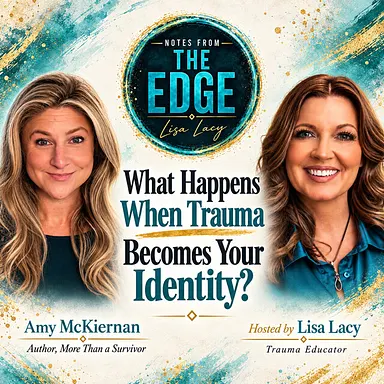
“What Happens When Trauma Becomes Your Identity? Sexual Assault, Trauma Healing, Reclaiming Your Power, Boundaries & Consent with Amy McKiernan” was turned into text by HappyScribe’s speech recognition. Related tool: Google Meet transcription.
Ads in this audio differ from the text. Tap the sentence you're hearing to follow along.
Synced: the text now follows the audio.
Welcome to Notes from the Edge, where we have the conversations we should have been having all along. We talk about the things that we're not talking about. I'm your host, Lisa Lacey, writer, trauma educator, executive advisor, and author of the upcoming memoir Notes from a Certified Madwoman. Welcome to The Edge. Hey, hey, my friends, welcome back to another episode of Notes from the Edge. I am your host, Lisa Lacey, and this is the place we have the conversations we should have been having all along. Guess what? You're not talking about it. So today we're gonna— and we have our special guest here, Amy McKiernan. Amy is an author, and she wrote the book More Than a Survivor. I love that because, man, we want to be way more than that. Eight keys to overcoming sexual assault and finding a path to living a fulfilled life. This was a deeply personal exploration of healing after sexual violence, drawing from her own experiences with sexual assault, including rape at fifteen. Amy spent 10 years bringing her story and healing process to. To the page. Her work focuses not only on surviving the trauma but on helping people go beyond that.
You guys, we don't want to get stuck in survival mode in this space. She wants to help people reclaim their power, agency, voice, and capacity to build a life that's authentic. Her book includes 8 keys for moving forward into healing, along with reflective journal prompts designed to help readers engage with their own experiences. She incorporates perspectives from members of her support system— that is key, have a support system— and creates resources not only for survivors but for the people that love, care about, and are in service to them. She has built a career in early childhood education and serves as the director of employee relations for 5 learning schools. While her work centers around communication, team building, problem solving, and creating supportive environments. She is a speaker. She's an author. She is here today. Amy, welcome to Notes from the Edge. How are you, my friend?
I'm doing great. Thank you so much, Lisa. It's a, it's a pleasure to be here.
Yeah, I'm excited about this conversation because this is one of those that we are not talking openly enough about. So a lot of people are, uh, being silenced or silencing themselves and suffering emotionally in that isolation. So what I love about your work is that you make it the clear delineation that there is an absolute difference between surviving and then getting your life back. So for you, when did the realization come that, man, I'm stuck in trauma survival mode and This is not the life that I want.
Yeah. So I think that's a really great question. And, you know, to be honest, it's not like, you know, as we like live with, with trauma and things that have happened to us, we, or at least in my experience, right, it's like you kind of go through life, not really realizing how much your trauma is affecting you.
Exactly.
And so it's like, you know, can I say honestly, it's not like one day I was sitting down like, hmm, man, my trauma is really dust. It's time, you know? Like, that's not how it was, right? It was like these— it kind of came in phases. And it wasn't even like in these phases, I still wasn't connecting it to my trauma. I think it was my work afterward, after like healing and kind of getting out of it, that I was like, oh, this is all tied together. And now I can see it clearly, right?
Yeah.
Um, and so for me, like, the survival and then the overcoming piece, it came in phases and in phases looked a lot like— I mean, for one, immediately after, I went straight to numbing. I went straight to this emptiness and this numbing with a lot of drugs and alcohol and just kind of navigating through life like that. And that was my coping mechanism. I didn't realize it. I was very much like, oh, I like to party. There's nothing wrong with that. So, so it came with like these, these little resets in life, right? The first reset was getting away from doing so many drugs. And that was a reset I didn't know that I needed. And that was with the help of getting in a lot of trouble. I was a teenager. I was always lying to my parents. I was out doing all sorts of things. This was before location and GPS on cell phones. So they were desperate. it. And they like ended up putting me on basically house arrest for 6 weeks. And that like forced me to be sober for a while. And I would love to tell you that that was the reset I needed to turn it all around.
It wasn't. It— did it help me stop doing drugs so much? Yes. Did a lot of other things happen after that? Yes. I still experienced another rape. I still had some pretty terrible things happen. But it was like one step closer to some clarity. And then like as I went on the path, I'm doing some healing. I'm in therapy. I'm still struggling a lot. And it wasn't until I was in my 20s and I became pregnant with my son that— That was like, I was living more sober. I was in— I was going to school. I was, you know, living. I was surviving. I was living. Um, I was in a really toxic relationship, and that's where a lot of my trauma would come out, was, was how I handled relationships, um, and what I accepted for myself.
Um, that's a big one.
Yeah, yeah. That was like the driving factor. It was just like the self-love piece for me wasn't there. And so I accepted a lot of poor treatment because I didn't think I would ever get anything other than that.
Yeah.
It kind of became my lot in life to be this person that people just, you know, used and abused and tossed away. So I clung on to any love that was given even if it wasn't, you know, what I deserved. And so I was in this toxic relationship and I became pregnant. And that was one of the bigger turning points for me. Because once that baby came, I had this other person outside of myself to care for. And when the relationship continued on with the cheating and, you know, the poor treatment, it was like this— it like hit me of like, what kind of example am I setting for my son?
Hmm.
I want my son to treat women better than this. I want him to know what a loving relationship is, but how am I going to do that if I'm not in one myself?
Yeah.
And, and so I really made a change for him, which ended up being a change for me. And that was like this turning point of being 20 and having this baby, finally getting out of this toxic relationship that I was in, moving back home with my parents, um, becoming a single mom, focusing on school. And like, that was the— it was like just this pivotal point in my life. And again, I didn't, I didn't link it to my trauma at the time. It's not like I was like, oh, this is definitely stemming from all of the things I went through.
I don't know that we have those kind of lightning moments of clarity where the, you know, bush lights on fire.
Look back now.
Yes. You look back and you go, aha, aha. You have the aha moments 20 years later. Yes. Yes.
Exactly. So like, you know, that— but I did begin to choose myself finally.
Oh, right.
And that was so empowering. And that— it was like it started this whole new path in life for me of choosing myself, accepting, realizing and accepting my value, right? Like we can, we can know that we're valuable, but like refuse to accept it. for a long time, you know, and accepting my own value, finding my confidence again, finding my spark for like life and my career and just all of the things again, and just becoming this like healthier, confident version of myself. You know, and it was, it was having that baby, that baby, you know, my— I tell my son all the time, like, I needed him in so many ways. And he saved me in so many ways. Because it was that push that I needed to finally start Putting myself first too. And looking at myself as this worthy person. Um, and, and so, yeah, you know, it was like a lot of little different things. That was definitely one of the bigger ones. Um, and again, it wasn't like I connected it at the time. Um, one thing that I think is, is special about the keys in my book is that I help others make those connections, I think, earlier than I did, right?
It's like—
Isn't that the goal, guys?
We want you to have an easier ride. It took us way too long. It sucked. It sucked.
Yeah. Like, it's a guiding—
if you listen, right?
Like, you could start kind of making these connections for yourself sooner, and then you're like, oh, wow, this is impacting. Like, it really drives the ship. I mean, it steers your ship, you know what I mean? It is like in control of your life and your path.
Oh, if you're not conscious of it. Oh, yeah. It's doing it all. You're on autopilot with it. Yeah.
And then once you like finally realize that, you're like, oh my gosh, it's here. It's here. It's in my career. It's, it's everywhere. And it's, and it's just so powerful. And it has this chokehold over you. And you don't even know. So, um, yeah, I think I kind of bopped around there. But that was an excellent answer.
There's, there's, there wasn't one pivotal moment. It was a bunch of baby steps combined together that got you to where you are. The next right choice is, as we like to say. So you were assaulted at 15. and at such a young and tender age. And it took 10 years to actually get this book out and written. So what happened to your identity when something so traumatic happened, when you were still trying to figure out who the heck you were?
Yeah, yeah. And that's a, that's a great question because, you know, my first rape was at 15. I had a couple— I had other experiences before then. and then I had other experiences after that.
Mm-hmm.
Um, and I'm— I was still growing. I was still figuring out, you know, um, my identity and who I was. And, and those are such crucial times in, in a young person's life where they are kind of finding their way and, and learning about themselves. And so when these things happen to me, you know, I think when trauma happens at young ages, it, it like intertwines with your identity. It becomes, at least for me, it became my identity. So instead of that path of a young teen, like, figuring out who she was, I automatically became the girl who was raped. Um, you know, at 15, it went around my school. Everyone knew about it.
Oh, wow.
And like, that's, that's who the— that people literally referred to me as, like, oh, that's the girl. That's the girl who was raped. And so like, It just became who I was. And so I like lost that kind of experience of, you know, truly finding, finding yourself in high school, right? Like that experience that we want for all kids.
Yeah, yeah, the innocence. Yeah. Yes. By the way, I'm not sure why my dog is barking. I think somebody's delivering a package. We will cut that out, guys. I hope. This is what happens on lives. Poppy, my husband is gone. She might be going crazy because of that. So, but what I love that you pointed out is that it's almost like your identity was thrown upon you. You didn't get to choose it, right? Yes.
Yeah, that's certainly how it felt. And, and so it just, it like was all-consuming. Um, and it's literally like how I just navigated every day is this like new person and, and everyone knew. And, um, and this was before social media, so I can't even imagine now, right? So tough.
Yeah.
And so like everyone knew it was, um, there were 2 stories going around, you know, mine and then his. You know, he obviously was saying that I was lying about it and, and, you know, people took sides. Um, you know, I had either people calling me a whore that I never even met or giving me a hug. And I didn't even know who they were. And neither of those things helped, right?
Right.
Because I just wanted to not be seen. You know, I went from being a kid who was in drama classes and theater and doing school plays, who like enjoyed the spotlight, to like not even wanting to be seen. I couldn't even finish my theater class and do the final project because I couldn't take people looking at me, you know, and watching me. And, and so it, it just became all-consuming. I identified as, as broken and damaged. And, and as life happened and more things happened, that identity became stronger. You know, I became— that was like my lot in life. That's literally how I viewed myself. Like, well, when something else happened, it was just like, well, I mean, what do you expect?
Yeah.
This is who I am for the world. Like, this will always happen to me.
Oh girl, that's a heavy load. That is heavy.
It is. And so it was dark for a long time there. And, you know, I think a lot of people struggle with that when they, when they experience trauma, especially at a young age when you're still developing kind of and getting that sense of self and all of that.
Yes. And I think a lot of times I don't think statistics around sexual assault are real. I am 50 years old and I haven't yet to meet one woman who does not have at least one violation story in her life. And most of us will just try to push through and keep going and not say a word. So your book is built around 8 keys to overcome sexual assault. And guys, we're using the word sexual assault. We're not saying SA. That drives me insane because it silences the people who have been through it. Are there particular parts of healing that you think survivors misunderstand? Or here's a better one, try to rush when it comes to healing?
I think I love this question, and I could probably go— I could probably talk for an hour on just that.
All of it.
All of it. Right. It's like, I think I think we misunderstand what healing actually looks like. I think that we think healing is like an immediate thing. I'm healed, right? It's like, I'm healed. It's done.
Yay, I did it. The destination has been reached.
Yes. There is no end to healing. I think that we're constantly healing. It ebbs and flows. There's some days that are so strong. And then there's some days where you literally feel like you're back at the beginning. And you did nothing. And those days are hard. And those days are hard.
That's a great way to put it. Some days you feel like you're back at the beginning.
And with those days, what you'll notice though, like if you're continuing to do the work and push through and chip away, right? It's a very, it's a slow process and you chip away. You'll notice that those harder days, you bounce back a little easier. Or you'll notice—
And quicker, right? So something that tanked you for like a month, Takes you for 2 weeks.
Slowly but surely, yes, the triggers become less debilitating, right? And it's like, that's where the growth is. That's where the healing is. It's not about— and I think that the other piece is that people think that you have to like forget or not talk about it or just like, like, I'm healed if I don't think or talk about what happened, you know? And it's like, I paint a lot of pictures in my book. Like, I'm a very visual person, and I talk about, like, viewing your mind like it's a closet, right? And your, your trauma, that story with all the pain and identity that comes with it, it's like that pain and those identifying factors are all, like, just woven into the fabric of this, like, sweater that's hanging in your closet. And that sweater, it's like it becomes your comfort item. It's that sweater that you wear every day, and it's like almost like you don't feel normal without it because that's literally who you are now, right? And you don't— sometimes you don't even take it off, right? And people know you by that sweater. You know yourself by that sweater. You become the identity.
And, and that sweater is heavy, and it's not—
And it's old and it's worn out and it's— And it's just—
but you wear it every day and it doesn't make you feel good. But it's comfortable.
Not even your color. Right.
It's not even your color and it's itchy material and it's terrible, but you cannot not put it on. And it's like instead of viewing as healing and being healthy is destroying it or crumpling it in a ball and throwing in the back of your closet and never looking at it again, you think of it as taking care of it, right? You take— you carefully take that sweater off. You put it away. You put it away safely and with care because healing doesn't mean forgetting. Healing doesn't erase what happened. What it does is it gives you a healthier relationship with what happened. It makes it so that you put that story, you put that sweater away in a box in your closet where it's accessible.
Yeah.
And when you need to, you take that box down and you be with your story.
Yeah.
And then you put it back again. You're not wearing it every day. You don't need it to weigh on you every day. You take it out when you want to think about it and talk about it or whatever, deal with it.
Process it.
Yeah. And then you put it back. And there it is in your closet in a safe, healthy place. It is not something you're carrying with you every single day. It's having a healthier relationship. And I think that that's where people get confused as to like, what does healing look like? It means like, oh, I don't even talk about it anymore. Nope. It's like, I'm good.
I'm good.
I'm fine. All right. It's like, well, that's, that's not what it is though.
You know?
It's okay.
Yeah.
It's probably attached to your back and you don't even realize it. You know, it's like underneath your shirt. Yeah. Yeah. So, you know, it's, it's definitely, it's, it's having a healthier relationship. It's not letting what happened to you define you.
Exactly.
It's having a healthier relationship with you, with yourself, and with, with what happened to you. And it's, and it's identifying as the strength and power that comes from these things.
Yeah.
You know, because there's always strength and power.
Yeah.
It doesn't always feel like it, but there is. Right. And so like, it's, it's getting to choose what you want to identify as from it.
I think that's what it becomes. It becomes, it has to become at some point you getting out of autopilot. And making conscious choices for yourself, because our choice was taken away, right? Yes. So we get to take that back. Yes.
And I talk a lot about that, the power of choice, and that power when you do get to take your— have your choices back. It's amazing. It's amazing. And we often go through life like we've lost that power forever, and we didn't. We actually didn't.
And we get to choose our partners, guys. We get to choose who we're with and how they treat us.
And when you realize— Yeah, exactly. And when you realize that you get that power back of, of your choices and where you want your life to go and how you want things to look for yourself, especially when your choice was taken from you. And it wasn't just taken, it was ripped, right? And it left a gaping hole, you know. But not addressing that gaping hole, that it's going to forever be there, it's not going to heal properly. And it's Gonna be infected with all sorts of things. Yes.
And you're gonna bleed on other people. It's gonna show up at work.
It always does.
With your kiddos, it's gonna show up. So absolutely. So you reached out after hearing, um, our conversation here on the show about mental health diagnoses becoming identities or prisons. Guys, it was a solo episode that I did. I'll be sure to link that here. Particularly because of your experience with your son. So we're going to kind of switch gears a little bit. Guys, definitely grab the book if— even if you haven't. Actually, if you're a woman, grab her book. I'm just going to leave it at that because we've already talked about I don't believe statistics one little bit. So how has being a trauma survivor and a mother changed the way you think about labels? Because, right, you were labeled in high school. Um, diagnoses, behavior, human beings that are struggling— how has your experience and your experience with your son changed the way you look at humans and human suffering?
Yeah, that's a, that's a great question. That's so applicable because, like, my whole— the way I just live my life is very much we can overcome hard things. And, you know, hard things, they don't define us. And so, you know, I 100% believe that my experience and my journey helped me be the mom that I am today for my son and my daughter. And with his mental health crisis that we were hit with 6 years ago, you know, it rocked us. And I related so— that episode, it like It was like you were speaking to me. I actually sent it to him because a lot of what you talked about, like even the diagnoses and things, like very familiar and having a lot of them at the same time, very familiar. It's like, which disorder do we pick today?
Exactly. And how many can you possibly have?
Absolutely. And so, and that was, you know, that's, that's, that was life. It was confusing and it still is, but we're in a much better place because, you know, my approach is that we can get a handle on this. Absolutely.
Right?
It doesn't mean— this isn't who you are. Your trauma and your trials, that doesn't define you as a human. And everyone has the capability of getting a hold on it and still steering the ship, right? And that— it might look different, reality might look different, and there's this acceptance piece Of, okay, there is an acceptance piece, right?
I may have to manage this.
Yeah, this is going to be harder in, in these ways than I thought. And maybe the path isn't going to go that way, it's going to go this way. But there's still a path and there's still choice there. And so, you know, the approach of we just— let's understand what we're dealing with, let's figure this out. Um, we can do this. There is hope and there is always overcoming for everyone. And so You know, my son's an overcomer in so many ways too. And, and he is— I mean, his path has been very challenging and at times have felt hopeless and like, I don't know, I don't know, I just don't know. But you know what? We've stuck with it every step of the way. We've brought understanding. We've— I've researched, I've read, I've, I've just, you know, been that support for him of like, you got this. Yeah, I know it doesn't feel like that right now.
Sometimes that's all we need to hear.
Yeah.
Without somebody sitting there holding space without judgment, just saying, I've got your back, I've got your back, and you've got this. So I want to talk about agency, right? Agency, autonomy. Again, that goes back to the choice, right? Because trauma can steal way more than our physical safety. And I loved this description you had of just this, this, this gaping hole kind of in our soul even, right? It can change trust, it changes our relationship choices, it changes our sexuality, decision-making boundaries, how safe we feel in our own bodies. That's a lot to change. So what does reclaiming agency look like in daily life, in practice, in those baby steps?
Yeah, yeah, another like great question. And I think, you know, it kind of— it goes back to like choices and power, right? I think it looks like reclaiming your power and your choices in your life, you know. Um, when you realize that you can make decisions for yourself again and you are actually making decisions for yourself again and you're setting Boundaries, or you're, you're choosing a different type of relationship, or to end a certain relationship, or even just making choices of what you're not going to put in your body anymore.
Yeah, that's a good place to start. That's right. Like, you're like, start no more sugar.
Yes, like something healthy, right? Like, I'm— you know what, I'm gonna go for a walk today. Yeah, I feel like utter crap and I want to just Be in a ball and, and stay in bed all day. I'm just gonna step outside and I'm gonna go for a walk. And that's— you're taking back your power by making these little choices. And that's what it all boils down to, is making choices. Yes. And then those choices become bigger. And, and so I think that it just does. It looks like baby steps and like these small little victories.
Yeah.
And, and then they become bigger. And then your path becomes clearer and you're kind of going down it every day without even thinking twice, you know. And so like—
Because you have a new default. You eventually have a new operating system where—
Yeah, it's like natural instead of like you're feeling like you're plowing this road every day and now you're just like driving down.
It's like my depression walk. I'm going to take my depression walk. I was so mad at the walk, you know. I still did it, but I was mad at it for a little while.
So even if you got to be mad at it, be mad at it, but go do it.
Okay. So, Amy, somebody's listening today and they're catching this episode and they have survived something devastating and they cannot imagine right now in the moment they're in feeling whole again, like you described where you were. No inspirational speech. What's one tiny thing they can do to move from— remember, guys, we want to get out of survival mode because it's what kept us alive. It's what got us through. It's what got us to today. But I promise you, there is way more than that. Amy, how can people get to this life belongs to me?
I think that when— I mean, I understand, right? I understand that it can feel way too big, right? I understand that boulder that feels like it's in front of you and you're like, you want me to chip away with this little tiny—
Spoon.
You're expecting me to do that? Really? And I get it, right? It feels unattainable when you're so in it. And I think that it really— and I feel like I've said this a couple times, but it really— what is the next small choice that you can make for yourself right now, right? Like, if you're listening, you're listening, you're choosing to listen, you haven't turned it off yet, right?
Which is a good choice. We like that.
You're choosing that. We like that choice. What do you— what can you do next, right? And it can be— and you don't need to go and, you know, heal, right? What— but what can you do next? Is it reaching out to that one safe person and telling them that you're stuck and you need help? Is it Getting down a piece of paper and just writing it down, right? There's so much— like, get it out of your brain, get it out of your body, put it on a piece of paper. Just write, just write whatever's jumbled up in your brain right now. Write it down.
Yeah.
That's one small choice right there. Is it choosing not to have that drink tonight because that's your go-to and you just have that and that's what makes you numb it and feel better?
Yeah.
Is it going for that walk? Is it setting that boundary, going to the therapist? Is it calling a hotline? Right? Like, there are so many smaller and bigger choices that we can make. And when you're feeling stuck and lost and like, I just can't do this, you just focus on the next small step. It's literally one step at a time.
You always feel better once you do the thing.
Oh, absolutely.
Every time you do the thing that you didn't want to do, you're like, ah, I feel better. I feel better after doing it. Well, Amy, where can we find you? Where can we find the book?
Yes, so I am on social media. You can find me on Facebook and Instagram, LinkedIn, uh, pretty much everywhere. Um, I have a website, amymckiernan.com. You can also find all my links, uh, there. Um, you can buy my book on Amazon, uh, BookBaby Bookshop if you want to support independent authors. Um, oh, good idea. Yeah, search online for it. Um, I, you know, I have a copy right here just know what you're looking for. And I'll say the COVID is inspired by kintsugi, which is the Japanese art of repairing broken pottery. Uh, you take the broken pieces, you put them back together, and you fill the cracks with gold. And that piece is deemed more valuable and stronger and more beautiful than ever before. And that's what I want for anyone who's listening, is that you can become whole again. You— it will look different, but it will look more beautiful and more powerful than before, I promise you. Um, and so yeah, you can find it on Amazon, BookBaby Bookshop, online.
Um, you know, guys, we're gonna provide all those links for you. You don't even have to write it down. We're gonna make them clickable so that you can find her. All right, Amy, before we let you go, we always ask our guests 2 questions before we let them off the hook. Are you ready?
Sure.
All right, the first question is, in your own life, what did you perform in order to survive, and what did setting that role, mask, or performance down do for your life?
What did I perform? Um, I think I performed, um, you know, like in relationships just like an easygoing, accepting, like catering person, right? Like that was my performance is that I was like forgiving and like it would be— I could fix you and I could like, I can fix this, like even though it was completely not fixable and also not okay for me.
Mm-hmm.
This like acceptance and like forgiving fixer of a person. And when I put that down and set boundaries and stopped accepting things that I shouldn't be accepting in my life, that was actually, you know, the power, right? It's not this like mission to fix all that's broken when there, you know, you can't fix somebody who doesn't want to be fixed, right?
No.
People have to fix themselves. And so putting that down And, um, shifting gears to setting boundaries and being clear on what I'm accepting for myself was a game changer.
Ah, it is. What are you accepting for yourself, my friends? All right, last question, Amy. What do you want us to be talking more about? What human conversations should we be having that we're not having?
Oh, I love that because I want us to be talking about What consent actually means. I want us to be talking about what it means to cross lines. So that's part of the work that I do with Campus Outreach Services and Take Back the Night is we do educational programs, these really great I Said, You Said educational programs where, like, we're really laying it out there of like, this is actually what it means to be when someone's incapacitated. And did you know that when you're incapacitated, due to drugs or alcohol, you cannot give consent even if you say the word yes. Did you know that?
Yeah.
Because a lot of people don't know that. And so I think talking more about what it means to be incapacitated and what it looks like and that education for young people of, you know, crossing those boundaries and the laws behind it and rights and consent and just human decency. And holding people accountable for human decency. Please, more of that. Let's talk about that.
More humane behavior. Stop being assholes, guys.
That too.
That too.
Yeah, yeah, that's what we need to do more of. Great answer.
All right, my friends out there listening today, I'm gonna ask you the same question I asked Amy. What are you performing in order to survive? And what might happen in your life if you set that role, mask, or performance down? May it lighten your load just a little bit. I am your host, Lisa Lacey, here with my beautiful guest, Amy McKiernan. And when you find the answer to that, we will both see you at the edge. Amy, thank you so much.
Thank you for having me.
It was an honor.
What happens when something that happened to you starts defining who you are?In this episode of Notes From the Edge, Lisa Lacy sits down with author and survivor advocate Amy McKiernan for a raw conversation about sexual assault, trauma, identity, addiction, boundaries, consent, and rebuilding a life beyond survival.Amy shares how being raped at fifteen shaped her identity, relationships, coping mechanisms, and sense of self-worth. She and Lisa explore numbing through drugs and alcohol, toxic relationships, motherhood, mental health labels, and the long process of reclaiming agency after choice has been taken away.They also talk about why healing is not linear, how small choices can become acts of recovery, and why trauma can remain part of your story without remaining in control of your life.In this episode:• Sexual assault and trauma identity• Addiction and emotional numbing• Boundaries, self-worth, and toxic relationships• Healing that is messy and nonlinear• Mental health labels and identity• Consent, intoxication, and accountability• Reclaiming agency and choosing yourselfConnect with Amy McKiernan:https://amymckiernan.comConnect with Lisa Lacy:https://www.lisalacy.comWhat did you perform in order to survive?Welcome to the Edge.See Privacy Policy at https://art19.com/privacy and California Privacy Notice at https://art19.com/privacy#do-not-sell-my-info.