
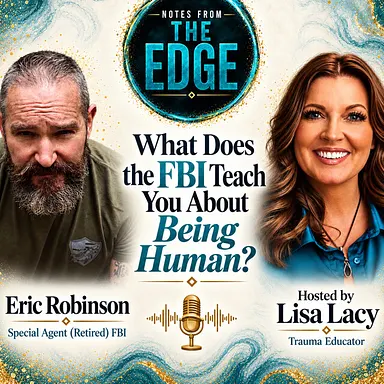
This transcript of “What Does the FBI Teach You About Being Human? From Pastor to FBI: Faith, Trauma, Survival & Human Behavior with Eric Robinson” from Notes from the Edge was made with HappyScribe’s speech-to-text technology. Related: AI notetaker.
Ads in this audio differ from the text. Tap the sentence you're hearing to follow along.
Synced: the text now follows the audio.
Welcome to Notes from the Edge, where we have the conversations we should have been having all along. We talk about the things that we're not talking about. I'm your host, Lisa Lacey, writer, trauma educator, executive advisor, and author of the upcoming memoir Notes from a Certified Madwoman. Welcome to The Edge. My friends, welcome back to another episode of Notes from the Edge. I am your host, Lisa Lacey, and this is the place we're having the conversations that we should have been having all along. Guess what? You're not talking about it, so we're gonna. And today's guest is Eric Robinson, and Eric has a pretty amazing nonlinear path to get to where he is helping people today. He recently retired after 24 years as a special agent with the Federal Bureau of Investigation. During his FBI career, he worked across a wide range of investigations, including white-collar and financial crimes, counterterrorism, crime against children, gangs, drugs, political corruption, civil rights violations, and national security. He spent 15 years as a SWAT operator and also served as a firearms and tactics instructor. His work included human intelligence— we love that in here— recruiting and developing informants, interrogating terrorism subjects, and working directly with victims and individuals involved in some of the most difficult circumstances that you can encounter.
2 of his investigations received Attorney General's Awards. Now here's the interesting part. Before entering the FBI, Eric spent 12 years in the Christian ministry, including serving as pastor of the Baptist Church in Western New York. That background is what gave him an unusual perspective on human behavior, trust, and communication that followed him into federal investigations. He has spoken about principles learned through ministry to recruiting informants, interviewing people, and navigating the deeply interesting part of simply being human. He is now preparing for the release of his very first book, which chronicles his very unlikely journey from the pulpit to the FBI, and he shares humorous, surprising, as well as difficult and intriguing experiences from his career. Eric, welcome to Notes from the Edge, my friend. How are you today?
I'm, I'm always better when people say glowing things about me, so doing good. Start my day— I, I recall record these and then I just play them back when I wake up in the morning. Like, Eric, you're such a great guy and you've done wonderful things.
It sounds better coming from someone else. It's so much easier. Yeah, it's so much easier when somebody says it. So, um, we're always interested in what led you to how you help people today, which is going to be, uh, through your book, um, that is releasing soon. Um, so talk to us about that transition period. How the heck Do you go from the ministry into the FBI? How does that happen?
Short answer is I was looking for a job with less stress.
Okay, fair enough.
And what's crazy is when I talk to people who have worked in churches, I get, I get a different response, which is—
I get it.
So I had very few guns pointed at me in, while I was a pastor. But the issues that people brought to me that were normal as a pastor, I found myself incapable of separating their burdens from being mine. And it was normal stuff. I lacked a group of men around me who could work through those things with me, how I was feeling and how the stress affected me. And the way that the stress did affect me was I had headaches every single day for 2 years. And it was because of just dealing with people. And the reason I know this for a fact is because the day I was accepted in the FBI and they gave my conditional acceptance, headaches stopped.
So— Whoa! Wow!
I went from a place where I felt accountable for people, that their livelihood and their welfare in some ways depended upon me, to a place where I I could work cases. I could find criminals. I could be successful, get the job done, and then just move on. And the victims that I saw weren't my responsibility.
Yeah, I can, I can see that being a, uh, a very heavy burden. My, my, uh, first husband was a pastor— story for another day, my friend. So less stress. I love the answer. I love the answer. So, but I will say this, ministry and FBI actually sound like Completely opposite ends of the spectrum, but they do require people to trust you enough to tell the truth about what is happening. So what did being a pastor do to prepare you for the FBI?
Well, so I came into the FBI, I had never handled a gun. I didn't— I mean, I knew about law enforcement as much as you know about law enforcement. And so I, I was learning how to manage cases and then learning about this storied agency that was 100 years old in the FBI, and trying to take all that in, which I did along the way. But I'm next to former military, former police, even former support staff in the FBI in my class. But then when I got out in the field, now I had the advantage, because I had spent 12 years learning how to listen to people and connect with them. As you said, making them feel safe when victims were speaking with me. or informants I was tasking, they had to feel like I was looking out for them. And then even with, even with the criminals, of making them feel comfortable enough in a moment to tell me things that were against their better judgment. This was not to their advantage, but I could find ways to break through. And though different from the ministry now, I'm being manipulative, but it's for the better of the community, getting getting through to them and having them make admissions and confessions to me.
Yeah, you know, you brought up something earlier and I want to circle back to it because I think it's so pivotal for all of us— males, females, men, women alike— and that's having mentorship. You said when you were in ministry it was kind of you and you, and in the FBI, uh, you had mentioned, you know, having a team of men support underneath you. I am a big advocate for always having mentorship. mentorship, that it is somebody that has something that you want, a life that you want, a skill that you want, a quality that you want. How important was mentorship to you, which sounds like it would have been new for you as opposed to the ministry? How important was that, having people that have your back and inspire, uplift, support, and advise you when asked?
Yeah, it, it was very important for my well-being. So even though, you know, obviously, there were stressful times in the FBI, I had whatever, whoever I could turn to. I had a dozen, 15, 20 people I could turn to who understood what I was going through or what I experienced, because they were either there themselves or they knew, they understood that. So they spoke my language. And that wasn't new, because obviously, built into the church is discipleship and mentoring.
Yeah.
But I was foolish. I was a little young. I didn't— looking back, I knew— know now that if I were to do this again, I'd get a small group of men that I could turn to who'd be non-judgmental, that I can just say whatever I need to. I didn't have that. I was the sole pastor.
Mm-hmm.
I, I had no one else that I felt comfortable turning to. But the issue was just Now, I had many people, and whatever I had encountered, we could talk about it. And, and they got it. They were wading in the same water I was. And so that, I think, did a lot to alleviate any of those traumas or the effects of them, and just allowed us to work through those issues, because we've all been there.
Yeah.
And it didn't mean, it didn't mean putting your head on somebody's shoulder, but it just meant bringing it out in the open.
Yeah, yeah. And to know that you're not alone and that you're not crazy, you're not losing your mind, and it's all very, well, appropriate— we won't use the word normal— appropriate for your circumstance to be, to be struggling. So yeah, I'm a big advocate of finding mentorship. And my friends out there, you know me, I'm gonna say it: if you feel like you may possibly be struggling find and seek support, ask for help. And that's the hard part sometimes. Sometimes we don't even know we need it. And then when we do realize, wow, I might be struggling a little bit, it's because there's so much stigma and shame attached to asking for support. So be sure to ask for support. So you spent, Eric, 15 years on SWAT and worked in counterterrorism, crimes against children, civil rights cases, and some really dark investigations. And we talk a lot in here, a lot of our focus is on trauma and what trauma can do to the victims. What does repeatedly witnessing some of the worst things human beings can do to another do to kind of change your perspective, not only about perpetrators, but more importantly about the good humans that exist in the world.
Well, I found that it expanded my view of who humans can be and who they are, and, and that can include the bad things. But having an understanding of that, just it— when you hear about sex offenders and it's not someone you're interacting with, then they are monsters. They are an idea. When I am now engaging with this person, I, I've looked into their life. I, I know this is a son; they've got family. It, it makes it human. And so now I can see that, OK, this is something that a human can do. And it's awful; it's egregious. But now it expands that, that concept of, okay, who does God love? Well, he loves these people too. These are people he created. These are people who are struggling. Same with the victims. You know, my dad used to tell me when I worked in the church, like, you know, hey son, you're, you're sheltered here. Like, your ideas are great, but there's a lot to the world. And then I get in the FBI and like, well, look at that, the old man was right. That, you know, people with a common mindset look like me, come from my background too.
Okay, we're all gathering together to talk about our lives, and they're all pretty much the same. Now, when I'm working with a runaway teen who's a prostitute at 15, well, that's something brand new. And I'm seeing what they've gone through in their life to bring them there. I'm seeing the pimps who are 27 years old and are now preying upon them. Mm-hmm. Getting their mindset of how they can excuse this. It's— there's so much involved there. The gang members in Chicago or the high-volume drug dealers, like, what's their mindset? What brings a person to here? And how do they allow for this to continue in their lives? And many times I saw the reasons for that. It didn't excuse it. We're still going to charge them. But it now made the world make more sense. And I think when you see that, it, for me, the effect was, oh, I have a better concept of what humanity is like and what they're capable of.
I love that. It humanizes everybody, even though they will still serve the consequences of said actions. But it humanizes everybody. And I, I loved the word you use, expand, because it is expansion of a perspective. And anytime we're willing to expand our perspective, I think we have a little bit easier of a ride on this journey, don't you? Especially for trauma survivors, if we can learn to expand our perspective a little bit.
Well, yes. And, and I can remember the exact occasion I— this came to me. And it wasn't too long in my bureau career that, you know, I'd gotten up at, you know, 2 in the morning or something, preparing for an arrest. We're going through this. I'm tired. I'm hungry. We're doing a search. And then I realized, oh, yeah, but I can eat breakfast later and take a nap. This is the worst day of that person's life.
Hmm.
Which, they deserve it. They, you know, they committed a crime. But it, it just gives me an— a look at, stop, you know, stop thinking about myself. Like, now I'm recognizing, oh, this is horrible for them. This is, this is the lowest point. But then it also allowed me to use that to better the community because I'm going to use that against the criminals because then after time, I realized this is your lowest point. I'm going to reach out to you and I'm going to help you through this because very few people we encountered, many of them hadn't been arrested before. Most of them had not been arrested by a federal agency. So this is unfamiliar. This is difficult, but I've been there. So I can guide you through. I'm going to help you through what's next, what you need to do. And I can do that treating them with humanity and some compassion too, so that now they're going to connect with me and they're going to, they're going to grasp onto that because the moment that we're talking is most important to them. This moment right here, the future when you have to see a judge and talk to an attorney about that, it pales to the cognitive dissonance that's going on right now, the, the panic that they have.
Yeah, if I can soothe that, they, they feel like they owe me. And there is a connection there, and, and I am truly helping them. But it's also to the advantage of the American public to say, look, I'm gonna, I'm gonna help you, but also you're going to end up damning yourself by the things that you tell me.
Yeah, yeah. Well, what I love about your approach— and I've been caught up in the system and in the system, in said system, I saw very little, uh, humanity, uh, compassion being extended. And so I— and I see that changing now, um, especially when it relates to, uh, mental health, mental illness, and criminality. Um, so it's so lovely to hear that, yes, you will suffer the consequences of, of said actions, but I'm still going to treat you like a human being. So that's refreshing to hear, and it's refreshing to see changes taking place in that arena. So—
I can play bad cop; that's easy. But, but it's just like when you call Verizon to complain about something. If you start out, like, at this level with the person on the phone, like, where do you go, where do you go from here? So, you know, you start off—
Guys, he's got his hand raised above his head. He's like, start at the very top!
Yeah. So I can only, like, if you're going to be an ass to me, well, I can match you. I'm gonna give you a couple because this is a bad time. But, you know, if we start at a professional level, then I can raise it if need be. But I found so many times, and it wasn't just me, it's, it's my colleagues, We'd have people thank us for being professional because their interactions are the ones that you had experienced where they're being treated poorly. You know, you wake up a guy at 6 in the morning and he's like, you know, here he is in handcuffs. You've cleared the house and he's like, hey man, can I do my business? You're like, yeah, you know, you, you've been, let's, let's go ahead and take care of that. As opposed to where they might be told, you know, hey, just piss yourself. You know, that's your problem, not mine. Well, That kind of sucks.
Well, and I love your non-judgmental approach to it. And, um, I would assume that that would carry over into— we're a big fan of talking about relationships, our personal relationships in our lives. But there is something so special about being surrounded by people who are supportive, inspiring, but most importantly, non-judgmental and can sit in a non-judgmental space and hold space for you. So how have your experiences deepened the bonds you have in staying present with the people that you love, care about and serve in your immediate circle?
Well, it would be, it would be ridiculous if I'm offering grace to criminals, and then I come home and yell at the kids. So I'm just, I joke about this, but it's, it's also true. When, when I would go to a search warrant and you get into some of these houses. And I think, I don't even understand how people can live like this, you know, just throw trash on the floor and that's how it is. My first search warrant I was ever on, the first thought I had was like, a rag and water are very cheap. You can clean the place. And then I come home and hug the kids and tell them like, hey, sorry for being hard on you about cleaning your room. You're not so bad.
Yeah.
But you see some of these circumstances. So, you know, take a gang member in Chicago, for example. I did not grow up with wealth, but I had many opportunities. I went to college. I had a family that stayed together. I didn't have mental health or drug abuse in my family, or alcoholism. And, and now you have this teen who has fewer options than I did. He, he probably has those injuries in his family. He may not have his entire family. Like, you see now where those decisions make sense. I'm joining a gang because I want affiliation. Well, yeah, I had that with Cub Scouts or with my church or with the school. They don't have that. They may join a gang because they need protection from the violence that's out there. So It gives that acknowledgment that I grew up in a very, in the wealth of having options and having good things brought to me. So I need to appreciate that, maybe try to cultivate that where I can too.
I love that. Cultivate it where you can. Absolutely. The gratitude for it. So you recruited informants, interrogated people involved in some pretty serious crimes. What did that teach you? So fascinating. What did that teach you about the difference between— what did that teach you about human behavior the most?
It, what it taught me was very simple, and that people are going to act many times in the ways you expect them to, that The informants I recruited or the criminals I'm interrogating, they are going to respond the way you would expect people to. It wasn't anything special. For example, when I think about how I would interact with informants, there are some people who look at informants as a tool, like, hey, we're just going to use this guy and move on. Many of the informants I recruited were were just good citizens who had high-value information, could get us near somebody that we wanted information from or recordings on. And they were doing things that they didn't have to do.
Yeah.
And so I looked at them, and I would interact with them in the same way I might with my children, that if they needed to be praised, I'm going to make sure I praise them. If they needed to be told, I'm going to keep you safe in this way, I'm reaffirming that. So People respond to the common things that you would expect them to. And so there's not much magical about it. It is just remembering, this is a person; they have expectations and needs. They're going to perform at their highest when I fulfill them.
Hmm.
When, when this person knows I'm not going to put them in a dangerous position, or I'm going to let them know all the possible dangers here, then they can move forward and say, OK, I can evaluate this properly. It's not, they're not going to get stuck somewhere that they're going to get shot at when that was not in the calculus. So that's how I brought that in.
Yeah, it needs to be in the syllabus, guys. Put that one in the syllabus. And I loved what you said, people are going to perform their best when I fulfill them or fill them up. And that's across the board. That's Our inner circle, our second circle, our third circle, when we're interacting with humans. And we do start way up here, guys. My hand is above my head. You know, one thing I learned in martial arts training is aggression is going to meet aggression. You know, you cannot fight aggression with more aggression because it's just going to feed. It's like a beast and it feeds on itself. But you're absolutely right. And what a lovely perspective in that when you are filling them up, when you are fulfilling their needs, At that time, people are always gonna operate at their best and try to operate at their best for you. So, um, I appreciate that you approached human beings in that way. So in addition to all of that, you also worked with a lot of young people, um, involved in commercial sexual exploitation with victims across a multitude of very difficult cases. When you look beyond the crime into the circumstances in front of you, what did you begin to understand about survival and the paths that lead people into places that the rest of us are so quick to judge?
Well, Lisa, if you, if you'd allow me to be a little bit crass. Go for it. This is News From The Edge.
We want an explicit rating on this one. Go for it.
Oh, well, not in that way, but But if I were to ask you, Lisa, what would it take for you to, to today decide that you're going to have repeated sex with strange men who are probably disgusting too, for money? What type of a threshold is that for you to cross through? That, that's tremendous, right?
Yeah.
I mean, just the thought of that probably brings some type of small trauma, like to make you shudder. So here's 15, 16, early 20s women and girls who are already through that threshold. So what does it take for someone who's not even fully developed in their mind yet to try to deal with this? How does it— what does it take for them to already be through that? Well, they were probably pushed through it.
Mm-hmm.
They were initiated into that by someone else already. So now they have devalued that act of sex, or they are so desperate that that's something they're willing to do. And I doubt that you or I could imagine being in a place where the desperation is so deep that we go, yep, I think I'm going to engage in regular sexual activity with strangers who are defiled. That, that brings an understanding then of now what's going on in their lives and what brought them there. I had one young woman, she was in her early 20s, probably £100, and we had arrested her on a sting because we knew she was going to have information about a 15-year-old that we're trying to rescue. And after we had arrested her, we We literally could have charged her with human trafficking because she had assisted the young girl, but her motivation was just to help out. And we wanted to value finding the teenager above whatever we could do to this woman. So, you know, we cuff her up. I put her in my vehicle and I say, hey, it's about lunchtime. Are you hungry? Let's go get something to eat.
And so we then sat on my bumper, took her handcuffs off, And I'm now trying to reach out to her and build rapport. And at that time, she says to me, you know, my, my dad has molested me since I was 2 years old. Do you think that's why I do what I do? And I said, yeah, probably so.
And—
Mm-hmm. But that interaction that, you know, that gives insights. Like, this isn't, this isn't a dirty whore. This is a woman who feels like she's useless now through whatever now mental health issues that have come from that sexual abuse is to a place where she says, I have no skills, I have my body, you know, how else am I going to survive?
Yeah.
So that definitely gives you a reason to maybe set aside some of the aggravation that you have working with some of these victims and go, okay, I get why you're here.
Yeah, you know, it's interesting because you talked about the young, uh, young man who decides to join a gang, and you talk about the young woman who's sitting on the back of your car eating. You know, even though one is engaging in, uh, highly illegal destructive behavior, you know, not much difference. Some people don't see other options. because of their own traumas, and they certainly don't have people in their lives that they can look up to for help and support. So yeah, I would imagine that, um, hearing the backstory, right, context matters. Context matters. Talk to me about how context matters with a human being.
When you're engaged with victims who hate you because you're taking away their soulmate, like, you know, here's a girl, we arrest a pimp, He's the only adult in her life who's ever shown her love or value, and now they're spitting at me or slapping me. Like, okay, I'm gonna show some patience because you've been mesmerized by, by this man who knows how to take advantage of you. And also, you've been shown throughout your life there's never been an adult who has any value to you. Parents are probably drug addicted or have mental health problems or absent, abusive. I mean, there's so much that's been told by fact and by circumstance to these women, like there's no reason to trust police, they're out hunting you. And while I'm trying to tell them, no, no, no, no, I'm actually one of the good guys, I'm— I want to help you, um, I understand it's going to take time to get them away from this situation to break that spell. And, and your point is good that she feels like she has few options, and we would find success with them if there was somebody from an NGO, maybe had a charity or a mission, most likely a former prostitute in her mid-30s who says, hey, I've got a bed, I've got a place, I've got mentorship.
I can talk to you about how there are other options that you as a young girl can't see, but I'm here to tell you I've found those. And that's where the success happened most.
Oh, I just got chills. That's big work, my friend. That's big work. That's big work. So talk to us about the book that you have coming up. When do you feel like— I know how books are. I'm in the process of my memoir now. We just pushed the launch date up some because I'm adding another layer. When is your book going into presale?
It won't go into presale until— until it— it won't be in presale. It will be— we'll publish a number and then it'll be on demand. But coming out in October, the book is called Irreverent: From Saving Souls to Chasing Sinners and the FBI.
Oh, I love the title.
It tells the unlikely story of a Baptist pastor who's never handled a gun. And the 24 years he spent in the FBI working some remarkable cases along the way. So I tell— I was in the ministry because of who I was. I was in the FBI and that was the same person, but the Bureau drew out other talents and abilities that I wouldn't have had been able to see otherwise. And so now the guy who never shot a gun is a firearms instructor. The guy who was nothing special gets to be on a SWAT team. So those were unique opportunities, but the people I got to see and interacted with, I did as a man who was a pastor. And so I kept much of that along the way too. So it was, it, it was, uh, releasing for me to write it, to just get the stories out, and they came like a flood, just You know, here's one case, great. Next case, next ideas. And I remember the experience I felt when the Bureau said, yeah, come on board. And I thought, this is awesome. And I never lost that. And now looking back, I can look back and go, that, that was awesome, getting to do many of those things.
Yeah. Well, how did it change your confidence as, as a, as a, as a man, as a human, uh, working in the FBI? And, and again, having that support and mentorship that was provided for you throughout the whole process? How did it change your confidence as a human?
Well, when you get to face life-threatening situations and come through and see the competency that you can have, and then the men next to me having that same competency and the women on the team too, obviously, that gives you, that gives you confidence. So I, being on SWAT, I knew how to carry myself. I knew through firearms that I can take that shot and I'm gonna make it, and I wasn't the best shot on the team. So like, I feel comfortable for me. I feel great that these guys are next to me. And as we're doing tactics and the footwork is moving and guys are taking their places without a word, then I think there's nothing to be afraid of. And so when we would come to a house where we don't know if this criminal is going to oppose us violently, and that's a threat to our lives, there was no buzz in the back of my head that says, hey, Erik, you might die. You got to be careful. And because I had that clarity of not having fear and worry, then that opened things up to just do my job. And so I think the repetition of being in those experiences is going to have that effect of— Not invincibility, but just feeling confident that I can manage myself or whatever situation comes.
Talk to us about fear. Fear is the big stopper for a lot of us— fear of taking the next step, fear of getting out of our comfort zone, fear of having that gnawing inside of us to write the book, to find the mentor, to ask for support. Why do you feel like fear stops us so much?
Well, I think it ties into what I was saying So I like to think of Alex Honnold, who is a free climber. He, no ropes, just goes up the side of a mountain. I would have fear.
I don't like heights. I would have fear as well. Yes, yes.
That's not even, that's not encapsulating my feeling well. I would have fear doing what he does because I'm not competent at it. Because I don't, I haven't done that 1,000 times where I'd go, OK, I've done this. I'm successful. I've had enough training. If you grabbed Alex Honnold and said, here's a gun. I don't know if you know how to shoot, but here you go. You're No. 3 in the stack. We're going to go into this felon's house. I assume that he would have fear.
OK, fair point. Yes.
Because, because he's not competent at that. I mean, this man who does things I never could and would not because I'm afraid, would be afraid in, in my milieu because he hasn't had the training. And if you would have grabbed me from the pulpit and done that, put me in there, I probably would have been afraid too. So the competency and a repetition of knowing what you're capable of, I think, is something that takes away that fear. And now broaden it. When I was in the church and I was considering, what do I do? Like, I get headaches every day. I can't deal with this. Part of my reasoning for not leaving was fear. I wanted to continue doing ministry. I loved it. I was successful at it. But a large part is, what if I make the wrong choice? This is what I thought I was going to do for 50 years.
Yeah.
What if objectively leaving the pulpit is the wrong thing to do? And now looking back, 25 years later, I can see, even if it was the wrong choice, I'll bounce back.
Yeah.
So when we go through those traumas, and we go through difficulties, and we make wrong decisions, the fear shouldn't be there, because nothing has defeated me to this point. None of the wrong decisions I've made have defeated me. I'll just recenter, correct, and my life might be different, but I'm still going to be moving forward.
I love that. I love that. And we recently had a guest on that told us the original meaning of the word sin— I love this— was just missing the mark, right? So if you miss the mark, you just take a deep breath and you recenter like you just said, and you try again. But it's in the trying that we get what you stated, and it was practice. The word daily practice. We, we it is helpful for us to practice moving through those fears. You know, for me, I, I escaped in a bottle for 20 years, and when I finally turned to face everything I was running from, I was like, what the hell, this isn't that bad. And actually, it eventually became a lot of fun. So absolutely, daily practice of moving through those fears, and get training, get mentorship, get support underneath you. So, all right, my friend, where can we find the book that will be available come October?
Well, right now you can find the book on my computer only. Uh, the Bureau is still reviewing, and—
We are not hacking into your computer, my friend.
I appreciate that. Uh, but if people want to follow along to see, oh, okay, that sounds like an interesting book, they can go to my website, which is preacher to breacher.com.
I love it, I love it, guys. You do not have to write that down. There will be a clickable link right here at the bottom of this episode where you can either copy and paste it or click, uh, directly depending on which platform you're using. Now, Eric, we don't let any of our guests go without asking a couple of questions. Are you ready for them?
I'm ready.
All right, first one is this: in your own life What did you perform in order to just survive? And what did dropping that role, mask, or performance do to improve your life?
Yeah, that, that one's easy. You know, I say I left the ministry because of the stress, and part of that stress too was believing I had to be perfect. That— and, and I know it was self-imposed, but You have to admit, there's a, there's a kernel of truth that people in the church expect their pastor to not have problems. And me emphasizing that made that I had to have a mask. I didn't have to— I have to be sunny. I have to always be happy to see people. And so part of the stress was me being on point all the time. When I went to the FBI, I didn't have to be perfect. I just had to be a good agent and do what I could. So that relieved a lot of stress. So what did that, dropping that mask do? It stopped the headaches. The day I got accepted, I remember thinking, the day I got into the FBI, I don't have to do this anymore. I don't have to be that person. And that was very relieving.
Yeah, that's a lot of pressure. It's a lot of pressure. All right, Eric, what do you wish— second question— what do you wish we were having conversations more about? What do we need to be talking more about that we are not talking about?
Being kind.
Mm-hmm.
I, I find that we have opinions, and we read the headlines, and we talk about topics. And yet, if we are exposed to those topics in human form, it often breaks it into reality. So The idea of this political notion or that one, you know, these people are terrible, they're monsters. But if we're exposed to them as actual people, now it's less of an idea and more of a person. So some of that is being curious. So honestly wondering, why do you feel this way? And hearing more. If you tell me about some political issue that I disagree with, but I I want to hear more. Maybe I learn, like, there's a very good reason for that. I can still disagree, but that makes sense for you. So rather than coming to a conclusion of saying, this is right and you're wrong, if I can open up and just hear what you have to say, that is going to allow me to treat you with more kindness. And throughout my time in life and in the Bureau, I never looked back and said, damn it, I shouldn't have been curious. That was a mistake.
I love that. Be kind to be curious. And I loved what you said. You know what? That makes sense for you. It's great.
Well, well, you know, try to argue with me about that. I don't think— Exactly.
It's beautiful. It's like, that makes sense for you. Not for me, but for you. And we can always agree to disagree, but We love the word curiosity in here. Well, my friends, I'm going to ask you guys the same question I asked Eric. What in your life might you be performing in order to survive? And what may dropping that role, mask, or performance do to lighten your load just a little? I'm your host, Lisa Lacey, here with my guest Eric Robinson. And when you find the answer to that, We will both see you at the edge. Thank you, Eric.
Thanks, Lisa.
What happens when a pastor trades the pulpit for a 24-year career inside the FBI?Eric Robinson spent 12 years in Christian ministry before becoming an FBI Special Agent, eventually serving 15 years as a SWAT operator and working investigations involving counterterrorism, crimes against children, gangs, drugs, financial crime, civil rights violations, political corruption, and national security.But this conversation isn’t really about badges, guns, or cases.It’s about what happens to your understanding of human beings when you’ve spent decades sitting across from victims, informants, criminals, survivors, and people living through some of the darkest circumstances imaginable.In this episode of Notes From the Edge, Lisa Lacy and Eric Robinson talk about:• Going from the pulpit to the FBI• 24 years inside federal law enforcement• What ministry taught Eric about interviewing, trust, and human behavior• Witnessing trauma without losing your humanity• Why context matters when we judge another person’s choices• The relationship between trauma, circumstance, crime, and survival• Why mentorship and nonjudgmental support matter• The psychological weight of believing you have to be perfect• Dropping the mask Eric wore as a pastor• Fear, competence, repetition, and learning to trust yourself• Why making the “wrong” decision doesn’t have to destroy your life• Humanizing people without excusing harmful behavior• Choosing curiosity over judgment• Why Eric believes we need more kindness in difficult conversations• His upcoming book chronicling the unlikely journey from preacher to FBI Special AgentEric’s story is a reminder that people are almost always more complicated than the headline, the crime, the job title, the mistake, or the label we’ve been given.Sometimes understanding another human being starts with getting curious enough to ask what happened before we decide who they are.Connect with Eric Robinson:https://preachertobreacher.comConnect with Lisa Lacy:https://www.lisalacy.comWhat did you perform in order to survive?Welcome to the Edge.See Privacy Policy at https://art19.com/privacy and California Privacy Notice at https://art19.com/privacy#do-not-sell-my-info.