
Every line of this episode of Notes from the Edge was transcribed with HappyScribe technology. See also: Google Meet meeting notes.
Ads in this audio differ from the text. Tap the sentence you're hearing to follow along.
Synced: the text now follows the audio.
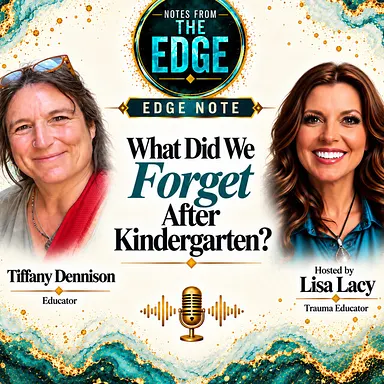
Welcome to Notes from the Edge, where we have the conversations we should have been having all along. We talk about the things that we're not talking about. I'm your host, Lisa Lacey, writer, trauma educator, executive advisor, and author of the upcoming memoir Notes from a Certified Madwoman. Welcome to The Edge. Hey, hey, my friends. Welcome back to another episode of Notes from The Edge. I am your host, Lisa Lacey, and this is the place we have the conversations we should have been having all along. Guess what? You're not talking about it, so we're gonna. And today we're going back Before the resumes, before the career, before the curated identity, before we learned to pretend to not be scared or lonely or curious, we are going back to kindergarten. Today's guest is Tiffany Dennison, and she is a passionate kindergarten teacher with 22 years of experience teaching kindergarten and first grade. And for the past 18, she has taught at the same rural school in a small town in Vermont's Green Mountains. Her teaching philosophy centers on place-based learning, social-emotional development— boy, didn't we need a lot more of that when we grew up— authentic interaction, play, and belonging.
And she believes that children learn as much from one another as they do from adults, and that they understand Sometimes more emotionally than maybe some of us do. She has taught in public schools as well as private schools. Her classroom is largely screenless, with play, children's interests, relationships, and community at its core. After more than 2 decades in education, some of her greatest lessons have come from these children, and she's going to be sharing them with us today. Tiffany, welcome to Notes from the Edge. How are you today, my friend?
I'm doing wonderful. Thank you for having me, Lisa.
Yeah, it's so exciting. I love this topic for us, um, because there's no doubt that as adults we forget play, pleasure, joy, all the things that, uh, I was telling you earlier when my daughter was 5. I just, I so adored that age. So what do you feel that kindergartners know about being human that adults seem to forget after watching them for 22 years?
I believe that kindergartners really learn how to delve closely into like what they're looking at and they slow down and they're not concerned with the procedure of getting things done, like we as adults are always making a checklist and checking it off. They're not jaded. The magic is still in their world, and they're still very much in this ethereal, imaginative way of thinking. And so I think they are really, really grounded. on this earth yet. They haven't really taken the societal restraints that we all learn how to act by in this world, in the United States at this point. And they're still very much learning who they are. And they are still very much playing with each other and learning about each other. And it's, it is, it's pretty, a pretty magical experience if you have the opportunity to stand back and watch.
Yeah, I love that. Still figuring out who they are without all the societal conditions that eventually get placed on us. So—
And basically, you know, I mean, and I live in a rural area. Maybe it's different somewhere in a city where maybe there's the restraints and what's expected of you is very different, but where I am teaching from, it's rural and not, not as urban as, you know, some people live. And I think that also creates the opportunity for kids to, you know, be outside more deep, steeped deeply in nature, which I think is very important.
Yeah, and I love that, friends. Notice she said that 5-year-olds are more grounded than some of us adults. So there is something to be learned from them. And talk to me about imagination and creativity in that groundedness.
Well, I think if you give kids the opportunity to slow down and play— and I don't mean play for 5 minutes, I mean play for 45 minutes, whether we're outside or inside. It gives them an opportunity not only to grow their imaginative minds, but to use each other to grow their game or what they're thinking about. And maybe it's a unicorn or an alicorn, or, you know, a bunch of kids running after each other, you know, playing some lion or tiger game. Or maybe it's family. There's sometimes there's mom and dad and, or mom and mom, or However, however it goes, and they can use— they support each other and grow and grow their imagination that way. And so that's when they can like lean on each other and do that. And are there disagreements? Sure. Does, you know, a student say, no, I want to be the mom, and, you know, I don't want to be the baby, I want to be the dad, you know? So, you know, you're teaching those skills as well. But for the most part, They are playing with each other, and really, if they're given the time and they know they have the time, it's different if they are given an hour, one, you know, once a week.
That's very different than knowing they have 40 minutes to play before we go inside and start the day, and they can really grow the, you know, their communication skills with each other and grow their ideas, which is pretty awesome.
Off of each other.
Off of each other, and as a teacher you stand back, you might ask a question here or there, but you're not directly going at kids and saying, trying to change their games or trying to see if they know something, you know, that you're trying to find out. You maybe ask a question that might shift their play a little bit, but not to end it or to create any sort of rift between kids.
Yeah, I love that.
Yeah.
When do— so kindergartners can be remarkably unapologetic about who they are.
Mm-hmm.
Until they start receiving the messages about who they're supposed to be. So at that age, do you see that happening at all yet? I mean, what do, what do we as adults unintentionally teach kids about fitting in or people pleasing or hiding parts of themselves? Is, is that an age where you start to see this, this what we become in adulthood happening?
Well, I think it depends on the parenting and who they're exposed to. I think if you are part of a group of parents who's always trying to one-up each other, or if you are part of, you know, a group of people, because they learn by watching, they learn by watching each other, they learn by watching adults, they learn how to act. You need— sometimes I get a 5-year-old in here who acts like she's 30 because she spent all this time with her mom or her dad, and that's the way, that's the way she rolls because that's all she's been really been exposed to.
Yeah.
You know, and so, or then you have kids who have siblings and they, their imagination is really deep and connected to each other because they've spent hours and hours playing a set of twins. You know, I'm not saying that a kid who's only with their parent doesn't form an imagination. I'm not saying that at all. I'm just saying it— you are a product of your surroundings.
Yeah.
Right? And so I think that it depends on what your surroundings are, are like growing up, that and what the atmosphere is will determine whether a kid is still very much in their imagination or if they've started already learning about the societal restraints that we put on kids and adults.
Yeah, yeah. And so it, it would, it would absolutely depend on what's being conditioned at home and modeled around them. So what have 5-year-olds taught you about conflict and repairing after conflict? Because children can be furious with each other and then 5 minutes later they're all fine, but yet You know, here I am bringing up 8 years ago to my husband over an argument about biscuits and gravy, right?
Yeah.
So what have you learned from them?
I've learned that slowing down and having a very simple, direct conversation and being able to say how you have felt and where, maybe even where in your body you felt like my heart hurt because you told me I couldn't play, or having a really simple conversation that doesn't bring in a lot of the, you know, maybe some other judgments you've had or resentments you've had. Being— talking about what's going on right there is really, really important.
Yeah.
I think really taking the time and talking about just that piece, not maybe like, but all the other pieces that you may, as an adult, have in your head. Oh, He didn't do this last night. He didn't put the, you know, he didn't finish the dishes. The toilet seat was left up. The toilet paper wasn't on the right way, you know, like whatever it is. And just focusing on like what it really is that went wrong right in that moment.
Yeah.
Right. Being really present. I think being present is so key and I, and not bringing in these exterior like bits and pieces of, you know, something that happened yesterday. You know, so I think really focusing on like just what the little thing is, the little disagreement is, and how to remedy that, how to make each other feel like they still belong. Because feeling like you belong is really the one of the only ways you can really access being able to learn wholeheartedly, for sure.
Wow.
Yeah, I think that the way parents and teachers react to, um, you know, kids disagreeing shows kids how to act. If you freak out, you know, and you're like, stop it, kids learn about that. Versus, what do you think went wrong? What do you think we could do differently next time? How did that make you feel? How did that make you feel? Can you ask each other what you can do to help each other feel better? Can we move on, or do we still need to talk about this? So really being able to dive deeply and in the most simple way.
That just took you 15 seconds.
Yeah.
Yeah.
Yeah. For sure.
That just took you 15 seconds. And I think we all should write that down. Tiffany, so what you're saying is when you're arguing over biscuits gravy. Don't bring up the tab from 8 years ago. Damn it, woman. I may owe my husband an apology. I think I'm going to go back and listen to this and write down what you just said. What could we have done differently? And how did that make you feel? And how do you feel? And do we still need to talk about it? No? Okay. But then you have to be willing to move on.
Exactly. Well, and if you aren't clear, like as a teacher, if you are not Crisp, very, very clear, their behavior will tell you, or their misbehavior will tell you, you weren't clear. So if you can sit back and like look and see, you know, how your classroom's running and what you're doing, or how they're playing outside, how you act is really what will tell your reaction, and watching them will tell you how things are going. And their misbehavior, if they're not getting along or they don't know what to do and they're looking at you like, what do you want us to do? Or what are we doing right now? Will definitely tell you if you— So you have to be observant. You have to be so observant. And as a teacher, you're switching things, you know, so many different times. And I hear so often, oh, kindergarten's so easy. And sure, the concepts, the academia isn't like a 6th grade or 12th grade or college complication and all these different layers. However, think about going from the number 9 to the number 10. And how do you explain that to a kindergartner? How do you explain them how to unitize and go from the ones digit to the tens digit in such a way that they actually really understand it?
They know the procedure, they know how to write the number 10, but do they understand what it really means? And a base 10 system.
Well, and also you got 30 of them. Can you sit them all down at the same time for lengths of time? Girl, that's where I'm at.
I'm like, how do you do that? And what does that look like? Yeah, and what does that look like? And can you break up into groups and have different stations and let kids play and, you know, have a story? Really, through story, kids really learn their best. There's You know, we do this phonics program that there's this bird, you know, an owl. And one of the pieces of this whole program, there's all these different pieces, like you could spend all day, you know, and one of the pieces is telling a story that has been scripted. But what I've done is taken all the pieces of a story that kids need to learn, and I just tell them a story. And there's something so rich, more, even more rich than reading a book. being told a story, kids are just enthralled. And they learn— I feel like they learn so best through story, best through story and communicating with each other. It's really, it's really astounding how kindergartners can learn from each other. And I learn from them all the time to slow down, look closely, use your senses, think differently, try and communicate in such a way that people feel like they belong.
Because if kids don't feel safe, If they don't, if you don't create an atmosphere where kids feel safe, you have lost them intellectually in many ways.
Yeah.
In many ways. They could get the procedure of what you want them to do, but you've lost them in a way where conceptually they're not going to deeply understand if they're afraid they're going to get yelled at, or if they think their misbehavior is, or their stress behavior, depending on, you know, what you believe in, in brain development, will, you know, drive how they can move academically and whether they have a fixed mindset or a growth mindset. There's so many different pieces, so many different pieces to teaching kids how to learn and teaching, creating an atmosphere where kids can learn and observe and absorb information.
Yeah, yeah.
For sure.
Something you said, safety as a foundation, I think I think so many of us adults still don't feel safe in, in our own bodies, in our own skins, and that sense of belonging. I think there's a loneliness epidemic right now. We've never been so connected and disconnected at the same time. So—
Smartphones are making us stupid in many ways. Yeah, because we're like stuck here and we're not looking people in the eyes. And all you're doing is looking at a screen and scrolling at all that happiness, and then you don't— you're not actually experiencing happiness and being present when you're looking at a screen. I mean, I don't have screens. The only screens that are in my room are something that is cast onto a big whiteboard that everyone can see.
Mm-hmm.
If there's something I want to show them that happens to be in a video format, or if I'm writing something and I want them all to see it, I can shine what I'm writing up on the board. But really, they're on screen so much that it— that I try not to have them in my classroom. And not have them get on any sort of, you know, Chromebook or anything here for them to, you know, learn, because it's really— it's 2D, you know, they're looking at it and, you know, trying to think and then pushing a button instead of, you know, maybe building something or, you know, drawing something and talking about it. They're just looking at a computer, and I, I don't think kids learn best that way.
Yeah, well, and you had said earlier that you see— you are able to see the effect of telling a story. I believe adults are still the same way. We learn best through story, oral storytelling, and we've lost that art. We call now podcasts long-form conversation, and this is literally just you and me having a conversation.
Yeah, absolutely. Well, think about, think about The Moth and like that radio. Do you know what that, you know, the storytelling radio show that people, you know, they have a topic and people actually compete, I think, and tell their stories. And that is very— people are very drawn to listening to other people's stories.
Yeah.
And yeah, I think it's, I think it's critical for kids to have someone who's telling them stories at night. My husband used to talk to— tell my kids stories before they went to bed instead of reading stories. And I, you know, I would come home and he would be with them, you know, putting them down if it was, you know, if that was the situation for the evening. And I can, I can hear them just asking questions and, you know, wondering what's going to happen next. And he would tell stories about when he was a, you know, when he was a kid. And maybe it started out completely truthful, but then it turned in, you know, then he spun, you know, something Even deeper, you know. And so it's— I think it's fascinating.
Yeah, yeah, absolutely. And it's a great way for us to, um, learn. And I don't know, guys, maybe sit down and just converse with your own children tonight if you, if you hear this episode. Um, so what happens when a child— you talk about social emotional learning and Recognizing whether a child is actually available for academics. What does distress look like in your classroom, and what changes when curiosity is entered into the equation?
Say that again. What about— did you say distress or stress?
Yeah, distress. So what does distress look like, and then what happens when you infuse some curiosity as their leader or teacher into the equation?
Yeah, well, and then if you're in an environment where the teacher is the authoritative, you know, disciplinary, and it doesn't always help kids, especially if they have some stress behavior. So it depends on what your beliefs are, but I think kids have misbehavior. And then there's a tipping point where it becomes stress behavior, and then kids don't actually even realize what they're doing because they're their body, their nervous system is so— has spiraled. So they are doing things like a kid might kick someone and then not even remember that that's what happened because they have, they have tipped, they've gone over the tipping point. And this, a lot of this, a lot of this is Dave Melnick's work, who is an educator. He's an educator in Vermont who isn't a school-based educator, but like he's a brain trauma Informed educator who comes to just, you know, I love some brain science.
I'm a brain science geek.
Yeah, me too. And it's so interesting because he was also the person who taught me that the way I react is what is going to be the defining point, whether a kid is going to end up feeling safe or not. You know, my reaction, my reaction. So if you, like, show a reaction, kids can read you so well. Even by your body language. If I come in, you know, my father-in-law passed away. I came to school and the kids were like, what is wrong? And I wasn't crying or anything. They could just tell by my body language that something was wrong. And they are so keen on reading body language, better than us, better than adults, by far, by far.
Yeah.
If they're present, if they're able to be present. So whether a kid feels safe or not depends in your classroom, what really depends on how you react when things happen that are not ideal, not ideal. And I'm kind of forgetting the question that you asked me.
Distress and curiosity. So their distressed or stress response, and then what happens when you infuse curiosity on your part into the equation?
Yeah, why do you think he did that? Or I think to get kids to move out of a stress behavior or misbehavior to like become more grounded, techniques about breathing or doing, you know, and I have this huge like thing that gets big and small. And in the beginning of the year, we breathe in and breathe out and they're always like, it's huge, we could fit in there and out and teaching them those skills to help alleviate the stress or just become a little bit more grounded really helps. I, um, when kids are, when kids are distressed, your reaction, if you are calm and collected, kids will come around much quicker, much quicker than reacting in a, in a big outburst. So will adults. True that. True that. But if I have a kid who's very stressed, I do not go straight at that kid. I do not say, you know, come and talk to me when I'll come from the side, or I use the art of distraction to distract them to then come back around. Oh, could you hold this for me? Or I just dropped all those markers. Can you help me pick them up?
And a lot of times they're like, oh yeah, sure. And then they're distracted enough that their nervous system regulates a little bit more, and then they can talk about it. I think the art of distraction is in a kind way, in a kind way to distract kids from From, you know, what their anguish is, and then they can relax a little bit and then maybe come back around to be able to talk about it.
I love that, go in from the side. That's a great communication skill. Yeah, come in from the side. Don't go, don't go head in first, guys. Sometimes is not the way to go. It's going to put—
It's taken me a long time. Yeah, it's taken me a long time to learn that. And, you know, routine and what kids expect and their structure. Really, really balances out feeling safe. Because if you don't, if they don't know what's going to happen next, if they don't know, then their nervous system starts to, you know, buzz. Because if they do know what's happening and you've set up a classroom where they can look at the pictures because they don't quite read yet, some kids do, but a lot don't, and they know what's happening and they know what the expectations are and they feel the edge, then they feel safe. If it's like a free-for-all all the time and it's loosey-goosey all the time, then— I don't mean not having free play. I just mean if they know what's happening and they know we're going to have free play for 40 minutes or whatever it is that has been scheduled, and they understand this framework with which it works, they are much more likely to be relaxed enough to delve into their imagination and communicate with each other in such a way that Um, you know, is wholehearted to both, to both adults and each other.
And if you aren't focusing on those skills, they're not going to be ready to learn academics anyway.
Yeah. Because they're still going to be in those distressed or stress responses.
Yeah, for sure. Yeah, for sure.
Because that builds on itself. It becomes a perpetuating cycle. So from, from your observing, from your standing back and observing these Cutesy little 5-year-olds. How have we as adults psychologically underestimated the importance of joy, pleasure, and playtime?
How have we under— I feel like we live in a society where we are, you know, kids are scheduled out and we are always moving on to the next thing. I think that not being present has created— we're teaching these kids that they always have to be on the move and they always have to be doing the next thing, right? So I feel like we haven't really, as adults, you know, they were modeling behavior. So if we're running around and we're not taking time to be present and we're not communicating, we're not looking each other in the eyes, we're not sitting around a dinner table, What is that teaching kids? It means it's not important, right?
Yeah.
So, you know, as adults, sit back and, and, you know, think, what could I do to, to create an atmosphere where we are communicating? When you're going around the dinner table, um, you know, a rose and a thorn, you know, something that was great, something that wasn't great, and something you're looking forward to, a bloom, you know, like having those, like, kids used to hate it. And now, as now they're, you know, 19 and 22, and, you know, it's— they're like, oh yeah, and I get it now. I've had my daughter come back so many times and be like, I understand where you're coming from. I'm so glad you fought the fight of no screen time. You know, it's, it's interesting as they grow older, they're like, oh, I get it now.
Yeah.
You know, so as adults, like, just take a step back and take a breath and We all do things that, you know, we all lose our temper, you know, and I just think if we take a step back and look in and take a look and see like little things you can do to change or to shift things so that you're like looking at your kids in the eye and like taking the time to really communicate.
Yeah, and see them.
Yeah, and let them see you.
Yeah.
them see you for sure. If you, you know, if they've never seen you sad, that does not help them because then they have that feeling and then they're hiding it, right?
Yeah.
If they haven't ever seen you, if they have never seen you take a deep breath, you know, and try and calm your body down or even listen to you talk through something of the sort. I'm really frustrated. Do you hear my voice is getting faster? And I don't— this is, you know, I need to go take a breath or take a walk. That is, you know, you're teaching your kids social-emotional learning skills that way.
I love that.
I love that.
Well, Tiffany, before we close out, we always ask each of our guests a couple of questions. Are you ready for them?
Okay, sure.
The first one is, in your own life, what did you perform in order to survive, and what did dropping that role, mask, or performance do for your life?
Wow. Okay. I would say, what did I perform? I, as a child, was a people pleaser, tried to not make waves. And in hindsight, doing that masked who I really was and who I was supposed to become. Um, and I had to figure out who I was without that component to really be able to see who I was, like, for real. Like, if you take away all the bits and pieces, like, not what you look like, your skeleton, like, who are you? Who are you? And if you're people pleasing, Um, that is something that you have to let go of in order to be able to look deeply inside. And I think that, I think that is, that was a critical, and it took many, many, many, many years to do that.
Yeah.
And I still sometimes go, is that really what you want to do? You have to check, you know, you have to keep yourself in check and listen to your body and not necessarily what your mind's telling you. Right.
I love that. I love that. Listen to your body. And, uh, yeah, recovering people pleasers, check in with that body first. And I love her question. It's a simple one. Do I really want to do that?
And it's okay to say no. It's okay to say, oh, can I get back to you? It's okay to say no. That is okay.
Oh, I, I, is it okay if I get back to you? Or I'll need to get back to you on that is a great way to buy yourself time if you're in an oh shit moment. It's a great way. All right, and my final question for you is, what do you wish we were having more conversations about? What should we be talking more about that we're not right now?
You mean in, in general or in terms of kids?
Just the first thing that comes to your mind. What do you want to hear us as adults talk more about?
Um, I would love to have more conversations about screen time and what that does to children.
Mm-hmm.
Because little kids' minds cannot form the way they need to if they're consistently bombarded with lights and flashing and screens. And I think we're, we're starting to talk more and more about it, and some of the studies that have come out are really grim in terms of screens.
We're starting to see the science now. Yeah.
And I think that conversation is critically important. Like, if I had a choice, I'd have no screens K-6 in schools. I know that that is not likely because kids are typing more and whatnot, but we've sort of learned we've lost the form of handwriting because, because kids are on screens and typing, you know, and I, and I get it's part of our society and I feel like kids lose their childhood more quickly when screens are a part, you know. Yeah, part of their childhood, you know, a majority of their childhood if they're spending hours and hours on them.
And again, you're right, grim is a good word to discuss, to describe the science and studies that are starting to show up now that we've had time to have some long-term effects be determined.
So yeah, I mean, you lose your agency when you are— you lose your agency of like who you are and, you know, what you, you know, what you're doing when you're constantly looking at, you know, all these pictures and all these different things on screens.
Yeah.
Yeah.
All right. Well, Tiffany, thank you so much. Guys out there, I'm gonna ask you guys the same question. What are you performing in order to survive? And what might setting that role, mask, or performance down do to lighten your load or let you play just a little bit more? I'm your host, Lisa Lacey, here with our guest Tiffany Dennison. And when you find the answer, we will both see you at the edge. Tiffany, thank you so much, my friend.
Thank you so much. My pleasure.
What did we know at five years old that we somehow forgot along the way?Tiffany Dennison is a kindergarten and first-grade educator with 22 years of experience whose work centers on play, belonging and social-emotional development. Her classroom offers a fascinating reminder that children may understand some of the fundamentals of being human long before adults complicate them.In this conversation, Tiffany and I talk about what happens when children are given enough time to actually play, why belonging and emotional safety have to come before learning, and what five-year-olds can teach adults about repairing conflict without dragging yesterday’s resentment into today. We also get into screen time, storytelling, nervous-system regulation and Tiffany’s own journey of recognizing and releasing people-pleasing.In this episode:Play-based learning and why unstructured play mattersSocial-emotional learning and childhood developmentBelonging, emotional safety and nervous-system regulationHow children repair conflict differently than adultsThe effects of screens on connection, creativity and attentionStorytelling as a tool for learning and human connectionWhat adults model for children without realizing itPeople-pleasing, identity and learning to listen to your bodyWhy slowing down may be one of the most important things children can teach usConnect with Lisa Lacyhttps://www.lisalacy.comWhat did you perform in order to survive?Welcome to the Edge.See Privacy Policy at https://art19.com/privacy and California Privacy Notice at https://art19.com/privacy#do-not-sell-my-info.