
Every line of this episode of Notes from the Edge was transcribed with HappyScribe technology. See also: AI tool that takes meeting notes.
Ads in this audio differ from the text. Tap the sentence you're hearing to follow along.
Synced: the text now follows the audio.
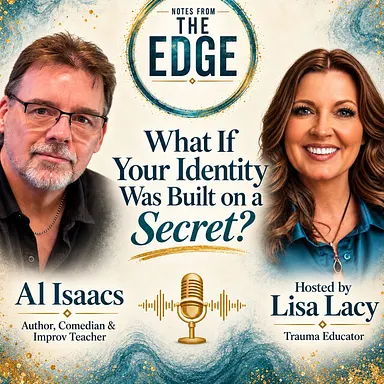
Welcome to Notes from the Edge, where we have the conversations we should have been having all along. We talk about the things that we're not talking about. I'm your host, Lisa Lacey, writer, trauma educator, executive advisor, and author of the upcoming memoir Notes from a Certified Madwoman. Welcome to The Edge. Hey, hey friends, welcome back to an episode of Notes from The Edge. I am your host Lisa Lacey, and this is the place where we have the conversations we should have been having all along. Guess what? You ain't talking about it, so we're gonna. And today's guest is Is Al Isaacs, who is the author of the memoir Finding Mary Smith. At 52 years old, a routine phone call unexpectedly revealed that he had been adopted through the gray market adoption system of the late 1960s and that nearly everyone in the family had known except for him. What followed was a years-long journey through DNA testing, genealogy, hidden family history, forgiveness, and ultimately meeting the birth mother he never knew existed. So this isn't simply a story about adoption. It's a conversation about identity and what that means and who we really are and the stories families tell, the stories families don't tell.
We talk a lot about family secrets in here, the ones they keep hidden, and what happens beneath the foundation of your life when it shifts over a phone call.
Wow.
So today we're exploring truth, belonging, resilience, and whether it's ever too late to discover who you are. We already know the answer to that, but let's dig into Al's story. Al, welcome to Notes from the Edge. How are you today?
Oh, I'm doing great, Lisa. Thank you for having me on. This is great.
Yeah, I'm so super excited. So we're just going to dive right in and go to that pivotal moment at 52.
Yeah.
So I just had Welcome to Notes from the Edge, which is a transition event. Uh, so I know what those transition events can be like, but take us to that moment.
Yeah, uh, well, to give you a little context, um, I was raised on Long Island as an only child. I had no hints, clues, suspicions whatsoever.
Wow.
Um, and at the time, uh, this was just at the end of COVID Okay. Um, both of my parents were diagnosed with dementia, and it was hitting both of them in completely different ways. And in addition to that, they each had different health challenges. My dad had broken his shoulder, which started a chain of events, and my mom was dealing with cancer for the 5th time in her life. So With the dementia, my mom had been telling some pretty creative stories to different doctors.
Mm-hmm.
You know, when I would take her, you know, she would tell one doctor about all these surgeries that she never had. And then another doctor, she would deny ever having the surgeries that she actually did have. You know, she would tell one nurse about all these symptoms she was having. And then when the nurse would go to follow up, she'd say, I don't know what you're talking about. That's my husband. I don't have those symptoms. So it was a challenge. And me being, like I said, the only child, I was kind of having to juggle and deal with all of that.
Whew.
So the moment of truth. As COVID was taking place, like a lot of comedians, I was not working. You know, I wasn't on stage. I also taught improv comedy. So I wasn't doing that either. I had no outlet for anything. But I was— I would— I had taken up a job designing websites. So I was at work one day and I got a call from my mom's oncologist. And she was trying to get in touch with my mom to discuss family medical history. And my mom kept hanging up on her. You know, the dementia, whatever, you know, paranoia. Hanging up on her. So she asked me if I had any ideas of what to do. I said, well, you know, if you need to talk to my mom, I had hired a live-in nurse 24/7 for my parents. I said, give her a call and she can kind of act as intermediary. And she tried that. And maybe 5, 10 minutes later, I got another call back at work telling me, nope, mom keeps intercepting the call, keeps hanging up on her. And I said, all right, well, you know what? I know being a doctor, your time ain't cheap.
So let me see what I can do. Let me see if I can help you out. I'll give you as much family history as I know. And the doctor, assuming that I already knew, said, well, you know, I need your mom and dad's family medical history. I don't need yours since, after all, you know, you're adopted.
Oh.
Yeah. So let's forget— let's forget the multiple HIPAA laws we have just violated. That's okay, that's fine. Oh, I didn't believe her. I laughed. I assumed—
I was just joking.
Yeah, well, no, I— well, I assumed this was just another dementia story that Mom spit out. So I laughed, and the doctor was kind of freaked out that I'm laughing at this. And, and she said, well, maybe it's a brother of yours. I said, no, I'm an only child. if any of the Isaacs kids are adopted, it's, it's me. I'm it. So we just kind of left it at that. I tried to fill in the blanks, whatever I could. I left that, you know, went in and told my boss, hey, guess what? I'm adopted. You know, we had a good laugh and I went home. And, you know, with COVID as with everyone else, you lose touch with family. You know, people aren't stopping by. People are— So I had messaged an aunt of mine to say, you're not going to believe what the dementia is saying now. You know, it was literally— it wasn't a question of whether or not I'm adopted, because of course I'm not adopted. It was just, let me tell you how things have progressed since she hasn't seen my mom in a couple of years, you know. And again, the doctors had told me, you know, with their dementia, Um, if you were to speak to my mom for 5 minutes, you'd never know anything was wrong, right?
She had her patter down, um, and she and my dad kind of, you know, protected one another. And so, but, but if you were to speak to my mom for 20 minutes, you'd start to go, ah, that's kind of weird. If you were to speak to her 2 days in a row, you'd go, oh, something's definitely up here. But, but no one kind of— so this was me reaching out to my aunt to say, Here's where we're at. Here's how bad the dementia has gotten. She actually told a doctor that I was adopted. Okay, how crazy is that? Radio silence. I heard nothing back from my aunt.
Oh, you're like, what? Hello?
Yeah.
And my wife's—
my wife's going, you know, she's elderly. You got to give her a break. She was probably sleeping when you— you know, this is— you got to give her a moment, you know. technically, you know, she's not savvy, so she might not have seen it. I said, okay. About a day and a half later, I get a message back from her that began with the line, I always wanted to tell you. And I went, oh.
Oh.
Oh. Um, I literally— I couldn't speak. I, I had to print the page out and, and, and walk over and hand it to my wife. and show her. It's like, I guess I'm adopted. And I, I went to my mom with it. And I said, hey, you know, so I hear I'm adopted. And my mom's like, oh, yeah, who told you that? I was like, well, first your doctor. And then, you know, my aunt. And she's like, oh, yeah, yeah, you're adopted. Oh, this nurse of mine. And she just like pivoted and went in a different direction. We're going back. We're going back. Yeah, I was like, I guess we're not going to discuss this right now. And actually, a week later, I kind of went to her again. And this time, no, it's a lie. You're not. I went, okay, we know we're not going to. And unfortunately, it wasn't too long after my dad went into hospice and he passed away about 3 weeks after I found out. So I never told him I knew. I said, you know, if you're going to hide this from me for 5 decades, There's no point in creating drama at this moment.
And it's really funny because I did it. It didn't occur to me until much later on that when I would go and visit my dad, whether it was at the hospital, at his house, or in hospice, my mom watched us like a hawk. And it's like, I think she was terrified of there being a deathbed confession. You know, but, but that never happened. And like I said, you know, he, for whatever reason, pride, he didn't want to tell me. So, okay, I respect that. That's okay.
Yeah.
Yeah.
Well, wow.
Yeah.
So turns out you're adopted. I've always wanted to tell you. Oh, I just, I I can only imagine the stomach drop with the opening line. I've always wanted to tell you this. Wow. Okay, so then what, what happens? And I'm so sorry for your loss, by the way.
Oh, thank you.
What, what happens then? How do you begin this journey of who the hell am I then? Right? I mean, because that has to come up for you, right?
Yeah. Yeah. Um, you know, I've been thinking about this a lot. I was thinking about when I wrote the book, I was thinking about it when I recorded the audiobook. It's like, it just keeps recycling in my head. And then someone mentioned to me, he's like, you lost your parents 3 times. It's like you lost them when the dementia set in. They're not the same people. Then you lost them when the adoption thing hit, and you lost them when they passed away. It's like, wow, I didn't really— that didn't hit me that way. It's a lot of grief. Yeah, it was a lot of grief, and I was processing none of it. I'll be honest with you, I was processing zero. Because like I said, I wasn't doing comedy and I wasn't teaching. And that was like a big outlet for me. Whenever I had an issue— It's an outlet, yeah. It's like, all right, let me just go do 15 minutes, blow off some steam. I feel good. For whatever reason, and we'll discuss this later, I don't drink, I never did. So comedy was kind of my outlet and music was my outlet and my drums had been broken during COVID So I didn't even have that.
So, ah, so yeah, me dealing with it was me, you know—
Not dealing with it.
You know?
You're like, I'm in denial. I'm in denial.
That's what I am.
Yeah, sometimes it helps you get through for a bit, for a bit.
It does. And you know, If anything, writing the book and the search that began, it allowed me to kind of dive into a project and not deal with emotions. It was almost like, okay, this guy just found out he's adopted. What are the steps? Let's, let's see how we can unravel this puzzle. You know, I took, you know, I went, I took all every different kind of DNA test, you know, the 23andMe, the Ancestry. It's like, if there was anything around me that looked like a cup, I was spitting in it and putting it in the mail.
There's so much spit required. I'm just, I'm just like, what more?
Just getting over my mouth.
I, you know, I was like, they have our DNA now. I said, what are you planning on doing? Like, Okay, I didn't know I wasn't allowed to have my DNA tested, but right. Yeah, what are you planning on doing there, Mom? Yeah, so there's a lot of spit required.
So yeah, and because— and you, and you don't know who took what test, you know, if someone is out there, right?
Are they on 23andMe or are they on Ancestry or are they on a third-party one? Oh, so you are doing them all?
I'm doing them all. I'm covering all the bases.
And they're not cheap either.
No, they are not. But how do you put a price?
In order to really connect, you need a subscription to all of them too.
All of them. Yeah, all of them. Because you don't know, they might sign up, you know, next month. You don't know.
You need the subscription forever too.
Forever. You don't know. Because I, I, I was probably, you know, I think there's, there's, you know, 2 different Uh, trains of thought here for people who are signing up for these things. Um, you know, mine was like the pipe dream that I'm gonna do this and in 6 weeks they're gonna go, this is your mom and dad's name, and it would be, oh, you know, and the clouds would part and, you know, oh, the Disney ending. It would be delightful.
Yeah, because those happen for us all the time.
When, when I tell you That this entire journey was one giant plot twist after another.
Oh no.
Completely unintentional. You know, just, just like, you know, me emailing, messaging my aunt. It was not to find out whether I was adopted. It was to find— to, to give information about the dementia.
Yeah.
And then you find out you're adopted. But it was like that at every step. It's like the universe was just going, oh, this is gonna be great.
How bad do you want it? How bad do you want it?
Yeah, yeah.
So, so more stories for your book though.
Yeah, well, the book, I mean, it, it started off really, um, kind of as therapy, you know. It's like, as I'm, as I'm going, it's like, all right, I'm— if I'm not gonna speak to someone about it, at least let me get it down on, on paper.
Get it out.
Yeah, get it out.
Yeah, especially catharsis, pen to paper, words, putting it out, seeing it.
Yeah, yeah, yeah. So the first step was, was doing all that and then speaking to my aunt again, who confirmed the adoption. And, you know, the 2 things that she was able to give to me was that, A, it was a closed adoption. So she's like, I don't know how much information you're going to find out. She's like, there's not gonna be any names. She's like, let me give you what little I know. She's like, I think your mother was an entertainer in the late '60s in New York. And when you say entertainer in New York in the late '60s, there's a lot of wiggle room there. That could mean a lot of things.
Yeah.
An entertainer who, you know, found herself in a situation that she had to give up a baby, you know. All right, all right, well, you know, we're gonna write it down. We're gonna— and, um, you know, just, just little tidbits, you know. She gave me this story about, um, how she was actually a major part of it, that she had gotten a call in, in the late '60s, in, in late 1969 from an attorney asking if she had, um, a different cousin's, uh, contact information. Apparently her other cousin was trying to adopt a couple of years earlier. Something fell through, didn't happen. And apparently my aunt wasn't talking to that cousin at the time and said, well, I don't have her information, but I have a different cousin who wants a baby. It's like Craigslist. And, uh, she went, okay, give me her number. And, you know, a few weeks later, Mr. and Mrs. Isaacs had a baby. Okay, great. Um, you know, so she— you know, it was, it was little bits and pieces. And, and the, the next big thing while I was waiting for, um, the DNA stuff was, um, my mom's dementia had gotten much worse.
Mm-hmm.
Um, to the point that it's like she wasn't recognizing when she was hungry or thirsty, and she was paranoid about everything. So she would flush her meds and just a lot of stuff. So finally, we kind of had to, you know, come to this. All right, we have to find a facility that could care for her properly and keep an eye and have medical staff there. And anyone who's gone through anything like this with dementia, you know, I don't need to tell them. I'm like the kind of guy who likes to do a lot of homework. and feel prepared and ready before I make a decision. And I had none of that leeway. It was like my hand was forced at every turn. So it's like I— and no one tells you the guilt you're going to feel afterwards. But, you know, it is what it is. But that being said, after I had moved my mom out and I was gathering clothes for her, for, for the nursing home, I found my adoption papers.
Oh.
They had squirreled them away in the back of a closet. I don't have— I don't have proof other than circumstantial evidence, but I think they were sitting in a bank box for, for years because I know at the beginning of COVID Um, she was calling all the neighbors to drive her to the bank but didn't ask me. And it's like, okay, so she would— she had to get something out of her safety deposit box. It was probably this.
Yeah.
And because, like, well, I go into it more in the book, but, you know, for, for the conversation's sake. So I find the adoption papers, and like my aunt says, there's no names on it. Um, it's on this really thin onion skin paper. Um, but there is some information that I'm getting. And one of the things that—
More than you had?
More than I had.
Okay.
And that's the funny thing. More than I had, except because at the top of the page was the name of the attorney who handled the adoption.
Okay.
And I'm going, okay, you know, maybe Maybe he's alive if there's, you know, if I'm lucky, but I'm probably not lucky. But maybe his, you know, maybe his firm is still around. Maybe someone got his papers. Maybe there's someone I can contact who can— because I, like, I am completely ignorant of how any of this works. I don't know what I'm entitled to, what I can see, what I can't see, how much info, you know. I know nothing.
Yeah.
So, so here, just like emailing my aunt about dementia and finding out I'm adopted, here I am Googling this lawyer to find out more information about the adoption. And it turns out that the first thing that starts popping up— this guy's name was Stanley Mickelman— the first thing that pops up are all these articles about how this man was the biggest baby broker in the country.
Oh no.
In the '60s and '70s.
Oh no.
I went, Oh, so when you said I had more information than I did before, yes. And it was all fabricated. It was all wrong. So I went, oh, there's a plot twist. That wasn't on my bingo card. Yeah, I was, I was a product of a gray market adoption.
Wow.
So, and my wife was the first one to pick up on it. My wife was the first one to look at the adoption papers and go, hey, this is weird. You know, the lawyer who handled your parents is is also the lawyer who handled the birth mom. That doesn't seem right. And I'm going, you know, what did I know? So, so, you know, for those of you wondering what a gray market adoption is, black market adoption is, you know, I have $250, Lisa's got a baby, let's meet in a parking lot somewhere and we'll trade. You know, gray market is exactly this. It looks like it's on the up and up, it looks like it's legitimate, But you have one attorney handling both sides, so there's no one on the other side going, hey, are you sure that information's correct? You know, on the adoption papers it said my birth dad died before I was born. You know, do you have a death certificate? Do you have proof? So there's no one overlooking. He could write anything he wanted and did.
Wow.
So, um, Do you have any questions or I'll just continue? I'll, I'll, I'll—
Keep going. It's not on the edge. We let you, we let you roll. You're in, you're in a good spot. Keep going. Keep going. I'm, I'm, I'm in, I'm in it. I'm in it with you. I'm trying.
Ring a bell if you have a question.
Keep going. So that's just like, wait, what? There you go. That's a terrible Google search.
Terrible, terrible, wonderful Google search. I'm going Maybe I spelled the name wrong. Maybe— no, no, that's him. All right.
Okay, um, more, more data, more data, more, more frustration, more anger.
Um, so I get, I, I get my ancestry information back, and, uh, you know, and, and the funny thing here was my wife always wanted to do this stuff. Like, she had cousins, you know, out of state who had done it and found out they were related to some king or emperor or whatever. And she— oh, that's cool, let's try that. And, you know, I was a broke comedian at the time. I'm like, you try it, I know who I am. Um, it would have really been funny if my wife had done it and if my son had done it and it came back with no information that I thought I had, because as far as I knew, I was 75% Russian, 25% English. That's it. That's, you know, I— there's the information. I was told that from birth. And that's the other thing, I, you know, because people always ask me, well, did you have any clue? Did you suspect it? I never suspected for a second. And in fact, my mom was always right there to give credit to somebody else for anything I was or did. She would— oh, your eye color?
Yeah, it's your grandpa. Oh, your height? Yeah, you get that from so-and-so. Oh, you play the drums well? You know, Aunt So-and-so played the flute. It's the exact same thing. Oh, you like telling jokes? Yep. Well, So-and-so loved to tell jokes. So I did. All right, all right, all right. You know, it's like the line in the movie JFK, you know, how do you know your daddy's your daddy? Because your mama told you so. Well, mama was telling me a whole lot of stuff. So, you know, it just came to a point where I'm just going, all right. Sure. Okay. Yeah, but, but it was— she was reinforcing that idea on me my whole life that— and of course, all the people she's referencing have all passed away, so I can't follow up on a single thing she's saying. I did. Okay, great. So, so I get my information back from Ancestry. Um, turns out, uh, mostly Scottish, which my wife—
We have a lot of Scottish in us too. Nobody knew it. I was like, Why is anybody not mentioning the Scottish? Dad's Scottish, Mom's Scottish. There's a lot of Scottish guys.
And my wife being a big fan of Outlander, man, she was happy.
Was she like, you're hotter now?
Yes, let's get you a kilt.
Yeah.
So yeah, Scottish.
That's out of— I mean, that's new. Like, that takes some absorption. Like to go, whoa, whoa, wait a minute. Okay. Yeah.
But you know what? And this is where I'm— I was really lucky. This is where I mean, I really, really consider myself lucky because now I'm going online and I'm joining groups on Facebook and whatnot for, for people who, you know, NPE, found out late in life they were adopted and so on. And, you know, I'll give you my, my brother-in-law as an example. He is Irish. And when I say Irish, I mean all caps IRISH. Like, St. Patrick's Day is Christmas 2.0. It is corned beef and cabbage. Let's wear the green all year long. If he was to find out tomorrow that he wasn't Irish, his entire identity would implode. You know what I mean? It would just— that was— that's it. Oh my God.
Yeah, right. Yeah.
Russian?
You know, I—
You weren't a fan of it. No, they were the bad guys in Rocky IV. What did I know?
I, I—
we didn't celebrate Russian history or holidays or— and so for me, that was like, all right, I guess I'm not Russian. Cool. Yeah, it's like, I, I gotta— you know, I was Scottish, Irish, British in there. So that's, that's cool. So I didn't have that. You know, for me, when it comes to identity, Um, husband and dad are, are right there. This didn't change any of that. And, you know, it was probably worse for me being a comedian and teacher, losing that. But that was COVID. That had nothing to do with this. So I was, I was really, really fortunate in, in, in that terms of my identity.
I love that. Yeah, because you weren't so attached to it.
Yeah, it didn't define me.
Right.
Um, and, uh, so I get my ancestry back, gives me that information. And if you've done one of these tests, I don't have to tell you, 5th cousins as far as the eye can see.
Yeah, you got a lot of 5th cousins.
Thousands of them. I got 5th cousins everywhere. But there was one, there was one cousin that was coming up, and my wife is looking at the number. And, and going back to when she did Ancestry, she goes, you know, this percentage and the age on this woman, I'm thinking she's an aunt. And I went, all right, yeah, exactly. I'm going, okay, this is interesting. All right, so let me reach out, because I'm reaching out to all of them going, does anyone know about a baby getting— no, nothing. All right, like, I'm just— I'm sorry, throwing darts. Anyone?
Is there a random baby somewhere that anyone knew about?
Anyone missing Having a baby?
No.
You know, put in a basket, pushed down the Nile?
No.
Oh my God, look kind of like this, only 51 years younger? No.
How many times do you have to like— what do you say even? Hi, my name is Al.
That, that was my biggest thing. Hallmark didn't have a card for this.
No, Harvard does not have a card for this.
No, no, I, I wrote this. I wrote this. Well, I found— I— so I found this woman. I found her on Facebook because, like, on Ancestry it tells you when they were last active, and she didn't touch Ancestry for over a year. So I'm like, all right, that's not gonna work. I found her on Facebook and I found her daughter. So I'm going, okay, we're staring at the picture. Does she look like me? Um, and I messaged because, you know, Facebook Messenger has given me nothing but joy.
Because there's no creepy people on Facebook Messenger.
No, no, not at all.
No creepy dudes.
No, none.
It's great.
So I messaged both of them and I tried to be as cryptic as possible. And it was just, it was just along the line, because I'm going, if you don't believe me, just check your ancestry. You're going to see me pop up there and you can message me through that.
Love that.
But I said, so I said, it says we are related. Something recently happened. I have a lot of questions. Do you think, you know, you, you might be able to help me out? Her daughter was the first to get back to me, and she seemed to be excited. She's like, oh, this is great. Yeah, I'm sure my mom will love to connect with you. We'll chat soon. All right, we are off to the races. This is awesome. Um, 3 days later I got a follow-up. Hi, yeah, my mom's not interested in connecting. Best of luck to you.
Oh, downer.
Yeah, so this was like, I probably would have given up. I probably would have walked away from this. My heart, you know, because again, you know, my, my dad had just passed. You know, I'm still dealing with mom. I'm, I'm going, I can't put myself through this. It's like, all right, you know, my wife and son picked up the ball. My wife especially, she gave the woman's name over to her sister, who was very proficient with a computer. And she said, just, you know, if, if you could look, as Al's kind of taking a step back.
Yeah.
So maybe a week, 2 weeks later, my Sister-in-law finds something and she's not sure what to do with it. And she shows my other brother-in-law Frank, she goes, take a look at this. And he falls out of his chair. And I'll tell you why in a second. So they said, well, we got to show Al. And they're both going, yeah, but Al said he can't do this anymore. So they bring my wife into the room and they go, Theresa, we got to show you something. And they show it to my wife and it takes her breath away. So she comes over to me, we're at a family gathering. She comes over and she goes, Al, she goes, I think Vicki found your dad's obituary. And I said, oh, from like 1969? I'm still going on the premise that the adoption papers, you know, wouldn't have lied about that. I'm going from 1969. And she says no. I said, okay, let's take a look. So I sit down and I look at this thing, and again, in the back of my head I'm going, she's probably wrong. My birth dad died before I was born. I'm looking at this obituary from 1998, and I'm reading the story of this man's life, and I'm going, yeah, that sounds familiar.
Yeah, that kind of checks out. Yeah, I could see that. Okay, that makes sense. But, you know, still I'm going, yeah, you know, but how many people do this? How many people— oh, he's a musician. Okay. Yeah, but there are a lot of musicians. Okay. And then we get to the bottom of the obituary and there's a picture there. And when I tell you it's a picture of my son, that it was literally like they took my son's high school yearbook photo and just made it black and white in Photoshop. Oh my God.
Wow.
And I went, oh, that's my birth dad. And, and like, the emotions that— like, it's like that. I, I just read about his life. I, I have— I know his name now. I, you know, this is him. And, um, it's like I lost 2 dads in less than a month, and it, and it was like even though I, I thought he died in '69. It's like, but now he's a person. Now there's a name, there's a connection, there's a life. But at the same time, in the final paragraph, it mentions that he has a daughter, and I'm going, I've got a sister. I got me a sister out there. I, I legitimately, legitimately vividly remember Easter 1980, I'm 10 years old, saying to my mom, I wish I was a brother. I, you know, I, I didn't quite get the concept of what was involved in that. I just thought it would be nice to have a friend who lived with me that I could just play with at all times. And little did I know that at 10 years old, um, in Montana, my sister was being born.
Wow.
So I'm back in it, baby. I'm in it to win it. And like, all right, but, but I had questions because I'm going, none of this matches up with this woman who's his wife. I'm going, according to this obituary, they were married since '69. I'm going, but, but doesn't sound like she's my mom. Um, it was— I had questions.
That's confusing.
Yeah, very confusing. Yeah, so I took, I took my sister's name Molly, and I, I did a little more detective work, and I found her address in Chicago. And this time I sat down and wrote a letter. I'm like, I'm not playing with Messenger anymore. I'm, I'm done. Let's go old school. I'm writing her a letter.
I love that. I love that. Yeah, take it, take it old school.
Yeah, because no, I don't think any Nigerian—
Can't blow you off as a creeper dude, right? Oh yeah, yeah, right.
So I write this letter and I send it, but again, I'm kind of keeping cryptic. Hey, I think we might be related. I think there might, you know, we might somehow be. And I mailed it off. And again—
Oh, the waiting.
Oh, the waiting's killer. Um, 6 days later, I get an email from Molly, and, um, it just kind of began with, um, we're not just related, you dope, you're my brother.
Oh, that's adorable! I love Molly already!
You have to love Molly.
Yes!
And I had her phone number, and I think I was dialing the phone before I finished reading out all the numbers, and I got her on the phone, and it was the most amazing— she had been looking for me for 20 years.
No!
She knew about me and was looking for me for— she— and she said to me, she goes, I, I just— I thought you didn't want to be found. I said, I didn't know I was lost. Um, so it's— yeah, it turns out, it turns out that, uh, after her dad passed away in '98, um, she went off to college, um, in California. And, um, on the drive home from her graduation, her mom told her, you have a brother out there. So, um, she found out from, from her mom, who is not my mom. Um, that I, I was out there and she was trying to find me. But again, I'm not in any database. I didn't know.
Yeah.
So, but now I knew. And, um, Molly was amazing. Um, and, and what was really great was we're talking and she's crying, you know, and, and I'm, I mean, I'm getting all emotional. And it turns out one of the reasons she was crying was that she was pregnant and she brought me a brand new niece that December.
Oh.
So it was, it was awesome. And, and let me tell you, um, if I was writing this as a piece of fiction, um, the last person I probably would have cast as kind of one of the big heroes in the whole story was Molly's mom, because Molly's mom is not my mom, and Molly's mom didn't have to tell Molly about me.
me. Yeah.
And Molly's mom didn't have to get on the phone and tell me everything she knew about my birth mom because she knew my birth mom. And it turns out that, um, well, according to Molly's mom Roz, um, her husband Paul found out about me 4 days after I was born. He found out that, you know, this girl called him up on December 24th and said, hi, I had your baby. I took care of it. Don't worry about it. You know, and, and that was like the end of it. That was the version that they had. Um, but now the two of them got into the hunt with me. They're going, here's what we know. And, um, the first thing that Roz tells me is, your mom's name is Mary Smith.
That's crazy. Get out of here.
That exotic? Come on, that's not a real name. That's a name you check into a motel under. That's not a real name.
Because at this point you're not believing anything.
You're like, no, no, it's like I'm not believing anything, but I'll believe anything. It's like, really? Are you sure? Mary Smith? That's what we're going with? Mary? But it turns out that like Mary Smith. Yeah, really?
Mary Smith.
That's what we're going with. Um, but it, but it turns out like a couple of weeks, not even, maybe not even a couple weeks, like just after I contact Molly and Roz, I get my pre-adoption birth certificate from the state of New York, which wasn't a thing for a really long time. New York didn't do that until like sometime in the 2000s. And right there in the pre-adoption birth certificate, a lot of information was incorrect, but birth mom's name, Mary Smith.
Oh my God. Love it.
Now, had I gotten that before I spoke to Molly and Roz, it would have been, sure it is, Crunkle, bye. You know, I never— nice anonymous name you've given yourself to have a baby and give it away. Great. But, but her name is Mary Smith. So now, now became the fun part. Now, so let's go find Mary Smith, you know. And I'm, I'm working with that particular name, and my wife found a, um, her high school yearbook picture. And of course, the school shut down 25 years ago because why make anything easy at this point?
Yeah.
But yeah, we were, we were kind of off, off to the races with that.
So you had a whole team at this point. I love it.
Yeah, I had, I had a, I had a whole team and the team got bigger. I, I, one of the, one of the best things I could say about this whole thing was, was people coming out of nowhere willing to help and people trusting me, um, with information. Um, and like, I, I was kind of, you know, on Facebook, that's where I was venting stuff. And, um, you know, like, I would put up like, um, Dr. Seuss, Are You My Mother? as my, you know, Facebook gallery page. Yeah, all these things. And a friend of mine, um, contacted me um, through Facebook, and she's like, you know, have you ever heard of search angels? And I said, no, what's that? And her name is— my friend's name is Lee, and she introduced me, um, to the whole world of online search angels and people who help you find stuff and who are, you know, are DNA detectives. And I said, all right, you know, now it's like, it's like we are assembling a team, you know, and everyone's got their particular strengths. Um, I love it. And man, it was, it was awesome. It was, it was very, very cool because, um, you know, as I'm looking for Mary, um, you know, hearing just little bits and pieces of it, you know, like when they said, oh, she's an entertainer in New York.
No, no, she actually wasn't an entertainer. She was actually a folk singer in New York. And it's going, oh man, it's like suddenly like My life. Yeah, behind the scenes, my brain's going, oh hey, that checks out. Okay. Um, and you know, kind of skipping ahead a little bit, um, you know, Chelsea and Meredith were the names of the 2 search angels who were helping me out, and they were great. They were amazing. They knew their stuff. But the way they worked, um, man, I'm like a really impatient guy. Like, I, I need to— it's like, like both my birth parents—
You were not checking with them 5 times, anything yet?
Anything? How about now? How about now? How about now?
Um, so they need the patience of saints too.
Yeah, like both my birth parents were guitar players, and I, I took up the guitar when I was 6, and I put down the guitar when I was 6 because I had no patience to make it But drums, they sound like drums. Let's go with that. Um, so they were, they were going back, like, they were going back, you know, uh, 5, 6 generations of DNA with Scotland. And meanwhile, Teresa and I were, we're, we're digging into, like, yearbooks and, and, and doing that tangible stuff.
Yeah.
I have an— I have an— actually, I have 2 amazingly, uh, talented nieces, you know, not on my side because they're talented. Um, but, uh, but that my one niece does, uh, she's a singer, she's an actress, she does plays and stuff. And every time she does, there are, you know, articles and pictures and stuff. And she— and my wife's going, well, you know, if Mary was any, you know, If she was good, like, she was any good, maybe, maybe, maybe there's something. And I said, okay.
You have a brilliant wife.
Yes, yes. Oh man, she is, yes, one of a kind brilliant. Um, so I, I— now I'm going to tell you what I, what I actually wrote in the book, because this is, you know, I hate the word just. I hate when someone tells you Just do something. Because it's like either they don't understand the value in what you're doing, or they don't want you to understand the value of what you're doing. Hey, if you could just, just rotate my tires. You know, it's like, it's telling you, I want you to do that, but I'm not going to pay you a lot for it. So I'm going to make believe it's not a big deal. And my whole thing was always like, yeah, but if it's just, then why don't you do it? But that's neither here nor there. And the reason I say that was because I wrote this really dopey message email to the search angels going, hey, could you just— because you don't know your job, listen to a retired comedian. I know what I'm talking about. And it was— the, the crux of it was, hey, I need you— if you could just look into these names that I'm looking at I mean, we're finding so many Mary Schmidts, but I'm going, if you could just look into these couple that we kind of maybe sort of could be her, because like in the worst case scenario, you tell me no, that's not her, and I can eliminate her from what we're doing, you know what I mean?
Yeah.
Like, I wrote it and then like instantly regretted it, you know? I'm like, it wouldn't have surprised me, or I, I wouldn't have been shocked if they wrote back to me, hey, you know, it's been We're just done. Yeah, that's all. So that was what I would— that's what I did. And, and, and I would not blame them one single bit, but they knew where I was coming from. And it turns out, it turns out that, um, Chelsea writes me back later in the afternoon, hey, I just did what you suggested and I found this article. And it was an article from 1968 in Michigan about this contest called Sound of Youth that was going on. And it was this, you know, musical talent competition, and they had a, a band, uh, section. They had a male singer and they had a female singer. And it turns out the name of the female singer who won was Mary Smith. And I went, ah. And this was set up— it was set up like American Idol, where it was like, yeah, where it's like, okay, we have a town, uh, competition, then we have a city, then we have a state, then we have a regional, and then they have finals, right?
So she was good. But so this article was telling me that she won the town.
Wow.
So I went, okay, cool, this might be my Mary Smith. And now I had a search term. I had Sound of Youth to start typing in instead of just going Mary Smith. No. Um, so I type in Mary Smith Sound of Youth. Turns out Mary Smith won the town, Mary Smith won the city, She won the state, she won the regional, and in November of 1968 on WOR-TV hosted by Duke Ellington, Mary Smith won the finals of Sound of Youth USA. She won the whole damn thing.
Oh, Mary!
So now I'm like, ah, because now it's like I, I now have this, I now have pictures And the more I'm putting in Sound of Music, all of a sudden I'm getting these articles and interviews with her, and I'm learning all about her background and all. And it's going— and there's all the stuff where she talks about how she does her crowd work at shows, and I'm going, that's me, that's how I do my crowd work.
Yeah.
I'm like, now it's all falling together. And then one day my son comes running upstairs He's all excited. I said, what you got there, pal? And he slaps his iPad down on my desk. He's got YouTube up and he hits play on Mary Smith's B-side of her single called Wrap Runnin' On Down. And there's my mom.
Oh.
And my wife leans into me. She goes, by the way, this is the first time you're ever hearing your mom's voice. And I went, oh my God. So now it's like, it's all coming together. And like, now mind you, at every one of these steps, like, people would just keep going, you gotta write a book, you gotta write a book, you gotta write a book.
Yeah.
And I'm going, well, I'm, I'm, I'm writing it down, but I don't know if it's gonna be a book. I don't know. You know, it's like, and it can't be unless I find Mary, unless Mary's out there and she's alive and well. The search continues. So, um, before— you want me to just keep rambling on? You have any questions about anything I've said so far?
We're at 47 minutes. Yes, another guest right after you. So, okay, how did you find Mary?
So, um, here I am Googling every day, just dutifully out there Googling different things. And I Googled one morning— I was doing, you know, Mary Smith songwriter, Mary Smith coffee house— she was doing the coffee house circuit, Mary Smith. And then one day I type in Mary Smith guitar, and my friend Google pops up this beautiful Martin acoustic guitar. Gorgeous. And right next to it is a picture of Mary standing in front of the Bitter End in New York around 1970, 1971. And I'm going, that's her guitar. So now I'm doing a little more homework. I'm going to the website that that picture got pulled from, except that picture is not on the website. So Google Cache kept it in, in memory.
Wow.
It turns out that—
For you.
That good for me. It shouldn't have been there because that guitar was sold a year earlier.
Wow.
So now I reach out to the owner of this guitar shop, which again, what are the chances that a guy at a store is putting the name of an owner? He— you, you just put up the guitar, put a picture of it and information about the guitar. Who puts the name? Well, this guy did. Yeah, guy Tony. And I write to Tony, and once again My expectation is, hey Tony, do you have any pictures, more pictures of this Mary? Do you know what happened to her after like '73, '74? Because I kind of lose the trail. Do you have any information? So I'm, I'm looking for more stuff for my scrapbook. And Tony writes back to me, Mary? Sure, I know Mary. I said, you know? Do you mean you knew Mary or you You, you know Mary? He goes, no, no, I know Mary. I got on the phone with Tony, and it hadn't occurred to me until I'm getting on the phone with this guy that his Replay Acoustics website wasn't a .com, it was a .uk. Tony's in England. So he calls me up, and, um, I'm doing my best to not sound like a lunatic.
I am doing my best to not seem like—
I got it together. I got it together.
To like, I, 'cause I'm, it's like, I'm, it's like, dude, I'm gonna give you—
Tony doesn't know how long it's been to building this.
No. And I've been cyberstalking this woman for a year. It's like, I'm about to give you an information dump, Tony. I hope you have a good therapist 'cause you're gonna need one after I'm done. And I, I'm, I'm, I'm telling him what I know. And I'm like, it's like, it's that, it's that fine line of, I'm giving you enough information that you believe me, but not too much that I'm insane.
Yeah.
So I kind of— I kind of— and, and, and, and because even, even like when he wrote to me, he's like, I have a feeling this might be something special, you know, before I called him. And I'm like, yeah, yeah, it kind of is. And he's like, do you think she's expecting your call? I said, not in a million years. And, um, he's like, okay, I can't promise you anything, but I will— I'll I'll contact her. I'm like, I'm sending him pictures and stuff. I'm like, send it, show her this, show her that. And, you know, because it's, it's occurring to me, it's a very different thing for an 18 or 19-year-old kid to show up at your door and say, hey, you're my mom, versus a 52-year-old man with his own family and his own life showing up and going, hey, you're my mom.
Yeah.
And that's not to say it doesn't have its own set of issues. Like, I'm, I'm gonna drop this bomb in your lap. You know, I have no idea what your current situation is, if you ever told your family about me. If, you know, I, I don't, I don't want to hurt anybody if no one was supposed to know. Um, but, uh, about 2 weeks after I told Tony, um, I got an email from Mary.
Oh.
And, um, turns out I was the only baby boy she ever had. She quit while she was ahead. Um, but she met a man, um, in 2007 and 6 months later married him and moved to England, and they've been together ever since. And, um, as good as it could have been, it was 100 times better. It was that Disney ending. There are so many times—
You got your Disney ending now!
I got my Disney ending.
You got your Disney ending!
I did. Wow.
How many moments did you almost lose hope?
A thousand. Okay, almost on almost a daily basis. Like, even in the book, for every time I tell you about a complication, there were probably a dozen that I didn't bring up. Yeah. And that's one of the— the title of the book is actually A Memoir of Family Secrets, Gray Market Adoption, and the Miracle Reunion with My Mom. I'm spoiling it. right on the COVID because I'm letting you know there's a happy ending. I'm letting you— because I'm gonna put you through some stuff, you know. It's gonna be funny, it's gonna be— but yeah, there were a lot of, a lot of people who are adopted.
My best friend, my BFF, is adopted, and she recently found her adoptive family at 55, and it was a happy find. Them, they talked They, they, uh, see each other. Well, the dad was very busy, busy dad. So there's both of them. They keep finding more, they keep finding more of them.
Isn't that the beauty with Ancestry and 23andMe? Yeah, they just want to see if they're related to Napoleon and turns out dad ain't dead.
Yeah, that's— but that was busy, that was very busy because they keep popping up. But, uh, and it was interesting because she did it through 23andMe and was gonna do Ancestry, but just did 23andMe, and that's how they all found her.
Yeah.
Um, well, and she— they found her, and then they found one more after her. But wow, it's a very positive story of being included, and they get together 3 times a year and they have a good chat. And so, uh, you know, she got— she got the fairy tale ending with her family too. And it— during those moments of not knowing where you're from does something to you, right?
I, I've talked about, you know, being, being an improv teacher. One of the things I teach early on, or I talk about, is whether you want to call it stage fright— they used to call it— or, or, you know, imposter syndrome. That voice in the back of your head that's going, you know, you're not that funny, you're not that smart, you're not good enough, you shouldn't be here. You're, you know, it's— this should be somebody else. So I, I teach people how to deal with and hopefully overcome it on stage. I overcame that a long time ago. Yeah, it came screaming back.
Wow.
When I was dealing with this, because it would just be in just little moments. You're never gonna find her.
You're never gonna find it. Give up.
You are never gonna— yeah, right. In the beginning it was, you're never gonna know your real parents' names. It was, you know, the only blood relative you actually know is your son sleeping in the other room. You know, just like going—
our minds play such nasty tricks on us. Oh my goodness.
Horrible.
Yes, our minds play nasty tricks on us. Well, Al, listen, we always close out our episode. I'm so glad you got your Disney ending. I'm so glad Lisa got her Disney ending. Not every adoption story gets that. And, uh, true. Um, tell us the name of the book. Tell us where to find it.
It's, uh, Finding Mary Smith. And, uh, it's available everywhere. It's Amazon, Barnes& Noble, Um, it's paperback, ebook, and I do read the audiobook version. So it's—
I love it. Well, congrats on getting the book done. I know that was a catharsis and a process for you too.
Yes.
Um, so guys, get out and look, look for the book. Um, although the ending is run— we don't know the journey, right? We want to know the journey, the moments he could have given up that he didn't. He kept going and have a support system. Because when he wanted to give up, it was his support system that had his back. So make sure you have a supportive, uh, system that has your back. Okay, Al, before we let anybody go, we close out with 2 questions. You ready for them?
Hit me.
All right, here we go. In your own life, what did you perform— not on stage— what did you perform in order to survive? And what did dropping that role mask or performance do for your life? That's question 1.
Okay, um, boy, I, I guess, you know, improv really saved me, um, just in, in that I could go through this. You know, I was used to in improv taking on different characters, and, and so the 2 parts of improv are yes and, which is you accept everything that your partner gives you, and like any good story, what if. So using—
Great question. Question. What if? There's so much curiosity in it. Yes.
So with those 2 things, it helped me get through it. It was yes, and I'm gonna take this. I'm not gonna let fear stop me. You know, it's, it's yes, and, and it's what if? What if this is the day? What if this is the phone call? What if, you know, this is—
So we call it a soul yes. in here. We call it saying a sole yes and always leading with curiosity.
So there you go.
Absolutely. All right. Last question. What should we be talking more about?
What should we—
yeah. What conversations do we need to be having that we're not, according to you?
According to me, man, I think family, just, you know, the whole honesty with family. You know, I'll try to give you as quickly a thing. So with, with my family, I— it's not that I wish I'd found out sooner per se, um, to find anyone, because 10 years earlier I wouldn't have found anyone. DNA wasn't where it was, the internet wasn't where it was. I never would have found anybody had I found out 20 years earlier. But that being said, I didn't know my parents' situation. I didn't know that Every time I got an award, every time I was playing a big gig, every time I was doing a show that I was really, really proud of, I was reminding them that I wasn't made of the same stuff. And I didn't know that.
Yeah.
And maybe had I, we could have had an open and honest dialogue instead of me playing a game that I didn't know the rules.
Yeah.
And it kind of— I had a moment that kind of killed me. It's like no matter how big a show, no matter what I did, I was never going to make them proud doing what I was doing. But I kept trying. That was like my drive, right? So after my dad passed away and I was cleaning out his room, his office— he built a man cave before that was a thing. So he had this man cave and, um, he had a stack of papers because he was a hoarder. If I, you know, um, but in going through it, there was a file that, uh, had my name on it, and I thought it was just financial insurance, whatever. And I opened it up, and it was all my press clippings, and it was old interviews, and all the— it was literally just like the file I was putting together for Mary at home.
Oh, man.
And I'm going, but I was here. We could have shared this. I wish, I wish I had known.
I wish I had known.
Yeah, I wish.
Yeah, when we leave, we get our memories and our regrets, guys, and make sure some of your regrets are not the memories you missed out on because you kept too many family secrets.
Exactly.
I think Al's going to speak to us a lot about that in his book. So, Al, thank you so much. Friends out there, we're going to ask you the same question in your own lives. What are you performing in order to survive? And what might setting those roles, masks, or performances down do for you? I'm your host, Lisa Lacey. Then this has been our guest, Al Isaacs. And when you find the answer, we'll both see you at the edge. Thanks, Al.
Thank you.
What happens when everyone in your family knows the truth about your life except you?Al Isaacs, author of Finding Mary Smith and longtime comedian and improv teacher, joins Lisa Lacy to talk about discovering at 52 that he had been adopted and what happens to identity when the foundation of your own story suddenly shifts.Al takes us inside the ordinary phone call from his mother’s oncologist that accidentally exposed a secret his family had kept for more than five decades, and the search that followed through DNA, genealogy, Search Angels and the trail of a folk singer named Mary Smith. The conversation also moves into imposter syndrome, forgiveness, the power of improv’s “yes, and,” and the painful cost of family secrets, including the conversations we may lose when truth is withheld.In this episode:Late-discovery adoption and identityFamily secrets, truth and belongingGray-market adoption in the late 1960sDNA testing, genealogy and Search AngelsSearching for a biological mother decades laterImposter syndrome and reclaiming identityForgiveness without erasing what happenedHow “yes, and” helped Al keep moving when he wanted to give upThe memories and relationships family secrecy can cost usConnect with Al: AlIsaacs.comFinding Mary Smith is available in paperback, eBook and audiobook.Connect with Lisa: LisaLacy.comWhat did you perform in order to survive?Welcome to the Edge.See Privacy Policy at https://art19.com/privacy and California Privacy Notice at https://art19.com/privacy#do-not-sell-my-info.