
Every line of this episode of Notes from the Edge was transcribed with HappyScribe technology. See also: AI note taker for Teams.
Ads in this audio differ from the text. Tap the sentence you're hearing to follow along.
Synced: the text now follows the audio.
Welcome to Notes from the Edge, where we have the conversations we should have been having all along. We talk about the things that we're not talking about. I'm your host, Lisa Lacey, writer, trauma educator, executive advisor, and author of the upcoming memoir Notes from a Certified Madwoman. Welcome to The Edge.
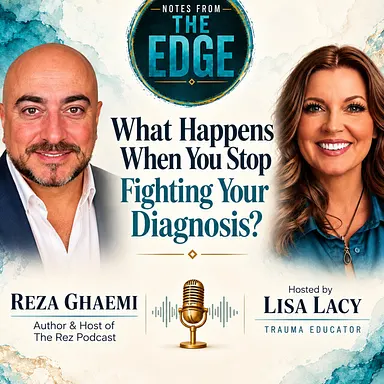
Hey, hey, my friends. Welcome back to another episode of Notes from The Edge. I am your host, Lisa Lacey, and this is the place we have the conversations we should have been having all along. Guess what? You ain't talking about it. So today we're gonna, with my special guest, Reza Ghaemi. Now today we're going to be talking about What happens when we stop performing in order to survive? What happens when acceptance stops feeling like surrender and becomes the beginning of recovery? So my guest today is the author of Bipolar Is My Superpower: How Acceptance Changed My Life, and he is the host of his own podcast, The Rez Podcast. After being diagnosed with bipolar 1 disorder just in 2018, He began moving through denial, major manic episodes, hospitalization, stigma, substance use, and the consequences of resisting treatment before discovering a different relationship with his diagnosis. Today, he speaks openly about all of those— medication, faith, family support, personal responsibility, creativity, and the self-awareness that helped him actually rebuild his life. Welcome to The Edge, my friend. I'm so excited. We finally made it here.
How are you today? I'm great.
Thank you so much, Lisa, for that intro. Um, it was such a pleasure to be on your show. And yes, we did finally make it.
We had some technical difficulties. There's always some involved, isn't there? My poor husband. Guys, we had some, uh, we had some internet issues that, uh, required a little— a few little curse words. I'm glad the camera wasn't on. But anyway, all right, Reza, it's Notes from the Edge. We're gonna just jump right in.
You said acceptance was the turning point. for you. Um, but what did you have to stop fighting before your life could actually change once you got this, this late-in-life diagnosis just in 2019 when the world was about to go crazy for a little while?
Yeah, so in 2018, the Persian New Year is on March 21st, the first day of spring. I was with my family. We were having dinner, or lunch rather, And I was irritable that day. I had been expressing the very textbook symptoms of hypomania. And I was doing stuff like that I felt grandiose. I felt like I was being watched. I felt like I was famous. I felt I was picking up trash. And at the same time, I was very religiously spiritual. I was picking up trash from the ground, putting it in the garbage can. I don't usually talk about what I do in my episodes, but this just came to my mind. I was kind of doing like—
We like rabbit holes. You're already down one, roll with it.
I was doing like, to me in that moment, I was, I felt I was in such a high state that I wanted to give back. And one of the ways I was doing that is by literally picking up the trash, the garbage from the ground and putting it in the garbage can. I remember vividly driving in a car wash, being in a car wash line, lineup, and I saw trash and I got out with a suit. I was working at a major tech company at the time. Fancy suit, step outside my fancy car, and people are like probably thinking, what the hell is wrong with this guy? But I was picking up the trash from the ground. So, so those are the kind of things that I was doing in my hypomania— spending a lot of money, not sleeping much. And when you were first— eventually what's gonna happen, Lisa, is you're either gonna end up in the hospital, or for some folks that have such high self-awareness and such compliance with their family members and their doctors, they're gonna comply to the medication right off the bat, which saves them hospital time. This typically happens with type 2 bipolar people.
I'm type 1. And with type 1, the episode is so severe that you do not have the self-awareness to know that you need Help. So once you're in that state, you think it's real. You think it, you know, it's, it's real. And so I ended up in the hospital that day. And initially, when you end up in the hospital, they put you on very heavy, heavy medication. We're talking things like olanzapine. This is known to be a horse tranquilizer, Lisa.
Mm-hmm.
So imagine just how much it sedates you. And that feeling that you were at during your episode, now all of a sudden you're sedated to the point where you're just sleeping in the hospital. And then on top of that, they're telling you now that you have this thing called bipolar disorder. You don't want to hear that. Who wants that? Who wants to hear that quote unquote they're crazy? Because that's what we hear in the media and in pop culture. Bipolar disorder is for crazy people. And that's how they show very nasty depictions in movies and stuff. Anyways, so the stigma is there, the fear of the diagnosis is there, the medications have these side effects. You don't— you want to be— you don't want to accept it, so you go through denial. The denial is a very common thing I observed among the folks I was in the hospital with. And to this day, Lisa, this is why I wrote the book. And if you— if I can show the book cover.
It's your show.
Yes, show the book.
Amazing. So I'm very excited. Um, so Bipolar Is My Superpower: How Acceptance Changed My Life. And, uh, quick disclaimer, the title does not glorify mania or psychosis. It is what you— the resilience I built afterwards. But, but just, just to kind of finish this, my— with the story, I was explaining that I had a few friends of mine that reached out to me over, over the past while, and they would say things like, Reza, I don't want to take my medication. I just— do you think that's cool? Like, I, I'm gonna stop my medication. And I'm like, in my head, I'm like, dude, how many times do you have to— I don't know if I can swear on your show. Probably not. I won't do it.
Yeah, we were trying to get—
I've been swearing and have been told that we need to get the explicit ratings off.
Okay, we got it. Oh, it was just coming out, so I wanted to be careful.
I was actually going for the explicit rating. Apparently that was not the way to go.
So I said to myself, how many times, man, do you have to have an episode? You've been in this— you've been bipolar for years, and you're asking me if you should go on your— off your meds? Are you crazy? Excuse the pun. Are you crazy? And so that led me to writing the book Um, which ultimately took me 5 years, Lisa, to accept that I need to, to, to be on my medication to stay well. And I need to— that's the first thing. And then the second thing is by working on myself, by building the recovery skills you learn in support groups, from your doctor, you, you know, you learn that you need to, to get your sleep, always be monitoring your sleep. always be doing other things. And, and again, my, my important thing is the medication. And so I decided to write the book because I noticed this was such an important thing that, that people with bipolar disorder face, is that they're trying to constantly to fight it, to manipulate the doctor, to say, no, it was drug-induced, I don't have this, I don't need the medication, this, that, and the other.
And my message to the, to the community of bipolar disorder people is Please, please, please take your medication and give it a chance.
Yeah, well, I think, I think what happens for those of us who have had a history of psychosis and a ton of labels thrown at us is we are taking said medication and we start to feel better, right? Then do you feel like maybe some of it is that we want to be so normal? Well, I'm normal now. Everything's fine.
I feel great now without piecing together that it's probably the medication that's helping us feel better, right?
Yes. So it's these, it's these games of denial that we play with ourselves, right?
Well, but Lisa, when you say feel better, you see, with bipolar disorder, when you say that, like, are you saying that people want to feel like in the manic state that they were in? Or because again, when I was in my manic state, I didn't know I was unwell. It was the realization after recovery That's when I'm like, oh, now I know I wasn't well picking up trash, you know, like that. Right. But at the time, I didn't know I was unwell. Does that make sense?
Yeah, that makes sense.
But I see your point. Yeah, I definitely see your point. For those with type 2 that are more self-aware, they're like, oh, now I'm well, you know, and I don't need the meds anymore.
Well, yes.
And then they relapse. So yeah.
Yes, yes, yes. So Talk to us about when you were first diagnosed, because I think for a lot of people that get late-life diagnoses, did it scare you? Did it answer some questions for you? Did it help provide some relief, explain some things in your past? Talk to us about getting the diagnosis, especially for those listeners out there who may think there's something going on, or that their family members may have told them there's something going on, and that might be a little bit resistant to getting some extra support around it.
For sure. The hardest thing about— definitely no relief. No. Again, this is something where it kind of came out of nowhere, Lisa. Like, it came out of nowhere. Like, I, you know, I'm starting a job at this major tech company. And all of a sudden, I'm feeling great, everything is fine. And then I realized that I have bipolar disorder. And everything I thought was real was not real. So basically, what I'm saying is, And then on top of that, the medication has so many side effects. The ones they give you early on, for some reason they give you really bad ones to start with. They don't give you the good ones.
Here's the real heavy stuff. Yeah, they give you the stuff that's gonna sedate the hell out of you to start off with.
Yeah, at least in my case, that's how it was. And I swear to gosh, I wish that they had just started me off with Abilify that I'm on now. Because it's been great for me. Again, this is— I'm not being sponsored by Abilify. I should probably contact them though for a sponsorship because I'm promoting them so much these days. Um, but I'm grateful for them to have released such a, a drug that is working for me personally. But again, so that's all part of it is why you're in denial because of the bad medications sometimes. And then you just, you don't want to be on the meds and You just want to do whatever you can to be off of the meds. And that's really not the right way to do it.
Yeah, it's definitely, it's definitely a slippery slope. So yes, talk to me about your book, Bipolar Is My Superpower. And you've already addressed, guys, he's already addressed the fact that he's, he's not downplaying any of the symptoms associated with bipolar 1, because it, it, we're going to talk about it, Reza. I'm assuming it can be hell. How do you talk about the perspective as far as resilience you gained without romanticizing the real dangers of mania and psychosis?
Yeah, that's a great question. And I appreciate the question and the opportunity to talk about that. So basically, I often say to people, imagine you don't have bipolar disorder, right? You're just kind of a quote unquote, a normal person. You know, you don't need to really be learning about CBT and DBT and all this nerdy psychology stuff that we learn about in recovery. But then when we are bipolar, and we go through the hospital, and then we're coming out of that in recovery, oftentimes, they put you in support groups. And especially, at least in Canada, I'm very grateful that we live in a country here where we have access to this for free. And so they put you in all this stuff. And now all of a sudden, I can nerd you out, Lisa, on mental health stuff. I'll be like, Lisa, boom, boom, boom, CBT, DBT, opposites, like, and it's like—
All the acronyms. All the acronyms.
And now that's my superpower, Lisa, because I'm so, so much more smart and so much more wise. That's the superpower. It's not the mania. Although Although, to be fair, the mania does make you very spiritual. And this is in the literature, and it's anecdotally— there's anecdotal evidence many people become spiritual. This is why I converted to Christianity from a Muslim background. Imagine how crazy, quote unquote, excuse the pun again, how crazy that is to convert from a Muslim background to Christianity. And this is all the stuff that happened during my episodes. So I carried the good stuff with me, to be honest with you. And that one of them was, was the, was the religion Christianity.
Reza, what, what was it? So it was a hospitalization? Yes. But what got you there? Was it, was it the people that love and care about you going, yo, something's up, we got to get you help? What was it that got you there?
Oh my gosh, Lisa, I always say if I didn't have my family members, God forbid, I don't know where I'd be, Lisa. However, I do want to say, in one of the episodes, I actually went to the police myself. And I thank God the police car was near me. And I went to them and I said, hey, I need help. Can you take me home? And thank God they took me home. And then my parents explained to them— long story short, they took me to the hospital. But in most cases, if I didn't have my family members I don't know where I'd be right now, Lisa, because who would have caught me? Who would have taken me to the hospital?
Yeah.
Who would have taken care of me? And so it's one of those things where we all in this world need each other. But with us bipolar people, we need our family and we need our friends more than the average person does because they help us when it comes to catching these episodes. when they happen. And supporting us during recovery.
What, Reza, what advice do you have for family members of people that may be struggling? Because that's not always the most comfortable conversation to have.
No, I would say my biggest advice to family members is, please do not judge the behaviors of these— of the person experiencing the episode please don't judge them based on what they're doing during the episode, if, if that makes— if it's hard to understand that. Because imagine you're in an episode and imagine I say some mean things to you.
F you.
God forbid. Let's say, right?
You almost said it, didn't you? And it is.
So you just have to be a very forgiving person and realize that there's something going on. There's some chemical imbalance, probably. Please forgive that person and also understand that it's going to take some time for that person to even recognize that he was in that state and just be as supportive as possible and try to research. If, let's say, you're a mother or you're a father or you're a sister of somebody with bipolar disorder, Take the time to understand this condition. Do some research, right? ChatGPT it, you know, understand it more. Don't just sit there and judge the person based on the behaviors of his episode, because that would be unfair to you and him or her.
Yeah, yeah. And instead of deepening your bond in, in healing and recovery together, it's just gonna, um, drive, drive a wedge. So, um, why— okay, out of everything you could have written about in your book, you chose acceptance. When, when did you kind of get out of some denial and go, okay, this is it, this is what I've got to manage, life has changed a bit for me? When, what was that moment or moments for you?
You know, Lisa, I wish there was some like, significant moments that, that happened. And I wish I could tell you that, but really the way that it happened was through time and through multiple episodes. And I know it's kind of like, I wish there was an easy fix to people where I can say, buy my book and you'll accept this in 2 days. $9.99. I wish it was like that. I really, I wish I could say that.
He's not saying 2 days, guys.
In my case, it took 5 years. And listen, when you're learning the piano or the guitar, you can't learn those things overnight. And you can't learn them in 2 months either. And so you have just got to be very passionate and practice learning them. And working on yourself requires the passion for you to want to become a better version of yourself. That's my message. And that's why acceptance in both addiction recovery as well as mental health recovery, the very, very first step is acceptance. That's why in AA meetings, I never understood why they would always say, my name is Reza and I'm an addict. I'm like, what the hell are you talking about? I'm not an addict anymore. I'm here, man. But they would always tell me, they're like, no, no, no, you've got to accept that you're an addict. And now I understand those folks. So mad props to the AA people. Because they taught me that, what that means. And same with recovery and bipolar. You got to accept it in order to get better.
Yeah. And guys, there's no— is there a destination? Is there a destination on this recovery journey we go on?
We are all an unfinished product, Lisa. We are going to get— we need to get better until the day we die. And there's just levels to this stuff. You can get better and better and better at it.
Yeah, yeah. And I will say this, the, the time, the repair time gets shorter. So for example, what used to tank me for 2 months and then tank me for a week, and now it may tank me for an hour because what do I have now? I have tools, tips, skills, and resources that are in my toolbox that weren't in there before. So Yes, it does get— and it's worth it. Is it worth it, Reza? The recovery journey?
It's totally worth it. It's totally worth it. Again, you just, you gotta, you gotta—
I love your word passionate about your own recovery.
Yeah. Yeah. And again, just, it's not easy, but it will come to you one day. You just got to give it some time and just trust the process. Trust the process.
It does take time, and it takes people different amounts of time too, my friends. It takes what it takes for you, for our individual builds and designs and brains that even with the same label or the same diagnosis are going to be totally different. So what may take Reza 5 years may take me 7 or may take somebody else 3. So yeah.
Or even 1. Or there's, like I mentioned, there's some people that It could— there could be like, oh, I have my— thank you for telling me. Now I'm, you know, they could take it so they could receive that information so well too. I'm sure there's those folks.
But no, I'm smarter than that. I remember being in inpatient rehab. They told me I was trauma bonded. I said, I'm smarter than that. That's okay. No, I'm smarter than that. Yep. About 3 years later, I was like, oh hell, they were right. Okay, well, we might want to do something about this situation.
Yep.
All right.
So medication for you, faith for you, family support, and personal responsibility have all been pivotal parts of your own recovery. What does taking personal responsibility for your mental health look like without turning it into the blame game, whether it's blaming other people or especially blaming yourself with the inner critic and self-criticism and judgment? What, what is the difference there? How do they show up differently?
I kind of lost— so can you repeat the question one more time? Sorry, Lisa.
What does taking personal responsibility look like without turning it into self-blame or criticism?
Got it. Medication. For me, medication is taking the responsibility is number one. For me and for anyone with bipolar disorder should be the medication is, is number one, is your responsibility to have the awareness to realize this is not— I'm not trying to undermine what depression is or what ADHD is or what anxiety disorder is, but this is something different than those things. Those things you can do without the medication from what I've seen in the literature. But with this condition, trust me, this is not my opinion. This is the opinion of the majority of the psychiatrists out there. You need your medication in order to stay well. And if there's any doctors trying to sell you on something else, I would double, triple check what their credentials are.
Um, always triple check anyway. Yeah, always triple check anyway. Do you do your own research, guys? Do your own education so that you can own it. as, as, as your own. Reza, how is it different? Talk to me about that. How is bipolar 1 a little bit different than— because you have obviously educated yourself so much on it. How is it different than, say, depression or anxiety?
Well, I mean, I'm sure clinical depression can be severe. And I may want to take back what I just said a few seconds ago, because I was kind of thinking out loud. But the difference there is in depression.
Biologically, what's the difference? Let's do that.
Yeah. I think that the consensus really is that in bipolar disorder, there's a chemical imbalance. And again, don't quote me on that. But with clinical depression, for example, I do think it's less of that scenario of there being sort of the chemical imbalance. And it's more deep-rooted in your psyche and your thought patterns and the way you see the world. Whereas bipolar disorder, it really just comes out of nowhere. I was a happy, happy, happy kid all my life. My parents were good. I wish I had a— I state this in the book. I wish this book was about me uncovering my childhood trauma, Lisa. I was a spoiled little child. They bought me everything. They spoiled me. They were great parents. They still are. They bought me the best video games when I was a kid. I, I couldn't ask for more. I don't have a childhood trauma story. This just came out of genetics and maybe drug use, and that's it. But what I'm trying to say is, like, with depression, I think that there is more of a cause as to how it happens to people. With PTSD, we can see, okay, well, it's from this.
With anxiety, we can uncover it a little bit easier with CBT. But when you're going through a manic episode, Lisa, and you find yourself on top of a tree and you think you're Jesus, that's a little— that's tricky. There's got to be something going on there, and you need medication for that.
And you believe it wholeheartedly. Yeah.
Wholeheartedly. Yeah.
Yeah. Yeah.
So, um, thank you. Thank you for clarifying that. So for any listeners out there, Reza, who in one of two situations, maybe they just received a diagnosis late in life, it just came out of nowhere on them too, or maybe they know something's up, maybe their family has told them something's up, And they're scared or terrified or don't want to deal with the shame and stigma. What would you tell them today about reaching out, getting the right support, getting help?
It's tricky, Lisa, because I do know that in some cases, people are misdiagnosed. And so what I would say is, Definitely, if you're in Canada, we have public healthcare here. If you're in the United States, I wish you— I pray for you that you can get to see a doctor. Right? And so I would say this, the first thing is to talk to a therapist. I mean, if you have self-awareness to know something's going on, then good for you. You don't need to take 5 years to accept this. Right? By all means, talk to a doctor. I was— what I would say, if you are— to address what you said about if your family members are telling you that, you know, something's not right, right, Reza? You're spending a little too much money, you're not sleeping much, etc., etc., etc. In those cases, I would say, again, it's hard to have the self-awareness to trust your family. No one's going to do it, Lisa, but I would say just, um, please, please, if you're listening to this and your family is telling you this, my story, if I had listened to them, probably I wouldn't be in the hospital more than once.
So, you know, so I'm saying listen to your family members. They love you. Listen to your doctors. They're not all crazy. Some of them are, but yeah, that's a different episode.
Some are, some are, some are. And it's, it is a tricky situation because if you don't know, you don't know. And if you don't think anything's wrong, then why are you going to listen to people telling you that something is wrong if you don't think anything's wrong? But so, friends out there listening, you know, if you have people in your life that have proven themselves to be, um, supportive and love you and in service to you in the past, there's absolutely no reason for them not to have your best interest in mind with these concerns as well.
You couldn't have said it any better.
Thank you for that.
Yeah, yeah, yeah. So, all right, what are we going— what else are we going to learn? We're going to learn acceptance from the book. What else are we going to learn? Some of your journey, I assume? Yes. Yeah.
Gosh, I gotta, I gotta look at the chapters again. And then the What This Condition Is Not. One of the chapters I talk about is It's stereotypically, we think that by, you know, Katy Perry, because you're hot and you're cold, and that song, right? Hot and Cold. I forgot the lyrics, but she's talking about an ex of hers that had bipolar in that song, right? And she describes it to be this like moody guy. In my case, Lisa, I was never— I'm still to this day, I'm not a moody person.
I'm not.
I'm very— I'm pretty— I'm a pretty chill guy. I swear. I'm being honest with you. I'm the most chill guy in the world. And outside of my episodes, believe it or not, I'm living a normal life. I'm a podcaster. I'm a DJ. I have a sales job in the daytime. I'll be starting a mental health program soon to go to school for that. I don't get upset. Ask my girlfriend. I'll give you her number after the show. Call her up.
We're verifying. We're verifying because the stereotypes out there certainly don't depict that.
She'll tell you. She'll tell you. I am a normal guy. It's just when I don't take the medication, I've had these weird episodes outside of it. When I take my medication, Lisa, I swear to God, I am a chill, normal guy.
But see, that's how the stereotype is. I mean, it's so ingrained in our conditioning that you have to be like, I swear, I swear, I swear it can be different.
It can present differently, guys.
Yeah, with Type 2 though, Lisa, with the Type 2 folks, it is a little bit like the stereotype with Type 2, because the episodes are less severe, but they're more frequent. So it's the Type 2 that they— the stereotype is the Type 2 bipolar. Not to offend any Type 2 folks here. I love you all. And you're in my—
You've been doing a lot of apologizing on this podcast.
You got to be careful.
I can't can't say anymore. I don't know what we can and can't say. It's Notes from the Edge. It's okay. We have an explicit rating already. It's fine. All right, Reza, how can people find you?
How can they find the book?
Where should they go?
And how can they find the podcast?
Yeah, thank you. Um, so the podcast is the— it's basically the website is rezpodcast.com. R-E-Z like zebra. rezpodcast.com. My Instagram is Reza G Life. And the book is available on Amazon and there's Prime shipping, $9.99 USD. I think it can really help you with acceptance if you have the self-awareness to understand that you're not there yet. Thank you for letting me—
I love it. Well, I'm not done. I still have 2 more questions we always ask everybody.
You're not getting out of here yet.
Guys, you don't have to write any of that down. We're going to have clickable links to the book, to the podcast and, um, to his Instagram, um, so you can, uh, check out, uh, his content. Uh, Reza, before we let all of our guests go, we ask 2 questions. Are you ready for the first one?
I'm ready.
All right, first question is, in your own life, what did you perform in order to survive, and what did setting that role mask or performance down do for your life?
I think you're, you're, you're letting me have it easy tonight, aren't you? So if I'm understanding right, are you talking about performing an art? Does that count?
I'm talking about performing people pleasing or overachieving, or—
Oh, I see. I thought you were talking about like an art performance. I was like, oh, I'm a DJ.
No, I've been a performer.
Yeah, before.
That's Too easy. Not performing on stage or DJing does not count either. You can't say yes, you're a performer there.
Hang on, I wanted to read Ali's comment before you get to your answer, so that gives you time to think. Um, Ali says, my impression of this podcast is I found its content extremely useful, especially for younger generations. I believe that we should bring scientific knowledge and ideas out of the shelves of libraries and into society through open social media platforms, making them accessible to everyone at any time and any place. Sincerely appreciate the opportunity. So thank you, Reza. All right, now you get to answer. You had some time to think.
So, Lisa, one more time, just to remind everybody what the question was.
What have you performed in your life in order to survive? Like, in survival mode?
Okay, in survival mode. So what have I performed to To, to go into survival. I'm sorry, I'm not trying to bug you.
Have you been— have you ever said you've been bugging me since yesterday? I love you to death, man. You're like, I'm sorry.
I'm like, I'm not trying to push your buttons.
All 76 freaking episodes on Facebook have been private the whole time, dude. I'm so glad you pointed that out. I was like, what? No wonder people haven't been showing up. Um, what— where am I at? I don't know. Now you threw me off.
So, so what have I performed?
People pleasing, overachieving, competence is camouflage. anything that wasn't you? Did you ever in your life throw on armor or a mask or anything that wasn't really authentically you?
Yeah, I understand. Yes. So after what would happen, there was a pattern that would happen throughout my recovery journeys. Every time I would come out of the hospital, that would affect my career in a very negative way. So remember, during my job, I would have these up moments, manic episodes, and then I would go to the hospital. So initially, people would be like, like, wow, Reza's the coolest guy. He's super confident. He's on top of it. And then suddenly I wound up in the hospital, for example. And then when I went back to work after the medical leave, they'd be like, this guy's a different person. He's down now. Because they— again, those meds that were bad, and I wasn't in acceptance. I didn't tell people why I was off work. I kept it a secret. So now they're thinking, this guy was off for 6 months. That son of a gun, now he's back to work. What the hell was he doing? Maybe he was just on vacation. Maybe he was just on his couch watching TV and eating popcorn. They didn't have the context, Lisa. So now if it ever— God forbid if it ever happens to me— now I'll go into work owning my story.
Hmm.
I'll be like, listen, I'll be— I'll pull a Jerry Maguire on them, you know? I'll be like What does he say in the show? Jerry Maguire is like— I forgot, I forgot. But he, um, he's like, I'm not gonna flip out. So, so basically what I'm saying is I will own my story and say, listen, I have bipolar disorder, but this is what I'm doing about it. I'm, I'm working on myself. I'm sleeping. I'm on— oh, I'm on my medication. That should have been number one. I'm on my medication. I have a support system. And so don't worry. Don't worry. I'm not gonna do—
Talk to my girlfriend.
I promise. Talk to my girlfriend. But yeah, so that would, that would be it. It was, it would be the fear that I had. And now I've replaced the fear with love.
Wow.
There we go.
Yeah.
Very biblical.
That's, that's, well, and such a big Transformation going from complete denial, complete stigma, complete shame, not wanting to share it, to being like, hey, here's my book.
That's big.
That's huge.
Yeah, it's brave, my friend. It's brave. So congratulations on the book. Congratulations on reaching a place of acceptance. All right, last question. What do you want us to be having more human conversations about that we're not talking about?
Obviously, I would say mental health. And it's okay. Not because it's become so quote unquote cool, the cool thing to do. No, not because of that. But just because, again, your story not only could help other people, but other people could help you. I'm not saying go up to people and just dump your crap on them. And again, it's the place it's coming from, Lisa, that's key here. If I tell you, for example, if we're going on a first date, and I'm not gonna, I'm not gonna, you know, say, I have bipolar disorder, so I'm gonna be up and down, I'm gonna be hard to deal with. No, don't do that.
Guys, not a first date conversation. Give us some time. Let their red flags show and see if you even need to have the hard conversation.
Yeah, that's heavy. That's heavy for a first date. Because people— it's unrelatable.
And they haven't earned the right to know yet.
They haven't earned the right to know yet. Instead, when you do reveal it to somebody, you gotta say, listen, I do have this condition. But guess what? I'm managing it by medication, by frequent visits to my therapist, my sister, my dad, my mom, etc., etc., etc.
I love it.
I love it.
All right, friends out there, I'm gonna ask you the same question I asked Reza, and, um, that is, in your own life, what are you performing or putting on in order to just get by? And what might setting those roles, masks, or performances down do to lighten your load just a little bit? I am your host, Lisa Lacey, here with my special guest, Reza. And when you find the answer to that, we will both see you at the edge. And be sure to click all the links and go check out Rez as a podcast host, all right, at therezpodcast.com. Thank you so much, Rez. I appreciate it.
Thank you, Lisa.
What happens when accepting a diagnosis stops feeling like surrender and becomes the beginning of recovery?In this episode of Notes From the Edge, Lisa Lacy sits down with author and podcast host Reza Ghaemi for an honest, funny, and deeply human conversation about living with Bipolar I Disorder, surviving mania and hospitalization, resisting treatment, and eventually learning to work with his diagnosis instead of fighting against it.Reza, author of Bipolar Is My Superpower: How Acceptance Changed My Life and host of The Rez Podcast, shares why acceptance became a turning point in his recovery and why calling bipolar his “superpower” is not about romanticizing mania or psychosis. It is about the self-awareness, resilience, recovery skills, and responsibility he built afterward.Lisa and Reza also dig into stigma, medication, faith, family support, disclosure, relationships, and what changes when you stop hiding your story and start owning it.In this episode:• Bipolar I Disorder, mania, psychosis, and hospitalization• Moving from denial and stigma toward acceptance• Medication, treatment, sleep, and building recovery skills• Mental health disclosure in work, dating, and relationships• Replacing shame and fear with self-awareness and ownershipConnect with Reza Ghaemi:The Rez Podcast: https://www.rezpodcast.comConnect with Lisa Lacy:https://www.lisalacy.comWhat did you perform in order to survive?Welcome to the Edge.See Privacy Policy at https://art19.com/privacy and California Privacy Notice at https://art19.com/privacy#do-not-sell-my-info.