
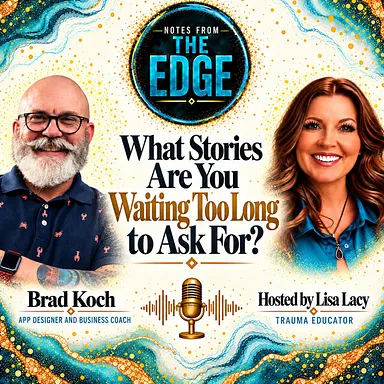
This transcript of “What Stories Are You Waiting Too Long to Ask For? Preserving Family Stories with Brad Koch” from Notes from the Edge was made with HappyScribe’s speech-to-text technology. Related: AI note taker.
Ads in this audio differ from the text. Tap the sentence you're hearing to follow along.
Synced: the text now follows the audio.
Welcome to Notes from the Edge, where we have the conversations we should have been having all along. We talk about the things that we're not talking about. I'm your host, Lisa Lacey, writer, trauma educator, executive advisor, and author of the upcoming memoir Notes from a Certified Madwoman. Welcome to the edge. Hey, hey, my friends! Welcome back to another episode of Notes from the Edge. I am your host, Lisa Lacey, and this is the place we have the conversations we should have been having all along. Guess what? You ain't talking about it. So today we're gonna with our special guest Brad Cook. Brad is a business coach, entrepreneur, and former United States Marine whose work focuses on health. Helping businesses regain control of their business so that it can help them with freedom. And he now, as an entrepreneur with all that experience, has a passion project that he just launched. And we're going to be talking about that because after working with so many businesses to get them to a place of true freedom— because isn't that why we start them?— he has started a new one that I think is going to bring a lot of us some deep understanding of where we came from.
So Brad, welcome to Notes from the Edge. How are you today, my friend?
I am wonderful. Thank you so much for having me.
Yeah, well, we were kind of doing a podcast before the podcast, so, uh, and everybody missed that because we weren't hitting the record button. So tell us about what you have just launched and kind of the the origin story of about how it came about?
Sure. So the, the name of the passion project is called The Story Project. It has officially launched in a founder's capacity now, and the URL is storyproject.app. What it is simply is an easy way for families to request from their elders— I call them VIPs when I talk about the Story Project— to share memories and stories from their youth, lots of times before they had kids. So you get to know them and know how they are the way they are. Many years ago, my wife had the brilliant idea of bringing our video camera, and back then it was huge, and kind of hiding it. And we had a conversation on a, on a patio porch with my mom's mom and dad. And we just started talking and recording and asking questions, and, and one story would lead to another. And we really didn't understand how, how great this was going to be, but at the end we had this beautifully raw, you know, archive of my grandma and grandpa, and we made copies and gave it to obviously my mom and my brother and their family. We, we did it a couple more times, but not in that kind of way, and then never thought of it again.
2 years later, or 2 years ago now, my wife lost her dad. And one of the first pieces that I could just see was the regret that she didn't have more video, audio of him, like we are today, being able to see his face and hear his voice and his mannerisms, the way that he would stroke his face. And it just— we just reflected and said, there's, there's a better way. There's a way that we can be proactive. And so that's what birthed The Story Project, is this desire to help families easily get stories and memories from their VIPs.
I love it. I love it. Well, Brad, why do you think we learn better as humans from stories rather than like a, here's 5 frameworks or here's— we learn better as humans from stories. Some of our greatest teachers have used stories to teach us. Why do you feel like stories hit us differently?
I think it's part of our DNA. You know, I'll put my business coaching hat on for 2 seconds. And as a marketer, stories is what moves consumers to make decisions about brands and purchases. And those that can use story well end up doing very well in business. I think that stems from our hundreds, thousands of years ago, depending on what your belief is, we only learned what was passed down through a story. And I can speak for personal preference in, in school and just in general. I tune in at a different level when it's a story. I can see myself in the story. I can— if the storyteller is doing a good job, then I can really see myself walking alongside of them, as opposed to— You know, just this linear, like you just mentioned, framework. 1, 2, 3, 4. You can do the same thing in my mind as passing on that framework information. But if you do it as a story, it's going to resonate and it's going to stick. And I think that person's going to be able to recall it much better.
Yeah. Yeah. And I think the key is what you said. If we can see ourselves in it, we are actually having an experience.
Right.
Of it. And there, there's where we're pulling the, uh, the lessons from. So, um, the reason I'm so excited about, uh, your passion project is, um, I too lost my father. And, uh, he was this tough badass biker dude, and, uh, everybody was kind of scared of him. And he had written me letters while he was on the road doing whatever it was he was doing, um, And I never opened any of them, and I didn't open them up until after he had passed. And what I discovered was he was not the guy we thought he was. He was a prolific writer, he was a poet, he was a sensitive, and he loved me very, very much. So my third book will be a memoir and collection of all of his letters. So, um, yeah, when you told me, hey, let's make this about my passion project, I was like, absolutely, heck yeah. And why do you feel like That's important. And I loved that you pointed out being able to remember their mannerisms and the sound of their voice and what they looked like, even. Like, we forget over time, it feels like.
We do. And it won't be long before technology allows us to, to add another sense, um, the sense of smell, into stuff like this. So, um, He was— her dad always wore Stetson. He wore way too much. But he would walk in a room and 2 weeks later it would still be wafting around. But it's that smell just— I catch my wife going down the cologne aisle and just smelling it just so she could be taken back. But really quick, because my brain works this way, Your dad, what kind of motorcycle did he ride?
Oh, he had a, he had a Harley. It was a Fat Boy Harley, uh, with the long, long, long front end. Um, okay, I would, I would help him. That was our connection. I would help him polish his bike as a kid. There was one time he, he rode, he drove me to school on it. It was in the 4th grade. I still remember it. And all the little kids were in a fence in the front of the school, and boy, when we pulled up on that Harley, I thought I was the coolest coolest kid in the school. It was amazing. But also, he terrified me a bit, like he did everybody else. But that was all a front. Uh, you know, he had some hard times and spent some time in prison, and it hardened him a bit. But underneath, in all of these beautiful, beautiful letters with his gorgeous handwriting, he was a different guy and, uh, so wanted a relationship with me. And I was too angry to give it to him at that time. I will say this though, Brad. in his transition. And with me becoming a death doula and a grief recovery specialist, I have a great relationship with him now, if that makes any sense to you.
It does. It does. It's funny. And in some ways, maybe you wouldn't have been as successful as you are in that area had, had you not have that drive, you know, assuming that this desire to stay connected was part of your drive to become so good at what you do. But, um, I think stories— well, let's, let's face it, um, I know my parents. I've, um, I'll say I'm 58 years, 57, 58.
We forget the older we get.
I know, I know.
The years start blending.
So, so I, I've known my parents for that long. And they tell periodic stories about when they were kids, and you glean a thing here or there. But there's— I'm in this period as they are old, and I see time as this really, really important thing to understand better. Like, my dad was in a small town. He was a big-time pitcher, you know, Couldn't walk down the street without someone, you know, hey, Al, and, uh, go get 'em, you know. And they were just all— so he had— he couldn't do any wrong, but he had all these other pressures carrying this town on his shoulders and all of that. Like, he can't just tell me about it, but he can tell me— he can bring me there with him in a story. And as I was developing this app, I was using my mom and dad as guinea pigs. And I would ask some of the prompting, and we can talk about some of the specifics if you want, but some of the prompting was, you know, what was the first thing you got in trouble for? Tell me about that, you know.
Yeah.
And he probably wouldn't appreciate me sharing what that answer is, so I won't. But, but there are so many ways that we can, we can learn about people in our family, and the more we learn, I think the stronger the connections are.
Yeah, yeah. And then I think we, we remember that we have roots, and remember, we remember that we came from somewhere, and we remember that we belong, and we remember that we Um, are loved. And also, I think, Brad, to this app that you've developed that can help people too, is we start to understand our family in a different way.
Right.
And may understand their struggles in a different way. And, you know, knowing my father in the way that I know him now, you know, I totally let him off the hook for all the abandonment issues I ended up with, all the trauma I ended up with. I mean, there were reasons for that. And so when we can look at our other family members as human beings through their stories, we start to experience our past, our trauma, and ourselves in a completely different way. Wouldn't you agree?
Oh, 100%. I mean, I, I am the way I am because of you know, in many respects, the ups and downs of my parents' life because it came through in their parenting of me. And my hope is that, you know, the Story Project is a conduit. It's a tool to help people be more in the moment about wanting to know more about their family. And when I say family, I'm speaking broadly. It could be a dear uncle. It could be someone in your, in your, your sphere that has been influential and it's someone you want to connect with more. But I'd love to see at some point that people don't necessarily need a tool like the Story Project because they're being intentional in their real life. They're not waiting to this point to where They see time expiring and they go, I got to play catch up. I want to know as much as I can.
Well, I think the beauty of the app is this. I think it has great potential to bring people into that deeper bond because, say for instance, when you were talking, I was thinking about my first cousins that I was an only child. So they were the closest thing to siblings I have. But as life has gone on, we have, you know, gone our separate ways. life grew apart, but man, I'd love to hear some of their stories. And maybe hearing some of their stories through the Story Project app would make me pick up the phone and go, hey, how's it going? You know, how's life been? So I think there's great potential for it to really bring families closer together, especially because now we're so spread out. I mean, our tribes don't stay together anymore. We end up spread out and isolated and alone. So walk us through How it works once we get in there and kind of sign up. How does it work for us?
So, um, there's, there's 2 core principles that I wanted to make sure that it was easy to use, that our VIP didn't have to download an app, create a login, remember another password. So that's principle number one. And principle number 2 is By asking a general question, it's like a writer staring at a blank screen. It's, it's hard to come up with it. So I felt like prompting, asking specific questions would be the conduit for them to start thinking of a memory, and it just chains together this awesome story. So it starts with someone that is considered the family admin, and I'll use myself as an example. I may make the decision to subscribe to the Story Project because my parents, who are in their mid to late 80s, I want to, I want to build this archive and I want to understand it so my grandkids understand their Gran and Big Al better than they would just seeing them on birthdays and whatnot. So as the family admin, I— all I simply do is I put in a phone number or an email address, a way to, to send the request to the VIP.
And I also send invites out to people who are family members that would be considered viewers. So we want to record these things, but we also want to share them, right?
Mm-hmm.
So like in my case, I would invite my brother, his wife, his kids, And that's the job of the admin, and it's literally— it's not a job, but out of everything, they've got the most clicks to do. So once that happens, they can prompt a few ways. The system will automatically randomly select a prompt, and let's just assume that it goes out via text. Um, you know, Grandma's sitting in her recliner watching Wheel of Fortune or something. She gets a little ding, she looks at her phone, and a text just basically says, hey, your family has asked you to share a story. And then it'll have a question. And there's a big orange button that says record your story. Now I just want to pause and say the thing that I think is important is they don't have to do it that second. In fact, I would hope they wouldn't. Because when you ask someone that question that's on the spot, they, you know, they get fumbled over the words. But if they sleep on it or they think 2 or 3 days, they'll be able to articulate, you know, as well as they can, a story, a moment.
Once that happens, then the system notifies the admin and all the viewers that, hey, Grandma has just recorded a new story, click here to see it. At 30,000 feet, that's basically how it works. An admin signs up a VIP. Now, you could— a family could have 5 VIPs. It really doesn't matter. Grandma, Grandpa, if they're still around, Uncle Jim, whoever. The point is everybody that's important to that family should be able to engage and start to share stories. That's at 30,000 feet. What also can happen are 2 other things. I know that for me, if I get a prompt and it's a text and I'm reading it, um, that's, that's okay, that's good, and that would get my juices flowing. But if I looked at the text and there was actually a video of me asking the question, so the family admin or one of the viewers could say, instead of just texting Grandma the question, what was the first time you got in trouble, they could record a video and say, Grandma, you know, I want to know, you know, I get in trouble all the time and my mom and dad say, you know, you never did anything wrong, but however.
But now that video is, is now connecting to our VIP a little differently, a little deeper. And the another reason that's important, because at the end of that year, the Story Project will stitch together all of those videos into one video that is edited, that removes a lot of the ums and ahs, if they choose, and put some background music in. So they will have this edited thing and If someone has recorded that, that prompt as a video, it'll show that prompt, it'll show that person asking, and then it'll show the answer. If they didn't and it was just the question, that question will come up. And so you'll see this continuity. Now, one of the questions that you're going to ask, or your viewers will ask, is, all right, well, where are the videos? Because if I'm recording, I don't want these things stuck in the cloud. They do reside on our servers, but with one click you can download that video directly to your phone, your tablet, whatever you want. It's not about keeping the video or whatever. So they're yours. It's, it's nothing that we use, or with the exception of at the end of the year putting those videos together for them.
Yeah, so you actually want to leave it up on the server so that over the course of the year that all that information can be collected and made into a beautiful video for the family, right?
Right. And there's—
you can just pull them down and not house them on the server.
Yeah, well, you could, you could download them and still leave them on the server to be, you know, combined and edited for that year-end memory. One more feature, and this, as you told me your story, I was like, dang, that is, that is exactly what you just experienced. Sometimes it might be important to a VIP to send a message to someone after they've passed. And so they have the option of when they record a message to choose that that message go into a vault as opposed to the, the regular story, um, storage. The vault, nobody has access to it with the exception of the person that they, um, deem. Like, I want this to go to Brad, and what triggers it Is the family admin, that person that kind of starts this process, checks a box and says, you know, Grandpa passed away. So within 7 days, the system will create that video. If it's multiple, it'll put them together and send that out to the one person that's supposed to have it. It doesn't reside on our server at that point. And I, and I think, I don't know, hopefully I'm years away from having to think about this.
I'm probably not, you know, judging from my parents' age. But I think about my wife and, you know, as she's healing, as she's grieving her dad's passing, all of a sudden out of the blue, a message shows up and it's a video of him talking to her. It's like that shoebox you had of all those letters you had collected from your dad. You know, if this technology was around back then, like a video showing up and it's your dad, it's, you know—
It's amazing. And I have 3 pictures of him. That's it, 3 pictures left. So a video, uh, would be amazing to add. To all the beautiful letters that he goes. And what I love too is that you made it so user-friendly. You even thought about not having to create another password. That is pure brilliance because some of the VIPs are not going to be very adept at using technology. So it was very well thought out. I am so excited about this project. I actually want to go look at it as soon as we get done here and get my entire Because we're so spread out, signed up for it. So how can we find it one more time? Guys, you don't have to write this down. There's going to be a clickable link in show notes. But Brad, tell us where to find it.
You can go to storyproject.app. It may refresh to a founder's page. It's in essence no different. And there you'll be able to see exactly what it's like to use it. There'll be videos. If I can get around to it, I was just on my local Fox News talking about the project, and there'll be clips of that. And it's subscription-based. It's not a lot of money. It really just covers the storage and bandwidth of uploading videos and whatnot. And you could upgrade if you want. I think the subscription is 10 stories. You could easily, for a few bucks, add on 5, 10, 20, like if you had a lot of VIPs. But yes, storyproject.app. And yeah, I'd love to see— as many people enjoy it as I can.
I'm excited about it, and big congrats having—
thank you—
something so beautiful come out of, uh, grief and loss. For us sometimes is, uh, um, there's always a lesson in everything that we move through in this human experience here on Earth School. All right, Brad, however, before we let all of our guests go, we always ask them 2 questions. Are you ready for them? The first one?
I'm ready.
Okay. The first one is this: in your own life, what did you perform in order to survive? And what did dropping that role, mask, or performance do for your life?
Well, you just answered the first question. I kind of, I kind of refer to it as a mask. It's probably performance. And when I was 17, I went into the Marine Corps and I was in boot camp and I was still really young. I had to be someone I wasn't. I had to be the future Brad in order to get through. And so I think Everybody deals with stress and trauma or, you know, hyper experiences differently. But on the other side of it, you sort of have this awareness like, oh, all right, I just, you know, I went from A to B. I didn't die. And I can see how I got there, right? And so you have this understanding. But the second part is, what did I realize when I dropped it? I don't know that I dropped it. I'll be honest, that persona has probably changed over the years. It's not the 17-year-old kid trying to be Rambo or, you know, to get through basic training. it's, it's somebody different. But, um, yeah, does that answer your question?
It does. It absolutely does. I, I— and what I love is that— and sorry, uh, my husband's home and the dogs go insane.
That's okay.
Every day he comes home, it's like it's a new time he's coming home.
That's why I love dogs.
Yeah, I know that. We've got 3, and one's 21 years old. He's a little Italian Greyhound. I've had him since he was 3 months old. Sure enough.
Wow.
Yeah. Okay, my last question to you. What do you want us to be talking about more that we're not having conversations about? What should we be talking about that we're keeping silent about?
Uh, this applies in my business, in business coaching, my 9 to 5, as, as well as what we just got done talking about. It's being okay asking for help, whatever that is. So, and talking about it, talking about the fact that I don't have it all figured out, whatever it is. In my coaching world, that's a business owner who is good at fixing cars but doesn't know how to manage 4 other mechanics. It's okay. That's not your God-given talent. Your talent is, you know, doing the thing. But someone can help you get there, and it's okay. It's not a weakness. Um, I think the more we talk about having to lean on other people for certain things, the better our society gets over time. Oh, I don't hear you. I don't think it's me. No, it's— can you hear me? Technology.
All right, we're back online. I got you.
I got you.
So you were saying— I was saying Yes, get better at asking for help, receiving that help, and letting each other know when we're struggling. I think that's a beautiful thing to be talking more about. And you had brought up the mechanic situation. My husband is in the process of taking over the family mechanic business, and he is a brilliant mechanic, but he will be delegating. We just got him a business mentor. And guys, get mentors too. Don't be afraid to look for mentors out there. So my friends, grab this app, at least go check it out. Um, because, you know, at the— I live with a congenital blood disease. I face my mortality every day. And I know for a fact that when all is said and done, it's not going to be the house, the car, the money, any of that that I'm worried about. It's going to be my regrets and my memories. And I don't want some of my memories Or my regrets to be the memories I lost out on. So this is a great way to, uh, keep some of those memories and remember those little things that our loved ones did that we may forget over time.
It's a beautiful project, Brad. Big congrats on launching it. So my friends out there, I'm going to ask you guys the same question. What are you performing in order to survive, and what might dropping that role, mask, or performance to lighten your load just a little bit. And I'm your host, Lisa Lacey, here with our guest Brad Cook. And when you find the answers to that question, we will meet you at the edge. Thank you so much, Brad.
My pleasure. Thank you for having me.
What stories disappear when the people we love are no longer here to tell them?In this episode of Notes From the Edge, Lisa Lacy sits down with entrepreneur, business coach, former United States Marine, and founder of The Story Project, Brad Koch, for a deeply human conversation about family stories, grief, memory, legacy, and the things we often wait too long to ask.Brad shares how the loss of his father-in-law, and the realization that his wife wished she had more recordings of his voice, face, mannerisms, and stories, helped inspire The Story Project. Lisa and Brad explore why knowing someone’s story can completely change the way we understand our family, our childhood, our trauma, and even ourselves.This is a conversation about remembering where we came from while the people who came before us are still here to tell us.In this episode:• Why preserving someone’s voice, mannerisms, memories, and stories can become an irreplaceable part of their legacy• How learning our family’s stories can deepen connection and change the way we understand our own past• Why waiting until time feels limited can leave us scrambling to ask questions we could be asking now• How The Story Project helps families capture and preserve stories across generations• Brad’s experience entering the Marine Corps at seventeen, the role he performed to survive, and why asking for help is not weaknessConnect with Brad:https://storyproject.appConnect with Lisa:https://www.lisalacy.comWhat did you perform in order to survive?Welcome to the Edge.See Privacy Policy at https://art19.com/privacy and California Privacy Notice at https://art19.com/privacy#do-not-sell-my-info.