
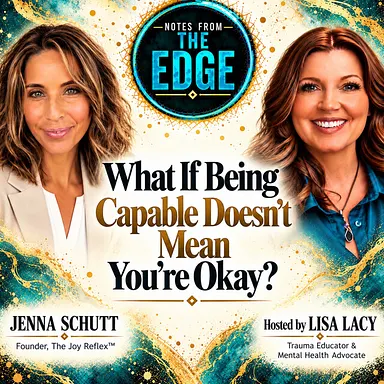
Every line of this episode of Notes from the Edge was transcribed with HappyScribe technology. See also: AI note taker.
Ads in this audio differ from the text. Tap the sentence you're hearing to follow along.
Synced: the text now follows the audio.
Welcome to Notes from the Edge, where we have the conversations we should have been having all along. We talk about the things that we're not talking about. I'm your host, Lisa Lacey, writer, trauma educator, executive advisor, and author of the upcoming memoir Notes from a Certified Madwoman. Welcome to The Edge. Hey, hey, my friends. Welcome back to another episode of Notes from The Edge. I am your host, Lisa Lacey, and this is the place we have the conversations we should have been having all along. Guess what? You're not talking about it. So today we're gonna— and today we're gonna be talking about what happens When survival requires you to become incredibly strong, but eventually you have to ask whether that strength is still serving you or whether you're just exceptionally good at overriding the heavy things like fear, grief, exhaustion, and uncertainty. And we're going to be talking about it with our special guest, Jenna Schutt, who is a former cardiac registered nurse, author, mother, And stem cell transplant survivor who was diagnosed with a very rare, incurable disease at 30 while raising 2 young children. Her journey included— get this— 10 rounds of chemotherapy, serious medical complications, stem cell transplant, and living with graft-versus-host disease.
And Jenna will talk about that too. That experience changed not only her relationship to her body, But also her understanding of the emotions like fear, identity, faith, motherhood, and what it actually means to be strong. Today, she is the founder of the Joy Reflex, where she helps women recognize the responses they have practiced in fear and survival, and intentionally— we like the word intention in here— build new ones that are rooted in faith, truth, peace, joy, and emotional honesty. Jenna, welcome to Notes from the Edge. How are you today, my friend?
I'm great. I'm so glad to be here.
Yeah, I'm so excited to have you here too. Boy, you have been through it. You have been through it. So what struck me when we had initially reached out to each other is you said the words, I performed strength for years. So it's Notes from the Edge. We're diving right in. Talk to us about What performing strength looked like for you? Like, how did that manifest? And then when was there a realization that, whoa, this isn't really me, it's not serving me, although I may be taking care of everybody else in the process?
Yes, yes. Well, when I was diagnosed, I was a young mom, so I was 30 years old, both my kids were in diapers, and so I was very busy as a mom doing all the mom things. You know, when you have 2 under 2, it's a lot of A lot of hats that you're wearing, a lot of things you're juggling because they're both still, you know, not on completely solid foods. They're both still in diapers. They both still need all the things, still in car seats, all that. And so—
And they come with so much, like children, babies come with so many things. Yes.
Yes. And I loved my children and I love— I still do. I still have my children, but I love my children and I loved being a mom. That was really, you know, when I was younger, that was what I always envisioned myself being. But then, you know, you get into these things with really heavy, heavy things. So whether that's a diagnosis or whether it's financial strain or job stress, any of those things, you get into those and you have to really start examining yourself. So for me, that performance strength really looked like I was functioning very well, I was carrying all the things, but internally I was struggling because I could take care of the things. I could show up. I could take care of my kids, make the medical decisions. I, as a nurse, understood what the doctors were saying. And because I was capable, people assumed that I was fine, that I was okay. And, you know, I really realized that being capable can be confused with being Mm-hmm. And those aren't the same things. And sometimes what looks like strength is really survival, and you can become very good at overriding what you're feeling because you believe everyone needs you to keep up with what you've been doing the way that you've been doing it.
And so I think that real strength for me looks like being able to say, this is hard, Or I'm tired, I need to rest, or I need a minute to myself, or I just don't know what to do or where to go or what happens next, but I'm still going to move forward in faith. And so not being confused with being capable, with being okay.
Yeah, yeah. So many of us, I mean, we say, how's your day? I'm okay, I'm okay, I'm fine, everything— yeah, I'm fine. That's always a good one. I'm fine. Yeah, my husband knows when I say I'm fine, it ain't fine. So Well, you— speaking of being a nurse, you were a cardiac nurse, um, before you became a patient yourself. So you did understand everything they were telling to you, but at the same time, was that a strange transition being on like the other side of the clipboard?
Absolutely. You know, knowledge is not always power, and to have all of those things, knowing those things, and then to be the person in the bed instead of the person standing over the bed helping the patient is such an identity shift and just a whole different perspective. So as a nurse, I understood things clinically. I understood things up here, you know, as I'm taking care of the person. But then when you became the patient, suddenly everything is personal. You know, when you're, when you're the nurse, you hear the diagnosis, you hear the complications, the lab results, and you think, what do we do about this? What do I need to do to help this person? And then when you are the patient, you hear the same thing, only it's speaking about you. And so instead of thinking, what do I need to do? You start thinking catastrophically. Am I going to survive this? What does that mean for my children? What happens to my husband if I don't survive this, if I don't get better, if I'm not able to do these things? And so the medical knowledge is there. It's buried somewhere deep inside.
But then the emotional side tries to take over. And sometimes knowing that can give fear more material to use because I knew the things that could go wrong. And so I definitely learned that information and peace are not the same thing.
Definitely not. Sometimes we can have too much of it intellectually. I agree with you wholeheartedly, my friend. So let's, let's get into these emotions that I never label good or bad. I call them heavy and light. That's just the way that I talk about them. But you've described that you had to live through fear. You had to live through a lot of grief of what you thought life was going to be. Certainly some exhaustion, I imagine. My goodness. Uncertainty, chemotherapy, and then eventually a stem cell transplant. Yeah. At what point, Jenna, in, in your own lived experience and in all the people that you've worked with, At what point is survival no longer the only job? Like, at what point does survival change and you start recognizing that you have all of these emotions running sometimes at the same time on the same day going on underneath all of that? When did you realize you had all of that going on?
I think for everyone it's going to be different, but for me, I realized it just when I got to the place where I literally couldn't do it anymore. And it wasn't so much that I realized it like a light bulb came on, but it was like, if I don't stop, I'm just hurting myself physically because I can't do it and I'm continuing to push through like I can. And I think we end up there because we, we tie our identity and our value in what we're able to do and what we're able to produce and those things that we're able to hold up. And when that is stripped away from us, when that part of our identity isn't there anymore, we are asked, who even am I? What even am I? How do I even exist if I'm not able to do X, Y, or Z? And maybe that's being a mom and taking care of your kids. Maybe that is taking care of your house if you stay home and take care of that. Maybe it's your job, because there's no way that I could work when I was going through these things and all of the complications and all of those things.
And so I think that survival mode can, can then become your identity when you live there so long that you don't know how to do anything else. And so when hard things keep happening, then you become conditioned to ask, what's next? What else is going to go wrong? When is the other shoe, you know, going to drop? And what am I needing to prepare myself for? And so survival mode doesn't always look like falling apart. And I think that from the outside, that's what people think, that, oh, she's fine because she looks fine, because she's doing all of the things that she always has done. So she looks great. She looks fine. Like for me right now, I lost all my hair during chemotherapy and now my hair is coming back and I didn't really, you know, care much about my makeup or my whatever. I just was surviving, right? And so now that I look this way and I look more put together, people just assume that I have no other issues. I have nothing else is going on. I'm never tired, but I'm still on oral chemo. I'm still dealing with graft versus host.
I'm still doing infusions every other week. And so sometimes survival mode looks incredibly productive. It looks like nothing is going on and it still looks like you're the woman who gets everything done and everyone praises how well you're handling it, even though internally you can be completely exhausted and completely tired of holding everything up.
Yeah. Yeah. And look healthy, right? You look healthy. Yeah,
yeah, we hear that a lot. We hear that a lot. Good though.
Yeah, yeah, exactly.
Nice. Thank you so much. I appreciate the comment and the compliment, but that doesn't tell you anything about how I'm doing.
That is on the inside.
Yeah. And there, I can't tell you how many people, because when I had chemotherapy, we had a bunch of chairs and it was a bunch of people having chemo for a bunch of different things. And I can't tell you the amount of people that looked like nothing was going on. I think we have this image in our brain of what chemo looks like, you know, and not everybody loses their hair. I didn't lose my hair my first 8 rounds. I did not lose my hair. Wow. And I, I looked like a normal person. I still got up in the morning and got dressed normally and did my makeup, and I had my long hair. My hair was all the way down to my back, and if I didn't tell you You would not know what was going on. And there were many people that were in that same position as I was, and they were just coming in, having their treatments, and going right back to their jobs or to their lives or to their things. And you can never really know what someone's going through until you really take the time to ask them, how are you really?
Mm, we like better questions in here, and that's a darn good one.
How
are you really? How are you doing today? I'm fine. No, no, no. How are you really? Which is an invitation to tell the truth.
Yes.
I want to circle back to one of these emotions. I want to circle back to grief because I think a lot of people in the, in the loneliness epidemic that's happening out there, we're never, we've never been so connected and disconnected from each other as we are right now. I do feel, talk to me about the grieving process when you got the diagnosis and what that was like for you. going through that?
I think I really grieved the most later on. So I was told that I might not ever have more children, and that was a big dream of mine, was to have a big family. And then you're told that might not ever happen. And then at 35, after I had my transplant, I was in complete menopause. So it was final. This is done. You're done. You're not going to have more children biologically. And that was a big— that's a big thing to grieve, is that idea that you've had since childhood of what your life is going to look like. And to know that, that 2 things can exist at once. So you can be incredibly grateful to be alive and to be a mother to the children that I have right now and still grieve those things that you have lost through just surviving. And so I think it's important to know that 2 things can still be the same and they can still exist and you can still be grieving something and maybe people don't even realize that and people just want to say, well, but you're— it's just so good that you're alive. That's true.
Yeah. I'm very grateful that I'm alive. I'm grateful that I have the children that I have. I love them very much and But that doesn't mean I don't grieve that part that feels like it was taken away from me. And it wasn't something that I really got to make the choice of. It was either you will live and you're going to take this chance at living, or you take the chance at not living and might have more children. And those are 2 choices that are not really fun to be in the middle of and having to choose between. And so I think That is probably the area that I had the hardest, most difficult grief in because that part was just over now. There's no going back. Right. There's no crossing— you cross that line and you don't get to go back now. And so being able to pull on my faith, which is very strong and is very strong part of me, and pull on that faith and peace and joy in some of those hardest moments were really what I needed. I had to have something to hold on to, and that was that I'm still going to be able to have that joy even though this is really, really hard.
I love that you bring up 2 truths can exist at the same time, because even if there's nothing going wrong with our brain, we're such black and white thinkers— good, bad. You know, it's this way, that way. It's so hard for us to think in the, in the gray areas.
Yeah.
Most of life exists in said gray area. So thank you for bringing to our attention the 2 truths. Can you— can be grieving and still be grateful, but still be grieving. And people do say the silliest things. We are not trained well at handling these types of situations.
You
know,
people think they need to say something magical and enlightening and inspirational, and really we just need you to say, this is awful and I'm sorry.
Yeah, or just show up.
Or just show up and say, I just wanted to give you a hug and I don't need anything in return, or here's a meal and I— you don't— and you can throw away the packaging and I don't need you to do anything. You don't— I don't need a thank you note. I don't need anything. Just here's a meal so you don't have to think about cooking. And that's, that's all we don't need.
That is enough.
Yes. We don't need big gestures. We just need to know that you are there and you understand that you don't understand. That's okay. Like, you don't get it.
Stop trying to fix it.
It's okay. And stop trying to Like, understand— you don't have to understand to know that it's hard and it's really difficult. The situation that that person is in is having a really hard time with it. You don't have to understand. You just have to say, I don't get it, and I, I can see that it's really hard, and I'm really sorry.
Yeah, and, and that's enough. I love that. Thank you. Thank you for educating our listeners that, that it is okay to be awkward in these situations. It's okay to not know what to say, and Sometimes it is enough just to have presence in, in the moment that somebody you love, care about, and are in service to is struggling. It's enough just to show up. And I love, do you need a hug? You know, how can I best support you? Or you're right, here's a meal, I'm out of here, have a nice night. That's always—
I've done that with other friends that are like, no, I'm fine, I don't need anything. And it's like, I've already decided. So it's going to be on your porch and you can do with it what you want. You can throw it in the freezer, you can eat it now. I don't care, but it's yours.
So I love it. I love it. That's, that's a good pointer, guys. Use that one. Use that one. So, um, you have described all of this. Um, well, what came out of this? So let's kind of fast forward the, the decade-long period or however long you were in this struggle. The joy reflex was what came out. Of everything that you went through, which is essentially practicing a different response before fear takes over, which is so fascinating, which means we have to catch it. Like, we've got to be aware of what's happening inside of us. We've got to be able to acknowledge the fear. Talk to me a little bit about that, the joy reflex and catching it before the fear— we succumb to it and then it becomes that ugly spiral that is just taking us down a rabbit hole.
Yes. So fear is a natural response to danger. That is our body's natural response. And so I'm not saying you should never feel fear. This isn't some toxic positivity thing where I'm telling you to just put a smile on and go on, because sometimes that's just not possible.
Mm-hmm.
So sometimes it's not possible that we don't feel the fear right away. But the joy reflex is learning how to train yourself in how to respond. So I say that a lot. I talk a lot about faith, and I say that faith doesn't deny the reality that you're in. So I think there is that narrative. Some people in the faith want you to not say what you're going through or not talk about it or, you know, just pray about it. And we should absolutely pray about it. That's wonderful. But you still— need to know what the root of the issue is because how can you deal with a weed if you don't know, if you don't get rid of the roots? Because it just keeps coming. Yeah. And so when I talk about these things, that's the very first thing that I do talk about is exactly what you said is the recognition. So what is it that is causing this? So we know the, the problem maybe. So the problem may be a medical diagnosis. That's what I dealt with. Maybe it's a financial issue, a relationship strain, a grief, a loss that's really difficult.
And so you know that that's the problem, but that may not be the root of what the fear is. So what is the root of that? Recognizing what that is so that you can actually address it. And so for me, when I'm dealing with my thing, okay, this diagnosis is scary, but what is it really that I am scared of? And You know, some of the things that I really was concerned about was my kids growing up without their mom or me not being able to take care of the things that were important to me. And so being able to address that and then being able to turn that around and start responding differently. So it's not so much that fear never shows up because I think that that goal is unattainable probably. But it's more of where to know and what to know, how to respond.
Well, I love that because what you're talking about is developing muscles. It's practice. It's a skill set that can be learned and that can be practiced over time so that each time you practice it, just like with anything, you're going to get a little bit better, a little bit quicker at recognizing it, a little bit better at getting to the root of the root. A little bit quicker each time. So I absolutely love that. So faith— and you've already brought up faith a lot— is central to not only your work but your life, to your survival. Um, and you've lived through circumstances where positive thinking alone ain't gonna do it. And we don't do positive thinking in here because in my lived experience, it actually frustrated me more because it didn't work.
It feels like a failure. It feels like another thing you're failing at when you can't just choose joy. Or, you know, you hear that choose joy or faith over fear, and I always like to call that bumper sticker faith because it sounds good on a bumper sticker, but in real life, what does that look like? And is that anything more than just smiling through pain?
Mm-hmm.
So that's not what I'm talking about. And I think that what you kind of brought out is this what we call in the science world is neuroplasticity. Just the thought that your brain can be trained to respond differently to different circumstances. And that's really what I'm talking about. And that's some of my nurse brain starting to come out. But in the faith world, we know that as being transformed by the renewing of your mind, because that's a Bible verse that we would stand on. And that is neuroplasticity. That is Training your brain. And so how do you do that? Well, the first thing is you have to know what you're training. And so that's why I'm talking about recognition. So we have to be able to see this is the issue that I need to train. And then we can move from there to actually starting to practice things, like you said, to train up and build those— I would call you're building that spiritual muscles. You're, you're making muscle memory. So you're forming those neural pathways so that you have that habit reflex that you are going to use whenever that starts to happen.
So your body knows where to go.
I love that. And I love the word reflex too, because it's indicative of eventually that's where your body goes first, not, not to the fear. And it's, guys, the quote, the scripture is Romans 12:2. It's actually tattooed on my arm, Romans 12:2. Yeah, it's, it's a good one. It's a good one. Um, yeah, so I love the word reflex so much. And what you're teaching people is eventually they're gonna have a new default system, pretty much, right?
Yeah.
Like, and it'll get, it'll get quicker over time. Talk to me about that when you work with, when you work with people.
Yes. So I always try to talk about a reflex as what you would think of in a normal physical world. So you, a lot of times you would think of the reflex hammer. So a doctor comes and whacks you on the knee and your foot automatically comes up. Or another way that I think of it is when your hand goes over something hot, the first thing your hand is going to do is pull back. And that is a reflex. That is a protection for you. And so how do you start to train that? And really, it's Training a habit. So how do you train a habit is you repeat something enough times that your brain realizes that that is how you're going to do it every time. And so then that is what you will do. And so when I talk about these things and training habits, you'll know one thing if you've studied a lot about habits is that it doesn't happen right away. Right. It doesn't happen overnight, and it takes days and days and of practicing it over and over and over again. And I know this because I, I very much want this, but we very much want the healing process or the training process to be very linear.
We want it to start down here. We want it to come right up to the top and we want it to be like we have rocket fuel and we just get it right up there. That's what we all want, right?
Right to the destination. I'm healed. It is done.
Let's go right up there.
No more fear.
Right. No more fear. Okay, I'm done. I've decided I've got the joy reflex and it's here. Right? That's what I call it, like McDonald's faith. Right? We want to place our order and we want to come around and be like, okay, here's my Big Mac and we're
good.
We want that, right? Everybody wants that when they're trading.
We do. We do. I so wish. I so wish.
But in reality, Healing oftentimes looks more like hills and valleys, hills and valleys, hills and valleys, and you're going to kind of have those things where you feel like you're on top of the world and you're doing great and you're having a wonderful time and you're training joy and faith and peace, and then sometimes you feel like you slipped on a banana peel and you are flat on your back and where did I even go? I thought I was doing so good and—
And then you feel like you're failing, right? That your brain starts playing tricks on you to say, oh, I'm not I'm not doing it right. I'm not doing it good enough. I must be failing at this. Do you have a lot of your clients go there?
I think that everybody goes there. I think it's just a part of our normal life is we want to do good at things. We want to be the best. And I, I'm an eldest daughter, so I— that's very much like, I want, I want that gold star. I'm gonna work hard for it, right? I'm the person that was like, in— if there was ever a group activity, I was always the one that was doing all of the work because I was like, I have to get the A. And so for me, even 100% more, I want to like do the best at this thing and I want to get that. And so I think we all want that, but I think that we put these— we put this pressure on ourselves that we wouldn't put that kind of pressure on ourselves in any other situation. So if you went into a gym and you're like, I'm gonna— yeah, I'm gonna get healthy, I'm gonna start training my body, and I'm gonna build these muscles and you've never set foot in a gym before, you probably would not go to the 100-pound dumbbell and try to lift it and do some curls, right?
And I don't think you would be able to, much less try.
You might be able to like pick it up and drop it directly on your foot, but you're probably not going to be able to do a curl, right? That's true. Yeah. And I know this because after chemo, I've had to restart so many times building strength up again. And there were times when I literally started with 2-pound weights, like a can of soup is all I could do, right? That's it. Up and down, up and down. And it feels like you're doing nothing, but what you're doing is you're just starting where you are and being okay with knowing I'm starting where I'm at. And when you go through chemo, you do— you have these times when you feel great and you're like, I can exercise, I can do this. And then you'll have a chemo infusion and then you're like, I'm out for the next 5 days. Mm-hmm. And so then you feel like you're getting great, and then you have this bump in the road, and then you have to feel like you kind of start all over again. And in the natural, we wouldn't look at ourselves as training and expect ourselves to get that 100-pound dumbbell, or expect ourselves to just never have a time when we have to rest or take a break or feel like we're not doing it 100% all the time.
But in that spiritual or the mental arena, we We are like, nope, nope. I should be able to lift this 100-pound dumbbell immediately. I should be able to just be a bodybuilder the second I walk into the gym. But that's not how it works in in real life, in physical life. And so we need to stop putting that pressure on ourselves to be the best and to be finished and healed the second we start, and know that it takes. time and it takes intention and it takes returning again and again and again.
I love that. I, and I, I want to go back to what you said because it's, it sounds so simple, but it's so beautiful. Start where you are. That's it. Start where you are. This is beautiful. So, um, how do you hold faith, fear, medical reality, grief, uncertainty all at the same time without using your faith to bypass the very human emotions that cause us to suffer so much?
Mm-hmm. Well, I think that— and I think maybe I said this earlier too, but just to be repeated— that faith doesn't require me to pretend that what I'm going through isn't hard or it doesn't hurt or it doesn't cause fear or it doesn't cause these emotions to try to come. Because chemo was hard. Transplant was hard. Uncertainty was hard. That grief was hard. And there were losses. There were things that came that I wasn't even expecting. I had many complications that I never expected. And there were days that that was concerning. And it made me worried for what was going to happen next. And so calling those things wonderful wouldn't have made me any more faithful. Faith
allowed
me to say, this is really hard, but God is still there for me, and God is still good even if my circumstances aren't good. Because again, both, both two things can be true at the same time. You can be going through a really hard thing and God can still be good. You can be going through the worst thing in your life And you can still choose faith and you can still choose peace and you can still choose joy. Now, when I'm talking about those things, I am not talking about living like your head's buried in the sand or your head is up in the clouds and you're just acting like nothing is happening. Because I'm not saying that. If I would have done that, then I don't know where I would have been because we had to do the chemo. We had to do the transplant. We had to do all the things in the natural. So I always like to say that faith and medicine should not be an either/or but an and also. So let's do everything we have to do in the natural and everything we have to do in the spiritual, in the mental arena too.
Let's get those together because I wouldn't want you to— let's say it's a financial thing. I wouldn't want you to go and like sign a contract for a house and knowing that you can't afford it just because you're trying to be a person of faith, right? You have to use wisdom. You have to do all the things in the natural that you would have to do, but you can still have faith. Those things can exist at the same time, and faith gives your emotions that you're having somewhere to land, somewhere to go, and it doesn't require me to be untruthful about what I'm currently experiencing.
I love that. It doesn't require you to deny that you're suffering. It doesn't require— so I want to circle back to something that, that in, in your— because you're a nurse, explain to us what graft-versus-host disease is.
Yes, so graft-versus-host is where you have the donor cells, which were my brother's cells. My brother was my donor. So when you have a transplant, they give you extremely potent chemotherapy to knock you down as close to zero as you can while still being alive. And the reason they do that is because they want those cells that are not yours to be accepted as yours, and they want them to be engrafted in you as your own cells. So I actually have male chromosomes now because my DNA has changed. So my DNA has changed at the very cellular level because I had new DNA put inside of me when I was almost to zero. And so then my body started recreating that new DNA as my own. So what happens in graft versus host is that we know from other types of implants that our body doesn't typically like something that it can't recognize as our own. And so it causes a lot of times inflammation and it causes those kind of things. And so because I had a transplant that was stem cells, that means it's in my bone marrow and it goes all over your body.
So graft versus host means that the host, which is me, my cells are fighting against those graft cells, those graft pieces. And so I specifically have it in that I've been dealing with my liver, my skin, and my eyes. So my eyes, they look pretty normal right now, but I actually don't produce tears anymore. So my eyes are extremely dry. So I have these hard scleral lenses that feel like hard, hard, hard plastic, almost like glass. And what they do is they have a bowl and they— I fill up the bowl with fluid and I take a plunger and I put it in my eye. Mm-hmm. And that holds that fluid against my eye so that I can function. Otherwise, I can't. I'm in such amount of pain that I can't do anything without my contacts in. So I put them in with a plunger and take them out with a plunger every day. And they're in from the time I wake up to the time I close my eyes because once they're out, I'm done for the day. I can't do anything else. And so that is an example of what graft-versus-host disease does.
It can do many different things, but those are the issues that I'm dealing with. And so I'm still on immunosuppression, meaning that I take medicine to help decrease my fighter cells from fighting my own self. And I'm also on immunotherapy that's supposed to try to help decrease decrease that inflammation and help with those things. So that was a long— sorry, that was a long definition.
Oh no, I love it. I love it. We're all about it. We like to be educated in here. We love science, we love the body, we love the brain. So, and we love rabbit holes. So, and you just went down a great one. I love it. So, all right, you— this is important, and this was so important for you too because you would always, always envisioned a larger family, but you were a mother trying to keep life moving with 2 young kids, both in diapers. Did you say they Yeah,
I had 2 under 2. So they were both— I had an 18-month-old and a newborn. And then when I was diagnosed, I had a 2-year-old and a 6-month-old.
Wow. So I'm, I'm, I'm just trying to envision that. What did motherhood ask you to perform during those years? And what would you say now to the woman who believed she had to do it all?
Mm-hmm. I felt like motherhood meant for me that I had to carry all of it by myself, that I had to carry all of the responsibilities of the children because my husband was working and I, I couldn't. And so I was staying home and I felt like I needed to do all of the cooking, all of the cleaning, all of the dishes, all of the laundry, plus all of the diaper changes, all of the naps, schedules, you know, everything. I just felt like I had to carry all of it. And as an eldest daughter, it's not easy for me to ask for help. And I think if I could go back and I could tell myself, you know, 8 years ago what I know now, I would have to say that it's okay for you to ask for help. It's okay for you to go and rest when you need to rest. And it's okay to offload some of those responsibilities that you can to somebody who can hold that so that you can hold on to the ones that are the most important to you.
I love that. Know, know what to— know what to delegate. Yeah, that was a, that was a big one for me. Even in business, it was hard for me to delegate. And talk to me about asking for help. It's very hard for us high-achieving, high-functioning women to ask For help, the hyper— if we're hyper-independent, if we ended up hypervigilant because of numerous reasons. Why do you feel like it's so hard for us to ask for help, Jenna?
I think it's hard because in our minds we see asking for help as failure and we don't want to fail. And so we feel like if we have to ask for help, that means we can't do all the things that we feel like we're supposed to do. And so if you feel like you are giving that to someone else, that means you can't hold it. And if you can't hold it, then you must be failing because this is something that is, quote, your responsibility. And so you feel like if everybody needs me and I can't do what I am supposed to do, then I'm one, a failure, and I'm two, not needed as much as I feel like I am.
That's a good one.
That's hard. That's hard as a mom and as a woman to feel like the things that you are truly deeply needed for, you have to give up. And so then who does that make you? But it's important that you know that your family doesn't need a woman who never has needs, but they need you.
Hmm. Has this helped you define your wants, needs, values pretty clearly, I would assume, huh?
It's helped. I think it's, again, you know, you want it to be like this, but it's been up and down. And I think some of that is because of the way that the treatment has gone. And so I started 8 years ago, it was dormant, and then it quickly became aggressive. I was in remission for a very short amount of time. back to aggressive, back to chemo, and then back to stem cell transplant. And then you've got post-recovery. And now I'm still on oral chemo. So it's not like I just had chemo and it went away and it got better. And now I'm on the other side of things, which that to me is just the start of a whole new race, is the end of chemo. Because, you know, everyone thinks that's the finish line and it's just the start of a whole new race. But for me, it was very much up and down and up and down and up and down. So I would feel like I was great. and then I would have this complication that would set me back, and then the same thing would happen over and over and over again.
And so I really had to learn that I didn't have to destroy myself by continuing to put out, put out, put out, put out. And I didn't have to do that to prove that I loved the people who were in my circle. Right. I don't have to do that to prove that to them, and that needing help didn't make me a bad person. It didn't make me a bad mom and that resting didn't make me lazy. And I'm still learning that if I'm being honest. That's something I still have to remind myself of, that resting doesn't mean I'm lazy and having limits didn't mean that I'm weak.
Yeah, I'm still working on resting without guilt and doing the I should be, I could be, I need to be working in my head. I'm like, rest. It's rest. If your brain's not shutting down, it's not rest, guys. It's not rest. Well, Jenna, has this given you a new relationship with your body in terms of listening to it?
Yeah, it's given me a new relationship in several ways. So I, when, when I was younger and even into my adulthood, I was always known for my really long, thick hair. My hair was like all the way down my back. And I was just known for that. And so I— and then I lost all of it, just gone, all my hair gone. And so you realize how much of your identity is carried in the way that you look and what you are used to seeing and how you're used to looking. And then you go through where I did, where my liver shut down and I had a stomach full of fluid that would inflate and deflate whenever I would have the fluid drained off. And so I would look like I was 8 months pregnant, and then I— my stomach was flat, then 8 months pregnant, then stomach was flat. And I went through that for months. And so I think that what I learned about my body is that as hard as it is, sometimes you have to know that your body is doing the best it can, it can as surviving. And you can see it and appreciate it for what it's doing, even if it doesn't look the way you think.
feel like it should or like you want it to and know that you just keep going and you just keep honoring that and that giving it rest is in and of itself like taking a medicine. Rest is helping your body even though it feels up here like you're not doing what you're supposed to do.
Yeah, rest is medicine.
Yeah,
that's quotable. That's quotable. Well, Jenna, where can people find you to work with you, uh, using the joy reflex and, and learn this new skill to help, um, deal with some of these heavier things that come up for them on the daily? If they're feeling really super stuck, where can they find you?
Yeah, 100%. So if, if you're hearing this maybe for the first time, or you're thinking, wow, I really need that, or I just want to know more about this. And you can be someone who's never stepped foot in a church before to somebody who grew up in the faith like I did. I was a pastor's daughter, so I grew up in this, and I still had to learn it. So there is no shame in any sense of the word if you're new, if you've been there. But you can come to my website, which is just my name, jennashute.com, and I have free resources. There might be one linked here where you can start training your joy reflex. It's the 7-Day Joy Reflex Guide to start training right now. And I'd love for people to come and say hi and check it out. I have pictures of me going through my journey so you can see what I looked like and the things that I had. I looked much different, so you can really see what I'm talking about. And then there's, there's free resources that anyone can grab onto. I don't charge for those things.
My heart is to be an encouragement and an empowerment to those people who need it and want it.
I love it. And guys, you don't even have to write that down. We're gonna put those resources, both her website and a few other links for you for free resources, right in the show notes. So don't worry about writing that down. We'll have it in clickable links for you. All right, Jenna, we're not done with you yet. We always ask our guests 2 questions before we let them go. Are you ready for the first one?
I'm ready.
All right, in your own life, what did you perform the most in order to survive, and what did setting down that role, mask, or performance do for your life?
I think what I performed the most Was this idea that I had to carry it all and I had to do it all. And I think setting that down allowed me to be able to pick something else up. And what I was able to pick up was this training of my faith, peace, and joy that would hold me when I couldn't hold anything else.
That's beautiful, my friend. Beautiful, beautiful discoveries. All right, last question. What do you want us to be talking more about that we ain't talking about? What should we be having more human conversations with each other about?
I think we should be having more human conversations about how important it is to do that internal search of ourselves as to what ways can we improve And what, what things can we put down that we feel like we can't? Because there are so many things that women and moms are holding and they feel like they're the only ones that can hold it. And sometimes that's true. There may be a few things that you are the only holder of, but there's probably a lot of things that you could maybe delegate. You could ask for help. You could find time where you could Give that to someone for a little bit so that you can work on those things like faith, peace, joy, your own joy reflex, and so that you can start responding different. I think that if you see that in someone or see that in yourself to be able to say, hey, let's, let's talk about this. What are some ways that we can offload some of this so that you can pick up some things that you really, really want to work on?
That's a big one. That's a big one. All right, my friends, if you're feeling stuck out there, uh, click the links in the show notes and hit Jenna up. Um, before we go, I'm going to ask you guys, the listeners, the same question. What in your life are you performing in order to survive? And what might setting that role, mask, or performance down do to lighten your load just a little bit, like Jenna was talking about? I'm your host, Lisa Lacey, here with my special guest, Jenna Schutt. And when you find the answer to that, we will both see you at the edge. Thank you so much, Jenna.
Thank you for having me. This has been a great conversation. I had so much fun.
Yes, we could talk for hours. I have no doubt. I have no doubt.
What happens when the strength everyone sees is actually survival mode?Jenna Schutt, former cardiac registered nurse and stem cell transplant survivor, joins Lisa Lacy for a deeply human conversation about chronic illness, faith, fear, motherhood, and what happens when being incredibly capable convinces everyone around you that you must be okay.Diagnosed with a rare, incurable disease at 30 while raising two children still in diapers, Jenna endured ten rounds of chemotherapy, serious medical complications, a stem cell transplant, and ongoing graft-versus-host disease. But this conversation goes beyond what happened medically. Jenna and Lisa explore the identity shift from nurse to patient, grieving the life you thought you would have, learning to listen to your body, and recognizing when strength has become a performance.In this episode:Chronic illness and survival modePerforming strength while struggling internallyFear, faith and emotional resilienceMotherhood during a medical crisisGrief, identity and uncertainty after diagnosisStem cell transplant and graft-versus-host diseaseWhy being capable does not mean being okayLearning that rest is medicineThe Joy Reflex and retraining your response to fearConnect with Jenna Schutt:https://www.jennaschutt.com/Connect with Lisa Lacy Inside the Edge:https://www.lisalacy.com/inside-the-edgeWhat did you perform in order to survive?Welcome to the Edge.See Privacy Policy at https://art19.com/privacy and California Privacy Notice at https://art19.com/privacy#do-not-sell-my-info.