
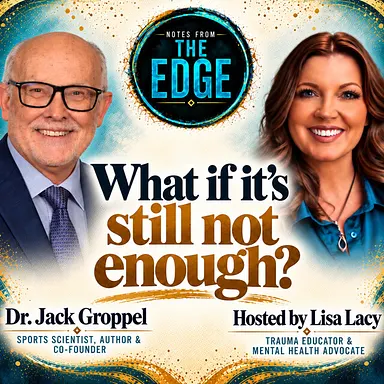
Every line of this episode of Notes from the Edge was transcribed with HappyScribe technology. See also: notes for Zoom calls.
Ads in this audio differ from the text. Tap the sentence you're hearing to follow along.
Synced: the text now follows the audio.
Welcome to Notes from the Edge, where we have the conversations we should have been having all along. We talk about the things that we're not talking about. I'm your host, Lisa Lacey, writer, trauma educator, executive advisor, and author of the upcoming memoir Notes from a Certified Madwoman. Welcome to The Edge. Hey, hey, my friends! Welcome back to another episode of Notes from the Edge. I am your host, Lisa Lacey, and this is the place we have the conversations we should have been having all along. Guess what? You're not talking about it.
So today we're gonna, with special guest Jack Groppel, What happens when achievement becomes your identity, success stops feeling like enough, and the person who spent a lifetime mastering human performance has to redefine, redefine what living well actually means? Our guest today has a PhD, is an internationally recognized authority in sports science, human performance, and energy. We're all energy. Management. A Hall of Fame coach, scientist, and entrepreneur, Jack co-founded the Human Performance Institute, later known as the Johnson& Johnson Human Performance Institute, where his work helped bring principles developed for world-class athletes into leadership, corporate performance, and everyday life. His pioneering research in biomechanics and performance training has influenced generations of athletes and organizations. He has worked with Olympic athletes, Nike, the Chicago White Sox, the US Tennis Association, where he served as founding chair. He has also spoken before United Nations, US Congress, and audiences around the world. But his story now goes way beyond performance. Because after decades of helping other people achieve extraordinary levels, he began confronting his own relationship with achievement, approval, family, purpose, meaning. And thus he wrote a memoir, Mountains Within: A Life of Achievement, a Quest for Meaning, and the Mountain That Changed Everything, which explores how fatherhood, adopting his son from China, and eventually climbing Mount Kilimanjaro together transformed his understanding of what success actually looks like.
Jack, welcome to Notes from the Edge, my friend. How are you today?
Hey, Lisa. Great. I'm doing well. Thank you. Thanks for having me. I'm really looking forward to our conversation.
Me too. I've been looking forward to it all day. Let me make sure I've got comments turned on in case anybody comes in with any questions. Well, Jack, this is Notes from the Edge, so we're just going to dive right into the convo and see what kind of rabbit holes we dig up. You spent decades studying what makes human beings perform at their highest level.
Right.
When did you begin to realize that being able to perform exceptionally well and being fulfilled were 2 different things?
Well, I mean, it's a tremendous question to start with because I think, like, my story is not unusual because I think I was— I thought I was doing everything right. You know, I honestly thought I was doing things perfectly well. You know, I'm providing for my family. I'm in love. I'm traveling all over the world. I'm working with the biggest names in sport. And yet I didn't really— I don't think I understood what fulfillment was. You know, happy is a state to me, um, but I was just go, go, go. I was like that— remember when we were kids, Lisa, when we were in the front of a body of water, a pond or a lake, and we try to find the flattest rock and then we try to skip it across the water just as far as we could skip it? That's how we live our life right now. We're like that flat rock skimming across the surface. And that's how I was. I was just go, go, go, go, go like that flat rock. But I never slowed down. See, the flat rock slows down and then it goes deep into the water.
I never slowed down. I just kept going. But at what cost? See, that's why my memoir was so significant in my life. And, you know, it was just incredible for me clinically almost to understand myself. that, yeah, it was go, go, go, but at what cost?
Yeah, yeah. And we'll get to that because that's the— that's the— we in here, we like to ask better questions, and that is the question: at what cost? But you've talked about— I love this achievement addiction. Yeah, because I was there for 20 years. I was like, next goal, next goal, next goal, next goal, next goal. Yeah. How does someone know when healthy ambition—
yeah,
has crossed over into needing the next accomplishment to prove worth, to be, to feel safe, to feel like you're enough to finally be accepted.
Yeah. So
Pascal is a guest with us today right now. And he said what an outstanding intro that was for you.
Oh, that's wonderful. Thank you very much. You know, it's just fascinating when you start. Let me give you a word picture, and that's professional speaking. You know, you do— let's say you do a great speech and you get a standing ovation. That's intoxicating. It is. You get a standing ovation. I mean, it's like, I'm worthy. I'm— oh my gosh, I'm valued. It's— but then you see, that's very different than being truly valued. You're— what you did, you hit it out of the park in that moment, and you may have touched a lot of people's lives. But that has really has nothing to do with your life unless it fulfills a purpose. See, what I was doing was just go, go, go, and I was just living for the standing ovation. So, you know, I never had a tennis lesson, yet I'm in 3 tennis coaches' halls of fame. You know, I never had a speech class, yet I've traveled all over the world. I'm not bragging, by the way. The whole point of this is at what cost? You know, the— I never had a speech class, yet I've spoken in front of millions in 52 countries.
Never had a business class, yet started a business with a good friend with our own money. And then 15 years later, we sold it to a Fortune 50 company.
Wow.
You know, I never was a father, yet in my 50s, I go to China by myself and they put a screaming 4-year-old in my arms that doesn't want to be with me. So the idea— so there's 2 parts of this story. One is to have hope that you don't have to be stuck wherever you are. But then the second part is to make sure you're doing it for the right reasons.
Yes.
Make sure you're doing it for the right reasons. That's the key.
Yes. Not on autopilot, right?
And I was— because—
Yes. Talk to me about autopilot versus conscious choices. Yeah, what you're doing in terms of your goals.
You know, you receive an award, you receive an honor, and you enjoy that, but then it's very soon, it's like, next. I heard a world-class athlete talking, um, and I forget who it was, but won the gold medal in one of the Olympics, won a gold medal in his sport. It was a male, but then he had to fly the next day, a 15-hour flight to another continent And he had to perform 3 days later or 2 days later. He said he never got to relish the fact that he won a gold medal. There was no time to celebrate. He was the best in the world and didn't get a chance to really enjoy that moment. It was, what's next? And I think a lot of us live our lives like that. You know, we make a sale, what's next? Oh, I made, I made good commission on that one, what's next? And then it's at what cost? You know, like, there's a wonderful story that we've always told in our company, Evolve Leadership, which came out of HPI. You know, and it's a, it's a dad who came home at 7 o'clock every night.
He was in financial services. He came home at 7 o'clock every night. And he was very strict on his boundaries. But the problem was he was still working. He was on his phone. Well, one night he got held up and he didn't get home until 9. Called his wife on the way home. He owned all this in our training. Called his wife on the way home and he said, sweetheart, when I come in the door tonight, I'm going to give you a quick kiss, but then I want to get with the boys. They had 2 boys, ages 6 and 9. And I'll take care of the boys. I'll put them to bed. She said, great. I've been with them all day. So he comes in, hugs, kisses, goes up to the boys, puts them in their pajamas, wrestles with them. They have a great time. They read a little bit, says their prayers. and he says goodnight. As he goes out to turn the light off, the youngest one, the 6-year-old goes, Daddy, can you come home at 9 o'clock every night?
Ah.
We call that the 9 o'clock daddy because you see, the dad thought he was doing everything right. He was coming home at 7 o'clock, but he wasn't giving them energy. He wasn't— he was there physically, but he wasn't there emotionally, mentally, and spiritually. when the 6-year-old called him out because I'll take this for 20 minutes every night if other than 3 or 4 hours of no dad, just a physical dad. I want the emotional, mental, and spiritual dad too. Yeah. And I think that's what we— I think that's a very good word picture. So where in your life do you have to be the 9 o'clock daddy that you're available for the people that matter to you?
And fully present. Yeah. And Pascal says achievement addiction can be a work slave driver. To be liked is great, but to live yourself and to have your soul smile when you have a noble heart with purpose, spiritually fueled. Yeah, yeah, with purpose, with purpose. And I think, um, you, you brought up 2 things that I, I want to circle back to.
Sure.
And that's being fully present with The people that we love and care about. And Jack, I'm in a unique position in my own life because I live with a congenital blood disease. And so I have to face my mortality on the daily. And this last scare has really made me realize that when I'm in front of them, specifically my husband and my child, my daughter, who is a young adult now, um, but I want to be with them. Not be working in my head. You know, the working in your head when you're there but you're not there. Talk to me about how important that is.
Well, let's understand, these have only been around since 2008. And for those just listening, I'm holding up a mobile phone, a smartphone. They've only been around since about 2008. So we're physically available, but we're not mentally, emotionally, and spiritually available when we're on our phone. And the idea You have to be able to answer this question. We'll probably focus on this a few more times in our time together, but you have to be able to answer the question, what matters most to me right now? That is, for me, that's one of the most important questions people can ask themselves at any— and several times a day, because every day you have to make a choice about whether I'm going to be on this conference call or I'm going to go to my child's game. or concert? I'm going to— whether I'm going to work, I've got a call with Asia at 9 o'clock tonight, or can I make that call at 10 and tuck my child in? You see what I'm— We have choices we have to make all the time. And I think if we just calibrated ourselves, what matters most right now? And yeah, there are times you have to take that trip or you have to make that call, but not all the time.
I can tell you flat out, There's a whole bunch of plane trips I didn't have to get on. I didn't have to get on them. I felt like I had to get on them.
Because you were skipping. You were continually skipping.
I was that rock skipping across the water.
Next, next, next. Well, adopting your son seems to have fundamentally changed the trajectory of your life. I am so sure of. What did becoming his father teach you that no amount of research or coaching or working with people or any achievement you ever had before do for you?
Oh, Lisa, how much time do we have?
We got about 30 more minutes. We got plenty of time.
The lessons. Because you see, I had— my father was a hard charger. My father, alcohol was definitely in there. And my father believed spare the rod, spoil the child. And he— I was, you know, he was why I got the achievement addiction. I thought The only way I would get his approval was to achieve. Well, when I got my son, and this is the most significant 2 weeks of my life, I tell people that God has a sense of humor because he's going to send this man in his 50s. My wife could not go with— she had been injured and had to have surgery. She couldn't go. So I go to China by myself, and in God's infinite sense of humor says, we're going to put this screaming 4-year-old in his arms. That, you know, this is a 4-year-old Chinese boy with an old white man, and they have nothing in common. The child can't speak English and the man can't speak Mandarin. All they've both got is tone of voice, touch, and facial expression. That's all they've got. And in 2 weeks, we're going to teach you 2 how to love someone else, how to love each other.
Most significant 2 weeks of my life. Lisa, yeah, I mean, and you just—
I want you to repeat that because I think if we humans connect in that way— what did you say? Touch? What else?
We had touch, facial expression, and tone of voice.
Yeah, it's our bodies, right? Yeah,
we could not communicate. In fact, it's pretty funny. They taught, they taught us some phrases. And because I had a toddler, one phrase— and I'll say the phrase in Mandarin so that everybody's really clear, but I'll give the interpretation. The phrase is bo yao zhar yang, and what it means is stop doing what you're doing. They said because you've got a toddler, the toddlers are going to be energetic and you're going to need to say stop that, stop doing what you're doing. So it's bo yao zhar yang. Well, apparently the old man was saying it all the time. I was saying bo ya tsar yang way too often. So here we are in the second week. My son, my little guy's jumping up and down on the bed. So I go— his name is Shen, that was his last name in Chinese, we made that his first name. I said, Shen, bo ya tsar yang. This little scamp jumps off the bed, starts walking toward me with a swagger going, bo ya tsar yang. He's totally playing the old white man. I'm just going, are you kidding? And I started laughing so hard, Lisa. Because I'm going, number one, the personality coming out of this child, and number two, the reality check, like, hey dude, back off, you know.
It was just an amazing moment in time where in his— I was trying to communicate in his language and then he's mimicking me, making fun of me, you know. Don't be so cocksure of yourself, young man, you know.
Isn't it amazing how our children just come out the way they are, the human beings that they are? They're, they're immediate. Yes, and they are their own little individual human selves. So, all right, so you and your son climbed Mount Kilimanjaro together.
Yes.
What happened on that mountain that changed your definition of strength, success, and what really matters?
Okay, let me just take 20 seconds and explain why we climbed it. Yeah, my father and I, remember, we were estranged, and when I was 20 years old in college and I was getting ready for my senior year— I was a junior— in March of my junior year, he called me and he said, Jack, tell your tennis coach that you're not going to play many tournaments this summer because we have to, uh, we're going to take a trip. And I'm going, okay, we're going to take a trip, I can still play some tennis tournaments. He goes, no, you're not going to be able to. And I said, why? Now, we lived outside of St. Louis, Missouri. He goes, we're going to drive to Fairbanks, Alaska. And I went, We're gonna do what? And I said, wait, wait, wait, wait, wait, wait. He says, yeah, I've got a— the pickup truck. It's a pickup truck, Lisa. He says, I'm gonna put a cover— not a camper, a cover— on the back of the truck. We'll put 2 wooden, uh, slabs in with sleeping mattresses. That's where we'll sleep every night. You cook. I was an Eagle Scout.
He says, you cook, I'll do the dishes. He said, this is gonna be great. I said, How far is this? He goes, I think it's about 4,250 miles. I'm going, how long? He said, I think 6 weeks. I literally said this. I said, Dad, somebody will commit homicide. This will not hold up. And he says, I know it'll be tough, but I think we need to do it. Well, at my dad's funeral, the pastor who gave my dad's eulogy said that Dad— all Dad ever talked about was the Alaska trip. And yes, it was a hard trip, but that was the beginning of a years-long reconciliation path for he and I. Wow. So, when I got Shen, my son, I'm an older father obviously, and I wanted to have an adventure with him. I wanted to do something like Alaska. But I'm sort of a go big or go home kind of guy, Lisa. So, I'm doing research. I come to find that Kilimanjaro— and I'd always had an affinity for Africa. My undergraduate degree was actually in wildlife biology. That's a whole different story. And I had an affinity for Africa. And I come to find out that Kilimanjaro is the highest mountain in the world that you can actually trek.
You don't need— there's no technical climbing. It's just under 20,000 feet. And it's— but you can hike it. There's scrambling, don't get me wrong. It's not that easy, but it's the altitude that's the big issue. So I called his mom and I said, what do you think about this? We were no longer together. And I talked her into it. I called her back and said, I, I said, by the way, don't tell anybody. And she said, what am I going to do, call my friends and say, you know what that idiot wants to do now?
You're like, we want to do it first.
Yeah, kind of like, that's who I am, you know, kind of doing this weird stuff. So now we trained for a year. He was in karate, I played tennis, just cardio. We couldn't train at altitude, so I took him to Rocky Mountain National Park. To get the week before to sort of acclimatize. That's why. Now we're on the mountain, Kilimanjaro. We get to day 2. It's been cloudy for 2. We haven't seen the mountain. Dinner finishes. We're at about 12,000 feet, so we're just about the same height we were climbing in Rocky Mountain National Park. We've got another 7,000 vertical feet though to go. The clouds cleared and we saw the peak. Kilimanjaro. And I went, no freaking way. Honestly, that was my first thought.
Oh, no way as in we can't? It's too much?
No, we can't. I mean, this is going to be too much. I've got artificial knees. He's only 12. See, my brain— this is what all of our brains do. Our brain is not our best friend, Lisa. It's not our best friend. Our heart is pretty good, but our brain is never our best friend. And so my brain was telling me, too far, too high. He's 12. I've got artificial knees. Both knees are metal. I can't do it. And all of a sudden it hit me. I said, Jack, stop it. What I'd done with athletes, stop it. Don't do that self-talk. I said, and I got Shen and we looked at it. We, I mean, I'm tearing up like, holy crow. In 4 nights, we're gonna try to summit that at night. And I literally said this to him. I said, I can't promise you we'll make it, but I can promise you that we can take the next step. Every step, we can take the next step. And I— and buddy, I promise you, if we keep taking steps, we're going to give ourselves the best chance to make it there.
Mm-hmm.
Everything was about the next step. Everything was that the rest of that time. Just got to keep taking the next step. Just— I know it's hard. I got a headache. I'm feeling nauseous. I know. I'm just going to keep taking the next step. And sure enough, we— and on summit day, they do this briefing and they warn you how cold it's going to be and the wind and And how it's going to be miserable, honestly. And they tell you to think about people that matter to you. We go back to the tent to rest before summit night. You, you leave the camp at like 10:30, 11 at night, and you, you hike all night to go 4,000— from 15,300 feet to 19,341.
Wow, that's a big jump.
On switchbacks. And we get back to the tent, and I'll never forget this. I said, Shen, how are you doing, buddy? I'm just really— he goes, I just think you're crazy for bringing everybody here. That was literally my 12-year-old. Meanwhile, the guides, they were betting against me. The porters were betting against me making it because of my age and the artificial knees. The guides were betting for me. They were betting pretty good sums of money. One group that I wouldn't make it, one that would. And the interesting one, the ones that thought I would make it— when I first got on the mountain, my nickname— I was the oldest man on the mountain. My son was the youngest person on the mountain at 12. And I was 65, and the mountain that week, and they called me Babu, which means grandpa. I'm going, really? You know, I've been busting my butt for a year to train for this. And then they found out on day 3 that I had artificial knees. And this is how that goes down. The guide comes up, the head guide, and he says, is it true what they say about your knees?
And I said, what do you mean? He says, is it true that you have metal knees? And I said, yeah, I do. They're artificial knees and they're metal. He says, okay, we change your name. I go, what's my name now? He says, your name now is Chuma Matu. And I said, what's that mean? He goes, Iron Man.
And I went, ah, so much better. Yes, yes.
Now, now, now we're talking. Let's, let's, let's go to the top of that doggone mountain. So the idea that Iron Man and, uh, my son just got connected with everybody, that's another story that's so incredible about the social connection too that happened on the mountain.
Wow, wow. Yeah, I, uh, I, I understand what taking those adventures can, uh, do. It's interesting, Jack, and I'd love to have you circle back for a round 2, um, next month. I myself drove the Alaska Highway.
Oh, you did?
I did, I did. And that's how I ended up with my daughter, because I went with a friend and There's a lot of tent time, and lo and behold, yep, we came back with a kiddo.
So
that's what drove me into corporate work. But so yeah, Alaska has, uh, life-changing, life-changing effects on people.
Yeah.
And we drove it in a 1970s Bronco that had a hole in the gas tank. What in the world were we thinking too? So, but you spent your career teaching athletes And executives. And I love this word. And Jack, sorry, my dogs are barking. My husband is coming home, and every time he does, they act like it's the first time they've ever seen him.
Right.
So I want to talk about the word energy.
Right.
Because you studied energy management. Please talk to us about energy, because you have talked to us about being present with our whole bodies, with our spirits, with all of us and our energy. What is this thing, energy?
In 1992, um, Dr. Jim Laird, one of the world's most renowned sports psychologists, and I partnered. And his doctorate's in psychology, mine was in exercise— mine is in exercise physiology. And we had been working with world-class athletes together, and we decided we wanted to create a center. And what we had been working on— so it became the Human Performance Institute. And what we determined, what we started teaching, was that there's 4 parts to the pyramid of who we are. There's a physical, an emotional, a mental, and a spiritual component to who we are. And this is all being done— if anybody's interested in this, we're doing this now with Evolve Leadership. They've taken it on since Johnson& Johnson decided not to be in the commercial business of what we did. So it's Evolve Leadership. That's who we're doing it with. But the idea that you have to build capacity physically, emotionally, mentally, and spiritually to meet the ever-increasing demand in your life, the energy. But then you also— this is the key part now. This is where the time management industry, Lisa, didn't live up to its reputation. See, time is finite. We run out of time.
Mm-hmm.
Energy is finite as well, but we can recapture energy. So, physical recapture of energy, sleep, nutrition, exercise. Emotional recapture of energy, not survival-based emotions like chronic impatience, but challenge emotion, like opportunity-based emotions like challenge and excited and positive anticipation. And then mental, we live in the world with these smartphones. scattered versus laser-focused energy. And then the spiritual, where we just beat— we're like the rocks skimming across the water, or we operate with a deep sense of purpose and mission.
Yes.
What we've always taught and what we're doing at Evolve is the idea that, that there is this— we are biological beings, we can increase our capacity, and we can recapture energy in all quadrants of who we are as human beings.
Which are what? Remind us again, what are the 4 quadrants that we can recapture energy?
Physical, the emotional, the mental, and the spiritual.
I love it. Recapture spiritual energy, recapture physical energy.
Foundation has to be right at the top. Yeah. Now this is key. If you want to change in your life, you have to change from the top down. From the spiritual down. Purpose will help you.
Talk to us about that.
Yes, hang with me. But you train from the bottom up.
Okay,
so you change from the top down and then you train from the bottom up. So you train— that's why the physical part is, is so critical. Exercise, nutrition, hydration, sleep is the critical foundation of who we are. And then emotional, mental, and spiritual. But if you want to change, change usually has to happen and begin at the spiritual piece. Like, why?
So that you can change at the physical. You change at the spiritual so you can make those adaptations and habit changes at the physical, right?
Yes.
Okay. And Pascal says, you are a brilliant storyteller.
Oh,
just magic. And then says, I am bearing a bearing torch of human connections. Who needs Marvel with us two here? I love it. I love it, Pascal. Thank you.
Thank you.
Thank you. Thank you. Okay, so talk to us about, um, this, this center that Johnson& Johnson's no longer involved. So how can people find you, work with you, find this information? This is, I think, vital in—
yeah,
what we want to do in here is give people ways to really transform sustainably.
Right. So if they want to follow my work, let's do the personal piece first, and then the organizational or the— so if they want to follow me, LinkedIn is probably the best place, Instagram, but LinkedIn, my name. My memoir, as you just mentioned, came out. It's called Mountains Within. It's available anywhere. But the company that where if you really want to understand all that we've just been talking about around energy, it's called Evolve Leadership. Okay. And they are doing a magnificent job of following up on what we did. And they're even creating new content. It's the newest areas of energy management. I mean, they're doing a lot of team building now with energy. I mean, it's just so cool what they're doing, right?
What made you go into energy management so long ago when nobody was talking about it?
Well, we had to, because remember, we started our careers with— we were the first sports scientists in the United States, especially with tennis. We were the first ones basically doing tennis. And what we started doing— I was the founding chairman of the Sports Science Committee for the United States Tennis Association, but I was starting to do sport research in 1974. And now, in fact, this is way before video, Lisa. You know, today these sports teams have mega million-dollar video budgets. Video didn't exist when I'm doing that. I'm using high-speed 16mm film.
Oh, wow.
And I'm gonna have to— and I have to sell this. I have to sell people on even, even if they're looking at how— what an athlete is doing, they're going, well, that's not how you do it. I'm going, what are you talking about? There it is in high-speed film. I mean, I'm doing frame by frame.
I have evidence.
Yeah. I mean, it's a funny story, and your, your viewers, they'll see— I tell this story in the— in my memoir, but I was giving a tennis conference in the early '80s. I was showing high-speed films that I'd taken at Madison Square Garden of Borg and McEnroe and Lendl and Connors, and in high speed, and I'm showing these orthopedic surgeons what happens and what's causing injury when they're not— when the average player isn't performing correctly. And I finished, every— it was received really well. And this very tall gentleman greets me in the aisleway and he says, can you do this in baseball? Now remember, video doesn't exist. And I go, well, I don't know, I'm sure you can, but what do you want to study? He said— now I don't know who this man is— he says, I'm very concerned about the head first versus the feet-first slide in baseball. And I said, well, yeah, if you want to study that, I would get behind third base, I'd set my camera up, and I'd turn it on when the runner's on first. And then when the runner takes off, I would turn the camera on, let it get up to speed, and then I'd pan, and then I'd block it so that it's at 90 degrees so I can digitize the athlete when the slide happens, whether it's headfirst or feetfirst.
Well, I'm getting set up on the first day, and the managing— the coaching staff comes out there. What is this? It's a high-speed camera. What are you going to do? And I'm telling them I'm working with the team physician for the Chicago White Sox. That's who it was that stopped me in the aisle. Wow.
And this was high-tech at the time. Like, oh, this is gone.
Yeah, they were— they even said to me, do not let the players see these films. Can you imagine that in today's world? Today's world, they say, I can't— I've got to look at the film before I answer your question. Today it's all about the film, almost too much, by the way. They go through— they almost get to a point paralysis by analysis. Yeah, but so then we published this, by the way. Your listeners can look this up. My last name, um, it was in the American Journal of Sports Medicine. We published an analysis of the head-first versus the feet-first slide in world-class baseball.
So very cool.
And we did this in the '80s. So the idea that this had never been done before and you had to sell it That's how I got involved in energy management. We were working with the greatest athletes in the world, and you got to understand, is it, is it technique that's going to make them better? Is it fitness? No, they're already fit. They're already the best. So what's going to separate them? We come to find out it's energy.
Yeah.
It's how they approach their each competition physically, emotionally, mentally, spiritually. Why are you competing? That's the spiritual piece. And we started working with And then we— and then in 1983, I coined a term and I trademarked it called the corporate athlete. And what— and then I wrote a book in 1999, The Corporate Athlete. And the idea that you can live your life like a world-class athlete, you don't— not, not about sprinting or performing, but living your life to be that performer, whether it's in an organization and be that good person with your family. But it's all about energy management. That's how we got involved in the field. It became the, the, the smallest little thing that helped the best of the best get better.
The best of the best get better through energy management, you guys. Yeah. So Jack, another little tidbit about me. I'm a martial artist and I train in 3 different disciplines. And one of the disciplines is Filipino Kusyo, and it does a lot of energy work. So, um, I believe wholeheartedly in how energy management can revolutionize anything and everything that you're doing. But what I love— yeah, what you're doing, you're bringing it back to your family. You're bringing it back to the people you love, care about, and are in service to in your home, right? Talk to us about that. What kind of energy do we want to be bringing to our Friends, family, loved ones, people we're in service to?
Well, what you want to be thinking about is the word we talked about earlier, being present.
Yeah.
When you're there, you're there physically, but are you there emotionally, mentally, and spiritually? Are you really there? And then what's preventing you from being there? I mean, I've worked with clients that when they pull in the driveway at home— pardon me— they might leave their phone in the car. For 30 minutes.
That's right.
They leave it in the car so it's not even present. See, some people think, well, I'll just silence it. No, you'll still pay attention to it. Leave it. Just leave it in the car for 30 minutes so that the people that you say I love you to, you really demonstrate that love for at least 30 minutes.
Because remember, see and feel that, right?
Yeah, Daddy, if you can come home at 9 o'clock every night, that's great.
Yeah, and what I love about what you're pointing out is, guys, it doesn't take 6 hours out of our day. So the fact that we don't have time is not a good excuse. So is it, is it, is it quality? Are you present? Are you aware? Are you making conscious choices, or are you running everything on complete autopilot.
So yeah, not to do this. You don't have time not to do this.
Yeah,
that's the key thing. You've got to do this. And it's small. See, the biological system of a human being, you can— if you learn to do it, you can recapture energy very quickly. Very quickly. I mean, this is what my partner Jim Lehrer— he just recently passed away, but he's renowned. And I think it was one of the biggest contributions to sport in the last half of the last century. He created the 16-second cure in tennis by studying the greatest players in the world and what they did in between points. Because what he found was that only— that they've only got 20 seconds in between points. And by, by having structure in your behavior, you recover much more quickly. So you can get— you can recapture energy in seconds if you practice it. See, and then you have the people that say, well, at my organization, they won't let us get recovery. OK, if you live in that organization, here's what I invite you to do. This— I want you to say to the manager who pushes you so hard that you have to go to the bathroom. I've never heard anyone say, no, I'm sorry, not at this organization.
You cannot go to the bathroom. No. But here's the deal. Maybe you don't have to go to the bathroom. But that's what you're going to say. And then here's what I want you to do. As soon as you walk out of that room, I want you to forget about the meeting. And I want you to think about maybe what you're doing that weekend and go up, go up a flight of stairs to another floor. Don't take the elevator. Walk.
Walk.
Move your body. So you change your heart rate going up the stairs. And then if you don't have to go to the bathroom, just walk down the hallway and go down. If you do, then use the bathroom on that other floor. And then go down to another stairwell and go down. And then as you get to the bottom of that stairwell, now reengage and prepare mentally for the meeting you're getting ready to go into.
I love it. Reengage.
In that short time period of disengage and then reengage, you get a little bit of recovery.
I love that. I love that.
I will tell you, it works. And this is what we're doing at Evolve Leadership. This is what I think is so cool.
Very cool. It is beyond cool, my friend. And I think it's something we all need to remember. So, you know, some of the highlights of what you have said and brought forth for us today is hope. Hope is a big word. Purpose. Know your purpose, right? You've brought that to our attention. And manage your energy in a way that brings you— and you said happiness is a state. I like words like satisfaction and contentment and Because those are easier places to be, right? Satisfactory.
Surround yourself with other people.
Yes, human connection.
We're not intended to do life alone. And this could be my closing story for you.
Okay, what you got?
On Kilimanjaro, my son was only 12 years old. He knew no one. The next oldest person was around 25.
Wow.
My son knew no one. At the end of dinner every night, he could have gone back to the tent to read or play games on his phone. He didn't have Wi-Fi, but he had games stored. But my son chose to play cards with everybody. So here's my 12-year-old son, and they did— nobody knew that he and I played cards all the time. No one could beat my son.
Ah, was he getting everybody? All the adults?
Hearts and King's Corners and—
Oh, hearts are so fun.
And nobody can beat him. So his nickname became the Big Dog. My name became Chuma Matu. His became the big dog. So the reason I'm telling you this story is that every night my son was playing cards. Now we get to summit night, which is terrible. We're— we get to the daylight, it's sunrise, we're almost at about 18,500 feet. We're close to the crater rim. We're not to the summit, but we're close to the crater. And it was awful. I mean, it's like chuck your poles, take a step, chuck your poles, take a step. And I heard this loud noise and I look up and the rangers were, were skiing down the scree of the mountain with sick climbers. People are throwing up. They've got altitude sickness. And it scared me. Yeah. And I turned around to Shen. I said, Shen, are you okay? And he didn't answer me. And I said, buddy, you've got to answer me. And, and this is my 12-year-old son. He's, he's, he's got his head down and he just shakes it. He just nods his head up and down. He can't talk. And the guide heard me get firm with him.
And he came back and he said, Shen, do you want to go back? And I'm going, we're done. As soon as, as soon as he said that, and my 12-year-old son, do you want to go back? Shakes his head no. And in that moment, here it is, here it comes. The people that he'd been playing cards with, all of our fellow climbers, were just above us at the crater rim, and they saw my son stuck, and they started screaming and cheering from Shen.
Oh.
And I said, and I'm starting to tear up, and I said, buddy, do you want to go? And I don't know if that meant go up or go down. And I said, buddy, how do you— and he holds his hand up. He says, Dad, I got this. 12 years old. And he starts walking and he made it to the summit of Kilimanjaro.
Wow.
At 12 years old.
Wow. With his dad.
With his dad. That was a moment. That was a moment. And in fact, for those watching us, we're holding our hands up high in triumph at the summit of Kilimanjaro. For those watching,
I love that. I love that. I love the adventure you took. Um, Jack, I'd love to have you back.
Oh, I'd love to be back. I'd love to. I've enjoyed this.
Where can we find the memoir?
Anywhere books are sold. Amazon is really easy, um, to get it. And, and by the way, for those that like audiobooks, I narrated the audiobook.
Oh cool.
So, so the person Pascal liked my storytelling, I'm the one that narrated the audiobook. So if you like audios, but it's in hardback paper, ebook, and audiobook.
All right, my friend, we're gonna put those links down there, guys. You don't have to write anything down. We're gonna make sure you have access to Jack if you want to work with him, if you have any questions for him. We're gonna make sure you have a link to access the memoir. Uh, but Jack, before we let any of our guests go, we always ask 2 questions.
Sure.
To close out. Okay, the first question is, in your own life, what have you performed in order to survive, and what did dropping that role, mask, or performance do for your life?
So the first question, what have I done to—
What have you performed in order to survive?
Wow. Mm-hmm.
There's so many different ways I could explain this. Um, there was one where I was put in an audience, in front of an audience of 30,000 people, and I had no idea what I was doing. I was petrified. There was another moment where I'm preceding Muhammad Ali on stage in front of 20,000, and I can't find the props, and nobody knows who I am. and the sweat start. I'm just giving you examples. There's other moments I'm on an airplane and we lost an engine. You know, there's other moments— I mean, honestly, there's so many moments that I've had to do something to survive. The biggest probably is going to China and getting my son, because that felt like survival instead of thriving. See, but in a, in a matter of 2 weeks, I went from survival Where that night in the hotel room, the translator said, I have to leave. And I said, I'll pay you $1,000 to stay 2 more hours. And he said, I can't take your money. He said, but whatever you do, don't give him a bath tonight because he's filthy. And I said— he said, it'll push him further away.
So here I am, my poor son's grieving, he's crying. We've pulled him from everything he knows is safe. He's on the edge of the bed watching cartoons. I'm sitting in a chair, just a hotel room. And I prayed and I said, God, what do you want me to do? Because I got nothing. I mean, this is survival. I got nothing. I cannot help this child. And I felt on my heart, give him a bath. And I'm going— and I said in English, I looked up at the ceiling and said, did you hear what the translator said? What do you want me to do? I'm going to— I'm going to be quiet. I'm going to ask you one more time. What do you want me to do? And I felt, you've got to give him a bath. And I said, okay. So— and I know this is not going to go be pretty. So I take him in and he starts screaming. He's scared.
Yeah.
So I make a very conscious decision. I'm not going to wash his— no, no soap in the eyes. Not— I'm not going to wash his hair. I'm not going to wash any private parts. Wash his shoulders and his feet. That's all. Get him out, towel him off, put him in a pair of pajamas, give him a sippy cup. Not another tear. And he slept right next to me the entire night.
Ah.
That was probably the moment
You know what I also love about that story, Jack, is you listened to that still small voice that told you what to do next.
Correct. Yeah, I didn't listen to what humans told me to do.
Exactly, exactly. And sometimes that voice is very quiet.
Yes.
Yeah, and sometimes we have to ask twice.
No, I did, right? I mean, I'm gonna ask you one more time. You heard what the translator said, really?
I love it. Well, Jack, listen, the last question is this: what do you want us to be talking more about? What should we be having more conversations about as human beings?
Connection. Connection. We've lost connection. These smartphones— we're being pulled by things that are not connecting us. If there's one thing that I want us to talk about, it's improving human-to-human connection, not Not through, you know, we're blessed that we have this technology, you and I.
Yeah.
But it'll never replace the actual human connection.
Well, that's where you can feel each other's energy more.
Yes.
You can see body movements more. You can touch if it's comfortable. All the things that you opened up with, you can do.
Yes, exactly.
If you have a human in front of you.
That's what I want the dialogue to be about.
Yeah, and there is a loneliness epidemic. So beautiful answer, my friend. Well, friends out there, I'm gonna ask you the same thing, and we'll see Jack here next month. What are you performing in order to survive? And what might dropping that role mask or performance do to lighten your load just a little bit? I'm your host, Lisa Lacey, here with our guest, Jack Gropple. And when you find the answer to that, we will both see you at the edge. Thank you so much, Jack.
Thank you so much. It's been such a pleasure. Thank you, Lisa.
It really has. Pascal, thanks for staying on. And he says Jack is on the ball, uh, with everything that you said. Great show.
Appreciate it.
What happens when you achieve everything you thought you wanted and discover it still doesn’t feel like enough?Dr. Jack Groppel is a pioneering sports scientist and co-founder of the Human Performance Institute whose work reveals a powerful truth: peak performance and a meaningful life are not necessarily the same thing.In this conversation, Jack and Lisa explore how achievement can become addictive, why our need for approval can hide underneath ambition, and what decades of studying elite human performance taught him about energy, recovery, and fulfillment. Jack also shares how adopting his son and climbing Mount Kilimanjaro together ultimately forced him to reconsider his definitions of strength, fatherhood, success, and what matters most.In this episode:Human performance and sports scienceAchievement addiction and overachievementThe need for approval and people pleasingBurnout, energy management, and recoveryFatherhood and adoptionLeadership and high performancePurpose, meaning, and fulfillmentMount Kilimanjaro and Mountains WithinRedefining success Learn more about Dr. Jack Groppel and Mountains Within:https://jackgroppel.netExplore more from Lisa Lacy Inside the Edge:Inside The Edge — Lisa LacyWhat did you perform in order to survive? Welcome to the Edge.See Privacy Policy at https://art19.com/privacy and California Privacy Notice at https://art19.com/privacy#do-not-sell-my-info.