
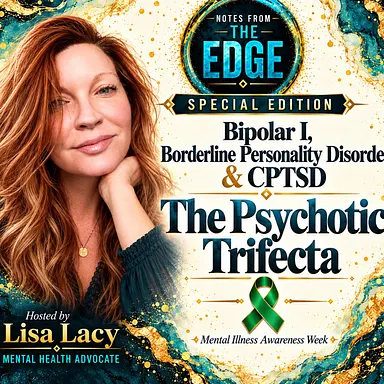
“SPECIAL EDITION: Mental Health Awareness Week | The Psychotic Trifecta” was turned into text by HappyScribe’s speech recognition. Related tool: Google Meet transcription.
Ads in this audio differ from the text. Tap the sentence you're hearing to follow along.
Synced: the text now follows the audio.
It's Mental Health Awareness Week, so instead of talking around mental illness, I want to tell you what it actually feels like from inside it. And I don't think I've ever spoken this candidly about this part of my life before. I've experienced psychosis, not metaphorically, not I was overwhelmed, not I was acting crazy, not the casual way we sometimes throw that word around. I mean, I've been psychotic. I've lived inside a reality that was completely different from the reality being experienced by the people standing around me. And here is the part that is so difficult to explain unless you've been there. I did not know I was psychotic. I thought everybody else simply couldn't see what I could see. I believed what I was experiencing completely. The things I saw were real to me. The connections were real to me. The meanings were real. Certainty. I wasn't sitting somewhere thinking, Lisa, you're hallucinating, you're delusional, your brain is creating something that Isn't happening for everybody else. There was no healthy version of me standing off to the side taking notes. I was in it, and from inside it, it made total sense. And that may be the most frightening thing about psychosis.
Psychosis does not necessarily feel like losing touch with reality. Sometimes it feels like you have finally discovered reality, like you can suddenly see connections nobody else can see. Like you've, you've been revealed. Everybody around you is missing something that feels painfully, overwhelmingly obvious. And even today, with insight and treatment and distance and years to look back on what happened with hindsight, there are pieces of those experiences that are complicated for me intellectually. I understand that other people did not share what I was experiencing. But understand what psychosis is. And, and still there are things I experienced that were so profound, so tangible, that a part of me continues to wonder about them. I can hold that uncertainty today without allowing it to control my life. That is different from being inside psychosis. I want to be careful here because this is only my experience, my lived wisdom. I'm not telling anyone listening that hallucinations or delusions are evidence of another dimension, a spiritual revelation, or an alternate reality. I'm telling you what it felt like to me. For me, it felt like living in another place. Sometimes when I talk about it personally, I even describe it as having visited another reality because that language becomes closest to describing the experience.
But today I also have the ability to say my experience felt completely real, and I cannot assume that my interpretation of it was objectively true. But those sentences can exist together too. That ability to question what my brain is telling me is something I did not have when I was psychotic. And this week, I don't want to give you a A sanitized version of mental illness. I don't want to give you an inspirational quote about overcoming adversity and then move on. I want to talk about the uncomfortable parts. I want to talk about the mania. I want to talk about the psychosis. I want to talk about the rage. Oh, the abandonment trauma, hypervigilance, disassociation, and what happens When several psychiatric conditions begin to overlap because one nervous system is living with all of it. Because I do, I live with bipolar 1, borderline personality disorder, and complex post-traumatic stress disorder, and they can overlap in ways that have taken me years to begin to unwind. And for most of my life, bipolar 1 did not look like depression for me. It looked like mania, movement, energy, ideas, ambition, creation, very little sleep, endless engine telling me to keep going.
And the complicated truth is that sometimes it worked extraordinarily well for me until it didn't. And I didn't truly understand the loss of motivation that can accompany severe depression. Until menopause. When that happened, it scared the hell out of me because I knew, I knew, I knew who I was when the engine was going, but I didn't know who I was when the engine stopped. So for this special edition on Notes from the Edge, I'm going to talk to you about the inside of all 3: bipolar I, borderline personality disorder, and complex post-traumatic stress disorder. Why they're different, why, where they overlap, what mania has felt like inside my body, what psychosis has felt like inside my mind, and what trauma taught my body and nervous system to do, and what I had to learn to order to recognize when my own perceptions may no longer be something I can safely trust myself with. I call this episode Bipolar I, Borderline Personality Disorder, and CPTSD: The Psychotic Trifecta. That's just my language for my lived experience. It is not a medical term. And these are not all 3 psychiatric psychotic disorders, but they collide. And that has been extraordinary, sometimes destructive, sometimes terrifying, sometimes impossible to separate and figure out what's what.
So during Mental Health Awareness Week, I want to do something very simple. I want to stop speaking about people with serious mental illness as though they aren't sitting in the room. I'm sitting in the room here with you, and I'm going to tell you what it feels like from here, right here inside the edge.
Welcome to Notes from the Edge, where we have the conversations we should have been having all along. We talk about the things that we're not talking about. I'm your host, Lisa Lacey, writer, trauma educator, executive advisor, and author of the upcoming memoir Notes from a Certified Madwoman. Welcome to the Edge.
Hey, my friends, welcome back to another episode of Notes from the Edge. I am your host, Lisa Lacey, and this is the place we have the conversations we should have been having all along. You're not talking about it, so tonight I'm going to in this very special solo episode, and it's really the first time I've come forward and talked about one of these particular diagnoses. So I want to talk about what happens when your mind creates a reality so convincing that everyone else can tell you it isn't real, but you still know what you saw, you heard, you felt, and you lived. Bipolar I disorder, borderline personality disorder, and CPTSD are the psychotic trifecta. And I need to start this episode with one clarification. I'm saying that it's just my phrase. It's not a clinical diagnosis. And I'm not saying that bipolar 1, borderline personality disorder, and CPTSD are 3 psychotic disorders. They are not. I'm talking about what it has felt like to live inside the collision of all 3, especially when bipolar 1 psychosis Trauma, dissociation, emotional dysregulation, and a nervous system built for survival all start talking at the same damn time.
Because when I was psychotic, I did not think I was psychotic. I thought I was right. I believed what I was seeing. I believed what I was hearing. I believed the patterns, the connections, the meanings. The thoughts, the certainty. I was standing outside of myself thinking, wow, Lisa, this is delusional. I was literally in another reality, and from inside that reality, it made perfect sense. And that's one of the hardest things I know how to explain to someone who has never experienced psychosis. You can tell me today that parts of what I experienced were not objectively verifiable. And I understand that, but I can also tell you that the experience itself was absolutely real to me at the time. Some of it still feels real to me. The difference today is I can hold both truths. I can live in both worlds. I have to. I experienced it as real, and the other people did not share that reality. That is insight. And during psychosis, insight can disappear. So let's talk about these 3 diagnoses. Because they overlap enough to confuse the hell out of people, even clinicians, but they are not the same thing.
First, Bipolar I is defined by mania. You do not have to have a history of major depressive disorder episodes to qualify for Bipolar I. The defining feature is at least one manic episode, and mania is not just being energetic, productive, creative, ambitious, sexual, confident, or Too much. Full mania can mean racing thoughts, almost no need for sleep, pressured speech, enormous energy, impulsive decisions, grandiosity, irritability, risk-taking, and a level of activation that can completely change judgment. And in severe mania, psychosis can happen— hallucinations, delusions, Beliefs that feel undeniable, connections that feel cosmic, a certainty that is almost impossible to penetrate from the outside. Most of my bipolar 1 life has been weighted towards mania. Here's the uncomfortable truth: I like parts of it. I ran on it. Mania made me feel like I could work forever, build forever, create forever, solve everything, outrun everybody. outwork everybody, sleep later, feel later, collapse later. And for a long time, it worked very well for me until it didn't. Because mania is seductive precisely because it can feel like a superpower before it sends you the invoice. Then comes the crash, the consequences, fractured judgment. Damaged relationships because you were an asshole.
The body that eventually says nope. The mind that crosses a line from usual activity into reality no one else can enter with you. You are alone. Now, depression was different for me. I had lived with bipolar 1 for years, but I had never known the kind of depression that stripped me of my motivation until I hit menopausal depression. That terrified me. I knew chaos. I knew rage. I knew agitation. I knew insomnia. I understood running too fast. I did not understand waking up and not wanting to move, or losing the engine that had powered my entire life. Menopause did not feel like slowing down for me. It felt like somebody had unplugged the fucking machinery. And suddenly I learned that bipolar illness can hurt from both directions. Now let's talk about borderline personality disorder. They are constantly confused because both can involve intense emotions, impulsivity, anger, unstable behavior, dramatic shifts in how you feel. But bipolar 1 is fundamentally a mood disorder With distinct episodes of mania and often depression. Borderline personality disorder is much more about emotional regulation, identity, attachment, relationships, and the terror that can come with real perceived abandonment. Oh, abandonment was the worst.
BPD can look like loving somebody with your entire nervous system And then feeling devastated, rejected, furious, or unsafe when somebody changes. It can look black and white— black and white thinking. It can look like unstable sense of self. It can look like impulsivity, explosive anger, emptiness, shame, self-destruction. Oh, it's a lot. Desperately trying to find somebody so you can make them stop leaving you. And under extreme stress, some people with BPD can experience complete dissociation or transient paranoia thinking. Paranoid thinking is another one that I have to manage constantly. It does not make someone manipulative, and it does not mean every person with BPD behaves the same way. For me, understanding BPD meant realizing that sometimes My nervous system was reacting to the possibility of abandonment as though it were actually happening, an emergency that needed to be solved right there. Not just an inconvenience, not a disappointment, an emergency. Now let's move to CPTSD. It is recognized as a distinct diagnosis in the ICD-11. Although the DSM used in the United States does not currently list it, but it includes the core features of PTSD, such as reliving the trauma, avoidance, a persistent sense of threat, plus deeper disturbances in emotional regulation, self-concept, and relationships.
This is where the overlap gets wild because What does chronic trauma do? It can teach you to scan every room, read every face, hear every change in tone, anticipate danger before danger arrives. It makes closeness feel dangerous. Oh, distance feels dangerous. Can make your body react before your conscious mind even has a moment to figure out what it thinks is happening. It can create shame that does not belong to you. It can make you not feel safe, especially in the unfamiliar. It can turn survival strategies into personality straight traits because you had to use them for so long. Now, all 3 of these in one human being— mania says go, BPD says don't leave me, CPD says something is always wrong, find threat. Find the danger. And sometimes they overlap so tightly that even I have to ask, which diagnosis is talking right now? Is it mania? Is it trauma response? Is it this abandonment panic? Is it hypervigilance, dissociation, rage, intuition? That's a big one. Psychosis. That distinction matters because the treatment The response and the level of danger to myself and others can be very different. And this is where I want to say something I wish more people understood.
Mental illness does not remove intelligence. Psychosis does not make a person stupid. Trauma does not make a person weak. BPD does not make someone evil. And mania is not simply high performance. I've been highly functional and profoundly unwell at the same time. Those 2 things can coexist. I can build companies, lead people, earn credentials, take care of other people, and still have a brain that occasionally became unsafe for me to trust without listening to outside support and help. And that is one of the most humbling lessons of my own life. Sometimes the smartest thing I can do is reality check myself. Sleep, take medication exactly as prescribed, call someone who knows my baseline so they can tell me where I'm at, tell the truth about how fast my thoughts are moving, tell the truth about how little I'm sleeping. Or when I feel invincible, when I'm starting to believe something so completely Then nobody can question it without becoming part of the story. And tell the truth when depression arrives too. That's an easy one to see because depression scared me in so many ways. Mania has always felt like motion. Depression felt like disappearance.
And recovery for me has not meant becoming less intense, less creative, less ambitious, or not me. It has meant learning that every burst of energy deserves to be followed. Not every fear is a warning. Not every thought is a fact. Not every perception is shared reality. Not every person disappoints me is abandoning me. And not every survival response deserves to keep running my life. And the danger is gone. The danger is gone. If you live with one of these diagnoses or all 3, I want you to hear this clearly. You are not required to reduce yourself to a diagnostic label, but understanding the label can give you a map. A map of what? A map of you. A map that helps. One that asks you to hold the compass. I spent years surviving my own mind. Now I'm interested in understanding it. That is the difference. It's a different way to live. And if you've ever wondered what it feels like when your mind builds a reality that is not completely convincing from other people outside, I can tell you this: it does not feel like losing your mind. It feels like finally understanding something everyone else somehow cannot see.
And that's what makes psychosis so powerful. And that is why insight, treatment, support, honest conversations about mental illness matter so much. My name is Lisa Lacey. I live with borderline 1 disorder. Or bipolar 1 disorder, borderline personality disorder, complex post-traumatic stress disorder. Everybody's experience is different, but I am no longer ashamed to tell the truth about my struggles. I am your host. I'm going to ask you the question I always ask: what did you perform in order to survive? And what might setting that role mask or performance down do To lighten your load just a little bit? When you find the answer to that, I will see you at the edge.
What happens when your mind creates a reality so convincing that everyone else can tell you it isn’t real, and you still know what you saw, heard, felt, and lived?In this Special Edition of Notes From the Edge, Lisa Lacy opens up about living with Bipolar I Disorder, Borderline Personality Disorder, and Complex PTSD, including what psychosis actually felt like from inside of it.“The Psychotic Trifecta” is Lisa’s personal description of the collision of these conditions, not a clinical term. Bipolar I can include psychosis, while BPD and CPTSD can involve dissociation, hypervigilance, emotional dysregulation, and disturbances in how we experience ourselves and other people.This is not a clinical lecture.This is what it feels like to live it.Lisa also talks candidly about spending much of her life running on mania, why mania can masquerade as extraordinary productivity, and what happened when menopause brought a kind of depression she had never experienced before.In this Special Edition:• What Bipolar I mania and psychosis can actually feel like from the inside• Why Bipolar I and Borderline Personality Disorder are often confused, but are fundamentally different• How CPTSD, hypervigilance, dissociation, and trauma responses can overlap with both• Why being highly functional does not necessarily mean someone is mentally well• What Lisa has learned about reality-checking, treatment, self-awareness, and recognizing when her own mind may not be a reliable narratorMental illness does not remove intelligence.Psychosis does not make someone stupid.Trauma does not make someone weak.And a diagnosis does not erase the human being living underneath it.Connect with Lisa Inside the Edge:https://www.lisalacy.com/inside-the-edgeWhat did you perform in order to survive?Welcome to the Edge.See Privacy Policy at https://art19.com/privacy and California Privacy Notice at https://art19.com/privacy#do-not-sell-my-info.