
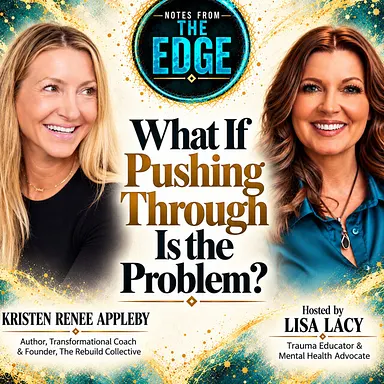
This transcript of “What If Pushing Through Is the Problem? Burnout, Autoimmunity & Healing with Kristen Renee Appleby” from Notes from the Edge was made with HappyScribe’s speech-to-text technology. Related: AI tool that takes meeting notes.
Ads in this audio differ from the text. Tap the sentence you're hearing to follow along.
Synced: the text now follows the audio.
Welcome to Notes from the Edge, where we have the conversations we should have been having all along. We talk about the things that we're not talking about. I'm your host, Lisa Lacey, writer, trauma educator, executive advisor, and author of the upcoming memoir Notes from a Certified Madwoman. Welcome to The Edge.
Hey, hey, my friends! Welcome back to another episode of Notes from the Edge. I am your host, Lisa Lacey, and this is the place we have the conversations we should have been having all along. Guess what? You ain't talking about it, so today we're gonna. And today's special guest is Kristen Renee Appleby. And today we're talking about trauma identity, mental health recovery, reinvention, and the things we perform in order to survive. Hmm, stop performing your life, guys. We're talking about what happens to the person who has always been able to handle it. And Kristen and I were having a podcast before the podcast about being Gen Xers, and I think that's some of that too. Kristen Renee Appleby is an author, speaker, transformational coach, and founder of the Rebuild Collective. She spent years as a strategic partner in high-profile CEOs leading HR and operations, and even worked as a celebrity stylist for a leading New York fashion designer. From the outside, she had reached success. Inside, she was running on empty, constantly pushing and enduring, achieving, taking care of everyone else, and becoming increasingly disconnected from herself. Then An autoimmune diagnosis hit her in her 30s, and she went on that decade-long search for answers, specialists, treatments, different modalities, examining what happened physically.
But the patterns she carried through were emotions, work, relationships, finances, and the way to move through the world. And that was the foundation for her 12-principle Healthy Foundation framework designed to help you examine your entire— life, not just pieces of it. She's also the author of 3 books, The Purpose Workbook, The Elements of Healing, and Healing the Money Wound. That's a big one. Kristen, welcome to Notes from the Edge. How you doing today, my friend?
Thank you. I'm great. And that was quite an intro. Thank you so much.
Always better when somebody else says it about you.
I've done a lot. That's great. Yeah, you have, girl.
Yeah, you have. It's Notes from the Edge, so we are just gonna dive right in. So you spent years being the woman who did it all, supporting executives, achieving professionally, pushing through, enduring, taking care of everybody else. So talk to us about when does strength start becoming a survival performance? When did you start recognizing that disconnection that we talked about in your bio?
I honestly didn't know I was living Overextending, giving as a pleaser in the hustle. I didn't know any of that. To me, that was just life and normal. So not to jump right ahead, but it wasn't until I received a diagnosis that you kind of end up looking at all parts of your life, or that's what I did after trying everything. So I didn't know I was living that way at all until I really had to take a a good long look and slow down and, you know, start looking within and to see that you were living that way, you know, and to accept that you're a pleaser. And, you know, it's my personality to kind of bend and mold to help people, or even when you're in a support position, that's your job is to kind of read the other person and learn how to work you know, how they want to work. And, um, I think I just did that in all parts of my life when I look back at it, like as a girlfriend, as a daughter, as, you know, an employee, a boss. Like I was just trying to understand, you know, I see, I see some good in like you want to understand the culture, but you also want to be your whole authentic self-loving, worthy self too, with boundaries and knowing when to say no.
So, um, yeah, it took, it took having to take a look at my life to, um, to really understand that I had been living that way.
Yeah, I, I think hindsight helps us a lot because when we're— and I think sometimes when we're in it, we don't have language for it.
Mm-hmm. And
that's why I think people like you are so, um, beneficial and pivotal because you're here to help give us language for what we're going through. And you said a word that I think is so important, and that's the word no. So talk to us about when, when the diagnosis hit you, when that came, how did that come about and how did that teach you to say no?
Sure. So I'm— I am an avid runner. And I was an avid runner when this happened. The diagnosis, it was, you know, a swollen knee while I was doing a double workout. And I guess, to back it all up, and to paint the picture, and again, hindsight, I, back then, was living for everyone else, right, as a pleaser, but not only just in my job, or, you you know, social life, but my external, my body, I wanted, you know, acceptance based on having a perfect body too. So I was overdoing it in every area in hindsight. So I was on a double workout day on the weekend. And, you know, my knee swelled up and within 2 doctor's visits, which is quite lucky for this, quite quick, I received an autoimmune diagnosis, which Um, when you're getting that diagnosis, it's the feeling you get is, oh, I wish I, I wish it was a tear. I wish I needed surgery. Because they— it's that feeling like this is something you may need to manage for the rest of your life, right? And we don't know if you'll ever run again. Um, so I received that when my identity was that of a runner and a perfect body.
So like, how could this be happening? All my friends would say, why you? I'm like, I know. But in In hindsight, it all makes sense. I think I was kind of leading up to this, as you're starting to see. But at the time, you don't get it. And I didn't get it for another 10 years of not only a swollen knee, but it— I ended up having inflammation off and on throughout my body, or off and on throughout the years, from my eye down to my ankle, you know, various degrees. Yeah. And I kept, you know, I did all the protocols that were out there and did what the doctor said and meanwhile tried, you know, elimination diets and all the things. But I kept my same life, my busy social life. I tried to just put on a brave face and a smile and suppress all the fear and panic that was in my body with what was actually happening and just wanted to continue living the life I had been living, right? And if, if I couldn't run, I'd do arms and abs. You know, I was still like trying to juggle all the balls.
And yeah, still never saying no. I was— I had a friend call me 5 Minute Christy because I was always 5 minutes late because if I had a spare 10 minutes, I'd squeeze something in and I could never slow down. And I never said no. And I wanted to be the best friend to everyone. best employee, even the best daughter when there was some dysfunction in the family. Again, everything I just suppressed what I needed to just keep going. So the word no was so rarely used. And if it was, it was followed with a million apologies, right?
Oh, the I'm sorry, I'm sorry, I'm sorry. Yeah. Yeah. Well, Kristen, I have a congenital blood disease and it took them a while to diagnose it. And I got the same thing. I was a martial art— I am a martial artist, but they said you'll never do martial arts again. And there is something that, that happens. But we high achievers, we do try to just roll on by like nothing happened and keep doing the things until we no longer can. So talk to us about when you decided to slow down. What was the moment there, or moments?
So I, I was— I think the first— I started to listen to internally what some nudges were. And, um, it wasn't slow down at first. But, uh, the first nudge was, I want to get out from some financial stress. Maybe that will help give my body some relief. And I sold my house, even though everyone said Don't do that. And I said, no, you don't know what I'm going through internally. This is what I'm going to do. And I moved and sold everything, moved with my dog, told my company either I'm going to work remotely or I need to— this is a resignation, but this is just— I decided to sell my house.
Wow. You went full pivot.
Yeah. It was probably the first time I really listened to what had been— I'd been hearing inside or feeling. I'm a feeler. And I did it. And I needed, I needed that kind of sense of freedom. And I also thought the financial relief would really help and I'd be allowed to explore other methods of healing too. Um, so on that move, and I'm getting a little off course, but this is a good story. On that move—
We love rabbit holes. That's the whole point. I'll get back.
Um, on that move, so I'd been seeing a an ophthalmologist every single week for my eye. And because it was that inflamed and we were monitoring it and, and on that drive, I'm like, suddenly I'm like, oh my gosh, how am I going to find another ophthalmologist? You know? And I just sold my house, everything moving. Like it was like a blip on my radar. And I'm like, that's actually a big one. But I just remembered to myself, nope, I'm going to leave that in the last chapter of my life. I'm not bringing this in the next chapter. I just can't add this stress. And I never had the eye inflammation again. So I have some theories on that. I do think part of it is finally showing yourself some self-love and courage and self-worth and listening to what your body is saying. These are my beliefs. I'm not trying to, you know, this is what I think. But so when I moved, I actually, the other benefit was I eliminated a lot of distractions because I wasn't near all my friends and the busy social life. So it was like time that I needed to really focus on the healing.
And I enlisted a coach and I finally started to learn how to meditate. I'd always resisted it. And meditating and sitting means you have to feel stuff and think about stuff. And that's what I had been suppressing. So this kind of time without the distractions, taught me how to slow down. I also had started to learn through tests and things I'd been doing on the side that— and what I had understood is, you know, I needed to slow down. I was completely running on empty based on test results and everything. My stress was off the charts. So I really did it because I didn't know what else I could do at that point. And if I had been only living in the hustle and the rush and the stress and the go and so depression, I needed to learn how to add in some of the opposite too, because I thought that— I realized like it was so foreign to me and it's probably what my body needed too. So that's when I learned to slow down and, um, and learn to enjoy meditation. Um, but again, it was like, it's like a new muscle to learn, right?
We go to the gym and we work those muscles, but Meditation might be hard in the beginning because it's so different and new, but, you know, with time, I, I learned to understand the benefits of it as well.
Well, what I love about your rabbit hole— great one— um, is that you listen to your intuition even though everybody was probably like, what the hell are you doing? You were just like, I, I feel it. I know, I know what I gotta do. And you told your body we're going to be good, it's all going to work out. And some things, the inflammation settled down because we all know stress causes inflammation. So, um, and then really listening to yourself to get to that place where you could balance out, um, is brilliant work. So talk to, talk to some of our listeners out there who may be stuck in a, um, transition period. And we've got Pascal on the line with us and he says, gotta say, as humans, Are so brave. Um, we do not deal with any mental health we have to control for decades. You ladies rock. We do rock. Thanks, Pascal. We do rock. We do rock. Okay, so, um, yeah, so talk to me about, about what did you discover when you slowed down? What was on the other side of that that you were running from literally all those years?
Yeah, it's so funny you say that. My dad, one time on a vacation, I went on a run and he said that to me, what are you running from? And I remember thinking, just going for a run. Now I realize I actually was— I was running from feeling for sure. I was running from emotions coming up and out. Um, so yeah, when you learn to sit, I think it's, it's a lot like I do. Suggest for people if they've been through some stuff to, you know, maybe be supported when you go through that. But, um, because you— it's— you, you'll feel stuff, right? You'll think about things that happen. I had to accept parts of my path, which I realized is part of the process of healing. Um, you witness it. Oh yeah, that actually did really happen. I need to sit with it. I wanna feel it, see it, you know. And that's like, it's painful. And, um, but they say the only way through it is through it, and, you know, feeling it to alchemize it and release it. So, um, it was so incredibly beneficial for me to finally sit still and feel it.
And, you know, it kind of was around the time that I started to write too, which was also really cathartic for me to kind of process more things and more emotions and really letting them out. Everything that I like just pushed down to keep going, it's like what goes down must come up eventually, right? So, um, I almost was forced to because my body was kind of going haywire and I needed to do things differently. Um, and it was one of the hardest things I've ever done, but one of the best things I've ever done too. Like, it was needed. I don't know what would have happened if I kept going, you know, with a stuck arm, swollen knee, swollen ankle, inflamed eye. Like, what, what would keep happening when your body is just screaming at you to make some shifts? So yeah.
Yeah, it sounds like your body really was. Yelling at you.
And, and I, I know this sounds dramatic, but, um, to say all that, I mean, those things were happening to me, but I also know I'm— in hindsight also, I know I'm very sensitive. I know I'm a feeler. And I think it's almost like a canary in a coal mine. Like my body is just pretty sensitive, right? So if— and, you know, I think the path was for me to connect more to my body because it was It was kind of a fearful place for me. So the process was also like learning to love my body and not think of it as defective at all, but in fact, completely trying to communicate and look out for what was best for me and put me back on my right path, which is like being here now and writing books and helping others. So it, it ended up unfolding so beautifully. But, you know, you, you can't— you need to feel it to kind of get to the other side is, is what I learned.
Well, and what I love about the process of finally stopping is, to your point, it's hard at first. It's hard to make the initial step. But then you turn and you face all that. And you go, oh, it wasn't that bad, right? Like, you have that moment of, man, I made it through that. And then you get to the other side where you can sit in stillness more often and you can enjoy your own company and be alone and not have to be surrounded by people. So it is a hard first step.
Yeah.
But with practice, with daily practice— and it's daily practice, it doesn't happen fast— um, it, it gets better with time. And Did you find that the same thing, that there was a time where you were like, well, that wasn't that bad, right? Turning and facing all of that finally.
Mine was hard.
Wasn't it? Wasn't it?
There was a lot suppressed. There was a lot of crying, but it all was necessary. And yeah, the way I see it now is like life on the other side of that is incredible. And for me, I was shown like life happens on the other side of your fears. I was very, very, very fear-based in hindsight. I was completely living in survival in hindsight. I was in fight or flight. I was in the rush, suppression. And that's just a difficult and not a very fun way to live. And first I was like so sad I had lived my first 40 years of my life that way. And then it was like, well, okay, how do we not live that way anymore? I don't want to live that way anymore. And to your point, I learned to love, love, love the calm and the meditation and the slowing down and the receiving and allowing and trusting. I loved it so much, I did that too much. And like, honestly, I'm like, I love this life.
I believed in being alone.
Yeah, I just— my body got softer and I was like, whoa, look at all this. Like, it was just so foreign to me and so cool and such a different way to live that I just— that's all I wanted to do. And then I've since been like, okay, reel it back. We're gonna do both. You can do both the working out and the hustle and the go-getter and the allowing and receiving and meditating. So I'm like back to balance, which is so beautiful. But you do have to kind of restructure your life a little bit. For me, like, I want to, you know, read and meditate every day, but I also want to work out and move forward with my business, right? So, um, maybe some other things have to fall by the wayside to do this, like, balanced life that I want to live. So yeah.
I love that. And you brought up something I think is really important. There is a grieving process to this. There is a grieving of what you endured. What you put up with, you know what happened. So there is grieving, and you pointed to something earlier that I think is so important, and I fully support in here, and that's mentorship, especially transformational coaching. I'm a big advocate. It's what was the game changer for me to finally get me some forward momentum. And there's all different kind of modalities out there, guys, and you can reach out to Kristen if if you need one. But that was the game changer for. me. So I'm a big advocate of mentorship as you're going through this transition process of learning how to practice slowing down if you've been, um, high momentum your whole life, like at 95 and you're trying to get to 55. It sounds like Kristen went to 35 and got back up to 55. So beautiful, beautiful journey. Well, um, one of the most interesting parts of your work is the connection that you draw now. that you've kind of found that balance— physical wellness, workplace wellness, financial wellness, thoughts, emotion, behavior.
Um, but in our culture, we treat all these so differently, right? When in reality they are one. So talk to us about like that whole body, um, attention and focus.
Sure. Um, it kind of started when I, when I, um, When I healed and I was writing, and I was writing this first book, and at the end of the book I was writing about all the things I had done in my life and the shifts I had made to return to health, and I thought, oh no, I don't know the root cause. I did too many things, and I did too many things at once, you know, processing emotions, addressing my environment, slowing down, finding purpose, learning to love myself. And so that's when it hit me like, oh, it's not a root cause. It was all these like mini shifts throughout my life that I needed and kind of following what my body was saying too. And, you know, I really thought, okay, so that's what I do now. I help people with, you know, learning to understand their body and, um, what it's saying and maybe help with, um, bringing some wellness in. And Then I had a lot of financial things happen to me all at once. And my world was kind of just, you can't make up what was happening. And I wrote about it and I finally slowed down and said, what is happening?
Because this needs to stop. I just realized I was bringing in so many, just so much crud all at once in a 90-day period. And so I said, okay, timeout. What's happening? What am I being shown? I mean, I was editing that first book and one keystroke, it was gone. You name it, a lot of things. That's nothing but the big things. And so I'm like, okay, that means I'm not supposed to be writing this right now. What am I supposed to do? Let's pivot. And it hit me, bring your same framework and apply it to financial wellness and see if that shifts things. And so I sped it up and used my framework daily as like a boot camp, because it was, it's money, like, let's, let's change this fast. And so I did 12 days of just every part of my framework, one day, you know, one part of the framework every single day, 12 days. And I wrote about it in real time to see what would happen. And I had, you know, used my tools and And I wanted to see, you know, if that could make some shifts and if it applied.
And sure enough, I mean, it did. And, um, like, what— and what I realized, you know, there's a really big connection, they say, with physical wellness. Like, you want to— you want to talk about healing and the positive, and you want to envision a healed, healthy body, and you want to be worthy of a healed, healthy body. And, you know, Dr. Joe Dispenza talks about You can't— it's like you can't heal doing the same things and in the same places that got you into that circumstance. I see that with financial as well. They talk about— you hear people talk about with money, you want to envision a really abundant bank account or multiple streams of income, or think about these great scenarios and know it's happening and believe in it first, even when you don't see the results. Well, that's so similar to what I learned with physical as well. Like, you really want to believe in yourself and your worth and your healing and the positivity and the expansion and, you know, the best-case scenario. So I really started to understand the mindset with financial wellness too. And, you know, you want to magnetize good things coming to you, right?
If we hear about like attracts like, Well, if you're in kind of the muck and the limitation and the scarcity and the lack, you're bringing in more of that. So I want to like be up here and be in the like, I want to bring in great things. I want to bring in abundance and stop all this, the muck. And so I, you know, the framework is to kind of help you raise yourself from, you know, that and feel better, think more positively and expansively. And then I realized it for corporate too. I was in the corporate world for a very long time. I returned to the corporate world after this healing journey. And it was a game changer to return authentic, self-loving, not playing a role, being a fun person at work. Even though I'm HR, I was completely hiding fun Kristen too. I was just like corporate HR Christy. And Um, it's so much, it's just such a better experience when you go in with high self-worth and self-love and confidence and, you know, all these things from a healed perspective. I just saw this, this living with limiting beliefs and lack or scarcity or survival, all of it.
It impacts so many parts of our life.
It really does. It carries over to absolutely everything. And I bet that was an amazing experience walking back into corporate. as you and just you, you know, a lot less stressful, isn't it?
It really is. And I, like, I told myself, because I really— I, I was writing books and I'm like, why am I being pulled back to corporate? And, you know, I really approached it with curiosity and, and I realized why. And I'm like, why this job? Why am I in such a corporate environment again? Isn't that what I changed? And no, it's because I really wanted to go in healed? Does my framework hold up? Did my body hold up and my health hold up? What happens if I really speak up and be authentic? And what happens if I walk in confidently? Will that impact other people around me to believe that I'm, you know, a very capable person? What happens if I go in there knowing they're so lucky to have me? Absolutely, they start to think that way too, right? So it was actually really fun, even though it was, you know, you're in a corporate environment. I'm like, I'm gonna play with this. I'm gonna go in and do it so differently. And it's wild how— what a different experience it was just going in, you know, knowing your worth.
It was a big experiment for you, it sounds like, going in and saying, is— does this hold up? I love that question. Does this hold up? Okay, so you developed the 12 principles in real time. used them in your own life and they paid off. Um, what does rebuilding the foundation of your life actually look like? So if there, if we have listeners out there right now and, uh, Pascal says, cool concept from muck to light and healing and sharing it. You got so far an A for effort. He says, we like A's in here. We like A pluses, Pascal. We are A+ women. I'm just saying. We are A+ women. So, okay. Say we've got a listener that's catching this. And they're, they're super stuck. Um, where do they start? Where's a good place for them to start if they are starting to identify that, look, we can't live in chronic stress forever and not have it wear down our bodies in some way, shape, or form, and to your point, show up in every aspect of our lives. So what's one step that people can take today if they're listening to maybe start Doing a pivot, finding some clarity?
What can they do today?
Sure. I love this. This is why I'm a how person. You know, I would hear all these great theories, but it's like, but how? How when you're, you know, in the muck, so to say? The first principle I have is, I call it connection with your body. But really, it's, you know, can you just slow down for 5 minutes? Can you, you know, a lot of us are running just in our head rather than really connected to our body. We have stress, we have things to do, we're in our mind and our lists. So how can you just take a few minutes and try to be present in your body and connect with your body? You know, I even, I even say, like, I try to, um, this framework is to be realistic with our busy lives, right?
Mm-hmm.
And so, you know, if you're on your daily walk or run, Let's say it's a run. Can you just walk for a few minutes too and take the headphones out and maybe be in nature and observe a tree or listen to the birds, right? I, you know, even just take my first cup of coffee outside to just be like really present. It's a moment for me just to be still and present and connecting. Um, or yeah, just try to slow down. And maybe it's before bed and just kind of Be really present in your body. And maybe, you know, maybe some ideas will come up. Maybe you'll get a little ping, who knows. But that's kind of the first one. Like, I really try to create this as almost like a staircase. I don't tell anyone like, this is what you have to do. But it's like, could, could you maybe add something in this principle in your life to just bring some connection to your body as a first step?
I love that. And what I love about what you pointed out is it doesn't have to be massive amounts of times. You can start with 5 minutes.
Mm-hmm.
And man, if you're not finding 5 minutes for you in your day, then there may be some problems looming, you know, right around the corner if you keep pushing. So Kristen, you did it. So how do we stop abandoning ourselves in the name of achievement or ambition and find real purpose? Because when we're in it, we think that's purpose, right?
Right.
But it's not.
Well, I try to kind of guide people up gently towards self-worth and self-love. And I think once you have that, like, I couldn't have gone back into corporate authentically without deep self-love, which I learned to cultivate. I didn't have it. That's why I talk about rebuilding a foundation. I didn't start with self-worth or self-love, sadly. Again, that was in that realization. So you can slowly cultivate it and build it. And then I think that once you have that, then you're kind of returning back to authenticity. If you love yourself, then you want to show your whole shining, amazing self to the world, right? I think purpose is one of my principles too. I found purpose is immensely important for wellness and happiness. And, you know, of course, we probably need a paycheck, right? But you can still do purpose on the side. And, you know, I'm a big fan of a side hustle, right? Or even if it's you just send one email before or after work to add to your side hustle. I did it for years, writing books and creating things on the side. And, or maybe it's a creative pursuit, or maybe you just haven't quite found your purpose yet.
And that's totally okay. Sometimes it takes some gradual buildup. Like I had to really address some limiting beliefs and learn to connect with my heart before I could understand what my purpose was. So sometimes you need these steps first. So if you don't know it yet, it's okay. You'll, I think you'll still find it. I had friends reach out to me and say, well, how did you find your purpose? And I said, Let me write about that. So I wrote a workbook on it because I'm like, well, what, what did I need? Because I went to college not knowing what to major in. I got jobs out of college still not knowing what I wanted to do. And I realized later, my, my understanding is, I think I'd been living in survival so long that I didn't have time to stop and think about, well, what, what is my purpose? What makes me happy? Right? What do I want to do? So yeah, sometimes you might need a few steps before to then step into your purpose.
I love that. And Pascal says that he thinks your slow down for even 5 minutes to reconnect could be on a t-shirt. So you need t-shirts. Add t-shirts as a side hustle. I love that. I love that. Okay, Kristen, you've written 3 books. So The Purpose Workbook, The Elements of Healing, and Healing the Money Wound. If people want to get to know you better, which book should they start with? Which book would you recommend them to start with?
Oh, I guess it kind of depends. They all house that framework. It's just kind of— it's probably going to be in most of my books. I'm writing another one about all 3 areas right now. Um, you know, The Elements of Healing really is more about a framework for daily life. So even if there's not something that you need to heal from necessarily, it's really about that foundational program, and it walks you through each layer, um, it guides you, it invites you to do it weekly. Um, so, but if you're under, you know, some financial, you want to make some financial changes fast, the money one is the 12-day boot camp. So you can kind of speed it up too. So—
Grab both books, guys. Grab both books. And Kristen, if people want you for mentorship, say they're, they're stuck and they're not sure what next steps are, and guys, don't try this alone. Really grab somebody who has some of the things that, that you desire, um, or can help you define your purpose and hold your hand through the process. Kristen, how can people find you for that too?
Oh, thank you. Um, my website is called kristenreneerebuilding.com. Um, you can also find me on LinkedIn. And I'm— I do offer some one-on-one, and I am building some group coaching because I really— I want— and I have the books because I want it to be affordable too. So, um, that was a big goal of mine. Um, but I, I like the idea of building a group program because I want to be able to like give people that space or that, you know, I needed someone to give space for me when I was going through it. So it's kind of to give back and to create that for other people as well.
I love that. And guys, we'll put those— we'll put her LinkedIn, her website, and the place to grab her books in clickable links in the Uh, notes for the show so you don't have to worry about writing that down. All right, Kristen, before we let all of our guests go, we always ask 2 questions. You ready for them?
Okay,
okay, okay. The first— they're not terrible, I promise. And it says it everywhere on my stuff, so you've already heard it. The first one is, in your own life, what did you perform the most in order to survive? And what did dropping that role, mask, or performance do for your life?
I mean, I think it's what we covered a little bit, which is bending to fit into what other people wanted. And, um, yeah, to kind of please everyone but me and not ever going within. And Um, you know, to stop playing corporate Christy, to, to learn to follow my heart. You know, I don't know if wellness author is what my parents envisioned for me, but I had a deep calling, and the calling was just getting louder and louder and louder. And so, um, that's why I'm here. So learning to live authentically and love me. And, you know, I think back to how I was as a kid. I was always out in nature and barefoot and picking flowers. And so it's so cool to kind of— once you slow down and kind of return to your authentic self, you're like, she was there all along. I just got off course. And now, now we're back. And, and I love it. You know, I love talking to my friends about being out in nature or being the one to like remind them to slow down too. And, um, yeah, so living authentically and in my purpose and heart-centered and grounded is like It's truly like the best gift ever.
I love it. And you, you're proof that it worked for you, so I love that too because it's experiential wisdom that paid off. All right, last question: what do you want us to be talking more about as humans that we're not having conversations about?
Hmm, I mean, I think having like compassion and empathy just in general is, I think, would help so much. Um, you know, maybe just truly listening too. And, you know, you, you never know what people are going through deep down and maybe hiding. Um, so, you know, I like to just like give a smile to someone. You know, I was in a line at a grocery store yesterday and I looked terrible, but I'm like, I'm just gonna give her a smile because she was the only person checking people out. And I'm sure that was stressful. And I don't know, I just, I think if you lead with kindness and compassion and empathy and give a smile— that's my dog.
We love puppies. You're about to hear mine goes nuts when my husband comes home, just an FYI.
I just think all that ripples. And, you know, just really checking in with people and asking how they're doing and just Um, showing you care, I just think goes such a long way. And I think that may help someone else do that and could ripple out too. And, um, yeah, just talking about how people are and, um, being compassionate.
Yeah. And being real with each other. And Pascal says that he shall link you on LinkedIn. Merci. And he says empathy for sure. Um, all right, my friends, I'm going to ask you guys the same question if you're listening. What are you performing in order to survive? And what might set— setting that role masker performance down do to lighten your load just a little bit? I'm your host, Lisa Lacey, here with my wonderful guest, Kristen Renee Appleby. And when you find the answer to that, we will both see you at the edge. Kristen, thank you so much for today.
Thanks for having me.
What happens when the thing that made you successful, your ability to push through, perform, achieve, and keep going, becomes the very thing your body can no longer sustain?In this episode of Notes From the Edge, Lisa Lacy sits down with author, transformational coach, and founder of The Rebuild Collective, Kristen Renee Appleby, for a conversation about burnout, autoimmune illness, the mind-body connection, and what it really means to rebuild your life from the foundation up.Kristen spent years searching for answers while navigating autoimmune illness, chronic inflammation, demanding work, financial stress, emotional suppression, and the expectation that she should simply keep functioning. Eventually, she began questioning whether all of those pieces were actually separate.We talk about what happens when achievement becomes intertwined with survival, why changing a protocol without changing the environment may not be enough, and how our relationships with work, money, emotions, purpose, and ourselves can influence the way we experience our lives.This conversation isn’t about abandoning ambition. It’s about asking whether the life you’re building actually has a foundation strong enough to hold it.In this episode:• How burnout and high-achiever survival patterns can hide behind capability and success• Autoimmune illness, chronic inflammation, emotional suppression, and the mind-body connection• Workplace stress, unhealthy environments, and what happens when pushing through stops working• Financial stress, money wounds, limiting beliefs, and the connection between physical and financial wellness• Kristen’s Healthy Foundation approach to rebuilding self-trust, authenticity, purpose, and a life that doesn’t require abandoning ambitionConnect with Kristen Renee Appleby:https://www.kristenreneerebuilding.comConnect with Lisa | Inside the Edge:https://www.lisalacy.com/inside-the-edgeWhat did you perform in order to survive?Welcome to the Edge.See Privacy Policy at https://art19.com/privacy and California Privacy Notice at https://art19.com/privacy#do-not-sell-my-info.