
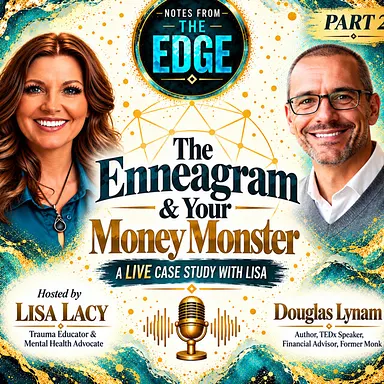
“The Money Monster Within: Managing Yourself Before You Manage Your Money | Part 2 with Doug Lynam” was turned into text by HappyScribe’s speech recognition. Related tool: audio transcription.
Ads in this audio differ from the text. Tap the sentence you're hearing to follow along.
Synced: the text now follows the audio.
Welcome to Notes from the Edge, where we have the conversations we should have been having all along. We talk about the things that we're not talking about. I'm your host, Lisa Lacey, writer, trauma educator, executive advisor, and author of the upcoming memoir Notes from a Certified Madwoman. Welcome to The Edge. Casey, writer, trauma educator, executive advisor, author of the upcoming memoir Notes from a Certified Madwoman that is still set to launch for presale in October.
We're so excited about that. We are on schedule with our editing, and we have a special guest back for more today. We've got Doug Linam here today again. We had Such a fabulous time talking to Doug, um, about our relationship to money, his journey with money. Um, for those of you who weren't here, a little bit about Doug. Um, he's a financial advisor, TEDx speaker, bestselling author, former monk whose unconventional journey reshaped the way he thinks about money, and he helps people now do the same thing. After serving in the Marines and then 20 years as a monk, he entered the world of wealth management with one mission: helping people understand that lasting financial change begins by understanding yourself. And I love that. He's the author of Taming Your Money Monster, Nine Paths to Money Mastery with the Enneagram, and we're going to be digging way deep into that today. I'm so excited. And From Monk to Money Manager and hosts the podcast Monsters and Lighthouses. His work blends psychology, spirituality, behavioral finance— guys, that's a thing— and Enneagram to help people transform their relationship with money from the inside out. So Doug, welcome back for more.
Yay, you came back.
Thank you, Lisa. It was— but I had such, so much fun on our last show, and you're a playful host and thoughtful questions, so we went deep, and I'm glad to go deeper today.
Well, yay! I can't wait to give people an even deeper glance into how you work with people, because I think for so many of us, if we can have a healthy relationship with finances, it's going to drastically improve our lives across the board. So for the people who did miss part 1, which, guys, I would highly recommend, go hit our YouTube channel, check out part 1. It was brilliant. We talked about how finances gets tied up with identity. Talk to us, give us kind of a 30,000-square-foot view of what we covered in terms of identity and finances.
Well, I mean, so it's a big question, but essentially, you know, we often equate our net worth with our self-worth is a very common trap we fall into. But also money, it triggers some of the most primal circuitry in our mammalian brain. So it's It's food, it's safety, it's shelter, it's our status in the tribe. And so it often triggers a fight, flight, or freeze response that we fall into. And then our personality type shapes the way that we fight, the way that we flee, the way that we freeze up in the relationship to money. So it's really understanding your personality. And what we're going to get into again today is this really cool robust psychological tool called the Enneagram. But what it basically tells us is that there's only so many ways you can design an ego. And there's some patterns in very broad strokes. And when you know the core functioning driver of your ego, what you learn through the Enneagram is what your deepest unconscious fear is that your ego is trying to protect you from. And then money becomes a way to either help you in that journey or even harm you in that journey in both helpful and destructive ways.
So we're really going to dig into, like, why do you do what you do? And, and how does money facilitate that? Where does it get you into trouble in terms of the way we have these sort of trauma responses to money are very unique to our personality type?
I love that. I love that. And it kind of brings me back to the idea that our superpowers also are kryptonite sometimes. So I love that. Talk to us about how How did you, you went from Marines to monk to financial advisor, but how did the Enneagram process come into play in terms of you helping people?
By a complete accident. It was just a fluke. Um, so I got a, I got a 2-book deal from HarperCollins. They gave me, I sort of won the literary lottery and the first book was, you know, called From Monk to Money Manager, a Former Monk's Financial Guide to Becoming a Little Bit Wealthy and Why That's Okay. That first book I'm really proud of, but it's really a primer on financial literacy. It's everything that you should have learned in high school or college but didn't about earning, saving, investing, giving, taxes, insurance. And then using my backstory and unique stories from the monastery as hooks to kind of make it engaging and entertaining and also kind of a philosophical deep dive and why money's okay, essentially. when you use it right as a tool for love and service. Now, that was really laid out in the book contract I signed. Then the second book was completely open-ended, and they said, well, what do you want to write about? Yeah. So I was thinking really hard, and what I really wanted to do was write a book that would help people make more ethical, spiritually grounded financial decisions in a framework that would transcend religion, politics, and culture.
So what would that be? That's big. What would be a universal framework that anyone in the world could read and understand and bring their highest spiritual values into their money? And so I spent a long time researching this project. I first landed on a framework called Spiral Dynamics and Integral Theory. everybody is familiar with that. It's a very deep, beautiful concept, but it's extremely technical. I drafted an outline in several chapters of that book. It took me about 2 years to pull money into that framework, and it was very challenging. I sent that proposal off to my publishers and they said, this is brilliant, but no, no one's going to read this book. It's far, it's far too technical. It is, it is just It's basically an academic book and we want something mass market. And I agreed with them. So like, that's what I want too. So I went back to the drawing board and I thought, well, what other framework could, could work? And I had a— have a good mentor and father figure named Richard Rohr, who was one of the pioneers in the Enneagram. And he'd been kind of noodling me about the Enneagram for years.
And I never took it very seriously because I couldn't understand the why behind it. It felt kind of like astrology or something, you know, and I'm not opposed to astrology. It's just not my thing. It didn't have a why behind it. And so I had to go back to the drawing board with the Enneagram. And, but I started looking at it carefully and I just, it was sort of a Hail Mary pass. And I sent an email to my publisher and said, hey, I think I could make this thing, the Enneagram, work Um, what do you think about that? And they immediately got back to me and said, yes, that's the book we want. Now, I didn't know a ton about the Enneagram at the time other than my type, but I, I had an intuition it could work. And, um, it— I also knew it was a simpler system than Spiral Dynamics Integral Theory. So if I can make it work there, I can make it work here. And that set me on another many-year project to really bring the Enneagram first of all, understand it, also rework it in a very unique way to really ground it in childhood developmental psychology and the latest research in neurobiology.
So it has real— to give it some real foundations I could rest upon intellectually rather than just being this sort of vague observational thing that seems to work. So that's kind of the— it's a long answer to a simple question.
So you answered the why though, for yourself first and then for your readers as well. So yeah.
Yeah. Most authors do a great job of explaining, uh, how the Enneagram works. But until this book, Taming Your Money Monster: 9 Paths to Money Mastery with the Enneagram, I've never seen any author attempt to really explain why it works. And until my math sciencey brain could really know the why behind it, I couldn't really write a book about it.
Well, you know, here on Notes we ask better questions, right? And why is one of the biggest ones we ask, right? Because we're having the conversations we should have been having all along, like how to balance a checkbook in 8th grade. Instead of learning parallelograms, we should have been taught how to balance a checkbook in 8th grade.
Former high school math teacher. I fully agree. You have my— why do we teach the quadratic formula? It's great. Agatha, awesome, but compound interest is far more important.
Okay, wait, that was not in your bio. We'll have to do a 3rd show on just being a high school math teacher. I love it.
Yeah, in the monastery, I was in a teaching order in the monastery, and I was the head of the math department. So that's how I got teaching econ and finance, because I was like, hey, our kids don't have this, and we aren't teaching kids this stuff. And that was a real passion project of mine, was bringing making personal finance a part of our math curriculum.
Yeah, they're basic life skills. Yes, basic life skills. I love it. Um, what I love about your work— okay, today we are turning the spotlight on to me. What did come up in our previous show was that I am an 8 and my partner is probably a 5. Um, one thing I love about your work, Doug, is you don't Shame behavior, right? Instead, you just have, you have a great curiosity about you, which I dig because again, we stay curious in this space because it's when you stay curious that you're going to find the best answers. So, um, I am now going to turn the reins over to you. Where do you want to go next? We just high level identified me as an 8. my partner as a 5, um, coming off of the heels of a new plan to, to have a family financial discussion that has to be recorded. It has to be recorded. Yes, we're both committed to it, but it— we have to record it because we have great forgetters. And you know how it goes. You'll be like, you said, I said, you said, I don't think so. And so— Right.
We're just like, just for posterity, we're going to record it, get a transcript. So we're kind of excited about doing this. He's in a great position now. He's taking over the family business, but it's new for him and it's scary for him. I, of course, now— and there is a 16-year age gap between us. So, I mean, I've run many, many, many businesses throughout my 30-year career in corporate, but Finances can cause divorces. Let's not pretend.
Yeah, it's one of the leading causes of divorce, in fact.
Okay, well, let's not go there.
And let's also say that money stress is— money stress is probably one of the primary stressors of life. But, and that's really why I went into finance, was realizing in the monastery, like, if I— people would come to me and say, you know, would you pray for me? I'm like, of course. But, you know, a budget might work better. Like, we could do both. These aren't mutually exclusive. Like most of the spiritual existential struggles that I, I met in people, if you dig deep, there's almost always a financial problem that is either the direct cause or a secondary issue lurking in the background. And, and if I could solve that, I can improve the quality of people's lives dramatically more than almost anything else I did.
I love that you can do both. You can do both. And then there's work for us to do too, because once you Say you have a client work with you, then change is going to be in order. So you have to have that willingness and that curiosity to go, okay, well, here's my biggest fear. What I love that you identified is finances bring up our base fears. Housing, clothing, water, shelter, bait. I mean, foundational safety, status. Yes. In the tribe. Right.
When our status gets too low in the tribe, we get kicked out of the tribe. Right?
Yes.
In, in the olden days, right? For, for the, for the, or the, the weak link, right? It's, it's always the runt that gets picked on, right? So you don't want to be that.
Yeah. Yeah. But what I, what I love that we explore in here is being who we are, figuring that out. And so I love the fact that you now have a system that you've added to, it sounds like, um, to help people really hone in on who you are right now, because I always say you cannot determine who you're becoming. You certainly don't want to go back to who you were because that's, at least for me, that's the gal who got me into a lot of messes. Um, so we've got to know who did survival make us? Like, what did we perform in order to survive? So I'm going to turn it over to you. I'm an 8. Talk about the numbers first. Will you give us a little overview?
Yeah, I'll put this— I'll put a little slide up if I can. I'll share it, but I'll talk it through so people who are listening can still follow along clearly. But if anybody wants to watch, is watching this, you can see it a little bit more succinctly. And let me just find the share button if I can on this machine, which I— we are on the wonderful platform Riverside, but I don't know where the screen— Share. I'm so used to Zoom.
Let me see if I can assist you. I haven't done this yet.
Got it,
got it. Okay,
share screen. I have that. Choose which screen to share.
And we've currently got 5 people with us, so just a heads up.
Oh, fantastic. Okay, so can you see this, this— so what, what, this color wheel on the screen?
Yep, now we can.
All right, so think of the Enneagram as a color wheel. And on a color wheel, there's infinite variety of shades, hues, textures, and colors. So there's room on this color wheel for every possible combination of human personality. And your Enneagram type kind of is what is one— if you were to take that color wheel and you were to chop it into 9 even pie slices, that's essentially what the Enneagram is saying, is where on this color wheel does your personality lie, right? Now, there's, um, 3 triads in the Enneagram. So we're gonna subdivide those 9 slices into 3 chunks. So there's, there's 3 core things to keep in mind when you're looking at your type. And what it— and there's what we know from— this is the neurobiology, and it's, uh, there's a neurobiologist named Salavallander and Jack Daniels, David Killian, done some wonderful research on this. And Jaak Panksepp also is really the pioneer of affective neuroscience. And what we know is that in all mammals, there are 3 core negative emotions. All your other negative emotions run off of these 3 circuits. And they are the anger circuitry. Then there's grief, which is like separation anxiety from a child from a parent.
But that grief often feels like shame in the modern human brain. So grief is grief, but it also appears as shame. And then the third one is fear. So really anger, grief, and fear are the 3 core emotions that we can experience. Now, where does your Enneagram type come from? How does this whole system work? And I'll give you a very quick summary. But you can go very deep. But essentially, think of it like this. Oh, let me— I'm sorry, back up. So there's 3 core negative emotions. There's 3 ways to process each of those emotions, which gives us 9 different types in the Enneagram system. So the ennea in Greek means 9, and gram means drawn. So there's just these 9 types. We're drawing them on a circle, or there's different ways of expressing it, but that's how I show it. Now, where do these 9 types come from? Why are there just 9? And I titled this, What Kind of Car Are You Driving? So, it helps to think of your ego as a style of car. Now, there's infinite type, every car is unique. You drive a unique year, make, and model, but there's styles of cars.
Like, there's SUVs, there's compact cars, there's sports cars, right? So, whatever you drive, it's totally yours, but it has to fall into some broader category of cars. And that's how I like to think of the Enneagram, right? So you can trick yours out in all kinds of cool ways. And, and one more key point is the Enneagram is really just talking about the nurture portion of your personality, how you were raised. It's not getting into the nature, which is your DNA, although there may be some overlap there. There's— so we're not saying everything about your personality, but we're talking about the core ego defenses and trauma responses you had in childhood To the biggest stressors that occurred in that environment. So let me back it up one more step and say, here's where your Enneagram type comes from. It comes from the fact that when you're born, you are like— think of it like this: there's a physical umbilical cord that gets severed the moment you kind of pop out of the womb, but there's a psychological umbilical cord that gets immediately formed between you and your caregivers so that you are egoically codependent On your caregivers in childhood in order for you to survive.
Your emotions are regulated by your parents, your behaviors, your actions. You are completely bonded, but that bond has to be severed over time. Slowly, that psychological umbilical cord has to be cut in order for you to do what we call individuate and differentiate from your caregivers and the world around you. And the Enneagram is explaining how that process happened for you.
Because that psychological umbilical cord, in order to cut it, we have to use these 3 negative emotions to do it. And one of them did more of the cutting for you than others. So you got hit with a little more anger, a little more grief, or a little more fear in your childhood environment that allowed you to separate. And it has to be done with negative emotions because positive emotions would just reinforce your connection with your caregivers. That makes sense. Makes perfect sense. Core wounds, right?
It's your core wound. We call it your— I call it your sacred wound. It's the core wound. It actually allows you to have self-consciousness or a sense of separate identity, right?
Love it.
So now we've got these 9 types. We've got these, we've got these 3 core negative emotions. You got hit with one more than the other. And as an 8, we're going to start off going around the circle with an 8. And we say that you've taken that anger for 8s to typically have a childhood environment that had a lot of injustice or a lot of some core betrayals, um, where your environment, you felt like, um, you weren't adequately protected in some core fundamental way from in your, in your childhood environment.
A lot of anger, a lot of anger. Yeah.
And, and, and
so somehow I knew an 8 would be on anger too.
And, and often these, these emotions, these negative emotions, where they come from is the boundary setting that reality put on us for whatever reason. It isn't just your parents. They are all to blame, but they tend to be the easy culprit. But for 8s, so we have 3, 3 negative emotions and we can take that emotion and we can externalize it. Which is what 8s do. So externalizing it is like having a food fight with the world. Then we'll get over to the other types. You can internalize it, you can drive it towards yourself, which is like giving yourself an emotional wedgie. Or you can have both. You can have both an internalized and externalized, in this case, anger or grief or shame. So jumping to the 8 real quick, back to that, you, you've externalized that anger. And what would happen for an 8, for complicated reasons, that anger is coming from your greatest fear, which is being harmed or controlled. 8s hate being controlled by their external environment because it was so intrusive in whatever way or so unsafe. So we call Type 8s the Challenger. I call them the Hummer of egos.
So using car metaphors, right? I call them the Hummer because they can sort of roll over objects really easily and they're Their best defense is a good offense, essentially. And so they, they, I call them the Hummer because they can roll over things easily, but they tend not to be fuel efficient with their opinions, essentially. They tend to like a good fight. They tend to come at things pretty hard. And if you push them, they're going to push back twice as hard.
Doug, that is so funny. I just met with my own coach, my tantric coach this morning. And she goes, so what's our goal for the next 8 weeks? I said, set boundaries with more grace and finesse. That is my goal because I can roll over people. Just get out of my way. Just get out of my way.
And that boundary setting, doing it with that vigor, it's also a superpower, right? So we say that the greatest superpower for 8s is having a lot of energy. Like they have this life force, this vibrancy that's wonderful about them, but it can overwhelm the people around them. And they often want to be in charge and stay in charge. For reasons that are obvious. They want to be in charge because they just don't want somebody above them who they think is incompetent telling them what to do. Um, it's a— other types want to be in charge for kind of ego aggrandizement. For 8s, it's really about being in control and being on top. So they, they, they have the power and not
be controlled. Yeah, that was really spot on. I, I, the idea of, uh, being controlled is most uncomfortable for me.
Yeah. And then I'm just going to go real quick. I want to focus on the 8 and the 5 because that's really the core conversation. I really won't have time to go too deep into the other types unless, if you want me to, but that's almost the whole show.
Well, if somebody has a question about their own, that's what we're doing today. We're showing them a little piece of how you work and they can reach out to you and get a little bit more information about their own. But I just want to let you know that thus far, you have been so spot on. This thing is so spot on. And yes, yes, yes, yes, yes. I'm on board with checking the boxes.
I'll do a speed date here with the other 9 types so people can get a sense, but I won't, I won't linger too long. So, so then we're going to jump over to Type 1, which is on the other side of this, this quadrant here. So we're, we're, but Type 1s, um, they take that where, where 8s externalize that anger, 1s internalize it. And they have a greatest fear of being bad or defective. So they're hyper— they have like a drill sergeant in their head always telling them to shape up and do it. They're very principled, very organized. And we call them the improver often, or the reformer, because they're always trying to improve themselves or the people around them or the systems around them. They see the flaws in things very easily because of this anger at themselves when they don't do things right. So I call them the BMW of egos because they're precision engineered, but they do take a lot of maintenance. Okay. And then we'll just jump over to the 9. We call them the peacemaker. They're in between the 8 and the 1. And they have this internalized and externalized anger.
Again, I won't go too deep, but essentially their fear is that if they— they have a hard time asserting themselves because their needs didn't get met in childhood. there wasn't anything they could do about it, and there wasn't anything that people around them were really doing about it. So it's like a volcano of anger inside them they never want to touch. So they're— they learn to go along to get along. Like, a good friend of mine, um, he had a younger sister who had Down syndrome and special needs. So by, by just default, the family's time and attention had to go to her. He had to put his needs in the back seat. He couldn't do anything to get his needs met. His parents were overtaxed. couldn't do much to meet his needs the way his sister was. So he just learned not to assert himself. So 8s are almost the opposite of the 9s in a way. So they're always trying to keep the peace, or I call them the RV of egos because they often want to chill at the campground while other people are taking a break. And then there's one— this is, this is a very deep piece of it, but it will help us move forward a little faster when we get to the 5 and the 8.
which is that, um, you may have heard of the 7 deadly sins in sort of classical Christian theology. Turns out they weren't being creative enough. Originally, the idea came from a guy named Evagrius of Ponticus, who said there were 8 deadly sins. Pope Gregory came along a few years later and said, no, actually, we're going to take one out, add one in, and he codified it as 7. But that wasn't really good enough. Actually, there's 9 And the word sin is often misunderstood. The classical— in, uh, in the original origination of that term, it's from the Greek. It comes from an archery term. It means to miss the mark. Like if you're an archer or you're a golfer, right, you're taking a swing. Where does your swing usually go sideways? How do you tend to— do you choke up? Do you slice to the left? Do you slice to the right? It's saying in life, where do you tend to miss the mark? Um, without putting this big theological fire and damnation on top of it. But what's why it's a helpful tool is that because there's actually 9 of these, I call them, call them your worst vice.
The, the original 7, the one they, the 2 they forgot are cowardice and they forgot deceit. So if we add cowardice and deceit or lying, you know, into those deadly sins, we get 9 and they track perfectly to the Enneagram. And what it means is there's one— Wow. vice, one sin, one way you miss the mark more than others. That's your thing, sort of your— again, I was a Benedictine monk for 20 years, so forgive me if I'm triggering people with Christian stuff, but it's a helpful way of framing it regardless of your theology, that there's that one vice that you are likely to struggle with more than others, that you don't— and we often pat ourselves on the back because, well, I don't struggle with gluttony and I don't struggle with avarice, but what, of course you don't. It's not the thing that is your, your, it's not your thing. It's not your cross to carry.
Well, what I love about missing the mark is it takes any shame out of the equation. It's just missing the mark. And what do you get to do when you miss the mark? You practice a little bit more and you try again.
Exactly.
Yeah.
And so why it's helpful for the 8 is you're your worst vice is what we call lust, which it can be sexual, but it's often more like this lust for intensity. It's why when someone pushes you, you push back twice as hard. It's that boundary setting. It's that go after and go get it kind of like— it's a superpower, but it's also the thing that can get you into the most trouble. And so, um, moving back, backtracking a little bit, for 1s, their worst vice is anger. For 9s, their worst vice is sloth. And then I'll just keep going because we're gonna get hung up here if we don't move along. But let me just run— so you get looking at that one triad of anger, you get a sense of how the system works. So there's these 3 core negative emotions, 3 ways to process them, 9 types. It's very simple. It's very simple to understand. Yeah. And then I'll run through these really quickly. I'll just show you the 2. We call them the helper. They have externalized grief, which means they feel grief about how they think people perceive them. So that's another way of saying shame, right?
They feel grief about— and they're— we call them the helper because they're always compulsively helping other people. I call them the ambulance of egos because they're always running around getting in other people's business, um, and helping others but have a hard time taking care of themselves. Interesting. And their vice is a kind of pride at what a good and helpful person they are. 3s, um, they have it— or have an internalized and externalized grief. So they feel grief about how they perceive themselves, which is internalized shame, and they feel grief about how they think the world perceives them. That's the externalized shame. And they call them the Achiever. So they're always running around trying to achieve things because their greatest fear is being worthless or not having any value. So they're always trying to prove their worth through their accomplishments. And we say their vice is deceit because we're— and I'm a 3, so that's my my cross to carry. We're expert mask changers. We'll, we'll, we'll, we'll change our persona to fit whatever environment we're in to win the approval of the people around us. So it's a kind of deception that we're always engaging in, or self-promotion we're engaging in.
Okay, I'm going quick. 4, um, they, they internalize that grief. So it's an internalized grief about how they perceive themselves. It's a shame. So they feel like they don't have a unique identity. They're always trying to stand out and stand apart by being different because that, that they don't feel like they have a place in the world. So they got to always think different, do different, wear the crazy clothes. They're kind of the—
That would be my daughter. She's a 4, definitively.
So they're often called the individualists. I call them the custom car because they would paint their car purple and drive it backwards to stand out.
It would be purple.
Yes, it would be purple or black. Purple and black are big with 4s for whatever reason. And so their vice is envy, meaning they envy the uniqueness they see in everyone else, but they don't see it in themselves. They can be moody, very melancholy at times, and struggle with that. Now getting to the 5, where we kind of wanted to kind of land is— what's your husband's name? Your partner's name?
Brody.
Brody. Okay, Brody, we're going to pick on you a little bit here, Brody. So now we're in the, in the fear triad. So 5s take that fear and they internalize it. They drive it towards themselves, meaning they're, they're afraid they're not capable or competent to meet the challenges of life. So they strive to be extremely independent and, and self-reliant and capable. And I call them the compact car because they have a small gas tank for social interactions. They get drained very easily because they're, they're pulling information. They're trying to pull this infinite amount of information in the world around them into their heads, figure it all out. And then when they've got it all figured out, then they'll speak and then they'll act. But they get stuck there because there's an infinite amount of data to process.
So, oh, he will take— you know me, you see how fast I talk. He will take a very— he's very methodical before he speaks. He takes his time. Before he says something. And you're absolutely right. Again, spot on. Um, at the shop, uh, what is happening is people are used to coming up there just to chit chat and that, uh, on top of doing the mechanical part, which is the easy part for him, but it's the social interaction that he's now responsible for that is draining him a lot. Yes.
And then we'll just wrap it up and I'm going to show you the ego map for the 8 next, which I think is going to be very exciting for you. Um, um, but lastly, we have Type 6. Oh, so we got 2 more, 6 and 7. 6 is a skeptic. They have, um, an internalized and externalized fear. So they, they fear that they're not capable to meet life's challenges, but they're also afraid of the external world. They don't trust that either. So they're the constant, like, uh, their threat detection level is on high all the time.
Mm-hmm.
And so I call them the family sedan because they want every safety feature imaginable and a few that they invent themselves. We say their vice is cowardice, but they're not physically cowards. Like, they might jump into a bar fight to help a friend, but it's— decision-making is hard. They don't know who to trust because they don't trust themselves. And they don't— there's constant skepticism of what could go wrong. So it's kind of this indecisiveness sometimes, or paralysis they get into, or just looking for security. So their greatest fear is being without support or guidance. So they're always looking for a system to embed themselves in. to feel like they're safe and secure. They want strong family ties, strong communal ties. They're very loyal, great friends, and ready in any emergency. Lastly but not least, we've got 7. They've got that fear that they've externalized, being they're afraid the outside world isn't going to meet their needs. They— and so they often had inconsistent parenting or whatever reason. So their fear is being trapped in pain. or trapped in privation or lack, like there's not going to be enough food, there's not enough resources, there's not going to be enough whatever.
So we call them— their worst vice is gluttony because they always want more because they're afraid that there's not going to be enough. But we call them the enthusiast because they're always really excited about what's next, always looking to the future like, oh boy, what's next? They're sort of the Peter Pan of the Enneagram. So childlike, not childish, but have a childlike enthusiasm for life because they want all the options and all the opportunities. So they live in this constant state of FOMO or fear of missing out. So we call them the enthusiast. I call them the SUV of egos because they're ready for any adventure as long as it doesn't involve being in their pain in the present moment. So they're always future-oriented, looking to get out of the present moment where their pain sits. So they're They're always spinning things in a positive way. 6s are always spinning things in a negative way. So they're really interesting how the number next to you is almost the one that's most different from you.
Interesting.
So that wraps up a speed date with the Enneagram. And if you have questions, we can take those or we can go deeper into your type.
I love that. I'm down for it. Let's dig deeper into my type because I think it is so spot on, even with my husband and daughter so far. Yeah,
I'm gonna, I'm gonna fast forward through a bunch of graphs here. Okay. I've got to, I've got to, I've got to zip through my slide deck, um, and I'm going to get to the ego map for the 8. Um, so now here is a deeper dive, and we're going to get to the money part here in a moment. We covered that in the last show, but what you're looking at, um, I won't go too deep into this because some people are listening, but there's a, a cool graph here on the left-hand side of the screen which is like a double— think of 2 traffic cones stuck together at their bottom. So it's like a double cone, and it, it really describes the journey of our progression of our ego through life, of how we, we sort of start our journey. And this is sort of a, a deep rabbit hole I'll skip over, but essentially there's one axiomatic assumption in the Enneagram. Every system, math or science, doesn't matter what you pick, you have to start with an assumption, some axiomatic thing. And for me, the assumption of the Enneagram is that you're starting your journey in life in the womb, like when your consciousness first flickers on in a state of unconscious unity.
So you aren't really aware of much. Your reality is very limited and you're— but you're in unity with everything you can experience. Mm-hmm. But you're unconscious of it. So you don't have this separation of I, thou, you, me, right? Then you pop out of the womb, that— and now you have to move through the first half of life up the bottom of this bottom half of this double cone into— you're establishing your independence in life. You're trying to get to a sense of conscious separation where you have a unique and strong ego. And then we're going to try to move from conscious separation to the peak of this double cone in the second half of life into what I call conscious unity. That's the mystical state of oneness that Buddhists are talking about, whether it's samsara or moksha or the beatific vision, take your pick. But getting at least tasting that— it's hard to live there, but you can at least— our spiritual practices are trying to get us to a state of deep interdependence where we see Not just our independence, but our interdependence. And along the way, we all would have to go through what I call the dark night of the soul, or many, many spiritual teachers talk about.
So that's just the meta map. Now let's put that into practical terms for the 8. This is— we're going to go do a deep dive. So you have a shadow structure, which is that bottom half of this cone, where we're building out your ego from birth. And we're starting with that sacred wound that we talked about earlier for the 8, of that externalized anger, that need to challenge everything and take, take control. Now we're going to move up— oops— into the next sort of— think of this a lot for those who are listening, we're kind of going up a ladder here of rungs. And so the second rung on that ladder is your greatest fear. And that's being harmed or controlled, as we already talked about. So this is The foundation we already covered. And then we get to your greatest— third rung is your greatest vice, that deadly sin that you struggle with, which is lust. Now here's where it gets even a little more technical, but I hope, hopefully more insightful for you so you can really understand your, your, where, where, how your ego functions. Your primary— we have it, you have a— we call your primary ego addiction.
This is the thing. Yes. That you lean on first and foremost because your greatest vice or that deadly sin of lust, like if your ego could see it clearly, it would feel bad. So your primary ego addiction takes your worst vice and almost turns it into a virtue. It feels good when you do it. And for an 8, it's vengeance. It's the boundary setting. It's that extreme pushing back. Like, if you come at me, I'm coming back harder, right? It's that.
Yes. Against injustice. Yes.
Especially.
Yes. Yes. Yes.
Right. All right. So if that resonates now, the other piece, and this is going to tie into the 5 with your husband in a minute, you have a secondary ego addiction. So your primary ego addiction, the problem with it is it's almost like a Twilight Zone episode. or a Black Mirror episode. Because when we overdose on our ego addiction, our primary ego addiction, it creates the very problem that we were trying to avoid.
So it's like we just bounce if we're not, if we're not conscious.
Exactly.
Okay.
Okay. So that, that need to push back on reality, if you push too hard, then you get double-teamed or triple-teamed by— by life comes at you back harder, and you can get pummeled essentially and create all kinds of problems for yourself. Like, okay, I want to be in charge, but maybe you're not quite ready for that leadership role yet. Maybe you don't have the skill set for it, but you wanted the power, but you don't have the competency. Now you put yourself in a position where suddenly you can You're in trouble. You're in trouble, right?
Yeah.
Yeah. Or you're mouthing off in a way that really isn't helpful, and your partner decides to just, you know, whack you upside the head, metaphorically or literally. And now you're being harmed or controlled because of
that, which is what you were trying to prevent all along to begin with. So there, and it creates a loop and a cycle. I see it. I see it. Yeah.
Okay, so you have a secondary ego addiction, which is like, if your primary ego addiction is a stimulant, then your secondary ego addiction is like a depressant. It creates the inverse behavior of your primary ego addiction, but it's still maladaptive. It's like, and I don't have any experience with this, I'm, but I'm just speaking from the research, you know, like if you, if you Um, well, how do I know that metaphor doesn't work? Uh, well, it kind of flips. It's like, um, like alcohol. And if you drink too much alcohol as a depressant, you could take cocaine and it can undo the effects of the alcohol. Not that I know anything about cocaine, but like, it should actually be the reverse. But in this analogy, that's why it doesn't really hold up. But you could take a stimulant and a depression, like, there you can balance out The secondary ego addiction pulls you back from destroying yourself, essentially. Like, if you were to— if you were to complete— it would call it your stress response. Like, if when you've overdosed on that vengeance, you were to double down with yet more vengeance, you would just keep going into a spiral.
That would be very dangerous.
Yes,
it would be very, very dangerous. So you have this backup thing, and the secondary ego addiction for you is stinginess. And that stinginess doesn't stand alone. But what's interesting is that is the primary ego addiction for, for Brody. Okay. So that withdrawal that you see, it creates your ego stress response, which we call— I call rigid withdrawal. Like, that, that stinginess mixes with the lust, so you don't become a Type 5. That That intense lust of lust stinginess becomes like an intense withdrawal. Like you pull back into yourself like a tortoise into its shell and just go into—
Like energetically.
Organically.
And he can feel it. Yes, yes, absolutely, absolutely.
So is that, is that tracking for you?
Yeah, it is tracking. We're on board. I'm excited. Yeah.
And once you understand the ego map for one type, all the others make a lot more sense. It's pretty easy to pick up the others because it's just different responses. Now let's get to the money piece. I know this is the focus of our talk, but we took a long way around it. And as we discussed in the last episode, what I've layered on top of the Enneagram is what I call the Attachment Theory of Money, which is based on the Attachment Theory of Relationships, for those who are familiar. It's the same concept, just applied to finances. I love it. If you're not familiar with it, what the attachment theory of money is saying is that when we have an unhealthy relationship to money, it's triggering that fight, flight, or freeze response. And actually, fawn is also another response, which is also part of this, but some people aren't familiar with that. And so, it leads to one of 2 unhealthy behaviors. One is an avoidant behavior. That would be the fight or flee, flight or freeze response that money triggers for us. We tend to become avoidant around it. We withdraw. We don't look at the bills when they come in the door.
We'll do our taxes eventually. We'll budget eventually. We just essentially will think about retirement someday. It's that avoidant mentality around dealing with these big questions. And that can lead us into one of our money monsters. And for 8s, the avoidant money monster, I call them the detonator, meaning they, they don't like boundaries that are controlling them. They don't like the boundaries and limitations that money is putting on them. So they'll just detonate those boundaries. They'll just pull out the credit card, you know, and go shopping, or they will pick up the tab at a restaurant because they want to. Mm-hmm. show everybody who's the boss, right? They want to be in charge. So they, they tend to—
Boy, back in my party days, a lot of people had fun on my dime. I'm just gonna say that. Yeah. Oh yeah. Oh yeah. So
that's the avoidant 8. And then there's the anxious 8, which is— that's gonna be the fight or fawn response where we're fighting with money, we're fawning over it, uh, maybe being too hyper-aware of it to our detriment. Um, and it's called— I call it the Dominator. So that would be, um, if you watch the show Succession or Billions, you see those are really good Dominator 8s. Like, I want all the money, I want all the power, all the control, and I'm going to dominate, use that wealth to manipulate and control the people around me, the environment around me, and reality.
So that I'm not controlled, right?
So I'm not controlled.
Yeah. Yeah, makes total sense. Makes total sense. Yeah.
Is that working for you?
It's working for me. It's working for me. I'm liking where this is heading because we're going up.
Going up. We may not get all through the 5, but maybe we'll see. We'll get through the 8. So then we've got— so that's essentially your shadow side for the 8. That explains where your money monsters come from. Now we want to think about, well, what's your spiritual path to wholeness? And we're going to move now. We're into the— if we were— if we're looking at a double— 2 traffic cones stuck together, that double cone we were talking— we've got on the screen now. We're moving into the second half of life, into the top half of that double cone. But typically there's a breaking point in the middle. There's that dark night of the soul that you have to go through where your ego gets— you've overdosed on your ego addictions to the point where you feel separate from everyone and everything, including your sense of the divine, whatever that is for you. Mm-hmm. Like, you feel like you're in this desolate space of deep despair because you're— it's through grief and through sorrow, through traumas, you know, we get thrown into this space. And often some of our worst sufferings, there are tragic— leaving random tragedies aside, but even those, it's our response to them often that creates some more suffering, as the Buddhists would go deep on that one for us.
But we need to essentially, when we hit this dark night of the soul, we can— we have a lot of responses, it varies. But essentially we have a choice, which is either to stay there or regress. But the better choice is to sort of break open, is to let that suffering break our ego And those, as the Leonard Cohen song mentions, like, it's those cracks where the light comes in. It's where, where grace and, um, and, and, um, a kind of, um, opening— you know, our hearts never fully open until they fully break. Yeah. And that's kind of the idea behind it. And so we're, we're going through that breaking process and opening up so we can have a deeper sense of interdependence and deeper sense of connection and compassion and connection to the world around us. Is that tracking so far?
That is tracking. That is tracking. My, my rock bottom was, I mean, I almost lost my freedom. So it, it did break open my ability to get into the present and appreciate the small, simple things very skillfully on some days. It's still some days. Yeah.
And I'm, I'm presenting this as a linear process, but it's nothing. It's never linear. We can go up and down this at any point in a day. And we can go through many dark nights of the soul. It's never a one and done, but it's just sort of where are we? Where are you at today? Like, and trying to move, practice, how to practice.
I liked your wording to crack open. And then how do we stay open, right? Because it's scary being open. It's just a little vulnerable and it may be new for us, but I loved that cracking your ego open, not wiping out your ego, right? Because we need it. It's kept us here. It's kept us safe. It's helped us survive. Um, so for people to be like, kill your ego, I've never gotten that, but I love that visual. So yeah.
Yeah. Especially for an 8, because what people forget about 8s is that They have this rough exterior, but they have a really warm, tender, gooey interior. They're really deeply compassionate people at their heart. It's just they've up-armored and they, it's learning for 8s to take the armor off a little bit and let that more innocent, loving, compassionate side of them come out, which has always been there.
A little bit, a little bit, take a little bit of the armor off.
Take a little bit, right? Baby steps.
Baby steps.
Right, where appropriate, right? Life is still— life will still be just like, you know, yeah, we need to be—
we need to be where appropriate.
There's so many caveats we could put on that one. So it's not— it's not a naive reduction of the armor. It's a mindful, like, I can soften here.
It's a choice, right? It's a choice. It's a conscious choice. I love that. I love that. Breaking open your ego and dropping the armor and, and feeling okay with just being okay some days is hard, you know, being okay with being okay. It's just like making money is okay. Having money is okay, which is what we're talking about. So I love this. Yes.
Making money is okay. And having money is more than okay with the understanding that we're using it at the, in its healthiest expression, not through our money monsters of that, of that, maybe the anxious dominator. money. It's like, okay, how can I use my— this wealth as a tool for love and service to a suffering world? How can I use it to bring more justice, to bring more compassion to, to that injustice that 8s feel? It's like, how do I use my— now my time and talent to fix the injustices I see around me in a loving way? So like, uh, Dr. Martin Luther King Jr. was a classic example of a type of a very healthy Type 8. Right. So you see that, that energy, that power, that, that need, that, that anger at the injustice, but also a loving response to it. Yeah.
Yeah.
Okay. So I want to be mindful of time. Now we're going to go up into the enlightenment structure. And before we get to the good stuff, we've got one little trapdoor for the 8. Now, it's what I call your fake virtue or your faux virtue. And it's a virtue for other types, but it can be a trap for the 8. And now the faux virtue for the 8 is joy. Now, that doesn't mean you shouldn't enjoy life and have a great time. It's, it's the joy you take in that hard boundary setting. It's the joy you take in going after. It can be like when for 8s, it's like the joy is like a— you'd be like a bull in a china shop if they thought that breaking things was hilarious, right?
It's like,
I'm really loving,
You always feel better for a while after you're done. It's short-lived, but there is relief involved.
Yes. So that's something just to be— that joy, it's a, it's a really important virtue for another type, but for you, it can be a trap to feel like, oh, this feels so good. I love that. That's a whole nother conversation. Okay. Now we're really into the meaty stuff, which is the primary recovery virtue. So. The primary recovery virtue for the 8 is mercy. And mercy is the antidote to that vengeance that you are prone to. It's learning to soften and set softer boundaries. And, um,
mercy, that's not a word I play with a lot. I love it. It's gonna be my new word of the week.
Can you be merciful when people are being absolute idiots around you, right?
I don't know, Doug. I don't know.
Can you let things slide a little bit and not have to point out every stupid, idiotic BS thing that somebody is throwing on top of you? Right?
We can aim for mercy. Yes, we can aim for mercy. I'm jotting that word down. It will be one I ponder on because again, it's not really in my vocabulary.
Mm-hmm. Yep.
At all on my radar at all.
At all. So maybe that's the thing to— and in my book, uh, Taming Your Money Monster, there's actually a contemplative prayer. It's a non-denominational, non-religious prayer that for each type that you might think about, uh, it's like a little mantra. It's like a 3-line, um, koan or—
Oh yeah, I'm on it. I'm, I'm— your book's coming as soon as we wrap up here for sure. Yeah.
And then you've got a secondary recovery virtue because you've got 2 ego addictions, right? So now your primary recovery virtue is mercy. You're, you're set. Once you start practicing that, what tends to open up, if you allow it, or what you need to work on, is, is honesty. And, um, and that's that honesty. It is, it, um, it's your relaxation point, what we call your— where when you're more at ease, you can be more honest about the warm, gooey part inside of you. Where the armor is coming off, right? So the mercy is, is softening those boundaries, not pushing back. And then the honesty is more of that opening up of letting that, that deeper, more vulnerable, um, side of you come out.
Non-performative, right? Because we're— what did you perform in order to survive? The armor is a form of performance to some extent. If I am ooey gooey on the inside, which is very, very true, I can get my feelings hurt very, very easily, but it's probably not something you want
to do. So letting those feelings come out, so you risk being hurt, you risk,
you do,
you know, that vulnerability. And that's—
Love is a risk. Relationships are a risk. They're— it's all a risk, you know. It's all but worth it. It's so worth it. So worth it.
And then we're, we're gonna kind of get to the top of this. So then you have your greatest virtue. So your greatest virtue is sort of a combination of those 2 second— of your primary recovery, your primary virtue, your secondary virtue. They mix when you, when you, when you sort of start to master those. Then that mercy plus honesty creates innocence, and that's the highest virtue for the 8 is that, that, that childish but childlike innocence and trust in the world around you.
And wonder and curiosity. And yeah, and real joy, right? Not joy in I got them, but joy in wow, I enjoyed this. Yeah. Yeah.
So, and then we'll get to the money back. Well, we'll get back to the money thing here in a minute. But there's also your greatest hope. So you Your greatest hope for an 8 is the inverse of your greatest fear. So that great fear we talked about in the beginning, which is being harmed or controlled, now your greatest hope is to experience complete freedom from harm or control.
Freedom is my favorite word. Freedom. Yes.
But it's true freedom. It's the freedom to be okay with things sometimes not being okay. It's the,
it's,
it's knowing that you're secure internally. Therefore, the external world can be in chaos and you're still grounded.
And it's not going to destabilize you. Yes. Yes.
Yeah. And that's where your greatest hope. And so the thing about the Enneagram, why it's so much more powerful than other, other systems, is it's not a static system, right? There's a growth model built into it and how you look as an 8 can be why 8s will present in wildly different ways depending on what level of health they're at in this journey. Right. And so when you have that deep, you know, when you get to that space, we can taste that innocence, then you're really going to find much more deeper contentment and satisfaction in life.
Contentment is also a word I've been playing with a lot lately. I don't— words like happiness and joy seem like so high to me in terms of vibrationally to achieve and maintain consistently long-term, but like satisfaction and contentment are words I've been playing with a lot lately. Yeah. And divine justice. Oh, yes.
And that's the, uh, we're almost, we have hopefully more steps. And then your sacred, each type has a sacred gift to bring to the world. And the sacred gift for the 8 is divine justice. It's that you are, if you think of each of us as being, you think of, you know, this is my, my worldview, um, which is that we're all fractal pieces of the divine. Like, we're all— we all have a soul, that spark that unites us, that we're all piece of this greater whole. But we express that greatness of that whole in a unique way. We're put on this earth for a unique reason. And the reason we have the 8s is they really bring us justice, but a kind of divine justice at the highest, which isn't so much about the individual slights that someone is inflicting on me, but you're really standing up for the underdog. You're, you're like Martin Luther King Jr. You really stand up for the, the deeper justice societally, interpersonally, relationally for others.
Well, the book Notes from a Certified Madwoman is to give people an insider's view of the psychiatric arena as a psychiatric patient, to hopefully change something within the system to bring a little more dignity, a little more hope.
Yeah,
a little more humanity to the experience of being a patient. Yes.
Wow. So that's a great example of 8s at their best, right?
Yeah.
You really bring more justice to those people who are not being treated well in the system.
Yeah.
And now let's bring it back to the money bit, which is your money as a money master, where we, we want you to be building wealth. We want you to be making money. We want you earning. So again, your financial life has, as we talked about in the last show, is several components. You've got earning, you've got saving, you've got investing, and then we have giving. So earning, saving, investing, giving— those are the 4 pillars of your financial life. And you can be anxious or avoidant in any of them, or you can mix and match those money monsters at will. We really want to get you to be secure in your relationship with money across all 4 pillars of earning, saving, investing, giving, having all those all 4 wheels, you know, running smoothly in the same direction. And then when we tie that to your highest spiritual growth, you become the— what I call the dynamo. So if your body masters are the detonator and the dominator, using alliteration, your highest state is that dynamo with all that energy, all that power, all the— all that sense of justice, and comes together. To drive you forward, to really bring that divine justice through dynamic action.
And you love that without the anxiousness, without the avoidant behavior. Yeah, I love it. This is beautiful, Doug. This is beautiful work.
Thank you.
What a beautiful process.
Thank you.
Let me ask you this, because we're, we're right at coming on time. From your work with clients, say I'm like, hey Doug, I want to work with you. And we go through this, we've identified me as an 8. We, we want to get me from, you know, where I'm stuck in avoidant anxious or stop detonating and dominating and get to the dynamo. What have been some of the biggest changes you've seen in your clients? Talk to me about some of your success stories.
Well, just being able to see people really, uh, particularly people who are avoidant finally taking control and getting, taking charge of their finances. And seeing the stress that gets relieved from their lives when they're really taking positive action in the right direction. And then people who maybe— I work with a lot of very high net worth clients who have caused a lot of suffering in their children and in their spouse because of that anxiety. It makes them— they can stop manipulating the people around them with their money and can actually Maybe open up those purse strings with a little more grace and dignity and not feel like whether an 8— each type will express it in very different ways. But that aha moment, like, so as Richard Rohr, who's— I'm a big fan of, he would often say, you know, if we don't transform our pain, we are destined to transmit it.
Mm.
Especially to those we love most. And that's typically our children. And so it's about not— money is how we take action in the world.
Isn't that fascinating that you work with clients and they improve their relationship with money and their other relationships with humans improve?
Exactly. Because money becomes the way they transmit that trauma unconsciously to their children, to their spouse, to their colleagues, to their coworkers, to their employees. And it's like, oh, I can stop using money as a way to defend my ego or transmit my pain and make— basically, that pain, it gets projected on other people very easily, especially through money. And when you can break that process, that chain, people's personal lives improve, their families improve, their businesses improve, and, and they're making healthier, more mindful, more conscious decisions rather than reacting out of these unconscious wounds.
Exactly. And that's what it's about, is conscious choice, right? We have choices that we get to make consciously. This is such beautiful work, Doug. Thank you so much. I have learned so much. I'm going to be reaching out to you after this. I'm definitely on board for your book related to this. How can people find you? I'm going to put all the links, guys. Those of you who have listened and hung out, thank you so much. If you are interested in working with Doug, Doug, where do they go to find you other than the links we're going to provide here. Where do they go?
If you want to work with me for coaching, you can go to my website, which is my name, douglynam.com. D-O-U-G-L-Y-N as in Nicholas, A-M as in Michael, dot com. If you want to work with me as an investment advisor, you can reach me at Course Management Investment Advisors. And coaching comes free if you're a client. So that's part of what I do with my clients. And you can always just pop me an email. Uh, it's my name, Doug Lynum. Excuse me, email is doug@douglynum.com. So, and all my social media handles are my name, uh, across the board. They're all @DougLynum. So you can find me on all the socials there.
Lynum like line them up. I love that. I won't forget that. All right, guys, thank you so much. These are the conversations we should be having, but we weren't, but we did today. Finances are a very big deal, like Doug highlighted. leading cause of divorce, a terrible stressor, and improve your relationship with, with finances and money and improve your relationships across the board. And my philosophy is when our relationships with human beings are healthy, man, we can take on the world. But when they're not healthy, we loop and we loop and we loop and it becomes all we can think about. So Uh, here's a, here's a different angle to come at it. Fix your relationship with finances and fix your relationships across the board. Doug, as always, pleasure to have you here. Uh, we're gonna put this everywhere. Um, had one of the most popular episodes that we had. Uh, all great news, and we'll post a link for people to find you. All right.
Thank you, Lisa. It was great. Maybe we could do another show and we could look at Brody's ego map and then put his next to yours and see where all—
I wish he liked social media because everybody wants to talk to Brody. I'm like, he— remember, he went without a phone for 2 years and it was the best time of his life. So, but yes, maybe next time we'll come back on and we'll, we'll try Brody. Um, looks like we didn't have any comments, but we did have people that hung out for the entire time. Guys, again, reach out to Doug if you want to, to work with him, even from the place of, uh, your own human understanding. Um, everything that he said about me being an 8 and how I felt, how I handled money, was spot on. So if he's spot on for me, uh, he's gonna be spot on for you. So reach out to him. All right guys, be well, be wise. Peace, much love, and this has been Notes from the Edge. We'll see you on the edge next time.
What if your biggest financial obstacle isn’t your money, but the unconscious patterns controlling your decisions?Financial advisor, former monk, and bestselling author Doug Lynam returns to Notes From the Edge for a live Enneagram case study with Lisa Lacy, exploring how personality, trauma, fear, and identity shape our relationship with money.In this episode:Why financial stress activates survival instincts and unconscious emotional patterns.How the nine Enneagram personality types influence spending, saving, control, and financial decisions.A live examination of Lisa’s Type 8 personality, including power, boundaries, anger, and the fear of being controlled.How Type 8 and Type 5 personality patterns affect relationships, communication, and financial behavior.How self-awareness, compassion, and intentional choices can transform destructive money patterns into healthier financial habits.Missed Part 1?The Wealth We Can’t Spend: From Marine to Monk to Money Manager with Douglas Lynam.Find it on Apple Podcasts:https://podcasts.apple.com/us/podcast/notes-from-the-edge/id1896943121Connect with Doug Lynam:https://www.douglynam.comConnect with Lisa Lacy | INSIDE THE EDGE Membership:https://www.lisalacy.com/inside-the-edgeWhat did you perform in order to survive?Welcome to the Edge.See Privacy Policy at https://art19.com/privacy and California Privacy Notice at https://art19.com/privacy#do-not-sell-my-info.