
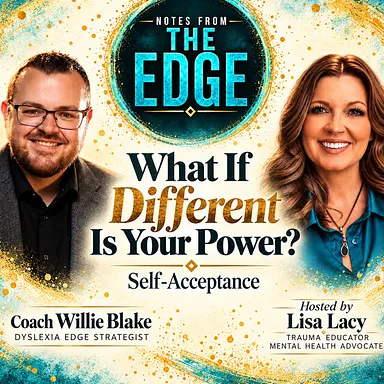
This transcript of “What if different is your power? Self-acceptance with Coach Willie Blake” from Notes from the Edge was made with HappyScribe’s speech-to-text technology. Related: transcription service.
Ads in this audio differ from the text. Tap the sentence you're hearing to follow along.
Synced: the text now follows the audio.
Welcome to Notes from the Edge, where we have the conversations we should have been having all along. We talk about the things that we're not talking about. I'm your host, Lisa Lacey, writer, trauma educator, executive advisor, and author of the upcoming memoir Notes from a Certified Madwoman. Welcome to the Edge. Hey, hey, my friends. Welcome back to an episode of Notes from the Edge. I am your host, Lisa Lacey, and this is the place that we have the conversations we should have been having all along. Guess what? You ain't talking about it, so we're gonna. And today's guest is Coach Willie Blake. And Coach Willie, is an entrepreneur, speaker, podcast host himself, and high-performance coach who helps dyslexic professionals, entrepreneurs, and creators transform self-doubt into confidence, overthinking into clarity, and feeling stuck into some forward momentum. Diagnosed with dyslexia in the first grade, Willie spent much of his lifetime believing he was broken. He tried to hide his differences, chase perfection, please other people, and become somebody he thought the world would finally accept. Eventually, and we talk about this a lot in here, he made the decision to stop merely surviving with dyslexia and began leading with it.
And I can't wait to hear about how he did that. Today, he teaches from lived experience using practical frameworks such as the 2% rule and the GPS goal method to help people take meaningful action, build consistency, and move towards their goals without waiting to feel ready. Remember, guys, we talk about those soul yeses and those big leaps. He is also the host of his own podcast, Light Beyond Limits, and has shared his message across more than 500 stages, 100 podcast episodes, blending honesty, humor— we love to laugh in here— energy, and hard-earned wisdom to help people feel seen and empowered to finally move forward. Coach Willie Blake, welcome to Notes from the Edge. How are you today, my friend?
Wow. With that, uh, giddy is the word. That was you.
Uh, people love my intros. They're like, that was me. I was like, yeah, it always sounds different with somebody else.
Uh, I love it. I, I appreciate the honor of being here and, ah, just so excited today to talk with you.
Yeah, I'm excited about this conversation too because I think, um, so many people— keywords: self-doubt, self-doubt, self-doubt. Can I do it? Can I do it? Taking the big leap, saying the soul yeses. is so vitally important, and that's what you help people with. But let's talk about the transformative moment that you decided you wanted to do this work with other people. Let's go back to that moment. When did you realize that the way you struggled was a way you don't want to see people continue to struggle?
That moment, or I guess series of moments that led to it. It was about halfway through college, so I was around 22-ish years old at that time.
Okay.
And before that, went through elementary school, was diagnosed with dyslexia about age 6, age 7.
Oh wow.
Felt like I was broken, felt like I was behind, always had to put in double the effort just to like get the average like everybody else did. And working weekends with studying and stuff rather than being with friends who are out boating and having fun. But it was about halfway through college to where I was switching from an accounting— my accounting degree to business management. I got the numbers. Numbers were fine. I just didn't want to sit behind a desk all day. I wanted to go out and talk to people and have more fun than I was. And so I came across this statistic and it said that 95% of CEOs read 50 or more books a year. Wow. And I thought, okay, I'm going into business. I want to be a CEO or business owner. I think that'd be kind of cool. Ain't no way I'm reading 50 books though.
Way too far out there.
No way I'm getting that.
Oh, so you knew that was a hard no to begin with. You're like, no, I didn't have it. What else can I do? Yeah,
because at the time, I think I maybe read an average of 1 book a year. Because it's like I, I just didn't read. Reading wasn't a thing unless it was assigned in a classroom.
Yeah, yeah.
But I wanted it. And so instead of the 50, I made it smaller, and it was still— it still felt impossible, but I set it for 12 books.
Okay,
12 books for the year. One book a month. Yeah.
Okay,
for that year. And I went to my bookshelf, grabbed the smallest self-help book I could, a purple book called Rich Dad Poor Dad. By Robert Kiyosaki and started to read. And it was that moment to where I started learning about business and entrepreneurship, about psychology and personal growth and finances and what this whole mindset thing was and the difference between self-esteem and self-doubt. And like everything just started to come in. And dyslexia, I always thought was bad. But then as I learned all these different things, entrepreneurship wasn't all this glamor that I thought it was before. There was a lot of hard things to go in it too. too. So maybe dyslexia wasn't all this bad, but maybe there was good with it too. So what I did, I typed into Google, I'm like, what are the advantages to having dyslexia? Because I don't know it. I didn't type that part. I'm like, what are the advantages to dyslexia? Article popped up, it was like 9 superpowers for dyslexics. Clicked on it and I was open to this world that I knew because I grew up with it, but I couldn't ever put it to words.
Yeah.
So things such as creativity, of pro— there's problem solving, thinking outside the box, being able to recognize patterns, uh, communication. We're able to say things more simply because we don't like the— all the jargon and stuff that go into it. But then also being able to empathize and sympathize with people because we know what it's like to go through a challenge and we can be in the trenches with the other people who are going through that same thing. And so it opened my mind to this advantage-disadvantage. It's not just black and white, it's all gray. And at the end of the day, I got to choose whether I stick with what I thought of before and which didn't serve me, or now that I'm learning about this, it's unknown what's going to happen, but there's so much that can come from it. So I started to lean into it, and that's the moment— and around that time was the moments where and now brought the trajectory to where we're at today.
Right on. Right on. You said, you said yes. You said yes. You said yes to the what if, to the curiosity. Well, we'll
see. Let's try. It's like, let's try it. I already tried this. It didn't work for me. So let's just try this.
Yeah, this ain't working. So let's, let's say yes to something else. I absolutely, I absolutely love that. And What a, what a profound moment of, oh, I'm not broken, not broken. I'm just built and designed differently than some other people. It's, it's really that simple. So I love that. So, um, dyslexia is often discussed as a learning difference, but not always as an emotional experience. So this is gonna help educate me as well. So How did it shape your confidence and identity and relationships and the way you measured your own worth?
Yes, relationship-wise, like through kid and teen years, I always felt like I had a wall up. And I remember saying in high school that I would put a wall up against my heart because I didn't want it to break. I didn't want to get close to people. And so I had friends and I got to— and got to know them, and we were still great friends today. But I never was able to get to that in-depth level that I feel like a lot of people are able to get to, which is more of an emotional connection side. It's like, yeah, we, we have fun, me and my bro— me and my bros, we go and play some games, we have a lot of fun. But other than that, then I go back to my house and it's like I still feel that this is just— it was, it was numbing. It was normal. It's just like I'm now back to where I'm at. Can't wait for the next time I get to see him. But that connection didn't— it didn't feel like it was able to be there. And that also led from my personal worth.
And I think that is probably where it was more apparent because my friends weren't doing anything wrong. They were doing what they were as friends, and they were connecting with me. But it was like from myself growing up with being dyslexic and not just dyslexic. I know, I know, I have like a little bit of ADHD and definitely have some OCD within me. If you see me load the dishwasher, everything has to be put in its special place. My wife's like, can't we just put it here? The bowls here and here? And I'm like, you can if I'm not the one that's next to you loading the dishwasher.
I'm gonna redo that. I'm like, okay, you're gonna redo that. He's like, you were terrible at doing dishes. I was like, I know, I know.
It's like, even so, my kids, they help put away the dishes, and so they'll put like the forks and the spoons in there, but there's different sizes of spoons and forks. So after they do it, I go in there when I'm grabbing one and I'll just like quickly like reorganize it. Yeah. Hi, I'm Willie. That's me. That's part of who I am, and I embrace it now. I love that.
Embrace it. Yeah.
Yeah, you gotta, you gotta. We're not gonna be great.
We're not gonna be great at everything. But you know what, we can try to get better and better at whatever it is that we want to do a little bit and in bite-sized pieces like you did when, when you started reading. And may I ask, how much do you read now starting off with that one book a month? Is it, is it much higher than that? Did it increase? I assume it did. Yeah, exactly.
Yeah, I go through, I go through about 60 books a year. Now, it's not just reading, not just reading. I also, I listen to it. I can listen a lot faster than I can read.
Yeah,
but I'll also, I still read. I still have my book on my nightstand. And just like everybody else, I have a couple books there that I haven't touched in a while. But it's nice because you like feel that you're actually reading when you might just read one book.
Yes.
Hey, it counts. Yeah, it does count. Yeah, about that's, that's 60, 60 books. If I can add one last thing.
Yes, please.
With myself and value to that question, it was, I never felt because I had to fit a neurotypical system, I couldn't be neurodivergent. And so when other people would write down the answers, My— the other students would be able to raise their hand and give it, and whether it's right or wrong, the teacher will say it and the students will just go by. But for me, it was sitting there, I'd write down the answer, and once I have it, 10 seconds would go by, 20 seconds would go by, and I'd have this literal physical anxiety of, I want to raise my hand and give the right answer because I want to be— I want to be praised and want to know that I'm right. But man, if I'm wrong, if that answer is wrong, then the teacher will think that I'm dumb. And the other students will think I'm stupid too. And really, that was just myself saying to myself, I already think I'm dumb and stupid.
Mm-hmm.
And it's taken, you know, it's taken a lot of work since then to get out of that. But back then, that's what it was like. And then the student would raise his hand, give the exact same answer that I had, and then she just said, yeah, that's right, and would go on with it. And then my inner talk would be saying, Willie, you're so dumb. Why didn't you just— and why didn't you just raise your hand? A simple step of raising your hand and ask— and answering the question.
So it's more self-abuse though, right? It's like, oh, now you should have, you should have. Yeah, I remember when I was first, um, reframing thoughts Um, and you said it, it's, it's not always a fast journey, you know. Um, I would catch myself in the kitchen for goodness knows how long, sometimes 10 minutes, could have flumped on a wheel, you're so stupid, you're such an F-up, you're never gonna have healthy relationships, it's all your fault, you're so stupid, you're such an F-up, you're never gonna have healthy— so I had to start with the thought, you're so stupid, right? And replace that with what's the statement of fact? You're actually a highly intelligent person, right? A highly intelligent woman is what I used. And now it never comes. But it was, it was one thought at a time, daily practice, one thought at a time. I'd, I'd catch it and I'd, I'd reframe it. And there's so many different skills and tools that transformational coaches have. And it was actually transformational coaches that got me into forward momentum, which is why I'm such a big, big advocate for them, which is why I became one. name a clinical therapeutic arena acronym, and I've, I've got it in my, in my, my case file.
We'll call it my case file. Um, because I gotta— I got a few of those labels myself. Um, but yeah, it started with one thought, one thought at a time, just like one book a month, right? We take this in, you know, bite-sized pieces. And it's not that the world— miracles happen when you start working on yourself and you start seeing yourself differently. It's not that external factors happen. Life still happens to you. You still still got to manage that stuff, but you get much better at, um, dealing with it. So at what point did you stop viewing dyslexia as I'm broken altogether? When did that— when did, when did you have that I no longer call myself stupid kind of moment or string of moments building up to?
Yeah, it was around about a year after I started those 12, starting with those 12 books and working up from there. About that time to where I, I wasn't negatively talking about dyslexia, but I also wasn't really talking good about it. Like, I read the article, read the advantages, and I'm like, oh, that's cool. But it was just flat tone neutral at that point. But then fast forward, I think it was about 2 years later, I was at a mastermind networking event. And afterwards, I remember me and my friend Ian. It was raining outside. We were standing in this business building and kind of like the middle corridors between the outside and like the main lobby. And we talked for about an hour and a half. And during that, I told him, I've been doing this coaching thing. Like, I started out as the success coach. If you want to be successful, I'm the person to go to. But then that didn't really work out. Because when you talk to everybody, no one listens. People listen when you talk to their pain points. So then I want— then I want to be the empowerment coach.
It's like I help empower people. That's, that's more niche, right? Empowerment. Then we had this conversation and I love— his name's Ian Stermer, one of my best friends. Love him to death. He said, Willie, you know that Empowerment coach, you do great work, and the people that you talk with, you help out a lot. But the posts that you do are just like every other motivational post that's out there, and the inspiring that you do is just like what everyone else does. But I also know you a little bit more, and you're dyslexic. So why don't you help the dyslexic community out and start there? And I shrugged it aside and like, yeah, I'm dyslexic and talking about dyslexics, that could be good and everything. But on the drive home, that's when it started to like really click in my head that my most experienced experience that I have to be able to talk real life to is my dyslexia because I've lived with it my entire life.
Yeah.
And people who are out there, if you're from the age of 0 to 18, there are a lot of resources out there for dyslexics. Schools have them. There are organizations that help you out, to help you out with resources and flashcards and everything. But once you hit this magical age of 18, all of a sudden it's just like throw you into the world. Good luck. Good
luck with what you're trying to do.
And, and of course corporations and businesses, they like have HR models and they have different neurodivergent plans incorporated. But what I've learned and what I've seen is just like in high school, I had resources in high school with a 504 plan to help me out of getting extra time on tests and getting the notes and everything. But I didn't use them because I didn't want to be the kid to walk up in the middle of a test and ask the teacher, can I have some more time? Because then everyone behind me, all the students, would overhear that and either think 2 things. One, oh, Willie's a— Willie's a special needs kid. He need— we need to make sure that he's okay. Which I didn't want pity from people. I just wanted to feel like human. Or 2, the exact opposite route, well, why the heck is Willie so special? Why don't I get extra time on tests? And so they attach a negative feeling to that. So I could either be the outcast of the classroom, we're trying to get these resources, or I could stay quiet. And I know that for me in high school, I stayed quiet.
And a lot of adults out there, whether you're in your career or business, or whether you're just trying to live life, build relationships, You stay quiet. Because one, there's not too many resources out there like there was when we were teenagers and youth. But also two, why would we want to stand out for a negative reason? And a lot of us have that inside of our heads, that dyslexia is a negative reason and really a disadvantage to my life. So why the heck would I share it if everyone else's life is doing great on the wonderful social media billboard of highlight reels?
I did that. They were— I was pictures were great.
Yeah, pictures are great.
It's just like, really happening was not so pretty.
Exactly. It's just a highlight reel.
Yeah.
So we're comparing our worst attribute to other people's best 5-second picture moment in time. And so of course, we're going to feel bad about ourselves. Well, and sadly, a lot of people feel that way.
You said something too. I just want to feel human. You said, I just, I just, I just want to feel human. And humans are built and designed differently, each of us. And I don't, I don't know that there's a normal one of us out there. So I just didn't want to gloss over that, that you, you said, I just want to feel human. And I think you're right. There's a lot of people out there What I love about what you're doing is you're giving a new language to it using your frameworks. And, um, you're giving people permission to say, I'm struggling because see, I looked like a success on the outside, right? I had the 6-figure income, all the toys, the houses, the cars, the family looked perfect, the polished veneered pictures on Facebook. And by the time I came forward with what I was struggling with behind the scenes, people were like, well, that's not happening. And I was like, wait a minute. Yeah, yeah, it's been happening the whole time. So I didn't have language and I didn't— I, I felt guilty about saying the words, yo, this is too much and I'm struggling and I need some help.
I need some help. So talk to me about how you go about, um, coaching people. Like, what's your, what's your process and what's your framework and Um, what have you developed from not only your lived wisdom but all the stuff and the research that you've done?
First off, I want to say thank you for bringing it back to we're all human, we just want to be human. That's a very real thing that I know a lot of your listeners probably hear that and just like, dang, I just want to feel human at times.
Yeah,
then you got to ask yourself that question, right? Like What, what is normal? What does that even mean?
Is
that just like this fictitious goal that we're going to reach our hand out to and never be able to grasp? Because if that's it, that's just a rabbit hole that's never going to end.
Yeah.
Because it's so, it's so important with what, what I do with coaching. It's being able to get results that you want without losing yourself in the process. So a lot of what I go into with clients that I have and people that I get on, uh, I call them game plan sessions, um, is that we start with what is it that you want? Not your mom.
That's a good question. It's such a good question. When they asked me, look, I was in inpatient rehabilitation, Coach Willie. I went in thinking I had a bad marriage, slightly bad marriage, just slightly bad marriage, and maybe a minor drinking problem. And I came out with a chart this But, uh, I was like, oh, I got more problems than I thought. I'm a little disordered. They put so many disorders in that thing. And then they put on the last page, prognosis for recovery, poor to none. But they asked me what my wants and needs were, and I thought they were speaking a foreign language. I was like, what? What is that? So you are absolutely right to start with, what do you want? It's a great question. Yeah, and we're worthy of it. Yeah.
Yes, yes, we are so worthy of asking it. If, if you're human, you are worthy of asking it.
Yes, yes, we want to be human and we want what we want. We want what we want. I love it. Yeah, get clear on what you want first. Yeah.
And at times, let's go back to our childhood and think of what we wanted back then, because those are great indicators Like, we wanted to be astronauts and paleontologists. We wanted to be Pokémon masters. We wanted to be right next to Chef Gordon Ramsay cutting up vegetables and being a chef. Like, get in— like, think about what did you want as a kid, because that is such a great indication of what as adults we've forgotten because now we have to be adults.
Oh, that's good. Yeah. Because now we have to be professional, right? Now we have to be professional parents.
Yeah, I have to be— I have to be nice, and we have to have all the gadgets and make sure we're all professional in the suits and ties and the dresses and stuff.
Yeah, no, it's
one of— it's one of the reasons why I love— I wear t-shirts, because the people I work with, a lot of them are entrepreneurs and professionals, but then I also have a lot of people who are just trying to get through daily life and want their life to be better. And I don't need another disconnect from the people I work with. I don't need them to see me on this pedestal of highlight reels. No, I want to be with them in the trenches. Yeah, we're all going through this.
Yeah.
And so asking them, what is it that you want, is where we, where we always start off. As when you have that, and well, as well as where you're at, then you got the direction you can head. Then we go Take that goal, reverse engineer it backwards. Because if you start where you're at and look forward, there are hundreds of ways you can go. But if you start at the end and work to where you are, that path becomes a lot clearer.
Brilliant. Love it. Love it.
And then the— and then the last thing always is start moving. Like, get into motion. If you want to change your mental state, change your physical state.
Okay. What does that look like? Get into motion. Taking a walk? Is it making the phone call? Is it picking up the book? Is it any of the
above?
All the above.
All the above. It depends what you're working on, right? If it's like— if it's a physical goal, then go out and take a 5, 10-minute walk. If you're trying to get on— if you want to be a speaker and try to get on like 1,001 stages, well, it's opening up your laptop. And let's say you want to go like the virtual podcasting route. to get your stages. Well, then open your laptop, jump to ChatGPT or Claude or that, and start having a conversation about what is it you would speak as, as a speaker.
Yeah.
Or if you just want to build the skill of communication, as you're going out today, talk to a single person and don't even— don't even need to ask a question. Say, how are you doing? Just say hi.
Hi.
Just, just hi. That's it. and smile and walk by and let that be it. Everything else, everything else could be a bonus, but just do one thing that's a little bit uncomfortable.
Yeah, talk to us about that comfort, getting out of our comfort zone and comfort. Why do you feel like we stay so comfortable in what's uncomfortable?
Comfortable with what's uncomfortable. I think we stay in comfort from what I've seen in myself and other people is because our brains don't like doing new things. Like, our brains are— our brains are tools. Let's, let's put that out there. Our brains are tools for us to be able to use them. So the 20, 30, 40 years of experience that we have from the day we were born to now, we have built habits. And sometimes we have habits that are 15, 20-year-old habits that now we set this New Year's resolution to try to break. And we're like, oh, after 2 weeks, I'm not— I'm not changed. It's hard for me to get up. I'm like, of course it is. It's been 20 years that you're trying to break past this.
Where's my six-pack abs?
Exactly. But it's the— it's like the small little things. And so our minds are made to stay and use as little energy as possible. That's, that's why we create habits and it creates— I don't know the scientific words for it, but like the neurons create pathways to make it easier for us to do things. And when we break out of that, it's kind of like treading a new path. But when you're treading a new path, our minds always want to go back to what's comfortable. Until what's uncomfortable is comfortable.
I love it. I love it. So we got to try something new. Yeah, get curious about it first, right? Decide what you want, get curious about it. Okay, talk to me about the 2% rule, as well as the GPS goal method.
Yes. Best thing, we already tapped into it. So it's very simple. So the 2% rule is if your goal is 100%, that's like the bucket list checkmark off the box. This is what I want. Then 2% is taking 2% action every single day to get to your goal.
Hmm.
And it's not like literally 2% today, 2% today, and in 50 days we got 100%. It's less of that and more of Do something small and consistent every day as you work toward the result you get. Because if you want to be able to, like, read a book, it might take you less than 50 days. But if you want to be able to build a house on Mars, it might take you over 50 days.
Maybe.
But it's, it's the small, little consistent things that we do to get there. Which is why we talked about the 5-minute walk, the talking with ChatGPT, or applying to be on a stage. It's the being able to just say hi. Or if that's too much and uncomfortable is just making eye contact, do what one of my clients did, which he was in that realm too. He's like, just saying hi gives me anxiety. And I'm like, cool. One of the things that is a philosophy of mine is if it seems too big, you haven't broken it down far enough.
Ah, okay, that makes perfect sense. Yeah, yeah.
So for him, it wasn't even saying hi, it was have a smile and a nod on standby.
Okay,
and that was it. So when someone— when that awkward moment comes when someone's walking your way and you're walking another way, and you're like, what do I do? Do I say hi? Do I look at them? When do I look at them? We've all been there, we all get that anxiety. What you do, and I found it works so well is you're going to make eye— you're going to look at the person, and when they look at you, because about 95% of them do, you're just gonna have a smile on your face and a little nod. Smile.
I like it. I like it.
If they say hi, sure, you can say hi. That's fine.
Then there's your opening. Yes. And there's your opening. Yeah, you created an opening.
Yes.
Yeah.
Smiling and nod on standby. Break it if it feels too overwhelming. Break it like, yeah, if it feels too overwhelming, you haven't broken it down, breaking it down small enough.
What I love about that is you're still creating opportunities for yourself to be able to say soul yeses. Yeah, yeah,
yeah. It's not saying like, no, I'm not going to do it. It's just saying, here's another— we're, we're going to get exposure therapy, but it's going to be mini exposure therapy.
Yeah, it's not gonna like— yeah, it expose us to more trauma. Got it. Yeah, I like that. So if it's too big and you haven't found the comfortable place yet, you just break it down and you break it down and you break it down. So maybe a 10-minute walk is a 5-minute walk. Maybe it's a step outside, go sit on the front porch, you know, get outside, just something like that. I love that. I love that. Making eye contact.
That's And each of those, like, that is— and the 2% is to each of us, so only we know what it is. But when people focus on 1%, it's too small. People don't get out of their comfort zone. But then if people also focus on 100%, they hit analysis paralysis. There's just way too much going on that you have to do to where you don't even start.
Yeah.
So I like 2% because it's just, it's just big enough to where you get a little uncomfortable. The smile and the nod, the 5-minute walk, the 10 push-ups, whatever it may be. But then it's not big enough to where I got to start a business and change my income and do a side hustle and then also start a podcast. Like, no, we're just smiling and nodding today.
I got an idea. Let's start a podcast. 47 days later, we got a podcast. And that's all. So I love it. I love the, the, the 2% after having a transformational moment. This podcast is actually out of a very direct pivot from a life-altering experience. So I truly do love those. I love those. And you can create those bigger moments from those smaller moments pieced together. And you hit a keyword, consistency. What if consistency is hard for some of us? What do we do about that?
Then you haven't broken it down small enough.
Ah, okay. So give me an example. What if— so if a smile and a nod isn't working for me, then maybe just eye contact, break it down to just one of those pieces, right? If I can't smile and nod, just look up and make eye contact. Just keep breaking it down, breaking it down.
And that could also give— I can see that working. I can also see that giving a little anxiety. So it might just be as you're walking down the street, just have a smile on your face.
Ah, okay.
That's it.
Okay, I love it. So we've just broken it down again, because if you cannot be consistent with it, just keep breaking it down, breaking it down. All right, GPS method. Talk to us about that.
Yeah, GPS method. It's an analogy acronym. Acronym.
Acronym
again. Words like that.
I've had all the acronyms. So acronyms.
So you got GPS. So the G is to get clear.
Okay.
P, plan the route. And then S, start moving.
All right.
And so we already hit areas of that. G to get clear. Where is it that you're going? What is it that you want? And when you have that, as well as where are you at right now? And sometimes we got to be a little bit more honest with ourselves instead of— because if let's say you at the beginning of the hour, you and I jumped on here and you said, hey, Willie, how you doing? And I'm like, good, but I might not be doing good. You got to be a little bit more honest. So it's like on the physical side, it's do we have energy to take us throughout the day? Do we have the six-pack or are we sitting here with a keg trying to lose a little bit of weight? On a finance— I always pat my stomach when I do
that. It's a different kind of six-pack.
Different size 6-pack. Hey, but I also tell people you want to bring a keg to a party rather than a 6-pack. So, but like on a financial standpoint, on a financial side, do you have like— are you financially independent? Do you have money to go on vacations when you want, or are you living paycheck to paycheck?
Yeah.
Or socially, can you carry a conversation? Can you ask questions, or is it just hard to talk to somebody?
Yeah.
when we know where we're at and where we're going, we get that direction. So that's what—
You need that brutal honesty. You do. And sometimes that's hard to take a hard look at yourself and really go, I'm struggling. You know, I'm not where I want to be. You know, that was me hitting 50 after getting discharged from the hospital. I'm not where I want to be. That's why the memoir came. That's why the podcast came. So yeah, it's, it's sometimes hard to take the finger that's pointed outward— oh, it's them, it's the blame game, victim game, whatever— and turn it inward and go, okay, where's my part? What's my accountability? What's my responsibility? And, and what do I want? And, and, you know, what am I willing to consider, right? Maybe just start Considering the possibility of making changes, right?
And that's— yeah, that's one of the keywords. Yeah, possibility. That's one of those beautiful words. You don't even have to do it. You don't have to do any of what we're talking about today, but just see the possibility of what could happen.
Yeah.
And that's always like that very first thing, because after you see the possibility and you know what direction you need to head, Well, then you go to the plan the route, which is the reverse engineering backwards to be able to create that blueprint. And then the S of start moving, do a little bit, just get into motion because that motion is going to help you then get into momentum. I love using this, this little visual image of whenever someone— whenever you're downloading or uploading something to a computer, If it were to sit at 0%, so many questions would come to your mind. Like, is my computer broken? Did I do the right file? Is it corrupted? Is it me? Do I need to go to a different system? Like, all these, all these questions and all these things that paralyze you start going. But the moment you get to 1%, just a little tidbit—
That's so true.
Gives you such a relief.
You're like, okay, It could take 5 hours, but yeah, yeah, yeah, I love it.
Patient at this point. So that's like, just, just get— just start moving, get that little bar moving, because then your mind's going to calm down, realize everything's okay, and then it's just consistent patient game.
Well, and if you have a blueprint and you have support in the role of a mentor— guys, get a mentor. If you do not have a mentor Be whatever it is that you do. If it's just trying to function better in life or feel a little bit lighter, more consistently throughout your day, have a mentor. They can make a night and day difference and, and make sure they are where you want to be, you know, and have lived and, you know, that they've walked through it, they've gotten to the other side, and now they're turning around and saying, hey, here's some tools, tips, skills, and resources that are going to help you. get up here. So I just, I believe so heavily in, in mentorship. When I first started in business, I didn't have it, and, uh, in my healing journey, I have had it, and, uh, just the night and day difference. So I'm a big fan of, uh, transformational coaching and mentorship, guys. So if any of you are, are out there, um, struggling right now— well, Coach Willie, where can we find your information should anybody be struggling, and they take a good hard look and they go, oh, I think I am.
So remember, guys, observation is not neutral. It's quantum physics, quantum mechanics. Once we observe it, and you know, once you see, it's not— it's really hard to unsee once you see. So once you acknowledge it, then it is time to take those actionable steps to do something about it. Where can your people find you, my friend?
I kept it simple for everybody. Every— I love simple. Everything is on my website, coachwillieblake.com. You'll be able to find a place to connect with me there if you want to work with me or just get on a game plan call. There'll be a button there as well as to people, people who listen to awesome podcasts like this. I have an ebook called Break Free: The 12 Limitations, What Their Names Are, and How to Break Them. That's free. Everything in that one place, my website.
I love it. And guys, you don't even have to write that down. There will be a clickable link right underneath this episode. So we got you covered there. All right, Coach Willie, we close out asking people, our guests, 2 questions. You ready for them?
Yeah.
Okay. In your own life, what did you perform in order to survive And what did dropping that role, mask, or performance do for your life? That's question number 1.
During my life, I tried to perform as the hero, someone who had a big heart and was there to save everybody. And then I dropped that and realized that even heroes need heroes.
Oh, don't— we all need a hero, and we can be our own hero, right? Yeah, we can be our own hero. I love that. All right, last question: what do we need to be talking more about? What conversations do you want us to be talking more about?
That we are human beings and we make mistakes.
We're human, guys.
We're circling it back. We are so good. I love my dyslexia. I love my OCD. I love everything about me, the strengths, the weaknesses, and it's taken me a long time to get here, but I love it. And I think that's a conversation that needs to be had because even if it's just with you and your mentor or coach or friend, or whether it's you with a group of people talking about it, about what's going on and realizing that Everybody struggles with something.
Yeah.
And it— like, there's that saying that if every, if every sin could be smelt at church, the church would smell really bad.
Yeah,
because some people have visual smell, like smoking. Others, it might be more towards like affairs or things as such. And it's like everybody has their challenges, and so let's, let's talk more open about them. Not in a sense of like, oh, self-pity me, but in like, let's be okay with who we are. And sometimes it's okay to not be okay, but realize that there's a reason why there's 8 billion people out here. It's not so that we're supposed to do it ourselves, but it's so that we can connect and love and talk and be able to get through life and experience love.
Oh, it's a beautiful answer and a beautiful way to close. All right, my friends, I'm going to ask you the same question. What are you performing in your own life in order to survive? And what might setting that role, mask, or performance down do to improve your life? I am your host, Lisa Lacey. We have had our special guest coach, Willie Blake. And when you find the answer to that, we will both see you at the edge. Thank you, Coach Willie.
What if the very thing you spent your life trying to hide was actually one of your greatest strengths?Coach Willie Blake, entrepreneur, speaker, podcast host, and high-performance coach, joins Lisa Lacy for an honest conversation about growing up with dyslexia, feeling broken in a world designed for different minds, and discovering that self-acceptance can change everything.From struggling with self-worth to embracing neurodivergence and building confidence through small, intentional actions, Willie shares the lessons that helped him stop merely surviving and start leading with his differences.In this episode:The emotional impact of dyslexia on childhood, relationships, identity, and self-worthReframing neurodivergence from a perceived limitation into a source of creativity, empathy, and strengthOvercoming self-doubt, people-pleasing, and the pressure to fit someone else’s definition of normalWillie’s 2% Rule and GPS Goal Method for creating momentum through manageable, consistent actionLetting go of the need to be everyone’s hero, accepting our imperfections, and learning that even the strongest people need supportConnect with Coach Willie Blake:https://coachwillieblake.com/Connect with Lisa Lacy Inside the Edge:https://www.lisalacy.com/inside-the-edgeWhat did you perform in order to survive?Welcome to the Edge.See Privacy Policy at https://art19.com/privacy and California Privacy Notice at https://art19.com/privacy#do-not-sell-my-info.