
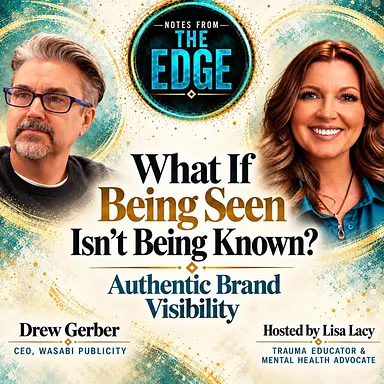
“What If Being Seen Isn’t Being Known? Authentic Brand Visibility with Drew Gerber” was turned into text by HappyScribe’s speech recognition. Related tool: AI notetaker.
Ads in this audio differ from the text. Tap the sentence you're hearing to follow along.
Synced: the text now follows the audio.
Welcome to Notes from the Edge, where we have the conversations we should have been having all along. We talk about the things that we're not talking about. I'm your host, Lisa Lacey, writer, trauma educator, executive advisor, and author of the upcoming memoir Notes from a Certified Madwoman. Welcome to The Edge. Hey, hey, my friends. Welcome back to another episode of Notes from The Edge. I am your host, Lisa Lacey, and this is the place we have the conversations we should have been having all along. Guess what? You ain't talking about it. So today we're gonna— with special guest Drew Gerber— and today we're going to explore what happens when we stop trying to be impressive Hmm, and start being real. Today Drew joins me to explore all the things we love here on Notes from the Edge: authenticity, identity reinvention, and why the most powerful thing we can offer people today is what we've spent years possibly trying to hide about ourselves. Before we jump in though, let me tell you a little bit about Drew. Drew is the CEO and co-founder of Wasabi Publicity, an international public relations firm he founded back in 2000.
2002 alongside Michelle Tennant Nicholson. With more than 30 years— that's 3 decades, folks— of experience spanning public relations, entrepreneurship, and human, human development— you're going to be hearing that word a lot today— Drew has built a career helping individuals, organizations, authors, and thought leaders communicate their message without sacrificing their authenticity. His company has been recognized by PR Week and Good Morning America for its innovative business practices. He's a member of Forbes Agency Council, created Pitchrate and Online Press Kit 247, and authored Destination Aha! Becoming Unstuck in Life and Business. But Drew's story expands far beyond the boardroom. In 2011, he moved to Eastern Europe, embracing a global lifestyle that challenged conventional ideas about success, belonging, and what it really means to build a meaningful life. And along the way, he invested in local communities, created created opportunities for others and built a business around the philosophy that I find particularly compelling. As you listeners well know, I spent many of my years in corporate America hiding who I really was. Drew, welcome to Notes from the Edge. How are you today, my friend?
I am— I'm in my happy place. I'm fabulous.
I love it. We love happy places. Yes, we love happy places. Well, my friend, it is Notes from the Edge, so we're just gonna jump right into the rabbit holes I want to know, because you've been in public relations and publicity since 2002, I want to know the moment or moments things might have changed, because now your philosophy is let's be as human as possible. When did you see in the, in the PR arena that things have changed from this polished facade that I spent many, many years, nearly 2 decades, 3 decades hiding behind into, hey friends, let's be who we really are. What happened there?
So yeah, as you, as you said, we've been in business for since 2002, so I'm old, so I've seen a lot in my life. So it's some defining moments really. I think when the internet hit, right? And influencers started to come into our world. And I think that that's really the moment that I actually saw the distinction from someone being seen to someone being known.
Hmm.
And I really saw that they were getting eyeballs and people saw them and they had the notoriety and the celebrity and everything, but people didn't know them. And I got clear in that moment, in order to actually be known, You have to know yourself. And that really was one of the— where we kind of pivoted as a company, where I really saw this isn't about visibility. This is about our clients being known, knowing themselves so that they could be known to make the difference they're ultimately committed to making.
Yeah.
And then the other— the next one, of course, is AI. AI has radically changed The way I look at being seen and being known. The great thing about AI is perfection's on tap, right? And so it's super easy to be perfect. But what people are actually seeing is, is that's not what's winning the day. It's being known. I think that AI is really having us question, what does it mean to be human? And really, how do we connect human to human? What makes us great? Because I think we were going in a particular direction anyway. And AI really is a blessing in disguise in a lot of ways. I think it could be the answer to saving humanity.
I love that. I love that. Drew, I want to know for you personally, because for me it was a very long journey to know who I am. And in my own journey, I went from hating who I was, hiding who I was, to loving who I am, to knowing I am the coolest chick ever, enjoying my own company. Wanting alone time, being like, yeah, you guys go away now so I could have my alone time. For you personally in this journey, because again, you started when all of this was starting to shift. For our listeners out there, for you, what was the, again, moment or moments that you really knew who you were so you could be very clear about the messages you want the people you represent to put out into the world?
So I was very fortunate because my parents were into some kind of wild things when I was young. And so they got me into a course. It's a company called Landmark. They do personal growth and development companies, and they did it when I was 15 years old. What I actually— so I went through that transformative process, and I actually did see the cost of performing versus being yourself at a very young age. Because there I was sitting in this room, 15 years old, and the other people there were adults. And I'd seen what it had cost them in their lives to be performing in their career, in their relationships, and in their lives. And in that moment when I was 15 years old, something clicked for me. Like, I, I want to go through life to being authentic and as real as I am. Not that I haven't had my, you know, performing and all that struggles and everything like that, but something in that moment laid a very powerful foundation for me in my life.
Well, I wanna talk to our younger listeners out there because in our podcast before the podcast, you actually highlighted this, that you want our younger listeners to start how you started at such a young age because that's gonna save them the 3 decades that I struggled, uh, if they start young not watching the influencers and the fake facade, recognizing that that's not reality. So what's your best advice to our younger listeners today?
I know this is cliché, but get out into nature. Be in nature. I mean, I, I think that there's something about connecting with the beauty, nature, and this planet that reconnects us to something that fundamentally makes us us. Also spend time with other human beings. Limit your digital time that you spend in that world streaming and really be with people, friends, family, and connect with them as much as you can. I think that that's where we get to know ourselves and we begin to learn. We really get to learn, experiment, and understand not only who we are, but who we are for other people, and also who we are for the planet, right? It's all of that. Knowing all of that, I think that we get in touch with our humanity at all levels.
I love that. I love that. Well, my daughter, it was her idea apparently, although I've been telling her for a few years to take those. But she's like, Mom, I got a great idea. I'm taking a dance class. I was like, Brilliant. That's a good idea. I wonder where that came from. But yes, so we, we bought her some dance shoes. But yeah, and it's getting out of your comfort zone too.
And
you're right about nature. Nature reminds us what this Earth has given us.
Yep.
And that we are human and that we are a part of all things that live and breathe. And there is science, my friends, Backing us up here.
Yep, absolutely. We're lucky to have that science.
Yes, science is now catching up to everything some of us have been saying for years and years and years. Getting out, a 10-minute walk alone can decrease depressive symptoms by 20%. And if you do that in gratitude, it also decreases depressive symptoms by 20%. Drew, we opened up this, this, uh, connection talking about happiness. Uh, I want to talk to you about gratitude. How important has gratitude been in the success of your own business?
Gratitude, I think, is critical. And it's, it's— I think that people have gratitude. I think sometimes being grateful for what you have like material things and everything like that. I think that for me, the, the, the thing that strengthened and actually led to success is being grateful for those experiences that were unpleasant, that were confronting, that had me face my fears, that had me like go out and do those things that I was afraid to do. That's what I'm most grateful for. Is that, you know, one of the things I have, I have OCD. It was really crippling when I was younger, but as an adult, it's kind of lessened and I don't have it as much now. But I am so grateful for that because one of the things that I'm clear about, it allows me to be clear. I have no idea what's going on in the other person's world. And the difference that that makes for our clients has been amazing because they, after working with us, they know themselves differently. Because the thing about marketing and PR, you have to confront giving up control.
Yeah, because you don't know what's going to happen.
You don't know what's— that's— it's different.
You're going to put yourself out there and then it's like—
You're going to put yourself out there. And it is really, for me, you know, when we're talking about Performance, right? I know when a client is in performance mode or when they really are ready to break through by how they relate to control and how controlling they are.
So you learned not to control things by starting out controlling things.
Yeah.
And I think you bring up a good point about gratitude too. Sometimes it is being grateful, you know, those valleys. And this is going to sound cliché too, but those valleys are where we get our biggest education. Yeah.
If we really, if we really stop and really think about it, right, without all the noise and all of that, the truth of the matter is those valleys are the times we're the most alive.
And no people.
Yeah. And we avoid them at all costs, interestingly enough. But those are the places we are truly alive and in a lot of ways the most human.
Yeah. And the irony for me in my own story is I ran, I ran, I ran from mountaintop to mountaintop, goal to goal to goal, achieving, achieving, achieving, achieving, trying to avoid those heavy emotions, the trauma, and only to realize once I turned and faced them, it was not as bad as I thought. And that's where the healing really began. And that's where I was able to really show up as myself and own all of those experiences. So Drew, walk us through Wasabi Publicity. How do you guys work? How do you first connect with your clients? And then how do you go through determining, all right, we're going to represent this person, we're going to let this person grow a little bit? What's kind of your process for working with your clients to get them If they're coming in with that facade up, how do you kind of get them to— you just had a great article in Forbes magazine, which I so loved, which is why you're here today, because it, it ends with, let's have a new mirror. And I loved that. So how do you work with your clients to put up a new mirror for themselves?
Well, okay, we're gonna go down the woo-woo rabbit hole, okay? Oh, no!
Because I just want to—
I'm gonna take you down the— I actually believe that Wasabi is, is an entity that actually, actually has the right people show up at our doorstep at the right time. And so for 25 years, all I need to do is actually listen. Are we meant to be together? And I know if we're, we're put together There's a reason that we're together in that moment. It may be to work together. It may be for me to just give you some advice to help you along your path to things, or it may be something else. But there's always a reason. And my job is just to listen for what is the reason that we're connecting and what's obvious put us together.
Yes. Timing. Yeah. If it's meant to be, it's meant to be.
It's meant to be. And then the clients feel the same thing. Right. And so then we go to work on, okay, good. Why are we working together? What is it you really want? And then we do the deep dive into getting to the heart of the why. Why are they really doing this? And try to uncover the performative and actually get to the heart of the true commitment and their passions.
Yeah, Drew, that's a big question for a lot of people. I remember the first time I heard that question, I was turning 40. it was my birthday, actually, 40th birthday in inpatient rehabilitation. And I had a team of 5 of the most brilliant women working with me. And I was in session and one of them said, Lisa, what do you want?
And
I thought she was speaking a foreign language.
Yeah.
I was like, what? What do you mean, what do I
want?
So I love the fact That you're not just taking on clients.
No.
You're working with them, one, to make sure it's a fit.
Yep.
But 2, to get them out of performance mode that they may be used to, to really the root of why are you doing what you do. Because Drew, as you well know, it's not easy to be out in public. And on the days where it gets hard,
Yeah,
you're gonna need that why. Talk to us about why the why is important.
So here's the thing is, I— if you're not clear about the— your why, you're probably going to end up somewhere you didn't want to be. And it probably is like, you'll— you may end up with success, a New York Times bestseller, rooms full of people and everything. And we've worked with some of those people after they've achieved it and they're not happy, they're not satisfied, and they're not fulfilled because they did— they, they kind of forgot the why they were doing it. And then they got trapped into the marketing world. And the marketing world is not really about the why of it. It's really about performing and the external and the numbers and the success and all of that kind of stuff. That's kind of what we're told over and over and over again. It takes a lot to uncover that. It takes some real work to get to the heart of your why. But once you get— it's like clients with trust, right? Trust is one of those words everybody throws around. How do I get customers to trust me? Well, the question is, why do you want them to trust you? Because it's just for sales.
You don't need people to trust you to sell. I mean, I buy a lot of stuff from companies I don't trust. Right? I don't really think about them. I just buy them because I need them. But if you really want trust, you need to figure out why you want the trust so that then you can trust yourself to stay true to that why.
Yeah, I was gonna say the same exact thing. You gotta trust yourself.
You do,
before you ask other people to trust you, because people are smarter than we give them credit for. Like, people pick up on it. Well, you feel like I
an email, right? And I feel— and it doesn't mean that you're going to do it perfectly, right? Like, we've all had the experience where we're following someone and we think they're great and everything, and then an email comes out or a tweet comes out. We're like, what? And it feels off, right? But what's interesting about the people that know themselves sense that, and then they actually take accountability called, you know what, I misstepped there. And then it's like, okay, great. Trust restored.
Accountability. That's a big word. And accountability in public. Yeah, that can go a long way to build trust with people. A simple, I messed up. Whoops.
Yeah. Yeah. Like, it is, it is amazing to me how many people are so resistant to be accountable. It's like life and death for them. It's like if they admit that they're wrong. It's like life is at stake. They will go to the battlefields fighting to be right. I mean, we go to wars to be right, for goodness sakes. But yes, but accountability is a big one. But that is— I think it's— I was thinking about this interview a lot, and I was so excited about it. And the word that kept coming to me was control. And I talked about that a little bit. But if you have this You are trying to control your image, your business, and everything, you are not going to have an authentic business that people trust.
Yeah, yeah, because we can't. It's, it's a, it's a, it's an illusion.
It's— but, and what's great about it, what I love about AI, is it's busting through that illusion because it's all so perfect. Veneer, veneer, veneer. Perfect website, perfect. You know, it's all of that. But, but, but what it has us do is we have in this AI world, we have to stop. We have to check in with ourselves. And then we have to actually— is that your baby?
Those are one of— that's our big baby. He thinks he's— I am a freak.
I'm a dog freak. Just so you know, I hear a dog and I'm like, oh my heart.
I think our dogs are talking to each other, actually. I absolutely love it.
Every time I hear a dog, I'm like, dog.
When we get done, I'll tell you the story of how we ended up with him. But he was supposed to be an Italian Greyhound. He is not an Italian Greyhound. He's a soul dog. I put out the call for my soul companion, and he showed up howling on our front doorstep at 3:00 AM in the morning. So,
yes.
Speaking of talking to the universe, God, goddess, divine, whatever that is, the higher power, For you. Yeah. I think that's so vital in this work too, because we as humans have the opportunity to do that in terms of what our whys are, what our wants are, what directions we're going. And you're right about AI. And I love your perspective about AI, that it's forcing us to be more real, more ourselves, and more human. I want you to speak to that because AI right now is such a divide. It's weirdly divisive. For a lot of people. Yeah, but I would, I would, I would beg to agree with you, is it is forcing us to, to acknowledge what makes us humans.
So what I think is interesting, so I, I am really big in getting to the heart of what is enough for you, and I think you have to answer that yourself. For yourself, if you really want, I think it begins to open up the door for really happiness, peace, satisfaction. And so much of our world has been grooming us that it's not enough, they're not enough, you're not enough. I mean, that's what we're bombarded with. So if you're listening to that, then you're going down an AI rabbit hole, right? And it looks like AI is the solution to that, the feeling that not enoughness. The interesting thing is, is though, it's just gonna give you back more not enoughness. I just, I went through that. My, I went through this recently. We went through this huge project. We hired a guy. Um, we were gonna implement AI in, in, in certain aspects of our company, not the human, cuz we're really human, but that and everything. And I found myself, it's like, oh, you know, I'm trying to feel not enough. And the, and the, and the project, finally I was like, no, I am not interested in going down that rabbit hole.
I want AI to— I want AI and to use AI for AI to be what it can be, the best it can be, and us to be the best we can be together.
With humans first. Humans first.
Absolutely. I think that humans, humans first. And I think that also, you know, a friend sent me this fascinating article that the AI leaders were actually meeting with all these religious leaders and ask, you know, asking all these really interesting questions about AI. Does AI have consciousness? And if so, what we're creating is slaves. And how we treat AI will be how they treat us. It was this fascinating article, right? I love that. And I do think that there is— we now need to coexist on the planet. But coexist means that we both are bringing out the best in AI and the best in human. But what is interesting is I think we're returning to what makes us Great, which we weren't.
Yeah, speak, speak more to that. How— what— where were we headed before we were forced to face our own humanity?
I think we were— I think we were sleepwalking. You think about, like, you think about the advent of the internet, and then you look at, like, social media and what we gave away inside of social media, and how it, particularly with with kids and everything, and then you had the lockdown, and then basically, basically they're living in virtual worlds. Kids are not connected to one another. And so we've, we, we fundamentally were losing what it meant to be human being. One of the things that I love about, you know, being in Hungary is, is that it's like America 1950s. The kids still play together out on the streets. at night like I did when I was a kid. They're not in front of screens, they're at the park playing, they're having those human connections, and I love to see that. Yeah,
yeah, yeah. I think, um, I think you're right. With the beginning of social media, we started heading down this hole of Everything was digital, digital world, which are not real worlds, my friends. That's what we're trying to say here. It's not real. Talk to your friends. At bare minimum, pick up the phone and have a real phone call. Drew, it's so funny. I like to connect with people on the phone with an old school phone call instead of set up everything via email. And people are so freaked out by it. They're like, you want what? You're giving me your what? I'm like, it's a, it's a phone number. It's a phone number and you may call it so we can do things faster than 10 emails between ourselves. But some people are really surprised and freaked out. These are adults now.
Yeah.
I would like to talk to you. I still do this. This is how dated I am. I still do this. I'm like, can you hear me?
I'm so bad. I don't know. Mine's the— and for the old people, you'll get it. For the young people, like, what's up with that?
When you're mad, it was so hard to do because you were like, oh yeah, yeah, being mad and making a phone call on a rotary phone is very, very difficult. Yes, very, very difficult. Yeah. Well, Drew, how can, um, how can people The biggest question to answer that we have for you today is people that are marketing themselves, whether they're using somebody like Wasabi Publicity or they're a solopreneur and they're doing it by themselves right now. How do you believe people can set themselves apart in this crazy day and age of so much noise?
The way that you absolutely set yourself apart is for you to do the inner work. Get to know yourself, get to know your why. I can't stress that enough. And it sounds like, you know, you're just, oh, get to know— no, there's work involved with that.
Mm-hmm.
Like, you've gotta really, like, you've gotta actually sit and ask yourself, Why? And then that all that noise, that little voice in your head that's always there, you know, that we think's us, it's not. It's gonna have all of its opinions and everything. You need to go deeper than that. Like, okay, good. I wanna make a difference. Okay. But, but to who do you wanna make a difference and why and how do you want to make that difference? Those are the fundamental things because that will give you your marketing plan. And then listen to that. You know, when clients come to us, I— how do you— how do you want to make that difference? Do you like talking to people? Do you like being interviewed? Do you like writing? How do you want to make that difference? What's that expression for you? And then listen to yourself. Too often we go to the experts, right? And the experts have a formula. Formulas don't work, right? Blueprints. And like, I got caught up in all that blueprints and all And they work for some people, but the people they work for are the people that are already clear about the why and how they want to do it.
And it's aligned with that. People that it's not aligned to and they try to force it, they don't see the results and they're like, well, why am I not seeing the results? Well, because it's not aligned.
It's not a good fit for you. Yeah, I went to— I've bought a lot of blueprints.
Yeah, the money I've spent on that, because I wasn't coming from enough. There was a lack that I was trying to fill from some course or some expert that knew better. Our job is to have the clients remember what they know because they know.
I love that you trust them to know. You trust them to know.
1,000%. They absolutely know. Our job is really help them remember that and then amplify it. That's it. That's our job.
Yes.
And amplify it the way they want it to be amplified. That's in line with them and everything. This is not rocket science, but people have made it complicated because it makes them a lot of money.
Yeah. Frameworks, blueprints.
Yeah. You're not enough. You need this. You need to know this. This is how I do all of that kind of stuff. What happens is that You know, we're usually buy that stuff when our amygdala is hijacked, and then we buy it, and then we're like, "What the heck did we do that for?" And then we get into the course, and it just doesn't feel good. Sometimes we press through it, but most of the times we just stop. It's this, it's this vicious circle. You have to make decisions from that place where your amygdala is calm, you're in enough, and making that choice from there powerfully to work with anyone or take any.
Yeah. And you spoke in your Forbes article about shame. And I feel like this cycle that you're talking about is the shame cycle, right? We get hijacked into the lizard brain. We, we do the thing. Then we're like, why'd I do the thing? Then we beat up on ourselves some more. Then we're in the shame spiral. So how do we stay out of the shame spiral and put ourselves out into the world at the same time, knowing this? We are not everybody's cup of tea there, especially if we're choosing to be ourselves, which may be polarizing. So it's gonna, it's gonna throw off the people that, that are not our people, and it's gonna bring in the people that are our people. How do we stay out of that shame spiral and still put ourselves out into the world in big, big ways?
Um, You have to stop the addiction to the shame cycle. We're addicted to it, right? That's the truth of it. You've got to stop that. Now, how you interrupt that, that is you. For me, the place that I find that interrupts all of those detrimental cycles for me is silence. I sit in silence. I'll go out, you know, depending where I'm at. If I'm I'm here in the country right now, so I'll go out and I'll listen to my neighbor's lambs. And I'm like, or I'll be with the dog, or I'll be with like everything. So I just— you have to stop it. And I know it sounds easy, but it is an addiction. So you've got to stop it. And then you've got to go and do something that's not related to that, where you can kind of return for yourself. It's one thing. 2, you've got to surround yourself with people who know who you are. You have to have your— you have to have your people that just are saying, you know, you're full of it. What are you doing, girl? You crazy? Stop this insanity. You are— who are you? No, you've got to— you've got to have that, right?
You've got to have those people around you, whether they're people that you work with or your friends. But for sure, if you're hiring company, you need to make sure they're your people. Yeah. And they're gonna be like, no, no, no, no, you don't. You— this is not who you are. And they return you to you.
Yeah.
Not try to train you, fix you, change you, alter— just return you to you.
It is so imperative to have support on this journey.
Absolutely. You absolutely have to have support within this because And particularly because, look, starting a business and birthing— and I mean literally birthing that in a business into the world— is so courageous. And you're putting yourself out there in so many different ways that you do have to have cheerleaders. And then you've got to have coaches and you've got to have mentors. You've got to have people that say, you know, are straight to you like, you know, you've got to have it all.
Yeah. Yeah. We call it my BFF is like your inner critic's being a bitch today. Tell her to stop. Yeah.
Just stop.
Yeah.
Just stop.
No. Well, you highlighted something we talk about so much in here, which is mentorship and transformational coaches. And they were the game changer for me because I had done all the acronyms in the clinical therapeutic arena, walked that rite of passage, but I was still waking up like, oh, I don't know about all this. It was mentorship. and transformational coaches and forward momentum.
Yeah.
That helped get me going. What I love about Wasabi Publicity is you do kind of serve as that mentorship and that cheerleader all at the same time with helping people kind of walk that inner journey to be very clear before they put their stuff out into the world. How vital is mentorship and finding the right fit to help you move forward on this journey?
I think it's really critical. And I think that that's where, you know, now that I'm older, I think age and wisdom comes in in a way that I'd never really appreciated that fully until I've gotten to the age that I am. There's something about the passing the baton and that mentorship that I think that someone that's gone through the fire, so to speak, I think is super. But they have to have gone through the fire, right? I think too many people become coaches and mentors, but they haven't gone through the fire. So they have to go through the fire in order to do that. What I love about the work that we do with clients is they are transforming, but it's on the field, on the court. So we are doing it while they're doing their PR, while they're doing their marketing. And it's when it's such a rich, interesting playground because all of that comes up in a different way than if you're just talking about it. Yeah. Which is so exciting. And I love it when clients say, I now know myself differently, or I remember who I am. Like, those are the— that is for me so much more important than, hey, we got you on Good Morning America, we got New York Times, we got you like, Like, we've done all of that.
Great. But for me, the places where my heart sings is when clients will say, I know myself differently.
Exactly. Exactly.
That's where the magic is. It's like,
yeah,
does it get better than that?
It doesn't. It doesn't. Helping one person at a time. And when they know themselves and they are out in the world, because I've worked with many of your clients and they are changing the world in big, big ways. And it shows that they are very clear. About their why and their reason for being and what they're doing. And we do it one person at a time.
What I feel really lucky about is that— okay, good. So one of our clients, right? So she clears trauma and amazing, amazing work, right? So we worked with her getting clear on all that. And she'd worked with this other marketing company for a very long time. We just started working with her on the marketing side, not the PR side, but the marketing side. And I was so excited. Like, this one— she did a podcast and this one little clip went viral. 1.5 million people saw that process of clearing trauma. 68 million shared it. It was phenomenal. And I am sitting here in my— I mean, in the rural country. I'm like in the Great Plains of country. I'm like, how great is my life to know that I— that we had a hand in having her get clear? But Also, all those people's lives that were touched. How does life get better than that?
It doesn't. But it starts here, my friends, and I'm pointing to our hearts. Starts with the inner journey. It starts with the accountability we've been talking about. Well, Drew, if people want to work with you because you are unlike, uh, most other publicity companies, how can they find you?
So they can go to our website, wasabipublicity.com. Now, if they want to have a chat with me, they can just go to wasabipublicity.com/schedule and they'll go right to my scheduler and they can book a call with me.
How easy is that, guys? You don't have to write it down. It'll be a clickable link in show notes. But Drew, we are not done with you yet because yes, we always ask our guests 2 questions to close out with. Are you ready for the
first one? I am so ready.
Drew, in your own life, what do you feel like you performed or put on the most in order to survive or just get by? And what did setting down that role, that mask, or that performance do for your life?
Ah, that is juicy. Um, I think that the place where I was the most performative really is in the place where I was nice and relatable, but not fully trusting myself. And so it becomes where I'm great and I'm empathetic. And as I shared, the OCD had me be able to relate to people in a lot of ways. But there is— when I put down the not trusting, and it really is putting it down, right? There's no other way other than you just start trusting yourself. But when I started trusting and knowing that literally I could trust myself and I was tapped into something, the universe, call it whatever, And I was a vessel for that, that changed— it changed everything for me and the people around me. So yeah.
It has a ripple effect. Absolutely.
It has a ripple effect. I think that one of the things that I think I love about you, your podcast, and the work, and these kind of questions is when people get present to what they put down their mask, they get clear that just by being with Them and other people, other people put down their mask. There is a ripple effect to that. People being authentic and putting down their mask, they're with a person with their mask down, they naturally put their mask down. It happens. It's a human phenomenon.
Yeah.
Yeah.
It's incredible to watch. It's incredible to experience and it's incredible to be part of. Well, one more question, my friend.
Yep.
Yep. What do you want us as human beings To be talking more about that we're not having conversations about?
It's simple. What is enough? What is enough for you? And sitting in that question, because if you really sit in enough, you begin to unwind all the conditions and everything we've been conditioned and groomed to believe about ourselves and other people. You know, you listen to that nattering in your voice and that, you know, and but if you stop and just ask yourself, What is enough for you? You start to really uncover the truth, really what is enough for yourself. And once we're living in enough, that is the hope for a planet that where everyone is thriving, because we're, we're in the messes we're in because people fundamentally believe there's not enough.
And we are all enough. We are all enough.
There's an— we're enough, they're enough. The world is— there's enough resources. We are playing this interesting game. Like, we've been groomed in that there's not enough. So we're— we do this weird stuff. Like when during lockdown in the United States, when they were hoarding paper, toilet paper. What is going on?
Or no, we as humans do do weird things.
You do do weird things. But, but if we actually stop, we have the know- We have the intelligence to feed the world sustainably, but this not enough stuff has— it was, it was, yeah. So I could go down this rabbit hole a long time.
Maybe we'll have you on for round 2. We have some of our favorite guests on for round 2. We've got much more connections to make.
I would go down the whole rabbit hole of enough because I think it answers so many of the most pressing things and what is really causing the suffering on the planet. And that's really what I would like to end.
And my friends, it starts with you, your individual work, and finding what satisfies you. And we're going to put Drew's Forbes article in clickable links as well. It's definitely worth giving a read no matter where you sit today. But I'm going to ask you guys the same question that I always do: what might you be performing in order to survive or just get by? And what do you think setting your own role, mask, or performance down is going to do to lighten your load just a little bit? When you find the answer to that, I am your host Lisa Lacey here with our special guest Drew Gerber, and we will see you at the edge. Thank you, Drew.
You're welcome. Thank you.
What if being seen isn’t the same as being known? In a world obsessed with personal branding, social media visibility, artificial intelligence, and polished public images, authenticity may be our greatest competitive advantage. Lisa Lacy sits down with Drew Gerber, CEO and co-founder of Wasabi Publicity, to explore why meaningful visibility begins with knowing who you are, not performing who you think the world wants you to be.From finding your purpose and building authentic relationships to breaking cycles of shame, control, and never feeling good enough, this conversation goes far beyond traditional public relations. Drew shares how self-awareness, accountability, mentorship, and human connection can transform the way we approach business, personal branding, and our relationships with ourselves.In this episode, we explore:Being Seen vs. Being Known: Why authentic personal branding and meaningful visibility begin with self-awareness.Purpose-Driven Public Relations: How understanding your why creates more aligned marketing strategies, stronger trust, and meaningful impact.AI and Human Connection: Why artificial intelligence, social media, and digital perfection are challenging us to rediscover what makes us human.Breaking the Shame and Control Cycles: How releasing perfectionism, embracing accountability, and trusting yourself create room for authenticity.Mentorship, Self-Worth, and Enoughness: Why the right support matters and how asking “What is enough?” can redefine success, happiness, and fulfillment.Connect with Drew | Wasabi Publicityhttps://wasabipublicity.comConnect with Lisa | INSIDE THE EDGEhttps://lisalacy.com/inside-the-edgeWhat did you perform in order to survive? Welcome to the Edge.See Privacy Policy at https://art19.com/privacy and California Privacy Notice at https://art19.com/privacy#do-not-sell-my-info.