
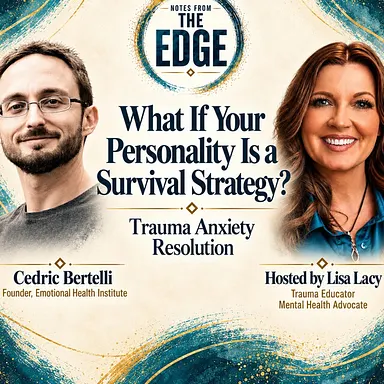
“What If Your Personality Is a Survival Strategy? Trauma Anxiety Resolution with Cedric Bertelli” was turned into text by HappyScribe’s speech recognition. Related tool: Teams transcription.
Ads in this audio differ from the text. Tap the sentence you're hearing to follow along.
Synced: the text now follows the audio.
Welcome to Notes from the Edge, where we have the conversations we should have been having all along. We talk about the things that we're not talking about. I'm your host, Lisa Lacey, writer, trauma educator, executive advisor, and author of the upcoming memoir Notes from a Certified Madwoman. Welcome to The Edge. Hey, my friends. Welcome back to another episode of Notes from the Edge. I am your host, Lisa Lacey, and this is the place we talk about the things we should have been talking about all along. Guess what? You ain't talking about it. So today we're going to— and my special guest today is Cedric Bartelli, who is the founder and director of the Emotional Health Institute. And co-developer of Emotional Resolution, or EmRes. So today we're talking about what happens when survival strategies become personality, why managing an emotion may be very different from actually resolving it, and who we become when we no longer have to perform the things we're always talking about in here— performing strength, competence, control. Or certainty just to be safe. Now, Imre's is a body-focused approach to understanding and resolving disruptive emotional patterns. Cedric grew up in a tiny village in southern France and took an unconventional path into his work.
He left traditional schooling after middle school for culinary school, eventually building a career in luxury hospitality and becoming director of restaurants and food and beverage for the Ritz-Carlton. I bet that was a stressful job. I bet that was where he managed more than 250 employees. Now, while he was performing composure, competence, and leadership on the outside, his internal experience looked very different. And that's why he began studying emotional functioning in France in 2009. Friends, this was before we were talking about this. And continued that work after moving to the States in 2011. Today, he trains practitioners, therapists, coaches, educators, and other professionals in emotional resolution, exploring how physical sensation, interoception, emotional prediction, and the nervous system influence the patterns we often mistake for, hmm, this is just who I am. His work has also moved into clinical research, including a UCLA study evaluating emotional resolution for anxiety among healthcare workers. And what fascinated me most about Cedric's story is this one question, because you know we like better questions in here: how much of what you're calling your personality is actually an adaptation? Cedric, welcome to Notes from the Edge, my friend. How are you today?
I'm doing very well, thank you, Lisa.
Good, good. It's so good to have you here. You are All on point with all things we love to talk about on Notes from the Edge. So we're just gonna dive right in, my friend. You have said that for much of your life you performed competence, strength, control, certainty. So what happened for those listeners that may see themselves in you today? What happened for you to make you realize, whoa, This is not who I am, but this is an adaptation and I am in a performance.
I think most of us know it's an adaptation, right? I think, uh, I think we don't have to look deep inside to realize that for, for some of us, it was my case, what we are displaying is an adaptation that we had to create to, I don't know, Oh, whatever it takes, right? You have to create what the philosopher Henri Bergson called the crust, which is this appearance that you— yes?
I— we lost you for a minute, but we caught back up on crust, and I love that word crust for the armor we put up. Brilliant.
Brilliant. That's right. That's a concept by Henri Bergson, a French philosopher. It's like everything we have to— everything we create over the years through our education, our beliefs, our trauma, et cetera, et cetera, we create this armor, as you said, this persona, so that we can be in society in the most comfortable way possible. But to answer your question, I think most of us realize that if we stop and Or I would say in the morning when we brush our teeth, we know who we are inside before we go out to the world. And what created the shift is the turmoil that was going on inside of me on a daily basis. And it's not special to me. I think it's a case for many people. Yes, you have to display confidence. You have to do work. You have to be out there, especially in hospitality business. You have to entertain people. And that's wonderful. I absolutely loved it. But at the end of the day, I was drinking too much in order to regulate myself. And working in hospitality business, it is almost normalized to drink alcohol, to have wine, anything. But I knew very well that I had to do it in order to calm down.
And at some point, it was clear to me that that wasn't a way to live. It wasn't healthy. It's in whatever I was trained, psychotherapy workshops. I'm in California, so you can imagine all kind of workshops you can find here for emotional stuff. And I did a lot of them. I spent a lot of money on them, and some were absolutely great. I'm not saying anything bad about that, but it wasn't sustainable. It was constant emotional regulation, and you go to a course and then to find something else and then to another one. It's nonstop. And, and at some point, you had to stop. It just was not sustainable. So.
I like your word sustainable because really, when we're looking for transformation, we want it to be something that at least gets us past the threshold where we're not always going back to the starting point. So you were leading hundreds of people in the hospitality industry that I've worked in hospitality and it can be fun. Yes, it can be be exciting, but it can be really stressful too. What did it cost you emotionally and physically to become really good at looking or performing I'm fine? What does that cost us, you think?
It costs a lot of energy. It also costs— it costs a lot of energy because when you perform, it's draining. You know, Lisa Feldman Barrett, the neuroscientist from Boston, who wrote the book How Emotions Are Made. She talks about body budget, right? Every day you have a body budget and you take out of this budget when you have anxiety, when you perform over your— past your potential, etc., etc. And you put some energy money, so to speak, in the budget when you do something that brings you joy, that relaxes you. Well, when you do perform a lot, you take a lot of energy out of your body budget, so you're more sick, you're sicker, you know, your immune system is lower. And how do you do? Well, you drink. In my case, I was drinking too much, and that was clear to me. It takes a lot of space as well in your mind. You're not 100% present for others when you have to fight the tension inside in order to, for example, speak in front of a group of people, you know, doing lineups every day or meetings. You know, when you're taken by tension, you're have to deal with your own tension and try to look relaxed and fun.
And it's this paradox inside, right? Looking cool outside and inside being tight like a rope.
Yeah, tight like a rope. And that is no way to live. So there came a point in your personal experience, your lived wisdom, where the identity you had built was no longer sustainable. So what you were doing was no longer sustainable. So what happened when the version of you that helped you become that successful, because that's making it pretty high up there in the hospitality industry, what happens when that version of you is not the next iteration that's going to help you heal? Like, how do you, how did you kind of let that go? Did it happen in a moment, a bunch of moments? Kind of walk us through your process. of making the discoveries that became the modality that helped you the most and that you now teach?
Yes. Well, I think it's an accumulation of things, right? It was at the time 2009, 2008, 2009, and the economy was going down. So a lot of things were changing in the company as well, the way that we were doing business, etc. It was, it was a very strange moment. I don't know if you remember, it was the time when the economy crashed. So it was a very strange moment in many fields, but in the hospitality business as well. And in a way, for me, created an opportunity. Like, we didn't do business in a way that— we started doing business in a way that wasn't fun anymore. You know, everything had to be regimented, everything had to be— you know, you go to hospitality, or I went to hospitality business because it's a party. You know, you make a party for people. It's like, it's It's joy. And everything became strange and tight and tense. And so, I didn't feel the balance was in there anymore. I didn't have fun anymore. The way that we were cutting hours with the employees we had to was not— it just didn't feel right. So, for me, it was an opportunity.
So, it was that and also seeing that, again, the way that I was living my life wasn't sustainable. And in the background, I always had my grandfather in mind. You know, my grandfather was a World War II veteran. Uh, he was in the Maquis, which is, uh, uh, in France, people who hide in the forest, receive messages, and then go do operations against the Nazis. And my grandfather, that was very present for me in my childhood, was a very calm man, a bit like a Buddhist monk, you would say, you know, very calm. And I always wonder how him and elders that was in the village were able to go through intense trauma that they lived in World War II. to being these people who were— they were not perfect. It was PTSD at the time as well. You know, nothing is perfect, but how they were able to get at that point of resilience. And why me, who had a pretty comfortable childhood, we're very modest, but, you know, nothing bad happened to me. Why did I carry so much stress and anxiety and anger? Like, that didn't make any sense. How somebody goes through so much actual trauma and can access a point of resilience, raise a family, raise, bring his family from nothing to comfort, right?
And me, who had it good, we're like packed with demons. So that was always in the back of my mind is like, there is something that can be regulated, that can be resolved. So because it is not natural for an individual such as myself to carry so much burden and weight for quote unquote, no particular good reason. So that also was, I would say, a motivation behind me to understand what is it that is blocking within. Nothing that I didn't think something was wrong with me per se, but there is something to understand. There is something, there's a process that can be reached. I was convinced on that, that could allow emotion to resolve, to be integrated in life. So it was, you know, it's an accumulation of different things to answer your questions. And 2008, 2009 was a good opportunity. And I got to tell you, when I quit my job here in California and went back to France to study what I'm doing now, to start studying what I'm doing now, it wasn't easy. You know, when you have to let go of a fantasy, you know, you started with a dream when you're 14, 15, 16, and you go on to follow it, to follow a fantasy.
And then when the fantasy goes away, what do you have? You have to reinvent yourself. And there is a moment of limbo there. And You know, the scariest for human mind is not knowing. So you can have desire, you can have ideas of what you want to do, but you don't know if you're going to be successful. You don't know if you're going to make it. And if you don't, what's happening? So the not knowing there, the limbo, it was not easy, but I learned a lot during it. Well,
I love the fact that you looked at something that could have been terrible and looked at it as an opportunity for change. And you said something that sounds so simplistic but can be so complicated for us in practice, and it was the simple, it didn't feel right. My friends out there, he's saying if it doesn't feel right, it might be time for a change. So I absolutely love that. So, um, you make an important distinction between— and see, I love the word resolution. Resolution is a different word than just regulating nonstop all the time, working towards it all the time, because I do believe we've gotten in a state where like healing now becomes something else that we have to perform great at all the time, right? That's right. So you make an important distinction between regulating managing, controlling, and then resolving emotions. Talk to us about that and what you learned in your studies and working with so many people.
So, so you said it perfectly here. We became champions at regulating our emotions right from the get-go. I have a little girl who is in kindergarten now, and from preschool on, she's been taught to regulate emotion, right? When you feel something, you breathe. So we became champions at regulating emotions. And there are plenty of workshops, plenty of books, plenty of— that teach us to regulate. That means that there's a trigger, we feel a certain way, we shut it down so we can survive, and then we go on. And then we are faced again with a similar stimulus, the body is reacting again, we regulate, and then we go on over and over again. And that was a big thing for me. It's like, Why do we have to keep on doing that? If you look around, we're basically the only mammals to do that. You know, at the Emotional Health Institute, we work with ethologists and veterinarians, and they looked at emotions in other mammals. Just food for thought, it seems that there's only 3 kinds of mammals that keep on repeating the same debilitating emotional pattern, and those mammals are human beings, pets, and in some kinds, farm animals.
Now, what is the common denominator to those 3 kinds of mammals? It is that us human beings control the youngs. We control our youngs, we control our pets until they die, and then in some cases, often we control our farm animals. By controlling very early on our youngs, we shut down a natural capacity for emotional resolution. We do not let the body go through a natural cycle that allows to integrate an information that was just lived. We shut it down in a way, and we keep on shutting it down again and again and again as we grow older. So what did we see with emotional resolution is that what we are able to do with EMDR, what we're able to observe and now study clinically with EMDR is that if you get to an emotion at the beginning of this emotion. So first of all, maybe I should explain in a second. A debilitating emotional pattern, meaning an emotion that keeps on coming back, toxic emotion, so to speak, that keeps on coming back, anxiety, recurrent fear, recurrent anger, and such. All it is in the brain is an outdated prediction from the brain. The same way that when you're about to have a cup of coffee and before drinking your first sip, you are predicting, your brain predicts the taste of coffee, the same things happen for everything in life.
That means when your brain in your current environment, in your current ecosystem, recognizes one or several elements that were present during a moment of trauma, in this case, your brain is going to automatically and instantly predict what physical sensations you're about to feel based on what was felt during a specific traumatic event in your life. Now, those physical sensations, you feel them in your body. That's what lets you know that you feel an emotion. You know that you feel an emotion because you're feeling physical sensations. Those physical sensations, we call that interoception. Those physical sensations are nothing else but an outdated prediction from your brain. Basically, your brain is predicting that you're about to feel the sensation that's starting to be generated in your body. Well, what do we do usually when we feel those sensations that we conceptualize as anxiety, as anger, or whatever? We shut it down. We breathe, we have some water, we go to yoga, we smoke marijuana, we watch porn, you know, you name it. You know, we do whatever it takes so we can survive them, so we can shut it down. But that's the problem. Every time we shut down this interoceptive prediction, the brain doesn't have an opportunity to go to the end of the prediction and notice that at the end of the prediction, when it is anticipating to be hit by some kind of danger, nothing happens.
You're safe and sound in your current ecosystem. In your current ecosystem, the stimulus, the trigger that referred to something that was dangerous that happened years ago currently is a non-event. We never take the opportunity to go through this interoceptive prediction until the end. And this is what MRS does. What we were able to isolate is a simple fact that if you put attention and do not interact with the physical sensations at the beginning of an emotion, and you keep your attention sharp, active in feeling what's happening without trying to control what's going on around you, or without trying to control what's happening inside of you, This prediction is going to take between 2 and 90 seconds. This is how long an emotion takes in the brain, about 90 seconds. We feel like emotion takes longer because we keep on thinking about the emotion, or we keep on being retriggered, or we keep on having emotion about that emotion. I feel anger, and then I feel shame, and I feel guilt, et cetera, et cetera. So we feel in a funk for days sometimes, or hours, but an emotion lasts for 90 seconds. So what we find, to go back to the road to try to answer your question, is that If you are able to keep your attention sharp without acting on it, without changing anything until the end of this interoceptive prediction, at the end, your body realizes, your brain realizes that you're safe and sound.
At this instant, your emotion is not regulated but resolved.
I love that. And we do do that to ourselves. We have an emotion about the emotion about the emotion about the emotion, and then we're just replaying these cycles Sometimes all day long, sometimes a week later about the event, sometimes 2 months later about the event. So I'm gonna dig into that just a little bit more for our people out there that are going, 90 seconds? No way. I've been living with this for a decade. So it's hard though for us to sit with anything that's uncomfortable. Right? So why is it so hard for us to sit in 2 minutes of feeling some physical sensation that may be uncomfortable for us?
It is counterintuitive. You know, when you hurt somewhere, you want to make it stop. When you're uncomfortable, you want to make it stop. It takes a lot of effort and will to actually put your attention Into what hurts, what is uncomfortable. EMDR is counterintuitive. All we want to do is not jumping into the emotion, is to run away, is to shut it down, to control it. Sometimes in talks, I refer to EMDR as the ultimate hero journey. You know, the hero journey when the knights are fighting the dragons? Well, in this metaphor, the dragons are our debilitating emotional patterns, our disruptive emotions. And we have all these dragons inside of us, and we spend our life hiding from them or fighting them. That might be anger, or trying to control them, or trying to seduce them, right? That was a lot me, right? Mr. Nice Guy. You know, if I'm afraid, I'm gonna be super nice so you don't become a danger for me. So we have all those ways that we try to deal with our emotions. We have to, right? We have to survive. We have to thrive one way or another. Well, Emrys is telling you the only way to slay the dragon is to let the dragon swallow you.
That means when you feel something, don't try to run away, don't try to shut it down. Let it swallow you. You gotta feel inside, get into the flesh, get into the sensation. Those sensations are not going to hurt you. You feel them in your life no matter what. You're just shutting them down. They're not dangerous, they're just uncomfortable. Let them take you, feel them. And that's being like being in the belly of the beast, right? Once you're in it, that's when you slay the dragon. You let— you have to let the dragon swallow you. So you realize that it was only fear. The dragon, in a way, yes, it was very much real. It felt very much real. But they're like ghosts, you see. All those debilitating emotional patterns that keep on coming back, they're like ghosts. They do not belong to the present. They belong to the past. So we are all here, you, me, everybody, we're like a bunch of haunted houses. You know, we look good outside, you know, but inside we have all those ghosts, demons. And, and yeah, the facade might look good, but might look good, but we are worked out by all those, those, those ghosts.
We're just like ghosts. You just have to feel them. I don't know about ghosts, but you just have to feel them in order to bring them back where they belong, to the past.
I love that. I love that. You know, I, I ran into a bottle for 20 years, um, and when I first started doing my journey work, I, I remember Having a day where I stopped and I went, I ran from all those feelings all those years, and you know what? It wasn't that dang bad. My friends out there, it's not that bad to turn and to face them. And Cedric, what I love that Imre is putting out there is that healing doesn't have to suck. It doesn't have to be a trudge, and it doesn't have to take us decades to release and resolve some of these things that have haunted us like ghosts, to use your phrase, for so long. So, but it— you, you, you said the word, not the word hard work, but— Counterintuitive. Yes. Counterintuitive to what we want to do because we want to cope. in the way we've always coped, whether it was the bottle for me or for you, even drinking or gambling or sex or substances or shopping or whatever it may be. Work. The running that we do. Work. I was a workaholic too. Still working on that one.
I love my job now, so it brings me so much joy. So I don't consider it workaholism, but Yeah, I, I— how do you start people out with this counterintuitive work? So say somebody comes to you and says, Cedric, I've been haunted by this flashback or memory or event for a decade. What's, what's one way you would start working with them?
So, so, um, like, I like you ask one way because EMDR is a methodology, right? We, we develop several things that allow to do this natural process of triggering, if it needs to be triggered, the emotion at the very beginning so we can— so the person can feel the outdated prediction and then resolve. I will ask the client, one of my first questions I ask is, if we could resolve one thing within you today, one emotion that keeps on coming back and weighing on you, or you feel like it's toxifying your relationships or your life, what would that be? One emotion. And the client will tell me, well, I feel this anxiety when I look at my finances, or I feel insecure in my couple. Every time I'm in a public space, I'm afraid. Whatever it is, we're going to take the client the way they are today. We never talk about the trauma. I don't need to know if the client knows there is a trauma or not because it's irrelevant in a way. You cannot heal trauma. Right. Uh, true, it's, it sounds good, but you can't because trauma happened. So what is it to be healed?
No, the only thing you can heal are the wounds that this trauma created. And the wounds, they are what are affecting you today in your life. And that's what I'm interested about. Whatever happened to you in the past, yes, of course, recognizing that, of course. However, today, what is the problem? What is problematic? What are the circumstances that makes your life difficult, that do not allow you to be content. So we're gonna take this one emotion they choose to work on, something that affects them today, and we're gonna work on resolving that. But the way we work with Emres is, in my mind, emotions are on 3 levels: the conscious emotion, unconscious emotion, and subconscious emotion. And that's not in a book, it's just like one of my theories, and I got a lot of theories, trust me. So some people come, people come to see me most of the time, or see us, for a conscious emotion, what is quote unquote obvious to them, right? What is in their face, and they recognize it because that's the first thing, right, Nisa? You've got to accept your emotion if you want to resolve them. So even if it's an emotion that you're not proud of, even if it's an emotion that does not fit with who you think you should be or who you think you are, you need to accept it.
As long as you do not accept your emotional difficulties, you cannot treat them, you cannot resolve them. So anyway, they will come with a conscious emotion, and I will address this conscious emotion by retriggering it in a specific way, by using most of the time a present memory, some time when they felt that emotion within their current life. But then after that, we're going to work on the unconscious emotion. For me, the unconscious emotions are the shame, the guilt, the self-image emotions, the not good enough emotion that might have come from this emotion or under this emotion. And so that we're going to work into the subconscious emotions. What are subconscious emotions? Subconscious emotions for me are tensions. You know, all day long we are crossed with tensions, tensions that are not, tensions that are not strong enough to be conceptualized as emotion. For example, we meet for the first time, Lisa, and I don't know anything about you. We never met. We met maybe in a dinner or something like this. And as I come close to you, I start feeling tense. I don't know anything about you, but I start feeling tense. And maybe that's— maybe there's something about you, maybe a smell that my brain recognized being present in somebody who used to hurt me, you know.
Maybe your shape that my brain recognized. Again, it's nothing about you, Lisa, but my brain takes one element about you and match it to something that was present during a moment of danger. That's going to create some tension in me. And I'm going to feel those tensions, and I'm going to make up a story about them. I'll say, ah, Lisa, I don't know about her, right? That's nothing to do with you. I feel tension, I make a story about it based on my history, based on my belief, and then I'm going to believe this story. That means in this relationship that we could have been friends, we could have made business together, maybe a wonderful partnership, but because I am full of tension, it's not going to happen between us. I don't have an emotion about you, so to speak. I have a feeling about you that I'm going to conceptualize as being right, when often they're just tension in our body and nothing else. So we work on those 3 levels.
I love that. And I love how, again, simple it sounds at first. I'm assuming it would take practice to catch that on the front end rather than be stuck in it As in our old patterns. What I also love about the MRES process is you're not having to go backwards. You know, I happen to be an individual, and I'm advocating for talk therapy when it works for people because it does work for many, many, many people. It did not work well for me. I found it to be very rewounding. Um, and, uh, was not helping me move forward. And if somebody can resolve it, then there's nothing but forward momentum in front of them, and they're no longer being haunted by these— again, to use your words— ghosts. So what a beautiful process that sounds like it is backed by a lot of science, backed by this. So
again, guys, We're working on it. Go ahead. It's not a lot of science yet, right? It's, uh, we are, you know, clinical studies are not easy to, uh, to, to come along. So we're finishing a clinical study with UCLA and we're working. We have, um, other studies in the back— in the background, uh, working. Um, so we, we are trying to back it up, yes, with, with science, with, with data. So it becomes, it becomes obvious and people cannot deny it anymore, right? Uh, and I think human beings need that. human beings need to see the scientific. So we're working— that's a lot of my time is spent right now in, in, in trying to create partnerships in order to, to do more clinical research around EMRS. So I hope I can come back.
Success story is a, um, a proof of life. One success story is proof of life. So if you've got clients leaving you going, that has been haunting me for a decade and now I don't even think about it, I think that says something to be said for ditching these things in a fast amount of time. But Cedric, we have been conditioned, especially in this culture, in the clinical therapeutic arena, for it to take a lot of money, a boatload of time, and a little bit of codependency. Sometimes on the clinical therapeutic arena, there at least in my the small fortune that rivaled a small house that I spent in the clinical therapeutic arena, I found that it bred a lot of codependency. There was not a lot of you have power, you have conscious choice, you get to make these decisions. There was a lot of let me help you make these decisions, and we are autonomous human beings. And what I I love. Love about this modality is that it gives people a lot of forward momentum. And you said a word that I want to circle back to that I think is so important.
You're not making these promises of joy and ecstasy and extreme happiness all the time. You used the word content. And what I love about the word content is it's sustainable. Like joy and ecstasy and happiness. I mean, those are hard places to stay up at all the time, but satisfaction, contentment, curiosity, those are all places that we can sustain throughout our day more consistently, a little bit every day. So talk to me a little bit about that, about the word content and curiosity and satisfaction, and you're not aiming for, you know, this ridiculous state of being. You just want people to feel a little lighter, am I right?
Yes, this is correct. And I just want to, to drop a little thing. Psychotherapy, as you said, can work for many, many people. And I see EmRes as a tool that can be extremely flexible. So my, my goal is to put it in psychotherapists' hands, you know, so they can use it when they see it necessary. And yes, I just want to say that. I don't want to create any tension with any other field. Of course, I think everybody is doing their very best to help people. And to go back to your question, yes, Emres, is not cathartic in any way. It's about feeling contentment, joy. And I actually feel like Often what we can take happiness as a bit of euphoria, right? There is tension when you're too happy almost, you know? And that's the idea. Often people ask me, well, you call it emotional resolution, but are you going to resolve every emotion? No, of course not. No, the goal of emotional resolution is to feel the emotions that are congruent with our current reality. So instead of being overwhelmed by emotion from the past, you know, that create anxiety, that create whatever stress, no, no, it's to be able to have those emotions from the past integrated, so informing our life without overwhelming it.
So yes, it's all about feeling content and feeling joy. You know, there is this neuroscientist in France called Boris Cyrulnik, and he says something I love. He says, joy is a craftsmanship. You build it every day, all day long. That means that Do not expect joy to come from outside. You build your own joy like a craft, you know? And I think it's very empowering. Do not expect joy to come from outside. Make sure it comes from inside and from things that you do in your life, from people you surround yourself with, you know, and etc., etc. Yes. Yeah. So to answer your question, absolutely. Contentment, joy is, is what we are, we are aiming for here so that we can feel the emotions that are given to you, given to you by our current reality.
Well, and what I love too, once you have these tools in your toolbox or these skills, nothing's piling on top of, of you moving forward because as the stuff arises, then you know what to do with it. So you don't have new traumas piled on top of old traumas because now you have a new way to function within them and deal with them and let them ride through. Right.
Absolutely, 100%. That's why it's very important for Emrys practitioners to teach what we call self-Emrys to people so that they can be— we go back to the word sustainable— so that they know how to do it on themselves by themselves. When something new arises, to have the, the, the will and knowledge to do Emrys on themselves by themselves. Now, can you do it on everything? No. Sometimes the emotion is too overwhelming. Sometimes the circumstances do not allow us the space to do the MRS, even if it's very short, because life. So that's why there are practitioners out there that can work on those 3 different levels I mentioned earlier, because it is difficult to work on unconscious and subconscious fears on your own. But you're right. When people are now in the mindset of noticing, wow, at this moment in this situation, in this conversation, in this relationship, I do not have access to 100% of my capacities, mental capacity or physical capacity, then I know that I am in fear. That for me is the gauging, right? In that conversation, in this relationship, in this work, do I have access to 100% of my physical potential and intellectual potential that I have today?
No. Chances are I feel tension. Chances are there is something that creates fear within me. Let's accept it and resolve what can be resolved.
I love it. I love it. Because then again, it's not bricks piled on top of bricks piled on top of bricks. And then you can, if you're working on the stuff moving forward and you need to dig a little bit deeper in the clinical therapeutic arena with anything that's deep down in there, in the deeper arenas with talk therapists or other modalities. then you can do that. But in this way, stuff's not building on top of what's already there. It's another tool to add to your toolbox. I love it.
So interesting.
Imres works heavily with physical sensation, and I would venture to game a lot of us are completely disconnected from our bodies about from, oh, I don't know, the neck down. So What, what, how do you help people get embodied if they have had a lot of trauma in the past or they don't even know how to get into their body? So what's one way today somebody can start getting used to being in their bodies? Because for a lot of us, that is a brand new experience.
Okay, that's a beautiful question. Um, first of all, uh, something has to be, uh, out there is like Like, if one realizes they feel an emotion, if they realize they feel angry or anxious, that's a proof on its own that no matter what happened in their life, they're not cut from their body. Because if they feel the anger, if they feel the anxiety, it's because they feel physical sensations. So they might not realize that, right? They might surf the wave of the emotion, but the current inside the flesh is full of tension. So it's good news in a way, right? they're not completely cut because they feel emotions. And the, the something that I often do with people who are quote-unquote cut from their body, who have what I would call a lower interoceptive awareness, is I ask them to pay attention to their biological needs. I have to use the bathroom. Oh, okay, okay, okay. How do you know that you have to use the bathroom? Well, I just know it. No, stop, stop. Close your eyes. Move your attention to your body. What sensations let you know that you have to use the bathroom?
Well, I feel tickled in my lower belly. Ah, well, okay. So little by little, we're gonna start using, for example, biological needs. I'm thirsty. Okay, how do you know you're thirsty? I just know it. No, that's not true. You just don't know a thing. Close your eyes. What in your body lets you know that you're thirsty? Dry mouth. Okay, okay. So little by little, you know, we work a lot with veterans and people in the army learn to shut down from their body because they have to stand maybe in some positions for hours without drinking, eating, going to the bathroom. We also work with professional sportives, so professional athletes and ballet dancers, for example. You'd be surprised to know how much ballet dancers shut down their body. We think they're completely in tune with it, but they have to shut down because it's so painful sometimes to, to, to ballet dance, on a nightly basis, and, and the wear and tear on the body is, is too much. If they were in touch with the pain, they would not dance. So little by little, through little exercises such as the one I, I just described, we create— we try to recreate an intimacy with what I call the flesh, an intimacy with the body, little by little.
And, and I don't want to say everybody after a while is able to feel sensations because nothing works for everybody. But most people are able to feel sensations and again be intimate of their inner world, of what's happening inside of you, which is in a way, it's a, it's a, it is, uh, yeah, you're right. It is so strange that a lot of us do not feel what's going on when everything goes through this window, right? We see life, we experience life through what's happening in our body. Yeah.
Yeah, I love that. Start with the basics, guys.
Start with the basics.
Biology. Start with the basics. How do you know that you know? Because you don't just know. I love that. I love that. That's right. So, Cedric, if we stop organizing our lives around old emotional predictions and survival patterns, there's an identity question waiting underneath all of this. So who are we then? when we no longer need performance is, do you have your clients that are sometimes, I don't know who I am now because I don't have all this hanging over me or, or carrying me down or weighing me down? What kind of happens when some of these things get resolved?
Uh, you know, um, I will say that strangely, or maybe not so strangely, homeostasis happen very quickly. So you resolve something that have been in you for a long time. It's like, I don't want to say it's like it's never have been there, but it's almost like this. There is no questioning the who am I. That's very human, right? It's very, uh, intellectual. Who am I? So you wonder about it before, right? Who am I if I'm not anxious? Who am I if I am self-confident? So that's something you ask before. But once something is resolved, there's no more question. Sometimes you'll be surprised. Sometimes in situations where people used to shake or avoid, they're back in the situation and they're just in the situation. There is no like butterflies and fireworks, like, wow, I never was able to talk in front of the public and now here I am. Yeah. No, none of this. It's one of the difficulties we have with MRS is like, it's absolutely not cathartic. It's like, where used to be anxiety is not, you know, fireworks. There's no one next to you shooting a little firework. No. where anxiety used to be, or fear, well, now it's just contentment.
And as you said, contentment is not joy, it's not euphoria, it's just being in relationship with what is happening now.
I love that.
So to answer your question, the question happens before. Who am I gonna be? What's gonna be life? How will people relate to me if I'm not depressed? How will people relate to me if you don't have this chronic pain anymore? And, and, and how would I survive if people don't take care of me the way that they used to because I have this pain or this emotion? I feel less depressed. These are questions that you have before. And sometimes those questions prevent you to resolve the emotion, right? Because how will the world relate to me if I don't have that anymore? Like, who are they going to take care, care for me the same way that they used to? All those are questions you have before. And then you resolve and there is no more question because it's just what it is.
It is what it is. I love it. I love it. Well, my friend, how can people find you? More information about Emres if they need it for a supplemental modality to what they're already doing. If they've tried everything and it hasn't worked, how can they find you?
The best way is to go to emres.com. or they can also go to emotionalhealthinstitute.org. It goes to the same place, and there they will find the science behind EmRes, practitioners, the trainings available to therapists and coaches and firemen, etc., and all the information. And they can also contact us with any questions. They can also, if they wish, upload. We have a recueil, you know, how do you say that in English? A collection. like a book with several case studies, a lot of case studies, so they can see how MRS can be applied on different things, um, physiological symptoms, emotional difficulties, etc., etc. So they have— it's just case studies. Yeah.
I love it. Well, Cedric, let's make sure we have both those links, the direct link to the site and then the link to the book too with the case studies, so people can dig into it further. And friends, you don't have to write any of that down. We'll have it in clickable links in the show notes. Now, Cedric, before we let all of our guests go, we have 2 questions we ask them. Are you ready for question number 1?
Shoot.
All right. In your own life, what did you perform just to survive? And what did dropping that role, mask, or performance do for your life?
So what did I perform was to, to hide my anxiety and my self-direct— my self-directed anger. for a large part of my life up until my late 20s. And what dropping that, what did it create? It creates, I mean, even if I repeat myself, more joy, right? Being able to be in relationship with my wife, with my kids, with friends, with just people, be more in relationship, less in reaction. In a way, I would say being less afraid.
And more present. You can't beat that. Less afraid and more present is, uh, something to, to aim for, my friends. All right, Cedric, last question. What do you want us as humans to be talking more about? What conversations, according to you, should we be having that we're not having enough of?
Maybe realizing that all those reactions we have to pretty much everything is based on fear. So instead of first trying to have a conversation or an argument based on old beliefs or fear-based belief, get in, resolve those fears so you can have a conversation about what feels ethical, ethical to what you've learned through your life, through all the information you gather from your life. So I think we, we often go into arguments, into actions and reactions based on old beliefs and old fears. And I think that's why the word in is in such a mess. First, let's realize that we have those tensions. Let's resolve them as much as we can. And then let's go in conversation. Let's take action that is, I would say, for the greater good, not to shut down our fears or squish somebody else because they make us feel uncomfortable.
Indeed, my friend. Indeed. Well, I'm so excited about this modality being out in the world as another opportunity for people to feel just a little bit lighter. throughout their day. My friends out there, I'm going to ask you guys listening the same question: what are you performing in your life to survive? And what might setting that role mask or performance down do to lighten your load? I am your host, Lisa Lacey, here with my special guest Cedric Bartelli. And when you find the answer to that, we will both see you at the edge. Thank you so much, Cedric.
Thank you, Lisa.
What if the anxiety, fear, or emotional patterns you’ve accepted as your personality are actually survival strategies from the past? Lisa Lacy sits down with Cedric Bertelli, founder of the Emotional Health Institute and co-developer of Emotional Resolution® (EmRes®), to explore why managing emotions and resolving recurring emotional patterns may be two very different things.From Cedric’s experience masking anxiety while leading hundreds of employees to the ways our brains predict danger based on past experiences, this conversation explores trauma, emotional avoidance, and the body’s role in emotional processing. Lisa and Cedric discuss interoception, the emerging research behind EmRes, reconnecting with physical sensations, and why sustainable contentment may matter more than chasing constant happiness.In this episode:How anxiety, high performance, and emotional masking can become survival identities.The difference between emotional regulation and Emotional Resolution® (EmRes®).How past trauma, outdated brain predictions, and physical sensations influence recurring emotional responses.Why avoiding uncomfortable emotions can reinforce patterns of fear, anger, and anxiety.Reconnecting with the body, practicing Self-EmRes, and developing greater emotional awareness and contentment.Connect with Cedric Bertelli:https://www.cedricbertelli.comEmotional Health Institute: https://www.emotionalhealthinstitute.orgConnect with Lisa | INSIDE THE EDGE:https://www.lisalacy.com/inside-the-edgeWhat did you perform in order to survive?Welcome to the Edge.See Privacy Policy at https://art19.com/privacy and California Privacy Notice at https://art19.com/privacy#do-not-sell-my-info.