
Every line of this episode of Notes from the Edge was transcribed with HappyScribe technology. See also: Teams transcription.
Ads in this audio differ from the text. Tap the sentence you're hearing to follow along.
Synced: the text now follows the audio.
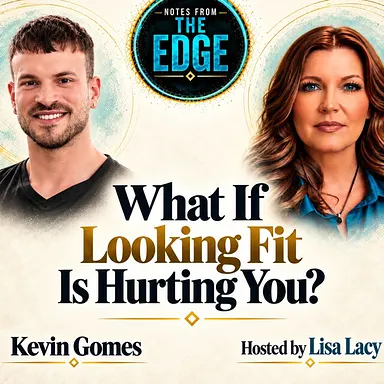
Welcome to Notes from the Edge, where we have the conversations we should have been having all along. We talk about the things that we're not talking about. I'm your host, Lisa Lacey, writer, trauma educator, executive advisor, and author of the upcoming memoir Notes from a Certified Madwoman. Welcome to the edge. Hey, hey, my friends! Welcome back to another episode of Notes from the Edge. I am your host, Lisa Lacey, and this is the place we have the conversations we should have been having all along. Guess what? You ain't talking about it. So today we're gonna with special guest Kevin Gomes, and today we're exploring why. So many successful men struggle with their physical and emotional health, how identity and unhealthy patterns influence our choices, and what it means to build sustainable fitness without sacrificing the life we're working so hard to create. Before we dig in, let me tell you about Kevin. Kevin is a health coach, former competitive bodybuilder, and founder of Pinnacle Coaching, where he helps men take control of their health through sustainable fitness, nutrition, and lifestyle changes. With a Bachelor of Science in Sports, Exercise, and Nutrition and more than 5 years of coaching experience, Kevin brings both professional expertise and personal experience to his work.
And we love lived experiential wisdom in here. After spending years in the competitive bodybuilding world where extreme routines and physical appearance often take priority, he developed a different perspective on what healthy actually means. Today, his approach focuses on helping— help men break unhealthy patterns, improve their relationships with food and exercise— that is a relationship— and build sustainable habits for longevity. Kevin reports more than 130 client success stories, including work with elite athletes, and has spent the past 2 years educating fitness professionals. As a husband and father, his mission goes beyond building better bodies. He wants to help men become healthier, more present— we'll dig into that— and more intentional, a word we love, in every area of their life. Kevin, welcome to Notes from the Edge. How are you today, my friend?
Lisa, I'm good, thank you. It's great to be here. Thanks for having me on.
Yeah, yeah, excited, so excited. Always happy to, uh, support men's health, especially mental health. emotional health. And we know it starts sometimes with physical health. You can work that way, work on your physical health, which then improves your emotional and mental health. But you came from competitive bodybuilding, a world where extremes are celebrated. And Kevin, you may not know this about me, but I ran a CrossFit box for a little while along with my Gracie jiu-jitsu certified training center. So I know something about extremes. It was a bit extreme. So what changed your perspective? What moments or moments made you realize, whoa, there's a better way that's more sustainable, that's not going to take things out of me but fill me up instead? Yeah,
that's a great question. Uh, I think that the real turning point was probably in my second competition prep. I think both emotionally. I wondered why I felt so drained and unfulfilled when I was going through that experience. And physically, for sure, just completely wiped out. If anyone's ever done an extreme diet, been to extreme levels of body fat, you know, you feel like wind could knock you over. Not the healthiest position for your body to be in, for sure. And I think that especially the emotional side, I really started to wonder like, why, why doesn't this feel as good as the first competition prep I did? This was a time in my life where things were mounting, business was growing. I was in a healthy relationship for, for the first time with my now wife. Uh, that came with, with some challenges to the prep as well. And it just created a real bit of conflict in me. And when I, when I really kind of got mindful with it and explored my own thoughts and emotions is when I started to actually realize, you know what, this doesn't actually serve me. If I really dig deep into why I'm doing this, I think, I think a lot of competitive athletes in any field might even be able to relate that it's— there is at least a part of it there that is to, to prove something.
And in my case, it wasn't necessarily to myself. Through, through my coaching journey, through my business journey, even, even people as close as my father had, had their doubts. I think there was some part of me that wanted to, you know, achieve something in the, in the competitive space to kind of prove, to prove to him. But when, when I got clear on that was when I realized this isn't actually serving me. This isn't where my values necessarily align. Now, now I'm in a much healthier place in, in my life. And then that was complemented by the physical aspect where I was like, man, I've— I'm very open about my past use of anabolic steroids and things like that. So add that into what is already a very physical, stressful position for your body to be in. I looked the best that I ever had, but I felt physically weak and drained. I felt like a zombie walking, and my, my mental health and emotional health was there to match. And that's what really got me thinking, where, where is all this actually headed? And I think the, the good news is that at that point I'd experienced fitness at every angle.
I started off in the corporate world, so I'd been that guy just trying to get a bit fitter around a very demanding job. I was studying a degree on top of that. I'd then kind of developed into the extremes and just got obsessed, obsessed with the, with progress and going into bodybuilding. And that's where I was like, you know, I owe bodybuilding a lot. I think that the average kind of lifestyle fitness approach leaves so much on the table. And bodybuilding, even through use of things like performance-enhancing drugs, I got to learn so much about pharmacology, about physiology, blood work, things that now really kind of bleed into the health side of what I'm doing now. with my clients. And I thought, you know what, what if I actually took this really optimal stuff and kind of distilled it into something that is much more advanced than the average lifestyle fitness approach, but I can turn it into something that's really simple to apply. So you get to marry really the pinnacle of simple but effective.
I love that. I love that. You know, when I met my current husband in the healthiest relationship of my life— congratulations on your marriage, by the way— we, we traded substances for for weightlifting. But, um, I was down to 10.5% body fat, just like square, uh, square and angular. And his body just hurt. And, uh, we lost muscle mass on purpose— him so he could play guitar better, and me, um, through menopause just got a little softer. And our bodies do feel better. What I love about what you've done is you've taken all that experience You've made it applicable. You've, you've made it user-friendly, right? In a way that we can understand. But you said you, you took all of that. And I love that you mentioned blood work. How important is measuring stuff as we go along?
You can only manage what gets measured. If you're shooting blind, then you're never going to know what's working and what isn't. Blood work, I think, is one of those where if you never look under the hood, you're never going to see what is actually wrong there. And sure, you know, the scales can be a predictor of success, the visuals that you see in the mirror. But if there's one thing I want to encourage, obviously based on me looking great but not feeling great, is how do you feel about fitness? First, from like a, you know, mental, emotional standpoint, but also physically. If you look good but you don't feel healthy, you feel really low energy, then what's, what's happening when we, when we lift up the hood and look inside? So I think blood work is huge in that regard. And especially, you know, with, with men and if we're talking about, you know, mental health and the impact, again, the, the physical and mental are married, you know, hormones, testosterone, things like that, how that can impact mental health, how that can impact energy and performance and drive day to day. The wellness mentally, physically is all linked and blood work is a huge Kind of underpinning theme.
I love that. Look under the hood, friends. Look under the hood. Even something as simple as a damn vitamin D deficiency that you may not know that you have can increase symptoms of depression and not feeling great. And boy, oh boy, isn't that a simple fix, right? Yeah. So I do value the fact that you are helping people measure their success. And what's great about that too is it is motivation. Right? Because you can see with your own eyes the changes that are taking place month to month. So, uh, how are they married? How have you married all of this, the extreme stuff that you used to do with the typical lifestyle stuff that you see? How do you kind of marry those 2 for your clients?
Great question. Great question. I think the easiest one to cover there is probably nutrition. I think that gives kind of the easiest insight because a lot of people like working out. That's not necessarily the hardest bit. A lot of people struggle, especially with the nutrition and keeping that consistent. And I think that, you know, bodybuilding and my degree, things like that, they gave me a great insight into the deeper stuff. I'm not here to reinvent the wheel. Calories in, calories out. 100%, right? Not here to dispute that. But in terms of application, when people are tracking their calories and they always end up over or they end up snacking, or as we delve into things like relationship with food, all these other areas. And if we're looking at, again, you know, things like blood work, if we're looking at blood sugar, blood glucose, that infamous afternoon slump, things like that, energy and output. As I said, this is about performance now and capability. And if we're kind of marrying those, it's like, well, someone can be tracking their calories, but if they don't actually have the education and the habits on what a good day of eating looks like, some of those deeper areas of nutrition, how to time their carbohydrates, how to distribute their protein, which also makes it a lot easier to hit that target, then again, they're shooting a little bit blind in the day and there's just more margin for error.
So teaching those, those habits and compiling it into a educational layout of, look, this is what good nutrition looks like, this is what you want a meal to look like, this is how we make decisions around food, not only makes it a lot simpler to actually adhere to energy balance targets, it means someone knows how to actually implement that so that someone can be hitting their calories, someone can be in great shape and low body fat looking good. But if they're feeling like, you know, they're having these slumps of energy or something like that, then Going that little layer deeper with nutrition beyond just calories and macros. As you said, even vitamin deficiency. People look at calories and macros, but they're ignoring micronutrients. How to make sure that we're getting the right array of vitamins and minerals in there. That's, that's the stuff that I think marries.
This episode is sponsored by Vented. You know, we talk a lot on this show about the things we hold on to long after they've stopped serving us. And apparently that applies to clothes too. I went through my closet recently and found things I haven't worn in forever, and I'm still thinking, well, maybe someday. Someday when? Who is this version of me I'm saving an entire wardrobe for? That's where Vinted comes in. Vinted is a secondhand marketplace app where you can sell clothes you no longer wear and make some extra money. And Vinted makes it simple. Listing is quick and easy, and when something sells, Vinted creates the prepaid shipping label for you. Even better, Vinted has zero seller fees, so you keep everything you earn. Suddenly, letting go feels a lot more rewarding. So maybe that green shirt that's not even your color you keep moving around your closet is ready for someone else. Give your clothes a second life with Vinted. Download the Vinted app for free and start listing. With no seller fees, you keep every dollar you earn.
so well. So if we can introduce these habits, these ways of eating and frameworks that allow you to fit it all in on the day, then not only does it remove a lot of the overwhelm of obsessing over every, every calorie— no one wants to be on MyFitnessPal every day for the rest of their lives— but it also actually helps to fill in some of the holes and gaps that those more basic methodologies still leave out.
Perfect. Perfect. Well, and you brought up something that I think I want to circle back to, and that's relationship, having a relationship to our bodies, to our fitness, to our nutrition. How is all this a relationship?
I think that one of the biggest reasons that people, men, but people in general struggle with their physical health is, of course, as we said, the logistics of the average fitness approach out there, the time constraints, the logistics of tracking, things like that. But beyond that, especially if we explore why maybe people constantly go back to square one, can't keep the weight off, I think it's an identity problem first and foremost, and the behaviors that those identities may kind of manifest in. So if someone is— again, kind of goes back to my values in bodybuilding and why I was going through those approaches. It was only when I realized like this isn't who I am or who I want to be from an identity standpoint, but then I could explore the patterns that were manifesting as a result of that, the perfectionism, this, that. And I think that a lot of people, if they understand where their goals come from, not just what they're looking to achieve physically, but why that's important to them, that starts to paint a picture of whether identity is attached to their fitness. This then kind of leads into building good habits and sustainable change.
Because if you are coming at your body from like a place of, I hate this, I need to change that, then those, those are the kind of people that, you know, they'll drop £5 for the summer, they'll make a little bit of progress, but they'll go right back to square one. And this is why I now promote a, an approach that's based around health, longevity, sustainability, because if you are coming at it from that angle and those are the reasons you want to get healthy, want to get fit, not out of shame and things like that, then you're going to become the man who is in control of his health. What habits is that guy carrying out? Where do those behavior patterns actually stem from? And that's when we can actually look to fix those deeper constraints that are keeping guys stuck.
Wow. I don't think a lot of people working with humans and fitness are going to those layers. Your why is so valuable and important. Why is the why so important?
I think that firstly, your, your behaviors stem to a large degree from evolutionary biology, right? We can look at things like dopamine. This now links into like stress eating and that side of relationship with with food, we adopt the behaviors that we see successful people portray because subconsciously that's like, cool, survival, right? That my parents, big one, they've been able to survive, reproduce what they've done, therefore works. And if we don't dig a layer deeper and understand where our ingrained behaviors actually come from, we have no means to really change that on a deeper level. So I think, what exactly was the question again?
Why is why important? And I think you just answered it, but go deeper. Go deeper. You said go deeper. Why is the why important?
Yeah. So ultimately, if our why, if the why we do things, if the reason we have those behaviors If we can start to reframe the perspectives on those, then that's how we unlock that deeper level of behavioral change.
Yeah. Yeah. And you also bring up a very important word in your work, and that's intentionality. Like, what are your intentions? And I think in the work that you're doing with people, what you're doing is getting them off of autopilot, right? The unconscious behaviors. into making conscious choices. Talk to us about that when you work with your clients, taking them from being on autopilot, being in those unconscious patterns, into conscious choices and intentionality. How do you do that?
Yeah, you know, I, I speak a lot with my clients one, one-to-one. You know, I don't, I don't just do quick check-in feedback, just look through their weight. Yeah, this is moving down, same again next week. I actually have calls with them because if there is a constraint, then I like to unpack where that constraint actually comes from, because only, only then can we start to help them unpack their behaviors and, and alter that. So I think firstly is recognizing the patterns, right? If we, if we look at, say, you know, stress eating and that dopamine hit, and again, that comes back to what behaviors are ingrained based on the people that we've seen survive, and that becomes a successful habit. It's getting them aware enough and intentional of where those patterns are coming up. Is it, you know, at night we're bored and due to that boredom we're looking for a dopamine hit and there's the food? Is it the boss sends a, you know, a bad email or something and then we're stressed? Here come the donuts. Yeah, exactly. Exactly. So I think, I think the first step is, you know, the fixes and starting to get mindful and and be able to do the inner work become a lot easier once you are aware that when those things are happening.
So first step is pattern recognition. When is that happening so that we can look out for it? Because then you can start to implement things like breathwork, getting yourself into a more conscious decision-making. I want to say parasympathetic state because that's like my default vocab, but I know that's maybe getting a little bit nerdy with the autonomic nervous system and stuff. But I'm more—
Yeah, we like to brain geek nerd out in here. And also more people are realizing about our nervous system. So I think you're good there. Yeah.
Cool. Cool. Because yeah, once, once we can, you know, actually start to tone down the unconscious part of ourselves and promote a more conscious decision-making and frame of mind, then that's where at first it's effort, because you've got to unwrap years of bad habits and where those behaviors come from. That's why awareness and the pattern recognition starts to make that simpler, because then once you've done it once and done it twice, we're actually bringing the intentionality in the, in the other direction. What was once more, you know, conscious decision-making to make the right habits, over time when you start to unpack the habits that aren't serving you, the behaviors that aren't serving you, then eventually the fitness, the, the good choices, the things that are serving you, that starts to become autopilot. And that's the goal of what I'm trying to do with my guys.
Absolutely. And I call it a new default, right? It's like a whole new operating system. But it does take sometimes one thought at a time, one, one habit at a time, one moment at a time. Why do you feel like— why do you feel like Well, let me ask you this first. When did you realize you would need to do the inner work with your clients? Did you start off just as fitness and then decided, oh, whoa, there's some inner stuff that has to happen here first?
Certainly, certainly. I like, I like firstly your, your, the new default phrasing that you use. It made me smile because one of my guys literally on like a testimonial video that he did for me, that she said it feels like the new default. So it's, uh, it's funny that you bring that up. Yeah. I think, I think what I realized was when I really started to change my approach, of course my audience started to shift as well. The kind of clients that I was working with started to shift. And again, kind of coming back to one of the biggest things that keeps people stuck is obviously the logistics, the time commitments, this, that. And the average approach to fitness just doesn't take those kind of things into account, let alone some of these, these deeper layers that we're digging into now. No one's really talking about that kind of stuff as as you said. And working with athletes to some degree is a bit more simple 'cause it's like a, what you tell 'em to do, they're gonna do it, right? But when my audience started to shift a little bit more, I did start speaking to these guys that, you know, were, were doing well for themselves and fitness was kind of the bottleneck.
They couldn't necessarily fit it in or the average approaches they couldn't really stay consistent with. That's where I started to have to think like, why is this happening? And that's, that's where I had to step up as a coach once again and go another level higher and understand there is a huge psychological component to what is going on here. And if, if men want to achieve their pinnacle, as I, as I call it, with their health, with their performance, with their fitness, then that goes beyond just doing some exercise in the, in the gym. We need to understand what's actually going to create real deeper change so that their whole identity can shift and they can now become the man from an identity standpoint that is in control of all of that stuff.
Why is men's emotional health and presence so important for our world right now?
I think, I think, you know, that's a great question.
It's a big one.
It's a time, it's a time in history where I think a lot of men are feeling somewhat disenfranchised. I think that, you know, the, the, the female health movement is fantastic, right? I've, I've worked, I've worked with women before in my clientele. I love working with women. Female physiology and hormones and that side is absolutely wonderful. And the only reason that I really focus on men now is because there are people in their field that are really top class at the female physiology stuff. And I like to simply focus on my expertise and what I know in and out. And especially with the rise of so many coaches going that level deeper with women. And I think unfortunately, because it's somewhat perceived as non-masculine to start talking about emotions and these deeper behaviors, and it is really seen as like you just got to plod on and do it. But it's like, what happens when that starts working? I'm all for hard work. I'm all for you know, doing, doing things that challenge you. But if you want to get the most out of yourself and you're real serious about change and being the best that you can be in any endeavor, why, why would you limit yourself to avoiding some of that deeper level stuff and talking about emotions and psychology?
Because all the evidence shows that that is a huge part of the process. Hell, even just the statistic that like 90% of diets fail and most people regain all the weight within a year or something like that, there's something that isn't working. So unless, you know, change requires change, unless we want to stay in the identity of the guy who's just looking for a quick fix and this and that, then that's all. I think that there's so many, so much left on the table in terms of what we can do to optimize that approach. But I think also on a personal level, you know, when I was becoming a father, when my wife was pregnant, um, you know, I had to really kind of think about the, the kind of man that I wanted to become. And also stepping away from bodybuilding, the hormonal issues that I had coming off of PEDs, how that then started to, you know, as I talked about the, the psychological impacts, the physical impacts, I started to dive into men's health a lot more and the blood work and the psychology and, and that. And I realized, I know that there are guys out there going through the same things.
I know there are guys who want to achieve everything that they can, and there are things that are going to be stopping them. I know that I can fix this. I think there needs to be that, that equivalent with women's health taking such a great step up now. Why are there so few people out there talking about the, the equivalent for men?
Exactly, exactly. And I think if we all do it together, we're gonna really see some changes in the world. If, you know, my husband and I are both in recovery and he does his work, I do my work, and we meet in the middle. And I think if all of us males and females do that, we do our individual work, we meet in the middle, the world's going to be a much, much better place. It's, it's— I think it's bigger work than you realize you're doing, my friend. And again, I have talked to very few people who focus on men's fitness and address addresses the identity, um, values and, uh, inner work. And how important is being present for your life?
It's everything. It's what keeps me in shape. As I said, being, being aware of your, your behaviors and patterns, become— becoming present around that is what's now allowed me to start making the right decisions for my health and make them more autonomous. Now being more present, especially now that I, that I have a son, you know, being able to also detach from the business, keep my work and my personal life separate and in good balance is important for his upbringing and my mental health as well. So I think presence in all areas is something that we should be striving for.
Excellent. Yes, absolutely. And boy, isn't it a challenge though to separate work? Sometimes I'll be talking to Brody and he'll be like, you're working, stop it. It'll be like, come back, come back to present. So, uh, you said that prior to your marriage you had entered the healthiest relationship of your life. What changed for you in order to, uh, have that happen for you?
That's a great question. Um, I think, I think probably another little identity shift. Um, not, not to say that I was perfect in the past by, by any means. I think that I had a lot of insecurities brought on by past relationships, and maybe I had a pattern. And again, maybe, maybe it was kind of linked to, you know, maybe if I'm thinking about it, maybe linked to parents that held me to such a high standard in this kind of constant seeking of approval that it meant that maybe I was almost kind of self-sabotaging myself to a degree. with the partners that I'd looked to prior, that kind of does some damage. And then you gotta work to undo that damage. And also, you know, kind of stepping into, well, you know, what do I want my future relationships to look like? What kind of person do I wanna be? You can only pour from a full cup, I believe. Mm-hmm. And being able to do the work on myself and improve myself meant that ultimately my now wife is who I was able to enter a relationship into. Funnily enough, you know, she'd, she'd been in therapy the, the previous few, few years.
Um, she'd been doing a lot of her work on herself. So I think we kind of encountered at the right time as much more emotionally mature people, and that allowed us to, you know, have a very healthy relationship in every regard.
Oh, emotional maturity, emotional intelligence, it all matters so much, and it absolutely starts with the inner work. So Kevin, if this is resonating with somebody and they are like, man, I, I don't have the time to get fit, but I want to get fit, and I want something different, something's off, don't know why— what's kind of the first step in the process of you working with one of your clients?
First, first step in the process is to look, look under the hood, so to speak. So As I said, we can only measure what gets— we can only manage what gets measured. So doing a deeper audit, right? Let's, let's look at what isn't working. Is it the nutrition? If so, what's getting in the way of that? Is it the logistics, the time commitments, the lack of consistency? Is that lack of consistency related to our relationship with, with food? If the training's not working, why is that? Is it that now, you know, we're not in our 20s anymore? exercises are starting to hurt a little bit? Do we need to think outside the box in terms of biomechanics, things like that? Is it those biofeedback markers? Again, things that a lot of people don't talk about. Everyone's looking at the weight graph and losing some weight, but how's your digestion feeling? The food that you're taking in, are you constantly bloated and gassy? Is that a result of the nutrition? Is that a result of stress? What's happening there? So we've got to do a real deep dive to understand what's, what's the bottleneck that needs to be fixed first and foremost.
More often than not, I think that starting to introduce a simpler approach that removes a lot of the guesswork and decision-making starts to allow everything else to fall into place. Do we need to do some specific work on relationship with food and identity and those deeper habits? 100%. But from week 1, if we can already look to get some better structure in with nutrition, firstly, I think momentum is huge. You start to prove to yourself that you're capable, that you can do it. You realize that it's not an unfixable problem. So I like for my guys to send me over a full kind of diary of what they're eating, because that lets me see where I can meet them, where they're at. If I can make that first step so incremental and I understand when they're eating, what they're eating, then the changes that I make can be so, so simple that from week 1, it doesn't feel like they've got to overhaul their life and get overwhelmed with all this change. They're like, from the second they get their plans, they're like, damn, this dude's done the research to understand what I'm up to.
I can see how this is actually tailored to me. And then they can be consistent from like week 1. After the first 7 days, they're already like, this can happen. I believe in myself. I can do this. And that's why then it's an educational approach. If they've mastered that, then boom, I'm now gonna challenge them that a little bit more and climb up, be it something to do with their training, something to do with their relationship with, with food, something like that. And just build up, master that, build up onto the next thing. And then 6 months, a year down the line, whatever, they're a totally different person in, in every regard. But from, from what I've actually seen, just getting things stripped down to simplicity just first off allows that consistency right off the bat, which gives them the momentum to be able to build from and already start to shake limiting beliefs and, well, even the, the physical constraints that they were struggling to, to keep consistent with prior.
We need those small wins to start building on. Yeah. And, uh, appreciate that you make it tailored and customized and individualized, and I'm sure your clients do too. Well, Kevin, uh, if this is hitting home for, uh, some guys out there, how can they find you?
Yeah, they can find me, uh, all over the place. I'm probably most active on Instagram. I post daily all sorts of tips, advice, things on there. My tag is @kevgomes_coach. I've also got a site that's pinnacleprogram.co.uk that gives a good insight into exactly what I do, what that looks like, if anyone's interested in, in that. Those are probably the 2 best places to find me. Of course If anyone has any questions, I'm always happy to have a chat and help where I can. If they want to DM me on LinkedIn, Instagram, Facebook, I'm on all of, all of those.
Wonderful. Well, my friends, you do not have to write that down. We'll have a clickable link to the website, uh, right down in show notes so you can go directly there. But Kevin, I am not done with you yet because we always ask our guests 2 questions to close out with. Are you ready for question number 1?
I am.
All right, first question is this: what do you feel like in your own life you have performed the most in order to survive or just get by? And what did setting down that role, that mask or performance, do for your life?
Ah, that is a good one. I need a second because I think the, the obvious answer is probably my, my approach to, to health and fitness. And if I was probably using that as a mask, you know, very focused on, on how I looked to portray a certain image, an image of capability, um, and an image of success. And I mean, ironically, you know, business takes some time to, to build, but I think I probably overcompensated in the early days by focusing so much on my training and what I looked like. And I think that was all kind of the, the perfect storm that led me to being so obsessive with, with everything. Um, and I think starting to let that mask down probably looked like me doing the deeper work to understand where where that actually came from, where those behaviors were coming from, and where my values and what was really important really looked like, especially as I entered a healthy relationship, thinking about having a family, which now we do have my little boy, starting to think about, well, I value that. I value my health. I value my longevity. What do I need to change now to become the man who fits that bill?
So that looked like scrapping off the steroids, making myself have an approach to fitness that was much more health-oriented. And getting really authentic with, with my business as well. It goes, it goes against the grain. I still have people commenting on my stuff like, you know, that there always happens to be like 20-year-old bodybuilders. I don't know if the algorithm's still just kind of stuck on my previous audience or something. And they're like, oh, but you know, this isn't optimal and this and that. And it's like, I'm a very different person now. I don't, I don't care about being massively jacked. And a lot of people disagree with the approach that I come out with because the industry is still so focused on just aesthetics, just what, just what you look like. And for me, it's now being able to kind of speak out against that and say everyone wants to look jacked, everyone wants to lose fat. And to a degree that is healthy. My guys get lean, they look fantastic. And but the way that they get there is different. And what I want people to take away from this is how do you feel with your fitness approach?
Is it something that is serving you? Is it something that you feel physically healthy doing? Because there's more than one way to skin a cat. You can look the, the same and use 2 completely different means to get there. One will sacrifice your health, one will enhance it. And dropping that mask was probably me stepping into a version of myself that was going to be a lot healthier, around for a much longer time to be able to support my little boy.
I appreciate your focus on sustainability and longevity for sure, my friend. All right, last question. What do you want us as human beings to be talking more about that we are not having conversations about?
Um, health. Health is a more broad umbrella, you know. I think I probably haven't shut up about this, but, you know, everywhere you look on Instagram, the fitness magazines, it's just abs and biceps. But Like, steroids is still very much a taboo topic, but people don't realize like how many people out there are taking this stuff. The physiques that you idolize, be it Hollywood, the magazines, Instagram, you don't know what these people are doing to get the physiques that they've got. There have been so many deaths in the industry over the last few years. These dudes in their late 20s, early 30s, all passing away largely from drug use. Um, that— why, why as an industry can we not be talking more about blood work, more about emotional health, more about that deeper layer? Because I think that will quite literally save lives.
Hmm. What is real health? It's a damn good question. All right, my friends out there, reach out to Kevin if you need him. We'll make it easy for you. And I'm going to ask you guys the same question I just asked him, as I always do. In your own life, be honest, what might you be performing in order to survive or just get by? And what do you think setting down that role, that mask or performance, will do to lighten your load just a little bit? I'm your host, Lisa Lacey, here with our special guest, Kevin Gomes. And when you find the answer to that, we will both see you at the edge. Thank you, my friend. Thank you.
What happens when you look healthier than ever but feel worse than ever? Former competitive bodybuilder and men’s health coach Kevin Gomes knows that contradiction firsthand. After years of extreme training, restrictive dieting, and performance-enhancing drugs, he realized that looking strong and actually being healthy are two very different things.Kevin joins Lisa Lacy for a thought-provoking conversation about men’s physical and emotional health, identity, perfectionism, and the patterns that keep us stuck. From our relationship with food to the pressure to prove ourselves, we explore why sustainable fitness requires more than discipline, and how real health begins when we stop chasing appearances and start paying attention to how we’re actually living.In This Episode:03:00 | When looking your best leaves you feeling your worst: Kevin’s bodybuilding wake-up call.07:00 | Looking under the hood: bloodwork, hormones, energy, and the health markers we overlook.12:00 | How identity, shame, perfectionism, and our relationship with food keep unhealthy patterns alive.16:00 | Breaking autopilot: recognizing emotional triggers, stress eating, and building intentional habits.31:00 | Dropping the mask of physical perfection, walking away from steroids, and redefining strength, health, and fatherhood.Connect with Kevin GomesFounder, Pinnacle CoachingWebsite: https://pinnacleprogram.co.ukInstagram: @kevgomes_coachConnect with Lisa Lacy Inside the Edge:https://www.lisalacy.com/inside-the-edgeGo beyond the public podcast with exclusive weekly episodes, private monthly live experiences with Lisa, and practical resources for deeper self-discovery and meaningful human connection.What did you perform in order to survive?Welcome to the Edge.See Privacy Policy at https://art19.com/privacy and California Privacy Notice at https://art19.com/privacy#do-not-sell-my-info.