
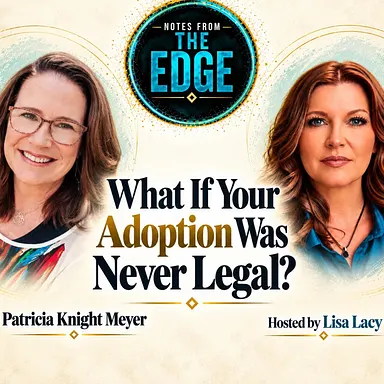
In this episode of Notes from the Edge, host Lisa Lacy talks with Patricia Knight Meyer about growing up after a black-market adoption in Texas, where she was given away as an infant without an agency, a judge, or legal paperwork. Patricia describes learning at 12 that she had no birth certificate, reuniting with her birth parents in midlife, and how adoption trauma and people-pleasing shaped her life.
They discuss preparing for reunions, setting boundaries, and the grief and shame birth families can carry. Patricia also explains writing her memoir Wonderland and why she argues that adoptee rights and family preservation deserve more honest attention.
In this episode Lisa Lacy, Patricia Knight Meyer
This episode about black-market adoption in Texas was made with the tool HappyScribe built to transcribe audio to text.
Ads in this audio differ from the text. Tap the sentence you're hearing to follow along.
Synced: the text now follows the audio.
Welcome to Notes from the Edge, where we have the conversations we should have been having all along. We talk about the things that we're not talking about. I'm your host, Lisa Lacey, writer, trauma educator, executive advisor, and author of the upcoming memoir Notes from a Certified Madwoman. Welcome to The Edge. Hey, hey, my friends. Welcome back to another episode of Notes from the Edge. I am your host, Lisa Lacey, and this is the place we have the conversations we should have been having all along. Guess what? You aren't talking about it. So today we're gonna, with our special guest Patricia, and today we're going to be talking about what happens When the story of who you are begins with secrecy, abandonment, and missing pieces, and what it takes to reclaim identity, belonging, and a life that finally feels like your own. And isn't that right up our alley in this space? We talk about that a lot in here. So let me tell you about Patricia Nightmare, who is a journalist, writer, and adoption reform advocate who whose story began in 1970 when she was handed over as an infant alongside a Texas hospital curb without an agency, a judge, legal adoption paperwork, and she would not obtain an official birth certificate until she was 47 years old.
So she grew up trying what she describes to be the perfect compliant child while navigating fear of rejection, codependency, and chameleon-like behaviors she later came to understand through the lens of adoption and attachment trauma. And at 39, she began searching for her birth family, reuniting with both her biological parents, and beginning what she describes as a journey out of the fog and towards a sense of her own identity. And she turned that experience not
only into her advocacy work and writing, but her new memoir, Wonderland: Memoir of a Black Market Adoption, Releases November 3rd, friends. That's right around the corner. It's probably in pre-sale now. The book has received recognition— check this out— in the 2026 Indie Reader Award in True Crime, finalist honors from the Eric Hoffer Awards, Next Generation Indie Book Awards, and Indies Today. Patricia, welcome to Notes from the Edge, my friend. How are you today?
I'm wonderful, Lisa, and thank you for that fantastic introduction and wonderful synopsis of Of the whole thing. Thank you so much.
Yeah, you're welcome. It's always a little bit easier if somebody else says it for you. So, so it's Notes from the Edge, my friend. So we're just gonna dive right into your journey and your story and what prompted the memoir. But you describe yourself, and we've talked a lot about, uh, being compliant as children. So, and somewhere underneath that was a fear of rejection. When did you realize that being good was a survival response for you? At what moment or moments, at what phase of your life were you at where you could look back with hindsight and go, whoa, that was attachment stuff, that was abandonment stuff,
right? Well, unfortunately, I didn't figure those things out until I actually did start studying attachment and abandonment issues and that sort of thing. It's something that adoptees struggle with. We're people pleasers, you know, and that's the way we live our lives, very unaware of what we're doing. The deep-seated fear of abandonment and rejection, it's something that we carry. It's part of the primal wound. But unless you actually open a book to study anything about adoption trauma, or you're fortunate enough to find a a group, a support association like Adoption Knowledge Affiliates, people who are there to— who have been down this journey and started and can teach you about these things, then you— many adoptees just go through the world not understanding that a lot of our behaviors are driven from that early attachment wound that came from separation from mother. But so for me, that was about the case. I entered reunion completely unprepared. I hadn't done any real research about how to go about a reunion, and I certainly hadn't ever taken time to consider how adoption had impacted the way that I moved through the world. But then when I did find myself in the middle of a rather difficult reunion with my birth mother, that's when I realized, oh boy, I need help.
And then I found the Adoption Knowledge Affiliates, and there were birth mothers there and other adoptees there who'd been through it, and they started giving me the resources to study and read and learn about these things. One of the big books was The Primal Wound, and another one is called The Journey to Self. And those 2 books really opened all of that up for me. And so it wasn't until I was in my late 40s— I'm sorry, early 40s— that I began to really understand that adoption had informed the way that I, the way that I was, the way I operated. Although I will say being a compliant child only served me right up until the time I hit my, my teen years, and then something happened, a specific thing happened that we can talk about that really swung me on the complete other end of this, of the pendulum, where I felt like if I couldn't be like or of anyone, I could be as separate and as different from everyone. And that was also a Attachment response, right? The being avoidant was sort of the way I swung.
So you swung into both. So what, what was the incident or event that, that happened, as much as you care to disclose, that made you go, okay, I'm not getting my needs met this way, you know what, I'm going to be as defiant as I can? So what happened, what happened to make you swing the other way?
Well, at 12, I mean, I always grew up believing that I was adopted. Lucky for me, no one kept that a secret from me. But at 12, I got a part in a professional play and I needed a Social Security card. And my adoptive parents had to sit me down and tell me that in order to get a Social Security card, I needed to have a birth certificate. And that they had never received a birth certificate because the attorney that they had used to go around the agencies and things that had them on very long waiting lists, that attorney ended up extorting them out of tens of thousands of dollars with the threat of taking back the baby. And so that's when I learned that my parents didn't know my true birthday and had never received this very important paperwork. And I was more upset by the fact that this had been a secret kept from me, and also the fact that it made me wonder, like, if they didn't get a birth certificate, then was I a stolen child? But this, this information really broke my trust in, in the family unit, and it also was a little bit of a— well, it was more than a little— very identity shattering.
Like, I already felt like One of the only few things I knew to be true in my life is that my birth mother probably thought of me on my birthday. And then suddenly I found out that we don't even really know what day that is. So it was— that's when I started pulling away and feeling like things were very much out of my control. And so I would just— I sort of gave all control away and just, as many teenagers do, I tested boundaries. But I think that part of— I've talked to some adoptive parents, and some adoptive parents are so fearful that their child will reject them that they have difficulty setting boundaries for those children. Because what happens if this child that I know that I'm like, you know, I'm not the biological mother, it's very hard sometimes. What if they completely reject me? And I wanted someone to show up and parent me. And so I was pushing boundaries, wanting to feel that security of that parent that was going to swoop in and say, oh no, no, this is not okay. But my mother, my adopted mother and I did this dance where we were both trying to prove ourselves worthy of being the other person's replacement and testing boundaries in that way.
And my mother was a very violent woman. She struggled with alcoholism. My father was at his heaviest £650 in his lifetime. He was about 300 when I got adopted. And I believe probably were already like pre-existing conditions for them may have been exacerbated by the stress of raising a child that truly, if their secret had been exposed, anyone could have come back and taken me from them. They didn't have any proof that I even belonged in their care. But being raised by people struggling with these addictions certainly impacted my sense of security and safety as well. Uh, so there's a lot wrapped up in there. There's a lot wrapped up in there.
There is. So, uh, what, what is it like in, in nearly midlife to all of a sudden have everything turned upside down? Um, in terms of a, a reunion, like, uh, meeting your Um, birth mother, which I imagine would all of a sudden give you an identity, not give you an identity. There's got to be so many mixed emotions there, right?
Yes. You, you don't realize how fragile one's sense of identity is until you see all these alternate realities, all these alternate universes that you almost grew up in. You know, I could have been a completely different person if this woman had raised me, right? And it happened quickly. I mean, I, I had been piecing together aspects of the clues to the story for decades, but from the time that my adoptive mother passed to the time that I found my birth mother— and my adoptive mother's passing was sort of the, the, you know, the spark that lit the fuse toward doing this— it happened very quickly. I always imagined that when I really, really put my heart into searching, that it was going to take me a decade, you know, and it actually only took a few months. And ironically, it was because I didn't have any— I found out when I was 18 I had also never been legally adopted, so there were no adoption records that were locked away. So the records of my birth actually did exist out in the world where, where I could find them. But getting back to your question about the identity aspect, I was very unprepared when I met my birth mother because it happened so fast.
And I, I had built this idea of who I thought she was going to be based on the stories that I was told as a child. And so she was very far from those stories that I was told. I was told that she had come from a very wealthy family and she had given up her child so that she could continue her college education and was forced to do so by her parents. You know, basically choose be on the street with your child or, you know, give the child away and continue your college education. So I grew up believing that she really valued education, and that was a big part of why I went to college. And so I had always imagined us meeting and her— I didn't want her to be disappointed with who I had become because I felt like, well, she gave me up because she really wanted me to have all the opportunities in life. And so if I squander these opportunities, then it's going to be a very difficult, sad thing for her if I ever meet her one day. And ultimately, when I met her, none of that was true.
And again, it doesn't matter whether she had an education or not, but it was still very destabilizing to my mindset on— because I had to sort of re-understand my, my origin story that I had built in my head and why I had been given away. And, and it was a re— it was having to start from the ground up on, on all of that again.
Wow.
But I will say finding her and then through her ultimately my birth father, I, I, it created a sense of self that I had never had. Decades of therapy could not give me the sense of self and grounding that learning my true origin story, you know, gave me. And seeing myself in both my mother and my father in different ways, I saw a lot of the things that I didn't like about myself in my birth mother, unfortunately. And I think, you know, a lot of people, we take after one parent or another whether we're adopted or not, right? It's just a genetic thing. You just tend to take after one parent more than the other. And I think that I did take more after my birth father. So when I met this birth mother of mine, and we both had a lot of trauma that we hadn't processed, and so that was part of the challenge as well. But the first thing I recognized were like the character, the aspects of her character that I kind of didn't like about myself, I could see in her. So I was like, oh, that's where I get that from.
Oh, now I understand why people say that's so annoying that I do that. And it was, it was a fascinating thing to learn. But it was also some of the struggles in our communication were that we were in a weird way, like so much alike in those negative ways that we sort of really butted heads against each other in that. But when I met my birth father, Also, I had had a year and a half of experience being in reunion with her, and he didn't have all that trauma because he never knew that I even existed. So our reunion was better paced, more informed, and carried a lot less trauma. And, and also, I think we were just really much more genetically aligned. So I had a, a very wonderful relationship with him, and that also healed me in, in a way, in ways that No amount of therapy ever could. Very, very grounding feeling.
Oh, I'm so fortunate that you had that piece of that experience. I have a— this episode is sponsored by Vinted. You know, we talk a lot on this show about the things we hold on to long after they've stopped serving us, and apparently that applies to clothes too. I went through my closet recently and found things I haven't worn in forever, and I'm still thinking, well, maybe someday. Someday when— who is this version of me I'm saving an entire wardrobe for? That's where Vinted comes in. Vinted is a secondhand marketplace app where you can sell clothes you no longer wear and make some extra money. And Vinted makes it simple. Listing is quick and easy, and when something sells, Vinted creates the prepaid shipping label for you. Even better, Vinted has zero seller fees, so you keep everything you earn. Suddenly, letting go feels a lot more rewarding. So maybe that green shirt that's not even your color you keep moving around your closet is ready for someone else. Give your clothes a second life with Vinted. Download the Vinted app for free and start listing. With no seller fees, you keep every dollar you earn.
Um, my BFF has a wonderful adoption story about connecting with her many, many siblings because her father was a very busy human being. We'll just leave it at that. Um, so before we get into the book and how the idea came about for writing the memoir and how you decided to structure it, um, it sounds like because by the time you met your biological father, you had some therapy under your belt, you had some trauma work under your belt, you had a support structure under your belt. So what's some advice would you— that you would give to adoptees that are starting the journey of finding their birth parents for the first time? What would you tell them to prepare for or how best to prepare?
Right, you know, telling an adoptee how to prepare for a reunion is like telling a first-time mother how to prepare for parenthood or childbirth, right? Like, you can try to explain it all you want, but until they've actually gone through labor or, you know, dealt with that, you know, a screaming 6-month-old in the middle of the night, there's just no knowing it, right, until you've been through it. But it is good to go in with a game plan, right? There's a— it's good to do your homework first, which is, you know, why they attend Lamaze classes. and such. So I would say definitely think very hard about what it is that you want. Recognize that all relationships take 2 people and that what you want may not be what your birth parent, or if you're a birth parent, you're searching for your child, your child will want. Oftentimes people go in thinking that reunion is going to answer more, answer all their questions that they have, right? There's lots of questions that we carry And sometimes it will answer those questions, but at the same time, it will open and lead to more questions that you had no idea to even ask about yourself.
And some of those questions will never have answers. And so it's not necessarily going to wrap everything up in a beautiful bow. It will also— it's also very difficult when it comes to— it's not just a reunion about you and this other person. It's going to impact your children. It's going to impact your relationship with the husband. It's going to impact your relationship with your adoptive family members, or, you know, it— and the same for like the people on the birth parent side. They have children, they have spouses, there are other people in their family. And just like a birth or a death, when someone, someone new comes or leaves a family, it changes the dynamics among everyone. And so you have to be very aware of how this impacts those around you. And to go very— my advice is always to go very slow. The tendency is to rush in. The tendency is, I want to get in the same room with this person and probably not leave for like a week. Not a good idea, right? A lot of the adoptees that I know have had— that have been very successful started with just emails or letters, progressed to phone calls for quite a while.
then maybe Zoom calls, and then finally got in the same room and met in person. And even when people do meet for the weekend or for a couple of days, I always say, before you ever get together, have the shared understanding that if at any moment you feel overwhelmed or you feel like you've taken in as much information as you can for right now, please let me know. And you can go back to your hotel room or you can go, you know, we can, we can part ways for the day. We can take time to process what we've just experienced, and then we can meet again tomorrow. And it's, it's sort of the dance, or like they say, you know, if a group of runners run together, you know, you, you're always going to run to the pace of the slowest runner, right? So you always have to be aware of which person in the— or even extra, you know, family member on the edges is— how are they coming along? And if those people are not able to come along with you, you need to slow things down and wait for people to catch up with you.
You cannot be the person at the front trying to set the pace. It will strain all the relationships in reunion. So, but there are a lot of books out there and a lot of organizations and online Zoom and support groups, and they're all on my website at myadoptedlife.com where people can go and learn how to be prepared for any kind of reunion that they're thinking about entering into. And there's definitely now with National Association of Adoptees and Parents, which I'm on the board of. We have online support group meetings that help people through reunion, and we also have support groups just strictly for adoptees who are searching but haven't entered reunion yet. And if there's an organization called Concerned United Birth Parents, that's for birth parents who are seeking their children or are in reunion with their children. to give them support. And there's also Adoption Knowledge Affiliates, and they also have Zoom and online support groups that help people, you know, who are there for you to help you understand. One of the things is early in reunion, people are like, did I call too much or do I call not enough, you know?
Or how do I set healthy boundaries? How do I— because with me, I was so fearful of telling my birth mother, of losing, of setting a boundary and losing her. because I'm saying, well, this is more contact than I'm comfortable with. I don't want to talk to you on the phone every day. And it was a weird feeling because I was like, I spent my whole life searching for this person, and now I'm like trying to create space. And I was so fearful that, that, that would implode our reunion, and then she would just disappear into the ether again. And the other person on the other side feels the same way. And when you've got 2 people like that tiptoeing around each other, it leads to a lot of inauthenticity. And the minute you become inauthentic, you're, you're just, you know, it's, you're, you're facing trouble. Like, it's going to be a rocky road if you can't be yourself and just accept that, you know, we can sort through this, but we really have to be honest with each other about how we're feeling, even if it's scary.
I love that. I love that. Setting the boundaries from the get-go, having the hard discussions up front. Um, and, and being willing to say, I've had enough and, uh, I, I need a break, which can be difficult in any circumstance, let alone this circumstance.
And there's another aspect of it is that in, as you're coming, what we call coming out of the fog, you can go through a lot of the, the phases of grief that we talk about. You know, there's bargaining and there's denial. There's also anger, right? There's, there's There's anger about what happened. And you can get like— my birth father was very angry when he found out that I was— that I existed because he'd never been told. And so he's like, I'm 70 years old and 40 years of life with you was stolen from me. So he had a lot of anger about that. He didn't push that off on me, but he definitely went through the stages of first being angry about it and then being very sad about it, having to mourn it. having to learn to forgive for it. And adoptees too can, can experience these feelings of sadness or anger about what happened. And birth mothers suffered so much shame and so much secrecy from the era, typically those eras, that it's sometimes very hard for them to get through it without dealing— without having all that shame and secrecy coming back up.
Sometimes they have to go to family members that are— like, my maternal grandmother was still alive, and my birth mother basically had to tell her aspects of the story that she'd never shared with her, that, you know, she didn't want to share with her. And she hadn't told any of her family members about me, and she had to go through all of that shame again that no one was putting on her but herself at this point, but she still had to deal with that and come clean and tell the family what happened. And that can be very, that can be very, very hard, and it can lead to difficulties in the reunion, especially when oftentimes adoptees will want the parent to sort of make up for, for being gone or to heal whatever is broken, still broken or hurting inside them. And sometimes the parents want that adoptee to do the same, and really we can only heal ourselves. And so I had to go off and do my work on my adoption trauma, my wounds, and I could not carry hers. And I needed her to go out and do the work herself and read the books and go to the Zoom classes.
And unfortunately, at that time, she was unable to do that. And so a lot of that is just the product of that generation. They put those women through so much. It's, it's just almost impossible for, for some to realize that, you know, to forgive themselves. Yeah.
Yeah. Yeah. That's a, that's a, well, and you had said you had highlighted it in the beginning that you were both bringing in your own traumas, um, that hadn't necessarily been even looked at yet. So yeah, that makes for, um, some, challenges to navigate in, in any new relationship. And that's what it is. It's a new relationship. So, well, let's talk about the book that is launching, your memoir that is launching November 3rd. It has already had so much success. Big congratulations on that. There it is. Thank you. So tell me, what was— how did the idea for the book come to you?
Oh, okay. Well, you know, my degree is in journalism, and as a little girl, I'd always— I was always loving to write and tell stories and things. And, and one of the first stories I wrote when I was 10 was about these 2 kids whose parents left the house one day. They lived out in the woods. The parents didn't come home because they died, and the kids had a— some random uncle shows up and tells them they have all this inheritance and he's going to take them to the big city and They're going to inherit their family's inheritance. And then the kids realize that the uncle is going to try to kill them so that he can get the inheritance because he's next in line if they don't receive this inheritance. And I look back on this story, and of course, and then the kids like take him out and go to the city and get their inheritance. They
live happily ever after.
A dark story for a small child, right? But when you think about what I was writing about, right, I was talking about family and inheritance and missing parents. And, you know, that shows you that I've been grappling with this sort— these sorts of themes and stories ever since I was very little. And I knew that one day if I ever had— I always said I will write— I never was interested in fiction, but I will write a book when I truly have a story to tell. And I guess I didn't feel like I had a story to tell unless I had the, the happy— well, not necessarily the happy ending, but an ending, right? I mean, like, I just wanted to know that I had an ending to this story. And the book started after I found— the blog started after I found my birth mother. And so I was blogging a lot, and that— and I was thinking, one day maybe these stories will make it into a book. And there were some other stories that I wrote in college that I saved or actually made it into this book that I wrote, like, in a college English class.
Like, polished, of course, but also included. But when I met my birth father and we— I had rented— he had a family. He had a family— didn't rent it. He had a family that gave me a cabin to stay in up the road from him for 2 weeks because I said I'd really love to start actually start writing this book. And so they gave me this, this cabin, and I would sit in it during the day and I would write. And then he would come at the end of the day and we'd grill or, you know, cook some dinner, have some wine or beer or whatever on the patio. And I would share my pages with him, and then he would take them home and his wife would read them, and then we'd come back and we'd talk about it. And then it sort of became a— it would change because from, from those pages or that story that I was sharing with him, other stories would come out. And then I'd realized I need to be capturing all of these stories. So the more I wrote, the more I shared with him, the more questions he asked, which led to more stories.
And I just— it just began a thing for 2 weeks where I was writing, he was reading, we were discussing the pages, and that would lead to the next thing that I realized I wanted to write about. And that's how we did it for 2 weeks, which wasn't all the stories in the book, but it was a really good starting point. primarily those were the stories around my childhood, which I guess take up like the first third of the book or so. And then of course he also wanted to know like how the reunion with my birth mother shook out. And so that was— those were other parts of it, but that began to give me the framework for the story that I would ultimately wanted to tell. And then within a few months after well, about a year, I guess, after I left that little writing cabin, all kinds of bad things happened. One of the things I write about and talk about in reunion is that, you know, it can strain relationships. And I lost my husband in that process. I was so involved in focusing on my birth father in reunion that my husband felt very abandoned and chose to have an affair.
I don't take responsibility for that decision in what he did, but I do see the role that I played in, in the— what, what sort of led to his feelings of being emotionally abandoned for a good while. He didn't deal with those feelings right, but it did lead to like a 1-year affair that he lied about. And, you know, adoptees, we don't take secrets or lies very well, and it triggers our abandonment issues significantly. And so the marriage was just over at that point. And so my marriage ended. It really, really tore me apart. And I, from that, I basically lost my job. And so at that point, my birth father said, well, I'm going to build this cabin, a different cabin. I'm going to build a cabin for you on my property. where you can come and write. So, you know, you can sort your life out however you want, but I just want you to know this place is here for you. And within months, he had taken an older building that he had on his property and turned it into a home for me to come and write in. And so after everything had sort of devolved, I said, sure, why not?
You know, I will— I'll come out there and I will put everything I have into this book. What else? You know, what do I have to lose? And I had— I had a a work from home, part-time work from home job on the side that was going to help, you know, here and there. But I was there for less than a month, and I let a friend of mine park her car in my— in his garage that was attached to the building, and it caught itself on fire, and the entire house burned down, and everything I owned burned down with it. Luckily, the book was in the cloud. And so that actually The scene from that actually is, is the prologue of this book. And I'd like to say in it that everything from my adopted life burned to ash on my birth father's property. And I— that, you know, everybody says you kind of have a— you find your bottom. And I certainly was not my bottom bottom, but I really felt like I had been completely at that point, my adoptive mother had died, my daughter was off in her own world in college, and I'd lost everything I owned.
And so I was truly starting over again with a new identity and everything. And, and that was part of getting the birth certificate, that my birth father went to court and got my birth certificate sorted out, because what few documents I did have burned in that house fire. And so without knowing him and having my DNA test with my birth mother, I could have never gotten my name put on a legal birth record. So the book came from— it took a very long time to write because I had these— this very difficult period shortly after I started writing it. And so then I put the book aside, moved to New Orleans, sort of began to rebuild my life, and that would have been like in 2017-ish. And by 2020, I turned 50. I sent myself on a birthday trip to a writing retreat in Costa Rica. The woman that was running the writing retreat was an adoptive mom and a developmental editor from Canada. And I just felt like the universe was saying, okay, let's go. Let's— now's the time to really take all these, you know, the stacks of random stories that you have, this, you know, very disorganized chunk of messy stories and create an actual book out of them.
And when we got back from— when we were leaving last day from our beautiful week and a half in Costa Rica, and everyone said, there's something about— something's going on, there's some kind of— somebody's— people are sick, you know, the flights might get canceled, we might not be able to leave the country. And I'm thinking, what in the world? Like, I didn't know. We were in heaven while the world was falling apart. And so when we came back, obviously it was COVID, and, and then she basically proceeded to give me a mini MFA for those— for the next 2 years. We went back and forth working on the manuscript, and she taught me everything you need to know in order to actually turn just a chunk of little stories into an actual book with a through line. And so I credit my relationship with her to really bringing, bringing the book to life. Yeah.
I love that. I love that. What does it— what did it mean for you, or what does it mean for you to reclaim your own identity that's not attached to anyone else?
I, uh, I've had a lot of names in my life. My, my parents nicknamed me Pam, Patricia Ann Meyer. The initials spell Pam, so most of the people that know me when I was little called me Pam. When I got to college, I got tired of trying to explain to professors why they should call me Pam, so I went with Patricia. Then I got married and I became Patricia Knight— I became Patricia Ann McDonald. for a while because I was always Patricia Ann Meyer. But then when I found my birth father, I took on his last name as my middle name, and I became Patricia Knight Meyer. And that is the name that I feel is truly the name that I embrace and carry forward. There was a record of my birth until I was 47 years old that just said baby girl on it. and no birth father listed. And my birth— that's on the Texas birth index record. And when my birth father went to court, through his testimony, they were able to put my name and his on that record. And that's how they gave me a true and legal birth certificate.
And I got to tell you, it's a double-edged sword because when I did that, as much as I loved my adoptive parents, it meant that it felt like a divorce from them, even though the paperwork with them was fraudulent, and I don't even know where it came from. I mean, I say I believe it was fraudulent, couldn't find records of it. You know, I had printed versions, but the state couldn't find the records. It felt like nowhere in history are they going to be recorded, you know, and they, they're the ones that raised me. So having my name on the Knight family tree is a beautiful thing. But it omits these other people that basically made me who I am today. So there's a little bit of sadness when it comes to really trying to figure out what family tree you belong on, or, you know, how history will remember or record my lifetime. But knowing the facts and having that true and legal document, knowing that I can go down to the court and go down to the, you know, call the Bureau of Vital Statistics and get my birth certificate and that it is real and legal and not having to worry that it's going to get destroyed in a fire.
That's a sense of self, that's a sense of security. For many years I felt very poofed into the world. I didn't know what was true about me, what to believe. I was fearful that I had been a stolen child, so finding the answers to all of this has certainly given me a sense of a strong sense of self. It's made me feel very grounded, and it's given me a sense of agency and certainly drives the advocacy that I do today because I realize that I'm not the only adoptee out there who has dealt with these sorts of issues. Actually, the attorney that handled my, my birth certificate, my, my, my illegal black market adoption It turns out a cousin found me and he had handled hers as well, and she too didn't have a birth certificate. And so if it's the two of us, then I'm sure we're not the only ones. There were 11,000 Black market babies the year I was born in 1970 alone, so I know that this is an issue that other people are dealing with. I found out about the cousin because she found me through Ancestry. She was looking for her birth mother who ended up being my birth mother's sister.
And that's— they had both used the same attorney, and that— and we both had the same outcomes. So part of writing this book is hoping that I can find, uh, or not my hope, I mean, I hope I don't find any, but, but worried that there may be other adoptees from Texas who are struggling with the same sorts of issues, because it— I know for a fact it happened twice already. So I'm hoping to find more. Yeah.
Yeah. Yeah. Well, and where can people find you again? I know you said it earlier, but remind us again, where can people find you?
So my website is called myadoptedlife.com. And so that's, that's the main website. People who are looking for the memoir can find it on that website, or they can go to wonderlandthememoir.com. And find the book there, and it is on pre-sale, so you can go on Amazon and order it on pre-sale as well. And also, if you don't mind, I'd also like to let you know that the launch for this book is happening on November the 6th, and it's going to be live streamed from the Bob Bullock Texas State History Museum for free, so anybody can come and watch it, And it will include a live staged performance from chapter 18, which is called Roses and Thorns. It's when my parents tell me that they don't know my birthday and never received my birth certificate. So that's going to come to life on stage. And then after that, we're going to have a panel discussion about the state of adoptee rights in Texas. And that's, that's going to be featuring 4 different women from some different adoption advocacy groups. interviewed by Emily Ramshaw, who is the CEO of The 19th. And all of that is going to be live for anybody to tune into.
All you have to do is, is go to the Eventbrite and, you know, sign up for a ticket and it's free. And the link to that is at the top of wonderlandthememoir.com as well.
I love that. What an amazing way to celebrate. And guys, you don't have to write any of that down. We'll make sure you have a clickable link in show notes. Um, so don't worry about writing that down. Now, Patricia, before I let you go, we always ask our guests a couple more questions before we wrap up. Are you ready for the first one?
Sure. Shoot.
Okay. In your own life, what do you feel like you performed the most in order to just get by or survive? And what did setting down that role, mask, or performance do for your life?
That's a fantastic, fantastic question. So like many adoptees, I performed the role of the people pleaser. It was the way that I chose to feel safe. As long as I was keeping everyone happy around me and going along with the crowd, then I knew that I was much more— I was safe from being rejected Or being abandoned. And so I've always been the people pleaser, and it's still— I'm still very much a people pleaser. I did learn that when you focus on people pleasing, it's also a form of self-abandonment. And every time that I make a choice to put my own needs or desires aside that it's not necessarily a selfish thing. I grew up believing that to not be a people pleaser meant that I was going to be a selfish, self-centered person. And that's why I could never find that happy balance of respecting what I needed and not abandoning myself, you know, in the process and just always saying yes to everything and everyone. So I did learn to find the difference. in that. And when I was able to stop performing and just show up authentically in the world, my life became a much easier life to live and a happier place.
And I, and it also verified for me that the relationships that I have are based on, you know, true connection and not just, you know, that I have been, um, performing like it, you know, responding like a chameleon, trying to blend in. exhibiting that chameleon behavior is really just driven by the fear of being rejected. And when you, when you show up authentically and people accept you, it's a very liberating feeling. A weight lifts off of you. Yeah.
Liberating freedom. Yeah. All right. Last question, my friend. What do you want us human beings to have more conversations about that we are not talking about?
I would love for human beings to talk a lot more about family and about the importance of finding ways that we can think of adoption not as the first option but as the last option. There are so many ways that we can support mothers that find themselves in difficult situations. I'm very much a fan of kinship adoption. I'm also a fan of not even adoption, just legal custody that retains the adoptee's identity and all of their information about who they are is not locked away from them. Adoptee rights are huge. Adoptees' rights are human rights, and right now adoptees are one of the— we are one of the few people in the United States that are not allowed— I mean, we're the only people in the United States that are not allowed access to their original birth records. So I'd like people to talk a lot more about the fact that adoption is not a win-win situation and that adoption is trauma. And we need to find a way to help the mothers who want to keep their children. The majority do. And they relinquish because they fear— well, they don't see another way. And I think that as a society, we can find other ways if we really put our heart into it.
Yeah,
I love that. I love that. Well, my friends out there, uh, be sure to grab Patricia's book. I can't wait to get my hands on it. It is currently in pre-sale. We will have the clickable link to her website where you can find it. And as we close out, I'm gonna ask you guys the same question I asked her. What might you be performing in your own life in order to survive? And what do you think setting that role, mask, or performance down might do to lighten your load just a little bit? I'm your host, Lisa Lacey, here with our special guest Patricia. And when you find the answer to that, we will both see you at the edge. Thank you, Patricia.
Thank you, Lisa. It was a fantastic conversation. Thank you.
It really was. Thank you.
What if your adoption was never legal? Patricia Knight Meyer was handed over as an infant along a Texas hospital curb without an agency, a judge, or legal adoption paperwork. At 12, she discovered she had no birth certificate. At 47, she finally received one that reflected her true identity.In this deeply personal conversation, Patricia joins Lisa Lacy to explore black-market adoption, adoption trauma, abandonment, people-pleasing, and the complicated emotions of reuniting with biological parents. She also shares the story behind her award-winning memoir, Wonderland: Memoir of a Black-Market Adoption, and why adoptee rights, identity, and family preservation deserve more honest conversations.In This Episode:02:43 – How adoption trauma, abandonment fears, and people-pleasing shaped Patricia’s childhood.06:04 – Discovering her missing birth certificate and questioning whether she had been stolen.09:19 – Reuniting with her biological parents and confronting the identity she thought she knew.15:05 – Preparing for adoption reunions, managing expectations, and establishing healthy boundaries.24:25 – Writing Wonderland, surviving devastating losses, and reclaiming her personal history.Connect with Patricia Knight Meyerhttps://www.myadoptedlife.comConnect with Lisa | INSIDE THE EDGEhttps://www.lisalacy.com/inside-the-edgeGo beyond the public podcast with exclusive weekly episodes, private monthly live conversations, and practical resources exploring identity, trauma, recovery, and personal growth.What did you perform in order to survive?Welcome to the Edge.See Privacy Policy at https://art19.com/privacy and California Privacy Notice at https://art19.com/privacy#do-not-sell-my-info.