
Every line of this episode of Notes from the Edge was transcribed with HappyScribe technology. See also: AI notetaker.
Ads in this audio differ from the text. Tap the sentence you're hearing to follow along.
Synced: the text now follows the audio.
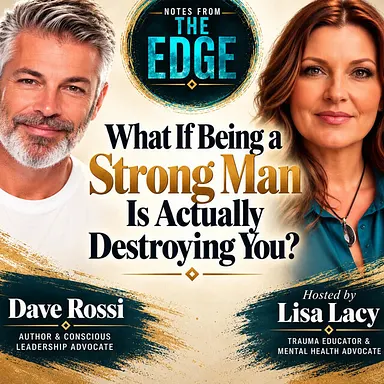
Welcome to Notes from the Edge, where we have the conversations we should have been having all along. We talk about the things that we're not talking about. I'm your host, Lisa Lacey, writer, trauma educator, executive advisor, and author of the upcoming memoir Notes from a Certified Madwoman. Welcome to The Edge. Hey, hey, my friends! Welcome back to another episode of Notes from the Edge. I am your host, Lisa Lacey, and this is the place we talk about the things we should have been talking about all along. Guess what? You ain't talking about it. So today we're gonna— with special guest Dave Rossi, and today we're talking about What happens when everything you were taught about being a strong man might be the very thing destroying you? Before we get into it, let me tell you a little bit about Dave. Dave is an entrepreneur, author, leadership thinker, and founder and CEO of CQ Construction, a Silicon Valley-based construction company specializing in complex high-end residential projects.
After decades of building businesses and leading demanding projects, he began questioning the traditional high-performance model of success he had spent his whole life embodying and building. His own experience with anxiety, burnout, and serious health crisis— we talk about that a lot in here, guys, if you don't get it together, it's right around the corner— led him into studying neuroscience, mindfulness, behavioral psychology, and emotional self-mastery. He is the author of The Imperative Habit and Alphas Die Early: Redefining Strength, Success, and the Modern Man, in which he challenges traditional ideas of masculinity and introduces what he calls the Omega Man, a model of strength built around awareness, discipline, emotional intelligence, compassion, and purpose rather than domination and ego. His work focuses on conscious leadership, men's mental health, burnout prevention, and creating success That does not require the self-destruction or self-hatred. Dave, welcome to Notes from the Edge, my friend. How are you today?
Lisa, I'm great, and thank you so much for having me. I, I hope I can live up to that amazing and well-put, uh, introduction.
We had a podcast before the podcast, friends. You missed it. I warned him it's so much easier when somebody else says it. And the podcast is done. We're not— yes, yes, we're done. So Dave, it's Notes from the Edge, so we are just gonna dive right into the juicy stuff. So I want to go to that place where for you, you realized, oh shit, like, this is burning me out. I thought this was success. I have it all. And I'm still not happy.
Wow, you want to stick the knife right in the wound? I mean, you know, so I had this huge life. 8,000-square-foot house and 6 acres, 3 vacation homes in different places, Oregon, Michigan, and California, outside of my primary residence, 2 buildings, big business, $40-$45 million a year sales. I had lost my health. I had a very bad relationship with my wife, who was also my partner. We started this business. I was having back surgery from an old injury for football. And I wasn't speaking to my parents, which, which the wedge my wife at the time had driven. 3 kids, uh, 2 dogs, you know, 2 bunny rabbits, the whole thing. And I remember sitting, getting ready to have surgery and thinking, how does somebody with all this talent who worked so hard— I had all the, all the, all the resources and support from my family, education and new tutors and Sports, and and I took risks, and I was dedicated. How does someone with so much try to hit the square, hit the bullseye so squarely on success? Hit the opposite. I consider myself a failure. I was so unhappy. I was having this back surgery.
My health had gone. The business was a burden, not a joy. The houses were not things that brought me any kind of enjoyment. They were their accolades that made me look important, but they didn't intrinsically fulfill me. And I literally remember. walking to the top of this mountain behind my house saying, how did I try so hard to be successful and hit so much the opposite? And that was kind of the moment when I realized I kind of had to hit reset.
Yeah, I love the word reset. What— how old were you when the reset happened?
46. 46.
Yeah.
And I started, you know, I first started, I had to rehabilitate myself from my surgery. Our business was failing. a very toxic partnership. And I realized that I had to get back to work so this company didn't fail. The recession hit. We had offices in LA and Northern California. And how do we manage a construction company through this recession? And how do I go out for 6 weeks with back surgery to come back? So I started— wanted to try to get in shape somehow so my downtime was less. I started RESET in that same period and I realized as I began to read books to research how to, you know, find therapy for my back, I realized maybe I could find books for therapy for my mind. I started reading these books and I was like, how did I miss? How did I miss? I was so ripe for RESET that I honestly, if you said, hey, wash your hair with ketchup, I would have to make a better life, right? So, I read this book, you know, it was like, wow, you know, you're forward gapping. I'm like, I'm forward gapping? You're right, I'm forward gapping.
I'll be happy when I have this, I'll be happy when I have that. I'm like, I have 4 houses and 2 buildings, how am I not happy? Because that doesn't work. It's not a sustainable practice. So amongst this planned surgery, which I canceled, by the way, um, I, I literally found things to help me, and I was so shocked that I had not learned it sooner.
Ah, you canceled the surgery.
I did, yes. I never had it. Yeah.
Wow. Wow. And you said a very important word, and that word is sustainable. I mean, we think we can be— for me, it was being, it was being Wonder Woman. It was doing it all, running 2 businesses, raising the family of 5, financial provider. Like, you can only go for so long.
Yeah. So 5 kids. Wow. I mean, what an important accomplishment. there. I had 3 children, and what an amazing thing that brings your life. Sustainability is really important. I mean, it really is a marathon, not a race, and I'm sure you're running sprints at marathon distances, and that really creates a lot of burnout. Yes. And, and, um, the things that make you successful— discipline, hard work, grit, determination— Those things become your downfall because those are the things that keep you running at sprinting speed at marathon distances. I was £50 overweight. I was on high blood pressure medication. I was trigger, trigger hair or hair trigger temper, numbing myself with TV at night with half a pint of ice cream, you know, neglecting balance. for sabotage. I deserve to rest because I'm tired. All those sabotaging thoughts basically were counter to all of those things that made me successful, the discipline, the grit, and all those things. And so it isn't sustainable. And if you're successful, like it sounds like you were, you think you can keep being successful by just taking a different avenue towards that success. Let me try something new. I'll just pivot and do this new.
I'll get one better manager to manage projects, or I'll get one better accountant. To help. I'll get a better babysitter that takes on more with my kids. And there's always this forward gapping. If I get this, then it will be easier. And it is a complete and total trap and lie. And I wish more people would realize that.
Yeah. For me, it was mountaintop to mountaintop, right? I'll set this goal and then this goal and then this goal. There was never any downtime. There was never any, and I want to circle back to something you said. Um, there was never any time to celebrate. Yeah, time to celebrate getting there, right? But you said the word rest.
Yeah.
And for some of us high-functioning survivors or high achievers, rest takes practice. Yeah. And rest without guilt takes a lot more practice. So talk to me about how important rest is In, uh, on your— how important was rest on your journey?
Well, I think I'll, I'll answer that a different way, and I've used this quote a lot. Um, those who love to walk will walk longer and farther than those who walk to a destination. If you love to walk, you really don't need to rest. You will find balance through the enjoyment of your activity. If you're walking to a destination, then the entire walk is a burden and you're going to need rest. And you create frustration and disappointment when the length of the walk is longer than what you expected it would take to get to the lake. So you're like, I'm not there yet. Are we there? I'm not there yet. And so there's this— Why did I expect it to be so short and it's taking so long? You know, when you think, oh, I'll make a million bucks by the time I'm 30. Why am I 35 and I hadn't made it? Those expectations become the frustration and the burnout that you need rest. And so I don't, I don't consider myself needing rest now because my work life and my, my personal life are so intertwined as the same thing. And I love the walk.
So my walk is balanced and my walk is really enjoyable. And what I'm saying and how to get here are 2 different things. So for those listening, you're like, oh, that's BS. How do you do that? Look, I'm a walking testament that you can do it. And I know there's nothing special about me. Trust me, there's no— I don't have like this— I was on academic probation 5 years of college, right? So, so there's nothing special about me that says, you know, this is unique. Everyone can do this. It just takes a lot of practice and a lot of understanding and a lot of, you know, courage to jump into places that are— that make you afraid.
Talk to me about that fear. Talking about that fear of getting out of your comfort zone and taking risks and doing something different. We are so good at staying in the familiar, even though it can be so freaking miserable.
Well, you know, I gave a speech yesterday. Um, our bodies are wired for survival, and we've been trained through our experiences and our beliefs and our skills and our training what survival looks like to us. And every single person in this room I gave a speech to has a different map in their heads on how to survive as an animal.
A big thank you to today's sponsor, Vented. I talk a lot about identity on this show and the versions of ourselves we keep around because we think we're supposed to be that person. And I realized my closet may be doing exactly the same thing. There are clothes for the person I used to be, clothes for the person I thought I'd become, and clothes I'm convinced I'll wear again Despite years of evidence suggesting otherwise. At some point you have to ask, why am I still holding on to this? And that's why I like Vinted. Vinted is a secondhand marketplace app that makes it easy to sell clothes you no longer wear and make extra money. Listing on Vinted is quick and simple. Once something sells, Vinted creates the prepaid shipping label for you, and Vinted has no seller fees, so you keep everything you earn. So maybe look at your closet and ask yourself the very Notes from the Edge question. Am I actually going to wear this, or am I just performing? Give your clothes a second life with Vinted. Download the Vinted app for free and start selling with no seller fees.
And so anything outside of that map becomes difficult or stressful or challenging. And the map that we have is typically programmed or developed by our families and our parents at a very young age. And so our ideas of what survival looks like are from a different environment, from a different generation, from a different set of people than the environment that we're in. And, you know, forget, um, how you got to where you are. Where you are, 100% of the times, is going to require something different than how you were programmed as a child. And so breaking out of that programming feels like you're dying because it's the script you think leads you to survival. And then someone like me comes on and says, yeah, you need to do something different. Sorry, right? It's like, I don't want to. This is hard. This is scary. And, and, and you get this feeling in your gut, uh, that you're literally— to your body, it feels like death. Um, the, the hormones in your brain, the neurotransmitters, do not know the difference between a saber-toothed tiger chasing you to eat you And a deal that didn't go right.
It's the same chemicals that says you might die. Our brain has just been wired to, to say what is danger and what isn't danger, and the chemicals are the same. And so to break out of your mold is hard. And, and I, I tell this to my, my, my new wife, um, who I've been with for 8 years and married for, for 1. The, the, the feeling of fear is the invitation. to do something. It's like a giant flare that shoots in the air. Do something now. Look at that giant flare. It's like really bright. That means do something. You have to do something. That's really, really important when that flare— I'm not saying like just go to be reckless. I'm saying that's invitation. What do I do? What, what, what direction do I go? What, what lesson do I implement? And I'm not gonna let fear stop me. I'm not gonna let the fear hold me back from doing what I need to do when I need to do it and why I need to do it for the right reasons.
Yeah, and sometimes we have to just do it scared until we get to the other side and we go, whoa, that wasn't that bad. And most of the time we have that, whoa, that wasn't that bad moment, right?
It sounds like you've had that same experience.
Yeah,
but what was it for you? What was it for you that you got that I'm gonna have to walk scared to walk the right path.
For me, it was, it was sobering up. It was getting out of the bottle. I drowned and ran from all the trauma, all the emotions, everything. I numbed it all. I was self-medicating for 25 years.
Yeah.
Oh, you know, everybody thinks that getting sober is this great, fantastic, you want to jump on it ride, but it's Changing everything. It's changing absolutely everything down to a cellular level. So, but sometimes you just have to, uh, do it scared. And my rock bottom was pretty, um, rock bottomy.
Yeah, it was a hard landing.
Yeah, it was a hard landing. And I was like, I ain't got much choice here. I better, I better be doing something Something different. So, you know what's interesting?
I bet you every time you, in your past, went to the bottle, your brain said this is acceptable.
Oh, every time. Totally.
In fact, that was a more successful, a more acceptable path than the opposite because that was more sustainable, and that was how you knew, and that was the path to safety that your body and brain told you this is safety. That's hard. Sobriety is hard. I'm not losing that much by just drinking. I, I look, I, I have a bed and a house and I got—
I bet you had all the things. I had the 6-figure income on this, so I had the pretty pictures on Facebook. Yeah, it looked great from the outside. Um, nobody could tell how, how miserable I was nor what was going on behind the scenes. Nobody. And I didn't say a word to anybody. And when I hit rock bottom, I, I voluntarily entered inpatient rehabilitation, uh, 10 years ago at 40 years old. I turned 40 in inpatient rehabilitation. So let me—
No, go ahead. No,
go ahead. You go.
I might connect some dots. I bet you this show is trying to help people realize you don't need to hit rock bottom like you did and I did to fix and change things.
That's the hope. Yeah, that, that people ask for help before they hit crisis.
So my rock bottom was I was making $500,000 a year With a marriage and 3 kids and a big house with a vacation house and boats and everything, to having $16 and losing my house and sharing my kids 50% of the time with blood pressure, high blood pressure medication, and £50 overweight. My ex-wife transferred every dollar into her name. When I said I'm leaving, she just transferred the money. Hey, what happened to all that money? We put some houses into a trust for our children that we couldn't access. lost her primary residence, and my contractor's license was tied up in a bunch of lawsuits when I shut the business down. She wouldn't sell her half to me, and she wouldn't buy my half. So I said goodbye, I'm leaving, I'm shutting it down. So I'm leaving, I don't care what I lose, I don't care if I lose everything, I'm leaving, I'm starting a new life. And I did lose everything. And these houses for the trust— the trust had paid for all my kids' education, and I have not accessed it or had access to it. But I literally Went from $500,000 to a $65 an hour job.
Wow.
Yeah.
That's changing everything on a cellular level too. I wanna talk about, Dave, what made you say, I'm willing to let it all go to change this life?
Well, that is a great question. Um, Leo Tolstoy, The Death of Ivan Ilyich. I remember hearing this story from Wayne Dyer. Leo Tolstoy was talked into being a lawyer from his parents and his wife. My parents are amazing people and I love them to death, and I still do. We're incredibly close. And as a child, there was a lot of guilt for me growing up of making choices for them, not for me. My whole marriage for 17 years was making choices for her, not for me. And Ivan Ilyich made choices for his family and his wife, not for him. I saw immediate parallels. that I did things to be appreciated and loved for other people. And then Ivan was on his deathbed and he looked up and he always wanted to be a musician. He always wanted a different career. And the whole book is about this, this, um, this, this competition between what he was doing and what he wanted to do. And on his deathbed, he looked up and said, what if I lived my whole life wrong? And when I heard that, it wasn't a question. It was, I am living my whole life wrong.
Do I want to be on my deathbed saying I lived the entire life for other people and didn't have my own life? And at that moment, I knew every second I was on the train of the wrong life. was one second I wasn't on the train for the right life. And what those 2 things look like, those 2 trains, is very difficult to understand. And I've come to distill it, and I'm happy to share it. But, but that's what I realized, that when I heard that, and then I heard another phrase, don't be afraid of the outcome. I was afraid of the outcome of getting divorced and what that looked like. And I said to myself, I'm sacrificing the right life for fear of an outcome. Can I accept that outcome or do I want to accept the wrong life for the rest of my life until my death? Mm-hmm. And I said, I will at any cost want to be on the right train because that's where good things happen to you. That's where my destiny unfolds. That's where my life unfolds. That's where all the beauty that life has to offer comes when you're on the right train of destiny.
And I walked downstairs. I said, hey, I'm getting divorced. We're leaving. I'm done.
Yeah, yeah, I had a very similar experience. I have a congenital blood disease, and at the beginning of the year I was hospitalized again, almost died for the umpteenth time, and turned 50 right after. And, uh, had that moment of canceling everything, went to the mountains, and, uh, thus the book and this podcast came out.
Wow.
Yeah,
boy, death is such an amazing teacher, isn't it?
Isn't it? Yes, because we only get to take our memories and our regrets. And you know what, I, I, I ain't wanting to take many more regrets with me. So I want to talk about, I want to talk about the, the alpha man versus the omega man.
Yeah.
Talk to me, talk to me about the difference, because it sounds like you were very alpha man, had it all, all the things that people think, whoa, he's got it All you had.
Uh, from the outside, absolutely. Yeah. Um, so the alpha is a metaphor for biology, for the, the DNA aspects of our humanity. We are animals. I, I don't think anyone really realizes that, but yes, we're, we're primates, we're Homo sapiens, we're mammals, right? And so there is an animal DNA to us that makes us want to be an alpha. We, we fall into the Darwinian survival of the fittest. We procreate through the survival of the fittest. All betas want to be an alpha, and all alphas want to be the biggest alpha. It's just the way our biology works. But the trap is that we're the only animal on this planet with elevated levels of consciousness and cognition, and we're wasting it on acting like animals. We, we choose alphas because of the perception of strength, the perception of performance. The peacock gets picked because of the bright feathers, but no one picks it for the bird. The bird could be an absolute asshole, but the feathers are pretty, right? And, and, and, and men are rewarded from women that are on the biological selection process And business is on the performance, bravado, presentation side. And all of the world chooses based on perception rather than reality.
And that is not sustainable. And, you know, so the Omega says, I'm not going to play that game anymore. I'm not going to perform and jeopardize who I really am I'm taking the feathers out, you know. And I think a lot of men, um, have a persona, right? And our, and our Jungian persona, the Carl Jung persona, is to hide our weakest insecurities. And so when someone prevent— presents an important presentation or persona, it's 100% the opposite of who they are because it's, it's protecting their wounds. And so it's our psyche, our, our cognition has taken over the animal side and said, let's protect this animal with our ego and present something that is a wall to reinforce the things that will make us feel weak. So let's hide our vulnerabilities because that would be death to an animal. If a peacock shows blank feathers, that thing's dead. If a gorilla just kind of, you know, wilts down and maybe is a little more vulnerable, a little bit more emotional, It's not going to be revered and it's kind of death. So our persona does that. And then we have a second persona in front of that that we present meeting to meeting or region to region or woman to woman or place to place.
We have these double layers. And so my first book was really about this outer layer, about happiness and how we interact with the world. Alpha's Diet really is about the mask we present to be men. That's a mask. To be an alpha is a mask. And no part of it is sustainable. So I set out to make sure that, that myself and to help others don't live life with, with fake feathers and that we're chosen for truly who we are. And if we can't connect with ourselves, we're not gonna be able to let others connect with us as well. And so usually what happens is you go around with the first mask connecting with shallow interactions, and the second mask might be interpersonal intimacy relationships. But it is literally mask to mask. Hey, I connect with that mask. Oh, I connect with that mask. Oh, we have a great mask connection. This is great. Who are you? I can't tell you who I am. I got to hide all these things, you know, and we hide those things. So, the Omega is let's rip it all apart, OK? Find the courage to be yourself. Find the courage to be vulnerable.
Have the awareness, and when you are lying to yourself that drinking is helpful, And, and don't lie to yourself. And I don't— I'm not suggesting walking around, you know, telling the postman that you're, you're weak or that you have these feelings of love that you can't fulfill. It's about saying what you need to say when you need to say it for the reasons you need to say it without any fear. And that is truly strength. And that is the, the real alpha, which I call the omega.
Ah, so we're circling back to— there's that word fear.
Yeah.
Again, it's such a heavy, heavy driver for us. You said something really important. You said, and I can't remember the exact wording, but it was about the inner work, the coming home to ourselves, to finding ourselves.
Yeah.
Because it really is an inward-outward journey. You know, when I was drowning myself in that bottle, I hated myself. Now I love myself, my own company. I love to be by myself. I ask for time alone to do the things that I do need to find balance. And I, I just think I'm a really cool chick now, which is a, a huge new default.
Yeah.
So how do we get there? For our listeners, how do they get there to start that inner journey, take the mask off? But it starts inward.
Well, that's, you know, the path is not easy. I don't want anyone to think the spiritual path— and I call spirituality like athletics. If you're running and your legs get tired, your body says your legs are tired and this is hard. You're breathing hard and you're hot and you're sweating and your face is red. To me, a spiritual act is saying, hey, legs, I'm going farther. I know the feedback is this is hard, but I'm going far. I'll keep doing this because I know it's good for me. Okay, that's a spiritual act. You're making choices above and beyond the feedback of the body. So when the body says you're afraid, it's just like your legs sending lactic acid to your brain. You should stop. And the the mechanism is just because my body says I'm afraid, it doesn't mean moving forward isn't good for me. Just like running, and so so so. You know, I always talk about the journey of a caterpillar to a butterfly. And a lot of what I'm saying right now is very butterfly, and it's hard to speak butterfly to a caterpillar. And so there's this trajectory that, you know, context begins to grow and change.
And so the early stages of transition is awareness. I'm aware I'm afraid. Think how many moments when you drank, you weren't aware that you were drowning in numbing. Your brain said this is fine. So you lack the awareness that is destructive. Your brain convinced you this lactic acid is so hard. You were so tired. Stop running. Oh, go stop. Okay, stop running. I should stop running. You stop running. Stop running. Okay, I'm gonna stop running now. And that's what you did. And that lacks the awareness to say this is feedback that may not take me to the place I want to go. I need to temper those voices in my head. and check them. And it's the awareness of knowing that what your brain is telling you is one route, and the awareness is I may have other routes to get to where I want to go. And usually you need to have a goal in mind. And keep in mind, with things like depression and sadness and difficulties and, and, um, isolation, the goal gets the same treatment as as the addiction, right? The goal is not so good. You don't need that goal.
You don't need to be that happy. Happiness is overrated. So keep in mind, the sabotaging voices will hit you in every route. But to have the awareness that's the case, and you need to kind of keep pushing through the easy route and the one-way avenues to explore other ideas. And that's really where it gets hard. And it's a growth. It's a progression from caterpillar to butterfly. And everyone's path is different. And whether you think you're on this path or not, you are. Every day you drank was one more day closer to where you eventually got to grow. And even though it didn't feel like it, you needed every single drink to get you closer to that point. And, and hopefully people don't have to hit rock bottom like you did, or I did, crying on top of a mountaintop, telling myself how messed up my life is, with enormous pain of failure and, and, and guilt and and isolation and loneliness of how badly I failed my family and my children and my parents and myself. It was gut-wrenching, and I'm sure you had the same feelings.
I did. On my 50th birthday, I was looking at a mountain view, one of the most beautiful I'd ever seen, just with tears streaming down going, I've wasted my life. I cannot check out with these stories.
Yeah,
left in me because they're important. And then I wanted to make room for other people's stories so that we can catch people. One, give them permission to say and recognize, because step one is that awareness, recognizing I'm struggling. Yeah. I'm not, I'm not doing well here. Because see me, I was never gonna admit that, Dave. Never gonna admit that I was struggling behind the scenes. So one is admitting it to ourselves. And then the overcoming the fear of telling somebody else, hey, I'm struggling. We're, we're very good in our society at crisis— inner crisis management.
Yeah,
but we're not so great at helping people before we hit the ground.
Yeah, I call that subjective reality and, um, situational morals and ethics.
So talk to us.
Subjective reality is Hey, I'm good. I'm gonna lie to myself subjectively. I, I can lie to myself objectively. No, no, you're really not. It's really not. It's like that American Idol syndrome. You're not a good singer. Yes, I am. Why do you think you are? My parents told me I'm a good singer. But you're really not objectively. You're not a good singer. People believe their subjective reality and don't realize that there's other people that have different views than us that might be closer to objective reality. Than our subjective view of ourself. And that's lying to yourself. And then situational morality is situationally, I deserve to drink and neglect my health and so many other commitments that I made because situationally, this situation, my morals don't really matter that much because I've convinced myself that the morality code that I want to have doesn't apply now. The situation doesn't need my morality. So I take a backseat. And shut up. And I'm going to do all these things, whether it's moral or not. And, you know, so to, to start this path, you know, um, why I would give this talk on meditation, you know, meditation is massively misunderstood.
It's not to get relaxed and it's not to be woo-woo and it's not— it's basically practicing ignoring thoughts. That's it. And it's very uncomfortable to meditate. I used to almost throw up and get nausea when I would meditate. And I think if you can't start ignoring thoughts, which is meditation, if you can't spend 10 or 15 or 20 minutes a morning practicing ignoring thoughts, then you're really not ready to change your life. And there's no, there's no judgment if you can't. Keep drinking until you figure it out. That's okay. Just waste 20 years. That's okay. I mean, waste 50 years. It's your life. I mean, I, I, I'm, I'm great. I'm having a great life. You— I tell this to my kids, until you can decide to change the things you want to change, then, then, then you're not going to. I can't help you if you won't spend— yeah, it's your life.
Yeah. Talk to me, Dave, about how important— because you brought up something I think is so valuable. Because once I started my journey, I did all the acronyms in mental health arena. Name one, I did them. I did them all. I was fortunate enough to afford really high-quality care. But I was still waking up feeling like, oh, I don't know about all this. Um, and it was mentors and transformational coaches that were really the game changer for me because of the forward momentum. Um, because they could see where I couldn't see. Yeah. Because I was looking left and they— and you said it in a beautiful way, you're seeing one path. Well, there's like 10 others over here. They go, whoa, no, you actually have power. Lisa, and a lot of it. We just need to figure out how to, to really harness it for you. So how important is mentorship and transformational coaches on this, on this spiritual journey that we go on to change?
Well, I think it depends. I think it can be— well, first of all, 100% is helpful. It is helpful, period, end stop. However, you can do it on your own as well. I was alone. I wasn't talking to my family. Um, you can do it on your own. It's harder. You, you know, it's like a coach when you're a diver and they say, oh, I saw that dive. You have to tuck your chin in. I saw your chin, just like you're doing. Hey, I heard these words. You know, someone else is observing you for you. They have awareness for you. Oh, I didn't realize my chin wasn't tucked in. Tuck in your chin. Okay, cool. So, so if you can be your own coach and know when you say, oh, I'm, I have a myopic view on what opportunities or paths I have for survival. And if you have the awareness to say, wait a minute, there might be others, and you have that awareness yourself, then, then your need for a coach probably goes down. Granted, it would be 100% helpful, period. But, you know, a lot of it comes down to building an awareness muscle because awareness is difficult.
It's very difficult to teach awareness, and I think a lot of awareness comes from desire and drive, and it comes from initially the practice of slowing down, which I think meditation plays a role. Atomic Habits— of my entire book, the only habit I'd tell you to do is slow down, right? The only habit you want to build is slow down, because once you slow down, you have the power of choice rather than the power of habit. Because if you get into a situation you haven't built an atomic habit for, You have the power of choice. And that's what I think is important, is to slow down and, and pull in awareness, even if it's post-event. Yes. Wait a minute, I should have done this. Maybe it was an hour after or a day after. I really should have said this. So next time I'm going to slow down. I'm going to have the habit of slowing down. And when this happens, I will be aware of it. And then maybe you do it, you know, An hour after the event. Okay. I got closer. It was a day last time. It was an hour this time.
At least I'm aware of that. I could have used different words. I could have used a different tone. I could have not drank. I could have eaten. I could have gone for a walk instead of grabbed a bottle. Okay. And then maybe it's 5 minutes. You drank. Ah, darn it. I had it after. Like, I should go for a walk next time. I have the urge, go for a walk, urge, go for a walk, urge. I slow down before I act. And then eventually it's before. the event, grab a bottle and go for a walk. You know, and now that awareness begins to seep into more everyday situations and behaviors. So I think that's, and I think in terms of coaches, you know, they're also accountability to tell you objective reality versus subjective reality. And I think if you have a coach, it's really helpful. And I think what would make you not need a coach is massive amounts of faith. And optimism and motivation, because coaches can really help you for that. And the ability to really jump in, jump into fear and be honest with yourself, even though it's painful to be honest.
And the reason why we can't be honest with ourselves is because it's painful. Um, and that's hard. That's hard to do even to ourselves. Like, how can you hurt yourself? You can't, you can't actually hurt yourself. The whole thing is an illusion, right?
It is an illusion because again, you get to the other side and you're like, what the hell was I doing? This is not as terrible as I thought it was gonna be. It always happens. It always happens. You brought up, and I, I dig the, uh, the idea that awareness is a muscle, which means it is practiced.
Yep.
Daily practice so that we do get better and better and better at it so that what used to tank us for 2 months now tanks us for a week, now tanks us for half a day, now tanks us for an hour. Now we don't get tanked by it at all.
So what happened— what happens when we work out? We get back from holiday, we get back from Thanksgiving, and we're like, ah, you know, I got off, I got off the habit, and we slide. And then it might take until February or March to get back and start running or exercising, whatever it is for you. And that happens with, with mental practice because when Awareness is hard. Like running is hard. Like lifting weights is hard. We begin to say that's hard and I need to rest again. We're living life for accolades. We're living life for the destination, not for the, for the walk. And so that takes over our thought process. It's like, what arena are you in? I'm in the arena of walking to a destination. So all the thoughts around destination walking are I deserve to rest. It's okay that I don't work out. It's okay that I don't have awareness. I've never had it before. I don't really need it now. I'm Leo Tolstoy. I'm Ivan Ilyich living everyone else's life. And that's okay. 'Cause it's not so bad. You know, I have money and I have a nice life and it's not that bad.
Okay.
Mm-hmm.
But you basically marginalize your goal. I always say, um, that your traumas should not be as strong as sabotaging the life you want to live.
Yeah.
Or they are usually.
You gotta know what life you want to live first.
Yeah. And stop compromising. And stop compromising for it.
Yeah.
And you know,
again, anyone for anything. Yeah. Yeah. You mentioned the word choice, which I think is so important in all of this journey. Talk to me about conscious leadership.
Well, being conscious— conscience is a— it took me a long time to even define that word. And leadership takes on so many definitions. And so if you ask someone to define leadership, they'd say it lots of different ways. And I think leadership is behaving in a way That intrinsically supports the situation you're in towards the goal you're trying to achieve. And sometimes that's following, sometimes that's in front, sometimes that's collaboration, sometimes that's taking a risk and being a counter voice, and sometimes that's being, you know, a compromising voice, even though it's not what you really think. And sometimes that can be lots of things. And so being conscious says, I'm going to set aside my identity I'm going to set aside a lot of things and look at things from an objective reality perspective. A lot of us argue for personal gain. Now, it doesn't sound like that when we speak, but when you, you'll parse off the, the persona or the mask or the ego that we make, even if that mask is to be masculine, we, we start putting feathers back in when we want to present ourselves and protect our weaknesses. So, you know, what that might look like is, hey, the group wants to go left, but going left will really trigger my insecurities.
So I'm going to try to narrate or, or, or, um, create a story around going more to the right because I don't really want to feel the pain of what's going left because it might expose me, right? Conscious leadership is It's not about me, and I should have the strength to accept the feelings that come with going in the right direction for the right reasons and be okay with that pain. And I think it's fair for listeners to know that biologically we're wired— so vulnerability is exposing our weaknesses, it's exposing ourselves, we're being exposed, okay? It's like standing there naked. I'm exposed. Feels threatening. So from a biological perspective, animals do not— nature doesn't have this. No animal by nature will put itself in the position of being exposed. Every animal has defense mechanisms. Roses have thorns, you know, some animals have them puff up their feathers to look bigger. All of us have survival mechanisms. So it's against biology to be vulnerable. But then as a man, we're taught— and a woman, just different ways— not to be vulnerable based on certain traits. For a man, it's not to look weak, it's not to share emotions, it's to be the, the, the— and, and so the mere perception of these things isn't actually having those things.
And so it's against not only our biology, but it's against society. And then for a man and a woman, our parents teach us who to be and how to be. So you have like a triple threat of how not truly to be honest. And so leadership is, hey, this whole group wants to go left. And you look at this, I'm in a Vistage group and my leader is a Vietnam vet. And so lots of times they make choices or these platoon leaders will make choices based on people's personal preferences or personal fears rather than objective reality. There's a difference between facts and thinking of facts. And so, conscious leadership looks at objective facts. And Warren Buffett is the best at this. These are the facts. These are the— this is the investment data. Stop trying to retrofit it for your personal survival because your personal survival is programmed, old beliefs, old experiences, what you were in the womb. And that's not where we are right now. And so, that's the difference between real facts and thinking what facts are. And that's, that's how I define it.
I love it. Yeah, facts are data, my friends. Use the information. Use the information that's actually there. Yes, objectively. Yeah, I just did a podcast, I think it was a solo episode last Sunday, on, uh, facing reality and, uh, and spiritual bypassing versus facing reality.
So same thing. Yeah.
Yeah.
Yes. Good vernacular. Yes, definitely. It's exactly the same vernacular.
Yeah. Well, Dave, we are running up on our time, man. I'd love to have you back for a round 2. It sounds like we have much more to explore and talk about and many more rabbit holes to go down. If people want to find you, find your books, where do they go?
So the books are on Amazon. I'm really proud of an amazing independent review by Kirkus on Alpha's That Early? I'm so proud of that. They actually put it in their quarterly review. The editor actually grabbed it and loved it so much they published it. So that was great news. So Amazon, my website, daverossiglobal.com. I'm on TikTok and Instagram and Facebook, Dave Rossi Global. I do stuff every day, um, mini speeches. Keep it a minute, 2 minutes long. They're, they're borderline more caterpillar than— more butterfly than caterpillar, but there's plenty of nuggets and meat in the bone for people to get something from.
I love it. Nuggets are where it starts. You got to start planting the seeds. All right, uh, friends, you do not have to write that down. As usual, we will have that in a clickable link in our show notes. But Dave, I am not done with you yet. We Always ask our guests 2 questions to close out. Are you ready for the first one?
Go ahead.
All right. In your own life, what do you feel like you performed or put on the most in order to survive or just get by? And what did setting that role, mask, or performance down do for you?
Well, I pretty much performed likability. an acquiescence for being likable most of my life. I kind of stopped that at 46. I, I turned, and I probably didn't really consummate that. It's still evolving, but that kind of, kind of took a big turn at 46, and then maybe at 50 it just kind of ended. There's traces, but no, I, I performed likability and lovability and sacrificed myself for that likability pretty much most of my life. And what it did for me, I would negotiate with whomever was around me whether I did enough for them or whether I was likable enough for them to accept my mistakes, to make feel that they still loved me or liked me or that I was still worthy. My worth was tied to other people's behaviors. And so that, that went on for a very long time, and I'm so happy I'm free of that. Oh my God, it's so amazing.
So you got freedom. Yeah, out of
it. Yeah.
All right, my friend, what do you want us as humans to be talking more about that we're not talking about with each other?
Being vulnerable is not weakness. It is true strength. If you need to tell people you're strong, you're probably not. And if you can't be weak, you're probably not strong. That is something that society as a whole needs to focus on. That— and you, you grab into that, and a whole— all of us are so gentle and sensitive and loving and caring, and yet we're We're shooting people and yelling at people and calling people names. And we have tempers and we mistreat ourselves and our loved ones and our, and our siblings and our children, because we get impatient and we get exacerbated. And if we just start letting all of this sensitivity out, we won't be so stressed out. So that's, that's it in a nutshell.
Thank you. Thank you. All right, my friends, as we close out, I'm going to ask you listeners the same question I just asked Dave, as we always do. What might you be performing in order to survive? And what do you think setting down that role, that mask or performance, will do to give you an easier ride? I'm your host, Lisa Lacey, here with our guest Dave Rossi. And when you find the answer to that, we will both see you at the edge. Thank you, Dave.
Thank you.
What happens when everything you’ve worked so hard to achieve starts costing you your health, happiness, and sense of self? Dave Rossi built a multimillion-dollar business, had the homes, the money, and every outward sign of success. Behind it all, he was burned out, physically unwell, and deeply unhappy. What happens when everything you’ve worked for becomes the very thing destroying you?Lisa Lacy and Dave Rossi explore the hidden costs of traditional masculinity, the pressure to perform, and why strength doesn’t have to mean sacrificing your health or happiness. From the alpha male mindset to Dave’s Omega Man philosophy, this conversation challenges what we’ve been taught about success, vulnerability, identity, and conscious leadership.In This Episode:02:18 – When having everything still feels like failure: Dave’s personal breaking point06:29 – How ambition, discipline, and constant achievement become a recipe for burnout19:54 – Alpha vs. Omega: redefining masculinity, strength, and the masks men wear34:03 – Building the awareness muscle, breaking old patterns, and finding the power to choose differently44:24 – Performing to be loved, letting go of approval, and why vulnerability is real strengthConnect with Dave RossiWebsite: https://www.daverossiglobal.comExplore his books, Alphas Die Early and The Imperative Habit.Connect with Lisa Lacy Inside the Edge:https://www.lisalacy.com/inside-the-edgeInside the Edge is a private membership featuring exclusive weekly solo episodes, monthly live virtual experiences, and practical resources for deeper conversations about identity, healing, personal growth, and the human experience.What did you perform in order to survive?Welcome to the Edge.See Privacy Policy at https://art19.com/privacy and California Privacy Notice at https://art19.com/privacy#do-not-sell-my-info.