
Every line of this episode of Notes from the Edge was transcribed with HappyScribe technology. See also: Zoom transcription.
Ads in this audio differ from the text. Tap the sentence you're hearing to follow along.
Synced: the text now follows the audio.
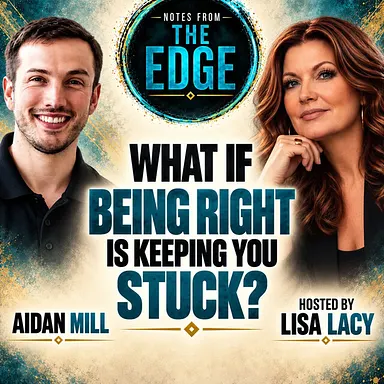
Welcome to Notes from the Edge, where we have the conversations we should have been having all along. We talk about the things that we're not talking about. I'm your host, Lisa Lacey, writer, trauma educator, executive advisor, and author of the upcoming memoir Notes from a Certified Madwoman. Welcome to The Edge. Hey, hey, my friends. Welcome back to another episode of Notes from the Edge. I am your host, Lisa Lacey, and this is the place we have the conversations we should have been having all along. Guess what? You're not talking about it, so we're gonna. And today's guest is Aidan Mill, and today we're going to be talking about something That may or may not be uncomfortable— being right. Aidan Mill is an Australian osteopath, educator, and podcast host based in Victoria. Alongside his clinical work, he serves as an associate teaching fellow at Deakin University and is the principal osteopath and owner of Forward Osteo. He is also the creator of his own podcast called Uncomfortably Curious, a podcast centered on substantial but relaxed conversations with researchers, clinicians, writers, and thinkers. His work explores ideas across health, science, psychology, history, philosophy, and everyday meaning. And of particular interest is Let's, uh, Let's Question Some of Those Assumptions.
At the heart of his approach is a deceptively simple idea: what if all the answers we have been seeking may have been there all along. We're just getting in our own way. Aiden, welcome to Notes from the Edge. How are you today, my friend?
Thanks, Lisa. Yeah, great. Going well, going well. Excited to be here.
Good, good. So as a fellow podcast host, um, let's open up and talk about how you ended up landing as a podcast host. What kind of was of your trajectory to there?
Yeah, yeah, it's been a bit of a, bit of a long time coming actually. So I, like you mentioned it, mate, you make me sound, um, quite established, I guess, with that introduction.
So much better when other people say it.
Exactly. Um, so yeah, obviously just been doing my usual work the last, you know, 10 years or so, and then probably the last 4, 3 years just had this bit of a, I don't know, inkling in the back of my brain that I'd like to start a podcast and just, you know, follow my curiosity and chat to interesting people. And it wasn't until— well, I've literally been doing it for about 2 months now, so I finally got enough momentum earlier in the year to get it off the ground. And it's been— yeah, I've loved it. It's been awesome.
Isn't it fantastic? Yeah, getting to talk to people who are Just wanting to help other people and have gone through some dark stuff and now came out the other side. Speaking of coming out of the other side of life experiences with some wisdom, Aiden, in your experience, why do you think we are so uncomfortable with saying the words, I don't know?
Yeah, I think it's, it's a very good question to start with. So I think it probably just comes down to the, I guess, insecurity, or it makes us feel less safe when we say I don't know sometimes. Um, probably more from that sort of social side of things where if we say I don't know about things and we, we look, you know, like we're not sure, it it can potentially, you know, force others to view us in a different way, or we feel like, yeah, oh, I don't know, I'm a bit insecure about everything, and, and we can feel a bit of ostracization. So I think that's basically where it stems from. Um, but I do also think that you can— it's a skill that you can get better at, so that if, you know, you have that feeling of like, oh, I'm not quite sure about this, Actually leaning into that is a good way to not only, um, well, develop that bit of resilience, but also, you know, it forces you to then learn more and, and maybe discover things that you didn't know previously. And now you might become more certain on some topics, but then other things you might think, actually, I've looked into it more and even I, I know even less now.
And I'm— and that's okay.
And that's okay. I love that. And I love your wording there, just lean into it, lean into the idea of it. And do you find that it takes practice at first to say, you know what, I don't have the answer to that, I'll get back to you, or, you know, I completely don't know? Do you think it takes us practice at first?
Yeah, I think so, definitely. And it's in all facets of life, um, whether it's from a professional perspective, you can, you know, maybe look a bit silly if someone that you higher up or someone that you're competing with in a workplace and you say, I don't know, and they say they do know, makes you feel a bit, you know, maybe insecure, like I said. But in other aspects too, like parenting, you know, I think that's a great time to, to say I don't know when kids ask you certain questions because it shows that you're human and, you know, you are instilling in that sort of, uh, those traits in them. And then I think, yeah, it's just, it's just literally like a muscle that you can work on. And, and the more you do it, the more you realize, like I just mentioned, and you, you said as well, that that's okay, but it can then foster sort of further growth and further development in, in you.
Well, I love that. And I love using at home with your children for practice for at work because it's a little bit— there's a little less pressure going on there. So yeah, use your kiddos for practice, uh, for, uh, that person that's, uh, competing for your same position to be able to say, I don't know, but I'll get back to you. How much, Aiden, um, in your own philosophy of what we call— we, we individually call our truth— is interpretation, do you feel? So 2 people can have the same thing happen to them, but Are they going to think their truths are different, and how much of that is interpretation?
Quite a bit, I think. And it depends on the— sometimes the definition of truth to start with, because people are often coming at it from different angles. So I do sometimes have a bit of a— I guess a bit of a bone to pick, or a bit of an issue sometimes when people say like, this is my truth. Because a lot of the time I'm thinking, well, there probably is a truth and we should try and figure out what that is. But on a personal level, there are, you know, our interpretation and our past experiences and how we rationalize and, you know, perceive things is definitely going to factor into how we view the world and experience everything. But it might be a bit of a difference between that and versus what is the truth. Yeah.
So you're talking statement of fact. What are the statements of fact? Like, here's the middle, here's your truth, and here's my truth. Yeah. So yeah, I get it, I get it. There is a truth. I love that. There is a truth, and then there's our interpretations of our own truths. And you're absolutely right, those are going to differ based on our, our past traumas, our past joys, our, uh, upbringings, you know, where we're from. Uh, there's so many different variables. that go into that. And you're going to hear my dogs for about 3 minutes, Aiden, because my husband is home and they love it. It's a big treat every day. It happens like it never ever happens every time it does. So I love that. So then if that's the case, where does objective reality end and perception begin?
Yep, that— I mean, I probably can't give you the correct answer for that, I reckon. But the— that I was thinking about, that about we don't probably have access to objective reality. Our brains are limited in terms of what they can perceive. For example, you know, different light on the spectrum, like we don't have access to seeing in infrared light, but it is still there. But just because we can't see it doesn't mean that it isn't part of reality. So we are, I guess, able to function in like a certain bandwidth in terms of lots of different things in reality. And I don't know if we'd ever be able to fully understand or perceive objective reality. But again, it doesn't mean that you shouldn't try and you shouldn't discover new things and learn. But there's a, um, I guess there's always a bit of a caveat at the back That it's, again, it's okay if we don't fully figure it out. It's more about the journey and trying.
Well, and I think, I think to your point, if we keep that in mind when we're trying to understand each other, it's going to lead towards us being a little bit more compassionate towards our fellow humans.
Yeah. And that, so when I say what the truth is. Sometimes I think people can take that a bit as being, you know, if someone says something that they believe that isn't the truth, they can, you know, be a bit, I guess, callous towards them. And that's not, that's not what I'm saying. You still have to obviously, you know, see the person in front of you and, and treat them from where their perspective and experiences are. Because if you just go at a purely rationalistic viewpoint of the world, You can become a bit harsh, I think.
Yeah. And then you're right, you miss the person that's right in front of you having their experience or interpretation of the event that you two just went through, but may have experienced it completely different for a variety of reasons. So your work in healthcare, so you've lived in a world where Naming something can be incredibly useful, right? It's a starting place for healing. It's a starting place for figuring out what's wrong. It's a starting place for treating. But what happens when a diagnosis or explanation then becomes somebody's complete identity? Have you seen that happen? And what can happen if that goes on for long periods of time?
Yeah, it can be very detrimental. So when people come to see me and other, you know, physical therapists, the— a lot of back pain, neck pain, shoulder injuries, all those sort of things— a lot of the time, the 3 things they want to know is what the issue is, what's wrong with me, what— how long is it going to take to, you know, recover, and then what can I and them do to help it along its way. And the first one of those is, what is wrong with me, is like you said, very useful and, you know, critical in a lot of ways. But it's less important from the person who's managing them because you'd sort of treat the symptoms rather than the actual ailment that it's written down on paper. Because certain things like, you know, say someone has a back strain, that could be a weak thing for some people, but other people could unfortunately turn into more of a chronic issue. And at least part of that is how they view the issue and themselves and their body. And it's not a switch that you can just flick on and just say, no, I'm not going to let this become part of my identity and consume me, because I think temperament comes into it a lot.
And some people just naturally Um, you know, more anxious. They worry about things. They, they, that becomes, you know, just in, in their brain, sort of fixed there, and they can't move past it. And that definitely has a negative impact on healing and recovery. But it's a really tricky balance because you can't say that to them because that sounds very, you know, almost like you're telling them that they're crazy.
Or just get over it. Yeah.
Yeah, yeah, yeah. So their experience is still real, but there are ways we can try and sort of help them gain a bit more confidence. Otherwise, they can tend to— or some people can tend to, and I've seen it quite a lot— they grasp onto that label and it becomes how they view the world and start to live day to day, whereas they avoid things they shouldn't. They don't, you know, partake in day-to-day activities. And then maybe even from a you know, a social or personal thing, they, they say, no, I'm gonna— not gonna do that because I've got a bad back. And there's all these sort of, um, I guess, yeah, ideas that can start to, start to flow in. Whereas someone who is, you know, a lot of it is just luck, is born in a way where, you know, water off a duck's back sort of thing, a lot of the time they will get better from injuries and, and conditions a lot sooner and a lot easier because they don't let it become that sticking point of, you know, what's, what's, what's wrong with them and what, what, what are they at their core.
Yeah, I love that. And I love the word sticky, um, because that's a great way to describe this stuff that, um, eventually stays around and hangs around. And then we go, oh well, this is just who I am, or just how I am or just what is in, in some cases. So, um, beautiful. A big thank you to today's sponsor, Vented. I talk a lot about identity on this show and the versions of ourselves we keep around because we think we're supposed to be that person. And I realized my closet may be doing exactly the same thing. There are clothes for the person I used to be Clothes for the person I thought I'd become, and clothes I'm convinced I'll wear again despite years of evidence suggesting otherwise. At some point you have to ask, why am I still holding on to this? And that's why I like Vinted. Vinted is a secondhand marketplace app that makes it easy to sell clothes you no longer wear and make extra money. Listing on Vinted is quick and simple. Once something sells, Vinted creates the prepaid shipping label for you and And Vinted has no seller fees, so you keep everything you earn.
So maybe look at your closet and ask yourself the very Notes from the Edge question: am I actually going to wear this, or am I just performing? Give your clothes a second life with Vinted. Download the Vinted app for free and start selling with no seller fees. So this fascinates me because confidence and competence are not the same thing. So, I don't know, the words I don't know, um, are actually an example of confidence. Talk to me about how using the words I don't know are actually confidence and really have nothing to do with competence.
Yeah, it probably relates to the first question you asked me with How you then are comfortable with the ramifications of saying that. Because I think if everyone really truly thought about it, they would think, I don't know, quite a lot. But being comfortable actually saying it out loud means that, yeah, I'm confident. I'm actually— I've got that confidence that I know that however this person responds to me saying that, I can handle. I've seen it before. the skill practice we mentioned as well. And then also just, you know, knowing that, that, that phrase becomes— it's actually, I think it's actually quite a, you know, admirable thing to, to, to see people saying. So yeah, definitely more on the confidence side. Um, a lot of, you know, you'll hear more— it's a pretty catchy phrase in a lot of, uh, areas, but you fake it till you make it sort of thing, which again, there's nothing probably 100% wrong with that because you do need to sort of build up that, that those reps before you can get confident and get competent. But there's a balance where overselling the competence can, I think, lead you into a bit of a sort of murky waters because if something pops up that you aren't sure about, you sort of get caught out a little bit if you're overdoing the competence side of things.
Oh yeah. If you have an answer and it's, it's not the answer. Yeah. Yeah. That, that especially with your kids, they'll be the first to tell you.
Yeah, exactly.
So yeah, again, I loved your idea of using them as a practice ground for just saying the words, I don't know, but you know what, I'll look into that. And, uh, And get back to you. Um, how, for you, Aidan, personally in your own life, how has your relationship to curiosity affected your personal as well as professional relationships?
Hmm, yeah, okay, let's think. I would say It's, it's one of my— so it's one of my core— well, it's probably my core personal value that, that, that I've sort of lived by. And probably only in the last few years I've written that down as a, you know, I know it's a value. But prior to that, I think I still, you know, live my most of my life with that in mind, where personal— yeah, it's a good question. I think it's definitely helped. Uh, it can in some instances be a bit of a, um, I guess Achilles heel or a bit of a, bit of a speed bump, especially if you probably ask my wife and she'll say that I'm a bit annoying when, when I question things too much. But so yeah, but overall I think it's led me into good, you know, good areas and just being able to, I guess, not settle for what the, the status quo is necessarily, like being comfortable with pushing back a little bit and, and asking that follow-up of, you know, why. It always comes down to that, like, why do we believe this? Why is that the truth?
Why do you say that? Um, and it can be a bit more in the moment uncomfortable, I guess, but overall you get a lot more out of it. From, yeah, professional and, yeah, personal.
Yeah, the questions why and how, because context matters. And because context matters, um, it's, it's nice to have us at least be willing to consider what the whole story here is. Um, I think those are really important questions. And in here we talk about, like you do on your podcast, asking better questions. Um, because it's when we ask the better questions, we're gonna get down to the better answers. So why and how are 2 of my, uh, my, uh, most favorite questions, especially when it comes to us as, uh, as humans. So, um, what belief have you had to Change, and that may have been uncomfortable or challenging as you've gotten curious about yourself and your own journey and healing journey? What was one of the most uncomfortable beliefs that you had to change when you got curious about yourself?
Yeah, it's a very interesting question. The— it's probably 2, 2 things come to mind that probably aren't fully formed thoughts, I don't think, but I'll try my best to get them out verbally. So one of them is probably to do with, uh, emotions and how— it's not necessarily that I had a strong belief about being, I guess, showing certain emotions, but the more I've— yeah, the last probably couple years, and probably since becoming a parent, has been a big instigator as well, that the spectrum of emotions and being able to not just show the positive emotions in front of, you know, people you care about, but also knowing that it's okay to be angry, it's okay to, you know, have these other emotions, and it's all about how we then you know, bounce back and repair and, and, and, and, you know, come back after we have these little things. So that's been one where it's been a bit of a slow shift for me of getting used to the, the, the idea that those types of things are, um, normal, um, and not something to be, I guess, looked down upon. Um, I think I'm still working on some of those a little bit.
Um, So yeah, not sure if that made 100% sense.
It made total sense. It did. And again, that takes practice too, that it's okay to show grief and sadness and anger in front of people. And I, I love that your point to our listeners is, hey, we're not going to be perfect at this, right, when we're practicing it and learning it and just becoming observant of it. But what's the The most important thing is, is to be able to circle back and go, whoa, you know what, I really just lost it there. I'm so sorry. You know, how can I best support you to repair or to move on from this? So, and that is all part of the learning and the practicing. Every step in that process is a practice that, you know, depending on again, how we were conditioned as children, um, is going to be different for each of us. So it's a very valid point, made total sense. Yeah, but you had a second part. What was the second part that talks about relationships and, and to yourself?
Actually, yes, the second part was, um, well, it was a different actually topic. So I had the 2 sort of ideas, one on the emotional side and then guess the other one is more, um, spiritual religious side where— and I'm not, I'm not, I'm, I'm not sure about your personal views, but— and I don't want to offend anyone, but the— I get from a young age I always sort of grew up in a very, um, like, you know, atheistic household. Didn't really have that as part of— and it's more common in Australia to— it's not as big a part of communities and everything as it probably is in America. Um, but I grew up, you're sort of being, you know, quite anti-religion, I guess, and just, you know, not believing it and everything. And that's been a slow shift where, again, I'll try and get my words out correctly, but I don't— I, at the moment, I don't say that I'm— that I'm not— definitely not religious, but I'm a lot more open to the idea and I can see the benefit a lot more than I did when I was younger. And it doesn't mean that I still believe that the things happened that people say they did across different religions, but I, I see the, the underlying stories and meaning and the way that it can assist people throughout their life as being much more beneficial than I did when I was, when I was younger.
Yeah. Yeah. I'm still a seeker myself. I'm still trying to figure it out too, my friend.
Yeah.
Yeah. So I haven't landed on anything quite yet.
Yeah. So yeah, I'd probably say
I
definitely call myself open to possibilities more now, even though I don't, um, you know, ascribe to any, any particular dogma or, or, you know, faith or anything like that.
Yeah. And I think there's something about, uh, uh, children perhaps that can sometimes, uh, uh, shift us there too sometimes. So, and just staying curious, right? That's— you still being curious as a seeker, and I love that. So speaking of curious, let's talk about your podcast. So what can we anticipate when we click the link that is going to be right under your episode and go to your podcast? What are some of the things you guys are talking about? What are you exploring on your own podcast?
So yeah, the topics, uh, fairly varied. I'm literally just sort of following wherever I see something that, that piques my interest. Um, the name, as you, as you said at the start, Uncomfortably Curious. So a lot of that is just my own curiosity. And like I've mentioned in here, it's just sort of built into me. But the uncomfortable part is, well, on a couple of, couple of fronts. It's one to do with how I'm sort of always, you know, uncomfortably curious. I'm always looking for more sort of, you know, hard to actually satisfy that, that need. So that can be a bit uncomfortable sometimes. And also just not being, uh, afraid or, you know, concerned to look into areas or ask questions that maybe aren't super comfortable to start with. But hopefully I say— I ask these questions in a way that don't, you know, get people's— people defensive. But the way that, yeah, I look at it is just Having no preconceived ideas, just wanting to understand the world and, like you mentioned, ask better questions and just figure, figure things out with lots of different people. So yeah, I've had people on that are, you know, neurobiologists and other people that, uh, sort of looking into a lot of parenting work.
Um, and then I think in the next couple of weeks, yeah, just, just looking into sort of all to do with how health and wellness, but also fitness. It's just really varied, and, and it sort of— there's no, no topic that, as long as it interests me, that I'm, I'm not willing to chat to someone about, especially if they're, uh, really enthusiastic about their work. That's the main thing.
Very cool, very cool. Well, where can we find it, your podcast?
So yeah, on literally all, all the major podcast platforms, you know, Spotify, Apple, Um, Amazon, all the everything. It's on YouTube too. I've the last month or so been putting out like my full episodes on YouTube as well, and then getting a few short clips out every week too, just to sort of get the— get myself out there with that, which I wouldn't say I'm super comfortable with yet, but I'm getting there. And like you said, it's just about getting used to it and, and, and practicing the reps.
Gotta practice the reps, my friend. Gotta practice the reps. And guys, you do not have to write that down. We're gonna have clickable links right underneath here for you. All right, Aiden, we never let our guests go without asking a few more questions. Are you ready?
Sure.
Okay. In your own life, what did you perform in order to survive, and what did dropping that role mask or performance do for your life? That's question number 1.
Okay, very tricky. I did see that this is one of the— one of your questions you like to ask people. And yeah, so I've been thinking about it quite a bit, and I really struggled to come up with one sort of definite answer. I think I probably Landed on probably the taking into consideration other people's views or opinions and then letting that dictate my actions. I think probably quite normal for a young person to have that because you know, we're social, social creatures, and you don't want to be, uh, you know, just willy-nilly doing your own thing without taking into account other people. But as I've gotten older, I think that's partly why, you know, starting the podcast, I've felt, you know, that's why it took me a few years to get it going, because you sort of, you know, you're afraid of how people are going to judge it and think about you because you've sort of yourself out there, especially in a, in a, you know, platform like this as well. So that's been— again, I wouldn't say I'm 100% comfortable with it yet, but I've had enough momentum behind me to, to actually shift that.
And it feels good. It's, it's great to actually, you know, do things that you say you're going to do and not have to worry so much about the opinions of random people.
Yeah, it does. It does feel good. You're still gonna have the, the one ever so often that gets sticky, to use your word. All right, Aidan, what do you wish— this is the second question— what do you wish we were having more conversations about? What do you want us talking about more that we're not?
Um, I think probably understanding why we think the way that we do. So it probably comes down to the why aspect. And I, I wish a lot more people would at least dig into their opinions or views at least a couple of levels deeper rather than just saying because, because. Thinking like, why do I believe that? Why do I have that view of the world? Why do I have that view of this person? And like, a lot of the time, there's, there's a little, you know, um, tool that people use. It's sort of the 5 Whys. And every time you've got a tricky decision or something's, you know, upsetting you or anything, just ask why. But then do that 5 times, and you just start to get to a deeper level where you can really uncover some interesting things. Um, And again, that's a, that's a skill you need to practice, and it helps with the self-reflection, which I think is, is another missing aspect where people just don't— they don't look back and see, you know, analyze why they've made decisions, or could I have been a bit more sympathetic or empathetic or treated someone a bit differently.
So I think the, the skill of why is probably the main thing.
I love that, the skill Of why, my friends. What a beautiful way to end. And before we let you guys go, I'm going to ask you guys the same question. In your own life, what might you be performing just to survive? And what may setting that role, mask, or performance down do to lighten your load just a little bit? I'm your host, Lisa Lacey, here with our guest, Aiden Mill. And when you find the answer, we will see you at the edge. Thank you, Aidan.
Thanks, Lisa.
Why is saying “I don’t know” so uncomfortable? Australian osteopath, educator, and Uncomfortably Curious podcast host Aidan Mill joins Lisa Lacy to explore curiosity, cognitive bias, and why questioning what we believe might be one of the most powerful things we can do.From the stories we tell ourselves to the labels we allow to define us, this conversation challenges certainty, explores how our experiences shape our perceptions, and examines what happens when we choose understanding over being right. Sometimes the most courageous thing we can do is admit we might not have all the answers.In this episode:Why we’re uncomfortable admitting we don’t know somethingHow personal experiences and assumptions shape our perception of truthWhen diagnoses and labels become part of our identityThe difference between confidence, competence, and certaintyHow curiosity, emotional openness, and better questions create opportunities for growthConnect with Aidan MillWebsite: https://www.forwardosteo.com.auPodcast, Uncomfortably Curious: https://rss.com/podcasts/uncomfortably-curious/Connect with Lisa | INSIDE THE EDGEhttps://www.lisalacy.com/inside-the-edgeWhat did you perform in order to survive?Welcome to the Edge.See Privacy Policy at https://art19.com/privacy and California Privacy Notice at https://art19.com/privacy#do-not-sell-my-info.