
Every line of this episode of Notes from the Edge was transcribed with HappyScribe technology. See also: subtitle generator.
Ads in this audio differ from the text. Tap the sentence you're hearing to follow along.
Synced: the text now follows the audio.
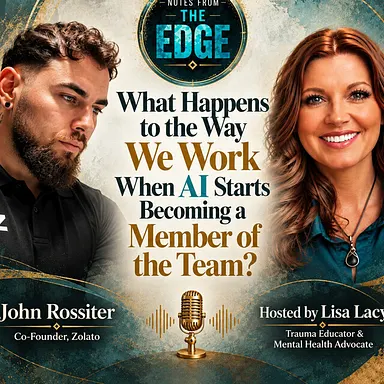
Welcome to Notes from the Edge, where we have the conversations we should have been having all along. We talk about the things that we're not talking about. I'm your host, Lisa Lacey, writer, trauma educator, executive advisor, and author of the upcoming memoir Notes from a Certified Madwoman. Welcome to the Edge. Hey, hey, my friends, welcome back to another episode of Notes from the Edge. I am your host, Lisa Lacey, and this is the place we have the conversations we should have been having all along. Guess what? You ain't talking about it. So today we're gonna— with special guest John Rossiter, and today we're going to be talking about What happens to the way we work when AI starts becoming a member of the team? So what happens to leadership? What happens to humans? What should they keep doing? We're going to be talking about all of that with John, but let me tell you a little bit about him before we get started. He is an entrepreneur and co-founder of Zalato, a CRM and AR workforce platform created specifically for the home service industry.
After years of experiencing building, scaling, and operating businesses, John and his co-founder saw a gap in the technology being sold to trades and service companies and the way those businesses actually operate. Hmm, that's important. So Zalato is their attempt to close that gap. The platform combines a CRM with a team of specialized AI employees designed to perform specific business functions. Its AI workforce includes roles across sales, operations, marketing, finance, executive support, handling tasks ranging from lead follow-up and appointment management to customer reactivation, financial monitoring, and business intelligence. But rather than positioning AI as a single assistant, John is exploring a model in which business owners can interact directly with specialized AI workers as part of their everyday operations. So his work sits at the intersection of entrepreneurship, artificial intelligence, automation, and the rapidly changing future of work. Boy, John, it sounds like you and I need a talk after the show. Welcome to Notes from the Edge. How are you today, my friend?
I'm brilliant. That's a fantastic introduction. Thanks so much. Yeah, I'm really glad to be on. So thanks for having me.
Yeah, it's a pleasure to have you here and It's Notes from the Edge, so we're just going to dive right in. This is kind of a hot topic for people right now that you're tapping into, and it can be kind of divisive sometimes, weirdly, for some people. But you don't describe what you're building as an AI assistant. You call these AI employees. So what changes when AI crosses the line from helping somebody perform a job to actually taking responsibility for the job itself?
Yeah, it's a good question. So I think first and foremost, you know, we decided to go down the route of calling it employees versus an assistant or a bot, because I think those words are too, like, quite common. And so we went down the employee route. But I think that, you know, a lot of people, I mean, you go back to your point, right? A lot of people, especially in the beginning stages, were very skeptical to the idea of deploying AI into their business. And over time, they got a little bit more familiar with it. But in terms of the crossover, I mean, the AI right now is big and it's gonna get bigger and bigger. And I'm sure we'll touch on this, but it's gonna save people so much time. You know, we have, you mentioned them, right? Employees. We have 5 of them that go across data, sales, finance, operations, and marketing. You know, this is a 6-figure payroll that you're effectively getting for a fraction of the price. And they work 24/7, 365 with no sick days or complaints. So it just, you know, it just saves people time, it saves people money.
It creates better efficiencies right across the business and a little bit more peace of mind as well for the owner.
I love that peace of mind. I love the no complaints too. You kind of take the human stuff out of it, but let's put the human stuff back in it. So in your business, if they're AI employees, what are the humans actually doing? And I am in agreement and alignment with the idea that AI can save us so much time. to free us up to do the stuff that really fills us up. That's my take on it. Tell me yours.
Yeah, that's absolutely huge. Um, you know, and to piggyback off that, a lot of people, you know, I think as business owners you have to be a sort of special breed if you enjoy this, but a lot of us don't enjoy doing taxes, right? Like, or we don't like doing accounting. Um, and so, you know, we can now remove you from that position to fill you up in other areas, zones of genius, places within the business that you're fond of, that you enjoy, that you like, again, that fills your cup. So I think it's really important, you know, that we really utilize it moving forwards. So, yeah, peace of mind is huge.
Yeah, yeah. Less stress, right? Less mundane tasks, right? Offloading stuff. So humans then get to do the stuff that really, really fills them up. Let's talk about what work do you believe that AI should be taking away from humans so they can be freed up to do the stuff that really lights them up? What's some of the tasks other than taxes and by accounting?
Yeah, sure. So, you know, to kind of get a little bit more specific, um, you know, we, we run a home service business ourselves, um, over in, over in the States. And it's, I mean, a lot of stuff can be covered here, you know, like following up with leads, re-engaging old leads that have maybe come in 7 days, 30 days, 60 days, 12 months and beyond. I think a lot of people are very focused on new business and new leads, new opportunity, and they often forget about what they have already sitting in there, in this case CRM or existing platform or existing network. And so they typically go cold and what happens is that they then go with somebody else. So you need to have systems, you need to have operations and processes to get these people back in. Um, so we have like re-engagement campaigns, uh, we have speed-to-lead systems. So again, another big issue that we're seeing, especially in home service, is that when a new lead opts in for something, it might take 30 minutes, an hour, 3 hours, 24 hours plus to get back to this lead. Sometimes they don't even see it.
And so, you know, we have proper systems in place to make sure that every single lead that comes in is answered immediately, like within 5 minutes. And I think there's a crazy stat. I think there's like 90+ percent that if you can get to the lead within 5 to 10 minutes, you increase your conversion rate by like 300%.
Whoa. So that's a big number. Let's not gloss over that one. That's a big number. Yeah,
it's crazy. And another thing that even elevates that statistic a little bit more is, and I'm sure, you know, you've had it, everyone listening to this would have had it. If you type something into Safari or Google, whatever it might be, you're then gonna start seeing ads pop up for things that are similar. And so people are in, when they've signed up for something, they're in the zone, they're actively saying to you, hey, I want help. And if you ignore that, they will find the help from somebody else. So you've got to have the right systems in place. Um, you know, so we can do like email, uh, campaign blasts, text blasts, uh, we can do, uh, marketing campaigns, uh, we can do, uh, invoice work. So we can mark anything that's unpaid, paid. Um, we can move leads through the automation pipeline. So effectively a new lead coming in right from the get-go to a paying customer. I mean, there's so much that it really is endless. It's, you know, we're even getting, we've got an AI employee right now that's called Sage, you know, so they've all got their names and faces and whatnot.
You can speak to these guys and, you know, she's like the strategic partner. So she gets to learn your business inside and out and, you know, she'll give you some Uh, direction and hiring, training, uh, business strategy. Uh, it's just ridiculous. Like, there really is— it's limitless on, uh, what you can do. So.
I love it. I love that, that you've filled the gaps in areas that for most people, unless they are that special breed, don't like doing that stuff, right?
Oh yeah.
Yeah, yeah, the mundane stuff. And those are huge astronomical numbers. And I love the idea of a re-engagement campaign, you know, pick up all those old leads that fell off to the wayside because everybody got busy and were focused on the new ones. So, so, John, the more autonomy we give AI, the bigger question around accountability becomes. So if an AI employee misses a lead, gives bad information, or makes the wrong recommendation, who owns the mistake? What responsibility? Where does the responsibility ultimately sit? Because really, it's you guys as humans at the helm of this, right?
Right.
Yeah.
Yeah, that's so true. I think across the world of entrepreneurship and business, you have to be able to take extreme ownership. For everything that happens in business, um, whether it's your, you know, directly your fault or not. Like, it's still your responsibility and ownership to do something about it at least. And I think the worst thing you can do is, you know, play the blame game, point the finger at somebody else. Um, it's never been our style. I'm sure it's not yours. I'm sure it's not for a lot of people listening to this. So, you know, it's definitely something You can't do so if something goes wrong or they send out, you know, let's say the wrong type of text to the wrong type of person. You as the owner, you as the creator, the founder, it starts from the top. Like you have to take responsibility. It's not the customer's fault. It's not the the business that we're serving's fault. It's our fault. And I think you know you have to sometimes say, you know what? We got it wrong. We'll hold our hands up. We recognize it's not went 100% perfect. And so we'll go behind the scenes and we'll fix it.
So I think, you know, if you've got a product or service, it's irrelevant what happens and who it happens to. You have to take ownership of that. I think it starts from the top.
So big. So big. And you know what? That does so much for your client or customer to build trust. I believe when we take accountability and say, messed up, sorry, gonna find a way to fix it, change it in the future, won't happen again. I just had a great business experience. where, um, I was anguishing for days over what was going to potentially be a very difficult conversation, and I didn't even have to have the conversation because somebody took the accountability in a way I've never actually seen in business before. So it was so great. So, um, it builds trust, um, and it builds peace of mind too.
Yeah.
And it, it also lets people know that you're doing the work. We're going to find a way to solve this so it doesn't happen in the future. Because let's face it, humans make mistakes. AI might make mistakes. We're all going to— we all make mistakes. But you're absolutely right. Responsibility and accountability starts from the top down. Because if you play the blame game, whether it's in your professional life or your personal life, it's going to keep you in anger. It's going to keep you in resentment. And that's not where the good stuff happens, right? The good stuff happens in that state of autonomy and accountability and responsibility. So I appreciate that you guys roll your business out that way. So what is step 1 for Xylato? So say I come to you and I go, I am swamped, and I'm not joking, I'm swamped. And I've got all these emails that are unanswered, all these people who want to be on the show, great guests, and they're fallen through the cracks? Like, what would be step 1 if I, if I'm listening to this and I'm like, I, I want to talk to John a little bit more about maybe streamlining and creating some systems?
My brain loves systems. Uh, this show would not be as successful as it is without systems in place. Um, what's step 1 for businesses for you? How do you start?
Yeah, great question. So the first thing that we do You know, when a new client comes to us, we want to take the time. Like, we're not just gonna put them straight into the system and say, all right, here's the key, go turn it. Like, we actually want to pay a genuine interest to their business. So like, we'll have a sit down with them, have a bit of a talk about, you know, where things are currently at right now, what they've got implemented already in their business, maybe where they see the gaps and where they're ultimately looking to get to and why us, you know. And that's something I think a lot of companies miss out on. It's like, Well, why us? There's plenty of other people out there that I'm sure you could get support from. Um, and especially with this space moving so fast, you've really got to keep up. And, uh, I think it's an important question to ask, well, why us? Because it gives you really great, uh, market feedback. Um, and so when they come in, they speak to us, and then we can get them, you know, fully onboarded.
Like, we see a lot of people coming from different platforms. For example, those in the home service space will know Housecall Pro, Jobber, GoHighLevel, I think is a little bit more universal. And so when they're switching over, we'll do a complimentary onboarding. So we'll take all their data, we'll move it across into Zalato, we'll get them fully set up, integrated and everything else. And then once that's situated, you now have a foundation that the AI employees can sit on top of almost as a cherry on the cake type thing. They're a layer. And what they'll do is we can literally implement those into your business, then turn the key, and then they'll get to know about your business. So like one of the things that we're doing is, you know, you're gonna have to fill out a quick form and that form will get submitted not just to us as the founders, but it will get submitted to the AI workforce. So they'll get to know your business inside and out. And then you can get full access to everything right there and then. And the way that we control it and the way that our users can control it, you have a list and that list will give you different responsibilities and you can toggle the responsibility on and off.
So if you want, let's say, I mean, we've got Jodie who handles our operations side. You can tick specific things on and off to hand off that responsibility to her. But if you want to keep some things that say, hey, look, you know what, I want to keep a human approach to this, I want to take control of that, or I might have someone on the team who wants to take control of that, you can just keep it toggled off and that's it. You know, it's pretty seamless. It's kind of like a click, drag, drop, upload, and you're away. So
I love that. Click— what'd you say? Click, drag, drop. That's it. Easy peasy. I love that you have the option to be like, No, because there's some stuff in, in my businesses— businesses plural, I'm trying to do a bunch right now— um, where I want to keep it because that's how I get to know, uh, the, the guests, what they do. So definitely wouldn't offload some of that. So I love the fact that it's very simple. Uh, you come in, you talk to them first. Mm-hmm. You get to know the business first, you plug the business in, and then they get to say, hey, we want, you know, Mary Smith to keep this task because we, we want human hands only on this. So brilliant, brilliant, brilliant, brilliant idea. You said something that I want to circle back to because you said, you said this is— AI is moving really fast. John, what do you feel like— this is just me asking for your personal philosophy— what do you feel like What do you think is going to happen to the companies or organizations that don't implement at least some of this within what they're doing?
It's a good question. I think there's no really polite way to put it, but I think they're going to get left behind. I don't think it's just in-home service. I think it's across the board. You know, you can look at across different areas of the business. and you'll eventually tap out of capacity, whether that's human hours, money, other resources. Eventually there's gonna be a cap and a tap out point. So if you don't have at least some automations, whether it's simple speed to lead automations or a true huge overhaul of sophisticated AIs and automation, you will get left behind. That is, that's my controversial take on that. You're either here for it or you're not, and the ones who are will fly past. That's my take on it.
I would venture to agree with you. And really, if we think about it, you mentioned the word automation. We already automate a lot of stuff, so this is just a much faster better way to automate things. So I absolutely agree that people will be left behind if they don't try to figure it out. And so for our friends out there listening, if you're not using AI in your business to help automate some of these processes, if it's scary, To you. If you don't know where to start, John's gonna be a good contact for you. So John, where can people go to, uh, find you? And then again, what would be step 1? Is it just a call with you and then you have the bigger call? Or how do they get— if they're listening and they're like, oh crap, I don't wanna get left behind, or I don't even know where to fricking start. What do they do? What's step 1 with you guys at Xalato?
Yeah, so we actually— so right now, like, you can— so Xalato is a completely free platform to use. So Xalato is more than just a piece of kit, it's more than just the software. We have Apex, we have Summit, which is more community-based. So the CRM is free to use and it will be forever. And so what happens is they can find us through our site at zalato.ai, or they can find me or my co-founder on social media. So typically they'll come in, they can either sign up and then book a demo, or they can book a demo and then sign up. And it's just giving them a couple of different options. But when they speak to me, it will be me. It won't be like another member of the team. It will be me as co-founder taking these I wanna learn as much as I can about why, you know, what are you looking for? What are the gaps? What are you still missing? What are you in need of? What support do you need to take this to the next level? And, you know, if I'm in a position where I think, you know what, we aren't the best fit, I will tell people that we're not the best fit.
But if we are the best fit, I'll also tell people. So we'll have an honest conversation about where everything is. And then typically we'll go behind the scenes, we'll do a bit of a demo, we'll show them around the platform and we'll get some takeaways. What do they like? What do they not like? What are some things they want included? One thing that we're doing right now is we're doing custom builds. So as well as complimentary onboarding, we're doing custom complimentary builds. So if they're missing something that maybe we don't have, we can go ahead and build it out. And so once we're in agreement, it's like, hey, you know what, I'm going to sign up, I'm going to get going. We can then just basically take their files and then we'll integrate it in the background and then we'll say to them, hey, everything's done, here are the keys, go turn it, start operating. And we'll keep them updated, of course, throughout the entire time. And one of the things that we also do have is the ability to chat directly with our co-founder, Oleg. who is the full-time developer right now. So that's built inside the platform.
So any questions, queries, concerns, any bugs that they find, they can message us and we'll answer in real time as well. So because he's in Oregon, he's 8 hours behind me. So, uh, you know, we can pretty much cover everybody 24/7 around the clock. So, uh, yeah. And then obviously, you know, we'll put them into the community, um, we'll get them introduced to other people if they want to you know, grow their relationships or better their health or connect with other people in the space. We've got everything. So yeah, it's basically an all-in-one platform. I mean, eventually, you know, we will become the Amazon of home service.
Yes, let's do it. Let's do it, my friend. I'm down for it. Hey, I want to circle back to something you said. You said the CRM is free and always will be. Why was that important to you?
Well, that's a good question because I get a lot of my fulfillment through helping people. And I have a lot of different platforms out there. They will charge. And, you know, don't get me wrong, it's not a bad thing. They have brilliant platforms. And I mean, this is the world of business, right? It makes sense. But we wanted to make it as accessible as possible, whether it's, you know, something for the little guy or whether you're bringing in $100 million plus per year. We want to bring you in and give you a place to feel at home. But we made it free because we wanted to make it accessible to everybody. So there's no hidden charges, no hidden costs, upsells, or anything like that. It really is free to use forever. And then anything you do want to purchase inside the software, which is not mandatory, Like you can fully operate as normal. It's optional, you know, and it'll only enhance your experience, but it's not mandatory. And so we started seeing with a lot of different platforms, not to name any specific, but, you know, a lot of different platforms were trying to nickel and dime people, charge people for like small custom builds that we could get whipped up inside of an hour.
If you wanted to add more users onto the platform, Like it was gonna, it was gonna charge you $80 to $150 a month extra. So it's all these little things they're trying to find ways to make money out of people, whereas we're just going to sit around and say, hey, you know what, we'll take this, this, this, this, this, this, and this, and we'll just give it away for free, you know. And so that really has been not just our spearhead into the market at the moment, but it's also been a great way to have the community recognize the fact like, hey, we're in this with you. This is built from home service for home service. We're not this giant tech company that's just trying to make a lot of money. We're trying to build a community, a fan base. And, you know, as corny as it might sound, it's a Zalato family, you know, and we want to build people. And so, yeah, that's— we just wanted to give back, really.
Not corny at all, my friend. That's what it's about. We are in a loneliness epidemic and we need more human connection and we need it everywhere we can get it. So I, uh, I support you. So friends, you don't have to write that down. It'll be in a clickable link in show notes, right where you can go and, uh, get some help, uh, for all your business needs. Um, and check it out for free at first and then, uh, connect with John, who will actually be the person that you talk to. Very, very cool. Um, all right, my friend, I'm not done with you yet though. Before I let all my guests go, I ask a couple of more questions. Are you ready for the first one?
Let's see. Let's make it happen.
All right. In your own life, what do you feel like you performed or put on the most in order to survive or just get by? And what did dropping that role, that mask, or that performance do for your life?
Um, hmm, could you, could you ask that in another way? Yes.
Have you ever worn masks, like weren't your authentic self? Were you ever putting on in order to just get by or make other people comfortable? Some people will say they're the people pleaser. Some people will say they were the good guy. Um, What masks have you worn, or mask have you worn that you have now taken off to be really authentic? And what did that do for you? Does that help?
Yes. Yeah, thank you. That's such a good question. Um, wow. Um, I'd personally say, you know, for, for the longest time, I've always been like, a bit of a people pleaser. Um, you know, I never have conflict, I never have arguments. I still don't now, but like back then I was like, I, I have to go out my way to please you. And, uh, no matter how long that took, how much it took from me, if I did that, it was mission accomplished. Um, but it took away from so many other things that I could put my energy, time, focus, and attention towards, things that would truly benefit me and those around me. So I think, I think there's an element of people pleasing I think is quite healthy. It shows that you care and you have genuine interest. But also when it starts to completely overtake, uh, or really get on top of you, I think that's where it starts to become unhealthy. Um, But yeah, I mean, I think that's it. It's— I used to be a big people pleaser. Now I, I'm not really bothered. If someone likes me, then brilliant, I'll go to the end of the earth to build a great relationship with you.
If you don't, that's okay. I'm not for everybody, and neither is everybody else. So it is what it is, really. Um, so that's, that's definitely the biggest mask I would say that, uh, I used to wear a lot. And now I just keep it hung up.
I love it.
I got one on my shelf right here.
That's an exhausting one to wear. Yeah, that's an exhausting one to wear. Yeah. All right, last question, my friend. What do you want us as human beings to be talking more about with each other that we're not talking about?
I would say our feelings, uh, and I don't want to sound too cliché, but I think there are so many people in the world who keep things bottled up, and whether they go to someone or not, they keep it bottled up. But I think they need to start trusting more people with how they feel. I think it's great to have one person in your corner 2 people in your corner. But if you can surround yourself with people who genuinely and truly want the best for you and will do everything they can in their power to make that happen, then I think you have to give other people a shot. Uh, to go back to your point, people are still, whether it's, you know, physically or, or mentally, I think people are still in isolation. I think they're kind of keeping things locked away. And I think the more that you can share with people, um, that are close to you and who, who really give a damn, I think that's, that's a powerful thing. Um, one thing that I, I got taught from, from a mentor of mine when I used to be really, really closed up, um, he used to say to me, you have to be able to trust Whether it's 1 person or 10 people, trust them that they will care and that they want to help because you're denying them the opportunity of true fulfillment by helping you.
And I was like, that's actually really interesting because I was thinking too much about myself and not others. So I want to give people the opportunity who do care, who want to help, and say, hey, look, you know what, I do need help. Let's chat. So I think just getting to, you know, build, build relationships, speak up, and, you know, just, just don't do it alone. I think life's— life can be difficult enough, so you need good people around you.
Perfect, perfect answer. So my friends out there, what John is saying is if you're struggling today, Please let somebody know. And as we close out, I'm going to ask you guys the same question I asked John. What might you be performing in order to survive or just get by? And what do you think setting that role, that mask, that performance down will do to lighten your load just a little bit, make it an easier ride? I'm your host, Lisa Lacey, here with our special guest, John Rossiter of Zalato. And when you find the answer to that, we will both see you at the Edge. Thanks so much, John.
Absolutely. Very welcome.
What if artificial intelligence could give us more time to be human?In this episode of Notes From the Edge, host Lisa Lacy sits down with Jon Rossiter, entrepreneur and co-founder of Zoloto, to explore AI employees, business automation, leadership, and the future of work.But the conversation goes beyond technology. Jon opens up about people-pleasing, authenticity, accountability, and why meaningful human connection matters more than ever in an increasingly automated world.What happens when technology gives us back our time, but we still have to decide who we want to be?In This Episode:AI Employees & the Future of Work: How specialized artificial intelligence workers are transforming business operations, automation, and the way entrepreneurs manage their companies.Entrepreneurship, Productivity & Work-Life Balance: Why eliminating repetitive tasks could help business owners reduce stress, reclaim valuable time, and focus on what matters most.Leadership, Accountability & Human Trust: Why taking responsibility, acknowledging mistakes, and building authentic relationships remain essential in an increasingly automated world.People-Pleasing, Identity & Authenticity: Jon’s personal experience of letting go of the need for approval and learning to show up without wearing a mask.Human Connection & the Loneliness Epidemic: Why technology cannot replace emotional honesty, meaningful relationships, asking for help, and supporting one another.From AI-powered business transformation to the deeply human need for connection and belonging, this conversation challenges us to consider whether the future of work should be measured only by productivity or by the quality of the lives we’re creating.Connect with Jon RossiterCo-Founder, ZolotoLinkedIn: https://www.linkedin.com/in/johnrossiterofficial/Connect with Lisa | INSIDE THE EDGEhttps://www.lisalacy.com/inside-the-edgeWhat did you perform in order to survive?Welcome to the Edge.See Privacy Policy at https://art19.com/privacy and California Privacy Notice at https://art19.com/privacy#do-not-sell-my-info.