
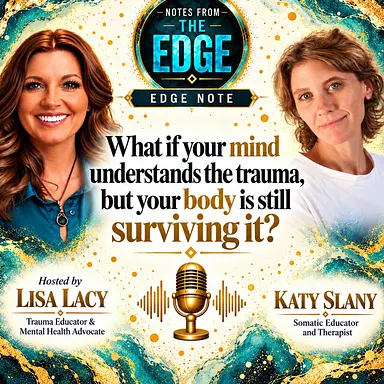
“Edge Note: What if your mind understands the trauma, but your body is still surviving it?” was turned into text by HappyScribe’s speech recognition. Related tool: notes for Microsoft Teams meetings.
Ads in this audio differ from the text. Tap the sentence you're hearing to follow along.
Synced: the text now follows the audio.
Welcome to Notes from the Edge, where we have the conversations we should have been having all along. We talk about the things that we're not talking about. I'm your host, Lisa Lacey, writer, trauma educator, executive advisor, and author of the upcoming memoir Notes from a Certified Madwoman. Welcome to The Edge. Hey, hey, my friends. Welcome back to another episode of Notes from The Edge. I am your host, Lisa Lacey, and this is the place we have the conversations we should have been having all along. Guess what? You ain't talking about it, so we're gonna. And today we're gonna be chatting with our special guest, Katie Slaney. And Katie Slaney is a registered somatic movement therapist and educator specializing in transformational learning, nervous system literacy, and embodied change. And boy, oh boy, do we like that. Her work is rooted in understanding that lasting transformation happens not only through insight, but through our body. So using nervous system education, somatic movement, and experiential learning, Katie helps individuals and groups Understand the patterns they carry, expand their capacity for change— capacity is a big word we love in here— and develop new ways of relating to themselves and the ones they love, as well as the world in general.
With more than 16 years of experience as an educator, she creates workshops, group programs, one-on-one therapeutic experiences designed to help people have these deeper relationships. Katie, welcome to Notes from the Edge. How are you today, my friend?
I'm great. Thanks so much for having me.
Yeah, I'm so glad we connected. Well, it's Notes from the Edge, so we're just going to jump right in. Let's start with something I think a lot of people experience. So you can spend years, because I did it, understanding your trauma intellectually. Like, one example was a DBT program. I had all the books memorized. But they weren't applicable. I wasn't applying them to, to life because they were so clinical in nature. So you can understand trauma intellectually, you can understand the healing intellectually, but your body still reacts. Talk to us about that. How is it that we get it up here, but we're not getting it here in our bodies? Guys, I'm pointing to my heart right now.
Yeah, I totally agree with this. And I think, we can spend so much time in our brains. And I think our society really tends to separate our mind from our body, which is why, you know, we have this disconnect. And when we have experiences of trauma, it's really a whole body experience. It's not something that we just experience mentally. And so the way that I like to describe it is that when we have these experiences, there's this huge mobilization of energy that's acting to protect us. And when we don't express that energy, it stays stuck in our systems.
Yeah.
So, yeah. So then we find ourselves in this kind of this disconnect. Our body is in this survival state. Our brain is thinking very narrowly. And our society prioritizes that, like, mental, you know, activity is better. And so we just really become disconnected from the source of the actual injury, which is the body. And so we can do all of this talk therapy, but ultimately, we're not really touching on the experience, and that experience lies in our bodies. And so, yeah, we have to come back to the body. That's, that's where it's at when we talk about trauma healing.
Well, and how— tell us about your kind of nonlinear path into somatic work. When was kind of the lightbulb moment for you where you were like, oh, this is, this is going to help change lives and give people sustainable transformation.
Yeah. Yeah. So kind of like you said, like you did this kind of logical brain work. I was very similar. I, I was diagnosed with PTSD when I was maybe about 17 or 18. And I was just frozen, like completely frozen. I knew something was wrong. but I didn't know what. And then I had also multiple chronic illnesses that I just spent like 25 years really trying to heal. And I did everything. I tried so many modalities and I just couldn't— nothing changed for me.
Mm-hmm.
Until I came across, uh, the training that I ended up doing. And it was really through the training that I started to get the tools that I felt like why didn't anyone tell me this sooner? Um, really understanding the body as a whole system and the ways that our— everything that's— that we've experienced in our lives impacts us. And it's like we can't separate ourselves from those things. Mm-hmm. And I think, um, you know, Western medicine really does separate us, not just from our experiences, but from our environment. And it takes us as if we're like, you know, just an entity, and then we become the problem. And, and then, you know, we have more issues to deal with when we start to have those beliefs. And so once I accessed, uh, this, this training program and I started to actually be able to feel my body again, things really, really started to shift for me.
Yeah. And so what happened for you in your experiential wisdom and lived experience? What changes take place when you're willing to kind of do the personal excavation and go, whoa, I do have some trauma. Yeah. I am hanging on to it, and the mental game isn't working for me. And now some of those modalities will work for some people. They do really well. They save lives. But for some of us, I was like you. I did all the acronyms. Name an acronym. That's what I'm saying. I did all the acronyms, and I was still waking up going, I don't know if I want to be here. This is not working. As a matter of fact, I would leave. This is a hilarious story. I would leave talk therapy, and it would have me so rewounded. I don't even use the word trigger anymore. It's so overused. And I'd have to pass by all the bars and in the little town on the way home. And it was tough. I was white knuckling it on the way home. It just wasn't the modalities for me. So I do wanna acknowledge that some of the other acronym modalities work for people.
But if what you're doing isn't working, maybe it's not you. Mhmm. So don't play the shame game. Don't play the it's all my fault game. I'm doing something wrong. Maybe you just need a different modality. So, um, how did you come across Um, your— the, the program, did it fall into your lap? Were you doing research? Were you like, oh, I need something else?
Yeah, it's funny because I, I don't even really remember. It was just like it kind of fell into my lap. And I, at the time, I was really looking for something and I was really struggling like very severely with, with the symptoms that I was having. And it was like, what else can I do? And, um, yeah. And then this this program came to me and it was like, I can actually learn the tools to heal myself. I don't have to go to someone to heal me. And I think that in itself was such a shift because I had been in this mindset that somebody's going to give me something, give me medicine or whatever it was, and it was going to shift my experience. And then when I started learning these tools, it was like, now I have the ability and the autonomy to apply what I'm learning. And that's— that started totally just shifting my paradigm. And I think that that's really what it comes down to with somatic work, at least the somatic work that I do. I'm not just focused on the body as this separate thing. It's so much bigger than that.
It's so interconnected with, as I said, like our experience, our past. Um, even going back to our ancestors and our lineage and our culture that we grew up in and the messaging that we start to like employ in our systems. And then we start to really believe this is who I am. And so this, um, this program and even and just my healing, it was really about accessing the understanding that my beliefs were informing my experience and really creating my experience of illness, and then, you know, all of the other things that were happening in my life.
Well, and I love what you just highlighted, some very important words: choice, personal choice, and autonomy. We can do so much to help and to heal ourselves without having to be codependent, because I think the system The mental health arena can sometimes create some very severe, long-term, years-long codependency. So it is so empowering because we are powerful beings. We are not powerless beings to be able to say, okay, now that I have these tools, right, that I've been taught that I didn't know that existed, I can help myself. And I understand what it's like to live with chronic illness. That can be so frustrating because you get dismissed by the medical health system. And so it's amazing that it— and it's amazing how God, goddess, divine, universe, source, whatever you call that, falls into our lap just in the time when we need it. So let's talk about the term regulate your nervous system because you're hearing that all over now, all over. Talk to us about what that really means. And why are we hearing about it? And why does everybody have a different meaning for it?
Totally. Yeah. And I'm really glad that you brought it up. Because I— it's frustrating as a somatic practitioner, just like, you know, I think media and, you know, our culture tends to really simplify and flatten things that are actually super complex. And, you know, when we're talking about the nervous system, it is a very complex thing. Mm-hmm. And yeah, so I think that we have this kind of misconception that regulation just means that we're calm, when that's not really the case. It's really that we want to have fluidity in our responses. We want to be able to respond in a way that is appropriate for the threat and that we can come back to calmness afterwards. So when we're talking about becoming regulated, we're often kind of missing the idea that we want to be fluid in our responses, but we also don't want to be stuck in our survival state. So I think what happens for most of us is that we become stuck stuck in a survival state.
Hmm.
But then there's this other layer here that I think is often really disregarded in Western wellness culture, and that is really that our regulation isn't bound to our individual identity and our individual experience, that we exist in a context and that the context that we exist in is constantly threatening, and we exist in systems that are oppressive. And so when we try to tell ourselves and each other that we should be regulated in a context where that's actually not appropriate, um, it kind of asserts that we, uh, should kind of be passive in, you know, the, the existence that we are in. Yeah. Which, you know, I think is kind of a harmful idea. And so I kind of have been shifting away from the term regulation just because it's now kind of lost its meaning. And I really prefer leaning more towards autonomy and self-sovereignty and really being able to respond to circumstances through our values and our aliveness and to really just have freedom in our responses rather than be, you know, stuck from the past and from our survival experience.
Well, and I love your term fluidity in our responses. And then being able to come back to baseline when once we've, we've responded. Um, that's such a beautiful, um, beautiful visual. So I, I love that language. So congratulations, good language. Keep that. That's a keeper. That's a keeper. Way better than regulate your nervous system. Everybody's saying it now, and I don't think half the people, they're not regulated when they're saying regulate your nervous system. Like, step 1, be regulated if you're going to talk about regulating nervous systems. So you recently raised a fascinating question. What happens when the way we practice somatics unconsciously reproduces the very pattern that we're trying to heal? What happens then?
Yeah, so I think we have to really remember the context in which the practice of what we now call somatics arose from. And I think, you know, Western wellness culture has this kind of idea that it's something that was invented by like a small group of white men, which, you know, isn't actually accurate. And these practices go back into ancient times. And these healing systems have kind of been appropriated and used in Eurocentric frameworks. And that erases their, you know, their origins and the lineages that they really come from. And so When we employ somatic practices— I'm putting it in scare quotes— for healing, we have to take into account those practices, but then— and where they come from. But then we also have to take into account what we might be trying to heal. And as I've kind of said a couple times, our physiology develops in relationship with the conditions of our lives. Mm-hmm.
Mm-hmm.
Our environment, our family, um, all of these things. And, and, uh, from a Western wellness perspective, so much of what we talk about when we talk about trauma healing is really centering the individual, and it forgets that the individual exists within all of these layers of like ancestral and social and cultural, uh, history. And so I really feel that we're all kind of impacted by this. We don't really— Yes. We're like fish swimming in the water. We don't really know what the water is. And there's kind of this wound of separation that I think we are all carrying, which is really this deep kind of psychological and cultural split from the Earth and from community, from each other. from our inner selves, from our bodies. And this has been really rooted in and accelerated by colonization. And so there's this worldview that we are within, and then the practices that we're trying to use to heal us have also originated in that worldview. Yeah. So I think it really requires us to take, like, a decolonial lens and ask us— asks us to look beneath the individual and at the system that—
Yes.
Within. And when we have that approach, uh, I think we can have so much more compassion because we can see the greater perspective that we're all in. And I think that helps us to understand each other, to understand different experiences. Um, and then I hope that it motivates us to have, um, a shift, to, to help create a shift in our collective paradigm that helps us to see, you know, to have a different perception. And, and this is really what I think embodied practice helps us to interrupt, is those perceptual frameworks that we have inherited.
Yes, so you can see differently. And sometimes, friends, You know how much I believe in transformational coaches. You know how much I believe in mentorship. You do not have a transformational coach if you do not have a mentor. It is absolutely pivotal, at least on my journey. That was the game changer for me because I think what our mentors and our transformational coaches are focused on is forward momentum for us, right? Like, we want to We want to be moving forward into all the juicy stuff that's ahead of us, not all that crap that's behind us. But we have some work to do to get there. So be sure you're reaching out and seeking— seek and you shall find— the right person to work with that is the right fit for you. So right modality, and then right person within that modality. So Katie, your work pushes against the idea that the nervous system exists in isolation. You've already talked about the system— system, not nervous system, but systems that, that we're all in, and we're all in it together. Yeah. Right? We're, we're all kind of in this together. So I love the fact that you highlighted that.
So I talk constantly on this show about identities people perform in order to survive. That's the good girl, the strong one, the caretaker, the people pleaser, the invisible one, the scapegoat. Can the body itself in, in your philosophy, can the body itself become organized around a role we have performed for years?
Yeah, absolutely. And I think that that's part of what can be so hard about healing is, is because our physiology forms in accordance with our beliefs, our expectations, our perceptions, emotions, experiences, all of those things. Um, we call this the soma. So it's like our body, but it's also our body that our embodied experience. Um, and so when we're trying to heal this and to shift, um, we have to confront this identity that has been built by this accumulation of experiences that are both inside of us but outside of us. And often that identity is built from developmental strategies. And, um, when we, when we employ those strategies that really becomes who we think we are, and it becomes our way that we survived. And so when we start to dismantle those, it feels like an immense threat on our system. And so because the body operates, um, really in, in efficiency, it doesn't care about like, you know, this is good and this is bad. It more cares about this is efficient. And so Um, we are just programmed to operate in ways that we're repeating patterns over and over again so that we don't have to expend the energy to change those things.
And so when we start to, to try to shift our patterns, our system detects that as a threat. And so we have to learn— I think part of like why semantics is so helpful is because we can learn that, okay, I'm sensing this. It feels like a threat, but it doesn't have to be a threat. And I can, I can acknowledge that, I can feel that, I can be with that, but I don't have to, um, operate based on that feeling that I'm having.
Yeah, you can observe it, you can know it's there. But the key there is to be okay with being a little uncomfortable. And that takes practice too, right? Yeah. That takes practice too. So let's talk about— you just brought up the word change, right? And we want sustainable change, transformational change. We tend to imagine healing as like a destination or this instant relief. Talk to me about why that's not the case.
Yeah, it's really not, unfortunately. And I just been like, I've spent the last maybe 4 or 5 years in this very deep healing journey of like, I want to no longer experience symptoms. And now that I haven't experienced symptoms, it doesn't end, you know? It's like there's still— it's still this idea that there's more to go.
Yeah. Um, and that's the exciting part, actually.
It is exciting. It is exciting. And I think so much of it has to do with how our brain operates. But, um, yeah, feeling like Uh, you know, it isn't a destination. It's really about changing your relationship with what you're dealing with. And that could be, you know, mental health, anxiety, depression, or it could be physical symptoms. And so why I think somatic work is so helpful is when we're equipped with the right tools and we have the right understanding, we can really become like alchemists of our own experience. And as you said, it's about learning to befriend the sensations. And so much of our responses to our lives and our worlds is based on a sensation that we don't want to tolerate. So, you know, we maybe feel anxiety and it's this feeling in our chest and we don't want to feel it. So we're going to turn to, you know, a substance or scrolling or whatever our thing is. Um, but when we start learning that this is just a sensation, it doesn't mean anything, you know, and we start to practice becoming intimate with those sensations, then we learn that the sensation is really the wisdom of the body communicating with you.
And then we can start to unpack that, and we can start to really listen and, and honor our body. And then we start having a relationship that's built on reciprocity with our body rather than like, I'm not friends with you.
I don't know you from the neck down. What are you? You just work automatically. Yes.
Yeah.
Yeah. I love that you just highlighted that it's just information. The sensations are data. They're information. They're clues. They're next steps for us if we, if we have somebody who's helping us Kind of leading us into a new perspective, a new way of thinking, a new way of being, a new way of relating for the first time ever. Sometimes for a lot of your clients, I would imagine, with their bodies, right?
Yeah, absolutely.
Yeah. Well, Katie, walk us through how do you work with people? Do you work in groups? Do you work individually? How do you work with people?
Yeah. So I usually— well, I do both. I work one-on-one and I also work in groups. When I do group work, it's a little bit more educational. Okay. So I'll explain, you know, how the nervous system works. You know, depending on the group that I'm teaching, we'll go into a specific thing. But then we really do practices and I help, you know, people start learning what it feels like to go internally. We talk about interoception, which is our ability to feel internally. And then we just start exploring. If I'm working one-on-one with somebody, it's a little bit different. I'm really basically operating as a secondary nervous system for them to build a container of safety so that they can go into challenging sensations in a way that feels like they're not going to die. Because I think Uh, we have what's called like the trauma vortex, which is, you know, maybe some of the listeners are familiar with, uh, if I go there, it's over. Like, I can't go there, it's terrifying, something really bad is gonna happen. And so I'm really there to like hold someone's hand to go into those sensations. And then we use, uh, the process of pendulation.
And pendulation is really a way to help make challenging sensations more bearable. So we'll go into a challenging sensation, and then we'll come out of it, and we'll go into a sensation that is resourcing. So often I, I get my clients to notice what's underneath them, like, how does it feel to notice the chair underneath you? How does it feel to be held by the chair? And by just going into that awareness and bringing your attention into that sensation of comfort or even neutrality, your nervous system starts to learn that it's not a big threat to go into those more challenging sensations. So we're going into difficulty and then we're going into resource. And it kind of works with the natural rhythm of the nervous system. And we're really just tracking sensation. And then Often what happens is memories come up or images come up or the body is telling you something. And so then over time, my clients start learning like the body has something to tell them and they just need to quiet down, go into the body, notice what it's feeling. And then the body's like, oh, I need you to do this.
Or, you know, it's trying to tell you something.
There is so much wisdom. We have disconnected ourselves so much.
Yeah, absolutely.
Out of fear. Out of fear. Well, Katie, how can people find you if they want to work with you?
Yeah, you can just find me on my website. It's katieslaney.com. Um, that's pretty much the only place that I am. I don't use social media.
Well, and what we'll do, guys, we'll put a clickable link straight to her in the show notes so you don't even have to write that down. Well, Katie, before we let any of our guests go, we always ask 2 questions. Are you ready for the first one?
I am.
All right, Katie, in your own life, what did you perform in order to survive, and what did setting down that role, mask, or performance do for your life?
Um, yeah, this is— I feel like I could answer in 2 different ways. Um, I think one of the ways that I performed— this one is so interesting because it really connects to my illness. And it was like I was performing illness. I was, I was sick for a really long time, for most of my life. And that prevented me from having connection. It isolated me immensely. And that made it so that I didn't have to risk, um, not being met in relation. And like, I've done all the work around it and it goes way back to my childhood of just having big emotions and not feeling like I could voice those. And so my brain, my being understood that that is way too scary. We're never going to do that again. And instead we'll create this illness so that you don't have to do that. And yeah, that's, that's pretty wild.
Yeah. Yeah. Yeah, and it's amazing what, uh, we do in order to survive. Well, Katie, what do you want— a second question— what do you want us to have more conversations about that we're not talking about? What do we need to be talking about?
Yeah, I think, I think it's really important that we recognize, like, so much of what I've said today is really recognizing that the ways that we see our world is informed by everything that we've accumulated, and that so much of what we've accumulated is really harmful. And so much of that tells us we can't create, we don't have autonomy, we're not strong, we can't do all of these things. And none of that is factual. It's just inherited beliefs. And so I think we need to really remember our power and our autonomy and our sovereignty. And that really takes unlearning so much of the programming and the systems that we live within. But I think when we do that, we're going to be able to really make such amazing, immense change, not just in our own lives, but in the world. Yeah.
Yes. Yes. And it starts with us working on ourselves, right? It starts there. It starts there. Well, my friends out there, I'm going to ask you guys the same question. What are you performing in order to survive? And what is setting that role, mask, or performance going to do to lighten your load just a little bit? I am your host, Lisa Lacey, here with my special guest, Katie Slaney. And when you find the answer to that, we will both see you at the edge. Thank you so much, Katie.
Thank you. What a pleasure.
You can understand your patterns. You can know where they came from. You can spend years learning the language of trauma and healing, and still find your body reacting as if the danger never ended.In this Edge Note episode of Notes From the Edge, Lisa Lacy sits down with registered somatic movement therapist and educator Katy Slany for a conversation about somatic therapy, nervous system regulation, embodied healing, and why insight alone does not always create lasting change.Katy explains why trauma is a whole-body experience, what people actually mean when they talk about “regulating the nervous system,” and how learning to tolerate and understand our physical sensations can change the way we respond to anxiety, fear, relationships, and the world around us. She also shares her own healing journey and how survival, illness, isolation, and the fear of connection became deeply intertwined.This conversation is ultimately about something bigger than regulation. It is about recovering choice, autonomy, and the ability to listen to the wisdom of your own body.In this episode:• Why understanding trauma intellectually may not change the body’s response• What nervous system regulation actually means and why it is often oversimplified• How somatic work can help us reconnect with sensations we have learned to avoid• Why healing is not a destination, but a changing relationship with our experiences• How inherited beliefs, survival patterns, and conditioning can disconnect us from our autonomy and powerConnect with Katy Slany:Katy Slany | Transformative Somatic EducationConnect with Lisa Lacy Inside the Edge:https://www.lisalacy.com/inside-the-edgeWhat did you perform in order to survive?Welcome to the Edge.See Privacy Policy at https://art19.com/privacy and California Privacy Notice at https://art19.com/privacy#do-not-sell-my-info.