
Every line of this episode of Notes from the Edge was transcribed with HappyScribe technology. See also: Google Meet transcription.
Ads in this audio differ from the text. Tap the sentence you're hearing to follow along.
Synced: the text now follows the audio.
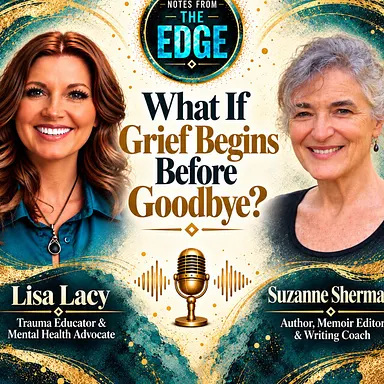
Welcome to Notes from the Edge, where we have the conversations we should have been having all along. We talk about the things that we're not talking about. I'm your host, Lisa Lacey, writer, trauma educator, executive advisor, and author of the upcoming memoir Notes from a Certified Madwoman. Welcome to The Edge. Hey, my friends, welcome back to another episode of Notes from the Edge. I am your host, Lisa Lacey, and this is the place we have the conversations we should have been having all along. Guess what? You ain't talking about it. So today we're gonna— with special guest Suzanne Sherman, and today we're talking about growing up in the shadow of a mother's schizophrenia, losing that mother to suicide, and the complicated grief that follows, and how writing can help us make meaning from what we could never understand or control. Let me tell you about Suzanne. She is a memoir editor, coach, consultant, and author since 1996. She has taught— that was a good year, Suzanne. She has taught memoir writing at colleges, online, and in workshops. and has spoken for organizations including the California Writers Club, the National Association of Memoir Writers, and Story Circle Network.
Her newest memoir, Living in the Shadow, traces her childhood in the 1960s and '70s Los Angeles after her musically gifted mother developed sudden onset schizophrenia when Suzanne was just 4. Told across 2 timelines, The book follows Suzanne's childhood and the 2 weeks after her mother died by suicide when Suzanne was just 18. Ultimately, it explores grief, acceptance, and the endurance of love. Suzanne is also the author of other books. She is the author of Lesbian and Gay Marriage: Private Commitments, Public Ceremonies, and Girlhood in America: Personal Stories, 1910 to 2010. And she lives and loves Northern California. Suzanne, welcome to Notes from the Edge. How are you today, my friend?
Thank you, Lisa. It's a real pleasure to be here. I would like to make one little correction in the book title and make sure everybody listening can know that the book is called Living in the Long Shadow.
Ah, that matters.
Living in the Long Shadow: Surviving a Legacy of Mental Illness. So just to correct that, but thank you very much for having me. I'm happy to be here to talk with you.
Well, good. And that correction matters because a shadow and a long shadow are vastly different, aren't they?
They are when it's kind of metaphorical. Yeah.
Yeah, definitely. So, Susanna, it's Notes from the Edge, so we're just gonna dive right in. You ready?
I am. Thank you.
All right, so when you were only 4, your mother developed sudden onset schizophrenia. So do you remember anything about that moment or Or childhood age between 4, 5, 6, 7, 8, 9?
Oh, very much so. Yes, I do. I write of that in the book. I— it surprised me. It surprises me how much I do remember from that time, but I truly do. And what I experienced, I was able— part of why I wrote this book was to help understand what happened to me and what happened to her. I wanted to understand it finally and at last, and that was about 40 years after she died. I finally felt ready to do that. So I started to explore it, and in doing that, I was able to track— I really wanted to know how long did that first— it was, I would call it really a psychotic, a period of psychosis. How long did that period of time last? Because things changed. My mother had what might be called episodic schizophrenia. It was— she had schizophrenia and always had that ever since it first came on, as it did in the year it did, which was about 1964 when I was 4. And she was 30, which is a very common age of onset. Of this illness. But then it seemed to— she thought that it went away.
It appeared to have gone away because the psychosis went away. She stopped hearing voices. She stopped having those delusions. Depression stayed for her. And depression does not always come with schizophrenia, but in her case, she had both. Hmm. So what happened in that year, 1964, that I was able to track, um, is that I recall, um, is that the mother that had been there for me and with us— I have a brother and a sister as well, I'm the middle child, so she had 3 kids— um, the mother that had been there and been so, you know, wonderful, she was part of the happiest time of my life, you know, at that time. And she was sharing her love of nature and her love of birds and art and music. She had a beautiful trained singing voice. She was a guitarist. She was a pianist. She did all of these, you know, so she was fun. Did a lot of song games with her kids and creative games with us and That changed. That changed. So when you say moment, I don't know if I could track a moment, but I certainly track a period.
And what I know is that she was not with us any longer. She was in her bedroom. And primarily she was in her bedroom. She came out. She must have come out to make dinner because she's the one who fed us at night. But I do not remember that. I don't remember— Really, there's a lot that I do not remember, but what I— an incident that I vividly remember, and I think tells quite a lot about what was going on at that time, is a memory I share of in the book of my father returning home from work. He was an entertainment lawyer, and he was new in his career at that time. She was 30, he was— 31, whatever he was. And he came home and saw that the kids were on their own, as we always were. You know, we were in the living room, whatever, with mom. So he calls out to her and, annoyed, heads off in the direction of the bedroom to go and find her. I went after him saying, what's wrong with mommy? You know, what's wrong? And he, you know, shooed me away with a hand. Don't follow.
Don't come in. She's sick. Mommy's sick. And I was wondering, why is Mommy still sick? You know, we always get better when we're sick. What's wrong with her? No one ever explained anything. My mother that day came out of the bedroom right away because my father could not accept that she had a problem. That was not in his wheelhouse. Nope. No, not, not my beautiful, smart, intelligent, creative, wonderful wife and the mother of my 3 kids. No. So he just absolutely was in denial about it. And my mother too was being— I don't know how she did it, frankly, but somehow she was able to very much keep quiet what was going on inside her. and go about some of the things that needed to be done to keep things moving along in the household. And that night, I watched her from the doorway, and I watched her, you know, open— put, you know, put— open a can of lima beans and put— I literally remember what she opened the can and, and what she did, because I think that what could be called hypervigilance might have started in me at that time, sort of a coping response.
And for me, I've read about hypervigilance, and in many ways I think I did not have it. I did not have a lot of aspects of it, but a part of it that I did have is I was very observant. I may have been born that way, I don't know, but But I was very much watching, and I was very aware. And I'm sure all of that contributed to my being a writer, because writers need to be. But in any case, that happened in my life because I needed to be on watch. You know, it's sort of a survival mechanism, I guess, in a little kid. Like, am I safe here? Is this okay? What's going to happen? It was never— No, it was never clear. My father was, of course, extremely, you know, he was extremely well, you know, and, but he was not a participant in running the show at home. He was not at all. So it really was all up to my mother. My father was at work 6 days a week, and, you know, he was a new lawyer and doing his whole thing, and he just was always working even on Sunday, which was his day off.
So that was early childhood, and that is what I recall from how things changed. She just became more absent. And, um, yeah.
Yeah.
And then, you know, things kept on changing, but that happened during that one time period, which was Like I said, a year and a half. Now I know how long that was because I was able to connect the dots and figure out when this happened and that happened and how it went, and it makes sense. And there's more to say about what happened after that, but I will defer. Yeah, we'll leave some for the book.
Let's see the COVID of the book because it's absolutely beautiful. It's absolutely beautiful.
Yeah, thank you. This is the COVID of the book, which we'll be publishing soon. This is an advanced reader copy. Living in the Long Shadow: Surviving a Legacy of Mental Illness.
Well, Suzanne, I want to ask you something. So, and this will be for aspiring writers out there or some listeners who have a story in them and it hasn't quite come out yet. You were a memoir coach for all that time, and it wasn't time to write this story yet. So how did you know? It was time to write this one.
Interesting. I know, it does seem, you know, I was in the world of memoir for such a long time before I— I taught memoir, and I was working with it all the time. I still do. I still teach memoir. I have a Zoom class weekly, which, by the way, is advertised on my website if anyone's interested in joining. But I suddenly decided it was time to write my own book. I jokingly say it took me 40 years and 5 months to write this book. I wasn't ready for all of that time. I simply was not. I felt like if I thought about it, and I did, I just, I didn't want to go there. I wasn't sure that That I wouldn't be opening a sort of Pandora's box in a way that I would open— I would open the lid on a well of sorrow that I would not be able to climb up out of, and I didn't want that to happen. I really just was a little bit afraid of— I was afraid of digging into it, and I didn't, so I just did not. And also, to write about your own life and put your life into story form, does it begin?
How does it travel through? What is that narrative arc? How does it come to the fin— you know, what is the finish? The obvious finish seemed to me to be my mother's suicide, her death. But I did not know where to start the book, and I felt that it was too predictable to end it with that. So I, I just felt really like I didn't know, and I really Frankly, I didn't really want to. I just really didn't want to explore it. But then when I was in my later 50s, it just so came to be where everything lined up in my life where I had a bit of time, and I thought, you know, what would I do if I were to sit down and start to write this book? How would it be shaped? What would this story be? How would it go? And so, I gave it some thought, and I did not do the detailed notes that I coach others to do. I did my own way of thinking about it and making some choices. And the best way for me to approach it was to take a stab at it, not to have a whole plan.
Because I wasn't 100% sure I wanted to do it, Lisa. The truth is, I really wasn't sure I did. So, I thought, I'll just sit down and write. I'll write 1,000 words and see what I get. I'll just see what happens. And so, I knew, I knew at that time where I would start the story. Excuse me. Where I knew at that time I would start this story. And I, and I sat down with my computer and I wrote 1,000 words. And I didn't want to stop. Wow. And so I wrote another 1,000 words. And then I had 2,000 words. And then I didn't want to stop. And I was on a roll. And I just kept going. And then, and I, I didn't look at it again. I just closed the computer. I felt excited to be doing it. And the next day, I went back to it and continued without reading back on what I had written. I wrote like that for 5 weeks with chapters, all of it. And I was— got to the finish of the book. And I did what I coach others not to do, which is I immediately looked again at page 1.
And, because really what I know is it's best to let the book that you've just written, if it comes out in a surge like that especially, let it rest for like 2 weeks. Let it rest, and then open it up again and look at it with fresh eyes. I was far too eager to do— to look at it with eyes. I didn't have fresh eyes, but I just wanted to eye it. So, I looked at page 1, And, of course, I started tinkering. And before I knew it, I was tinkering on every single page. And I was in a— I was in my first revision. I then decided sometime after that that I would change up the timeline, and it would not be that predictable linear timeline. And what I would do would make it a dual timeline, 2 timelines. And that's what I've done in the book, is have a primary narrative and what's called a secondary narrative where my mother's death, just leading up to it and her suicide, having that be portioned out across all of the chapters and appear at the end of each chapter. And it creates an interesting kind of tension between living the life and then what's going to be happening later and back to living the life.
And, and there are reasons, other reasons I won't detail right now. There are sort of writerly reasons, but why I did it. And I think it worked very well. I'm happy with that.
Well, good. Well, congratulations. I— and I—
thank you.
For our listeners out there, if you missed it, Suzanne said she started with a shape Right? What is the shape going to be? She started thinking about it, and then she put down 1,000 words. So, but also, Suzanne, I think it's important to notice and observe for ourselves that we'll know when it's time to write these very important life stories and memoirs of ours that are layered and complicated. Especially when it comes to grief and loss and mental illness specifically. So we'll know when we're ready. But I love that you started with a shape and you started with 1,000 words and you ended up with a book. So congratulations.
Thank you. Thank you.
By the way, guys, it launches on September 29th. It's in presale right now. And this episode, you'll be listening to it on launch day. We're so excited about that. So Suzanne, you— this is a topic that's very near and dear to my heart as a mental health advocate and somebody who struggled with mental illness as I raised my own child. So you grew up around serious mental illness. Um, what did you learn to, to hide, to manage, to perform in order to survive that?
Well, I feel that I have to say my mother did have that illness, and also my sister, who is 2 years older than me, what— has a lot— a number of different mental illness issues going on as well. And she and her illnesses in the household were part of what was going on for me and for all of us in my household. And for my mother, who unfortunately had to cope with that and try to deal with that because my sister's issues were very vocal and very much a part of the household. So for me and also my brother, who is a couple years younger than me, he and I were— I wouldn't say connected, There was not a lot of connection in my household, but we were much the most alike, you know, and among the 4 of us. And he and I, I would say both went into a kind of coping mechanisms. And so what were those? So I think for me, I won't speak of, you know, anymore for him, but for me, I would say it was finding a— I think I really kind of went into— I used music, especially when I became a young teenager.
But music was a real place I went to. And I spent a lot of time in my song, you know, with music. And books, I read a lot. Imagination, when I was a kid, I was playing imagination games with a good friend. And it would— so I would say going into my— anything that was taking me into my own world in a way was a coping strategy, was— that I can see now as that. I think that— You know, could be called in a way— it wasn't like I was living in a bubble because I couldn't. I really had to keep my eye on things. Um, but I was in a way living in my own world because kids, I think, usually have more of a— they're more relational with a parent. Um, they have certain responsibilities in the household. I did not have either, so pretty much was living my own way in my household. And, um, I think too that I had an inner sort of, you know, I think we're born with essential self, that we have an essence inside. And I think in, in part of my essence self was a real Just sort of that I do take pleasure in a lot of things that are here in life.
And I think somehow that stayed with me, and nature did interest me. And I think that that was a saving grace for me. It helped me have a core desire to survive this thing. And if this train was going off the tracks, I needed to get off the train. And that's what I finally did do when I was a teenager, was try to set a new course for myself so I could survive. Things weren't going well in my favor there.
Yeah. So as a teenager, that brings us to our next point. So as a teenager, um, you left to start a different existence. Um, right, that's not easy to do, uh, especially having not been given any tools, any, any guidance on, on how to live. So talk to us about that, being out on your own as a teenager.
Well, um, okay, I was not— thank you— it wasn't like I'd run away from home. I didn't run away from home in that kind of a way. It wasn't like I was you know, on my own on the street or anything. But, um, I had been seeing— at 13, my mother sent me to see a therapist, um, and, um, she thought that I must need that. It's kind of funny. I had caught, like many young teenagers, I'd been caught shoplifting, you know, with a couple friends. I had taken a nail polish for a friend of mine I'd gotten— I had gotten caught at Newberry's in Santa Monica and, you know, sent to the office and the whole thing, and my mother was called in. My mother was so against— my mother was very much, you know, about truth, fairness, truth. To her, stealing something was a very— that was to her, she thought— she said to me, you feel you're missing something. And, you know, as I just had to shake my head, like, are you kidding? You know, of course I missed something. But, you know, not like you're missing a nail polish, but you know what I mean?
Something big. You're missing something. Okay. So she sent me to a therapist. I didn't have a choice but to go. And He ended up being, I would say, someone who probably saved my life. I was very resistant to going, did not want to go, did go. And I saw him weekly for probably the next— a little over a year, probably a year and a half. And during that time that I was seeing him and I joke, actually I say in the book, you know, it was like days of the week became sort of like Sunday, Monday, Bob Day, Wednesday, Thursday, Friday. I mean, it was like he was part of my week and I looked forward to it. Um, somebody I could— who would listen to, I could learn from, who I— I was good. And I felt that there was something that happened that Gave me the feeling I really couldn't continue to live in this house any longer with my mother and sister and the whole situation of it. And I told him, my therapist Bob, that I just didn't think I could do it. And he took it seriously. And that was probably smart because I really— I didn't have a plan for myself to end my life, but I'm not sure that I was ready to stick around.
And he jumped right on it. And it was actually less than a week later. He called my mother right away, and it was in less than a week that I was moving out of the house. So I was 14. And I moved into— I moved in with someone that he knew and lived with her, which was— turned out not to go well. And I lived next with a friend for a short bit. All of this was temporary while we were waiting for my father to return from his honeymoon. Mm-hmm. And be able to talk with my therapist about what could be, what could happen for me. The idea of moving in with my father was pretty much the last thing on my mind. I was not at all interested. He had just gotten married to the woman he'd been seeing for 4 years. And it did not seem possible for me to move into that household with them. And I did not want to. But ultimately, when the other temporary options didn't work, when he got back from his honeymoon, he immediately came to get me where I'd been staying, took me to go and stay with him and his new wife on a temporary basis.
It was always sort of until something else could be arranged, but we never talked about what that might be. And, and, uh, and it never happened. That never happened. Um, so I did live with them temporarily in a guest room/storage room in that house. And, um, that lasted about 3 months before, um, My father invited me privately, not in front of my stepmother, privately to, um, to live with them if I wanted to. He told me he would send me to a boarding school, which was the possible temporary plan that we didn't talk about. He would send me to a boarding school if that's what I wanted to do, or if I wanted a home, I could stay with them. And I was grateful for the invitation. And, um, and things did improve in ways after that. But there were new challenges. So living with them for the next 4 years. So.
Yeah, well, and then 4 years, uh, moving up to when, um, You lost your mother at 18, correct? Yeah. Yeah. So, um, grief— grief is a strange beast.
Um,
talk to us about how you went through the grief process of, of a very layered, challenging relationship that you had with your mother. What is grief like under those circumstances?
Okay, well, I think I really would— yeah, I will, I will speak to that. First, I really need to make clear that— My mother and I developed a real friendship during those years that I lived with my father. I was able to get together with her periodically and And we had, you know, some things that we did regularly and visited together. And we both shared a love of poetry. I wrote poetry. She did— she had. She didn't then, but she read my poetry. We had connections. And music was a big connection for us. So, we had— she was— She was— important to me, and her illness is something that I would say was the biggest— a bigger part of my grief, as big a part of my grief as her death was, because that illness kept her from living the life of— Living her potential, living the woman that she was besides that illness. And she was medicated for that illness, which in the 1970s meant she was on Thorazine, which is a very, you know, it really depresses the entire system. And so she was, and so she was really always, her spirit was very dampened and her abilities were— Completely crimped.
Her reasons for ending her life made sense to me, and strange as that may sound, she's my mother. How can that be? How can I understand this? She wrote a letter to us, a suicide note, but it was a letter. It was a full page in which she absolutely clearly Cogently explained why and asked for our forgiveness and asked for our understanding and explained what was happening and how the drug that she couldn't live with and couldn't live without was hurting her. And she explained details about that, which I already knew about because she and I had had a conversation about it. So it was hard because it was understandable in a way. Like, how can this be? How could she possibly have continued? She was 45 years old. That is not terribly old. I mean, certainly when I was 18, it seemed old. But, but she wasn't old and she had a lot more life to live. But the way things were going, With her illness and that medication for it, which truly she had tried to live without taking and things had gotten worse. So it was either be super hypermedicated and heavily dosed so you can't hold a job and you, you know, there were things that she could not Do and couldn't concentrate, etc.
I felt like she really had— was in a very stuck place. And of course, I didn't think about it ahead of time. I didn't think, oh, this must be going to happen. But it always seemed that it was inevitable and that it would happen and it could. So yeah, when it did happen, of course, I had a huge grief. I missed her. The loss was the same as it would be for anyone that we love. The sense of loss was big, and, you know, her way of ending her life was hard for me too. It was kind of a hard way to see that happened, and so it was— that also affected me and took a long time for me to work with. So I would say, I don't know what your question was because I got a little lost down that rabbit hole.
You answered it perfectly, but I want to circle back to something you said that I think is so profound. You said you grieve for and because of the mental illness, right? So yeah, I don't, I don't, I don't want to skip over that. My friends, I want to make sure that we, we picked up on that grieving because she had the mental illness and it took so much from her, her being and her spirit. So, um, you chose to tell Living in the Long Shadow through the 2 timelines. You've talked to us about that. You talked to us about how it— that came to be in the editing process. But you described 2 years after you lost your mother receiving an extraordinary sign from her. What happened?
Not 2 years, but, but yes, more than— it was actually 12 years after. Actually, it's, it's such a— it was such an important, like a huge— it was life-changing. changing for me because it really changed how I, how I understood my mother's— how I understood a lot of things, including, I would say— well, you know what I want to say first? I really don't want to say what happened, so I'm trying to speak around it a little bit.
I see you trying to like not tell us because it's in the book.
I'm not telling you. I'm not telling you the actual thing that happened.
Don't ruin it.
I mean, you know, I'd love to tell you, but—
The day that changed everything. Yes, I love that. I love that.
I do tell it. I tell it in the book, and it's at the— it's in the epilogue in the book, and it did change everything for me. And what it did, it really was an uncanny and unquestionable— unquestionably true kind of mystical, yet true, and true sign that she's with me in spirit, that she is with me. She was with me in spirit. I believe she still is with me in spirit. She— we had a connection, and she was there for me at the moment that this particular event happened. when I was 31 years old on my birthday. And it changed everything for me to know that, that even after death, that, that love really does continue, that connection can continue. And it doesn't have any It doesn't mean that I'm not imagining it, and it doesn't mean that I've, you know, I'm losing my mind. And it's not like I'm walking around having a conversation with her, but I can feel her presence in a way ever since having that particular experience, because I know that that is also real. It's unseen, yet it is as real as what we see.
Well, and once you see, you can't unsee, period. That's it.
Exactly.
Yes. Right.
Well,
Suzanne, thank you so much for being, um, so vulnerable with us. I can't wait to get my hands on, um, the, the memoir. Um, I think it's going to, uh, speak a lot into my own, uh, life and existence at this moment in time. So I'm so excited to help support, get it out there. So it's in pre-sell Right now, you guys, as you're listening to this, this is the day of launch, so be sure to check it out. Suzanne, you mentioned your website. Tell us the website. We will put a clickable link, guys. You don't have to write this down, but Suzanne, where can people find you, find your coaching services, find your weekly class, and find the book?
Thank you very much. My website is my name, So suzansherman.com. And on my website, I have all of that information, including the links to the book, which is distributed by Simon& Schuster. So it's available, of course, on Amazon. It's also available on bookshop.org. It's available on Barnes& Noble and directly from Simon& Schuster. Yeah.
Wonderful.
And my class is— yeah, my class is advertised as well. So I do welcome new students every 8 weeks. So yeah, thank you.
Exciting. Well guys, if you're out there and you feel like there's a— it's time to write a story, specifically a memoir that's on your heart, uh, reach out to Suzanne and be sure to pick up, uh, the book. Uh, it sounds like a showstopper to me. So, uh, we'll put the clickable link here. You guys don't have to do anything but click on the link and you'll go straight to her website. But Suzanne, Before we let all of our guests go, we always end with 2 questions. Are you ready for the first one?
Okay, throw them at me.
All right. In your own life, what do you feel like you performed the most in order to survive or get by? And what did setting that role, mask, or performance down do for your life?
Wow, those are big questions, Lisa.
They are, aren't they? They make you think.
Yeah, let's see. Well, I want to break down— okay, I'm going to answer them. Can you, can you— so can you please say the first one again? I'll take them one by one.
What did you perform in order to survive or get by? And then the second part is, what happened when you chose to set that role, mask, or performance down?
Hmm, that's really interesting. Well, I think— what did I perform? I think that I performed something that I still carry to this day, which is a I mean, more to this day, it actually shows up in more of a mantra in my mind because I know about mantras now. And I know the importance of them sometimes. But which is, I can do this. And I think that, you know, I wrote my first book, I was 30 years old, and I put it on a Post-it. On my computer. I can do this. And that book was published by Temple University Press. You know, I was pretty young doing all of this to do with publishing a book. And I can do this. I think that I carried that as a— I had a way of just— I didn't necessarily believe Lisa, when I was younger, I could do it. But in my heart of hearts, I must have known because I kept on going. And when I got to a point where I could, I could speak those words, I did. And I, to myself, and I used them and I still do to this day.
Did that answer both questions or only one?
That's actually the edge note. for our show today, guys, is a simple one: you can do this. I love that mantra. It's short, sweet, and simple and gets straight to the point. Thank you for that. All right, last question. It's an easier one. Okay, what do you wish we as humans were talking more about? What do we need to be having more conversations about with each other?
Ah, I think that the importance of Of communication. I think the importance of speaking about what is, what is up and what is, what needs to be said. It's important to say what needs to be said and to do it with kindness and to do it with care and with love. And I think that from out of my experience with so much lack of communication and so much supreme independence going on by everyone. I think, you know, I came to learn in the negative in a way how important it is to communicate and let people know, you know, I, you know, even if it's saying to them something like, hey, you know, can we sit down together and just talk for 10 minutes about Something that I'm feeling like you're not really hearing me lately, and I need to have, I need to have a line of communication open with you. You know, just really take that, take that more seriously and not just keep going like, gee, this isn't working. I don't, I don't think I want to see this person anymore, but to actually try to make that point of connection In a, in a way that can be heard and in a way that feels good to both of your hearts.
Yeah, guys, so she's saying have the hard conversation sometimes. I love that.
Yeah. All
right, my friends out there, I'm gonna ask you the same question I asked Suzanne. What might you be performing in order to survive? And what do you think setting that role, mask, or performance down might do to lighten your load just a a little bit. I am your host, Lisa Lacey, here with our special guest Suzanne Sherman, with her book coming out in just a few weeks. And when you find the answer to that question, we will both see you at the edge. Thank you, Suzanne.
Thank you, Lisa. Pleasure.
What happens when you begin grieving someone you love long before they’re gone?In this deeply personal episode of Notes From the Edge, host Lisa Lacy sits down with Suzanne Sherman, author, memoir editor, and writing coach, to explore childhood trauma, schizophrenia, suicide loss, complicated grief, and the healing power of storytelling.Suzanne was just four years old when her mother developed schizophrenia. At eighteen, she lost her mother to suicide. Decades later, she found the courage to tell their story in her memoir, Living in the Long Shadow: Surviving a Legacy of Mental Illness.But this conversation reveals something profound: sometimes we grieve not only the person we’ve lost, but the life mental illness prevented them from living.Through memories of her mother, decades of unanswered questions, and the decision to finally write her story, Suzanne explores how love, grief, and healing can coexist.In This Episode:Growing Up with a Parent with Schizophrenia: How Suzanne’s childhood changed when her mother’s mental illness emerged, and what happens when children are left to make sense of experiences nobody explains.Suicide Loss & Complicated Grief: The emotional complexity of losing her mother at eighteen, including the grief Suzanne experienced long before her mother’s death.Mental Illness, Family Silence & Childhood Survival: How unspoken struggles, family dynamics, and the need to remain observant can shape a child’s understanding of safety and belonging.Memoir Writing & Healing Through Storytelling: Why Suzanne waited decades to write Living in the Long Shadow, how she found the courage to revisit painful memories, and what writing taught her about her own life.Love Beyond Loss & Finding Meaning: An extraordinary personal experience that changed Suzanne’s understanding of her connection with her mother, the importance of honest communication, and the simple words that helped her persevere: “I can do this.”From the lasting effects of parental mental illness to the courage it takes to tell a deeply personal story, this conversation reminds us that grief doesn’t always begin with death, healing doesn’t require forgetting, and some of the most important conversations are the ones families never learned how to have.Connect with Suzanne ShermanExplore Suzanne’s memoir, writing workshops, coaching services, and weekly memoir classes.Website: https://suzannesherman.comConnect with Lisa | INSIDE THE EDGEJoin INSIDE THE EDGE, a membership community for deeper human conversations, personal exploration, and meaningful connection beyond the podcast.https://www.lisalacy.com/inside-the-edgeWhat did you perform in order to survive?Welcome to the Edge.See Privacy Policy at https://art19.com/privacy and California Privacy Notice at https://art19.com/privacy#do-not-sell-my-info.