
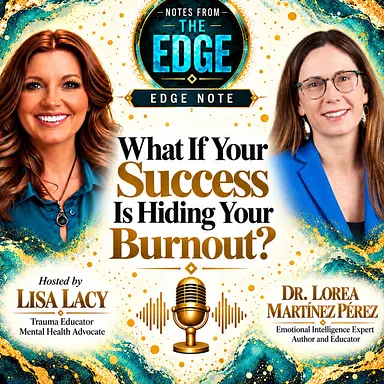
This transcript of “Edge Note: What If Your Success Is Hiding Your Burnout?” from Notes from the Edge was made with HappyScribe’s speech-to-text technology. Related: Teams AI note taker.
Ads in this audio differ from the text. Tap the sentence you're hearing to follow along.
Synced: the text now follows the audio.
Welcome to Notes from the Edge, where we have the conversations we should have been having all along. We talk about the things that we're not talking about. I'm your host, Lisa Lacey, writer, trauma educator, executive advisor, and author of the upcoming memoir Notes from a Certified Madwoman. Welcome to the edge. Hey, hey, my friends! Welcome back to another episode of Notes from the Edge. I am your host, Lisa Lacey, and this is the place we have the conversations we should have been having the whole time. Guess what? You're not talking about it. So today we're gonna, and today our special guest is Dr. Lorea Martinez. Perez.
And we're talking about what burnout is really trying to tell us and why high achievers can become disconnected from their own emotions and how emotional intelligence, boundaries, and purpose can help us move beyond survival mode. Dr. Larrea is an emotional intelligence expert, educator, and the award-winning creator of Heart and Mind A research-based approach designed to help individuals and organizations develop EI, or emotional intelligence skills that support wellbeing, leadership, and better relationships. That means in business too, guys. In her new book, Living with the Heart in Mind: A Practical Guide to Healing from Burnout and Cultivating Purpose, she combines emotional intelligence, neuroscience, mindfulness, and her own experience with burnout to help overwhelmed professionals move beyond survival mode and build healthier, more fulfilling lives. She has trained adults internationally, and today she's here to talk about not only helping you, but her first book. Dr. Lorea, welcome to Notes from the Edge. How are you today?
I'm doing great. Thank you for having me, Lisa.
Yeah, I'm so excited. This is a topic near and dear to me. Emotional intelligence is so important. Um, I happen to know a lot of science behind it because I worked in addiction and trauma recovery centers using it. But let's start with burnout itself. So what were some early signs for you as a high-functioning adult that you had hit it, you'd hit the wall?
Yes, one, one of the first ones was losing my joy. And my motivation to do the work. And I had been teaching educators, that was my life's passion. And it got to a point where even if I was doing things that in the past were exciting and I enjoyed them, I lost feeling that joy. And that was a big sign that I ignored for many months. until I, I got to a point of what I call adult meltdown, where I was walking with a colleague and he was helping me think through my consulting business. And he just mentioned, oh, would you consider this new line of work? And I just felt in my body like so overwhelmed and just a sense of I, I cannot take anything else. Even considering an idea felt so overwhelming, and I started crying, couldn't stop. We're in the middle of the street, I'm bawling. And that, that day—
Nothing like a nice ugly cry to get everything out.
Oh, it was, it was ugly. You, you don't want to see it. And I got home that day and I said, wow, this there is something here that I need to consider. I need to pause. I need to see what's happening. And that's how— that was kind of like the wake-up call for me. But things have been— had been building up for months. Normally burnout is not a one-time event, but it's something that accumulates over time.
I gotcha. I gotcha. So why are high achievers so good at recognizing what they need to do, everybody else's stuff. But we can be so disconnected from our own needs. Like you, like you were in it for months without even actually realizing it. What happens for us there?
Well, the thing is that if you're a high achiever, you have been rewarded by getting results, right? The— your work probably, uh, is telling you, hey, you are doing great. You are very focused, you are very effective, you are pretty good at your job. And that's what we tend to do. So even when things don't go well, you are still trying to move forward. And that was the reality for me. And I know that is the reality for many people. When something goes wrong, we double down. That's the
moment where we're like, do more.
We're going to try harder because what we are doing is not working well enough, right? So let's, let's try harder. And what we need in those moments is actually the opposite, because trying harder is not gonna get you the result of feeling satisfied with yourself and with your life again. What it does is it increases your feelings of overwhelm, anxiety, or feeling stuck. Whatever you're experiencing, it, it just goes higher instead of, you You know, lowering the level.
Yeah, I love that word double down. We sure do, just to try to keep enduring, right? So that's why you got to a place, you had an opportunity to make a change, you did. That must have been— let's talk about that transition, because a lot of us later in life are scared of transitions, but we may need one. So you, you took a leap in a whole different direction. What was that transition like for you?
Well, so to tell you a little story, I was in a meeting one day and I was working with colleagues. It was one of my clients at the time, and there was this lady that said, well, you know, the work that we are doing here is important. We're teaching these skills to educators, but the reality is that all adults need these skills. Mm-hmm. That lighted up, uh, uh, the, the bulb went on in my brain. I was like, I heard that differently that day. And I finished that meeting and I had the urge of opening a Word document and writing down the outline for what's now my new book, Living with the Heart in Mind. I just had that, um, connection to say, wow, these are skills that we all need, all adults, not just in the education space where I had been working for more than 20 years. So for me, that was the transition to see even the same thing with a different light and to see, oh, I can expand what I'm doing and really being able to help other adults, not only in the education setting, but people who are experiencing burnout.
I mean, I have people all around me that are not educators that are experiencing those same symptoms. So for me, that was the switch, and it's not a huge change, but my attitude and my even mindset changed a little bit, and that helped me find kind of like a new path to move forward.
Well, what I loved is you had a light bulb moment and you did something basic, opened the Word doc and started writing. So my friends listening out there, There's an idea gnawing at you, open the Word doc and start writing. So, Dr. Larrea, I wanna talk about emotional intelligence because in my own experience in teaching it in trauma and addiction recovery centers, it was a game changer. So talk to us about what it is and why it's so important. And there's a lot of science backing this now too. So talk to us a little bit about what is emotional intelligence.
So at the core is being smarter with feelings.
I like that.
It's that simple. It means that we have mathematical intelligence to solve mathematical problems. So what emotional intelligence does is it helps us solve emotional problems, problems that are related to relationships, to knowing ourselves, to how we make choices, how we conduct ourselves in the world. All of those things can be done with emotional intelligence. And what I love about, about it is the fact that these are skills that you can learn. So this is not for just our children. It's not for young adults. It's for everybody at any point in your lifetime. you can actually improve your emotional intelligence. And that means that if you are feeling stuck, if you are feeling frustrated, or you are kind of like looking for where to go next in your life, those skills can help you. And you can learn them, develop, use them every day to, to make better decisions in your life.
I love that. And I love that you highlighted relationships, um, because that's what I observed Is that a higher emotional intelligence improved relational bonds tremendously. So, so you had this light bulb moment, you opened the Word doc, you started writing, and you came up with Heart and Mind Model. So what does it teach us about emotional intelligence that the traditional ideas that you hear about all over now, self-care and stress management, often miss?
Yes, thank you for asking that question because I, I have— I, I almost don't like and try not to use the word self-care because it has been— today people use it as, oh, you just do something small to feel better, but it's not really addressing the, the real challenge that you have. It doesn't even help you name if you are going through a struggle, to really name what— that you are experiencing something difficult. And the difference with the Heart and Mind Model is that it's a skill-based model. It means that you have skills that you can develop to really get you at the core of how you can solve that problem that you are dealing with, or if you are trying to improve relationships how you can relate with others better, how to relate better with yourself. It's not just, oh, I'm gonna go, um, you know, to the spa for the day, or I'm gonna go take a nap. Those are things that can make you feel better kind of in the, in the moment, in the short term. But if you're really looking at building your well-being in the long term, it's much better to see, okay, what are the skills underneath that I can use that that then can be transferable to any part of your life.
It can be your parenting. It can be if you are a business leader. It can be how to become a better leader. Those are the skills that really bring that human component. And they help you solve human problems, which is, I would say, 80% of the problems are human problems.
They are human problems, aren't they? And it all goes— even relation in the workplace, what is it? It's relationships, right? So I want to talk about performing well wellness, because this is a topic near and dear to us here at Notes from the Edge. Because so many of us, especially high-functioning survivors, high achievers, we perform fine. I'm fine, really, really, really well. So somebody can look successful, productive, positive, and put together, but be in survival mode and unraveling behind the scenes. So what, what happens to us Why do we have such a hard time coming forward and saying, whoa, I'm struggling, I'm not okay?
So I would say 2 things. One is there's a perception of weakness anytime that you admit that, oh, this is not working, right? You— we generally put it on ourselves to say, oh, if I name that, how am I gonna be perceived by my colleagues or by my boss? even by my family or my friends, right? So there's a fear of that, um, the social perception of naming the challenge. Um, but there's also the how we are maintaining our energy levels. I understand well-being as how can you generate optimal energy in order to be healthy in the long term. So if you think about um, your energy as something that needs to be regenerated. You need to regenerate it, you need to rebuild it, you need to pay attention to how you are performing if you want to do it at high levels in the long term. And that means that you're gonna have higher periods of higher, uh, energy usage and periods that maybe you need to slow down so you can regenerate some of that fuel that you had, that you just used for a busy season. So with those 2 things, the fear that we experience is something normal.
But if you see it, that that's what's behind it, I think it's easier to address it because you can still almost like have a conversation with it and say, oh, what is this fear? trying to protect me, because fear is a protective emotion. That means that when we are feeling afraid of something, we are trying to protect ourselves from a potential threat. So if you can understand that and see, oh, I'm feeling scared about this situation, or about naming that I'm struggling with this, that makes it easier to do something about it versus being in the dark and not knowing why that is and just plowing forward like we would normally do.
Yeah. And I love that you pointed out too, a lot of times, at least in my situation, I didn't have language to describe what was happening. So yes, there was the stigma attached to it, which you named very eloquently. But there's also— we need language. And so working with somebody like you, the reason we would do that is to get some of that language around what the heck is happening to me? So, um, yeah, I, I, and I, we advocate in here on Notes from the Edge for people who are not okay to be okay with saying, I'm not okay, right? And then have the people who love, support, and are in service to us, you know, show up in ways with emotional intelligence. Again, emotional intelligence can make that conversation so much easier. So speaking of relationships, Let's circle into a fun topic called boundaries. Now, we are hearing about boundaries everywhere right now. We're hearing about it everywhere. Um, but setting them can create a lot of guilt, rock the boat. People don't like it at first. It's really hard to do, especially for those of us who have said, I can do it all myself.
We're hyper-independent. the ones that are the go-to people. So how do we begin to separate our— how do we begin to one, set the boundary, and two, not abandon ourselves in the process? But tell us what boundaries are in your philosophy first, because we're hearing the word everywhere right now.
Yes, boundaries are kind of like, you know, kids talk about their, their, their bubble space, right? Their personal space. So if you, if you think about that for adults, is the same. It's like, what are my limits, right? What— how can I set up, um, some, some boundaries to really be able to show up as my best self? Because that's the, the goal of developing your, your emotional intelligence and, and nurture your well-being. And you are so right that when we start doing that people around us may be puzzled because they are like, oh, you used to say yes and now you are saying no. Or maybe, you know, you had certain attitude towards certain topics and now that has changed. What was interesting to me as when I was writing the book and doing research on boundaries is that I was thinking more around, um, you know, more like physical boundaries or digital boundaries. But the one that I thought it was so interesting is emotional boundaries and how we consciously and intentionally may move away from toxic people in our lives or from being constantly engaged in what I would say emotional turmoil, right?
In drama. You know, like, like that would be drama. Yeah.
Every day, energy, right? It drains the energy you were talking about earlier. And it's interesting, a phenomenon I've seen, and tell me if if you see this in all the people that you've worked with. When you start working on yourself, the toxic people kind of just fall off, you know. Sometimes they'll just take themselves out, and they end up getting replaced with people that are on the growth path with you. But all you have to do is work on you. Have you kind of seen the same thing in your work?
Yes, because when you're, when you're in that process of, of really paying attention to yourself and and trying to nurture yourself, you become very grounded in your values, right? And if you're in your values, you might want to be in community with others, but when they are bringing that negativity or that energy that really doesn't match what you are trying to do, it feels a lot more empowering to say, hey, I love you very much, but I need to set up that limit. This is I can't be this person for you. Maybe this is what you need, but I'm sorry, I can't be that person for you. And you can say that in a very loving way with still protecting your energy. And one of the things that I work with, with people is in including themselves in the circle of care.
Mm-hmm.
And that's super meaningful for high achievers because we tend to just look at others, how we are working, how we are being effective and high performers, but we don't think about care to something where we, we can be part of it.
Yeah.
So when you include yourself in that circle of care, it is easier to see how maybe you need to let go of certain relationships because they are not healthy for you, because they are not helpful. Um, not that it needs to be like a transaction, but it, it can be very eye-opening when you are looking at it from that perspective, that you need to be well in order to be in that relationship.
Yeah, and have the relationship help you be well, not, not drain that. So I love that you're bringing attention to emotional and energetic boundaries. So very valuable and important to to do the regenerative process. Because if people are constantly draining us, there's no time to, to your point, to regenerate. So now, how do we begin to separate? How do we not abandon ourselves in the process of setting boundaries? Because they're hard to practice at first, at least for me. I wasn't very consistent.
Yes. And, and, you know, we have to name that it will be uncomfortable. Mm-hmm. So anytime that you are developing a new behavior, it requires a few trials, right? And you learn every time that you set up that boundary and you say no, or you say maybe later, you take a break for yourself, you are developing a new behavior. So it's like learning to ride a bicycle. At the beginning, it might be hard. You fall, right? Um, you, you hurt your knee, you get a scratch or two, right? And eventually it feels like, oh, I, I got this, right? I, I can do this. And then you can go downhill, uphill, right? You can go, you can do all the tricks if you want, but that beginning is difficult. So sometimes I, um, tell people to start with things that maybe that they perceive as lower stakes. Right? Maybe not go with the hardest situation they have in their lives, but just to start trying those new behaviors with situations that don't feel as stressful. And once you gain a little bit of confidence and you are creating those memories of like, oh, I did that and it worked, then you have, uh, another motivation to say, oh, I've done it once, I can do it again.
I love that. And you know what? I love, I love your wording. Maybe later. Brilliant, because it buys you some time, you know, because we're yes people, right? Yeah, sure, I could do that. Yes, yes, yes, yes. And no is the hard word to learn, and maybe later kind of sits in the middle. So I like that. So yeah, listeners out there, borrow her words, maybe later. Um, it buys you some time to figure out what you really want. Because sometimes it's hard to— if we haven't defined our wants, needs, and values, then it's really hard to determine where we want to say yes and where we want to say no. So, um, okay, when somebody realizes, I have built this successful life, but I'm not feeling, and to your point, joy in it anymore, it doesn't feel right to me anymore. What's one step if we've got a listener today that is resonating with you and is like, oh my gosh, that's where I'm at, but they don't know what a next step is. What's one step that they can maybe take tonight after they listen to this to help move themselves in a different direction if they think they've reached a level of burnout and lack of joy in some situation in their life?
I would say the first thing is try to name it. try to really describe it for yourself. And I have found that writing is a great way to process situations, but it can— if that doesn't work for the audience, you can also just, you know, record an audio piece on your phone, right? You are walking, you're going on a walk, and walking is another really good tool to process. You can be, you know, just record it. and, and just put it out there. Because as you are, um, processing, things will come up, right? And that you— maybe you were thinking that the issue was A, and then at the end of your walk, you're gonna realize the issue was actually B. And now you have more insight into what to do next. I think one of the challenges is that we try to go so fast to what's next, because sitting in the uncertainty of like I know something's not working, but I don't know what to do next. Well, let's sit with that for a little bit longer, because the more you can know what is the issue at hand, what is the, the struggle, why are you feeling stuck, what are some of the emotions you experience, and why— what, what, what are those emotions trying to tell you— the more data that you can gather, the easier it will be to see, okay, what's next.
But if you move too fast into that direction, you might be stuck. Like 3 months later, you might feel again, oh, I'm stuck. I took that turn and it wasn't the right one. So just sitting with that uncertainty for a little bit and just giving yourself the time to figure things out without rushing to the next thing might be a very, very empowering place to be and very insightful because you're taking your— the time to listen to yourself.
Which is you've got to stop. You've got to be still. And I love what you pointed out, and I think it's important to go back to that emotions are data for us. It's information that we need to be paying attention to within ourselves. Because, you know, in my situation, for so long I was run, run, run, run, running from all of it. And I got to tell you, once you sit and you sit on your face, on your process, on your moved through them, it wasn't that bad. And I spent 20 years avoiding it. So I love that you have pointed out that this is all data for us. And yes, the audio tip is great. So guys, take a walk, make an audio for yourself. And I love the idea of even maybe listening to it the next day to see what the message is for yourself. Yes. So let's talk about the book. All right, let's talk about your book. So what do we have to look forward to in your book?
Well, I would say it's the most personal piece of writing I've produced. It has a lot of personal stories of my own story of burnout and how I heal through all the tools that I'm presenting in the book. Truly, it comes from that practitioner's voice of like, hey, I've been there with you. And these are some of the things that I've done to, um, to help myself, and I'm hoping that it will help others. So very practical book. It has, I think, more than 30 tools that you can use. And what I love about it is that it has the, the heart and mind model, the heart skills, but it also has other aspects that can help you in your process. For example, leaning into curiosity. and creativity. So it has places where people can connect. So if there's one chapter where you're like, ah, that's not really talking to me, you can go to a different one. And I really hope that there's something there for everybody.
I love that. I love that you're actually giving us skills and tools that we can apply right away, because often, um, some books are so clinical in nature That they become really hard to apply. So I want to go back to curiosity and creativity. Curiosity is one of my favorite words because it changes our physiology. It puts us in an entirely new perspective. Talk to us about how curiosity not only changed your lives, but the lives of the clients that you work with.
Yes, it's such a great quality, and it can be as simple as asking what else can be true here? And I can tell you that we— I move through life, different situations, and when I put my curiosity hat on, I am a less reactive parent. I can listen to my spouse with more openness. I can engage in a work conversation, uh, with being with an open mindset versus instantly trying to judge. And, and just know that judgment is actually a really good skill, and it's the way that our brain operates to be quick and know, is this good or bad, right? That's what our brain is trying to do. But when you come to that conclusion too fast, then you are missing the beauty of learning more about whatever situation you have in front of you. So curiosity, even for your own process, if you are feeling stuck, if you are like trying to figure out something in your life, applying that curiosity and a little more playfulness so it makes things a little bit lighter can be very liberating and it can be very helpful to help you move through what you are going through so you can go, you know, you can move forward.
I love that. And we all need a little more play in our lives. We adults forget. We, we forgot a long time ago how to have some good playtime. So we all absolutely need that. Well, Dr. Luria, how can people not only find you to work with you, whether they're an individual or an organization? And listeners out there, if you're in an organization, every organization— actually, we need to be teaching emotional intelligence in like middle school. However, we kind of missed that boat. So let's teach it in organizations because statistics show that higher emotional intelligence within organizations increases productivity. Dr. Luria, I think the numbers are like 50%. It's an insane number.
Yes.
And decreases interpersonal conflict by like 25%. So friends, if you're in an organization and you feel like there may be some To Dr. Lorea's words, drama in there, reach out to her. Where can we find you to work with you as an organization or individual, and where can we find the book?
Yeah, so, uh, people can reach out to me at my website, loreamartinez.com, and the book is available, um, Living with the Heart in Mind, where books are sold. So anywhere you buy books, you can find it there.
All right, guys, and you don't have to write that down. We're going to put both of those links in the show notes so they'll be directly clickable so you can go straight to her website. Um, uh, Dr. Larrea, just make sure I have which book link you want us to send our listeners to. And before we let you go though, we always ask our guests 2 questions. Are you ready for the first one?
All right, let's do it.
All right, let's do it. All right, in your own life, what did you perform In order to survive? And what did putting down that role, mask, or performance do for your life?
Those are really good questions. The one thing I would perform, I would say, is having things under control.
Yeah, control gives us a sense of, uh, control.
Yes. Yes, and not only for, for myself, but like having the appearance of having everything under control. Um, and that can be very, uh, helpful and, and productive in the short term, but I would say that in moments it also made me feel very lonely at times.
Mm-hmm.
Because then I didn't have the help I needed because the perception was like, oh, she has everything under control, so she doesn't need help.
Yeah, that's a good one. All right, my friend, and what do you want us as human beings to have more conversations about? What do you feel like we need to be talking about more?
I think, you know, in the age of AI, having conversations about human skills and how we show up in the world as humans is going to become more and more important. So I'm glad we had this conversation.
Yeah, isn't this amazing? It's, it's like a dream come true to be able to connect with you brilliant minds who are just here to help others have an easier ride, and I love that. So friends out there, I'm gonna ask you the same question that are listening: what are you performing in order to survive, and what might happen for your life if you set down the role mask or performance? I am your host Lisa Lacey, here with our wonderful guest Dr. Lorena Martinez Perez. And when you find the answer to that, we will both see you at the edge. Thank you so much, Dr. Larrea.
Thank you, Lisa.
You can look successful, productive, and completely put together while quietly falling apart behind the scenes. In this Saturday Edge Note of Notes From the Edge, Lisa Lacy sits down with Dr. Lorea Martínez Pérez, emotional intelligence expert and author of Living with the HEART in Mind, to explore why high achievers often miss the warning signs of burnout until they’ve lost their joy, motivation, and connection to themselves.Together, they examine why pushing harder isn’t always the answer, how emotional intelligence helps us understand what our emotions are trying to tell us, and why boundaries, curiosity, and purpose matter more than temporary self-care fixes. This is a conversation about letting go of the performance of being fine, learning to include yourself in the circle of care, and finding your way beyond survival mode.In This Episode:Why burnout builds quietly and how losing joy can be an early warning sign.How high achievers become disconnected from their emotions while meeting everyone else’s needs.Why emotional intelligence is a learnable skill that transforms relationships, leadership, and well-being.How to establish emotional boundaries without guilt, including the power of saying “maybe later.”Why slowing down, naming your emotions, and embracing curiosity can help you rediscover purpose.Connect with Dr. Lorea Martínez PérezWebsite: https://loreamartinez.comExplore her book, Living with the HEART in Mind: A Practical Guide to Healing from Burnout and Cultivating Purpose: https://loreamartinez.com/living-heart-in-mind/Connect with Lisa LacyWebsite: https://www.lisalacy.comJoin INSIDE THE EDGEGo beyond the public podcast with exclusive weekly episodes, private monthly conversations, and a community built around meaningful human connection.https://www.lisalacy.com/inside-the-edgeWhat did you perform in order to survive?Welcome to the Edge.See Privacy Policy at https://art19.com/privacy and California Privacy Notice at https://art19.com/privacy#do-not-sell-my-info.