
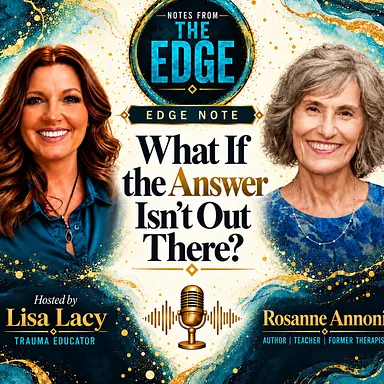
“Edge Note: What Happens When You Stop Searching Outside Yourself” was turned into text by HappyScribe’s speech recognition. Related tool: automatic transcription of recordings.
Ads in this audio differ from the text. Tap the sentence you're hearing to follow along.
Synced: the text now follows the audio.
Welcome to Notes from the Edge, where we have the conversations we should have been having all along. We talk about the things that we're not talking about. I'm your host, Lisa Lacey, writer, trauma educator, executive advisor, and author of the upcoming memoir Notes from a Certified Madwoman. Welcome to The Edge.
Hey, hey, my friends. Welcome back to another episode of Notes from the Edge. I am your host, Lisa Lacey, and this is the place we have the conversations we should have been having all along. Guess what? You ain't talking about it. So today we're gonna— and today's our special guest is Roseanne Annoni. And today we're talking about what happens when searching for answers eventually becomes learning how to stay present. Guys, there's a lot of safety in the present moment, and we miss it a lot of times. So Roseanne spent 35 years— that's a long time— as a psychotherapist before becoming an ordained teacher of the Diamond Approach in 2000. Guys, that was 26 years ago. She has taught and mentored students and teachers across the US, UK, Europe, and in 2024, she received an Emerging Writer Fellowship from Aspen Words. Her memoir is Unfolding the Heart, which explores grief, spiritual awakening, motherhood, healing loss, and the search for an authentic inner life.
Because we're—
when we're living authentically, it's so much easier to live our purpose and mission. Roseanne, welcome to Notes from the Edge. How are you today, my friend?
I am so well, and I am so happy to be here. Thank you for inviting me. Yeah.
Really appreciate it. Nice to have you here. It's nice to have you here. So, Roseanne, you began— it's Notes from the Edge, so we're jumping right in. We always do. Here we go. Ready for the ride? You began your spiritual journey pretty young. What do you think you were actually searching for between all the religion and the practices and the traditions? What were you looking for on that spiritual journey, even as a young woman?
You know, that is a deep question.
We get deep in here, sister.
You know, I could say I was searching for myself, but really there was something— it's like I think I was looking for some kind of connection that resonated for me, and I wasn't feeling it necessarily in my family. I don't think I really felt seen in my family, you know, as myself. So I think I was looking for some reflection back on, you know, who I was, what I was about. And I had this, as you know from the book, I had this vision when I was 10 that Christ called me to become a nun. Now, I was raised Catholic. I knew right then that there was some truth to that, that I really wanted to serve humanity, but what does a 10-year-older know? And, uh, I think, I think that my search was always for what does that mean? What, what am I here for? What's my purpose? Um, you know, it was like, use me, but I didn't really know. It took years to get some clarity on, you know, where— what was really—
Yeah.
my path or my purpose here, my design as a human being.
Well, and I think in, in the seeking, and if we keep seeking, we're gonna eventually get there. Take some of us longer, you know, could take us 10 years, could take us 6 months. You just don't know. But I think when you're living a life of purpose and, and meaning and fulfilling what you believe to be your mission, Um, hope is easier to find. So how do we know when spiritual seeking is helping us grow versus, um, helping us avoid something painful that we don't want to feel?
Hmm. Um, well, you know, there are many spiritual paths.
Yes, there are.
Some are transcendent. You kind of rise above all the fray. I was never drawn to that. And I think I was always more drawn to the teachers who were finding a way to be in the world, but not of it, like really be with the grit, the grit of life. So for me, I, when I began my own search, it was like the first step was, oh, I started to feel some connection with myself. So that was good. The next was, uh, I couldn't run away from what was here.
You.
Me.
Yeah, we can try. I tried for a long time, and I was like, well, I'm tired of myself. I go with me everywhere I go.
I thought, oh, oh boy, I'll just focus on my breath and then I won't have to feel everything I'm feeling. And, and it was like, oh no, that's not working. So I think, I think something that like takes you away from the grit and the meat of your existence isn't going to be very helpful in the long run, but something that can bring you closer to the truth. So for me, it was facing years of pain and trauma that I didn't even know. I, I had no idea I had trauma in my life. When my, my mom was a little nutty, and I'll be kind, she was, she was, she was difficult.
Mine's still living too, so I have to be very selective about what I say.
Oh yes, no, my mom, God rest her dear soul, is in heaven, I'm sure, by now. Uh, but You know, when my friends would come, they'd go, Wanda, what's, what's with your mom? And I'd go, oh, she's just Italian. I did not know that, you know, all mothers didn't slap the kids whenever you did, you know, said something wrong or looked at her sideways or didn't do what she wanted me to do. And so there's a lot of yelling and slapping and, you know, punishing. And I didn't— I didn't register that as trauma. I just— I think what happened was I just kept getting more and more further away from myself as a way to, to like cope and function in the world. And I became very precocious in that way. I just, you know—
Well, sometimes we don't have language for it when it's happening to us, you know. And we— I, I ran from all of those, all the events and all the feelings and all the things in a bottle. I ran straight into a bottle for 20 years, um, in addiction, and because I was running, you know, I was just numbing, I was self-medicating. So we all have our vices to, to be in denial. Exactly. But something amazing happens when we start to have language, not blame, Because blame is not where healing takes place. But when we start to have language for what we have experienced— so you have experienced grief and illness and motherhood and major loss. How have those experiences changed your understanding of how you exist in the world the most?
I think I could look back on my life and there were some very significant experiences. And it was more like little by little, it turned me in towards myself. But it was a very slow process. When I was— when I had first written this book and I asked Ann Hood, who was one of my writing teachers, I said, how would you classify this book? And she said, it's kind of like a coming of age, but in midlife. I'm in it.
I'm in it. And it was like, oh, I was not prepared. I ran.
Yeah, I love what you said about running because I ran too, but I— my running was I just kept going from one thing to another, from one relationship to another, from one husband to another, from one— I just, I left the East Coast because I wanted to get away from everything that was there, thinking I'm going to start a whole new life on the West Coast. And when I moved to San Francisco In 1979, and that was a huge move for me. That's it's interesting, but that's where I started to find myself because there were so there was this explosion of spirituality and metaphysical experiences and tai chi. I mean, I didn't know about any of these things in yoga and meditation, and I was just like, ah, I was like in a vat of chocolate. But it was it took time. You know, for me to actually settle down some and find out, okay, where are, where are all these experiences taking me? And they really were taking me further in. And so I ended up, I did some extensive therapy after I moved to the West Coast. That's when I really did therapy.
I was a therapist.
Yeah.
Was I doing my own therapy? No. I think that was my attempt to try to understand myself, understand humanity, try to make sense of everything that had happened in my life. So both being a therapist and having therapy, that was, that was one of the experiences that really changed me. It forced me to articulate.
Mm-hmm.
my pain. Mm-hmm.
And then to— I think, I think I would say honestly, I was— I had a victim mentality for a long time. I was the victim of my, you know, crazy mom. And, and yet that victim mentality really kept me trapped in something. It kept me trapped in a very young kind of a relationship with her, and it kept me from growing. And it really— I think when I started to see through that and see that, oh no, I'm not the victim here, I am— I'm participating in this drama, trauma. And so I needed to— that was— I think that was That was the real turning point when I went, wait a minute, just mind your own business. Start looking in. Start, you know, stop whining. Meaning I would complain to all my friends about, oh, my mother. And I would complain a lot, but I wasn't doing anything to change the situation.
Mm-hmm.
I wasn't growing up myself. And I think that was probably the biggest turning point for me as a middle-aged person.
We'll call it midlife. It's good.
Midlife. In midlife, like really midlife.
I'm not sure what to call this phase, sister. Well, I love what you said.
I did the same thing. I stayed in victim mentality far too long, and it kept me really angry. For a long time and I was playing the blame game for a long time and as long as we've got that finger other focus, our healing is not going to take place. It took me years longer than it could have if I had moved through the victim mentality faster because that's not where— that's just not where the healing takes place, my friends. So if you're playing that game with yourself, there is a way out of that and it is to do what Roseanne is talking about and maybe do some self-reflection inward.
Mm-hmm.
You spent decades, you managed to do decades as a psychotherapist. That's a long run.
That's right. Yeah.
And then you made the transition though into spiritual teaching. So where do psychology and spirituality kind of meet in how you work with people today?
Well, I think maybe you'll back up a little because that's a really good question. For me, I was doing psychotherapy. I was practicing as a psychotherapist. And then I was— I had started with Vipassana. So then I was practicing meditation. And after a couple years of that, that's when I started to scratch my head and go, wait a minute. I'm— when I'm meditating, I am learning how to not go along with my mind. with my ego, with all my thoughts. I'm learning how to watch that and not just follow the patterns that I grew up with.
Mm-hmm.
When I was practicing psychotherapy, it was more like I was helping people to see their patterns, but I wasn't helping them to get separate from their patterns. It just— and I started to go, wait a minute, there's something here That's— I wonder if there's a way these two could come together. And so that's— I started to get really curious about that. And that's actually what led me to the Diamond Approach, because I discovered that the Diamond Approach is a spiritual path, but it uses psychology, uses modern psychology to penetrate the ego, to start like looking. You— it's the path is inquiry. So you ask questions. You're always asking, is this the truth? Is this really what's happening? Well, what are you experiencing right now? And is that truer than what you think in your mind? That kind of thing. So eventually, I, I, I, I felt like what I would say back then is I felt like I came therapy came to the end. I came to the end of the road of psychotherapy. Let's put it that way.
Yeah.
And I knew there was something more. I knew there was a way to use all that psychotherapeutic experience to become free, to become free of psychology. I mean, are we ever completely free of it? No. But there's a way to be able to, if you can observe more, you know, kind of step back and watch your psychology unfolding, you can step back and go, oh, wait a minute, is that really the truth right now in my life? And so there was— there came a point where I decided I needed to stop being a therapist and just do the spiritual teaching. Because for me, when I made that decision, it felt like Like a big exhale. Oh, I get to just sit with another human being and be curious. I don't have to strengthen the ego. I don't have to give any instructions. I don't have to tell people what to do. The answer's inside, and all I need to do is help them to look inside and to find their own answers. And for me, that I mean, that was freedom. That— and I, I loved being a psychotherapist, and I love doing this spiritual teaching because it's— it just feels more, uh, expansive.
There's more possibilities once you did.
Oh, but the word possibility— I've been thinking about the idea of infinite possibilities in all situations lately. That's what I've been practicing. What I love about what you said is that curiosity came up a lot for you, and I think that's such an important word. And also the question. We like to ask better questions in here, and the question, is this the truth, is so dang powerful. So I like that your spiritual— your transition, your transformation into the spiritual coaching started with curiosity. You continue to be curious about the people that you're, um, holding space with and for.
Mm-hmm.
And I love the question, you know, is to ask ourselves, is this the truth for me? Is this the truth for me? Is this my reality? There's a lot of internal reflection in that work. So let's talk about forgiveness a little bit. I want you to educate us about forgiveness because that's a word that even confuses me, sister. I'm just going to tell you. And it gets talked a lot of like, forgive everybody and everything will be great. After everything you've witnessed and observed and done personally and professionally, What do you think happened? What is forgiveness for us? How can we find it? And what happens when we, when we nail it? What happens when we land on it?
Hmm, that's such a good deep question, really. There's so many— I could, I can feel my mind going in a couple different streams. I could take that in a couple different directions. Um, I can speak for what it was for me. And really, it started with me coming to terms with myself, coming to terms with how I participated in the hurt that I experienced in my life. It isn't— I didn't take 100% responsibility for it, but I just started really looking at, okay, what are my What— how have I been contributing to being hurt and abused? And I mean, I think that's a really delicate balance because you can tip over into blaming yourself.
Mm-hmm.
If you're not going to blame the other, you know, you mentioned the blame game. So it's like, if you're not going to point a finger out, but you're also not going to blame yourself, it's more like, how, how have I been participating? And then looking at where I was having a difficult time forgiving myself.
Mm-hmm.
I made a lot of mistakes as a parent, and that was— I'd say that was my biggest, um, my biggest sorrow to get through is where I felt like I had fallen short of what I would— my ideal as a parent. So as I started to reconcile with myself and come, like, be more kind to myself, I learned about compassion. I could be kind to others, but I could not be kind to myself.
Hmm.
So I think compassion being like starting to look at myself One of the things I would say, or others would say to me, but I didn't believe it, and then I finally believed it, was I did the best I could. I really did. And I think that's what we all do. We do the best we can with what we have.
I think mom guilt is— I think mom guilt is one of the toughest forms of guilt to ditch.
I was like, here, kiddo, here's your college fund, here's your trauma therapy fund. Uh, sorry, uh, messed that one up. Completely. And then silly me, I thought when she was 18 and left the house, my job was done. Now she'll call up and she'll say the word mama. She didn't even call me that when she was a kid. I know she wants something then.
But yeah, no, mom guilt is, is, uh, it's a tough one to ditch. So what was some of your process, or maybe a skill or a tool or something, um, a listener that maybe is like, man, I really messed up my kids? And I had no roadmap, but I messed them up. What can they tell themselves today?
Well, honestly, that we can only do what we can do with where we are maturationally at any given moment. And I had to really, really accept that, that I was immature. I was running from myself. Why did I think I could be a parent that was going to be 100% there for my son? I couldn't. I wasn't 100% there for myself.
Ah.
And so that's, I think, the key is the more you can be present with yourself, then the more you can be present with the other, with another, be it your son, your, your family, your lover, whoever, your friends. So I think Looking in at yourself and being there for yourself 100%, being as present as you can with where you are, not some idealized version of where you think you should be, but just acceptance. Acceptance is a big one, accepting this is where I'm at. These are my limitations. These are my strengths. I think that's another key, is getting more objective about your limitations. As well as your strengths, because we have— we all have limitations.
Elaborate on that a little bit more, on our limit being objective. Objective, what does that look like in practice of our limitations?
Well, let's say I'm— I'll use myself as an example. So I am less so now, but I used to be kind of high-strung, anxious, always trying to get to the next thing.
Mm-hmm.
So it's seeing that as a limitation and seeing that, no, I only have so much energy in a, in a minute, in an hour, in a day. There's only so much I can do. I was always trying to do as much as I could. quote unquote. So seeing that, no, if you're going to do something well, slow down, take your time. And for me, that was a limitation of trying to do more than I actually could do and stay present. That's, that's one kind of a limitation. You know, another Limitation is just your, your history, how you're raised, what your beliefs are about yourself. I really had no confidence in myself, and so even though I was functioning, probably high functioning, not even probably, I was a high functioning adult.
I get it.
I was high functioning. But I didn't have confidence in myself. And that was a limitation because that would trip me back into that victim thing. Oh, I can't do it. Oh, you know, that sort of thing. So it's like getting more objective about, wait a minute, that is a— that was a limitation, my lack of confidence. That was historical. But what's the truth now? Getting back to that question. Wait a minute, I'm doing fine. My son is fine.
Yeah, they turned out okay, didn't they? They turned out okay.
I used to say to him, oh, I'm so sorry I wasn't a better mother. And he'd go, oh no, Mom, you were fine.
Yeah, my daughter does the same thing. She was like, it was all cool. This is just crazy. It's okay.
You know, so what we track is very different. Because we're tracking it through that obscured lens of who we are.
So we need to broaden our perspective of who we are. And it's so interesting, Roseanne, I have a solo episode coming out tomorrow that speaks to this thing that you're talking about. Like, who told you that is a good question, too, about yourself. And when did you seep that in? As part of your identity. So some of this work is literally getting mom's voice out, ex's voice out, sister, brother, bully's voice out, and really finding your own voice.
Finding your own voice. That's it. Yeah.
And having self-compassion combats that shame so beautifully.
Yeah, it does. Because if you can't Be kind to yourself, or you can't see you really, really were doing the best you could. And you still are. I still am. You still are. We're doing the best we can, which is not perfection. It's doing—
Never gonna be.
Never gonna be. It doesn't exist. And you will exhaust yourself and end up with some chronic illnesses if you keep trying. Like, correct. That's the end result.
Well, my friend, what can we discover in your book? What are we going to discover when we read it?
Um, I think, I think my dedication, my— I, I really only looking back can I say that this is a story of courage. I just kept picking myself up, dusting off, and getting on, you know, not getting on with it necessarily, but just saying, okay, keep going. You keep going regardless of what you think you've done wrong or the mistakes you've made. You, you know, you just keep going. So it's a story of a way. It's one way that you can keep pursuing truth.
Mm-hmm.
So you can see, you can pursue truth through any kind of self-examination. It can be therapy, it can be you know, yoga, any of the practices that, that bring you back in tune with yourself, and not just your mind, but your heart and your whole body. It's like, how do you bring this human being that is a physical manifestation here on this earth of divinity? How do you, how do you work with that day in and day out? And of course, for me, Learning meditation was key. Learning meditation as a way to— they call it tame the mind, you know, to take— it's like a wild horse in there.
Yes, pretty crazy.
It's like a hamster on a wheel if you let it get stuck in the loop on the patterns, my friend. You gotta find— well, what I love about Roseanne is she's saying this is one opportunity, um, to use these tools, tips, skills, and resources. There's tons of modalities out there. You gotta find the right fit. You got to find what works for you. But what she said is stand up. We got to keep standing up. That's step one.
Got to keep—
that's right. Stand up. So edge note for us today from Roseanne's conversation, my friends, is go internal, right? Yes. If you're other-focused, go internal and keep standing back up. That's the first step. So, Roseanne, where can we find you, your work, and your book?
Well, my book is going to be published September 29th, and I know I'm very excited. It is my, it is my first book, and I will just be turning 80 after—
Yeah, girl, you're looking good. Oh yeah, we're gonna talk about your skin cream regime when we get done here.
So yeah, it's called Thank Thank you, my Italian mother. So, and I have come to forgive her over the years. It was a process, but I have come to truly love and forgive her. So, you know, so the book will be out September 29th, and it'll be— it's on all the platforms, you know, Amazon, Barnes& Noble, bookshop.com, and Simon& Schuster. They're the distributors of it. That's wonderful. And there will be an audiobook available on Pub date, but right now it's available for preorder.
And let's get it on presale, my friends. So, Roseanne, make sure I have that, not only in addition to where to contact you, but your presale link. Guys, you don't have to write it down. It'll be in clickable links. Let's help support Roseanne to try to get her on that bestseller list.
That would be super cool for her first book at 80. I love it. What an example for us that it's never too late. Yeah, it's never too late to figure this stuff out.
Well, Roseanne, before I let everybody go, I always close out with 2 questions for you. Are you ready for the first one?
Okay.
All right, question is, in your own life, in your own history, what did you perform in order to survive, and what did setting that role, mask, or performance down do for your life?
Well, I think there were 2 things. The precocity that I talked about early. I really just tried to do things myself because I really didn't feel the support. So, I thought, well, that's okay. I'll do it myself.
Mm-hmm.
And in the doing it myself, I really actually was moving further away from myself because I didn't have the ballast. You know, I was just sort of— I think that's where all the running was, just get ahead of myself, get ahead of myself, instead of settling in and being myself.
Oh.
And yeah, yeah, I didn't have that confidence that I could just be myself, and I wasn't getting the support externally. So I think that's— I think I did a lot of that. I did a lot of people pleasing.
Mm-hmm.
If I can get them to like me, maybe they will support me, because I really didn't feel an inner sense of support. And I, I think the change came in that turning inward And not looking for the support from others, but finding it within myself, finding, finding what it was that was, uh, that I didn't— it may be getting back to I, I didn't, I didn't need to care about what other people thought. I didn't need to take care of other people. I needed to take care of myself.
Right? We needed our backs first.
Exactly. And that was That was the last lesson I got. Put your— what is it? Put your face mask on first if you are in an airplane.
Yeah.
You take care of yourself first. And I think it felt selfish to me to do that. But when I finally put myself first, meaning I really have to take care of me right now, That, that's what allowed me to actually— I'm just thinking this out loud, paradoxically— that's what allowed me to accept help from others.
Yeah, my friends.
The community. It's so important.
It is having support. But there are going to be days, Roseanne, and you know this to be true too, where it's just you and you. And so if that's a safe space, those other people that love, care about, and are in service to you will show up. I promise they will. But you got to work on you first.
Yeah, that's right. And that is, that is the lesson. That was a powerful lesson for me, that as soon as I stopped trying to do it all myself, there was all this support and love. And, and, you know, and I really, I, I'm so deeply appreciative of my community, starting with, you know, my inner family and friends, but, but the whole community of humanity. You know, it's—
There are good humans out there. Yeah, there are people like this.
Yeah.
Yeah.
Do you, do you, did you like Ram Dass? He used to say we're all just walking each other home. And that's, that's something to remember. Like, we really do need to have the support of others And even though we're in this alone, it's one of those paradoxes.
2 truths can be true at the same time.
That's right.
All right, my friend, what do you want us, Roseanne, to be talking more about together as human beings that we're not talking about enough?
That we're not really different. We're all the same. We all Made of the same flesh and blood. We're all made of the same spiritual material. We're all part of this universe. We're not different. We're not that different, no matter what our opinions are. We really, we really are all in this together here on this planet, and we need to take care of each other and take care of the planet and stop getting caught up in. Those seeming differences. Yeah, it's like really finding a way to come to meet somewhere in the middle.
Yeah, yeah, yeah, in our humanity. Male, female, no matter where we're from, who we are, man, if we could, if we could hammer that one out, the world would be a completely different place, my friend.
It really would.
I would. I love what you said, meet us in our humanity. That's really it. That's, that's, you know, and it takes— it's, it's, it's a daily practice.
It is a daily practice.
It's a daily practice.
Yeah.
So Roseanne's point, it doesn't always come fast. And what were you gonna say? You still hit some heavy days, right?
Oh yes, there's some days in the news and then I think, and then I have to really work back with no. Nope. We're all, we're all in this together. Let's see, why do I think I'm not that person? Yeah.
Better questions. Well, I'm in untreated menopause, so it's a fun ride over here right now. So, yep, it's doing great.
My poor husband.
It gets better.
Thank you for telling me that, because right now I'm, I'm trying to see the light at the end of that tunnel, but it's like my last guest said, is the light the train coming back at you, or is it the light in the tunnel? It was hilarious. So, all right, my friends out there, what a wonderful session with Roseanne.
I'm going to close out and ask you guys the same question I always do. It's worth considering. When in your own life are you performing to survive or just get by? And what might setting that role mask or performance down do to lighten your load just a little bit? I am your host, Lisa Lacey, here with my beautiful guest, Roseanne. Uh, grab her book on presale. We'll provide the link for you. And when you find the answer to the question, We will both see you at the edge. Thank you, Roseanne.
Oh, thank you so much, Lisa. My pleasure.
What if the answers you’ve spent your whole life searching for aren’t somewhere out there, but waiting for you to finally turn inward?In this Edge Note of Notes From the Edge, Lisa Lacy sits down with psychotherapist, spiritual teacher, mentor, and author Rosanne Annoni for a deeply human conversation about spiritual awakening, grief, forgiveness, self-inquiry, and what happens when we stop looking outside ourselves for permission, validation, and truth.After decades as a psychotherapist and years of her own searching, Rosanne shares how therapy, meditation, loss, motherhood, relationships, and the Diamond Approach gradually brought her back to herself. Together, Lisa and Rosanne explore the difference between understanding our patterns and learning not to be ruled by them.In this conversation:Why healing often begins when we stop focusing on everyone else and turn inwardHow victimhood, blame, and self-blame can keep us trapped in old patternsWhat forgiveness can look like without excusing what happenedWhy people-pleasing and doing everything alone can disconnect us from ourselvesHow curiosity, presence, self-inquiry, and accepting support can change the way we move through lifeRosanne’s debut memoir, Unfolding the Heart: One Woman’s Quest for True Nature, explores a lifetime of searching, loss, healing, spirituality, and the courage to keep standing back up.Connect with Rosanne Annonihttps://rosanneannoni.comConnect with Lisa Lacyhttps://www.lisalacy.comWhat did you perform in order to survive?Welcome to the Edge.See Privacy Policy at https://art19.com/privacy and California Privacy Notice at https://art19.com/privacy#do-not-sell-my-info.