
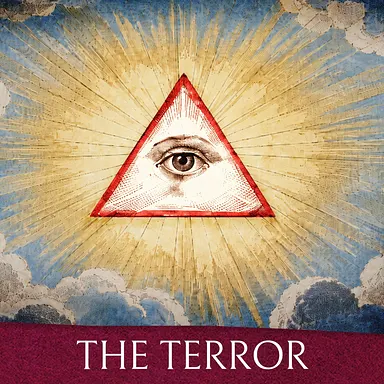
This episode of The Rest Is History examines the Festival of the Supreme Being, staged by Maximilien Robespierre in Paris in June 1794 at the height of the Terror. Tom Holland and Dominic Sandbrook describe the spectacle in the Tuileries and on the Champs de Mars, including the cardboard statues, the papier-mâché mountain and the massed choirs.
They explore Robespierre's belief in a Supreme Being, his argument that virtue requires a belief in divine justice, and his link to the Declaration of the Rights of Man. The discussion also covers the new revolutionary calendar, the campaign of dechristianization led by Fouché and Hébert, and the Law of 22 Prairial, which deepened the Terror.
Listeners will learn how religion, politics and violence were intertwined in Robespierre's final months.
In this episode Dominic Sandbrook, Tom Holland
This episode's transcript on the French Revolution's Festival of the Supreme Being was made with HappyScribe's technology for converting spoken audio to text, the same tool used for audio to text work.
Ads in this audio differ from the text. Tap the sentence you're hearing to follow along.
Synced: the text now follows the audio.
Willkommen zu einem Moment nur für dich und zu allem, was du liebst, bei Douglas. Finde einen Duft, der dich nicht mehr loslässt; Pflege, die aus Alltag ein Ritual macht; Farben, mit denen du dich neu entdeckst. Alles für dich am Singles' Day, jetzt 20% auf viele Artikel. Douglas, welcome to beautiful.
Let us be grave and discreet in all our deliberations, as men who determine the interests of the world. Let us be ardent and tenacious in our anger towards the leagues of tyranny, imperturbable in danger, patient in labour, terrible in adversity, modest and vigilant in success. Let us be generous towards the good, compassionate towards the unfortunate, inexorable toward the wicked, just towards all. Let us not count on an unalloyed prosperity, nor on triumph without obstacles, nor on anything that depends on the fortune or perversity of others.
We should rely solely on our own constancy and our own virtue alone. But infallible guarantors of our independence, let us crush the unholy league of kings even more by our greatness of character than by the force of our arms. So that was a speech given by Maximilien Robespierre on the 8th of June, 1794, in the gardens of the Tuileries, in the centre of Paris.
Now, some people might find that stirring; others might think it's the kind of thing that the headmaster of a minor public school might say at the first assembly of term, or that a particularly weedy Church of England bishop would say to his dwindling congregation. But actually, in this case, the occasion was the strangest and most colourful public spectacle of the entire French Revolution. That is saying something. So, Tom, when and where and why are we?
This is a festival in honour of the supreme being. So Robespierre had announced this deeply eccentric public spectacle a month earlier, on the 7th of May, and it was a great festival to which literally everyone was invited. Robespierre wanted it to be an occasion so civic that basically every citizen could turn up and enjoy the fun, enjoy the stirring oratory. And the whole occasion was very, very much his baby. He had gone to inordinate efforts to make it a success, and he had invested a lot of his political capital in putting it on, because there's a fair degree of scepticism around it, has to be said.
So not only had he had himself elected president of the National Convention, so basically the official government of France, four days before this festival is staged, so that he can play the kind of constitutionally appointed central role in the whole proceedings, but he has also very thoughtfully had the guillotine moved from the Place de la Révolution, which is kind of just across the road, so that the sound of the blade slicing and the spurting of blood and the cheers of the crowd won't detract from the solemnity of this great event that he's planned.
So very thoughtful.
That's nice.
And Robespierre has one of the great impresarios in all history at his side, and this is the painter Jacques-Louis David, who we did a bonus about with Laura Cumming.
Beth Amera.
Yeah, exactly. And he's prepared all kinds of extravagances for it. So he has a massive choir, and when they're all put together, all these various choirs constitute 2,400 voices. So that's quite a volume. Incredible stage sets, brilliant special effects, and some dazzling pyrotechnics. And he's also designed the costumes. He's hired florists with baskets to hand out flowers, freshly cut flowers, and he's got girls in white dresses to hand them out from these baskets.
So very, very kind of attractive.
He's learned his lesson from Marat's funeral, which was the last great spectacle that he staged. So he doesn't have any rotting bodies or severed arms falling off or anything like that?
No. But even so, even though he doesn't have any pustule-ridden bodies, kind of threatening foul smells, he is nervous when the great day dawned. Much like a Rest Is History host who is staging a festival at Hampton Court Palace.
Would such a person be nervous? I don't believe they would.
Maybe one of us was, a little bit.
Okay.
But Robespierre, he's trying to get himself in the mood. He's trying to kind of pep himself up by looking at his absolute best. And of course, we've been talking throughout this series about how fastidious he is, how concerned about his appearance he is. And so he has put on his very best Republican finery. So he has an exquisite blue coat, which we'll be featuring later in this series. He's wearing a tricolour sash. He's got a plumed hat. But unfortunately, he's so nervous that when he left the house of Maurice Duplay, his landlord, he left behind a large bouquet of flowers that had been made for him by one of the Duplay daughters.
So that's very sad. And the other indication of how nervous he is, his stomach is clearly so knotted up that he doesn't have breakfast, and he has to be persuaded to go up and kind of picket it. So he's very anxious. He wants this day to be a massive success. But in the event, you know, he needn't have worried, because everything goes brilliantly. Everybody absolutely loves it. It doesn't rain. Everyone has an absolutely lovely time. And the great thing, thousands upon thousands of patriotic citizens do flock to the Tuileries to partake of the fun.
Well, they love a public show.
Yeah, there's a slightly trump quality to the estimation of how many people turned up. So Robespierre's admirers say that half a million are there. It's probably an exaggeration, but it's certainly, it's very, very enthusiastically attended. And the girls all look lovely in their beautiful white dresses. The flowers all smell gorgeous. It's great. Everyone has a fantastic time.
Oh, that sounds wonderful. And David's stuff goes off, passes off much better than at the funeral of Marat, presumably.
Yeah, brilliantly. So the morning's highlight, people gather around this enormous spectacle, and it's a large statue of a hideous figure with the ears of asses, made entirely out of cardboard, which I don't think sounds very impressive, but everyone is incredibly impressed by it. Maybe it's very thick cardboard. Robespierre is there. He's looking very natty in his sash and his blue coat. And he appears in front of the crowd. He gives a speech, which, again, we're told goes down very well, but I suspect nobody can hear it.
I mean, obviously, there's no kind of amplification.
I think this is the case with all open-air speeches before about 1950, isn't it? I mean, the crowd loved it, but actually no one could tell what was being said.
Maybe reports of it are being kind of funneled backwards through the crowd. I don't know. Anyway, then the excitement. He is presented with a torch, a flaming torch, and he sets fire to the cardboard figure. So it goes up in flames. And then from the flames, another cardboard statue emerges. And to quote Ruth Gurin in her biography of Robespierre, this second cardboard statue was "fair, majestic, and only slightly singed." And this matters because this is an allegorical pyrotechnic stunt.
And obviously, if you're doing an allegorical pyrotechnic stunt, you don't want both of your statues going up in flames. Because it turns out that the statue with the asses' ear represents atheism. And the slightly singed figure that emerges from within it, once it's been burnt, is wisdom. So if wisdom had gone up in flames as well as atheism, the whole point would have been lost. As it is, the watching crowds cheer and toss their liberty caps in the air and shout, "Hurrah for Robespierre!"
Robespierre gives another speech, which, again, I presume no one can hear. And then everyone joins in with a patriotic hymn, which has been composed especially for the occasion. So, I mean, the fun is limitless. And then that afternoon, there's another spectacle, and this takes place in the middle of the Champs de Mars, just down from where the Eiffel Tower now stands, and all the deputies and the crowds have processed there from the Tuileries. And there, in the previous episode, Dominic, there was a papier-mâché mountain that had been built in the nave of Notre-Dame.
This is on a vastly greater scale. It's been built by David, so presumably is excellent. David has tremendous taste.
I mean, a sceptic might say the French Revolution is spending an awful lot of time making things that normally are made by four-year-olds in preschool glasses.
Yeah, you might say that, but four-year-olds don't tend to put statues of Apollo on top of their papier-mâché mountains, which is what David has done.
Right.
And also, there's a tree on the summit, which I think is impressive. I mean, I've never seen a papier-mâché mountain with a tree on the summit.
Town Nursery and Chippy Norton does some pretty good stuff, to be fair.
The Fate.
Yeah.
Flower show.
Nice.
Anyway, so this is the huge papier-mâché mountain, and it's the measure of the scale of it is that all the deputies climb up the side of it, and Robespierre perches himself right on the summit. So the deputies then kind of congregate around him. And meanwhile, the masked choir that David's been rehearsing, so that's all 2,400 of them, they perch themselves decorously on the lower slopes of the mountain. So, I mean, that is a massive amount of papier-mâché. I mean, I think that's quite impressive. I would enjoy seeing that.
And I might also enjoy the spectacle that then ensues, because it's an assemblage of patriotic songs.
Okay.
Do you like a patriotic song?
Depends where it's from. I mean, a patriotic song from our own beloved country, or from, I don't know, Costa Rica or Bosnia, I'd be all in favour of that. A patriotic song from just across the Channel, maybe not.
I think the odds that they're singing patriotic English songs on a papier-mâché mountain in the middle of the French Revolution are low. I mean, these are French ones. And then there's this specially composed hymn, and we'll be coming later to who this hymn is being sung to or what. Those are the kind of the festivities on the papier-mâché mountain. And then finally, in a way that is deliberately designed to ape the athletic contests of ancient Greece, there is a display of sports. The crowds drift away, and it's generally agreed that a good time is being had by all.
Wonderful.
People enjoyed it.
Although there are people who find this sinister, are there not?
Ludicrous and sinister, I would say.
Okay.
Because some of the deputies who followed Robespierre in a train, you know, it's like a kind of a crocodile, a school procession. They followed him from the Tuileries down to this papier-mâché mountain, and then they followed him up the side of the papier-mâché mountain, and they've had to congregate all around him. And they are scoffing and sneering and bitching away like nobody's business. Loads of them. They really think it's ludicrous. And I think that the general feeling is that the whole occasion is mad.
That this is a bizarre way to spend your time. The people who particularly feel this are the atheists. Because the atheists have just seen this cardboard guy with the asses' ears portraying their atheism torched. And the whole occasion, despite the tricolours, despite the patriotic songs, the object of the celebrations hasn't really overtly been the Revolution. It's been a god. And this god isn't even a god with which most people are familiar, because it's a very chill, distant, anemic god.
And this is a god termed by Robespierre, L'Être Suprême, the Supreme Being. And this is what it's all about. This is a festival in honour of the Supreme Being. Now, who is the Supreme Being? So back in November, people may remember, Robespierre goes to the Jacobin Club, and he publicly confronts the atheist trend that's been catching fire among the Montaigniards. And he opposed this by saying that even if God didn't exist, it would be necessary to invent him, kind of echoing the famous aphorism of Voltaire.
But Robespierre definitely thinks that there is a god. And this is the god that he calls the Supreme Deity. And he denies that he has invented this god. He thinks this god exists. And he says that this is the god of the people, and that to think otherwise, to doubt the existence of this god, is counter-revolutionary. So in this speech that he gave in the Jacobin, he declared that atheism is aristocratic, which might sound ludicrous to us, but if you think about the tradition of aristocratic atheism in France, the Marquis de Sade is the most notorious exemplar.
But the kind of sense that the characters that you would find in dangerous liaisons that they don't believe in God at all is very, very strong.
Surely. I mean, yeah, the common people that Robespierre claims to represent.
They all love God.
They're not atheists.
No, they're all believers. And so this is why it has some force. And Robespierre then goes on to say, "The idea of a great being who watches over oppressed innocents and punishes triumphant crime is one that entirely belongs to the people." So in essence, he's saying that if people don't believe that there is justice in the afterlife, then how can they possibly believe that there is justice in this life? That, I think, is essentially the core of his argument. And that if they come to feel that there is no justice in this life, then they will relapse into cynicism and despair.
And that is not what a revolution needs at all.
Well, is it not right that basically for Robespierre and so many of the other revolutionary radicals, their belief in the revolution is tied up with their belief in a kind of, in moral absolutes, in an absolute morality. And if you take that away, then you have nothing. And they, you know, Robespierre lives in a world, as we've talked about so many times in this series, of virtue and terror. And his belief in virtue, you know, it can't come from, it can't, it's not, you know, he's not a moral relativist. It doesn't come from nowhere. He believes that it is linked to a kind of metaphysical reality.
Yes, that's exactly what he's saying. And more than that, he could point out that this idea, this notion of a Supreme Being who keeps watch over the revolution and is guiding it to its conclusion, that this has actually been coterminous with the revolution itself. Because right from the beginning, the revolutionaries had been very keen to demonstrate and make exactly the point you were making, that their ideals are not culturally relative. They're not contingent.
They're not ideals that have been thrown up by circumstance. That they are absolute, they are eternal, they are universal. That is why the revolution can proclaim itself to be not just for the French, but for everyone across the face of the planet. And in this, of course, the revolutionaries are very self-consciously following the example of the Founding Fathers in America. And it's telling that Thomas Jefferson, who was serving in Paris as the American ambassador in the summer of 1789, had actually been on hand to give them advice.
No wonder it went to the dogs and they all ended up being terrible people. I mean, they were taking advice from one of the worst men in history.
The role that Jefferson plays, that's very significant, and we talked about this way back in our first series, he had helped the revolutionaries to draw up a kind of an equivalent of the Declaration of Independence with its insistence on human rights, the significance of human rights. And on the 26th of August, 1789, the revolutionaries had not just formally asserted that human rights do exist, that they have a kind of absolute existence, but in very Jeffersonian terms, had declared them to be natural, inalienable, and sacred.
Which they called the Declaration of the Rights of Man and the Citizen. And it is still being honored in 1794 as the foundational text of the entire revolution. And Robespierre absolutely reveres it. So back in 1793, he had said flatly, "The Declaration of Rights is the constitution of all peoples," so not just the French, all peoples. It has a universal application. "All other laws being variable by nature and subordinated to this one." And what enables him to feel confident in making this seemingly ludicrous assertion is another claim that had been made in the Declaration of Rights.
It was there in black and white. That the Declaration of Rights had been promulgated, and I quote, "under the auspices of the Supreme Being." And it's this Supreme Being, Robespierre believes, who has engraved the laws of eternal justice, and again, to quote the Declaration of Rights, "not upon marble or stone, but in the hearts of all men." And this is a massive deal for Robespierre that this should be so. Because for him, so much is at stake.
Because should the French doubt that the promptings of what they can read on their hearts is genuinely expressive of the purposes of a divine being, then he fears the worst. And what he fears is the return of the tyranny that the revolution has been launched to overthrow. So basically, the tyranny of kings. Because citizens, to behave well, Robespierre believes, need to feel that they are being watched at all times.
Because only then will they be steeled to follow the course of virtue. If they don't feel they're being watched, then they might get up to all kinds of shenanigans. And only if they follow the course of virtue will the revolution be fully secured. And there's a brilliant book on this by a guy called Dan Edelstein, The Terror of Natural Right. This is why at the festival, the Supreme Being is symbolized, to quote Edelstein, "primarily as a disembodied eye." So an eye that can see into the heart of every citizen.
And Edelstein describes it as an internalized surveillance mechanism.
Is that not a very common 18th-century device, the idea of the Supreme Being as an eye, and one that owes something to Freemasonry? And you see it in the American iconography as well, the Dollar Bill.
So it is current among kind of free-thinking intellectuals. This idea of a Sauron-type lidless eye, gazing and penetrating and watching. And this is why Robespierre stages the Festival of the Supreme Being, and it's why its success matters so much to him. Because he essentially believes that in its success lies the best prospects for the future of the entire revolution. He believes this passionately. There are all kinds of people who obviously think this is mad.
But the reason that Robespierre is so insistent on staging this festival is that he believes that if the people come to doubt the existence of a benignant but all-seeing God, then their prospects of arriving at true virtue are completely shot. You know, that they will all start behaving like aristocrats, like libertines. They will get up to all kinds of terrible things.
Robespierre psychologically, and this is, I think, reflected in the way he dresses and the way he carries himself, he's a man who believes in rules and order. Is he not? He's a man to whom control is incredibly important. And so the idea that you could have a kind of moral free-for-all, where people, you know, pursue their own individual morality, the idea that you would take off the shackles, as it were, which is presumably what people like Hébert and the atheists wanted to do, let's have a kind of anarchic, you know, world order, that you can get a sense with him, I think, that that fills him with a kind of deep psychological horror.
He lives in a world where, you know, you're still wearing your wig, you're still wearing your stockings, you're sticking to rigid formulae, and he wants to find a formula to sort of anchor the revolution to something, don't you think?
Yeah. Well, remember when he was a little boy, the comment that his sister made about him, that he didn't often play games, but when he did, it was always to insist on the rules.
Yes, exactly.
And I think that is Robespierre's leitmotif throughout his entire career. And there's a sense in which he hasn't given up on the rules. So even though the terror is gouts of blood spurting from the guillotine every day, it's not his ambition to preside over terror. That's not why he's come into politics to do. He doesn't want to rule as a dictator. What he's really about is his constitution, which he hopes, when it has been brought in, will enable France to live, you know, and be a happy, emancipated, terror-free country.
We've talked about it several times, this constitution that Robespierre and Saint-Just and Couton, between them, had drawn up very, very quickly in the early summer of 1793. And they had invested all their hopes in it. And it's been, by leaps and bounds, the most democratic constitution that the modern world had ever seen. And then it had been ratified by this popular referendum, by an overwhelming majority. And to Robespierre, this had served to make it into something holy. It was something that the people whom he identifies as being the voice of virtue, they had said, "Yes, we want this."
So this constitution is incredibly precious to him. I would go so far as to say holy to him. And this is why, I mean, it's such an extraordinary detail. Once it's been ratified, it gets ceremonially placed in a model of the Ark of the Covenant that David has kind of rustled up specially for it. And so the iconography of this is very obvious, I think, and deliberate, that what the God of the Bible had been to the Israelites. So God gives the, you know, the tablets of stone, the law, to Moses, and these tablets are then placed in the Ark of the Covenant.
The Supreme Being is to the Jacobin, is to the Montaigniards, is to the revolution as a whole. The constitution is something that is descended from the Supreme Being and therefore is literally, dare one say, sacral.
And yet the irony, this is a constitution that because the nation is facing a national emergency of war, you know, rebellion in the Vendée, the Federalist Revolts in the cities, and so on, this constitution has never been introduced. And at this point in time, which is, what is it, June 1794, there are no signs that it ever will be introduced because of the state of emergency. So this state of emergency is now, what are we, seven, eight months old? And absolutely no sign that they even have a timetable for when they will scrap the state of emergency and move towards a democratic system.
Absolutely. So there is no question the constitution is in a state of animated suspension. In fact, it's in a state of literal suspension. Because on the suggestion of David, the constitution, still in, you know, the Ark of the Covenant, had been hung above the speaker's bar in the National Convention. So whenever anyone goes up to talk, there is the Ark of the Covenant with this constitution kind of hanging above them. I think that, you may disagree with this, but I think that Robespierre is intensely frustrated by this.
He wants to see this constitution brought in. So R.R. Palmer, who we've been quoting quite a lot, his brilliant book on the Committee of Public Safety, I mean, he says that Robespierre regarded dictatorship as an interim phase, necessary rather than desirable, is beyond possibility of question. I mean, I don't know, do you agree with that?
I think it's complicated. I mean, we could spend hours talking about this. I think absolutely, if you asked Robespierre, or if you asked himself, he would say that, yes, of course, the dictatorship is an unfortunate short-term necessity and that eventually we will embrace this constitution and I will step back or whatever. However, I think practically, there is no moment, I don't think that moment would ever have arrived for Robespierre. I don't think there was ever a point where he would have said, "Now we can stop the terror.
Corruption has been eradicated. The threats are gone." I think he has got himself into a mental, psychological state where France will never be ready for that constitution. And that's a, you can argue, that's a kind of tragedy for him, arguably an even greater tragedy for the people who are rattling along the, you know, the streets and the tumb rolls to the guillotine.
I mean, I think he definitely wants to see his constitution introduced. I also agree with you that he is finding it increasingly hard to imagine a situation in which that would be possible. And the reason for that is he is finding it very difficult to identify who the truly virtuous are. Because he's coming round to a perspective that those who seem most virtuous may be most counter-revolutionary. And I think the consciousness of this is causing him immense mental anguish.
Yeah, I agree. I think he's in a mental state now where he thinks there are people who are obviously counter-revolutionary, corrupt, and so on, are traitors. But he's now got to the point, I think, where he's got himself into such a lather that he thinks, "Actually, do you know what? The more that people appear to be on my side, virtuous, upstanding, devoted to the revolution, they're really likely to be traitors as well." And that basically you can't win with him.
Yeah. And so this is why, although he remains personally opposed to the death penalty, he feels himself obliged to kill so many people. Because all along he thought the future of the revolution depends on this. And even though he's personally squeamish, he's ideologically opposed to guillotining, he feels that it is his moral responsibility as the man charged with the guidance of the revolution to do it. And in his, he delivers this famous speech on how terror is virtuous.
He spelt this out very clearly. If the basis of popular government in time of peace is virtue, that's what the constitution represents. The basis of popular government in time of revolution is both virtue and terror. Because virtue without terror is murderous, and terror without virtue is powerless. And this is the bind that he's in. It's the corner he's backed himself into. It's a tragedy for him. And obviously, it's a tragedy for everyone who is having their heads chopped off.
He is a very psychologically familiar case of a deeply controlled, anxious, you know, rule-bound person who cannot understand why other people don't play by the same rules. Why do people keep behaving badly? Why do they keep taking bribes? Why aren't they pure? Why do they let themselves down in all these ways? And he's getting more and more frustrated. And psychologically, he will just never get it.
He doesn't, he will not meet the human race halfway, basically.
No. And so I think in turn, that cements him in his opinion that he really is the protector of the revolution. Because there isn't anyone else, perhaps Saint-Just, but the future of the revolution depends on him. Because he's basically the only one who's following the rules. And so everyone has to be brought to follow the rules. And if they don't, then off with their heads. Now, this is why the Festival of the Supreme Being matters so much to him. Because it seems to offer him a way out. Because suppose in place of the Committee of Public Safety as sentinel over the French people, you have a restless and all-seeing eye, the eye of the Supreme Being.
This, from Robespierre's point of view, would be a brilliant solution. Because if he can leave the enforcement of terror to the Supreme Being, then he won't need to be responsible for it himself. And that's why he stages the Festival of the Supreme Being. It's why he's so delighted by its success. He thinks that maybe there is a sign here that the French people can be brought to respect the rules. Because now they are learning, you know, as in 1984, people are brought to love Big Brother, people are being brought to love the Supreme Being.
And pretty much every historian I've read who's written about Robespierre, they seem to concur that this festival was the single happiest day of his life. Because I think for the first time since the terror had begun, he can contemplate the lifting of this great burden that's on his shoulders.
Wow. So has Robespierre in the Festival of the Supreme Being found his way out? Has he found a way to direct the kind of moral and political life of the nation at last? Or by staging this papier-mâché festival, has he actually let himself in for a whole load of trouble? And is he actually hastening towards his own demise? We will find out after the break.
This episode is supported by Anthropic, the team behind Claude. Now, history's biggest leaps, many of them started as hard questions that people didn't want asked.
Yeah, there's a classic example of that, Tom, at the end of the 15th century. And the hard question in particular was, what is out there beyond the Atlantic Ocean to the west? And as you will know, the man who found the answer to that question was the explorer Christopher Columbus, great pioneer in voyage of discovery. And it is, of course, the Americas. So, you know, Anthropic knows the importance of questions. And it's why Anthropic is founded on one hard question above all. How can we ensure that the AI revolution really goes well for ordinary people?
Anthropic asked 100,000 people. And what came back wasn't just fear. There was hope as well. People wanted to know, will cancer ever be cured? Can kids have a better future? It turns out that there is hope in hard questions. Ask yours at claude.ai/restisistory.
And keep thinking.
Welcome back to the Rest Is History. Look at the bastard. It's not enough for him to be master, he must be god. So this was a bloke, a deputy in the National Convention called Jacques Alexis Touriau. And Touriau was sitting, I mean, he was effectively sitting at the feet of Robespierre on this massive papier-mâché mountain that the stuff of a nursery school's wildest imaginings.
It's like a kind of illustration from a children's Bible, isn't it, of the disciples gathered around the feet of Jesus during the Sermon of the Mount or something like that.
Yeah, exactly. Or like that, if you ever see pictures of the Tower of Babel, they always look like it's been made out of papier-mâché. This is a sort of more natural world version of that. Anyway, Touriau is sitting at the bottom of this flipping mountain that's been made by Jacques-Louis David for the Festival of the Supreme Being. And Touriau is not enamored of the entire occasion. In fact, he regards it as completely laughable, doesn't he? In fact, worse than laughable, he regards it as laughable and sinister.
Yes, he does. And I think all the more so, because actually he knows Robespierre well, because the previous summer they'd both been on the Committee of Public Safety together. But Touriau is an admirer of Danton, the kind of, you know, he thinks that Robespierre has taken a wrong course. And so he had resigned in September from the committee, protesting against the kind of the surge of executions, declaring, "We must halt this raging torrent which is leading us to barbarism." So that was Touriau in September 1793.
Intriguingly, however, in general, his disapproval of Robespierre is not because he sees Robespierre as an extremist, but the opposite. He sees Robespierre and criticizes him as such, as a moderate. And by calling Robespierre god, Touriau is actually awarding him a promotion. Because most of Robespierre's critics, when they insult him along these terms, tend to refer to the incorruptible as a priest.
And it's the quality of the priestly in Robespierre that revolts and disgusts Touriau. He sees Robespierre as reactionary in that sense that he is upholding superstitious standards that he feels an enlightened and revolutionary people should be getting rid of.
There's always a tendency, isn't there, among, there's a long-running antipathy that you find where more worldly people often resent, dislike, and slightly look down on people who are very earnest, very heartfelt, a little bit prissy. You know, the little boy who says to his fellows, "Why won't you play by the rules? The rules say we should do this." The other boys don't always look on that boy with tremendous approval, do they?
And there's something of that, I think, with Touriau and some of the others, and Robespierre. They just don't understand why he's such a drip and a fun sponge.
I don't think they think he's a drip, but I do think they think he's a fun sponge, definitely. And I think they feel that he's a fun sponge in the way that priests have always been fun sponges.
Yeah.
Robespierre is obviously passionately interested in questions of morality and religion. You know, you were saying how he's not bothering himself with the practical demands of logistics or food provision for the army or anything like that. He's all about questions of virtue.
Let me assure the listeners, there is nothing worse than somebody who is always talking to you about religion, just to be clear.
And yet here we are talking about religion, Dominic.
Yeah, I know. I'm Touriau in this analogy, by the way.
And then there's the fact that Robespierre does inspire this kind of fanatical devotion, and particularly from women. And it is often said by his critics, his male critics, that this is typical of a priest, that women are far more unnaturally superstitious and therefore prone to the blandishments of a priest-like figure. So that's a criticism. And then, of course, in the autumn of 1793, there had come his, you know, this overt declaration of war against atheism. So, I mean, it's very clear.
He stood up in the Jacobin, who are accustomed to kind of radical declarations of, you know, "Let's rip everything up and bring in a new world." And he had said, "Whoever tries to stop the saying of mass is a worse fanatic than the priest who says it." And I think there were a lot of jaws dropping when Robespierre made that statement. And to someone like Touriau, who wasn't just an atheist, but a very committed dechristianizer, he saw this as fundamental to the course that the revolution should be taking. You know, it had come as a massive shock to hear the supposed leader of the Montpellier say such a thing.
And so he comes to see Robespierre not just as moderate, but verging on the counter-revolutionary.
Yeah, because that anti-clericalism is such an important part of the revolution, isn't it? There are so many of those middle-class Montpellier deputies who are fired up with a loathing of Catholic priests and are determined to basically rip out all the churches and all of that sort of thing. And I think it's as much, there's a sort of political, psychological, aesthetic quality to it, as much as anything. They can't get why Robespierre is not on board with that. And of course, Robespierre is right in the sense that most ordinary French men and women are baffled by all this because they're quite happy to, I mean, they might have resented the bishop or they might have resented the local priest, but they're perfect.
You know, they've structured their lives around the Christian calendar. They don't want to see it scrapped.
Completely, yeah. And so that is definitely a crucial part of why Robespierre is opposed to dechristianization. He thinks that it's, you know, it's poking a wasp's nest. Why would he do this? You know, just let the wasps buzz around if they're not causing any harm. But I think also to do Robespierre credit, you know, he's not just being cynical about it. It's a point of principle for him that there should be freedom of religion. So kind of Elizabeth I style, he said, "There is no commanding of consciences." He genuinely believes that. Now, acknowledging that much, this principle for Robespierre does come with a serious caveat, namely that Christianity must know its place, or indeed any religion, Judaism or whatever, Protestantism.
He does think it is insupportable for priests to start barging into areas that they have no right to poke their noses into. So while Robespierre is fine with a Christianity that confines itself purely to the private sphere, he is not happy at all with a Christianity that, for instance, backs kings or priests who have not sworn oaths to support the revolution, that actually maybe identifies itself overtly with counter-revolution.
And there's an obvious reason for this, because there's been this massive war going in in the Vendée and in the western reaches of France, where rebels have been consciously attempting to stop the revolution. They've been wearing the Sacred Heart on their clothes. They've been attending mass before military engagements. They've been shouting out for God and the king as their war cry. There's no way that Robespierre is going to tolerate this. And so he completely recognizes that there is a need to educate the mass of the people out of superstitions such as this, and if necessary, brutally so.
And as for priests who set themselves up against the revolution and preach to their flocks that God hates what Robespierre is doing, they are plainly beyond the pale. And as counter-revolutionaries, clearly they have to go to the guillotine. And sure enough, over the course of the terror, a thousand of these priests do go to the guillotine. So there is nothing moderate about Robespierre's treatment of them there.
There is something very Protestant about Robespierre, isn't there?
So Protestant. I mean, there's something very Protestant about the whole wave of dechristianization, as we will see.
You know, church and state relationship between church and state, get rid of barbaric backwards superstitions, all of that sort of stuff. And also the sort of austere insistence upon the rules, I think, is something very Protestant about that.
Well, I mean, it's a point I may have made before, but I think it is so difficult, even for the most radical revolutionaries, to think themselves out of the box, the Christian box that their country has been in for centuries and centuries and centuries. You can't, you're just impossible to do it overnight. And so if you look at Robespierre, his ambition is to see Christianity replaced by the cult of the supreme being. But the dynamics of what he wants are recognizably bred of Christianity, I think.
And I think the Protestant element of it is clearly really strong. And you can see this manifest on the date that Robespierre had chosen for his festival, because it was on what originally was the Christian feast day of Pentecost. It's deliberately designed to replace it. But of course, if you're replacing something that overtly, you are in a sense paying homage to it.
Replacing Christianity. I mean, obviously this is something that most ordinary French men and women would find completely bewildering and baffling. But actually, they are prepared to go to quite considerable lengths in order to do that. And the classic example of this, one of the most famous things that people know about the French Revolution, is the, I mean, I already mentioned, the calendar. People structure their lives by the Christian calendar, the feast days, the festivals, Christmas, Easter, Sunday services, and so on and so forth. If you're a French peasant, that's what gives your life meaning and structure.
But the revolution is now saying, "We're going to actually get rid of all that. We're going to invent an entirely new calendar. And we are, I mean, we're not going to start with year zero, but we're going to start with year one."
Yeah, they're going to inaugurate a completely new order of time. And they'd done this back on the 5th of October 1793, when the convention, with the full approval of the Committee of Public Safety, they declare that the Christian era is officially at an end, and that years will no longer be dated from the birth of Christ, but instead from the first day of the French Republic, so the day that the monarchy was abolished. So that in the Christian calendar had been the 22nd of September 1792.
But it's not just the years that have been replaced, it's also the traditional names of months as well. So a whole new kind of yearly calendar has been brought in. So the year now begins with three months of autumn, and these are Vendammillière, Boumaire, and Frimaire. And these are named respectively after the French for the wine harvest, fog, and cold. And then winter, you have Niveaus, so named after the French for snow, Pluvieux, rain, Venteux, wind.
Spring, it germinates with a month that is called Geminal. It flowers in a month called Floryal, and it spreads through the ripening fields in Prairial. So prairie is a kind of meadow, isn't it?
Hence the name prairie.
And then in summer, you have Methidor, named after the harvest, Thermidor, named after heat, and Fructidor, fruition, when the crops and the fruit are coming to full ripeness. I think they're beautiful names. And they are the creation of a poet and a playwright whom we've already met, Fabre d'Augletine.
Yeah, corrupt, making up mad conspiracy theories about corruption, and ending up with Danton in the guillotine.
Yes. And the way they're structured wipes out the traditional Christian week. So that rhythm of Sundays every seventh day, that goes. So it's completely erased. And just to deal with kind of leap years and things like that, he adds in five extra days, which he calls, I mean, ludicrously, Sans Culottide. So Sans Culotte days.
That's a bad name. He's let himself down there, I think, Fabre. He had to go.
So what does Robespierre think about this? He's not against it at all. In fact, he brings an amendment to the convention, proposing that one of these Sans Culottide, these five days named after the poor of Paris, should be enshrined as a festival of virtue. And this motion is passed. So I can see your face lighting up with joy at the thought of an annual festival of virtue.
That feels so Sadiq Khan, doesn't it?
Completely.
Completely. Yeah.
Sadiq Khan and our lionesses will be celebrating diversity in Trafalgar Square.
Completely, yeah.
Yeah, that's what it would be. And also, you know, at the speech he gives to the convention announcing the festival of the supreme being, he gives the date not in the traditional calendar, so not on the 8th of June 1794, but he says it's going to be the 20th Prairial, year two. And it's sad that by this point, Églantine has been guillotined. So he's not around to enjoy the spectacle of his calendar being garnished with this great festival. So sad for him.
So Robespierre is okay with the calendar. He's fine with that. In fact, he's enthusiastic. But dechristianization, I mean, there's dechristianization, dechristianization. He's happy with something that appears, you know, that's all about celebrating, you know, inclusivity.
Decorus.
Exactly. However, there's a lot of dechristianization that he is not keen on. And this is where dechristianization, where it is more feral, where it is more obviously tipping into vandalism or vulgarity, I suppose.
Yes. Or indeed openly violent. And he's against tastelessness, and he's against violence if it's tied up with dechristianization.
Well, he's against violence if it is not centralized, controlled, rules-based violence.
Yes, not rules-based. Yes, exactly. And so you could see that manifest in his ambition to destroy Abert and the dechristianizers who were around Abert. But he's anxious to root it out in the provinces as well as in the capital. And here, by the end of 1793, the tide has definitely turned in favor of the revolution. And so essentially, the task now for the revolutionary elites is to inflict reprisals and punishments. And the most notorious of these takes place, unsurprisingly, in the Vendée, and unsurprisingly because that was where the peril had been the greatest.
And we've discussed the controversy around the casualty figures in the Vendée, but I think even those who would not apply the name of genocide to it would acknowledge that the degree of slaughter is very great, that perhaps a third of the population.
Yeah, a third to a quarter. I mean, a colossal number of people. I mean, we're talking about hundreds of thousands of men, women, and children.
Yeah, because lots of these are civilians who were not participating in the uprising. And I think the perspective on this of the revolutionaries in Paris is that, you know, if an occasional patriot is slain by mistake, then, you know, it's a sacrifice for the good of the revolution, and they should be proud to accept their death in that cause. So there was a general who was sent to pacify the Vendée in early 1794, and he gave his troops these instructions. "Spare with your bayonets all the inhabitants you encounter along the way.
I know there may be a few patriots in this region. It matters not. We must kill them all." And we're talking about the Christian echoes in the revolution. There's an echo there of one of the most notorious comments ever made by a crusader. So this was one of the priests in the Albigensian crusade, who supposedly was asked, "How do we recognize who the heretic is and who the good Christian?" And he answers, "Kill them all. God will know his own." And I think that that spirit is still clearly very much alive in the upper echelons of the revolutionary military.
And I mean, that's the sort of thing that would horrify Robespierre, you know, who believes in the rules. But what horrifies him even more are the atrocities that are carried out by individuals, particularly deputies who've been sent out to the provinces, who sort of go a little bit Colonel Kurts, become drunk with their own power, and effectively indulge their more sadistic urges, I mean, I would say.
Yes. And the most notorious of these in the west of France, not actually in the Vendée, but around the region of Nantes, is a guy called Jean-Baptiste Carrier. And what appalls Robespierre about him is not just his violence, but also his blasphemy, which Robespierre sees as completely unnecessary. So the stories that are told about Jean-Baptiste Carrier are debated by historians. I mean, are they counter-revolutionary propaganda? Some of them may be. But I think it's evident that in this case, there is no smoke without fire.
So let's just list the things that are reported of Carrier. So it's said that he loads prisoners with their hands and feet tied onto barges, and that these barges have had holes soared in the bottom and then been plugged. And when these barges get out into the middle of the Loire or, you know, some other river, the plugs are pulled out, the guards leap into boats, and the people with their hands and legs fettered just sink into the river and are all drowned. And Carrier, it amuses him to describe these mass drownings as Republican baptisms.
So that's a massive banter there. And some of them, if they are young men or women, they might have been stripped of their clothing because clothes are part of the perks that you get if you're a revolutionary guard dealing with counter-revolutionaries. And so the men and women naked would then be bound facing one another, and these were described by Carrier as Republican marriages. So I guess you either find that funny or you don't. Carrier obviously thinks it's hilarious. And Robespierre, back in Paris, I mean, he's not amused by this at all.
I mean, he's never found anything funny in his life. He's definitely not going to find this funny.
No. It disgusts him. And this is why in February 1794, he summons Carrier back to Paris, and Carrier is in deep disgrace. But Carrier isn't the Republican agent whose behavior in the provinces most appalls Robespierre. The guy who he really comes down on hard is the Republican agent in Lyon, so in the south of France, a long way from the Vendée. And the reason for this is twofold.
Firstly, that the blasphemies and atrocities that he's perpetrating in Lyon are particularly creative, imaginative. But secondly, this guy is an old associate of Robespierre's, and in fact, very briefly had been a suitor for the hand of Charlotte, Robespierre's beloved sister. So to that extent, it's personal for Robespierre. And this is a guy called Joseph Fouché, who, spoiler alert, will have a long and distinguished career under Napoleon in due course as his chief of police.
But at the moment, relative to Robespierre, certainly, he's not a significant player. Fouché had come originally from the west of France, from a small fishing port on the mouth of the Loire. And he had been educated by a religious group called the Oratorians, and these were guys who ran schools across France. And after graduating in this school, Fouché had stayed on, and he had worked for the Oratorians as a physics teacher.
That's worse than being a PE teacher, I think.
It's not quite as bad as being a PE teacher, but it's definitely up there.
Someone whittering about mass volume and density and stuff. Awful. Soul destroying.
Dominic, they said required him to take minor religious vows and wear a clerical robe. And you were saying how the vein of anti-clericalism among a lot of the revolutionaries, I think a lot of these revolutionaries, and again, there's a parallel here with the Reformation, are people who themselves had been clerics or had been clerically adjacent, that when they are anti-clerical, they know whereof they speak. You know, they've had personal experience of it, and therefore their contempt for it comes from the wellsprings of everything they've been through.
I mean, it sounds so reductive and a banal appoint, but personal resentment born of frustration, humiliation, disappointed expectations, all of those kinds of things, that's what drives quite a lot of these people. It drives Marat, it drives Robespierre. You know, Fouché, you can imagine, he's a physics teacher. Everyone hates a physics teacher. And the other people in the kind of Oratarian order, you know, who knows? He maybe burns with some resentment of them. They put him down in some way, and he thinks, "One day I'll show you."
And now he's got the opportunity because of the revolution.
Yeah, all agreed. And another possibility, something else to add into the mix, is that he is a physics teacher, and natural philosophers at this point are very prominent in coming to view Catholicism as superstition. And so there may be a tension between the discipline that he's teaching and the requirement to go and tend services every day or something like that. So that might be part of it as well. We don't know.
Yeah, I mean, he could be messing around with magnets.
Yes. Or, well, bellows.
Yeah.
So it's clear that already by 1788, he goes to Arras, the home, obviously, of Robespierre and his sister. And he is already starting to take an interest in radical politics then. And it's in Arras, so the hometown of Robespierre, that he meets with the incorruptible. He embarks on his courtship of Charlotte. And Charlotte, to give her credit, she identifies him as a wrong and right from the start. She says to her brother, "He's only after me because he thinks it's a way to get into your affections."
And so she has nothing to do with him. So when the revolution starts, Robespierre goes to Paris. Fouché doesn't. He doesn't go as a deputy. And so they don't see each other for a couple of years, two or three years. But then in 1792, their acquaintances renewed because by now, Fouché has been elected as a deputy, and he arrives in Paris where he votes for the execution of Louis XVI. And by 1793, he has become a fairly prominent member of the Jacobin Club.
You know, he's starting to make a name for himself. And he is exactly what you would expect from a physics teacher, Dominic. So he is cold, he is cerebral, he is self-controlled. And he is a man generally who flourishes in the shadows. And he is admired by radicals in the Jacobin Club for his fanatical zeal and for his ability and for the general sense that he will do anything for the cause.
I have to say, I think Fouché is quite a serious person, even though he's a physics teacher.
Okay. Well, I mean, he's graduating from the physics teaching lock. He's moving on to other things.
Yeah. I know he's about to let himself down and behave badly, but sometimes you've got to be robust.
I mean, perhaps by the Samraut lights, he's not going to behave badly. Perhaps he's just doing what needs to be done. I mean, we can discuss.
We can't make an omelette and all that.
This is by way of introducing his record in the provinces. So in the summer of 1793, this is a point where the revolution generally seems to be, you know, it's back against the wall, France is imploding, all of that. He gets sent out to deal with counter-revolutionary behavior in a region called Nièvres, which is midway between Paris and Lyon. And his mission there is to stamp down such counter-revolutionary activity as there may be, to requisition grain, and to ready the locals for this mass conscription, which is hoving into view.
And Fouché does all this very effectively, but he also takes his opportunity to embark on what is at this point the first systematic campaign of dechristianization that France has seen. So this is before anything that Abert is getting up to in Paris. This is the first attempt. And Fouché, who clearly has a lot of resentment that has built up over his years working for the Oratorians, he forces priests to renounce their vows.
He closes, desecrates, repurposes churches. He strips them of their gold and silver, and he sends it all off to Paris to fund the war. In place of the mass, he goes kind of very, very humanist, very Richard Dawkins.
Cult of reason.
Cults devoted to reason. We're not going to have superstition. We're going to have cults devoted to reason. I mean, that's not madly superstitious in its own right. And on the gateways of cemeteries across Nièvres, he inscribes a very famous message, which is a kind of murderous Dawkinsism, I guess. Death is an eternal sleep. And he thinks this is brilliant.
You're not coming back from this. You're nothing. You're dust.
It was like the thing that Richard Dawkins put up on his bus. You know, there's no God, get over it, or something. I think it was kind of along those lines.
At this point, like Philip Pullman's listening to this and wiping away tears of joy.
Yeah, exactly. And the measure of how influential this is, is the renown that it wins Fouché back in Paris. And it becomes a direct influence on the campaign of dechristianization that Abert and Chaumet, his immediate superior in the Paris commune, the one that the campaign that they launch. And it also wins him a much more significant posting after he's come back from Nièvres, which is the job of taking vengeance on the city of Lyon for having dared to divide the convention.
So this has been a kind of rumbling theme in the background of our previous episode, hasn't it? The fact that Lyon, the second city in France, had dared to oppose the dictates of the revolutionary government in Paris and therefore needs to be made an example of. And the government in Paris thinks Fouché is just the guy for this. He's clearly brilliant. And so Fouché arrives in Lyon on the 10th of November, 1793, and he kicks things off in very Protestant style, although that's not how he would have seen it, with a public parody of the mass.
And so there's a lot of smashing of icons. There's kind of usual Protestant shenanigans with donkeys wearing mitres, dragging Bibles and crucifixes by its tail, all of this. Great stuff. Very hard to tell the difference there between what the Anabaptists were getting up to and what the revolutionaries are getting up to. And he then follows it up with a series of atrocities that become notorious across France. And what Fouché does, he feels that the guillotine isn't quick enough. There are too many counter-revolutionaries who need dealing with.
So he introduces efficiency savings, and he ties up 60 young people together, chains them up, leads them outside the city where there's a row of cannon, and he then blasts them with grapeshot. And most of them initially are not dead. They're kind of left mutilated, screaming, guts spilling out of their stomachs, whatever, absolute carnage. And so they then have to be finished off by cavalrymen who gallop in with their drawn sabres and trample them down and stick them with their sabres and finish them up that way.
Yeah. So it's not actually that efficient after all.
I guess you could say that, but Fouché is trying to learn. And so the following day, he does it with 210 young people. And I do like the emphasis in the sources that it's young people. Again, Fouché may be working off his resentment of the students that he'd had to teach. I don't know.
He's the Douglas Haig of French revolutionary reprisals sort of commanders. You know, he's learning from his learning, and he's throwing more and more people into it the next time. And one day, he'll finally reach the efficient breakthrough that he's looking for.
I'm apologizing to Garry Sheffield, the great historian of Douglas Haig, if he's listening to that. I am not associating myself with that comment at all. Basically, does Douglas Haig learn? I don't know. We'll be getting onto that in our next series on the First World War, I guess. But definitely, Fouché has learnt because this time, the cannon are aimed much more effectively. And so the deaths are much more instantaneous. And these kind of executions continue for months. And by April 1794, Fouché has been responsible for over 2,000 deaths.
And we know that that's accurate because he's keeping a very precise account of everyone he's killed. And he thinks, you know, he sees nothing to apologize here. He thinks that he is serving the revolution. And so he exults terror. Salutary terror is now the order of the day here. We are causing much impure blood to flow, but it is our duty to do so. It is for the sake of humanity. But Robespierre, back in Paris, he doesn't agree at all.
So those lines are a chilling foreshadowing of what the Nazis said about their own behavior in the 1940s. We're doing this for the sake of the human race. Yeah, or whoever. But of course, listeners may think, well, Robespierre, who is horrified and disgusted by these reports, says this is absolutely abhorrent to behave in this barbaric and sadistic way. But you might say, what is the difference?
I mean, the only difference is that Fouché is using a different method. You're also killing hundreds and thousands of people, but you say, you know, oh, it's different because it's the guillotine and it's ordered. And here you come back, I suppose, to Robespierre and the rules. He thinks, well, I follow the rules.
Yeah, he's not following the rules. He's not following the rules. So he talks about this with Charlotte, his sister, you know, who Fouché had once courted. And they agree that, to quote Charlotte, "Fouché was a hypocritical, treacherous man without convictions, without morality, capable of doing anything to satisfy his wild ambition." He's not following the rules. He's doing it because he enjoys it. He's not doing it because it is prescribed by the dictates of revolutionary virtue. It's as simple as that. That's what separates Robespierre from Fouché in Robespierre's own opinion.
And it is sufficient to have Fouché summoned back to Paris. So on the 3rd of April, he sets off from Lyon, summoned back by the Committee of Public Safety, and the journey takes him five days. And you know, this is a mad time to be arriving if you're a notorious dechristianizer in Paris because this is in the middle of Robespierre's elimination of Abert and his gang. And you could easily imagine that Fouché might have been caught up in this. He isn't. And one of the reasons for this is that he starts to play a very daring and brilliant game.
So first of all, he arrives in Paris and rather than wait to be summoned by the convention to answer for what he's been getting up to, he goes there directly. He gets given the floor by the president. And he says, "This is everything I've done. I'm unapologetic. I've done it for the revolution." He emphasizes the fact that it's a virtuous terror. And who's to complain about that? And then he goes to see Robespierre in his own private apartments, you know, in his spartan little room. Robespierre tears a strip off Fouché, and Fouché comes out, you know, feeling pretty nervous.
I mean, it's a bold move. It's a punchy move. And I think it kind of unsettles Robespierre. He thinks, "Maybe this is more of a play than I'd appreciated."
Yeah. Well, we'll see next time, actually, as we reach the final weeks of the terror. Political ability, boldness, seizing the moment and making the right call makes a massive difference to your, you know, it really does come down to kind of political skill. And Fouché has played a blinder here. If he'd waited for them to come to him, he'd probably have been destined for the job. But by taking the initiative, putting himself out there, getting his story out, he's wrong-footed Robespierre, I think.
Yeah, he sees the initiative, and this is what he does even more brilliantly on the 6th of June. So this is two days before the Festival of the Supreme Brewing, when he pulls an absolute blinder because not only does he stand as election for president of the Jacobin Club, he wins it. Absolutely massive result. And Robespierre, of course, is outraged and decides, "Well, I've got to take him down now. You know, this is a direct challenge." So two days after the Festival of the Supreme Being, on the 10th of June, as it was, the 22nd of Père Lyell, as it is now under the revolutionary calendar, Robespierre kind of promotes a new law.
And this is probably the most notorious law of the entire French revolution. So it's called the Law of Père Lyell. And it was formally proposed by Georges Coton, one of Robespierre's closest allies, but it had basically been written up by Robespierre himself. And by its terms, the right of suspects to a defense lawyer was abolished. So that's, I mean, that's a big, big step. Plus the need for evidential testimony.
So basically, you don't need annoying things like facts, evidence to prove the guilt of someone who is being arraigned. If the jurors feel in their hearts that this guy is an enemy, a wrong one, then that's enough. And this was actually something that Robespierre had tried out with the Girondins, because the trial with the Girondins had been going quite well, and he basically said to the jurors, "Look, if you feel that they're guilty, that's enough. Condemn them." And he's now instituting this.
And so he's bringing in the rules. I mean, again, it's the point you keep making.
At the Torture à la Denton. I mean, again, they changed the rules halfway through, but it's important that there are rules. And at the end of that trial at Denton, the prosecutor, Fouquet-Tainville, said to the jury, "Forget about what you've heard and about the evidence." The question is very simple. Do you feel in your heart that Denton is guilty? And that's what they're now saying, isn't it? But what's I think even more chilling about this is not just that you don't get legal representation, and they don't need any evidence to convict you. It is that you can be charged effectively for anything because anything makes you an enemy of the people.
Yeah. And this is exactly it. That enemy of the people becomes a new category of criminal under this law. So to quote it, "Those who in any manner and no matter with what mask they have concealed themselves have sought to thwart the progress of the revolution and prevent the strengthening of the Republic." And that has Robespierre's fingerprints all over it. He's so frustrated by people who display the show of virtue that he needs to create a criminal category that is capable of dealing with it. And so what that means in practice, I'll quote what Riesger lists the category of people who are now subject to potentially capital punishment.
"Anyone seeking to reestablish monarchy, discredit the convention, betray the Republic, communicate with foreign enemies, interfere with food provision, shelter conspirators, speak ill of patriotism, corrupt officials, mislead the people, spread false news, insult morality, deprive the public conscience, steal public property, abuse public office, or plot against the liberty, unity, and security of the state. For those found guilty, there is only the one sentence, death." And basically, that is a sufficiently flexible array of categories that you can bring it against anyone.
Well, who has not, you know, spread false news or spoken ill of public officials or spoken ill of their country or whatever?
Yeah. You know, especially you don't have to have defense lawyers or actually any evidence.
Yeah. You also don't need any evidence that they've done it.
You know, you can basically go after anyone. And so the day after he's introduced this, Robespierre turns on Fouché and he goes to the Jacobin Club and he denounces Fouché as a, I quote, "basin contemptible cheat." And he issues a very blunt warning. "I have made these remarks only so that the conspirators know once and for all that they will not escape the people's vengeance." And he does not say who he thinks the conspirators are. So essentially, anyone listening to him might start thinking, "Am I a conspirator?
Or does Robespierre think I'm a conspirator?" And so the Jacobin, who are aware of this, aware that this law could be turned against them at any point, they duly strip Fouché of his presidency and they expel him from the Jacobin Club. And the following day, Robespierre goes to the convention and again, he speaks darkly of conspiracies. Again, he warns of terrible punishments. And again, as in the Jacobin Club, so now in the convention, those who listen to Robespierre, the deputies who are sitting there, are painfully aware that this law is hanging over their necks like the blade of a guillotine and that it might be brought to drop at any moment.
And Turiau, you know, when he'd been sitting at the feet of Robespierre on the Papier-Mâché mountain, he had muttered contemptuously that Robespierre wanted to be God. And meanwhile, Robespierre himself, only a few hours earlier at the speech at the Festival of the Supreme Being, had defined what he meant by God. It is he who instills remorse and terror in the bosom of the triumphant oppressor and tranquility and pride in the heart of the innocent. And Robespierre's ambition, as it had always been, was to fulfill the purpose of this supreme being, to fulfill the purpose of God as Robespierre understand him, and thereby to fill the revolution.
But increasingly, the paradox is, the tragedy, I guess, is that the more he tries to do this, the more blood he is spilling. And as the final days of Père Lyell slip by and then the days of Messe d'Or, so the guillotine is being drawn up and dropped faster and faster and faster, more and more relentlessly. And you can see this in the list of the people who are now being condemned to the guillotine. So a widow condemned for betraying the revolution to the English.
A 70-year-old seamstress for, quote unquote, "various conspiracies." They're not listed. A tailor who's only 19 years old for sawing down a liberty tree. A vintner, and this is brilliant, for producing sour wine injurious to the health of citizens.
I mean, to be fair, the vintner had to go. But yeah, you're absolutely right. And I think that's the most chilling thing about it. So often when we talk about the French revolution, we focus on the big names, Danton, Abert, Marie-Antoinette, Charlotte Gourdet, whoever. But actually, this is the point that's probably the most frightening because this is ordinary people who are being denounced by their neighbors for the most footling and trivial offenses, if they are offenses. Scores being settled, you know, the police state in operation. And Robespierre, because in some ways he is so unworldly, simply does not understand the implications, I think, of what he is doing because he does not recognize the reality of human nature.
You say he's unworldly. I think in lots of ways he isn't. I mean, he's a brilliant politician. He's outsmarted the Girondins. He's outsmarted Abert. He's outsmarted Danton. I think, however, by this point, you know, he is the victim of his own virtue. I think he's losing it.
On his brilliant political skills, he's a very good politician until he isn't. And then he isn't in a very catastrophic and self-destructive way.
I mean, he is not behaving wisely by this point because, of course, you know, if vintners are being executed because they're making bad wine, what about someone like Fouché? He must know he's a marked man. And so he does what he always does, which is to go on the offensive while operating in the shadows because he knows that there are large numbers of deputies who are very, very worried about whether they will be on the face of the earth for long.
And some of these are now, I think, increasingly prepared to give Fouché an ear and other people like Fouché, people who like Fouché feel that they are marked men. But I mean, I suppose the question is, how do you, what do you do when faced with someone like Robespierre? You know, is it going to be possible to bring him down? And these questions are hanging in the air as the days continue to pass and the month of Messe d'Or gives way to the month of Termidor.
Well, Termidor means heat, doesn't it? And for Robespierre, for the terror, for the people of Paris and indeed for the French revolution, things are about to get very hot indeed. So in our next episode, the final episode of this series, The Fall of Robespierre, a story of extraordinarily melodramatic twists. So a lot to come. Now, if you remember the Rest Is History Club, our own atheistical sect, then you will surely want to listen to that episode right away.
If you're not a member of the club, this really is the time to join. If you don't join now, you're a lost cause, frankly. You're a completely lost cause.
That's revolutionary, I would say. Deserving death.
I think, yeah. The guillotine is the only language you understand. So join the Rest Is History Club. The Republic of Virtue awaits. And we will see you next time for The Fall of Robespierre.
Au revoir.
Bye-bye.
Why did Robespierre hold a vast, eccentric festival in 1794 when The Reign of Terror was at its most frenzied? What does it reveal about his psychology and belief in the divine? And, did he really believe that the French Revolution could succeed in supplanting the Christian God?
Join Tom and Dominic as they discuss the extraordinary spectacle of the Festival of the Supreme Being, its sinister reception, and the transformation of France.
Join The Rest Is History Club: Unlock the full experience of the show – with exclusive bonus episodes, ad-free listening, early access to every series and live show tickets, a members-only newsletter, discounted books from the show, and access to our private Discord chatroom. Sign up directly at therestishistory.com.
To read our new newsletter, sign up at: therestishistory.com/newsletters
_______
This episode is sponsored by Anthropic, the team behind Claude. Try Claude for free today at http://Claude.ai/restishistory.
_______
Advertise with us: Partnerships@goalhanger.com
_______
Twitter:
@TheRestHistory
@holland_tom
@dcsandbrook
Video Editors: Jack Meek, Harry Swan + Adam Thornton
Social Producer: Harry Balden
Producers: Tabby Syrett & Aaliyah Akude
Senior Producer: Callum Hill
Executive Producer: Dom Johnson
Learn more about your ad choices. Visit podcastchoices.com/adchoices