
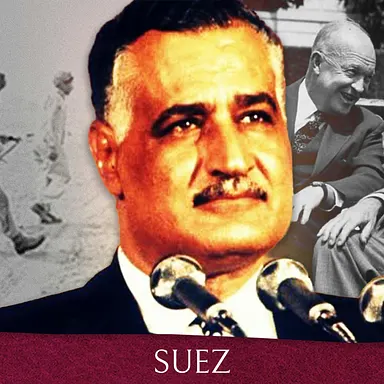
Dominic Sandbrook and Tom Holland conclude their two-part series on the Suez Crisis of 1956, tracing the secret plan with France and Israel that led to the British and French invasion of Egypt. They cover the air campaign, Nasser's defiance, and the backlash at the United Nations and in Washington, where the financial pressure on sterling forced Britain to accept a ceasefire.
The episode also looks at the fallout for Anthony Eden, Harold Macmillan and British foreign policy, and asks whether Suez truly ended the empire. Listeners will learn how a poorly kept secret unravelled, and why the crisis still shapes debates about the Anglo-American relationship.
In this episode Dominic Sandbrook, Tom Holland
This episode's transcript on the Suez Crisis's final act was made with the technology behind HappyScribe's AI meeting minutes generator.
Ads in this audio differ from the text. Tap the sentence you're hearing to follow along.
Synced: the text now follows the audio.
Willkommen zu einem Moment nur für dich und zu allem, was du liebst, bei Douglas. Finde einen Duft, der dich nicht mehr loslässt; Pflege, die aus Alltag ein Ritual macht; Farben, mit denen du dich neu entdeckst. Alles für dich am Singles' Day, jetzt 20% auf viele Artikel. Douglas, welcome to beautiful.
This episode is brought to you by Revolut. Standing still leaves no legacy. History is written by progress, by revolution. Fighting for independence, dismantling those broken systems, defying injustice. Every revolution begins with a refusal to accept the norm, a demand for more. And Revolut is founded on the same principle. Originally established to push back the frontiers of traditional banking, it puts the power back into your hands.
You can manage all of your money in one app. Plus, you can earn while you spend, with the RevPoints reward system. As a fully authorized UK bank, your money is FSCS-protected. Sign up to Revolut today at revolut.com/trih, that's all lowercase, and you'll get £20 after the first time that you spend. 18+. End date and promotion T's and C's apply, and RevPoints T's and C's apply.
Dear friend, it is a great grief to me that the events of the last few days have placed such a strain on the relations between our two countries. But I am convinced that if we had allowed things to drift, everything would have gone from bad to worse. NASA would have become a kind of Muslim Mussolini, and our friends in Iraq, Jordan, Saudi Arabia, and even Iran would gradually have been brought down.
His efforts would have spread westwards, and Libya and all North Africa would have been brought under his control. We in the French were convinced that we had to act at once to forestall a general conflagration throughout the Middle East. If you cannot approve, I would like you at least to understand the terrible decisions that we have had to make. I remember nothing like them since the days when we were comrades together in the war.
History alone can judge whether we have made the right decision, but I do want to assure you that we have made it from a genuine sense of responsibility, not only to our country but to all the world.
So that, Dominic, was a message from the British Prime Minister, Sir Anthony Eden, and he was sending it to President Dwight D. Eisenhower on the evening of 4 November 1956. And that was a very authentic rendering, because I went and listened to him, how he gave his TV address. And he wrote it immediately after a cabinet meeting in which he authorized a ground invasion of Egypt to seize the Suez Canal, which was going to begin the following morning. And it doesn't 100% go down well with the Americans, does it?
And in fact, it ends up precipitating probably the major crisis in Anglo-American relations since the Second World War, in which, of course, both Eden and Eisenhower had been major players and had known each other very well.
So you're dead right, the most conflicted moments in the history of Anglo-American relations. And it also sets the scene for what a lot of people would describe as the greatest humiliation in sort of post-war British history, which is the final stage of the Suez Crisis. Now, last time we heard about the personal duel between Eden and NASA, so Colonel NASA, as Eden always calls him, and NASA, his.
Magnificent pettiness.
Yeah. NASA's decision on 26 July 1956 to nationalize the Suez Canal, Eden's determination to use force to "we take it." And we ended with a secret visit by two French emissaries to Checkers on 14 October, and they floated their scheme for Israel to launch a surprise attack on Egypt, and that would give France and possibly Britain a pretext to intervene, to seize the canal, and to potentially bring down NASA's regime. So, picking up straight away, Eden didn't make a decision immediately.
He told the French he would think about it. But his junior minister, Anthony Notting, said that the prime minister could barely conceal his excitement. So if we pick up two days later, the Foreign Secretary Selwyn Lloyd has been in New York with talks at the UN. He thinks he's reached a decent compromise, the Egyptians will allow people to use the canal freely, but Lloyd is in for a shock. Now, Lloyd is the fall guy for this whole story, so we should say a word about him. Lloyd was the son of a dentist from Cheshire.
He won a scholarship to Fetis College, Tony Blair's alma mater. Went to Cambridge, he was barrister, he was a staff officer under General Montgomery, and then he became a Tory MP. And he's very loyal, he's very good-humored, he's a sort of, he's a decent chap, Selwyn. He's a little bit golf club and a bit gauche.
Didn't his wife divorce him because he went to bed wearing a sweater or something?
There is some issue there, and there is a question, there was later a question mark over his, which I don't, I mean, I'm just reporting, I don't have any inside knowledge. There was a question mark over his sexuality.
But he was the kind of chap who wore knitwear to bed.
I think something like Mammillon or somebody whose own love life was not exactly, you know, anything to write home about, said he was the kind of man who went to bed with a jumper on. Anyway, in 1951, Churchill offered Selwyn Lloyd a job as junior foreign office minister. An absolutely terrific exchange. Lloyd said to Churchill, "Sir, there must be some mistake. I don't speak any foreign language, except in war, I've never visited any foreign country. I don't like foreigners. I've never spoken in a foreign affairs debate in the House. I've never listened to one."
And Churchill said, "Yo man, these all seem to me to be positive advantages." So he became foreign office minister, Eden promoted him to foreign secretary, Eden became PM, because basically Eden wanted to run his own foreign policy. So now, they're having lunch, and 10 October, 16 October, Eden tells him about the French plan. And Lloyd, to his credit, says, "This sounds very risky. I think it's very underhand. It could be illegal. It might not work. I don't think we should have anything to do with it."
And Eden says, "Well, look here, I like this plan. Your UN deal is not going to work. I don't think the Egyptians can be trusted. This is all about Britain's national interests, and if we're going to move, we have to move now, because winter is coming." So it's now or never. And so that means Lloyd has a choice to make. He can either go along with it, or he can resign.
I mean, if he had resigned.
Yeah.
Would that have changed? I mean, he could have bled the whole scheme out of the water, couldn't he?
But he would never have done that. He would absolutely never have done that. So he would have resigned, and Eden would have found somebody else.
Okay, so it didn't really make a difference.
So, six days later, 22 October, Lloyd gets to star in his very own John Le Carré drama. He announces he's got a heavy cold, and he cancels all his public engagements. He puts on, as a clever disguise, a battered old raincoat. And then, as every single book about this incident says, he is bundled into a car, driven by his private secretary. I actually think he probably just got into the car. But even in my own retelling of this, I described him as being bundled into the car.
And who's bundling him?
Well, this is the thing, I think he's just getting into the car. I think he just gets into the car. But I can't remember now whether I got the thing about him being bundled in, whether I made it up, or I got it from somebody else. But I've now seen it repeated in other books, so presumably people are getting it from me. And there's just a general sense of, like, mysterious men in Macintoshes bundling Selwyn Lloyd into the back of this car.
Kind of a faint vibe of slow horses.
Yeah, very slow horses. Exactly. It's important spygraph, and as we shall see, Lloyd loves a bit of this important spygraph. So they drive to RAF Hendon. He gets on a plane, and he flies to an airbase just south of Paris. There, he and his private secretary are met by a French officer. The French officer bundles them into another car, and they drive at high speed to the suburban town of Sèvres, which is on the southwestern edge of Paris. And on the way, they're almost hit by a truck coming out of a side street. And if that truck had hit them, I mean, that really would have changed history.
You know, the British would have had to explain what he was doing there. It would have been a massive story. Anyway, it didn't hit them. They arrive at this townhouse on a leafy Sèvres side street, a townhouse that used to be a French resistance headquarters in the war. Lloyd is still in his disguise, his raincoat. He's very shaken after the near crash. And he's taken in, and in that side of the house are the French Prime Minister, Guy Mollet, and the Foreign Minister, Christiane Pinault. And, you know, I said it was resistance headquarters. They, like so many of the French in this story, are decorated resistance veterans.
They're socialists, they're part of the French Socialist Party. And they explain the plan to Lloyd, and then they say, "Do you know what, we've actually got the Israelis in the next room." And they take him into the next room, and there are David Ben-Gurion, the Israeli Prime Minister, Moshe Dayan with his eye patch, the Chief of Staff of the IDF, and Shimon Peres, the head of the Ministry of Defense, future Prime Minister himself.
Yeah, he was in Israeli politics forever, isn't he?
Yeah, well, basically everyone in Israel is in politics forever, aren't they?
But Shimon Peres is there forever, I think. I mean, he lasts until whatever, kind of 2023 or something.
Yeah, kind of incredibly old. Selwyn Lloyd, as is his want, tries to break the ice with a top golf club joke. He comes in, the first thing he says to them is, "I order a false mustache." What, what, what? And there's just a dead silence in the room.
I'll get my coat.
So the Israelis, you know, who are much more battle-hardened men than Selwyn Lloyd is, they are, they're knackered. They've been traveling for 17 hours to get there. They're very tense, they're very, this is serious business. And this British bloke turns up making terrible jokes in an old Mac, whispering about false mustaches. They find him patronizing, they find him boorish, and they find him tactless. So Moshe Dayan's assistant wrote in his diary, he said, "Lloyd looked like a typical English diplomat, with a shrill voice and a face that looked as if something stinking hangs permanently under his nose."
Oh dear.
So they talk all evening, and then we're told they broke off so they could eat an enormous fish.
Where did they get that?
I mean, how enormous?
How big was this fish?
How many people are there? There's the French, there's Lloyd, probably his private secretary is going to eat something, and there's three Israelis. I mean, there's got to be a big fish to feed that many people. And they're probably like staff officers. It's got to be massive. So they eat this fish, and then they nail down the plan. By midnight or so, big Israeli raid across the Sinai Desert. Within the first day, the Israelis reckon they'll be approaching the canal. At that point, after the first day, Britain and France will issue an ultimatum. They will say to protect canal traffic, both sides, Egypt and Israel, need to withdraw from the canal zone.
The Israelis will agree, the Egyptians won't. And so Britain and France will begin air strikes the next day, and then after air strikes, they will proceed to a full invasion. Lloyd is very quiet during all this. For all his sort of mad joking, he never thought this was a good idea, and his private secretary said afterwards that he seemed very thoughtful throughout. But of course, he's in too deep already just by going. And he knows that his boss, Anthony Eden, wants this. So Lloyd flies back to London after midnight, and the next day he briefs the British cabinet.
So everybody in the cabinet knew about this. He says, "I've had secret conversations with the Israelis, but nothing's yet decided." But on the 24th, which is a Sunday, the British send the Foreign Office Mandarin Patrick Dean to Paris to seal the deal. They type up an agreement in Sèvres. Israel will strike in five days' time, on the night of 29 October. Britain and France will issue their ultimatum on the 30th, NASA will refuse. On the 31st, will begin the air strikes, and then the ground invasion.
They sign the agreement, Ben-Gurion, Pinault, and Patrick Dean. And then the French sort of officials who are there hand out champagne, and they drink this awkward and sheepish toast. Moshe Dayan, who has already sent orders to mobilize the IDF, said later, "The British were the first to leave, and as they left, there were mumbling words of politeness, tinged with humor and not quite comprehensible." So the sort of sheepish.
Embarrassment.
Embarrassment, because this is an underhand business. So we come to the next day, Monday the 25th. So they're already, the clock is really ticking, there are less than 100 hours to go till this kicks off. Eden, who seems, everybody says, very excited, full of life, buoyant, you know, not a man at this point struggling with his health, formally puts the plan to the British cabinet. He says, "I know we may be accused of collusion with Israel, but I'm all for this." And he is backed up, not just by Lloyd, who is his faithful kind of political factotum, but crucially by the Chancellor of the Exchequer, Harold Macmillan, who is a central character.
Thank God he's got Harold Macmillan on board.
Yeah, well, crucial.
I mean, he's such a leading figure, isn't he? And so loyal, and he'd never stab Eden in the back. So thank God for that.
Oh, oh dear. You don't trust Harold Macmillan? This is shocking. So Harold Macmillan, for people who are not familiar with British politics in the 50s, if you can imagine somebody who looks basically just like Anthony Eden, but much more crumpled.
Oyster eyes, you're obliged to describe him as having, aren't you?
He's got these kind of droopy oyster eyes and a very sad mustache. It's a sort of, it's your absolute textbook melancholy mustache. So we can't get in too deep into Harold Macmillan. I mean, he's a great character, actually, but you know, he'll take over the podcast if we're not careful. His dad was a Scottish publisher, his mother was an heiress from Indiana in the Midwest. He went to Eton, he went to Balliol College, Oxford. He was incredibly heroic in the First World War. He was wounded at the Battle of the Somme, and he famously lay for 12 hours in a shell hole reading "Ischyllus" in the original Greek, which is admirable behavior.
So Harold Macmillan is a man who, Eden, remember, wouldn't tell people about his military cross. Harold Macmillan is a man who constantly is sort of saying, "Oh, war wound," you know, kind of rubbing his arm or something, in a sort of thoughtful way.
I mean, presumably, there's only one guy who's reporting on how Macmillan read "Ischyllus."
That's probably true, yeah. When he was Prime Minister, he used to say, "Everybody should go to bed with a trollop," which he meant Anthony Trollop. There's a lot of this kind of stuff.
He'd performatively retire at four o'clock in the afternoon when he'd read it.
Exactly, exactly. So he, it's on the left, he's on the far left, actually, of the Tory Party. I mean, he's properly kind of left, almost left wing in the 30s. And then he becomes Churchill's liaison to Eisenhower in North Africa in the war, and then he becomes Eden's Foreign Secretary, then his Chancellor. He's very feline, Harold Macmillan. He's devious, everyone always says he's theatrical. He's got a little bit of a hint, I think, of another Balliol man, Boris Johnson, about him.
It seems an odd comparison, because Macmillan is so much more impressive as a character. But there's a little bit of the performative showman about Macmillan. And he's untrustworthy, and Eden never trusts him. Anyway, because of his heiress mother, and because of his wartime experience in North Africa, Macmillan believes himself to be a great Uncle Sam whisperer. So he says to the cabinet, "I know the Americans, they're bound to go along with this." And people say, "Well, what about Eisenhower? Will Eisenhower not be offended that we've kept him in the dark?"
Oh no, no, dear boy.
Oh no, no, dear boy. I know, Ike, he will lie doggo. That's what he says. So, the thing is, this is unbelievably irresponsible and reckless from Macmillan. His Chancellor, and he of all people, therefore should know that if the Americans don't go along with this, Britain is in a massive hole. Because we alluded to this last time, the British economy in the 50s suffers from a very specific weakness. Because of our defense commitments, and because we're spending so much money on imports, basically because our own products are rubbish.
So you're buying, when you buy your washing machine, great to get a washing machine on the show. When you buy your washing machine, you're buying some imported washing machine, not a British one. As a result of that, Britain's balance of payments is constantly in the red. And in the 50s, they love the balance of payments, they never stop talking about it. So as a result of this, when your balance of payments figures are bad, international sort of currency traders say, "Oh my God, sell sterling, sterling's in crisis." So the value of the pound collapses, and the Treasury periodically has to spend its gold and dollar reserves to buy sterling to push the value of the pound back up.
And in August 1956, the Treasury said to Harold Macmillan, "Sterling is coming under mounting pressure. You know, we're going to have to spend a lot of our reserves in the next few months, so we have to be really cautious." And in September, his Chief Economic Advisor, who knew that something was going on with SUES, specifically said to Macmillan, "We must be aware of," and I quote, "the vital necessity from the point of view of the currency and our economy of ensuring that we do not go it alone and we have the maximum US support."
Now Macmillan hears this advice, and he chooses to draw a very different lesson from it. He says to his colleagues, "Well, all my advisors are telling me that if we strike quickly and decisively at SUES, it will banish doubts about Britain and it will restore confidence in the pound." And so as a result of this, he's one of the most influential voices in favor of going to war. And even though a couple of Eden's ministers have doubts, the combination of Eden, Macmillan, and Lloyd means that they're going to go for it.
So the die is cast, Tom. So three days go by, and then on the afternoon of the 29th of October, the Israelis launch Operation Kadesh, which is the first stage of the plan. So at three o'clock that afternoon, Israeli Mustang fighters launch attacks on Egyptian military positions in the Sinai. And two hours later, 400 Israeli paratroopers are dropped into the Mitla Pass, which is the key pass through the Sinai Mountains.
And from there, once they've established themselves, the plan is they will be reinforced by more paratroopers led by Ariel Sharon, another future Israeli Prime Minister. And so it works, and by nightfall, IDF tanks are joining them in the Sinai. NASA, we haven't had him on the show yet, because he's been at a birthday party. He's been at his son's birthday party, no less. So literally, there are people cutting cakes and playing party games when he gets a call.
And when he gets the call, he struggles to make sense of what's being said because there's so much noise at this party.
So it's like George W. Bush being told about 9/11.
At that school.
It's not dissimilar, exactly. And when he first hears, the Israelis have, you know, landed paratroopers in the Sinai, he says, "This cannot be serious. This must be a feint from them. They're probably going to attack Jordan. There's been a lot of tension between Israel and Jordan. Or they're going to attack Gaza," which in fact they do later do. They cannot seriously be invading Egypt. But he is wrong. By dawn the next morning, which is Tuesday the 30th of October, the Israeli paratroopers are fully dug in at the Mitla Pass, which is 40 miles from the canal across the desert.
So a couple of hours later, Eden's cabinet meets at number 10. Everything is going exactly according to plan. They draft their ultimatum to both sides, to Egypt and Israel. They give them 12 hours to stop all military action and to withdraw 10 miles from the canal. Egypt, they say, must allow British and French forces to move temporarily into Port Said, into Ismaila, and into SUES to guarantee freedom of transport through the canal by ships of all nations. And if they don't accept, the British and French will intervene in whatever strength may be necessary to secure compliance.
I mean.
When you put it like that, it sounds so outrageous.
It's quite outrageous, isn't it? I mean, who do they think they're kidding?
The world? I mean.
I guess.
Yeah, I guess. They very much told themselves what they want to believe, haven't they? I mean, they cannot seriously think that anyone, that people won't see through this. Well, actually, they do think, Eden does think people won't see through it. He's actually offended and outraged when people question, you know, his integrity. Anyway, at this meeting for the first time, and we're only hours into the whole business, and there is a hint of trouble. Macmillan is forced to say to his colleagues that already Britain's currency reserves are coming under pressure, because instead of strengthening confidence in the pound, the crisis in the Middle East is weakening it.
So the cabinet minutes record, "We should do our utmost to reduce the offense to American public opinion because our reserves of gold and dollars were still falling at a dangerously rapid rate." And so as a result of this, Eden writes to Eisenhower that morning, and he says, "Listen, this ultimatum is not about harking back to the old colonial concepts. It's about strengthening the weakest point in the line against communism." So you see how the rationale keeps slightly shifting. Remember, NASA was the new Mussolini at one point, now it's about communism.
Now we'll come back to Eisenhower. Eisenhower, spoiler alert, is going to be furious about having been double-crossed. Anyway, that afternoon, Eden goes to the House of Commons, very packed, very excited. He reads out the ultimatum. Now in Egypt, NASA, when he hears about the ultimatum, he is stunned by this. He never saw this coming. His intelligence chiefs had said to him, "It's very unlikely the British would undertake military action against us, because the British would destroy their own reputation in the Middle East and the entire Arab world if they got involved, especially with the Israelis."
I mean, that would be mad from the British. Obviously, NASA's first reaction is to reject the ultimatum. No way are we accepting this. But he also does two very smart things. I mean, NASA is a canny operator. First of all, NASA immediately appeals to the United Nations. He says, "This is a flagrant violation of the UN Charter, because it is not right to ask for a nation to disarm if it's facing a foreign invasion of its own sovereign territory," which is true, it's not.
And then the second thing, this is something that Eden did not expect. A lot of people would have thought, "Well, NASA might appeal to Moscow for help." He doesn't. He appeals to Washington for help. He asks to see the American ambassador in Cairo, and he says, "You and I both know that you probably expected me to go to the Russians, but I'm not. Nikita Khrushchev, the Russian Soviet premier, has offered me Soviet volunteers. I don't want them. I want you. I want your support, the Americans." I mean, that's so clever from NASA.
Now meanwhile, in Cyprus, the RAF aircrews are making their final preparations. And later on the afternoon of the 31st, they get the confirmation that everybody expected, NASA has rejected the British ultimatum, and so this is on. And so as night is falling, Canberra and Valiant bombers take off from Cyprus, and then a second wave of attack jets from three carriers off the Egyptian coast, their Eagle, Bulwark, and Albion. And what follows is a total walkover.
I mean, as we said before, the madness of claiming that NASA was going to take over the Middle East, when his army, his air force is destroyed within hours, effectively.
I mean, if anyone's behaving like the Luftwaffe, and it pains me to say this, it's the RAF.
So they're hammering the Egyptian airfields and bases. They destroy scores of NASA's fancy new Soviet-made planes, which are just sitting there, you know, sitting ducks on the tarmac. In fact, in purely military terms, this operation is going incredibly well. So the Israelis have cut through the Sinai, and the Egyptian army is already falling back towards the Nile Delta. NASA's officers are making contingency plans to evacuate Cairo. Maybe we'll have to carry on this struggle as sort of guerrilla warfare in the Delta.
Meanwhile, the British and the French, within hours, have got total command of the skies. Within three days, they've destroyed almost the entire Egyptian air force. They've destroyed 260 planes, and they themselves have lost only three pilots.
So that basically has met the Israeli war aims, I guess.
Yeah, they've basically neutralized NASA as a threat. They've got what they want, completely. So now the RAF bombers have moved on to Egypt's coastal defenses. They're clearing away for the troop landings. NASA is watching all this from the roof of his villa in Heliopolis, and he can see the bombs falling on the sort of outskirts of Cairo on military bases outside Cairo in this black smoke rising above the city. He goes into his military headquarters, and his comrades in the free offices have gathered there, and there is a mood of panic. You know, at one point, one of them actually says to NASA, "When are we going to surrender?
I think you might have to make the ultimate sacrifice for your country and hand yourself over to the British to spare Egypt more punishment." You know, they're really worried about what's going to happen. But there's also good news for NASA. So first of all, no question, all Egypt is behind him. The British and French had hoped that people would rise up. They believed this stuff about, you know, he's a dictator, you know, the Egyptian people can't wait for us to intervene. This is very kind of 2003, or indeed the American attack on Iran, right? You know, the people cannot wait to rise up.
But in Egypt's case, this doesn't happen at all. And because they don't knock out Cairo radio, NASA can continue broadcasting to his people this message of national defiance. Now, in the first half, we said how he'd read My Early Life by Churchill. His rhetoric at this point, I mean, it's not just Churchillian. It's pure Churchill. "We shall fight, not surrender. We shall fight from village to village, from place to place," and so on and so forth. On Friday, the 2nd of November, an amazing scene.
He's driven in an open-topped car through the streets of Cairo to the Al-Azhar Mosque, 10th Century Mosque, for Friday prayers. Huge crowds. And he gives a pure Churchill speech. "I will remain in Cairo. I will fight alongside you. For every one of us, among the armed forces and the people, our watchword will be, we will fight, and we will never surrender. We will defend our country, our history, and our future to the last drop of blood."
And is Eden coming out with this kind of stuff as well in Britain, and uniting Britain behind him?
No. You've got an Eden speech coming out, which you can do with your excellent Eden voice.
Oh, great.
Well, Britain, you see, Egypt is united behind the war, and Britain is very much not. So public opinion is basically 40-40-20. 40% are for it, 40% are against it, and 20% don't care. And over time, that shifts in the government's favor and Eden's favor, so 50-30, but it's still, you know, divided. So most Tor is back for war, but not all of them. We mentioned Lord Manbattan last time. Manbattan always thought it was a bad idea. And it was later said, I mean, it's impossible for anyone to know how true this is, that the Queen was not a fan of the operation.
So labor, labor are much more divided. So basically, if you're a bien-pensant duguda, then you're dead against it.
Your favorite kind of person.
My very favorite kind of bien-pensant person. If you're a well-meaning, you know, high-minded person, you're dead against this. A lot of the big unions are against it. The churches are against it. Students are against it. But a lot of more working-class labor voters are probably for it. So the future labor foreign secretary, David Owen, was working on a building site in Plymouth before going to university, and he said, you know, he turned up with his kind of lefty views. And the other builders, who were all labor voters, well, they thought it was brilliant.
They couldn't get enough of it. Anyway, all this is, I think, quite a good preview of the arguments in Britain, first about the Falklands, but this kind of feels very Brexit to me, actually, all this sort of stuff. Which leads me to the press coverage. So the Daily Telegraph, "How good it is to hear the British lions roar," and my absolute favorite, which was in the daily sketch, "Let the crybabies howl, it's Great Britain again." See, the thing is, I would have loved to have been writing in my middle market newspaper days, I would have loved the SUES crisis.
Well, it's kind of, as an anti-imperialist, I'm all in favor of the military occupation of Egypt.
Exactly.
And its annexation to the British Empire.
That's a remainer. Like, I think we should drop a nuclear bomb at Brussels.
Yeah, exactly.
Abroad, a lot of people have really let themselves down. It's very sad to say. A lot of people abroad are not cheering the roar of the British lion. They are howling crybabies. So across the Arab world, massive demonstrations, offers of military support for Egypt from Syria, and so on. NASA, again, very canny, turns all of them down. He knows it's better for him to look like a helpless victim, really, in the eyes of the world, so people will feel sorry for him.
The Saudis imposed an oil embargo on Britain and France. This strikes me as so weird that nobody remembers this. There was an oil embargo against Britain and France, and in Britain, they had to introduce petrol rationing from December 1956 till May 1957. You had to have coupons to get petrol, and you were allowed 200 miles of petrol a month. You know how people go on about the three-day week and the oil shock of 1973? No one ever remembers this. Now, A, it's 20 years or so earlier, but I wonder whether it's just that people didn't have as many cars, so it wasn't such a big deal.
Children were walking six miles to get to school and were happy to do it.
Yeah, of course.
Great days.
Great days. Now, Eden expected, of course, the Arab world would kick off. He didn't expect that the Commonwealth would let him down. So the governments of Australia and New Zealand were publicly supportive, but in private, they made it very clear they were horrified that Britain had not been honest with them. And above all, I know we've got a lot of Canadian listeners, and little by little, more and more Canadian history is finding its way onto the show. It's the new Welsh history, really. So the Canadian Prime Minister, are you familiar with Louis Saint-Laurent?
Is he a Quebecois?
He was a Quebecois, yeah. He was outraged by this. He sent Eden a private message. I deeply regret the course you're taking. He said, "You've undermined the United Nations. You've cloaked with a smokescreen the brutal international crimes of the Soviets in Hungary."
I mean, he's not wrong, is he?
He's not wrong. As this is happening, it is absolutely kicking off in Hungary. There are tanks on the streets of Budapest, and the two stories are fighting for attention on the front pages.
Yeah, and so the British and French are essentially kneecapping the moral response of the West to the Soviet suppression of the Hungarian revolution.
Completely, completely they are. Absolutely. Which brings us very neatly to the Americans. So Eisenhower was flying to an election rally in Richmond, Virginia, when he got news of the invasion. He could not believe it. He was absolutely furious. He did not lie doggo. That's how I remember when he said he would. Eisenhower said to his Secretary of State, Dulles, "You tell him we're going to apply sanctions. We're going to the United Nations. We're going to do everything that there is to stop this thing." Now, this was when he knew the Israelis were attacking Egypt.
He didn't even know the British were involved at this stage. Next day, he found out, and he just, it blew his mind. He said, "Nothing justifies them double-crossing us." Of course, he's got a huge dilemma now. Election Day in America, it's the 6th of November. It looks like he's going to win, but you can't be sure. Opinion polling is a sort of relatively primitive science in the 1950s. Eisenhower is campaigning as the candidate of peace and prosperity. Britain and France, on the other hand, are his closest allies in Europe.
They're key players in NATO. To abandon them would be a big step. And yet, if he backs them, he drives the whole Arab world, the whole of the Middle East, into the arms of the Soviet Union. And that would basically mean, you know, all that oil, all that strategic position, you know, is part of the communist world. So what is he going to do? Now, really interestingly, Eisenhower said afterwards, "If Britain and France had got this done within like a day or two days, and presented him with a fait accompli, he'd have probably gone along with it."
This is Eisenhower in 1964. Had they done it quickly, we would have accepted it. There would have been no great crisis. But, you know, I made the comparison with Austria-Hungary in 1914. Being really slow is a bad mistake. This whole thing is so protracted. So for the reasons of optics, the British decided their fleet wouldn't sail from Malta until after they'd issued the ultimatum. Of course, because they don't want to look like they're preparing for war before the ultimatum is rejected.
But what that meant is even after they wiped out NASA's air force, they still couldn't land troops until the 5th of November. And so there's loads of time for international opposition to mount, especially at the United Nations. And what they never anticipated was that the Americans would be leading a lot of that opposition. So on the 30th of October, as early as the 30th of October, the US ambassador introduces a resolution in the Security Council for an immediate ceasefire and for no external powers to get involved between Egypt and Israel.
That's a huge problem for Britain and France. They have to veto this resolution, and they have the embarrassment that they have vetoed a resolution that both the Americans and the Soviet Union have supported. Two days later, John Foster Dulles personally introduces a ceasefire resolution in the General Assembly of the United Nations. And this is excruciating for Britain and France because Dulles says in front of the world, "Britain and France are our oldest allies, but on this occasion, they're totally out of order, and we don't support them."
And the result for Britain and France is a total humiliation. So the only countries that vote against Dulles's resolution are Britain, France, Israel, Australia, and New Zealand. So effectively, I mean, fair play to the Australians and the New Zealanders, but effectively, Britain, France, and Israel are alone. They've been ostracized in the eyes of the world. So this is what's happening in New York. And at home, it's all kicking off as well. So Hugh Gatesgill, who would seem like he might support military action a couple of months ago, on the 1st of November, he brings a vote of censure against the government, which is a very punchy thing to do in wartime.
He says to Eden in the commons, "Everybody knows you've colluded in this. You can't fool people. You've obviously been conspiring with the French and the Israelis. You're destroying the Commonwealth. You're destroying the alliance with the Americans." All this, this massive pandemonium in the House of Commons. Labour MPs are shouting at Eden saying he's a liar. Tories are shouting at Gatesgill. They're saying he's a traitor, that he's a coward who never wore a uniform in the Second World War, and so he has no right to criticize other people. The Speaker actually has to suspend the sitting because MPs are so close to coming to blows.
This is before the days of broadcasting, so the public never gets to see it. And all this is piling pressure on Eden, because of course, Eden's self-image, he sees himself as the perfect gentleman. You know, he always does the right thing, perfect manners, all that, lovely mustache. And so when he does go on TV on the 3rd of November, it's a very, very earnest, defensive, sort of almost apologetic performance.
There's no hint of the "let the crybabies howl" spirit. It's quite the reverse. Tom, would you like to give us your Antony Eden again?
All my life, I've been a man of peace, working for peace, striving for peace, negotiating for peace. And I am still the same man, with the same convictions. But I am utterly convinced that the action we have taken is right.
Yeah. He says, "The only reason we're going in," and this is so disingenuous, "is because the United Nations couldn't organize it in time. If the United Nations will take over the police action, we shall welcome it." Now, he's obviously thinking the UN will never get their act together. We'll be able to get this done and dusted before the UN can do anything, which you'll see about this. It's pretty obvious now that he is, Eden is really shocked, and he's coming in at great personal sort of physical strain.
The next day, which is Sunday the 4th of November, the Observer, which was the sort of voice of liberal, metropolitan, educated Britain, the Observer ran an editorial which would have been unimaginable in the Second World War. It says the British and French governments have behaved like gangsters. They've shown total folly and crookedness, and Eden has got to go. That afternoon, ministers arrive for their emergency cabinet meeting, and they can hear Eden upstairs.
He's pacing up and down his study, and he is talking, presumably to himself, just talking incessantly. And then he comes downstairs, and they're all shocked how sort of drawn and tired he looks. Obviously, he's not been sleeping. And while they're meeting, there's an anti-war demonstration taking place in Trafalgar Square, being addressed by Niren Bevan, the great kind of labor firebrand. And they can hear the crowd kind of cheering and booing and chanting, "Eden must go," and all of this kind of thing, while they're in the cabinet meeting.
Now, Eden has just had some very bad news from the UN. He shares this with his cabinet. The Canadians have just introduced a resolution calling from a UN peacekeeping force. The Americans have backed it, and it has passed. Now, this is a huge problem for Eden. Eden had made that hollow offer. Yeah, we'd love it if the UN came in. He didn't think they would. And he thought it would take ages to organize. And now it's going to happen, and it's been organized by the Canadians and the Americans. So it would look really bad for him to oppose it.
And he now has a massive dilemma because basically this is the cabinet meeting to press the button to launch the invasion. So he's got a dilemma. Does he launch the invasion or does he not? He says to his colleagues, "Well, I think we should, we've got to go through with it now. We could maybe sell this to the world as the first stage of a UN peacekeeping effort if we attack Egypt first." Lloyd and Macmillan both support him. But now for the first time, there's a proper split in the British cabinet. So four ministers say, "Actually, we should probably postpone this."
And two of them say, "This is actually turning into disaster. Let's cool the whole thing off." So they take a break. It's very tense. And then the news comes that Israel has refused to accept a ceasefire. So Israel has kind of bailed them out. It's going to be very hard for the UN to send in peacekeepers if Israel are not obeying the ceasefire. So they're like, "Brilliant. We can use this as a pretext to go in." And they're cheering and laughing and banging the table in relief, and they say, "Come on, let's do this." So that evening, Eden writes another message to Eisenhower, and that's the message you read in the introduction.
Casting Nasser as a Muslim Mussolini and all this stuff. And he ends with that note asking Eisenhower to remember when we were comrades together in the war, "History alone can judge whether we have made the right decision." But Tom, will it? We're about to find out. Because at dawn the next morning, the British and French are going to launch their peacekeeping defense of world security. Or to put it another way, they're going to invade Egypt in a nakedly colonial operation.
And we will find out what happens after the break.
Hi everyone, it's Katty Kaye here from The Rest Is Politics US. The midterms are almost here. It's the biggest political moment of the year. And Antony Scaramucci and I will be right there with you, making sense of every twist and turn as the results come in.
Yeah, that's right. We're going to be live on YouTube covering the midterms as we get the results. Will Donald Trump be a lame duck for the next two years or walk away with a mandate to do whatever he wants? We're about to find out.
So join us from midnight to 3 a.m. Eastern Time on November the 4th. We'll be live reacting to all of the results as they come in. That's 5 a.m. to 8 a.m. if you're listening in the UK.
So make sure you're subscribed to The Rest Is Politics US on YouTube and turn on notifications, please. You won't want to miss this.
Hello everyone and welcome back to The Rest Is History, where it is 5 a.m. on Monday the 5th of November, 1956, and dawn is breaking on the coast of Egypt. And as it does so, some 700 British paratroopers are descending onto the El Gamil airfield, which is west of Port Said. And they come under immediate machine gun fire from the Egyptian defenders who are camped out in a nearby cemetery. But they dig in and they call in airstrikes.
And by evening, they have killed 30 Egyptian defenders and fought their way into the cemetery. And essentially, it's looking good for them and for the French, right, as well.
Yeah, very good. So they've fought their way across this airfield. And meanwhile, the French, their paratroopers have landed south of Port Said. They capture the main road, they capture a water plant, they capture a railway bridge. The French, you know, they're pretty hard. They've been hardened in Algeria. And they report said later they machine gunned every living thing in their path as they advanced. So by nightfall, the British and French have lost only 32 men, and the Egyptians have already lost about 2,000. And meanwhile, that day, the 5th of November, Eisenhower has had a message from the Kremlin.
Now the Kremlin themselves dealing with two massive things. So one of them is Egypt and the other, of course, is Hungary, which we'll talk about next week. Nikita Khrushchev basically is threatening to get stuck in himself. He's actually suggested to the Americans, "Why don't we both go in? What could go wrong? I'm joined to American Soviet peacekeepers." And this is, of course, I mean, Eisenhower, you know, the blood drains from his face when he hears this. He says to his aides, "If those fellows start something, we may have to hit them, if necessary, with everything in the bucket."
I mean, effectively meaning nuclear war. So Eisenhower puts the US 6th Fleet, which is in the Mediterranean, on a full alert, and he orders the US Navy to prepare to implement its emergency war plans. I mean, this is a serious business now. The next morning, Tuesday the 6th, the British and French resume the attack. The fleet hammering the Egyptian coastal defenses, and then they begin to land hundreds of Royal Marines. So 40 and 42 commando in amphibious landing vehicles, and 45 commando in the world's first major helicopter assault.
I didn't know this.
So that's a British first.
British first, yeah. We recently had the first use of khaki, didn't we, in the Abyssinian Expedition. And yet again, Britain is leading the world. So that's nice. So it's going, it goes really smoothly. The Marines are really up for it. They've been waiting for weeks. It was one said later, "We were in great heart, we were very fit, we were well equipped, and confident." They move into Port Said. It's an incredibly chaotic scene. There's machine gun fire, there's mortars, there's helicopters and planes buzzing overhead. The Egyptians are fighting back. The city's on fire.
Smoke everywhere. The civilians are hiding in their buildings. But by mid-afternoon, the British troops are moved into the city center. They've got the main roads, they've got the main buildings. And by nightfall, the gunfire is dying down. So, you know, within hours, they've achieved one of their key objectives. Meanwhile, two para, and the 6th Royal Tank Regiment, have moved off south from Port Said, down the canal. So if you imagine these long kind of roads heading south into the desert, because their job is to get as far as they can, secure as much of the canal as you can, as quickly as you can.
And they are trundling along in their tanks. They're totally unchallenged by Egyptian resistance. They're drinking whiskey, you know, to sort of fortify themselves against the night air. They actually cannot believe how well this is going. And they're about 23 miles south of Port Said when suddenly the lead tanks grind to a halt. And the whole column stops. They cannot understand why. And they ask, and their commander says, "We've just had word from headquarters, the Americans have stopped the advance."
So what has happened? The answer is that under economic pressure, Antony Eden and above all Harold Macmillan have cracked. So as late as the Sunday, which is two days earlier, Macmillan was still very gung-ho. And he was still insisting, you know, "When we've won this, that will turn around the fortunes of the pound." But the pressure has been mounting. So the Saudis have announced their oil embargo, the Syrians have cut off a crucial pipeline.
And all the time, the Treasury is spending more and more money, $100 million in reserves to try to protect the value of the pound. But by the night of the 5th, Macmillan's officials have persuaded him, "This cannot continue. The pound is going to tank, we're going to run out of reserves. You actually need to pick up the phone and talk to the Americans and get credit from them, short-term credit, and get their approval for a loan from the International Monetary Fund to allow us to support the value of our currency."
So the next morning, the 6th, while, you know, the fighting is going on in Egypt, two things happen. First of all, Macmillan rings Washington. And he speaks to the US Treasury Secretary. And he says, you know, "My dear fellow, will you back a loan from the IMF?" And the US Treasury Secretary says, "Sure I will. If you'll agree to a ceasefire at Syria, it's before midnight. You've got till midnight to agree to a ceasefire." Now it's the other thing. Eden is on the phone to New York, to Britain's ambassador to the United Nations.
And the ambassador says, "I've got really bad news for you. The Americans are preparing a resolution to impose oil sanctions on Britain and France if we don't stop fighting." And when they hear that, they think, "Oh my God, this is falling apart." Macmillan supposedly, when he heard the news from the United Nations, he threw his arms in the air and he said, "Oil sanctions. That finishes it." So at 9:45 that morning, they went into cabinet and Eden outlined the situation to his colleagues. And then Selwyn Lloyd, who had been, you know, so faithful for so long, said to the others, "Look, if we don't stop now, we're going to blurt the alliance with America forever."
You know, this is, this is, it's now or never. And then of all people, the most shameless person in British politics, Harold Macmillan, who had been all for it just a few days earlier, "This is going to revive our national fortunes." He says, "Well, of course we have to stop." He says, "If we don't have this loan from the IMF, we're going to have to devalue the pound and basically blow up our own economy." And so as quickly and as simply as that, the whole thing falls apart and it's all over. They announce a ceasefire for 5 o'clock British time, which is nighttime in Egypt.
Eden goes to the House of Commons and he tries to put a brave face on it. He says, "Our operation has been a triumphant success."
Comical alley.
Thanks to our brave boys, the two sides, Egypt and Israel, have stopped fighting. The UN are following our lead, and so on and so forth. But everybody knows this is a sham. There was a journalist watching from the gallery who said, "Eden looked like a broken man. His hands twitched at his horn rim spectacles. The face was gray except for a black rimmed cavern surrounded the dying embers of his eyes. The whole personality seemed completely withdrawn." But unfortunately for Eden, his ordeal, his punishment is not over yet. So he asks, "Can British troops stay in the canal zone and be part of the UN peacekeeping force?"
Because it would be very embarrassing for them to have to slink back home, having gone in and now come out again. And Eisenhower says, "No, you have to withdraw immediately all your troops. If you don't, we will veto the IMF loan. In fact, if you don't, we will start selling our own reserves of sterling. And that would trigger an immediate devaluation of the British pound." And when Macmillan hears this, he says to Eden, "Well, we absolutely have to give in. If we don't get American support, the pound will cease to be an international currency."
I mean, really kind of, Macmillan's always very apocalyptic. So there's a bit of dithering over the next couple of weeks, but on the 3rd of December, Selwyn Lloyd goes to the House of Commons. He says, "The operation has gone actually so well that every last British soldier is now being brought back home." And it is a crushing humiliation for the Torys. And it's made worse because this Labor opposite number in Aaron Bevan plays it absolutely brilliantly. Bevan was given to these long rants. And he could have done a long rant, but he gave a very brief reply.
And then he said, "Given the obvious embarrassment of the government, I feel I would be a bully if I proceeded any further." And then he just kind of sits down. And it's just utterly crushing for Lloyd. Not for Eden though, because Eden by this stage is not around. He's left the country.
He's gone on holiday, hasn't he?
He's effectively gone on holiday. So basically, everything you ever read about this, or a lot of what you read, says Eden at this point is massive, is just off his face on painkillers and amphetamines. He's addicted to benzedrine. And I think this is just not true. So his official biographer, D.R. Thorpe, is the only person who's seen his medical records, which are at Birmingham University, and has looked at them and said, "This is just rubbish." He was prescribed sleeping pills later, but he wasn't taking them at this point. What is true is that he is very haggard, he's very depressed, he's got this kind of permanent fever, and he can't sleep.
And on the 19th of November, Eden's doctors said to him, "If you don't get some rest, you're going to kill yourself." So four days later, the government announced that Eden was taking a break. He was going to leave Macmillan and Rab Butler to run the government while he was away. And of all things, he had accepted an offer from Ian Fleming to go on holiday to Ian Fleming's house, Golden Eye, in Jamaica.
The name of the house obviously inspiring the Pierce Brosnan Bond film. So the optics of this, I mean, you know, it's a pre-spin age, but you could not imagine worse optics. That basically the Prime Minister's gone off to the house at the Bloke Writes the James Bond books, sunning himself in Jamaica, while our troops are still being brought home from Port Said. I mean, it looks terrible. So the Daily Mirror ran a brilliant competition. You know, you send in your suggestions on how to get our brave boys home.
And the prize is a three-week holiday for two in Jamaica. And the other amusing contribution was from Churchill's son, Randolph. Randolph Churchill, who's a terrible person, he hated Eden with a passion. I think he was jealous of him, frankly. And he wrote an article in the Guardian, comparing Eden with Hitler. And he said, "The difference between them, the difference between them is when the Germans were trapped at Stalingrad, even Hitler drew the line at wintering in Jamaica."
I've got to say that's a banger.
It's a good line. So Eden should undoubtedly have resigned then. He didn't. He wanted to fight on. He came back to London on the 14th of December. He's very tanned because he's been enjoying the Jamaican sunshine.
Crisis? What crisis?
He read a very bland statement, "I'm glad to be home," whatever. His first draft of this statement, which was sort of unrepentant defense of the operation attacking Cairo, Washington, and Moscow, had been vetoed by his cabinet colleagues who said, "This is, this is mad." And there was an excellent headline in one paper, "Prime Minister Visits Britain."
Yeah, that's great as well.
So Eden made one last appearance in the House of Commons just before Christmas. And it was a very sad, ever had a dreadful appearance. It was a debate about, you know, the situation in the Middle East. He's directly challenged about whether he conspired with Israel and France. And he does the one thing that you can never do, you know, that's a resigning offense in British politics. He tells an outright lie on the floor of the Commons. He says, "There were no plans to get together to attack Egypt. There was no foreknowledge that Israel would attack Egypt."
And when does the truth come out?
It's alleged when Nutting writes his, Nutting writes a memoir a few years later. I think it's kind of common knowledge within years, within just a few years. I mean, frankly, everybody knows it's the case at this point. You know, people are not idiots. So those are the last words that Eden never said in the House of Commons. It's a pretty terrible way for his parliamentary career to end. Because just after Christmas, his doctors, he sees his doctors, and his doctors say to him, "If you carry on as Prime Minister, it will kill you. You know, you're not sleeping, you've got this fever, you just need a proper break, and going to Golden Eye for a couple of weeks will not cut it."
Later, there are loads of conspiracy theories. The Americans had forced him out because of the Suez Crisis and so on. I don't think that's true. I think the medical explanation is actually perfectly true. His wife, Clarissa, said later, "He left because he just wanted to stay alive." So on the 9th of January, he told the cabinet that he was off. He went to see the Queen straight away. And then he went on another holiday. And this holiday was a cruise to New Zealand. So a massive cruise. And the mad fact about this, he became on this cruise great friends with the guy who was his cabin steward.
And the guy who was his cabin steward was the future Labor Deputy Prime Minister.
Oh, John Prescott.
John Prescott.
And they got on well.
They got on very well, apparently. I saw an interview with John Prescott. John Prescott, they said, "What did you say to him? What did you call him?" I called him, "Sir." What did you used to say to him? I used to say, "A cup of tea, sir," or whatever.
So they didn't discuss Persian poetry or anything.
They didn't discuss Persian poetry. Do you remember how John Prescott in 2001 punched that bloke?
Yes, the bloke with the mullet.
The bloke with the mullet.
Who threw a negative.
Threw a negative and he punched him in the face. And Tony Blair said, "What can you do? John is John." And it wasn't such a big story after all for the Deputy Prime Minister to punch someone in the face. They had boxing matches on this boat and Prescott would take part in them and Eden would present, you know, "Here's the former Prime Minister, Sir Antony Eden." And he would present a bottle of beer to the winner of the boxing match and it was John Prescott. Prescott was the prize pugilist.
I bet the bloke who threw the egg wished he'd known that.
Yeah, of course. The bloke with the egg was taking on a man who'd been decorated by Sir Antony Eden for his boxing.
Yeah, insane.
So after that, Eden didn't die, well, he did die eventually, but he didn't die straight away. He vanished from politics pretty much completely. The break worked. He retired.
To Alvadistan.
Exactly.
Where he was looked after by Dr. Brown.
Yeah, and he lived, he, well, he was looked after by Dr. Brown until 1977 when he died at the age of 79.
His tomb is in the churchyard at Alvadistan.
Is it really?
Yeah.
So the good news for him is, you know, it saved his health. The bad news is he's generally considered the worst Prime Minister of the 20th century because of this catastrophic error. And I think there's something quite sad about his story. I feel sorry for Sir Antony Eden. I think he was a prisoner of circumstance to some degree. I think, you know, he's trapped by the pressures of a declining empire. He's also trapped, I think, by his own past.
As an anti-Apiza.
As an anti-Apiza, somebody who'd resisted the dictators.
Yeah.
And also I think he's obviously in terrible health. You know, he's had these three operations.
Do you think that in the war, I mean, the habit of using military force just becomes something that you take for granted?
Possibly. And an assumption that the, of the alliance, of the taking the special relationship as a word for granted.
Yeah, it needs to be you can send in the, send in the troops or whatever.
It's a shame for him because he should be remembered for his excellent mustache and his Persian poetry and his suits.
Well, in my heart he always is.
Yeah. But I think for a lot of people he's regarded as a personification of British decline, which is sad.
He appeared in Le Chagrin et la Pitié, that incredible documentary.
Oh, yeah.
About the resistance or the lack of the resistance. And he was filmed in his garden at Alvadistan, speaking in glorious conversational French. The absolute image of a suave, relaxed ex-Prime Minister.
If he's going to be rehabilitated, the rest of his history is going to be part of it. Now, on the rehabilitation, you sometimes see the argument that he should have just carried on. So this is what, first of all, Churchill said. Churchill said, "I'm not sure I should have dared to start, but I'm sure I should not have dared to stop." But obviously Churchill has on his copybook an absolutely ludicrous Mediterranean failure, which is Gallipoli, in which he didn't stop and he should have stopped. So there's that. And then also Clement Attlee said the same thing, actually.
"If you're broken the eggs, you should make the omelet," said Attlee. Always a little bit more terse than Churchill, but basically saying the same thing. But I think this is mad on two levels. And I'll just explain why people are interested in the Suez Crisis what-ifs. Imagine that Britain had gone through with it and it continued, Britain and France. They'd have destroyed the British economy. They'd have tanked people's living standards. They'd destroyed forever the alliance with the Americans. And in return, they'd have got the Suez Canal.
Yeah, which they got out of two years before.
Right.
Because it was so awful.
I mean, it's probably the best canal.
But who cares?
Well, the Panama Canal. I mean, the Panama Canal is a good canal. I'm not knocking the Panama Canal for the Panamanian listeners, but I think I'd rather have the Suez Canal. I think the Suez Canal is brilliant.
They have the Kennet and Avon Canal.
Right, exactly. The flipping Manchester to Stockport Canal, some early pioneering canal.
There are some great canals around and I think some of them are easy to get hold of.
Well, we own a lot of them already, surely.
Quite.
We need the world of canals.
Yes.
Why don't we need another one?
What always blows my mind about Suez. What did they ever think the end game would look like?
So as you said, if they just retake the canal.
Yeah.
Then they're back where they were two years ago. They've got this massive canal, massive military base, and everyone attacking them.
I suppose they have the, it was Lord Cromer, wasn't it? Who was, I mean, he wasn't officially running Egypt, but he was basically.
Sir Evelyn Baring.
Yeah, that they send in a Lord Cromer figure who will knock heads together and make sure that everything's shipshape.
So that raises the other possibility, right? To do that though, what you have to do, you have to get, you have to go with it along with the French idea and get rid of NASA. That's what the French want to do. The French plan appears to be, when you think it through, they're going to lay siege to Cairo? Occupy Cairo?
They're already having a crack at the Algerians.
Right.
Crack at the Egyptians as well.
The French can't even win Algeria. They can't even win in Algeria, which is part of France. How could they possibly believe that they could conquer Cairo and Alexandria and subdue Egypt?
I can only imagine that it's kind of imperialist muscle memory.
Yeah.
Because it's within what, I mean, it's, they were administering Egypt in the Second World War.
Yeah.
They won the Battle of Alamein there.
Yeah.
You know, they were a great military power and they assumed that even though they knew that wasn't the case, in their gut they still felt that it was. It's the only thing I can imagine would explain it. Because I agree, it is mad.
I mean, the French have absolutely no excuse because they've just lost Vietnam.
They're in the middle of losing in Algeria and they're like, well, the obvious thing to do is invade an even bigger country.
Yeah.
And take that as well.
So Eden made a fool of himself and off he goes. He should have taken on the chin. That's what I think he should have done. I understand why he didn't because he felt weak, but he should have done.
Dominic, am I not right that there have been journalists and columnists since Trump launched his war against Iran?
Yeah.
Who have said actually Eisenhower made a terrible mistake and he should have backed Britain and France and everything would be much better if they had done.
I don't understand that argument at all.
I suppose the argument is that the Americans' kneecapped British and French ability to project power in the Middle East and if they hadn't done that, then everything would be tickety boo.
I just think that's wrong. I think British and French power in the Middle East was ebbing anyway. And the idea that by attacking Egypt and taking it over, you would somehow become more respected and loved across the Arab world, I think is.
It's a definite.
I hear you. I hear you. So anyway, the person who succeeds Antony Eden is of course the other big Suez culprit, Harold Macmillan. He'd basically had a shocker at Suez. He'd completely misread Eisenhower. He'd misread the economy. He was the first to scuttle when it all went wrong. But the Tories pick him because they think he can rebuild the American relationship and because he's such a showman. They sort of pick him in the same spirit in which they picked Boris Johnson in 2019. And it actually worked because he did win the next election for them.
And Britain never had it so good.
Britain never had it so good, exactly. As for the other, everybody else, NASA obviously makes him a massive hero, untouchable, sort of personification of pan-Arab nationalism, big hero across the Middle East. He died of a heart attack at age 52 in 1970. He was a massive smoker and I think he had diabetes. Eisenhower won his landslide and actually as Britain withdraws from the Middle East, Eisenhower does succeed to some extent. So he issued the Eisenhower Doctrine, which was that any Middle Eastern country threatened by communism could ask for American aid.
Israel, Israel, you could argue with some of the big winners of the Suez Crisis.
Yeah, they got, they wanted, they destroyed all the Egyptian planes.
Yeah, they destroyed some of the Egyptian military. They basically got 10 years of peace and they can build up their military for the next round against NASA, which is the Six-Day War in 1967. Now finally, I think the French, the French were furious with Britain for calling off the Operation the French, are still insisting that, you know, just a couple more days and we'll be at the gates of Cairo. And so the French draw two conclusions. Number one, we need our own military capability to defend French interests.
So that maybe means outside NATO. And of course, de Gaulle pulls them out of the NATO Joint Command in 1966. And then the other thing, the French say, well, we can't trust Britain. Britain will always put the Americans before us. And as a result of that, the French end up sort of moving away from Britain and moving closer to West Germany. So Conrad Adenauer said to Guy Mollet after Suez, "Europe will be your revenge."
And by which he means your revenge on the British for betraying you at Suez. So just a couple more thoughts before we finish. The two things you often hear about Suez are, number one, it ends the British Empire. Number two, it's a massive national humiliation, very traumatic for Britain. I think both of these are totally and utterly wrong. So first of all, it definitely is bad for Britain's image. So Eisenhower said to his speechwriter, "I've never seen a great power make such a complete mess and botch of things." There's nobody in a war I'd rather have fighting alongside me than the British.
But this thing, my God. But I think actually in practical terms, this does not, it might be bad for Britain's image, but it doesn't end the British Empire at all. It's not a cause of Britain's retreat. It's a symptom of it. So, you know, India's gone, Africa is going. If I can quote a top historian, Tom of 1950s Britain, "British imperial power had been ebbing for decades. Suez simply demonstrated it powerfully and incontrovertibly to the world." That's from, "Never had it so good."
That's from myself.
Yeah, I'm quoting myself, which is nice. Both Sir Wilnoyd and Eden after the operation both said, "Suez didn't change Britain's power." Like, our power is on the way out anyway.
So why were they doing it? Mad.
As a sort of desperate last flail to try and get the power back, I think. Now, do you want a bit of Sam Brook bingo? Surely you do.
Yes, I would love some. And ideally, if it involves washing machines.
It does. So people sometimes say Suez was a massive national trauma, national humiliation. I think that is absolute bilge. So there's an imperial historian called Ronald Hyam. I'm not dissing Ronald Hyam. He may be a brilliant person. He wrote, "Suez completely shattered the automatic trust and confidence of younger generations in the good faith and honesty of their governments." I just think that's just not true.
Can I read what you said?
Yeah.
This might be true of some Polo-neck people. Polo-neck people. The worst kind of people.
Yeah. Yeah, but.
Scum.
I wouldn't say scum. I would just say Polo-neck people are not real people. What can I say?
Okay, this is Sam Brook bingo.
Yeah, so a minority of people are protestant Polo-necks and they think Suez is terrible and they're very stressed about it for years to come. Most people, they think about Suez while it's in the news. Then when it's out of the news, they don't care because you know what they're doing.
I do. They're buying washing machines.
They are buying washing machines.
And this is their energies.
Massively transformative. Well, the washing machine, as you know, is what caused women's liberation in the 1960s and 1970s.
I do. Yes, I do.
So because they're buying washing machines and new TVs, that's brilliant. They look back on when people say, "What do you think of 1956?" They think, they say, "Washing machines, Elvis Presley, Muffin the Mule." Was there something in the Middle East? I can't remember. That I think is what most people think of it. And the proof of that, because people will be saying, "This is just vibes from Sam Rookie. He doesn't know what he's talking about." They're wrong. I have proof. The proof of that is that in October 1959, when Harold Macmillan and Selwyn Lloyd and all the guilty men of Suez go to the country, you know, standing for reelection, Suez is not an issue at all and they win a 100 seat majority.
So the British people look at them and they say, "You did make a massive hollocks in the Middle East. On the other hand, I have a new washing machine."
So are you saying that this entire two-episode series has basically been a waste of time because it has no impact at all?
No.
I think the big impact is on Britain's relationship with America. Because actually there's a little bit of anti-Americanism after Suez. So Tory MPs signed a resolution condemning the Americans for endangering the Atlantic Alliance. But that doesn't really go anywhere. It's a red herring. Actually, the important thing is that in the corridors of power in Britain, people said, "This must never, ever happen again." An internal foreign office report on Suez. It was the action of the United States that really defeated us. The situation with the United States must at all costs be prevented from arising again.
And so from Harold Macmillan, I think for Harold Wilson, his successor, and for subsequent British prime ministers, sucking up to the Americans and staying as close to them as possible becomes a guiding principle of Britain's attitude to the world. I mean, even Fokke-Starmer was doing it. Even Burnham had to go and squirm on the seat next to Trump.
Exactly. Now, you could say this is just realpolitik. It's just an acknowledgement of where power lies in the world. Or you could say it's a kind of knee-jerk subservience to Washington. And we could pursue a more independent policy if we wanted to. The net result of it, of course, is that it makes it much more difficult for British politicians to throw themselves wholeheartedly into the European project. Their sort of emotional energies are divided. And they're putting so much effort into the American relationship. Macmillan, shameless, devious, but always farsighted, wrote to Selwyn Lloyd in 1959, "One of the basic reasons why we cannot integrate with Europe is our desire to maintain a special relationship with the United States."
And yet he keeps applying for membership of the Common Market, doesn't he? And keeps getting vetoed by his old mucker, Charles de Gaulle, with whom he'd been the liaison officer in North Africa.
Exactly. Which brings us to Charles de Gaulle, the man who, you know, your great hero. So Charles de Gaulle was out of office in France in 1956. He never said anything publicly about Suez at all. But he did make one remark in private to a confidant that summer before the military action even started, which tells you everything you need to know about Charles de Gaulle. He said, "The English will accept a compromise which will allow them to save face. The Americans will not act.
And you will see that once again it is us, the French, who will carry the cost of the operation." But what can one do? De Gaulle was not there. And that sums him up perfectly. So, Tom, that's the Suez Crisis. But there is one thing we haven't brought out. And do you want to tell everybody what that is?
Well, I think we have actually, I mean, we've certainly alluded to it. And that is the fact that while the Suez Crisis is breaking, so also is another crisis. And that is the incredibly dramatic and tragic story of the Hungarian Revolution against Soviet occupation and its suppression by the Red Army, which is going on while the British and French are kind of landing at Suez. To give a specific example, Sunday the 4th of November, the day that Eden's cabinet voted to go ahead with the Grand Invasion of Egypt, that is the very same day that Soviet tanks are launching an all-out assault on Budapest to crush the revolution.
And that, Dominic, is the story that you will be telling next week. You will be unfurling your mastery of tongues. The incredible array of weird consonants all jumbled up together will be unfurled by you. So that's something for everyone to look forward to. And Rest Is History club members can hear it right away. So to join them, go to the restishistory.com. But for now, Dominic, Suez Crisis is over. Antony Eden has retired to Alva Dyston.
Thank you and goodbye.
Goodbye.
What role did France, Russia, America and Israel play in the Suez Crisis of 1956? Did the Egyptian leader, President Gamal Abdel Nasser, respond to the foreign invasion with military force? And, how did the debacle unfold?
Join Dominic and Tom as they embark upon the final, dramatic leg of the Suez Crisis, and explain the outcome of the scandal.
Join The Rest Is History Club: Unlock the full experience of the show – with exclusive bonus episodes, ad-free listening, early access to every series and live show tickets, a members-only newsletter, discounted books from the show, and access to our private Discord chatroom. Sign up directly at therestishistory.com.
To read our new newsletter, sign up at: therestishistory.com/newsletters_______
Advertise with us: Partnerships@goalhanger.com_______
Sign up to Revolut at revolut.com/trih and get £20 when you spend. 18+, end date 30/06/2027 and promotion T&C's apply. Revpoints T&C's apply.
_______
Twitter:
@TheRestHistory
@holland_tom
@dcsandbrook
Video Editors: Jack Meek, Harry Swan + Adam Thornton
Social Producer: Harry Balden
Producers: Tabby Syrett & Aaliyah Akude
Senior Producer: Callum Hill
Executive Producer: Dom Johnson
Learn more about your ad choices. Visit podcastchoices.com/adchoices