
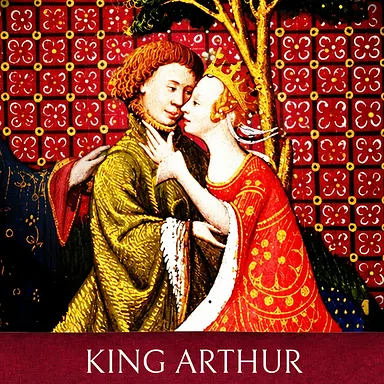
Tom Holland and Dominic Sandbrook continue their story of Lancelot and the Round Table, examining how Chrétien de Troyes shaped the knight who loves Queen Guinevere. They explore the courtly love tradition inherited from the troubadours and the patronage of Marie of France, the Welsh origins of several characters, and the way the mounted knight became a new military and social class.
The episode also looks at the invented Round Table and at how Thomas Malory's Morte d'Arthur portrays Lancelot's sin, tragedy and chivalric ideals. Listeners will learn how medieval romance turned a rivalry into a lasting model of chivalry.
In this episode Dominic Sandbrook, Tom Holland
This transcript of the episode on Sir Lancelot and the Round Table was made with the technology HappyScribe uses for Teams transcription.
Ads in this audio differ from the text. Tap the sentence you're hearing to follow along.
Synced: the text now follows the audio.
Willkommen zu einem Moment nur für dich und zu allem, was du liebst, bei Douglas. Finde einen Duft, der dich nicht mehr loslässt; Pflege, die aus Alltag ein Ritual macht; Farben, mit denen du dich neu entdeckst. Alles für dich am Singles' Day, jetzt 20% auf viele Artikel. Douglas, welcome to beautiful.
And so Lancelot comes to the bed of Guinevere, King Arthur's queen, whom he adores, and before whom he kneels holding her more dear than the relic of any saint. And the queen extends her arms to him, and embracing him, presses him tightly against her bosom, drawing him into the bed beside her, and showing him every possible satisfaction: her love and her heart go out to him. It is love that prompts her to treat him so, and if she feels great love for him, he feels a hundred thousand times as much for her.
Now Lancelot possesses all he wants, when the queen voluntarily seeks his company and love, and when he holds her in his arms and she holds him in hers. Their sport is so agreeable and sweet as they kiss and fondle each other, that in truth such a marvellous joy comes over them as was never heard or known. But their joy will not be revealed by me, for in a story it has no place. So that was "Croitiers de Troyes," as translated by WW Comfort, being both tantalising and a little bit coy in describing the coupling of Sir Lancelot and Queen Guinevere.
And Tom, you've described them as, after Romeo and Juliet, the most famous lovers in all world literature, which is a big claim, but not necessarily an incorrect one. There's probably a fair bit of truth in that.
It's definitely correct, I think.
Well, I mean, clearly you think that, because you've written it.
Name a more iconic couple.
Stanley Baldwin and Theodora.
Will they be sung of in centuries to come? I have my doubts.
Surely.
But time will tell, maybe.
So Lancelot has gained entry, as it were.
Who were Matron.
Yeah, by heroic means. There's been some action with metal bars.
Yes, so he's pulled them apart. They were on Guinevere's window, and he's done it with his bare hands, and he's cut a finger right the way down to the nerve as he does so. But Chrétien tells us, "So focused was he that he paid no heed to the wound." So that's true devotion. What Chrétien is describing here, the depths of his erotic passion, the rapture of its consummation, that this is perhaps the single most influential passage of erotica ever written by a medieval author.
Because not only does it introduce one of the great themes of Arthurian legend, so namely this adulterous relationship between Lancelot, who is the greatest knight of King Arthur, and Guinevere, who is King Arthur's queen, but it also establishes a template for what historians term courtly love that generations of knights would be inspired to try and follow. So the key to this notion of courtly love, Lancelot, he's not just Guinevere's lover, but her servant, almost her slave, and he will endure anything, even the most abject degree of shame, as we will see, to prove his devotion to her.
And this devotion, as you might have been able to tell from that reading that you did, Dominic, I mean, it kind of borders on the sacrilegious. So we heard that when he approaches Guinevere's bed, he genuflects, holding her more precious than the relic of any saint. And then in due course, when he leaves her, he suffers, Chrétien says, a martyr's agony. But the thing is, you might think, well, this is all very wet. He's kind of mooning over girls. What kind of rough, tough warrior does that? This devotion to Guinevere does not diminish Lancelot's standing as a great warrior, quite the opposite, because it's precisely his love for Guinevere, which inspires him to become the greatest of all the knights of the Round Table.
And this directly impacts the way that knights in the real world come to understand who they are, the kind of the ethos, the ideals of their class. Because the lesson that the love that Lancelot has for Guinevere is teaching them is that the true greatness that a warrior is capable of attaining, you know, it doesn't ultimately derive from a lust for conquest or for glory or for vengeance, a kind of relish in violence.
It comes from submission to a beloved, to a beloved lady.
Yeah, this is at the very centre of the idea of the chivalric romance, isn't it? And this text, I guess, is the foundational document of it, to some extent.
I think more than to some extent. I mean, I think it absolutely is fundamental.
Okay.
Because it's the text that introduces the love that Lancelot has for Guinevere to the world.
Yeah.
Chrétien de Troyes is writing it sometime around 1180, and he's doing it in obedience to a very, very glamorous patron. And so this patron is Marie of France, the Countess of Champagne. And in his dedication to Marie, Chrétien salutes her as, I think, only a top medieval French poet can. He writes brilliantly, "I am not one to wish to flatter my lady. I will simply say the Countess is worth as many queens as a gem is worth of pearls."
But of course, what he's doing there is what a knight should be doing with his lady. He's flattering her and paying homage to her beauty. And he's flattering somebody who is not just beautiful, so he says, or so we're led to believe, but incredibly important and powerful. I mean, she is the biggest patron in the Western world at this point.
I think you could say that Marie of France, who I'm guessing quite a few people may have never even heard of, that she ranks probably as the single most consequential literary patron in the whole of medieval Europe. She's also incredibly glamorous in terms of her parentage, because she's the daughter of the King of France, Louis VII, and her mother is the most glamorous and charismatic woman of the age, Eleanor of Aquitaine.
Oh, yeah.
And Eleanor of Aquitaine is a woman who is all about courtly love, because her father, Duke William IX of Aquitaine, he is the archetype of a courtly lover. So he is the earliest troubadour whose poetry survives. And troubadours are poets from southern France, and so Aquitaine is a part of that, who are very distinctive. They are celebrating love as an almost spiritual calling.
They emphasise wit, refinement, courtesy, and they praise adulterous love and the demands of secrecy and of inner torment that adulterous love imposes on a lover as something not to be ashamed of, but something ennobling. And so this is a very potent package. I mean, you can see that it's got the real kind of hint of the taboo about it. And so that makes it very, very exciting for people. And I think that Marie is very conscious of this inheritance that she's got from her grandfather and from her mother, even though she'd actually only been seven when her mother, in 1152, to the great scandal of Christendom, had walked out on her father, the King of France, and gone off and married his greatest rival, which is terrible behaviour.
And of course, the great rival to the King of France was Henry Plantagenet, who, when Eleanor marries him, is already the Duke of Normandy and the Count of Anjou, but who, two years after the marriage, in 1154, becomes a rival king because he becomes Henry II, the King of England. And when you throw in Aquitaine, which Eleanor has brought to the party, you know, that's her dowry, Henry is now ruling an empire that is larger than that under the control of the King of France, because Henry's empire stretches from the Pyrenees right the way up to the River Tweed.
Yeah, the Anjuvian Empire.
Yeah, a vast agglomeration of territories. And this presents a terrible threat to the French monarchy, potentially a mortal one. And so, unsurprisingly, the rivalry between the French and the English crowns in the second half of the 12th century is a ferocious one, and indeed it will continue after the death of both Louis and of Henry II. But it's important to emphasise that it's not just about war and rivalry, because even as Chrétien is beginning to write these romances, the lands on either side of the channel, France and Britain, you know, they are joined by more than just the mutual enmity of their two kings.
There is also this incredible cultural synergy, this incredible cultural exchange going on. And a court like Marie of France's is all about cultural cross-fertilisation. And in other courts as well, so Henry's too, and Eleanor's, and so on. But I think particularly Marie's is that this is where the troubadour influences that Marie has inherited from her grandfather and from her mother are meeting with Arthurmania. It's the only word for it. And as we said in our previous episode, what launches Arthurmania is this mad supposed history written by a cleric called Geoffrey of Monmouth, and this is the history of the kings of Britain.
So people will remember from the last episode that that kicked off with Brutus from Troy beating the giants, then it went all the way up to Athelstane, and that the centre of it is the story of Arthur and his reign. And this is where so many of the elements derive that are then picked up by Mallory and others. And Geoffrey's book had basically hit the shelves. I mean, I don't know what it hit the tables.
The scriptoria.
Yeah. You described him, didn't you, as the sort of the equivalent of the Tolkien or Rowling of the day.
Yeah.
So a fantasy writer that people actually, they cannot get enough. They're queuing up in Waterstones for it.
Yeah.
And so at this point, and it's at Marie's court, so 30 years after this, that you have the crossover between Geoffrey of Monmouth and then the troubadours singing about forbidden romance and people stealing into each other's bedrooms and all of that.
Yes. And the guy who leads the way is Chrétien de Troyes, and that is why he is as significant a poet as any who's ever lived in, you know, the European tradition.
Okay, wow.
He is that important. And I think you can gauge a sense of the impact that he has from the plot of Lancelot, which is the story in which that consummation between Lancelot and Guinevere that you opened this episode with features. So what is the plot of this poem? It opens at Arthur's court on the feast day of Ascension. And as always will tend to happen in Arthurian romances after Chrétien, he basically is establishing the template. You have this great feast, Arthur's presiding over it, and a strange figure arrives at the court.
And this guy is a knight called Meligon, the prince of a mysterious land called Gaure. And Meligon boasts that he holds, and I quote, "in captivity, knights, ladies, and damsels who belong to Arthur's dominion and household." And he offers Arthur a deal, that if any of Arthur's knights is man enough to escort Guinevere, Arthur's queen, into a nearby forest and there prevent Meligon from seizing her, then Meligon will free all the captives that he is holding in Gaure.
But should the knight who goes to free Guinevere fail, then Meligon will abduct Guinevere and take her to Gaure and keep her as a captive as well. And this is the kind of challenge that Arthur, as a great and noble king, cannot really turn down. And there is an additional complication, which is that Kay, who is Arthur's foster brother and steward, had earlier got Arthur to promise, very rashly, to grant whatever boon Kay might request.
And Kay now steps forward to demand the honour of escorting Guinevere into the wood. And Arthur's very reluctant to do this because he knows Kay, they've grown up together, and he knows that Kay is absolutely rubbish when it comes to defending damsels from sinister figures from otherworldly kingdoms. But he's given his word, and so he doesn't really have any choice. And so Kay escorts Guinevere out from Camelot into the wood, and there he's set upon by Meligon, who then duly carries her off to Gaure.
And so Guinevere has been taken.
And to be fair to Guinevere, I mean, she doesn't always behave well in the Arthurian romances. But you can see why she would be.
Yeah, a bit cross.
I mean, yeah, her husband's basically just reduced her to an absolute bargaining chip with the most useless person at the court to defend her honour, and everything has proceeded as she might have feared.
Yes, I mean, I think you can see why she'd be cross. However, that said, Arthur does send all the various knights of the Round Table off to try and get her back. And among these is his best knight, his nephew Gawain. And on the way, Gawain overtakes a knight whose horse is on the point of collapse because he has been pursuing the queen, I mean, absolutely frenetically. And this knight is Lancelot, although actually Chrétien doesn't reveal his name until about halfway through the poem, but we'll call him Lancelot because that's who he is.
And Gawain has, you know, he's riding there, he's a leading knight, and so he has a second horse. And he very generously gives Lancelot this second horse, and Lancelot climbs onto it and goes careering off into the wood. But he's going at such a lick that once again the horse basically collapses under him. And it's now that Lancelot meets with a dwarf, and dwarfs often feature in romances, and this is one of the first. And he's driving a tumbral, so the kind of cart that we last met carrying Marie Antoinette and Danton and Robespierre to the guillotine.
Yeah.
As in the French Revolution, so in the Middle Ages, tumbrals are used to carry criminals around and make them into objects of derision and mockery. And the dwarf says to Lancelot, "I will give you news of Queen Guinevere if you agree to get off your horse and get into the tumbral, and I will drive you through all the various towns and villages." And for a fraction of a second, Lancelot hesitates, because this is such a monstrous humiliation that any knight would shrink from it.
But he needs information about Guinevere, and so he does only hesitate for a fraction of a second, and he does climb into the cart, and he does willingly suffer all the mockery that this brings him as he's led through, you know, the local villages and so on. And it's as a consequence of this, the information that he's given, that he is the knight who ends up finding where Guinevere is being kept captive. He rescues her, and he restores her to King Arthur.
And having done that, it's Lancelot who fights a climactic battle before the whole of Arthur's court with Meligon, and he defeats Meligon and cuts off his head. And it is Lancelot, as we heard at the start of the show, who is going to be accepted by Guinevere as her lover, even though initially, actually, when they meet up, Guinevere is very frosty because she has discovered, we're not told how, but she just does, that Lancelot had had this brief hesitation.
And she's absolutely livid with him because he hadn't immediately leapt into the tumbral.
The only person who could have told her is the dwarf.
Or Lancelot.
Lancelot would be mad to tell her that, wouldn't he?
Well, you've got to be honest with your lady.
I thought about not doing it and then.
No, you've got to be honest with your lady, Dominic.
Insane from Lancelot's. I mean, he deserves everything that's coming to him. Right, so let's stop here, stand back, and look at the story that Chrétien tells. What is so special about this story? I mean, you've been making great claims for Chrétien and indeed for this story. What makes this different from what the stories that people have been telling up to this point? Why does it have such an extraordinary impact on the imagination of medieval Europe?
I think it's a cocktail, Dominic. It's a cocktail of various elements.
Yeah.
So a lot of the elements of this story come from Wales. And we promised our Welsh listeners that there's going to be a lot of Welsh history in this.
You can end the show there. That's the explanation. That's all I needed.
Well, no, because we want to look and see what are the Welsh elements in this story.
Oh, you're right, actually. When we've got some Welsh history, we want to delve deep, do we not?
We want to plunge deep into the murk of Welsh history.
Into the mine. Into the coal mine of Welsh history.
So lots of the characters who feature in this story, they have a Welsh background. So Arthur, Guinevere, Kay, Gawain, these are all characters who've been mentioned by Geoffrey of Monmouth and who feature as well in 11th and 12th century Welsh poetry. So Guinevere, like Morgan le Fay, like the Lady of the Lake, is basically a Welsh woman. So great to have at least three Welsh women on the show. Meligon isn't mentioned by Geoffrey, but he does feature in a hagiography, so the life of a saint, that had been written by one of Geoffrey's mates.
And this is a Welsh cleric called Caradoc of Llancarfan. And Caradoc of Llancarfan's life of the saint features in it, well, it's Meligon, but he's actually called Melwas in this life. And he is king of the Summerland, which seems to be Somerset.
Oh, interesting.
Because Melwas abducts Guinevere, and he takes her to Glastonbury.
Yeah.
Which we were talking about in the previous episode. And he imprisons her there behind reed beds, floodwaters, and marshes. So that's from the tale. And there he rapes her. And Arthur's looking for her and finally tracks her down. And he's preparing to free her by attacking Glastonbury, when disappointingly, the saint, who's a Welshman called Gildas, we'll be hearing about Gildas again later in this series, Gildas pops up and completely ruins the story by negotiating between Melwas and Arthur and securing the release of Guinevere.
So there's no fight. So great credit to the saint. But disappointing, I think, if you're a listener wanting a big bust-up.
Especially as Melwas has behaved poorly and deserves his come-up.
Yeah, I agree. But the odd thing is that this story is obviously being taken, I guess, by probably Bretons across Christendom. It's definitely reached northern Italy by the beginning of the 12th century because you remember that carving that appears on the Cathedral of Modena in northern Italy.
I do.
It's the earliest carving showing Arthur and his knights. The scene it shows is Arthur advancing on Melwas' castle to free Guinevere. So it's clearly very popular. And I think that although we don't have any source material, it clearly derives from the kind of Welsh mythology that Tolkien loved. So elvish, otherworldly lands that are perilous to enter, very difficult to escape, a kind of sinister Lothlorian. It's that kind of thing.
Yeah.
So Gaure is elvish, I guess, in its kind of character. So there's all these Welsh traditions, which are very venerable. They're very ancient. But at the same time, what Chrétien is doing in his story is he's fusing them with elements that are French and very, very cutting edge. And so the most obvious of these is the character of Lancelot himself, because Chrétien is the first-dimension Lancelot.
Yeah.
Scholars have obviously been very keen to know where does this figure suddenly pop up from. You know, they kind of derive his name from German or old French or even Welsh sources. But it's entirely possible that Chrétien has made the name up himself. I mean, it has kind of hint of Lance.
Yeah.
And as we'll see, Lance is quite important in this story. And also, scholars have kind of tried to distinguish, maybe there's a pre-existing folktale that Chrétien is drawing on. So it's telling, perhaps, that in another of his romances, Chrétien refers to Lancelot as Lancelot du Lac, of the lake.
Yeah, of course. Yeah.
And the reason for this, supposedly, is that he's been brought up by a fairy queen who lived beneath a lake. And so it's not surprising that within a few decades, Lancelot has been cast as the foster son of the Lady of the Lake. But again, it seems at least as likely that Chrétien has just made Lancelot up completely. And I think the reason why this is a credible theory is that he so plainly embodies everything that is kind of cutting edge about nightly fashion in the mid-12th century. So most obviously, he is the absolute archetype of a courtly lover.
Right from the beginning, the complete devotion that he shows to Queen Guinevere is perfectly in tune with the sensibilities of the Troubadours.
Right.
He is the ultimate Troubadour hero. And this is why, you know, he is happy to sacrifice his personal honour in the cause of his beloved by getting into that tumbral. And this is counterpointed to Gawain, who is also asked by the dwarf if he wants to climb into the tumbral. And then Gawain can hear what the dwarf has to say. And Gawain says no, because Gawain is old school, and he's not interested in humiliating himself in that manner.
So Lancelot's a very modern figure in that sense. And he's modern throughout, right? So readers at the time or listeners would have interpreted Lancelot as a figure much like themselves, not like Arthur is a figure from antiquity.
So in Britain, Gawain remains the great hero. Gawain is seen as the ultimate knight, really, in Britain, right the way up to Mallory, who actually loves Lancelot, as we'll see. But in France, Lancelot is seen as, you know, he becomes the great hero of the Arthurian stories almost overnight. And I think that is because Lancelot is embodying, you know, this incredible new trend in loving and fighting. So it's not just that Lancelot is happy to get into the back of the tumbral in the cause of rescuing his beloved.
But when his beloved says, "Humiliate yourself, embarrass yourself, shame yourself," Lancelot does it. So at various points in Chrétien's romance, Guinevere says to him, "Fight poorly, you know, behave like a coward, run away." And Lancelot does it. This is the measure of how obedient he is as her lover. And then, of course, on top of that, most glaringly, most shockingly, there is the adulterous quality of his love. So it's evident right from the beginning, because Chrétien writes about this in the opening lines of his poem, that he is uncomfortable about this.
And he specifies that he would never have written it had Maria France not directly commissioned it. So to quote Chrétien, "The material and the treatment of this book are given and furnished to him by the Countess, and he is simply trying to carry out her concern and intention." So he is aware that this is, you know, treacherous waters.
And he's getting this in the Troubadours. It's the Troubadours who are so obsessed with adultery and deception and stuff.
Yes.
And he's just simply picking this up.
Yes. It's a display of everything that's most edgy and glamorous in the literature of mid-12th century France.
Right. Got it.
And Chrétien has found the perfect hero to exemplify it. But just to say that the impact of the Troubadours is evident not just in the character of Lancelot, but in the character of Arthur's court. And a significant marker of this, I think, is the name that Chrétien gives to it. So in his history, Geoffrey of Monmouth had placed Arthur's court in the Welsh town of Caerleon, so the city of the Legion, thereby rooting it in the ancient history of Rome, giving Arthur the kind of the pattern of antiquity.
And Geoffrey very implausibly describes Caerleon as a match for Rome, which I think is probably overdoing it. But Chrétien, by contrast, places Arthur's court at a place called Camelot. And this seems to be a name which, again, Chrétien has made up. Because Camelot, this is the first appearance of that name in this poem, Lancelot. And although Chrétien situates it in Britain, it's transparently a court, I think, that owes its character to erotic currents that are flowing in from Aquitaine.
So it's British, but with a Troubadour spin. And it's incredibly momentous in its impact, because what Chrétien is doing is kind of mixing martial endeavor with courtly love, and thereby establishing a template for the narrative of the Arthurian quest, which will never be superseded. So people listening to the count of the plot, it may not sound that radical, but it is radical. You know, no one has really come up with something like this before. But it's so familiar to us now.
The idea of the knight who is motivated by a passion for his lady, riding out into the wilds in search of adventures, the knight errant.
Yeah.
It's a novelty in Chrétien. In its wake, it becomes the absolute convention.
When I think about Camelot, it does look like a sort of 12th or 13th century French court, I suppose, with the sort of the towers and the banners and the flags and the damsels and all of that. And of course, a big part of that is that there just seems to be a permanent tournament going on. And that, I guess, is also a reflection of the political and sort of cultural currents of the time, isn't it?
And of the influence of Chrétien, because it's in a tournament that's staged before Guinevere and the Lady of Camelot that Lancelot is demonstrating his devotion to the queen by playing the coward on her commands. So, you know, he's riding into the lists. Guinevere sends a message saying, "Run away," and so Lancelot has to do it.
Yeah.
And then when she commands it and says, "Actually, go in and prove yourself the greatest knight in the world," Lancelot does that as well. And the climax of this, of course, is when he fights with Meligon, the guy who's abducted Guinevere, defeats him, beheads him. And again, this is being done at Camelot in front of Guinevere. So to quote Morris Keene, great Oxford historian, who once interviewed me for Oxford.
He interviewed me. He interviewed me as well. He was a tutor of Balliol.
Oh, well, Dominic, that's something we share. That's something we share.
Did he let you in, though? That's the question.
Well, I went for Cambridge instead.
I said no.
If I'd gone for Oxford, I would definitely have gone.
Yeah, it doesn't sound like it, but anyway, continue.
I think you'll find that Cambridge is number one in the rankings. Anyway, Keene wrote, "After Chrétien, no literary description of a tournament would be complete without its word picture of the watching ladies and of the tokens from their dresses, the sleeves of their gowns or their hair, which the champions proudly bear." That's basically what you're saying, that when you think of Camelot, that's what you think of. You think of the queen, the princess, gazing down at the knights, you know, she's bestowing tokens on them. And Chrétien, again, is the guy who establishes the template for that. But I think it's not just about the literature, right?
I mean, these tournaments, you start having people who are kind of imitating them. And so fiction and reality starts to blur. And the quote from Keene comes from a classic book that he wrote on an ideal that both shaped and was shaped by the stories of the Round Table and by, you know, the inheritors of Chrétien's poetry. And Lancelot is the absolute epitome of this. And that ideal, of course, is chivalry.
Oh, yeah.
And after the break, we will be exploring how Sir Lancelot became the poster boy for an entire revolution in the practice of medieval warfare.
I genuinely can't wait. We'll see you after the break, everybody. Welcome back to The Rest Is History. "A Frank on horseback could drive a hole through the walls of Babylon." Not my words, Tom, but the words of Anna Komnena, who was the daughter of the Byzantine or Roman Emperor Alexios I. And Anna Komnena was marvelling at the spectacle of the vast crusader army that in the last weeks of 1096 had arrived outside the walls of the new Rome, Constantinople.
And she's looking out, and she can see these knights on horseback, the Franks on horseback, as she calls them. And this is something extraordinary. You know, this is an innovation that she has not seen before. The medieval knight in all his glory.
Yeah. And her astonishment is unsurprising, because a knight on horseback is a new kind of fighter, you know, really, really novel. So at Hastings in 1066, so only 40 years previously, you hadn't had the spectacle of the kind of armed cavalryman that Anna Komnena is seeing. A crusader cavalry charge is even more intimidating than the charge of the Norman knights against the Anglo-Saxon shield wall. And that's because over the four decades that have followed the Norman conquest, horsemen have basically mastered a new and devastating way to handle a lance.
And from childhood now, they are being trained to ride with it couched, which basically means you tuck it under the armpit so that it remains steady, and then your left hand is free to hold the reins and a shield. And you throw in stirrups, you throw in a kind of new kind of saddle, which has a raised back so that it will protect you against the impact of hitting someone with your lance. And you have a horse that's bred for strength, for aggression. So the greatest of these are called destriers. And the result is what Morris Keene, in his book on chivalry, describes as a human projectile, which is a very apt description, because you can see the success that these human projectiles have when they advance and charge en masse from the success of the First Crusade, which, against all the odds, you know, they go from Constantinople, they march their way through hostile territory, and they do end up capturing Jerusalem.
And it demonstrates just how devastating this new style of warfare, which has emerged in the lands of the Franks, you know, the Western Christendom, over the latter decades of the 11th century, just how devastating it is. And by the 12th century, the impact of this on the way that war is practiced in the lands of Latin Christendom is becoming impossible for any ambitious king to ignore. Basically, if you are going to be a cutting-edge monarch or even a cutting-edge baron, then you are going to need an army of these lance-driving horsemen at your beck and call.
And these are, for obvious reasons, called chevaliers in French, from cheval, horse. And these chevaliers are now the cutting edge that every king has to have. They are the face of the modern battlefield, if you want to put it like that.
And what kind of people are we talking about? So stereotypically, we think of chevaliers, knights, as the nobility, well-born, you know, well-bred. But is that strictly true? And I guess this also takes us to the origins of the English word for them, as knights.
Yeah. Obviously, kings, barons, lords, they can afford the destriers, the armor, the arms, and all of that. That's not an issue for them. So in that sense, they are chevaliers. But actually, the word chevalier in the early 11th century had been quite declassé. Essentially, it's a name that is given to armed retainers of local lords. And they are not looked upon as being in any way classy. They are kind of akin to the heavies employed by a mafia boss.
They are seen as essentially kind of thugs on horseback. And I think you do get a sense of this in the word knicked in English, which gives us our word knight, because that also, in old English, had basically meant a retainer, a servant, someone who is, you know, at the beck and call of a local lord. And this means that knights in the early decades of the 12th century are a very upwardly mobile class. These are people who, in the 11th century, had broadly been despised by the upper classes and are now clawing their way upwards into a kind of distinct social class.
And as always happens when you have an upwardly mobile class, the people who belong to it are afflicted by kind of anxieties and aspirations, and they're kind of a complex eddy. So the anxieties, I mean, they're very obvious what they would be. They're paranoid about being looked down on by kings and barons and whatever. And they're also paranoid about how they're going to fund the cost of the arms and the armor, which is getting more and more expensive. But then they do also have their aspirations.
These young men who are on the margins of aristocratic society, they're needed by the great lords to form the cutting edge of their military machines. The dream of these young men is ultimately to be accepted as a kind of brother knight by the great lords of the day. That's what they really want. And if you're from an impecunious background, but you've managed to get a horse, you've kind of cobbled together some armor, you can ride with a couched lance, your dream is that you and kings and lords and princes, that you might be joined in a kind of a brotherhood, common order of what the French call chevalerie, and which is comrades in what the English will come to call chivalry.
Yeah, brothers in arms. But I can see what's in that if you've worked your way up and you're the parvenu. What's in it for you if you're, you know, the Duke of Norfolk or something? Why do you want to hang around with these people? Why do you want to be brothers with them?
Well, the Duke of Norfolk might lean on his immediate retainers because the Duke of Norfolk needs these guys at his back. And the king ultimately might then lean on the Duke of Norfolk, because the more that victory in medieval battle comes to depend on heavy cavalry, the chevaliers, operating as a kind of single body, you know, this great massed charge of Frankish heavy cavalry. So the more chivalry comes to seem to kings and dukes and such like, an absolutely brilliant way of fostering the esprit de corps that you need to form a coherent body of heavy cavalry.
It's a way of generating a kind of shared ethos, because a band of knights who are fractured by snobberies and social divisions are going to be of much less value to an ambitious king than one in which these divisions have been dissolved by a sense of a common brotherhood.
Yeah.
And of course, Dominic, you will know what the most celebrated illustration of this principle is. It's devised in the mid-12th century just as chivalry is becoming fashionable across Christendom. And it is, of course, an entirely fictional one. And this is the Round Table.
And the roundness of it.
Yeah.
The roundness is key. There's no one at the head and no one at the foot, right?
The roundness is absolutely key. And it's completely telling that the Round Table, as a theme in Arthurian literature, first appears in the mid-12th century, exactly as this need for kings and such like to form their heavy cavalry into a kind of single body of men is becoming paramount. And it's introduced into the bloodstream of Arthurian literature by a Norman poet called Wace, great name.
Yeah.
And Wace is writing in the 1150s. It's a kind of updating of Geoffrey of Monmouth's history. And tellingly, he dedicates it to Eleanor of Aquitaine. So again, it's this idea of the fashionable southern kind of models of new behavior. Wace is buying into this as well. And the Round Table, you know, just as Lancelot seems to have been Chrétien's invention, the Round Table seems to have been Wace's invention, even though obviously he has to state otherwise, because it's supposed to be very ancient. So to quote Wace in his history, "On account of his noble barons, each of whom he felt he was superior, each considered himself the best, and no one could say who was the worst, Arthur had the Round Table built, about which the Britons tell many a tale."
The Britons don't tell many a tale about it. Wace is making this up, but he needs to say that. "There sat the vassals, all equal, all leaders. They were placed equally round the table and equally served. None of them could boast he sat higher than his peer. Each was seated between two others, none at the end of the table. All are equal."
It's a lovely idea. I'm curious whether any kings did actually introduce such a table.
No.
Oh, they didn't.
Okay. Well, there's that one that hangs in Winchester, but it's hanging from a wall. People are not actually sitting around it.
Because ultimately, the hierarchy is too important. You can't wish away the social organizations.
Yeah. You can go so far, but not, you know, the dukes aren't going to accept that.
Yeah, yeah.
But I think that what Arthurian literature does is that it offers ways, even though there isn't a Round Table, it does kind of offer paths for impecunious, upwardly mobile, ambitious young men to kind of make their way into the heart of courtly society in a way that would not have been possible before Chrétien's romances. So there are two shortcuts in particular, and both featured in Chrétien's romances, and both were centered on courts like those of Eleanor and Marie of France.
And one of these is the practice of dubbing. So this is the formal initiation into knighthood of a young man by, you know, a seasoned and celebrated knight. And everyone, I'm sure, will be able to imagine it, the young man kneeling before the elder man. The elder man touches him with the tip of the sword on each shoulder. And the younger man who is being knighted swears to a very solemn code of behavior. He swears that he will always be loyal to his liege lord, even unto death. He will always honor women and do all in his power to serve them.
And he will hear mass every day, and on Friday, in commemoration of the crucifixion of his lord, he will fast. And for a young man of obscure background to be knighted by a famous chevalier, a famous knight, it's a tremendous social leg up. And the bond between the guy who's been knighted and the guy who has done the knighting comes to be seen as something almost holy, something that is incredibly precious. And the classic example of this in courtly romance is in Mallory's Mortearther.
And it's the story of Lancelot's knighting of Sagareth, who is the youngest brother of Gawain, and who has ridden and is pretending to be a scallion in the kitchens. And so he's kind of roundly mocked.
Yeah.
You know, treated as a kind of violet, but who displays his knightly prowess. And Lancelot is the only knight who recognizes this. And he champions Gareth from the beginning, ends up dubbing him as a knight, loves him like his own. And Gareth, in turn, adores Lancelot, models himself on him, prizes loyalty to Lancelot ultimately over loyalty to his own brothers. And that bond is seen as being entirely acceptable. You know, people understand why Lancelot and Gareth would be as close as they are.
And as so often in Arthurian literature, it both inspires and is inspired by what is actually going on in the real world. So these bonds between the young knight and the older knight who's knighted him, you know, they are seen as being very precious. And it's a way for, you know, someone from kind of a relatively obscure background to kind of make a name for himself. And then, of course, there's the second way that a knight of obscure birth can bypass the social conventions that govern a life at a great court, and that is by winning the love of a great lady.
And here as well, it is Lancelot who serves as the archetype. You know, he is the supreme model of how greatness in martial exploits can be joined to the force and power of romantic love. And I would say that within a decade, maybe two or three decades after Chrétien's romance, Lancelot has appeared, the reputation of Lancelot as the ultimate model of chivalry is pretty secure across Christendom.
I mean, considering how difficult communications are, the fame that Lancelot has attained by the year 1200 is absolutely astounding. And he owes his fame to the fact that he is unfailing in his loyalty to Arthur as his liege lord, and he's unfailing in his devotion to Guinevere, who is the one and only queen of his heart. And the measure of this is the greatness of his renown. No one is more formidable in battle, fighting for his king, and no one is bolder in feats of knight errandry, winning glory for his lady.
However.
Yeah, there's a problem with him there, isn't there? Because, you know, it's easy to think that people don't take the moral strictures of the day seriously, but of course they do. And Lancelot is breaking an enormous taboo. I mean, he's an adulterer and he's, you know, betraying his. You said he's unfailing in his loyalty to Arthur, but with one gigantic exception.
Yes.
Does this not create a problem for fans of the Arthurian romance?
I don't think it creates a problem for lots of fans of the Arthurian romances, but it does for some of them. And I think particularly Churchman, who, you know, are swept up on the craze, but are obviously very worried about its celebration of adultery. And particularly at the beginning of the 13th century, the Stursions, so Bernard of Clairvaux and the Ilk, who are very ascetic monks who almost by definition disapprove of Lancelot.
And so they set about trying to promote a new model of knight who can take Lancelot's place as the greatest of Arthur's knights. And essentially, they sponsor the invention of a new knight, and this is Sir Galahad, who emerges into Arthurian romance in the 1220s. Clearly, I think with the encouragement of the Stursions, you know, they're basically sponsoring poets to write Galahad into the story.
And Galahad is the guy who goes on to win glory in the ultimate Arthurian quest, which is the quest for the Holy Grail. And he is the son of Lancelot, so the son who is greater than the father. And he's been born after Lancelot had been given the kind of the medieval equivalent of Rohipnol. And he's absolutely out of his mind on it. And he's tricked into thinking that Guinevere is in a dark room. In fact, it's not Guinevere, it's the daughter of the Castellan who is tricking him.
Anyway, the fruit of this misadventure is Galahad. Galahad turns up at Camelot. He sits in the siege perilous, which is a chair at the Round Table that only the greatest knight can sit in. And if he's not the greatest knight, he'll be swallowed up by the earth. But Galahad sits there, so clearly, you know, he's passed the audition. Then the Grail appears. Galahad goes off. He wins the Grail. And then shortly after that, he is granted the Beatific Vision, which is the chance to gaze in a direct and unmediated way into the face of God.
And once he's had this, he immediately dies and is taken up to heaven. And meanwhile, Lancelot on the quest for the Grail has been having an absolute shocker because he doesn't get anywhere near the Grail. He gets knocked out by a fiery blast and lies in a trance, we're told, for 24 days, one for each of the 24 years that he's been in love with Guinevere.
Wow.
And so it's Galahad won, Lancelot nil, in this Stursion-sponsored romance.
Galahad, I mean, he's a well-known figure, but he never quite inspires the same affection, does he, as Lancelot or indeed Gawain or Arthur himself, because he's just so untouchable and sort of.
He's too perfect.
Yeah, too perfect. Exactly.
I mean, chilly, prickish.
Yeah.
Ultimately unappealing. And I would say that for many lovers of chivalry, it's the fact of Lancelot's very sin, which makes him such an appealing role model, because ultimately, of course, Lancelot's sin is a sin that is hardwired into the way that chivalry is understood. I mean, it's been there right from the very beginning.
Right.
And I think that in the greatest romances, this generates a really profound tension on occasion, a tragic tension. And there's no romance that illustrates this better than the greatest of all the romances, which is Mallory's Mortearther. And I would say, I mean, you may disagree with this because you're not a Lancelot fan, but I think that to Mallory, Lancelot, even though he loses out on the Grail quest to Galahad, he's not just the real hero of the Mortearther, but he also provides it with its kind of moral fulcrum.
Because when you read through the Mortearther, I always had a vague memory from childhood books that all the knights of the Round Table were perfectly behaved. But when I then read the actual text of what Mallory said, it was kind of blimey. These guys are behaving absolutely terribly. You mentioned Arthur and Gawain as great models in the Mortearther. Both of them behave very badly on occasion. So Arthur, we heard in the previous episode, I mean, he puts a load of babies in a ship and sends them out into the sea, and they all get shipwrecked.
I mean, that's not great behavior. And Gawain, who we've said is the great hero in England, the great model of chivalry, much more than Lancelot, inspires Gawain and the Green Knight, the most famous medieval romance to feature Gawain. You know, he's a kind of a great hero in that. But in Mallory, Gawain behaves very badly. He loves a violent feud. He murders his enemies when he gets the chance. He stabs King Pelenor in the back, which is not good behavior. And at one point, he accidentally chops off the head of a lady.
He's impulsive and brutal and violent, and he loves a feud. Whereas Lancelot does not go around killing babies. He doesn't pursue blood feuds. He's always merciful, and he's always the absolute model of courtesy to women. So there's a famous example of this. He meets a damsel, and he's told by this damsel that ahead of them in the wood is the lair of a knight who robs and rapes all the ladies who pass through the wood. And Lancelot is appalled by this. So to quote Mallory, "What," says Lancelot, "is he a thief and a knight and a ravisher of women?
He doth shame unto the order of knighthood and contrary to his oath. It is a pity that he liveth." And so Lancelot rides into the wood and duly kills this murderous and monstrous knight who's bringing shame on the order of chivalry.
Yeah. But Lancelot's great offense, which is the adultery with Guinevere, I mean, that is the thing that ultimately destroys not just Arthur, but the whole world of Camelot, isn't it? I mean, this is the fatal flaw in the entire project.
Yeah, and that is the great tragedy. And that's what makes the Mortearther such a moving tragic book to read, because obviously it's Mordred who conspires to destroy the Round Table, but it is Lancelot who gives Mordred his chance. You're absolutely right. Now, listeners, if you haven't read the Mortearther, what is it that precipitates the downfall of Camelot? I mean, we talked about the last battle in the previous episode, but the build-up to this is that Mordred and his brother Agravane, who like Mordred is a kind of sneaky, murderous guy who operates in the shadows, they set out to surprise Lancelot and Guinevere in bed, and they finally achieve this.
There's a public exposure, and Arthur can no longer kind of close his eyes to what's been going on between his wife and his best friend. Lancelot gets away. He slays Agravane in the process of his escape. But Guinevere is taken captive, locked up, condemned, and sentenced to be burnt at the stake. And she's led out to the great pile of wood, which she's going to be burnt on. And walking with her are Gawain's other two brothers, Gaheris and Gareth.
And Gareth is the erstwhile kitchen scallion who Lancelot particularly loves because he dubbed him. Lancelot comes to Guinevere's rescue, but in the course of saving her from the flames, he accidentally kills Gaheris and Gareth, whom he has not recognized. And Gawain, who had forgiven Lancelot for killing Agravane, Gawain loves Lancelot and had recognized Agravane had been out to trap him, he cannot forgive Lancelot for killing Gareth. And from this point on, it's Gawain who pushes for vengeance against Lancelot.
And even though Arthur wants to negotiate, wants to kind of, you know, bury the hatchet, Gawain refuses to allow this to happen. And it's Gawain who urges Arthur to pursue Lancelot across the sea to France, where Lancelot has withdrawn. It's Gawain who insists on prosecuting the war against him. And it's Gawain who thereby gives Mordred, who's been left in England as Arthur's regent, his chance to seize the throne. But it's a measure of Mallory's artistry, his ability to kind of tug the heartstrings, that in the end, it is Gawain who brings about the reconciliation between Arthur and Lancelot.
Because what happens is that when Arthur, with his army, and Gawain sails back from France to England to confront Mordred, and they meet with Mordred's army by Dover, Gawain leads the attack against Mordred, his brother, defeats Mordred's army, but is mortally wounded in the battle. And lying on his deathbed, Gawain then writes to Lancelot, begging for forgiveness. And he hails him as "flower of all noble knights that ever I heard of or saw by my days." And he writes to Lancelot about the doom that Arthur, he fears, is facing.
"Wherefore, I beseech thee, Sir Lancelot, to return again to this realm."
Which Lancelot does, of course, but too late. I mean, there's the tragic irony. He gets there and he finds Arthur. Well, Arthur has been mortally wounded, hasn't he? And the Round Table is, you know, the knights are all destroyed and whatnot. Camelot is no more. And then he goes to find Guinevere, and she's become a nun in Amesbury.
In Wiltshire and the Salisbury area. So just down from Stonehenge.
Yeah.
Stonehenge will be featuring in our story in our next episode, just to flag that up. So yeah, he goes to Amesbury. He meets with Guinevere, who by now is an abbess. And Guinevere, when she sees Lancelot, swoons three times.
Yeah.
But she refuses to renounce her vows. And she basically tells Lancelot to go and ponder on his sins. You know, she's going to have no more of him. And Lancelot rides away weeping. And Mallory tells us that he threw his arms abroad and said, "Alas, who may trust this world?" And then in due course, he gives up being a knight altogether, and he becomes a priest.
So they've been punished for their sin.
Yeah, kind of. I mean, they've embraced their more spiritual sides, I suppose, at the end of their lives. The lesson that Mallory gives us in the Mortearther is that a knight can be the most perfect model of chivalry and yet still labor under a terrible guilty conscience. And we can never say for certain, because we don't really know anything about Mallory's inner life except what he reveals in the Mortearther. But I think it is possible to hazard a guess from the court records in which he appears as to why this idea of a knight who loves the ideals of chivalry but is suffering from a sense of guilt, why this might have had such an appeal to Mallory, why Lancelot meant so much to him, which he clearly did.
Because we mentioned in our last episode that Mallory spent a number of years in prison. We kind of suggested that one of the reasons for this might be kind of factional, that he'd fallen out, first of all, with the Lancastrian authorities and then with the Yorkist authorities. But in that account of Mallory's time in prison, we did omit one very significant detail. And that detail is that Sir Thomas Mallory, Knight of the Realm, author of the single greatest work of Arthurian literature in English, seems to have been an incredibly violent criminal.
Yeah.
There is no other word for what he seems to have been. And so I will list just some of the offenses of which he stood accused in the various court records of the time. So the ambush and the attempted murder of the Duke of Buckingham, poaching deer from the estate of the Duke of Buckingham, extortion, theft, tattle rustling, horse stealing, assorted prison breaks, including on one occasion swimming across a moat, and a very specific crime, breaking into the house of a Coventry man called Hugh Smith, burgling him and raping his wife, Joan.
I mean, with that, you know, I mean, poaching, okay, fair enough. But this, for a lot of listeners, I mean, that's obviously crossed a massive line. And you already mentioned how when they in the Mortearther, Lancelot is riding with a, you know, there's a ward or something, isn't there? And he says, "What is he, a thief and a knight and a ravisher of women?" in horror. So is Mallory portraying himself? What's going on there?
There've been numerous attempts to try and explain this seeming discrepancy between the ideals that are on show in the Mortearther and the kind of seeming brutal reality of the author. Some have argued that the charges against Mallory are all trumped up for political reasons, possibly. You know, this is just a hunt by the Duke of Buckingham.
Yeah.
It's not going to be a particular object of Mallory's hatred.
Yeah.
Listeners who heard the episode that we did on Geoffrey Chaucer may remember that the word raptus, which the Latin word is in legal Latin, can mean rape, can also mean other things as well. And so there have been scholars who've suggested that perhaps Joan Smith wasn't being raped. She was eloping with Mallory. But I think that's special pleading.
Right.
I don't think most scholars think that. Others have argued perhaps it's a mistaken identity.
Trying a bit too hard. That strikes me as, yeah.
And others suggested that perhaps, you know, Mallory was much more of a Gawain than a Lancelot in the terms of the Mortearther, that he was someone who was given to violence, to blood feuds, to behaving intemperately, who nevertheless yearned to be a Lancelot. Because as the Mortearther makes very clear, actually, chivalric culture is very violent. I mean, it's structured around, you know, military activities, killing each other, all that kind of thing. And so perhaps it's not surprising that this is the, you know, the reality of what being a knight in the Middle Ages seems to have meant.
And I think it's impossible to know, because ultimately, as we've said, all we have really is the Mortearther itself. So that being so, let's end this episode on Lancelot and the ideals of chivalry with two concluding scenes from it. And these are two of my absolute favorite scenes. They never fail to move me when I read them. And one of them comes from just before the fateful moment when Lancelot and Guinevere are going to be surprised by Mordred and their adultery revealed to the world.
And it tells a story for which we have no source. Most of the episodes in the Mortearther, we know where they come from. This one, we don't. And so it's possible that Mallory has made it up. And listeners may hear it and wonder, well, why would Mallory have made this story up? So this episode features a knight called Sir Uri. And Sir Uri had killed the son of a sorceress in a tournament. And so the sorceress had cast a spell on him. And Sir Uri, in this battle with the sorceress's son, had sustained seven terrible wounds.
And so the sorceress, to quote Mallory, "wrought by her subtle crafts that Sir Uri should never be whole, but ever his wounds should one time fester and another time bleed, so that he should never be whole until the best knight of the world had searched his wounds." And Sir Uri's mother places her son in a litter and for seven years takes him around all the various courts of Christendom, looking for the best knight in the world to heal her son. And now she has come to Camelot. And every knight of the Round Table takes turn to touch Sir Uri's wounds, but all of them fail.
And then at the last moment, Sir Lancelot, who's been away on a quest, he returns to Camelot. And Arthur tells him, "Lancelot, you must touch the wounds of this poor knight." And Lancelot wants to get out of this. You know, he really doesn't want to do it because he is aware of his sin. And he knows that he is bound to fail, as he had failed the quest for the grail. But Arthur commands him. And so Lancelot obeys. And he touches, you know, these bleeding, super-ating wounds of Sir Uri, all seven of them.
And all seven are healed. And then Mallory writes, "And ever Sir Lancelot wept as he had been a child that had been beaten." And I remember in T.H. White's Once and Future King, and most of it is an updating into 20th-century prose of Mallory, but this line he keeps. There's some key to Mallory's heart in it. And why is Lancelot weeping? Clearly because sinner though he is, God has touched him with his grace and allowed him this last proof of his moral stature as a knight.
And we don't know whether Mallory had a guilty conscience, but we know from this story that Lancelot definitely did. And I think that's why it has the kind of incredible power that it does. And it's also why at the very end of the Mortearther, Lancelot's death, I think, is incredibly moving again. So he dies in his sleep. And he's found the next morning by his friends. He's got a smile on his face. And we're told the sweetest savor about him that ever his friends felt. And Lancelot's body is then escorted to his great castle of Joyous Guard, which Mallory brilliantly speculates might have been Annick or more probably Bamburgh Castle.
Oh, nice.
And at Joyous Guard, Lancelot's brother Ektor arrives not knowing that Lancelot is dead. And when he's told that his brother is dead, he goes into where his brother's body is laid out. And he prays by its side. And there he delivers what I think is both the greatest eulogy in the English language and the noblest tribute ever made to the great ideals of chivalry. And so let's finish today's episode by reading it in full. It's a banger. "Ah, Lancelot," he said, "thou were head of all Christian knights.
And now I dare say," said Sir Ektor, "thou, Sir Lancelot, there thou liest that thou were never matched of earthly knight's hand. And thou were the courteous knight that ever bore shield. And thou were the truest friend to thy lover that ever bestrode horse. And thou were the truest lover of a sinful man that ever loved woman. And thou were the kindest man that ever struck with sword. And thou were the goodiest person that ever came among press of knights.
And thou was the meekest man and the gentlest that ever ate and hauled among ladies. And thou were the sternest knight to thy mortal foe that ever put spear in the rest."
Wow. So the last word there goes to Sir Ektor on Sir Lancelot. But there is so much more to come. Because next time, we'll be meeting the one character who really does rival Arthur as a titanic cultural figure, indeed perhaps even exceeds him. And that is the wizard Merlin. So we'll be digging into the story of Merlin next time. And then after that, the moment that everybody has been waiting for, the rest is history, will definitively and exclusively solve the mystery of King Arthur by explaining just who he was.
Now, if you want to hear those two episodes right away, there is tremendous and unprecedented news. We have started a club. It's called the Rest Is History Club. We've also set up a new website, the restishistory.com. And you can sign up there. And what we've decided to do is we've decided to throw in all kinds of thrilling new supplementary benefits. So you'll get all of these benefits if you sign up to the Rest Is History Club. And you'll be able to hear the episodes about Merlin and, more importantly, the definitive answer to the mystery that has perplexed legions of scholars for so long.
Some people would say it's our own round table, but we do not work on a democratic principle because we would very much be at the head of that table. So that's not how it would work. Just to be absolutely clear before the club members get ahead of themselves, right on that bombshell, I literally cannot wait. We will see you next time for Merlin.
Bye-bye.
Bye-bye.
Who was the real Lancelot, King Arthur’s dashing love rival from the Arthurian legends? Was he the first medieval knight? How would his relationship with Queen Guinevere come to shape romance and chivalry for centuries to come? And, was there a historical Camelot…?
Join Tom and Dominic as they divulge the tantalising true stories behind Sir Lancelot, Guinevere, and the Knights of the Round Table.
Join The Rest Is History Club: Unlock the full experience of the show – with exclusive bonus episodes, ad-free listening, early access to every series and live show tickets, a members-only newsletter, discounted books from the show, and access to our private Discord chatroom. Sign up directly at therestishistory.com.
To read our new newsletter, sign up at: therestishistory.com/newsletters
_______
Advertise with us: Partnerships@goalhanger.com
_______
Twitter:
@TheRestHistory
@holland_tom
@dcsandbrook
Video Editors: Jack Meek, Harry Swan + Adam Thornton
Social Producer: Harry Balden
Producers: Tabby Syrett & Aaliyah Akude
Senior Producer: Callum Hill
Executive Producer: Dom Johnson
Learn more about your ad choices. Visit podcastchoices.com/adchoices