
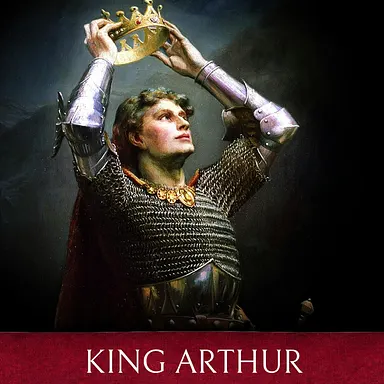
In this fourth part of the series on King Arthur, Tom Holland and Dominic Sandbrook examine the evidence for whether a historical Arthur existed. They look at Churchill's romantic use of the legend, the Historia Britonum attributed to Nennius and its list of twelve battles, and the brief mentions in the Annales Cambriae and early Welsh poetry.
The hosts weigh Victorian and mythological readings of Arthur, R. G.
Collingwood's theory of a Roman-style commander, and archaeology at Cadbury Castle. They also consider Nicholas Hyam's argument that Arthur was invented from scratch.
Listeners learn why the sources remain contested and why certainty is so hard to reach.
In this episode Dominic Sandbrook, Tom Holland
The transcript of this episode on whether King Arthur was a real warrior was made with the technology behind HappyScribe's Zoom meeting notes.
Ads in this audio differ from the text. Tap the sentence you're hearing to follow along.
Synced: the text now follows the audio.
Willkommen zu einem Moment nur für dich und zu allem, was du liebst, bei Douglas. Finde einen Duft, der dich nicht mehr loslässt; Pflege, die aus Alltag ein Ritual macht; Farben, mit denen du dich neu entdeckst. Alles für dich am Singles' Day, jetzt 20% auf viele Artikel. Douglas, welcome to beautiful.
This episode is brought to you by Revolut. Standing still leaves no legacy. History is written by progress, by revolution. Fighting for independence, dismantling those broken systems, defying injustice. Every revolution begins with the refusal to accept the norm, a demand for more. And Revolut is founded on the same principle. Originally established to push back the frontiers of traditional banking, it puts the power back into your hands.
You can manage all of your money in one app. Plus, you can earn while you spend, with the RevPoints reward system. As a fully authorized UK bank, your money is FSCS-protected. Sign up to Revolut today at revolut.com/trih, that's all lowercase, and you'll get £20 after the first time that you spend. 18+. End date and promotion T's and C's apply, and RevPoints T's and C's apply.
Somewhere in the island, a great captain gathered the forces of Roman Britain and fought the barbarian invaders to the death. Around him, around his name and his deeds, shine all that romance and poetry can bestow. Twelve battles, all located in scenes untraceable, with foes unknown, except that they were heathen, are punctuously set forth in the Latin of Neneias. The latest and best-informed writers are ready to believe that there was a great British warrior who kept the light of civilization burning against all the storms that beat, and that behind his sword there sheltered a faithful following, of which the memory did not fail.
It is all true, or it ought to be, and more and better besides.
So that was Sir Winston Churchill, and he was writing in The Birth of Britain, which was the first volume of his mighty History of the English-speaking peoples. And he wrote those words in the summer of 1938, so just before the appeasement episode at Munich. And I hate to say it, but I'm going to say it: the storm clouds of war were gathering over Europe.
And so this idea of a great captain who fought the barbarian invaders to the death, who gathered around him a faithful following and kept the light of civilization burning against all the storms that beat, and made sure that the memory of a land of freedom and honour did not fail, you can absolutely see why that would have appealed to Churchill as he sat there at his desk in the wilderness, waiting for his country to call him back to the front.
So the Arthur that we get in Churchill's history is effectively Winston Churchill. He is a man of great courage and indomitable spirit, who is rallying the British people to war against an invading horde of Germans. He is defending freedom, law, and honour against barbarism, tyranny, and massacre. But of course, Churchill wasn't the first British figure, was he, Tom, to associate himself with King Arthur, and we'll be meeting a couple more in today's episode.
We certainly will. And just to say, that phrase.
It is all true, or it ought to be.
I mean, people have been feeling that about Arthur for 1,000 years, possibly more, and we've met some of them over the course of this series. So there were the Cornishmen in 1113 who ran into some French clerics who'd come over to raise money for their church-building projects, and the Frenchmen pooh-poohed the idea that Arthur was real and would come again, and they got into a massive punch-up.
And then there are all the knights of medieval Europe who lived and loved and fought in emulation of the Knights of the Round Table. And then William Caxton, who published the Mort d'Arthur in 1485, with the stated aim of refuting those who claim that, and I quote him, "All such books as be made of him be but feigned and fables." But one of the reasons why Caxton feels the need to say that in the end of the 15th century is that by that point, scepticism about Arthur was starting to become very difficult to keep at bay.
And this is a development which upset a lot of people. So to take someone from the same period as an exemplar: Henry Tudor, a Welshman absolutely obsessed by King Arthur. And when he defeated Richard III in 1485 and seized the English throne, we mentioned this in our last episode, he claimed to be doing this in fulfillment of a prophecy of Merlin. And that prophecy, Dominic, was the one that featured in Geoffrey of Monmouth's account of Vortigern and the red dragon and the white dragon.
And the prophecy in that is that in due course, the red dragon would triumph over the white dragon, and Henry's banner at Bosworth was a red dragon, and it became a part of his coat of arms and was very, very important to kind of Tudor myth. And like you, Henry named his eldest son Arthur, and so had he not died, there might well have been a new Arthurian age.
There might as well. Yeah.
But the tragedy for Henry, who dreamed, obviously, that the Tudors were restoring the age of Arthur, was that the chill winds of scepticism were blowing ever, ever harder, and they were blowing from Italy. So when Henry Tudor, Henry VII, employed a top Italian historian by the name of Polidor Virgil to write a history of England, in the expectation that Polidor would big Arthur up for him, there was an absolute disaster, because Polidor had been trained in all these kind of historical methods that were being honed by the Renaissance back in his homeland, and he thought King Arthur was absolute rubbish, absolute tosh.
And he dismissed all the stories told about Arthur in very withering terms as good only for the common people who always more regard novelties than truth.
Yeah, but what did he know? He was Italian. I mean, actually, a lot, because the Italians, of course, at this point were sort of.
They were leagues ahead.
Yeah, exactly. They were world leaders in humanism. So, yeah, if you were a patriotic Englishman or indeed a Welshman in the 16th century, you might want to cling onto your legends of King Arthur. But over time, scholarly opinion—I mean, this is certainly the case if you stand back and you look at the last 500 years—scholarly opinion was to become more and more sceptical about the existence of a historical Arthur, wasn't it? And probably never more sceptical than today.
The tide has really been running in one direction, I'm sorry to say.
Actually, no. I think it was probably more sceptical in the 17th and 18th centuries.
Really?
Yeah. It completely melts away. And actually, kind of an interest in the Arthurian stories melts away as well. It definitely fades, but not completely. And I think that there is a kind of camelot-shaped hole left, and there still is, because as you say, even today as well, there is this kind of scepticism towards the existence of Arthur. And that camelot-shaped hole reflects the fact that despite all this, people still want Arthur to be true, I think. I think there is a kind of yearning to believe that some of the stories might have foundations.
And so people, in the hope that there might be a kernel of truth, have gone back and have looked through all the very earlier sources. And essentially, to the degree that there is a kernel, it's very identifiable what that kernel is. And we mentioned it in our previous episode. It's this tiny acorn from which the great oak has sprouted. And it is this obscure and little-regarded text, the Historia Britonum, the History of the Britons, which was written in 829 in Gwyneth in North Wales, purportedly by this Welsh monk called Neneias.
And I say purportedly because we are dependent for his name on a preface that many scholars claim is dodgy. And I'm afraid to say that this is going to be a feature of today's episode, that every time you think you've pinned a detail down, very learned scholars will pop up and say, "Actually, no, probably not. It's an interpolation, or it's late, or whatever." And so we can't be sure it's Neneias, but we will call him Neneias.
Let's call him Neneias. So this, I mean, we discussed this last time. This is unquestionably the oldest surviving document that names Arthur. It is not, unlike Geoffrey of Monmouth's History of the Kings of Britain, this is not a sort of fantasy blockbuster. Neneias is writing this as a chronicle, I guess, as a history, and it's treating this Arthur as a figure of history. He is a military leader who fights and wins battles. And this is the foundation stone.
So if you look at all the later stuff that was then added on, Merlin, Excalibur, the Lady of the Lake, Mordred, whatever, Lancelot, Guinevere, Morgan le Fay, all of this would have been impossible without this text from Neneias. This is the very beginning of the whole thing.
The great building block for the whole massive edifice. And so that being so, let's take a very close look at what Neneias has to say, because really everything depends on this paragraph. So it's just a single paragraph, mentioned in the last episode. It's just 14 short sentences long. And Arthur's appearance in the text, it's placed by Neneias against a very ominous backdrop. So Neneias writes, "A period when the Saxons were increasing in numbers and growing in Britain.
Then in those days, Arthur fought against them alongside the kings of the Britons. But Arthur himself was the dux belorum, the leader of wars." And this is one of the most debated sentences ever written about Arthur, and so let's try and parse it. So there are a number of ambivalences in this very short sentence. Is Arthur supposed to be subordinate to the kings of Britain, or their superior? It's unclear.
Who are the kings that Neneias is mentioning? Is this a stable coalition? Is it a floating array of allies? Again, it's just not clear. And what is the significance of this Latin phrase, dux belorum? So there are two schools of thought on this, basically. Does it deliberately echo a Roman title? So the commander of the northern reaches of the province of Britannia in late antiquity, so the final decades before the withdrawal of the Romans from Britain, he was called the dux Britanniarum.
Is Arthur being cast as a Roman-style commander, someone reminiscent of that figure? Or does the phrase carry no kind of technical freight at all? Is it simply a descriptive that Neneias has coined to describe the fact that Arthur is in charge of fighting the war?
Yeah. Is he the supreme commander, the chief warrior, the what is he?
Well, the key question, I guess, is, is he one of the kings and the high king, as it were, is that what this means? Or is he actually underneath the kings simply as their commander in chief of their armors?
Yes.
We don't know. So ambivalences. And then I think there is a slight ambivalence around the question of who Arthur is fighting. So we assume the Saxons, because these are the people who've been mentioned in the previous sentence. But again, Neneias isn't specifying it. So the precise word he uses is those people, illos. And so it could be the Saxons, or it could be a kind of much messier array of enemies. Again, there are ambiguities there. And then there is this phrase, "In those days," which has a deliberate biblical echo, I think.
And wherever there are biblical echoes, you kind of potentially have to worry about the authenticity.
Is that not the nature of all of these texts? There are biblical echoes in all of them, and literary formula in all of them. So that's not unique to this passage, right? This is the nature of any source from this period.
Certainly in this period. I just flag it up as an issue to bear in mind. So a lot of questions there. That's basically the first sentence that mentions Arthur, and then we plunge into an enigmatic list of 12 battles that Arthur, as the dux belorum, is supposed to have fought and won. Seven of these are fought beside rivers, and four of them, I think, rather improbably, beside a single river, and to quote Neneias, which is called Dubglas and is in the region of Lynuis. And Lynuis is thought by most scholars to be somewhere in northern Lincolnshire.
But if that's the case, then the Dubglas is a complete mystery, because there is no such river in north Lincolnshire. And so other scholars have suggested that Lynuis might actually be in Scotland, and the Dubglas is a river called the Douglas or something like that.
I mean, to be fair, if Neneias is Welsh, he's a long way away from all this, so he might get meddled.
He might indeed, or he might have alternative sources, as we'll see. The notion that a lot of these battles are fought in the region of Hadrian's Wall, perhaps further north, is very strong. It's a very kind of popular scholarly theory. And definitely, the seventh battle is fought in Scotland because it's described as the wood of Caledonia. So Caledonia, the Roman word for Scotland. The eighth battle, again, there's a possibility that it's fought in the region of Hadrian's Wall. It's fought in a fort called Gwynion, and Hadrian's Wall is the area of Britain with the largest concentration of forts.
So that's a possibility. There's a bit of a descriptor here. We get more detail about this battle than any other. And Neneias says that at this eighth battle at Gwynion, this was a battle in which Arthur carried the image of Mary, the perpetual virgin, on his shoulders. And on that day, the pagans were put to flight, and a great slaughter was upon them through the power of our Lord Jesus Christ and of Mary, his holy virgin mother. So what's going on here? There is a very popular theory that it is a mistranslation of the Welsh word for shield, which I gather is very similar to the Welsh for shoulders.
So it's, I think, the Welsh listeners tell me if I'm getting this hopelessly wrong. I believe that the Welsh word for shield is ysgwyd, and the Welsh for shoulders is ysgwith. And there's an extra D on the end of the word. So that's one theory. I know our Welsh listeners were getting detailed analysis of old Welsh. Or is it, Dominic, you'll know as a great admirer of Byzantine practice in late antiquity, that the Romans were very keen on carrying icons of the Virgin into battle.
Really?
So maybe is that a possibility? But they weren't doing that at the period when Neneias is writing. They're doing that in an earlier period, kind of 6th, 7th century. So maybe is that a clue that this might be a reference from an earlier source? I mean, I don't know. Slightly clutching at straws there, but let's clutch at straws, because we don't really have much else to clutch at. Then we have the ninth battle. This was fought in the city of the Legion. So it could be Caerleon, it could be Chester, it could be York, anywhere where there was a legionary base.
And then the 11th battle occurred on the mountain which is called Agned. I mean, God knows where that is. Geoffrey of Monmouth identifies it with Edinburgh, for what it's worth.
We've established that Geoffrey of Monmouth just makes mad stuff up, so.
I know. But if you're keen on the kind of idea that Arthur is fighting in the border region or in southern Scotland, there's something else there for you.
So is that Arthur's seat, basically, in Edinburgh?
Yes. But Arthur's seat doesn't get to be called Arthur's seat until the 15th century. So there's not a kind of, there's no continuity there. Then the 12th battle that Arthur fights, this is the big one, to quote Neneias, the 12th battle was on the mountain of Baden. And this is a resonant phrase, because of all the 12 battles that Neneias lists, this is the only one to have featured in another much earlier source. And we touched on it in our last episode. It's the one that's mentioned by Gildas, the highly educated Daily Mail-style columnist, who was born some three centuries before Neneias, almost certainly in southern Britain, and in the same year as the Battle of Baden-Hill, or the Siege of Baden-Hill.
And Gildas, although he wasn't a firsthand witness to Baden-Hill, he is as close to being a witness as we get. It's a battle, but it's also a siege, he tells us. So maybe it was at Fort at the Hillfort or something like that. We don't know. And also, Gildas specified that it ranked as not the least victory won by the Britons over the Saxons. Baden is often portrayed as a victory so great that it stems the Anglo-Saxon advance, that it wins the Britons a breathing space. This is a theme of many of the novels that are written about, I suppose, the historical Arthur, that Baden is the battle that wins it.
That's not actually what Gildas said. I mean, he literally says, "It's not the least victory," which is slightly damning with faint praise, I think. And I think it's clear that Gildas actually only mentions Baden-Hill because it's the year in which he was born. But to repeat, it is resonant. It appears in Gildas, and now it's appearing in Neneias. So what does all this mean for the historicity, or otherwise, of Arthur? I mean, let's give two perspectives, both of which are drawn from the work of very distinguished scholars. You could argue that it offers us clear, substantiated evidence for the existence of someone called Arthur.
This is an Arthur with a military background that seems to have kind of very strong Roman vibes. He's got this title, dux belorum, which has echoes of late antique command structures in the Roman army. You've got a range of military activities extending from north of Hadrian's Wall, maybe to Lincolnshire, maybe to the south of Britain. The south of Britain is where Gildas strongly implies that Baden-Hill was to be found. You have regional kings who seem prepared to accept Arthur's pan-British authority, if you're looking at it a certain way.
And Arthur is described as being victorious in a battle which we know to be historically authentic. So that's the evidence for Arthur as existing. Or you could argue that the entire paragraph is a literary fiction, and a very palpable literary fiction. So on the question of whether Arthur has a late antique military command, the obvious question is, how would a monk in 9th century North Wales have had even the remotest knowledge of what Roman officers in late antiquity were called?
There's a counterargument to that, though. How would he have known to make it up?
Well, it could just be the phrase, dux belorum. I mean, it could just be he's the guy who's in charge of fighting battles.
I suppose. But I think if you're pointing fingers at people and saying, "Well, how on earth can such a person know about things that happened hundreds of years before he was born?" the presenters of a history podcast are probably not in a brilliant place to do that, right? I mean.
Well, except we are, because we have ready access to enormous amounts of information, which Neneias probably didn't. It's unlikely that he had an extensive library.
He must have had something in order to write this at all. Surely. I mean, he's read books.
He must indeed, and we will be coming to this. But just to continue the skeptical perspective on it. You can also, I think, and I think this is clearly the case, that the list of Arthur's victories has basically been scavenged from a range of sources. One of these is Gildas. These places, a lot of them rhyme in the Latin.
Yeah.
And that implies, I think, that they come from poetry, and they may come from various poems and poems in the early medieval Welsh literature don't tend to be absolutely focused on strict historical fact. I think it's fair to say.
Yeah, that's a fair point.
The other kind of key thing to bear in mind is that Arthur is actually just one of a multitude of British heroes mentioned by Neneias in the Historia Britonum. And these other ones are patently fictional. So the first one is a guy called Britto, who's a grandson of Aeneas, and he supposedly gives Britain its name. And this is the guy who in Geoffrey of Monmouth will become Brutus, the guy who fights the giants and stuff like that. There's also a guy called Dolabella, who supposedly fights Caesar.
And Dolabella, where's he come from? He's Cicero's son-in-law. I have no idea how Neneias came up with this. Dolabella clearly didn't exist. Britto didn't exist. Does this imply that Arthur didn't exist? And then on top of that, going back to the kind of the biblical echoes, there is something possibly suspicious, if you're in a very skeptical frame of mind, about there being 12 battles. I mean, 12, it's kind of maybe an echo of the disciples or whatever. I think basically, the degree of support that Arthur provides for a historical Arthur in that paragraph is a matter of perspective.
And it always reminds me of that thing where you either see a duck or a rabbit, and it's very hard to see them both at the same time. Well, basically impossible. And so I think this passage doesn't really give a decisive answer in and of its own terms. So that being the case, are there other sources that might help to clarify matters? And there are. There are a few other pre-11th century texts that do mention Arthur, say before the year 1000. But the emphasis is, I'm afraid, very much on the few.
So firstly, the Historia Britonum, the passage that we've just read, that paragraph, is not the only mention in the manuscript of the Historia Britonum that has Arthur. So attached to it, like a kind of appendix, there's a group of what are called the Mirabilia Britania, the Marvels of Britain. And these marvels include two mentions of Arthur. So one of them is a stone imprinted with the paw print of a dog called Cabal.
And Cabal was the dog of Arthur the Warrior, we're told, in the Historia Britonum. And then there is a grave of a guy called Amr, who was the son of the warrior Arthur, and Arthur killed him there and buried him. And the thing that's miraculous about this grave is that its length varies every time it's measured, so that it's impossible to get an accurate reading. So that's very miraculous.
Yeah, that is miraculous.
Now, what's the significance of these two marvels, both of which are obviously mythological? I mean, they're clearly not historical. If the authorship of these marvels can be dated to the same time as the Historia Britonum, the kind of the mass of the material, 829, we know that that's the date very precisely, because we get the date of the king who was ruling at the time when it's written. Then that does suggest something intriguing, because it suggests that Arthur by 829 was already so celebrated a warrior that he's well on the way to becoming a figure of folklore.
And you become a figure of folklore after several generations have kind of bigged you up. However, there is inevitably a problem, because most, though by no means all scholars, date the Mirabilia to the 10th century.
It was much later and then added together with the other manuscripts.
To repeat, there are scholars who think that it is caterminus with the mass of the Historia Britonum. So in other words, it might be evidence for the fact that Arthur is already a figure of folklore by the early 9th century. But again, the problem is, there is something there for the believers, and there is something there for the skeptics. It's hard to be certain which way to go. The same is also true of another possibly very much earlier piece of evidence, which is a couple of lines in a Welsh Britonic poem, but it's written in the north, so at a time when the Welsh-speaking kings are, they're occupying Edinburgh, they're occupying Alcluwd by the Clyde.
And this poem is called O Godwthin. It's dated to the early 7th century, and it tells how a war band of 300 Britons left Edinburgh on a kind of doomed expedition to the south, into what is now Yorkshire. And one of the fallen warriors on this expedition, a guy called Gwrathir, is mourned thus. He fed black ravens on the rampart of a fortress, though he was no Arthur. So in other words, he is killing lots of people, he's feeding the ravens, but he's still not as good as Arthur is.
And if this is genuinely from around 600, then this is the earliest mention of Arthur that we have. And it implies, again, that he's already a household name. But Dominic, it will not surprise you, it will not surprise the listeners to know that there is a complicating problem here. So O Godwthin survived in a 13th century manuscript. That's the earliest written version of it that we have. And it is clearly written by at least two scribal hands. And one of these seems to have written the core poem, and the other one to have added additional later material.
And I am simplifying things massively here. So if you're a professor of old Welsh, please don't get cross with me for this.
Right. Do we have such people listen to the show?
Surely not. Who knows? We'll find out. And those two lines which feature Arthur disappointingly seem to have been written by the later scribal hand. However, it's not conclusive. There are definitely scholars who do think the Arthur lines are early. But I think to come to an informed opinion on this, you basically need to be a scholar of Middle Welsh, which I'm not.
There's only about 10 such people surely in the country.
Again, you pay as you money, you take the choice on this.
So unclear from the marvels, unclear from the O Godwthin poem, and then there's a couple of entries in one more source. So this is a source that you mentioned right back in the first episode of this series, called the Annales Cambriae, the Annals of Wales. And that was compiled in the middle of the 10th century. So what does that source tell us?
OK, so one of these entries, and this is for the year 516, again, describes the Battle of Baden. And it says that this was a battle in which Arthur carried the cross of our Lord Jesus Christ for three days and three nights on his shoulders, and the Britons were victors. And I think that this clearly derives from and garbles the Historia Britonum.
The thing about the shoulders and the shield.
Yeah, and he was carrying the Virgin Mary in the earlier one, and now he's carrying Jesus. But the second entry from the year 537, this doesn't draw on the Historia Britonum. It clearly comes from another source, and I think it is much more tantalizing. So this, again, we have we've read this out in the first episode, but I'll give it again. The Battle of Camlen, in which Arthur and Medraught fell, and there was a great dying in Britain and Ireland. And in episode one, we talked about how Medraught would become Mordred, and Camlen is the last battle that ends up featuring in the Mord Arthur.
But where does the Annales Cambriae get this from? We don't know. But there is an intriguing detail, and that is this detail about the great dying. What does that mean? It has been kind of discovered by volcanologists, I guess, climatologists, that there was in the year 535 a massive volcanic eruption, which was so immense that it seems to have precipitated famine across much of the world. So there are records of this famine in Roman sources, in Chinese sources.
And it's possible, therefore, that this is describing a famine that afflicted Britain and Ireland in that year. So a suggestion, perhaps, that this entry might be kind of authentic-ish. But again, I mean, it's not a kind of game changer, I think. It doesn't kind of seal the deal. And so that is it. Those are the sources from the first millennium that mention Arthur, and there are no others.
To be fair, I think that last source is pretty good. It mentions Arthur and Mordred in the same entry, and it's written from what? 537?
Well, it's written in the mid-10th century.
Yes, it is, actually. It's looking back to 537. So maybe the myths of Arthur and Mordred are already current.
But it's that detail about the great dying. Because if it's the terrible famine, then that's a detail that has only recently been shown to be true.
So the bloke writing this would have drawn on sources that no longer exist to find out about the great dying.
Otherwise, how would you know? Yeah, exactly. That's the one that is the most convincing of all the pieces of evidence that we've been discussing. Just before we come to the break, two authors who don't mention Arthur, but are very significant. And so therefore, the fact they don't mention him might be considered to be significant in its own right. First of these is Bede, the first great English historian, Northumbrian monk, writing around 730. And Gildas, who we've already mentioned, and he is writing a couple of centuries before Bede, so maybe around 520, 530.
Yeah.
And it's not surprising, we said this in the last episode, that Bede would omit Arthur because Arthur is a great British hero. Bede is very contemptuous of the Britons because he blames them for not having converted the English to Christianity and thinks that this is why God is punishing them by depriving them of Britain. So you could see why Bede might not wish to mention Arthur. But Gildas is a different matter. Remember, this is the guy who's born in the same year as the great victory at Baden Hill. And Gildas, not only does he not mention Arthur, but he seems to attribute that victory at Baden Hill to Ambrosius Aurelianus.
And Ambrosius Aurelianus is described by Gildas as a Roman whose parents had worn the purple, and that under him the Britons had rallied and taken the fight to the Saxons. So it's possibly Ambrosius Aurelianus is a kind of shadowy Arthur figure, possibly.
I mean, you're not the first person to have suggested that, are you? There's lots of historians who've flirted with that thesis.
Yes. But I suppose as regards Arthur, the question is, in this case, is absence of evidence maybe evidence of absence, or maybe not?
So after the break, we will be sifting this rather paltry evidence and looking at the various theories as to where and when and how the stories told of Arthur might first have emerged. And Dominic, you and I together will be giving our solutions to the whole mystery.
Finally, the solution awaits. I mean, if you've been listening this far, I bet you are absolutely beside yourself with excitement as we are about to solve the mystery of King Arthur. Come back after the break for this earth-shattering moment.
Welcome back to The Rest Is History. He who can accept of legends for good story may quickly swell a volume with trash. So that rather disobliging verdict was from John Milton in 1648. And Milton's view was that King Arthur was not a serious subject for study. So yeah, disappointing from Milton. And as you were saying before the break, in the first half, for two centuries or so, almost everybody, every serious scholar, every vaguely reputable writer who investigated what we would call the Dark Ages agreed with Milton.
They said the stories of King Arthur, they're not just made up, they're embarrassing. They're so clearly fabricated. But historians then began to change, didn't they? And I suppose you can date that to what, the middle of the 19th century, when Victorian writers and artists become infatuated with Arthurian legends.
Yeah, so you've got Tennyson, the Lady of Shalott, the Idols of the King, all that kind of thing. You've got the Pre-Raphaelites who kind of love a moody-looking damsel or a solemn-faced knight errant, lots and lots of paintings by them drawn from Arthurian myth. And there's the whole kind of Victorian obsession with chivalry, the cult of the gentleman, becomes a kind of great global marker of Englishness.
In the episode we did on the samurai, we talked about how the kind of chivalric ideal derives from the British idea of the gentleman. So all of this kind of fuels enthusiasm for Arthurian legend. But I think it also reflects something else, which is, in the late 19th century, a kind of escalating obsession with mythology and for identifying legendary heroes with sun gods or nature gods or fertility gods or whatever.
So in the 19th century, Arthur comes to be cast as a personification of the sun. Excalibur is seen as being the rays of the sun, the knights of the round table, the seasons, or the signs of the zodiac, or the planets, or whatever. And then in the 1920s, it's all about vegetation gods who die and rise again. So drawing on the Golden Bough by Frazier, and the most celebrated explication of this is Jesse Weston, who wrote a book called From Ritual to Romance, which cast the quest for the Holy Grail as a story that encodes deeply buried memories of ancient fertility cults.
And T.S. Eliot loved it.
Yeah, he loved this.
So the Wasteland, it's all about this, the Fisher King and things like that. But I think today that these kinds of universalizing theories don't have much traction. I think essentially scholars today would see them as kind of intellectual period pieces. And there isn't really anyone today who thinks that Arthur was a sun god or a fertility god or whatever. And there are two principal reasons for this. The first is essentially what we've been talking about in our first two episodes, the degree to which the stories and themes in Arthurian romance, so the Sword and the Stone, the Round Table, the Holy Grail, whatever, clearly originated in medieval times in response to medieval obsessions, medieval cultural needs, whatever.
So you think of the figure of Lancelot, the cult of chivalry, all that kind of stuff. This is clearly not an embodiment of some solar cult, you know, kind of global solar cult. It's bred off the cultural specifics of the 12th and 13th centuries. Now that said, there clearly are mythological trace elements in the stories told of Arthur, but these are deriving from one specific mythology, and that's the Celtic mythology, the mythology of Wales and Cornwall and whatever.
And we've mentioned some of them already in this series. So the plot which structures Chrétien's Lancelot, you know, he goes on this quest to rescue Guinevere from this knight who's abducted her to a strange, eerie kingdom. And you can see how that story is drawing on Welsh tales about figures from mythology who ruled strange lands, lands of supernatural, lands of fairy, whatever. And also in, I think that what derives from Welsh mythology is the hero who passes from our world into a condition of, if not death, then a kind of suspended, a suspended life.
And I think this is clearly one of the most venerable themes in Arthurian legend. And those Cornishmen in 1113 who were getting upset because the French were laughing at them, you know, that is testimony to how far back that story goes. But the notion that Arthur himself was a god at one point and slowly got adapted into a historical figure, it seems to me really implausible. So if you look at the Historia Britonum, you've got an Arthur whose dog is leaving his pawprint on a stone and who's killed a son whose grave can't adequately be measured.
And then you've got an Arthur who's a Dux Britonum and fighting at the city of the Legion or whatever. It seems improbable to me that the first one would have evolved to become the second one.
Totally, could work the other way around. You could have a real Arthur who is a great warrior or a commander of whom fabulous stories are later told. It's very unlikely that you have a deity who then over time.
Yeah, then becomes a figure of history.
Yeah, and just sort of left-hand colonel in somebody's army. I mean, that just seems highly unlikely.
Yeah, I mean, there's no question that Arthur does come to be associated with a huge number of kind of weird prehistoric monuments or hills or whatever you mentioned, Arthur's Seat. But this is an ongoing process. I mean, it lasts throughout the Middle Ages. It continues into the early modern period. And you can think of parallels in more recent history. So all the inns where Elizabeth I is supposed to have stayed, all the oak trees where Charles II is supposed to have hidden. I think that if those stories about the pawprint of Arthur's dog in a rock are being written down at the same time as the stuff about Arthur as the Dux Britonum, that suggests that Arthur is already a figure of myth when Linius is writing his book.
And that it reflects the fact that this is a mythologization of a historical figure, and therefore Arthur must have lived several centuries before Linius.
Yeah, but I mean, as you say, you can absolutely, I mean, history is littered with figures about whom tall stories are later told, you know, indeed sometimes supernatural stories. So that's perfectly possible.
Yeah, Drake's drum.
Right, exactly. Let's get to actually a key thing which we haven't really talked about at all. The word Arthur, so Arthur's name. It's not, if he's the Dux, whatever he is, Dux Bellorum, but it's not obviously a Latin name, is it? So what does the name tell us about him?
It's thought to be a Britonic word, so the Celtic name. Derived from the word for bear, Arth. But I gather from specialists in the field, philologists and such like, that the consensus now is that it derives from a Roman name, namely Artorias. And obviously, if that's the case, then there's a real problem in assuming that Arthur might originally have been a Celtic god. I mean, it basically blows it out of the water, because as Nicholas Hyam in his recent book, King Arthur: The Making of the Legend, wittily puts it, Celtic gods uniformly bore Celtic names.
In other words, not Roman names. There are no Celtic gods that have Roman names.
So let's assume that it is a Roman name. It's Artorias. And he is, of course, the Dux Bellorum. So is he therefore, I mean, this is a very standard view now, isn't it? That Arthur is some kind of Roman, you know, Romano-British military officer. The sun is setting on the Roman Empire. But you know, like Churchill in that opening reading, he draws his sword and rallies the last Romans to him to keep the flame of freedom flying against the invaders.
And I think it is no coincidence that this take on the origins of the Arthurian legend should first have emerged in the 1930s, just as Britain is kind of bracing herself for a war and possible invasion by Germans. I mean, I think it's, you can absolutely see what's going on there. And the scholar who blazed the trail for this theory was, he was a philosopher as well as an archaeologist and a historian, so a very interesting man called R. G. Collingwood.
And he wrote the Oxford History of Roman Britain. It was published in 1936. And in it, it's almost kind of throwaway lines, but it has a massive impact. Collingwood suggested how, through the mist of legend, as he puts it, the contours might be glimpsed of a kind of sub-Roman campaign led by a commander of rare genius. And Collingwood suggests that this commander had stood at the head of a mobile field army, so heavily armored cavalry, cataphracts, that were typical of Roman armies in the late antique period.
And that this commander was heir to the Roman province of the Count of the Provinces of Britain, and he had ranged from beyond Hadrian's Wall down to Dorset, down to Kent, and that this is reflected in the geographical spread of the 12 victories that you get in the Historia Britonum. And this commander was, of course, Arthur, and he's described by Collingwood as the last of the Romans, the last to understand Roman ideas and use them for the good of the British people.
And this is the theory that Churchill picks up in that passage that you read, the latest and best-informed writers. He's thinking of Collingwood when he writes that.
Right.
As you say, it's beautiful. It's a theory that you instinctively feels right, you want to believe it. And it's a huge inspiration to the general public, to novelists, and to serious scholars for several decades after the Second War.
That's the sort of Bernard Cornwell, The Winter King, Rosemary Sutcliffe's great book, Sword at Sunset. Yeah, so many, exactly. The Rosemary Sutcliffe, all of so many sort of 1950s, 60s onwards, fictional versions of Arthur have Arthur as a sort of Roman commander amid the ruin, the crumbling ruins of Roman Britain. Any archaeological evidence for this? Because we haven't talked about archaeology at all.
Right, so in the 1960s, this theory helps encourage a dig, a very famous dig, which is conducted by an archaeologist called Leslie Alcock. And this goes on for four consecutive summers, and it's covered in considerable detail by the BBC. So it has unusual fame for an archaeological dig. And it was held at Cadbury Castle in Somerset, which we mentioned in episode one as being one of the possible sites for the Battle of Camelan. And this was an Iron Age hillfort, which at least since the Tudor period had been identified with Camelot.
And in fact, there was a Welsh historian who was so offended by Polidor Vergil that he said, look at Cadbury Castle, everyone there says that this was Camelot. So that proves that Arthur existed. So it goes back at least as far as that. And Alcock's excavations revealed that the hillfort had been reoccupied in the wake of the Roman withdrawal from Britain. And he distinguished really very solid fortifications built of timber and dry stone and earth.
And there was a great hall, which had clearly been occupied by a very considerable warlord. And there were luxury goods, pottery imported from the Mediterranean and the like, very similar also to what you find in Tintagel, intriguingly. So it's not surprising then that when Alcock in, I think, 1973, published an overview of his excavation, he gave it a title which left no one in any doubt as to whom he thought had been occupying that great hall and enjoying the luxury goods that had been brought there from the Mediterranean.
Because he calls his book Arthur's Britain.
Well, to be fair, if not Arthur, then who? I mean, he's one of the few characters from this period who is named, and you know, he was obviously important enough to leave a kind of mythological legacy. So why not Arthur?
And Alcock gives a kind of brilliant description of Arthur as he strides around Cadbury Castle in his Roman military uniform. So he's going in very hard. And this in turn encouraged some scholars, some kind of, not so scholarly, over the course of the 70s, to go back to Geoffrey of Monmouth and say, oh, well, you know, if Geoffrey of Monmouth got this kind of link between Arthur and the world of the Roman Empire, right, what else might he have got right? And so we could look at a couple of these theories.
One of them is that Arthur had ruled as, and I quote, the last Roman emperor in Britain, heir to the island emperors who had been enthroned there since the withdrawal of the legions. And this was proposed by a scholar called John Morris, who was a historian at UCL. He wrote an entire book called The Age of Arthur, which I adored.
Yeah, brilliant book.
And it was full of diagrams with, you know, maps and kind of arrows showing Arthur's campaigns and things like that. And he then wrote a posthumously published History of Roman London. And that's where that description of Arthur as the last Roman emperor in Britain appeared. It has to be said, there is no evidence for this claim whatsoever.
Yeah, everyone now thinks that this bloke Morris made all this up, don't they?
Well, he was maybe overenthusiastic in his interpretation of the source material. Another theory was developed by Geoffrey Ash, who was the guy who wrote a number of books about King Arthur, inspired by Alcock. He kind of wrote the book of the dig. His theory was that when Geoffrey said that Arthur had led an army across the channel to attack the Romans in Gaul, that maybe this reflected distorted memories of an army of Britons crossing the channel to attack the Goths led by a British king.
And this theory derived from the undoubted fact that there was a king called Reophimus who had led an army of Britons against the Goths around 470. But there are considerable problems with this theory as well. Firstly, it ignores the fact that Reophimus, rather than triumphing gloriously as Arthur was said to have done in Geoffrey of Monmouth, had actually been defeated. It also required Reophimus to be not a proper name, but a title and a word for a king, which it definitely wasn't.
And it also required the Britons to have crossed the channel, and all the evidence points to these Britons actually having come from Brittany rather than from Britain. So basically, I think that's dead in the water, that theory.
There are other Roman theories, right? So what about this one? There was a Roman officer, I mean, with a very, very telling name. Is it, what is it, Lucius Artorias Castus? Is he the real Arthur?
Well, the evidence for this is it's a kind of funerary inscription found in what today is Croatia. And it includes not just Artorias's name, but the fact that he had served in Britain. So this might, you know, this might seem a kind of clinching detail, except for the fact that the date of this funerary inscription is the second century AD.
Oh no, that's far too early.
300 years before the collapse of Roman Britain.
Now, what about another idea? I'm going to throw another idea at you. So this, there's a film, I think, with Clive Owen in it. Isn't he Arthur?
Yeah, and Keira Knightley.
So in this film, if I remember right, Arthur has the cavalry, has this heavy cavalry. And these are summation warriors from what is now the Hungarian plain. So is there any truth in this?
Well, yeah, so this theory derives from the undoubted fact that in 175, the Roman emperor Marcus Aurelius did send summation warriors, specifically Iazygons, from the plains beyond the Roman frontier to Britain. And the theory is that it's the descendants of these Iazygon warriors, these summations, who led the fight against the invading Saxons, and also that they adapted stories that they had brought from summation to Britain, and that these would go on to provide the basis for many of the stories that were told of Arthur in the Knights of the Round Table.
So the summations, I mean, are they still going to be summations hundreds of years later? I mean, that just seems absolutely ludicrous. The Knights of the Round Table, I mean, you have demonstrated, surely beyond any possible doubt, that the Knights of the Round Table are inventions.
Are knights.
Yeah, of the Middle Ages.
They're not cataphracts, they're not summation heavy cavalry. I mean, it's mad to think that.
They're reflecting the age of chivalry. I mean, they are inventions of the age of chivalry. They are not folk memories of these kind of barbarian warriors or whatever.
You know, the other thing is that it's not even evident that these guys were heavy cavalry, because there are all kinds of summations who weren't heavy cavalry. We have no way of knowing for sure. So I think that that's improbable. And again, I will quote Nicholas Hyam in his tremendous recent book on King Arthur. "We can be as certain as the nature of the evidence permits that elements of the Arthurian stories were not carried to the West by Iazygon warriors posted to Britain by Marcus Aurelius in 175," which is a scholar's way of saying that it is absolute tosh.
But he goes further, doesn't he, in his book King Arthur, the Maker of the Legend. He basically says, the whole thing is made up. There is no historical Arthur at all. I mean, that's disappointing. So why does he come to such a sweeping and definitive verdict?
Essentially, he's dumping on the whole idea, which I think is very popular, that you can't have smoke without fire. And he says this is simply not true. So to quote him, when all is said and done, all we have are swirling shapes in a fantastical cloud. There is neither flame nor fire beneath. Half-imagined wraiths forming in hill mist are no foundation for our history. And his thesis is that Nennius literally made it up, that he's responsible for the whole Farago, that he invented Arthur from scratch to serve the propaganda needs of Gwynedd, the Welsh kingdom in the north, that was being menaced at the time by Mercian expansionism.
And he points out that the themes not just of the paragraph about Arthur, but the whole Historia Britonum in which that paragraph appears are kind of twofold. So firstly, the Britons, a.k.a. the Welsh, are the original and rightful people of Britain. They should own it. It's theirs. They're the indigenous people. But over the course of their history, there have been repeated invasions, there have been repeated waves of immigrants and conquerors.
So the Romans, the Picts, the Irish. And Arthur is just one of a long line of British war leaders that Nennius has invented from scratch to demonstrate that in the long run, the Britons are always bound to emerge triumphant. That just as the Romans were seen off, the Picts were seen off, the Irish were seen off, so in the long run, the Saxons are going to be seen off. And so Hyam, he's basically saying that Nennius is as bad as Geoffrey of Monmouth.
He writes, "Let us face facts. The Historia Britonum is in large part a work of historical fiction." Nennius too is Dan Brown.
So we could end the episode right there. But we're not going to, because I believe, am I right, that you don't quite agree with Nicholas Hyam's verdict, that actually having read his book, you've got your doubts.
It's a wonderful book. It covers every theory that you could want to have covered and does it. I mean, Hyam is a brilliant scholar, you know, and a really good writer, as you could tell from, you know, that wonderful stuff about wraiths. And when I began it, I thought that Arthur was a complete myth. But weirdly, by the time I finished it, I was starting to have second thoughts about that. There's no question what Hyam's book does with completely devastating clarity is to spell out how insubstantial our evidence for historical Arthur is.
But what it also does is demonstrate how contested it is. So contested, in fact, that I think it is actually really difficult to be certain one way or the other. Hyam, you know, he says, "I'm not at home to agnosticism." He definitely didn't exist. I think his book is a very convincing demonstration of why agnosticism ultimately is the only response to the kind of the insubstantial nature of the evidence.
Because the sources, such as they exist, such as we have been describing them, it's almost like they've been designed to preclude certainty either way. To say that Arthur's a total myth, you've got to side with saying that all the sources are late. If you're saying that they're all early, then perhaps you can say that they are, that they're authentic. And, you know, great scholars on either side are arguing both those things. So it's really, really difficult if you're not a specialist, I think, to arrive at certainty either way. So just to reiterate, to argue that Nennius invented Arthur requires all that stuff about Arthur's dog and the stone and stuff to date from the 10th century.
But if they're written, you know, in the early 9th century, then, and lots of scholars argue that, then I think that that suggests that Arthur has a kind of much earlier origin. And that would imply that Nennius couldn't have invented Arthur from absolutely nothing, because Arthur's already famous enough as a great warrior by 829 to have given his name to all these kind of various features in the landscape.
Then you've got that line in Augur Thodrin. He fed black ravens on the ramparts of a fortress, though he was no Arthur. I mean, he was no Arthur suggests that there is a universally accepted standard that is associated with somebody called Arthur that everybody thinks existed, right? As in, he was no Muhammad Ali, he was no, she's no Margaret Thatcher, he was no Winston Churchill. I mean, you don't say that unless everyone knows that person means something and existed.
Right, but that's the problem. It might be late, which lots of scholars think, but equally it might be early, and lots of great scholars think that too. So what do you do? And what if, and Hyam, this is Hyam's argument, that the Arthur is another Arthur. It's not the King Arthur. It's some Arthur, other Arthur. But I think that this is just kicking the problem down the road, because Nennius definitely wasn't making the name Arthur up. For a brief while, it does actually seem to have been very popular among British and indeed Irish princes and kind of royal families.
And here's the thing. The popularity of Arthur as a name in early medieval Britain is confined to a very precise period of time, and it's basically the 6th and 7th centuries. So that's much earlier than Nennius. And there's another recent book that's come out by Ken Dark.
Ken Dark, who's writing about the Dark Ages.
He would say he's writing about early medieval Britain, Dominic. Ken early medieval Britain. And he's published Kings and Tyrants, it's called. It came out just actually just a couple of months ago. And he points out that before the 6th century, there's no mention of Artorias from Britain. I mean, there's the guy in Croatia or whatever. But from Britain, you've got thousands of inscriptions, there's no mention of anyone called Artorias on them. And then to quote Dark, "After at latest the late 7th century, there are no more Arthurs in Britain prior to the early 9th century when Historia Britonum was written."
So in other words, this short period covering the darkest of what you might want to call the Dark Ages, this is when the name Arthur suddenly starts appearing. And this prompts the obvious question, what or who could possibly have prompted its emergence as a popular name among the royal families of Britain in the early 6th century?
That's tantalizing. Surely the most definitive piece of evidence. I mean, I've been thinking about this ever since we mentioned it earlier in the episode, and I wondered if we'd come back to it, and finally we have. This is that entry in the sort of the Welsh annals, the Annales Cambriae. So the Battle of Camlann, in which Arthur and Medraught fell, and there was a great dying in Britain and Ireland. Now this is not fiction or fantasy. You know, scholars don't think this is made up.
Yeah, and there's this thing about the volcano and the famine, if we're to assume that that's the great dying. And the other thing is that, you know, we have Arthur there, so Artorias, he's got a Roman name, but we also have Medraught, and Dark points out that this too seems to have derived from another Latin name, Moderatus. And the use of Latin names like that is fading out by the kind of 8th century.
To me, that is that Arthur and Mordred basically in the same source, with an attested historical fact, the famine that comes up from the eruption.
We don't know who they are. You know, we said in the first episode, we don't know from this whether they're on the same side, whether they're fighting one another, you know, who wins the battle, whatever. We don't know that. But what we do know is that these are two figures whose names derive from Roman names. So if we're talking about an Artorias and a Moderatus, that implies that these might well belong in the 6th century to a date which there is kind of external evidence might indeed have been in 536 or 537.
I think that is the degree of evidence we have. It's a pretty tiny flickering candle to set against the, you know, the icy winds of skepticism. But I think it is a candle all the same. And we began this series with the mystery alluded to by Mallory. Did Arthur die of his wounds, or did he, was he taken to another place, and is he destined to come again and win the Holy Cross? And we end it, I think, with something very similar, that question of did Arthur exist, or must he be banished from the history books as an outright fabrication?
And so I am going to sign off this series by echoing Mallory and saying, "I will not say that it shall be so."
Oh, that's very nicely done. So I think he did exist, by the way. Just going to pin my guy less than ask. You know, and I want him to have existed because I want him to have existed. Simple as that, really.
Yes, I think that's entirely, you know, you're not a professor of early Welsh, so I think you're entirely entitled to your opinion.
No, and I never will be. I'm happy to say.
You can believe what you like.
Surely everybody, all our Welshes who have listened to this, definitely want him to have existed.
Everyone wants Arthur to have existed, basically.
Of course they do. Of course they do, unless you're utterly joyless. Right. Tom, what have we got coming up next week?
We've got you, haven't we? Talking about a much more recent period of history, the Great Events of 1956. So that's the Suez Crisis, in which Britain doesn't show herself to best advantage, and the Soviet repression of the Hungarian uprising.
Yes, indeed. Those episodes will be out on Monday, the 1956 series, Suez first, then Hungary, for club members. If you want to get all of the episodes on Monday, as the club members will, then you know what to do. You need to sign up to the club at the restishistory.com. You'll get all sorts of supplementary benefits, which, let me just put this on the record, they absolutely do exist. The existence of these benefits is, there is absolutely no scholarly doubts about this whatsoever.
And that's the finish of the promo show. Tom, thank you very much for that. That was absolutely masterful. And we will see you next week in 1956. Bye-bye.
Bye-bye.
Hello, Gold Hanger History listeners. This is Marina Hyde and Richard Osman from the Rest Is Entertainment.
Hello, everybody. Every Thursday and Friday, we are reacting to the pop culture phenomenon that is the Celebrity Traitors. We'll be on YouTube and wherever you get your podcasts. And Marina and I are digging into all the castle's twists and turns, giving our expert opinion on what should happen next.
Now, which historical figure do we think would be the greatest traitor?
It's tempting to think of an actual traitor.
Yeah.
A Guy Fawkes or a Kim Philby, but then all of those are traitors who got caught.
Philby had a great run, though.
He did have a great run.
I think he could probably see off, you know, Jo-An.
Yes, maybe. And probably sort of where he ended up in Moscow is probably roughly like where the contestants have to spend every night as well. So maybe there's some sort of equivalence. So if you're watching Celebrity Traitors, don't forget to tune into our reaction episodes every Thursday and Friday night at 10 p.m.
Find us on YouTube or wherever you get your podcasts.
Did King Arthur really exist or is he just a legend that has developed over the centuries? Could he have been a Roman general who fought against the Saxons? Or is he a Celtic warlord? What is the truth?
Join Tom and Dominic as they solve one of the greatest mysteries in British history and reveal who the real King Arthur was.
Join The Rest Is History Club: Unlock the full experience of the show – with exclusive bonus episodes, ad-free listening, early access to every series and live show tickets, a members-only newsletter, discounted books from the show, and access to our private Discord chatroom. Sign up directly at therestishistory.com.
To read our new newsletter, sign up at: therestishistory.com/newsletters
_______
Sign up to Revolut at revolut.com/trih and get £20 when you spend. 18+, end date 30/06/2027 and promotion T&C's apply. Revpoints T&C's apply._______
Check out Ask the Archives at ask-the-archives.com and get started with Claude at Claude.ai/restishistory
_______
Advertise with us: Partnerships@goalhanger.com
_______
Twitter:
@TheRestHistory
@holland_tom
@dcsandbrook
Video Editors: Jack Meek, Harry Swan + Adam Thornton
Social Producer: Harry Balden
Producers: Tabby Syrett & Aaliyah Akude
Senior Producer: Callum Hill
Executive Producer: Dom Johnson
Learn more about your ad choices. Visit podcastchoices.com/adchoices