
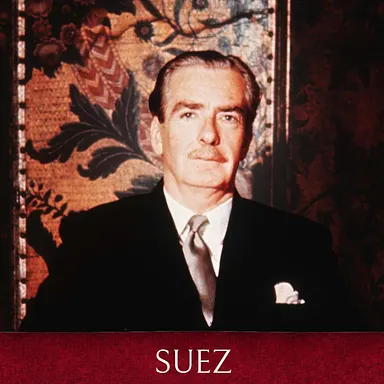
Part one of The Rest Is History's Suez Crisis series traces how Britain and France came to attack Egypt in 1956. Dominic Sandbrook and Tom Holland open with Gamal Abdel Nasser's speech nationalising the Suez Canal Company, then examine the decline of the British Empire in the 1950s.
They profile Prime Minister Anthony Eden, his wartime record, his fragile health and his views on appeasement, and follow his deteriorating relations with Nasser over arms deals, the Baghdad Pact and the Aswan High Dam. Listeners will learn how the crisis took shape and why Eden's personal history may have shaped his choices.
In this episode Dominic Sandbrook, Tom Holland
This episode on the Suez Crisis and Anthony Eden was made with HappyScribe technology, the same technology behind Teams transcription.
Ads in this audio differ from the text. Tap the sentence you're hearing to follow along.
Synced: the text now follows the audio.
This episode is brought to you by Revolut. Standing still leaves no legacy; history is written by progress, by revolution. Fighting for independence, dismantling those broken systems, defying injustice. Every revolution begins with a refusal to accept the norm, a demand for more. And Revolut is founded on the same principle. Originally established to push back the frontiers of traditional banking, it puts the power back into your hands.
You can manage all of your money in one app. Plus you can earn while you spend, with the RevPoints reward system. As a fully authorized UK bank, your money is FSCS protected. Sign up to Revolut today at revolut.com/tryh, that's all lowercase, and you'll get £20 after the first time that you spend. 18+. End date and promotion T's and C's apply, and RevPoints T's and C's apply.
Willkommen zu einem Moment nur für dich, und zu allem, was du liebst, bei Douglas. Finde einen Duft, der dich nicht mehr loslässt. Pflege, die aus Alltag ein Ritual macht. Farben, mit denen du dich neu entdeckst. Alles für dich am Singles' Day, jetzt 20% auf viele Artikel. Douglas, welcome to beautiful.
Citizens, we shall not let imperialists or exploiters dominate us. We shall not let history repeat itself. The Suez Canal Company was a state within a state, relying on imperialism and its stooges. The canal was built for the sake and the benefit of Egypt, but it was a source of exploitation and the draining of wealth. Today, citizens, our rights have been restored to their owners.
Today, we achieve true sovereignty, true dignity, and true pride. Today, when we regain our rights, I say in the name of the people of Egypt that we shall defend these rights, and we shall hold fast. We shall sacrifice our lives and our blood in defending them. And when we build the edifice of our dignity, freedom, and pride, we will eradicate domination, humiliation, and submission.
The canal constituted an edifice of humiliation. But today, citizens, the Suez Canal Company has been nationalized. Today, citizens, our wealth has been restored to us. So that was Gamal Abdel Nasser, the president of Egypt, and he was speaking to an estimated 250,000 people in Alexandria, a port on the north coast of Egypt, on 26 July 1956.
And listeners may have been wondering, did Nasser speak with a Yorkshire accent?
Yeah.
Well, in one sense, no, but in another sense, perhaps, because he was the son of a humble post office clerk. And as I've said, he's a native of Alexandria, which lies in the north of Egypt. Kind of quite upwardly mobile, but always proud of his roots. And so in a sense, Dominic, would you not say, in British terms, perhaps, he's like a kind of a Yorkshire grammar school boy made good.
Is he Harold Wilson?
A slight hint of Harold Wilson, perhaps, don't you think?
Wow. I like that. Yeah.
So he's a man of the people, isn't he? He's from northern Egypt, and he's very internationalizing things. So I think that, you know, there are kind of echoes there. And this is a seismic speech. It was carried live, not just across Egypt, but across North Africa and the whole of the Middle East by the Cairo radio station, The Voice of the Arabs. And to say that it has massive political consequences, well, that would be an understatement, wouldn't it?
It would be an understatement. I wondered if you were trying to do Andy Burnham there for a second. And this was the sort of nationalization was the theme. That had given you your way into Nasser's character.
No, no, no, no. My thoughts are kind of more what would the vibe be in the 1950s?
Fair. Yeah, very good.
So yes, you're right. This is actually a massively important speech. It's the speech that kicks off the Suez Crisis of 1956. So for people who don't know, this was the attempt by Britain and France in collusion with Israel to invade Egypt, to recapture the Suez Canal from Nasser, to overthrow Nasser, and to restore their kind of imperial dominance of the Middle East. And a lot of listeners will know, as you will know, Tom, that thanks to the American president, Dwight D.
Eisenhower, it ended in total disaster and humiliation. And it's always seen as this sort of landmark in the decline of the British Empire and the decline of British power more generally. So, you know, we're a patriotic podcast, aren't we? Are you going to find this a difficult recording, do you think?
Well, I'm looking forward
to our next series, which is going to be on the Crimean War, where, again, Britain and France head east. And although there are certain disasters in the course of that, ultimately we win that.
That's something to look forward to. Anyway, Suez is a brilliant window into post-war Britain, into the politics of the Middle East, into the Cold War, and of course, the decline of the European Empires. But it's also part of this bigger drama. There are some years in the 20th century where everything seems to be happening at once, and 1956 is one of them. So at the very moment, I mean, literally at the very moment when Red Army tanks are fighting their way into the Hungarian capital, Budapest, to crush the Hungarian Revolution, Britain and France are preparing their attack on Egypt.
And these two dramas happen side by side. So there's a great book on this by my friend Simon Hall about 1956, which basically does it kind of month by month. And it gives you a real sense of the sort of narrative momentum that in the newspapers at the end of October, beginning of November, these two stories, Suez and Hungary, I mean, they're on the same front pages. It's extraordinary.
They're both about imperial bullies, right? Trying to, you know, crush upstart rebellions.
Exactly. So what we're going to do is this week we'll do Suez. Next week we'll do Hungary. And a lot of club members will say, well, is there something for us here? And the good news is there is, because there is a special bonus series uniting the two stories. And it's about the sporting ramifications of these great events of the 1950s. And we're recording this series with the brilliant football writer Jonathan Wilson and the two great citadels of sport and indeed culture in the mid-1950s. So Budapest and Wolverhampton.
So that's something for everyone to look forward to.
Good grief. Can't believe it.
Let's start with Suez, Tom. And let's start with the protagonist of our story, and he's the British Prime Minister, Sir Anthony Eden. Are you a Anthony Eden fan?
I'm a massive Anthony Eden fan. Should I tell you why?
Go on.
Is it to do with Wiltshire and the Salisbury area?
It is. The Tort Valley, actually. He lived in the beautiful Wiltshire village of Alverdiston. And we shared a doctor. So he was very ill in his last days. And his doctor was Dr. Brown, who lived just up the road from where we lived. And I was a sickly child. So Dr. Brown was always coming round. He was always coming round. And he was a lovely man. And he was the only person in the village who had a swimming pool. It was ice cold, but we would go in occasionally.
So the same doctor who inspected your tonsils had previously been grappling with Anthony Eden's?
Yes, exactly so.
Wow. What a brush with greatness.
So in a sense, you know, this is my brush with the history of these convulsive events.
Well, that's poignant. And maybe you'll be able to offer some interesting apesu as the story continues.
I mean, I never met him, but I felt that I knew him.
You didn't need to. Did you? I mean.
Not really. Dr. Brown told me everything. And a big shout out to Dr. Brown. He was the wonderful man.
Great to get him on the show. Anyway, Eden is the paradigmatic example of how you go from hero to zero. He starts as, you know, he's Churchill's left tenant in the Second World War, and he ends up basically being the 20th century's Liz Truss. All the sort of surveys of British academics and whatnot rank him bottom of British, modern British prime ministers.
I mean, Liz Truss was always hopeless, right?
Yes.
Whereas Anthony Eden was seen as the great star of, I mean, kind of heroic, suave, dashing, opposed to Hitler, all of that.
This is exactly the thing. You're totally right. So Eden is a great character. He's a brilliant character. And when people moan about modern politicians being boring, I mean, Anthony Eden is not boring at all. He's genuinely a really interesting guy. So he was born in County Durham to a landed family in 1897. His father, Sir William Eden, was a local magistrate. And he was, everyone said, William Eden was an incredibly egotistical man. And he was sort of had these violent rages, like incredibly unstable.
I mean, please assure me that his mother was very stable.
His mother, Sybil Gray, so the Gray family, you know, another aristocratic, big aristocratic northern family, I think related to your friend, Sir Edward Gray, your great hero.
Yeah, from Falladon.
So she was a massive, she was profligate, she was flighty, she was incredibly promiscuous.
So flighty and given to rages. Did Eden inherit this?
He did. So his sort of deputy, Rab Butler, in the 1950s described Eden as half mad baronet, half beautiful woman, which actually does capture his character quite well. So it will astound people to know that Eden went to Eton, and then he volunteered.
Not to be over with the feather.
He volunteered for the army. He served as second lieutenant on the Somme when he was 19. And he was incredibly brave. So his sergeant said afterwards, everybody liked him. He was popularly known as the boy because he was only 19. And this sergeant was injured in no man's land. And Eden went and single-handedly rescued him. And Eden won a military cross for this. And he hated talking about it afterwards. He didn't even mention his military cross, you know, in sort of his CV, because he thought it was vulgar.
And he thought it was demagogue to mention it.
I really respect that.
Yeah, completely. So he went back to England. You would definitely respect this, I would imagine. He went to Christchurch, Oxford, and he studied unusual, very unusually, oriental languages, in which he got a first. So he learned Arabic and Persian. He became an absolute devotee of Persian literature. That was what he did for work. For fun, he read Balzac, Flaubert, Standard, Zola, in the original French. And he collected this fantastic library of French and Persian, particularly Persian literature and poetry.
And he also loved Shakespeare, didn't he? He was always quoting Shakespeare.
Massive Shakespeare buff. So he always, he used to say, he never left the house without a different Shakespeare play in his pocket. So at any given moment, he would whip it out and read some Shakespeare. So he's a massive theater buff. He collects art. He's just this unbelievably urbane and cultured man.
And also the best dressed man in Britain. Incredibly suave.
He's famous for this. Anyway, in 1923, when he was 26, he became the Touré MP for Warwick and Leamington. And his two favorite politicians were great friends of the rest is history and bowed very well for his future career. They were Herbert Henry Asquith, masterful war leader in the First World War, and everybody's favorite prime minister, Stanley Baldwin, who was, of course, prime minister at the time.
But Baldwin is subsequently condemned for having appeased Hitler, whereas Eden makes his name, doesn't he, as someone who sides with Churchill in this debate and is against appeasement.
Eventually. So Eden is kind of making his way up the ladder in the 1930s in particular. So because he's so handsome and he's so elegant and articulate, he's a sort of future England captain. And by 1931, he's a junior foreign office minister. So appeasement is kind of his thing for the first part of the sort of 30s. By 1935, at the age of just 38, he is foreign secretary. But you're right, in 1938, he makes his reputation, not just in Britain, actually, but internationally, by walking out of Neville Chamberlain's government because he says you're appeasing Mussolini.
Basically, we're giving Mussolini too much, giving him too many chances. Enough.
And so he first becomes an international star by opposing a military dictator.
Exactly. A moment that lodges in his, you know, in his kind of consciousness.
His mighty brain.
His mighty brain is a huge part of his self-image. And why wouldn't it be? I mean, fair enough. So he's elegant, he's fashionable, but he's also a man of principle. And this brings him into alliance with Churchill. When Churchill becomes prime minister in 1940, Eden becomes his foreign secretary again and leader of the House of Commons. He's a political star. He's incredibly famous worldwide. He's clearly going to be the next Tory prime minister when Churchill retires. Churchill loses in '45, comes back in 1951. Eden becomes deputy prime minister and foreign secretary again.
He's basically waiting now for Churchill to pack it in. And Churchill keeps having strokes and has become a sort of shadow of his former self, but refuses to leave. Four years go by, Eden is chafing.
He's chafing.
He's chafing.
Butter on the nipples, I gather.
Oh my God. I mean, don't ask Dr. Brown when you need him. So April 1955, Churchill retires and Eden is prime minister. Now, there are very few prime ministers in British history who have taken over with their star so much in the ascendant.
And so that is the difference with Liz Truss.
That's a definite difference with Liz Truss. So when Eden becomes prime minister, there are warm tributes, not just from the Tory benches, but from the Labour benches as well. People say, you know, what a tremendous fellow he is. We don't necessarily agree with him, but obviously he's the man for the hour. His public approval rating is 73%, which, you know, politicians would give anything for something like that today. I mean, everyone says of him, you know, he's suave, he speaks foreign languages, he's met everybody now, he's met Stalin, he's met, you know, every world leader.
Including Eisenhower, because he'd worked with Eisenhower through the Second World War.
Exactly. The Yorkshire Post, you might have had about a Yorkshire on the show, let's have some more. We're so lucky that there exists the seed succeeds, Sir Winston, a leader who's a world statesman in his own right. And a brilliant fact, my favorite Anthony Eden fact, there was a French-English dictionary published in 1955, and it advised French speakers that the way to translate the phrase "il est très distingué," he's very distinguished, was "he's a regular Anthony Eden."
That's a tremendous... Was that in your book?
Yeah, I think so. I mean, I must have got it from somewhere. I didn't make it up.
That's a great detail. Do you think that reflects French admiration for him? Because he'd been de Gaulle's great supporter throughout the war years. He'd kind of consistently backed him.
But also, he's the kind of man who's always taking the boat train to Paris, dressed in absolutely terrific suits.
Milord.
Yeah, very baggy trousers, but a massively brilliant suit and a lot of tweed, I imagine. And he just looks great and he's got a lovely mustache. So that's all good. He calls an immediate general election. He boosts the Tory majority by 20 seats. He's got a, then, I think, a record 49.7% of the vote. So basically, what could possibly go wrong? Well, there are actually a few shadows already, a few clues to Eden's downfall. So first of all, he's actually had quite a tragic life. So one of his brothers was killed at Ypres. Another of his brothers was killed at the Battle of Jutland.
His first marriage was a disaster. So he and his wife were both unhappy and they had loads of affairs. They had three sons. One of them died after a few weeks. Another, his eldest son, Simon, was killed in a plane crash in Burma during the war in 1945. So Eden got divorced. Very unusual to have a divorcee as prime minister. In fact, I think he may be the first divorcee to be prime minister. He married Churchill's niece, Clarissa, who was 23 years his junior. But they had a very successful marriage. Despite all the elegance and the tremendous suits, he's actually quite a sort of, he's quite a shy, lonely man, a tense man.
You know, he appears debonair and insouciant, but actually, he's eaten up by anxiety. He's not a good mixer. He doesn't hang out with other MPs. He's a workaholic. He has these massive tantrums, inherited clearly from his father, and sort of meltdowns. And people would always say of him, everyone who worked with him said the thing that drove them mad about Eden was Eden would, he was addicted to the telephone. So he would ring them up at all hours. He would start at 6 o'clock in the morning and he'd be ringing people up.
There's nothing wrong with that.
Yeah, this is very gold-hanger presenter behavior, I have to say. I'm thinking of some gold-hanger presenters in particular.
Well, I mean, I have often been described as half mad baronet, half beautiful woman.
Have you?
All the time.
Anyway, your health is, you're robust, but his health is very precarious.
Well, thank God he's got a good doctor on hand.
Yeah, well, exactly. We'll find the sort of him out. So before the war, he'd been plagued by all kinds of things like gallstones, migraines, whatever. And in April 1953, he went under the knife for a routine gallbladder operation. And this operation went hideously wrong. Basically, he started losing loads of blood. I think amazingly, right, part of the reason it went wrong was that Churchill insisted on instructing the surgeon personally, using the acumen that he'd brought to the operation at Gallipoli.
Churchill put loads of pressure on the surgeon who was shaking because he was under such pressure from Churchill. The surgeon slipped. He accidentally cut Eden's bile duct. Eden started losing loads of blood and then he just saved his life. He needed a second operation to fix the damage from the first operation. This second operation also went unbelievably wrong. He lost loads more blood and he came close to death. And finally, he was given a third operation in Boston and they said to him, you know, it's about 50-50 if you make it after this operation, but you need it.
This is your last chance. And it took eight hours and he did make it, but he was never the same man again. So this very suave, very dapper, sensitive, and very sickly man is taking office in 1955. And he's taking office at a really tricky time to be a British prime minister. It's 10 years after the Second World War and the British Empire is coming under intolerable pressure. So in some ways, it's already started to break up. So India, of course, has gone. Pakistan has gone. What was then called Ceylon, Sri Lanka has gone.
And the problems are piling up. So to put it very, I mean, I'm trying to do the decline of the British Empire in 30 seconds. Here we go. So for various reasons, from the impact of the Second World War to the fact that they have tried to modernize their colonies economically because they're desperate for money, all of this has provoked this upsurge of anti-colonial protest, of nationalism, everywhere from the Gold Coast in West Africa to Malaya in Asia. So on every front, the British colonial authorities are sort of fighting fires.
On top of that, the international climate is not sympathetic to European empires. So the two big superpowers, the two big winners of the 20th century, the United States and the Soviet Union, are both overtly unsympathetic to other people's empires, even though, of course, they're both informal empires themselves. The Soviet Union and China are promoting these communist and nationalist insurgencies, obviously, because they want the European empires to break up so they can profit. The United States thinks that European imperialism is a bad look.
They want the British and French to disengage in an orderly way so that they can basically replace these formal empires with informal American hegemony. And on top of all that, Britain just can't afford it. So Britain can't afford to fight these police actions and whatnot. Britain's been bankrupted by two world wars. Its defense budget is putting a massive strain on the national economy. Sterling is kind of flooding out of the country because we're spending so much money abroad. So that puts pressure on the balance of payments and therefore on the value of the pound.
So, you know, all of this is very stressful for any British government. And there's basically not really much point in fighting it, that the ship has sailed.
And it's a reminder that the British Empire was always basically a drag on the British economy.
Yeah, that it's a massive drag. And once it all starts to kick off, you're not going to be able to fight all these fires at once. In fact, you're not really going to be able to fight any of them. What's the point? And also, people at home don't really care. So just get rid. Now, the pace of change is much faster than the British would like, but by the time Eden takes over, Spring '55, the direction of travel is very clear. So there was a colonial office report at the beginning of the year. This process cannot now be halted or reversed, and it is only to a limited extent that its pace can be controlled. So whenever people say in that sort of blythe-hairy way they do, oh, these people in the 50s with their massive mustaches were like dyed in the wall imperialists.
They didn't realize the writing was on the wall. That's just rubbish. They absolutely, they're not idiots. They know more about it than we do. They absolutely know the writing is on the wall. Now, all of this brings us to one place in particular, which is Egypt. Egypt was never a formal colony, but obviously because of its location, it's so important strategically to British power in the Mediterranean.
And to India, right? I mean, that's the key thing for most of the British Empire's existence.
The reason it matters for India is, of course, because of the Suez Canal. So if people think of the map, the Suez Canal, 120 miles long, the waterway cut through the desert, it goes from Port Said on the Mediterranean coast, all the way south to Suez, which is basically the gateway to the Red Sea. And what this means, you start from the top of the canal, you go down to the bottom, it means that you can basically go straight through to the Arabian Sea and the Indian Ocean. You don't have to go all the way around Africa. And that basically cuts 5,000 miles off the journey from Europe to India.
And the backstory of the canal, the canal is actually French. So the canal was designed by a Frenchman, Ferdinand de Lesseps, in 1858, and it was opened 11 years later. And it was owned and run by the Suez Canal Company, which was half French, half Egyptian, basically a concession. But the Egyptians got into a terrible economic mess, financial mess in the 1870s. And Benjamin Disraeli saw the opportunity to buy it up.
So he got Queen Victoria to borrow 4 million pounds from Rothschilds. And she bought, effectively, for the British taxpayer, a 44% stake in the Suez Canal Company. So Britain is the largest single shareholder in the Suez Canal Company. The rest of the shareholders tend to be French investors. And after that point, protecting the canal becomes one of Britain's great strategic priorities. So in 1882, there were riots in Alexandria, and Britain used the opportunity to send troops into Egypt.
And from then on, Egypt was a colony in all but name. So you've got thousands of British soldiers guarding the canal. Even after, in the 1920s, Egypt becomes independent under Tom.
King Faward I.
Now, how do you know all about him? You've been inspecting his relics or something.
No, I was having cocktails in the British Embassy in Cairo, as one does, a couple of weeks ago. And they had a gallery of photographs illustrating Anglo-Egyptian history. So a King Faward was there, King Farouk, the ultimately very obese playboy, who gets kicked out, doesn't he? He goes off to the flesh pots of Monte Carlo.
He's basically like that bloke in Naples when Nelson was there. He's like King Ferdinand or whatever his name was.
No, I think he's fatter, isn't he? He's very, very fat and very, very fond of the ladies and a card game. Anyway, they've got great photographs. They've got Howard Carter. They've got Churchill looking at a baby, so that it's very hard to tell them apart. They've got, who is it? It's Lord Allenby with his pet stork in the gardens of the embassy. And they have a photograph of Anthony Eden with Colonel Nasser. And I'm sure we'll be coming to that meeting in due course.
But it's all there. It's wonderful.
Yeah, well, this is a great lesson, by the way, to aspiring podcasters, because what this is telling you is that even when Tom was having drinks at the British Embassy in Cairo, you were still effectively working.
Yeah, of course.
You were doing research, which is great.
I'm never off duty, Dominic.
No, good, very good. So let's get into the early 50s. Egypt is still seen as vitally important to Britain's national interests. So a foreign office paper in 1951 envisaging what would happen if there were a third world war, Egypt would be the essential central point from which to defend the Middle East.
As it had been in the second, right? I mean, that's the whole thing, El Alamein and stuff.
Exactly. And of course, oil is so important now. So oil from the Middle East provides 70% of Europe's energy. And of that oil, two-thirds of it passes through the Suez Canal to Europe.
So this will be familiar to listeners, won't it? The idea of throttle points on the global oil trade.
What kind of fool would kick off a military adventure over a crucial strait that controls oil supplies? Well, we'll find out. So the canal is still being operated by the Suez Canal Company, and it is being protected by British troops. And these troops are based in what's called the Canal Zone. The Canal Zone stretches for 120 miles along the canal. It's this kind of wasteland of airfields and ports and barracks and warehouses and ammunition depots and all this kind of thing. It's the biggest military base in the world, and it's guarded by about 40,000 British troops.
But Dominic, just to ask, it's not like Gibraltar or those airbases in Cyprus. It's not British sovereign territory. It's owned by the company. And so the British are basically, I mean, what, are they employed by the company? Or I mean, what's there?
There's basically a concession that they can establish bases there. The Egyptian government have agreed to it. But the Egyptian government could technically kick them out, as we'll discover. In fact, the Egyptians hate the Canal Zone. They loathe it. They see it as a standing afront, a massive insult to their national pride. They always complain the British behave very badly, that they're bullying, that they're condescending, they're racists, their troops get drunk and interfere with local women, all of this kind of thing. And in October 1951, King Farouk's prime minister, who's a sort of moderate nationalist, says, "Enough is enough.
Get out. You've got to go." Winston Churchill, who was prime minister at the time, responded to this with precisely the tact and sensitivity that one would expect. Do you want to give us a little taste of your Churchill?
Tell them if we have any more of their cheek, we will set the Jews on them and drive them into the gutter from which they should never have emerged.
So that's Churchill's reply.
He says that to Eden, doesn't he?
I don't know whether Eden relayed the message quite as expressed. Anyway, the Egyptians cut off water and food supplies to the Canal Zone. They started to launch kind of guerrilla attacks on the Canal Zone to try to get the British to leave. The British fought back. In January 1952, British troops end up killing 50 Egyptian policemen who have been kind of acting as kind of informal guerrillas. This kicks off huge riots in Cairo. People burn down the banks and hotels, the cinemas, the kind of gentlemen's clubs and whatnot, the department stores.
And they kill 26 people, these riots, half of whom are British. So, you know, big story in Britain. And this kicks off months of tension and instability in Egypt itself. And all of this culminates in a military coup against King Farouk in July 1952. And this is led by a group of military officers who call themselves the Free Officers. And chief among them is a young man called Gamal Abdel Nasser. So Nasser, as you said, he was born in Alexandria in 1918.
And his father did indeed run a post office. So he's not from the very bottom of society, but he's kind of lower middle class. And Nasser was sent away to school. He became involved in nationalist student politics. He actually is a massive reader, and he loved Churchill's book My Early Life. So all the stuff about Churchill escaping from the burs and all of that, Churchill at Harrow, what a strange thing to read in Alexandria in the 1920s and 30s. Anyway, Nasser thought this was brilliant. He joined the military academy.
He was a rising star at the military academy, and he becomes this sort of key figure in the Free Officers movement. And the Free Officers, they sit around, they're obviously not drinking alcohol, they're drinking coffee and smoking endless Egyptian cigarettes. And they're talking, you know, they're quite idealistic. They're saying, you know, how can we reconcile socialism and Islam? How can we kick out the British? How can we make Egypt great again? All this stuff. And Nasser, the funny thing is, you know, I have a soft spot for Anthony Eden with his nice mustache and his dress sense.
And Nasser is kind of the same. Nasser is very tall. He's very handsome. He's got a tremendous mustache. He's got a massive grin, you know, the kind of grin lights up the screen. He's very charismatic. He loves the limelight. For two years, because he's only a colonel, he operates behind the scenes. There's a guy called General Neguib. But by 1954, he feels confident enough to push this general aside and take power himself as the boss of Egypt. And there are some parallels, I think, with another 1950s sort of strong man, Juan Perón.
You know, the sort of nationalist colonel who rises to the top. And no one is quite sure where he stands politically. You know, he's a bit of this and a bit of that. But he's a modernizer like Perón. So he's committed to public works and to welfare and stuff.
I mean, to be fair, so with the pharaohs, so it's not that modern.
Well, I mean, Nasser would enjoy the comparison with the pharaohs because he's a very committed Egyptian nationalist. And what he's trying to do is he's trying to reconcile lots of different things. So he's a socialist. He's very pragmatic. He's an Egyptian nationalist, but he's also a pan-Arabist. So he believes in Arab unity. He is a devout Muslim, but he's absolutely not an Islamist. He really cracks down on the Muslim Brotherhood. And this is a very effective formula in the 1950s. It makes him hugely popular across the Middle East and North Africa. He is the great champion, Nasser, of Arab identity and Arab pride.
One Egyptian writer said, "He made us feel that there existed in the whole Arab world only one intelligence, one power, one personality, and that, of course, is Nasser." And a big part of this formula is standing up to the British after years of being second fiddle. So right from the start, kicking the British out of the Canal Zone is a huge priority for Nasser. He said, you know, we can't feel free and sovereign until they go.
I mean, fair enough.
Yeah, I mean, you can't really argue with that. You can't really argue with that because, I mean, the truth of the matter, I mean, just as a massive spoiler, the Egyptians take over the canal and they run it perfectly well. So the idea that the British are essential to the running of the canal is just not correct. Now, the good news for Nasser is the British are actually getting sick of this themselves. Defending the canal is costing Britain about 50 million pounds a year. And I did some calculations at measuringworth.com. And that, I reckon, is about 8 billion pounds today. And the thing is, the Egyptians are never going to stop attacking them and trying to get them to go.
And also, people are starting to say, well, if there is a war, it'll be a nuclear war. Like, why do you need a base in Egypt? Like the days of, you know, trudging across the desert are gone. So in October 1954, they make a deal. The British say, "We'll take all our troops home in the next 20 months." So by June 1956, we'll be gone and it'll be yours again. The Canal Zone we're talking about, not the canal itself, we're talking about the base. With this deal, in London, people say to themselves, "Well, maybe we can now get back on a better footing with Egypt.
Maybe we can get Nasser on side, do a deal with him. Maybe he's a man we can do business with." And so in February 1955, Anthony Eden, who's only weeks away from becoming prime minister, goes off to Cairo to see Nasser at where else? The British embassy where you were doing that important research.
So that's where the photo was. And do you know, something else that I learned in my intensive research in the British embassy in Cairo was that I think maybe a week before the Nasser had forcibly purchased the bottom stretch of the British Embassy Garden, which ran down to the Nile because he wanted to build a corniche along it.
He did build a corniche.
Yeah.
Why do people go on about the Suez Canal and not about this? This is absolutely disgraceful.
I think this is the real flash point.
Yeah, unbelievable. Well, Eden turns up. So you've got two men, two of the most elegant mustachioed men in all the world in the 1950s.
And both of whom speak Arabic.
Both of whom speak Arabic. So Eden arrives and he's on his most charming form. He greets Nasser in Arabic. They sit down together on the sofa and they chat about the Quran. And Eden, of course, read the Quran at Oxford in Arabic. And they exchange their favorite Arabic proverbs.
He who steals the canal.
Yeah, exactly.
Shall never come to a good fate.
A man in possession of a mustache is very, whatever. Anyway, Eden says to Nasser, "Listen, I'd like to interest you in our latest ways." And this is a thing called the Baghdad Pact. The Baghdad Pact is a kind of NATO for the Middle East. So it'll be Britain and it will be Iraq, Iran, Turkey, and Pakistan. People can perhaps already see why this didn't become a tremendously successful lasting alliance. They will be together in a military alliance to contain the Soviet Union.
And Nasser says, "I don't like the sound of this. This sounds very much like you're trying to bring back the British Empire in a disguised form." But actually, the meeting isn't that bad. Nasser was quite impressed by Eden. He's got a little bit of the kind of cultural cringe. He says to his aide, Mohammed Haikal afterwards, "What elegance. It was made to look as if we were beggars and they were princes." But they part on fairly decent terms. And Nasser actually says to Eden, "You know, I'd actually quite like to come to Britain. Never been to Britain. Like to come on a state visit, maybe in the autumn."
But this visit never happens because after this things start to go wrong. So first of all, four days after their meeting, Britain signs this Baghdad Pact. And Nasser doesn't like this at all. He denounces it and he gets the voice of the Arabs radio station, which is broadcast across the Middle East, to denounce it. The British are very upset by this. And so they back away from a deal to sell Nasser some arms. Nasser has been desperate for weapons to build up Egypt's army on their borders with Israel, to whom, of course, they'd lost a war at the end of the 1940s.
And the British say, "No, we're not going to sell you these arms, actually, because you won't join the Baghdad Pact." So at this point, Nasser sends some feelers to Moscow and the Kremlin are only too happy to organize some arms sales. So in September 1955, Nasser announces to his great glee that he's signed an arms deal with Czechoslovakia. They're going to send them loads of tanks and planes and rocket launchers and all this. And in the West, this is perceived as a very worrying development in the Cold War. And actually, Eden thinks to himself, "Is Nasser a communist?"
And he writes to President Eisenhower, "I suspect Nasser's relations with the Soviet Union are a good deal closer than he admits."
So actually, he's in a complete muddle about whether Nasser is a fascist or a communist. He's just a bad man. He's an evil dictator.
He's probably a bit of both. Now, for Eden, the final straw comes the following spring. And I'm sorry to say, the Arabs behave very poorly to a product of our great British boarding schools. So one of Britain's closest allies in the Middle East is Jordan. So we're very close to Jordan because we kind of installed the Hashemite dynasty on the throne of Jordan. Their army is called the Arab Legion, and it's commanded by Sir John Baggot Glubb, who was a product of Chiltenham College. And he was called Glubb Pasha. So everyone knows Glubb Pasha.
You know, he runs the Jordanian army. He's basically the sort of boss of Jordan behind the scenes. Jordan has a new king in King Hussein, who's only 20. And King Hussein is coming under pressure from Arab nationalists himself. And he decides, "I don't want people to think of me as a British puppet." So on the 1st of March 1956, he sacks Glubb Pasha and all the senior British officers in his army. And in London, this is a tremendous shock. And everybody says, "God, this is dreadful. This is the end of our influence in the Middle East.
This must be Nasser's doing." It's actually not Nasser's doing at all, but they kind of, he makes a scapegoat for it. And Eden, by this point, he's taking all this really personally. So for him, Nasser has become the personification of what clearly is this inevitable process, which is Britain's retreat from its overseas empire. And Eden, for obvious reasons which we've already discussed, he sees this through the lens of his own experiences. So he is a really good example of somebody who's a prisoner of his past.
He sees everything through the lens of the 1930s. Appeasement, Mussolini, Hitler, Spain, Abyssinia, all of this. So as early as March 56, he's telling President Eisenhower, "Our policy of appeasement will bring us nothing in Egypt. We must do our utmost to contain Egyptian policy." So basically, what's stuck in Eden's head is the idea that Nasser is the new Mussolini, and he must be contained and resisted and not appeased. So there's that.
And then I think there's another element to all this, which is that Eden is also running into trouble domestically. So things haven't gone brilliantly since he became prime minister. Prices are rising too high. The pound is under pressure. He's got tense relations with his Tory ministers. So in particular, these two guys, Rab Butler and Harold MacMillan, who we'll talk about a bit later, they've both got ambitions of their own. There's a sort of sense, I think, that Eden is a bit past his best, that he's one of these people who waits for ages to become prime minister.
And then when he gets the job, he's not quite as good as everybody thought he would be.
A bit shopsoiled.
A bit shopsoiled. So Harold MacMillan, who's a great man for a witty aphorism, said, "Well, the trouble with Anthony was that he was trained to win the Derby in 1938, but unfortunately, he wasn't let out of the starting stalls until 1955."
Fabulous.
Because he's not clubbable. He doesn't hang out with the backbenchers. He's not good at shaking hands in the House of Commons. I think lots of people think that he's basically too elegant and cultured. He's a bit too smooth. I actually think there's a sort of, this is a bit like what, I don't know, people on the right of the Tory party used to think about David Cameron, you know? It's all a bit too effortless and a little bit too smooth and shiny.
Effortless superiority, which always goes down well with the state agents in Essex.
Right. So the Telegraph ran an editorial about Eden in 1956, which ended up sort of creating a phrase. They said that Eden had a gesture. That what he would do is, when he was making a speech, he would punch his fist into his other palm for emphasis. But he never quite followed through. So you never heard the blow. You never heard the smack.
They want a smack. They want the firm smack of government. Readers of the Telegraph love getting a smack.
They do. The Telegraph wanted a smack and they weren't getting one. So Eden is very sensitive and he finds all this enraging and upsetting. And he's even more enraged that he's being frustrated by this jumped-up Egyptian colonel, who's, you know, Eden probably thinks that Nasser's Arabic is not as good as his. And on the 12th of March, a famous incident for people who read about the Suez Crisis, he gets a memo from a junior Foreign Office Minister protégé of his, called Anthony Nutting.
Nutting?
Nutting, yeah.
Unbelievable.
Nutting says, "I feel that we can isolate Egypt by building bridges with other Middle Eastern countries." And Nutting that evening is having dinner at the Savoy.
Of course.
When he's summoned to the phone, telephone call, fiesa, the prime minister. And Eden is on the phone and Eden shouts at him down the phone. Says, "What's all this nonsense about isolating Nasser or neutralizing him, as you call it? I want him destroyed. Can't you understand?" And Nutting tries to calm him down and says, "Look, you know, I don't think we should be destroying Nasser. I think we should, you know, we should try to find an alternative. The only result of removing Nasser would be anarchy in Egypt." And Eden just shouts at him down the phone, "I don't give a damn if there's anarchy and chaos in Egypt."
And then he slams down the phone. So as Nutting said, from that point onwards, Eden completely lost his touch. Driven by the impulses of pride and prestige and nagged by mounting sickness, he began to behave like an enraged elephant charging senselessly at invisible and imaginary enemies, the international jungle. Now, Nasser is not behaving like an elephant. He's behaving like a panther. So on the 13th of June, the last British troops, as per the deal, leave Port Said. They leave the Canal Zone.
And Nasser declares a three-day public holiday. He says, "This is brilliant. Egypt is no longer under the domination of the imperialists. We're entering a bright new era, all of this." Ten days later, they hold presidential elections in Egypt. Nasser, I have to say, does incredibly well. I mean, he really does do well. He wins 99% of the vote.
Are there any other candidates?
There are no other candidates.
Well.
So the question that surely would be passing everybody, what happened to the other 1%? I think that's just spoiled ballots or something.
Yeah.
Who knows? People have let themselves down. So Nasser has promised the Egyptian people this great new age of national renewal, public works, modernization, welfare, education, all this. And what's going to lie behind all this is this great new project, the Aswan High Dam.
Oh, terrible for archaeology.
They moved, like, what did they move?
They moved the statue of Ramses II.
Yeah.
Abu Simbel.
Abu Simbel, exactly.
But it just looked brilliant by the Nile.
It doesn't look as good now.
But I'm aware that, you know, obviously the electrification of Egypt is possibly more important.
Yeah. So this was at the time the most ambitious engineering project in the world. They were going to build this three-mile wide dam, 365 feet high. It's 17 times taller than the Great Pyramid of Giza. Nice fact for you. It will create this reservoir, Lake Nasser, which will store all this water. They will be able to regulate the Nile. They will reclaim millions of acres for irrigation and for farming. They will produce colossal quantities of electricity. You know, this dam is going to transform Egypt economically.
But it's incredibly expensive. And Nasser is going to pay for it with a loan that he's got. He's got loans basically from the USA, from Britain, and from the World Bank for a total of $270 million. Anyway, a month after his election, Nasser gets a terrible shock. The American Secretary of State, John Foster Dulles, on the 19th of July calls in the Egyptian ambassador and says, "The deal is off. American public opinion has turned against you. You know, maybe you are a communist." And actually, this is the most insulting thing.
And it's actually wrong. We don't think the Egyptian people are capable of this. But, you know, you're just Egyptians. You're never going to be able to build this dam.
I mean, an American saying that to the people who built the pyramids.
Yeah, exactly.
Mad.
The very next day, Britain pulls the plug as well. And then the World Bank. And it's obvious to Nasser, this is a concerted effort to cut him down to size. Now, he was on a visit to another splendid post-war dictatorial character. He's been on a trip to see Tito in Yugoslavia. So they've been like swimming, eating kebabs and stuff. And Nasser's flying back. So the brilliant time with Tito. And he hears the news that he's not going to get this money. And he said, "What stung me was not the loss of the money.
It was the insulting attitude with which the refusal was declared." And he thinks, "Right, I'm going to get my own back on the British in particular. And I have the perfect way to do it. I will strike a blow that will bring the British Empire to its knees and will confirm my reputation as the supreme champion of the Arab world."
Wow. What is his move going to be? Only one way to find out. Join us after the break.
This episode is brought to you by Wild Horse 9.
The thrilling and darkly funny new film from Martin McDonagh, the director behind the award-winning films in Bruges, three billboards, and the banshees of Inisherin.
Two old CIA partners, played by John Malkovich and Sam Rockwell, are sent to the fantastically remote Easter Island, right on the eve of the 1973 coup in Chile.
It's a riveting black comedy, but also a really interesting time period because this is just before the coup that brought down Salvador Allende in Chile and brought General Augusto Pinochet to power with very violent consequences. So 1973 is a year. It's a brilliant year to set a film in. It's the year of Watergate, unraveling. The Vietnam War is kind of winding down. The Cold War is at its height. So a brilliant sort of CIA setting. And I absolutely love the film, I have to say.
Wild Horse 9 in cinemas Wednesday, November the 4th. Book your tickets now.
Hello everyone, and welcome back to The Rest Is History, where it is the 26th of July, 1956. And it's the fourth anniversary of the coup that toppled King Farouk. Very large, very fond of the ladies. Had a massive coin collection, interestingly. And this is the coup that obviously brought the three officers to power in Egypt, and specifically Colonel Nasser. And Nasser is due to give a speech in Alexandria. And there are all these kind of rumors that he's planning something special. And so this is the speech with which we opened this episode, right?
And we said 250,000 people, perhaps, have gathered in to Liberation Square in Alexandria to hear him. And Dominic, what does he reveal?
Well, he speaks for three hours, so he reveals quite a lot. And as you said at the beginning, his voice has carried on the voice of the Arabs across North Africa and the Middle East. And a lot of it is devoted to sort of a little Vladimir Putin style history lesson. He says, you know, we're the heroic. I'm tempted to keep up with the New Yorker accent.
You're good for it.
We're the heroic people of Egypt, striving and fighting to cast off foreign imperialism. Never again will we feel the British boot on our throat. They thought they could undermine us over this Aswan Dam business, but they were wrong. And then he sort of lambasts the British, and then he turns to the Suez Canal. And he says, "I remember how I used to read about the year 1854. That was the year that Ferdinand de Lesseps arrived in Egypt to dig his canal. It was dug with our skulls, bones, and blood."
But then he goes on to say, "We didn't make any money from it. We made only $3 million a year, but the Suez Canal Company gets $100 million a year." Well, this is actually untrue. The Suez Canal Company gets about $35 million a year. Anyway.
Yeah, but still, I mean, point made.
Yeah, point made. And Nasser keeps coming back to Ferdinand de Lesseps. And he mentions his name 14 more times, which is quite a lot. And then suddenly he says, "But good news, the days of foreign exploitation are over. Earlier today, I signed a decree to nationalize Suez Canal Company. And even as we speak, my troops are taking it over." And they are. And the signal for the operation were the words Ferdinand de Lesseps. That's why he said it 40. He was worried the people would miss it, so he just kept saying it for mentioning Ferdinand de Lesseps.
Anyway, at the first mention, Egyptian troops started pouring into the offices and installations of the Suez Canal, which of course now do not have British troops guarding them. They've just got officials and stuff doing all the work. And by the time Nasser gets to the end of this enormous speech, the operation is done. They're in. They've taken it over. The Suez Canal has been nationalized and is in Egyptian hands. And in Egypt, people go absolutely berserk. They're so excited.
There are these huge crowds on the streets and they're chanting, "Long live Nasser, Lord and Savior of the Arabs." And the next morning, Nasser gets the train from Alexandria to Cairo. The train stops at every single station. There are huge crowds. When he gets to Cairo, there are supposedly 100,000 people on the streets who are throwing flowers at him and stuff. There are crowds in Amman, in Jordan. There are crowds in East Jerusalem, in Libya, in Tunisia, in Morocco, all of these places. Everyone says, "This is one of the great victories in Arab history against the colonial oppressors."
A Moroccan newspaper said, "Today, colonialism is drawing its last breath. Tomorrow, it will be dead." So in the Arab world, you know, Nasser is the absolute star of the hour. The reaction couldn't be better. The colonialists have not taken it quite as well. So news of Nasser's speech reached London about 10 o'clock on the night of the 26th of July. And Eden was at number 10, and he was hosting a dinner for King Faisal of Iraq and Faisal's prime minister, Nuri al-Sayed, who was very pro-British.
And they're having this dinner. At quarter past 10, Eden gets a little note from the duty secretary, which says, you know, can you come to the phone or whatever? There's news. And Eden comes back and he sits down with Nuri al-Sayed, who hates Nasser. And Nuri says, "Well, I think what you should do is the Egyptians will charge you to use the canal. That's how it makes money. You have to pay a sort of tariff or toll. You should refuse to pay. And then Nasser will probably close the canal to punish you, and you can use that as a pretext for war."
And Nuri says, "Hit him hard and hit him soon, otherwise it will be too late." Important advice, which Eden does not hear. Actually, preparing this episode, I was thinking so much about the Austrians in 1914, you know, who dither and are so slow. You know, act straight away or don't act at all. Well, as it turns out, Eden does neither. Now, because of the state dinner for the Iraqis, almost all the big political names in Britain are in Downing Street, including the Labour leader, Hugh Gateskill.
And Eden takes Gateskill aside. And Gateskill says, "This is what's happened, you know. I'm sharing this with you because it's national security." And Gateskill appears to agree with Nuri. He says, he said later, "I said that I thought they ought to act quickly, whatever they did, and that as far as Great Britain was concerned, public opinion would almost certainly be behind them," which I think is right. The dinner breaks up, and Eden convenes an emergency meeting in the cabinet room with his senior ministers. He's called his military chiefs in, and also the French ambassador.
And Eden is, you know, commanding presence. He's very much in charge. He says, "This is unacceptable. The Suez Canal is vital to our national interests. We're going to have to fight. We're going to have to get rid of Nasser. We cannot allow him to have his hand on our windpipe." But his military chiefs are much more cautious. So it reminds me a little bit of the meeting that Margaret Thatcher had with her military chiefs when she realized that the Argentines were about to capture the Falklands in 1982.
That then, the military chiefs were all for it, but they said it will take a very long time to get the task force. This time, the military chiefs are a bit more circumspect, but they also say it's going to take ages to organize. So the first sea lord is Lord Mountbatten, the former Vice Roy of India. And the queen's, what is it? The queen's uncle, cousin.
Something like that.
Some relationship. It's Prince Philip, isn't it?
Gets blown up by the IRA.
Gets blown up by the IRA. Mountbatten says, "Look, our fleet can sail within hours from Malta, where we have a base. And we could land Royal Marine commandos, but they will not be able to capture the entire canal without more support."
So actually, Dominic, to be fair to Eden, I mean, he couldn't just do a smash and grab.
No, he couldn't actually. You know, he's coming up against the practicalities of the issue. Mountbatten says, "It will take us six weeks, realistically, to get a full landing force with air and sea support to capture the whole canal zone." And in fact, the chief of the Imperial General Staff, Sir General Templer, who's speaking for the army, says, "Six weeks? You know, ideally, we in the army would like two months to get everything ready and get our people prepared." Eden is gutted by this, but he is clearly all in on the principle of using the opportunity to strike at Nasser.
And since this is the point at which I think he goes catastrophically wrong, it's actually worth pausing the narrative for a second to ask why he's so bothered about this. Because some listeners may be surprised to hear, Nasser is not doing anything illegal. He's not doing anything wrong, as it were. What he's actually going to do, and what he does do, is to compensate the shareholders based on the closing price of their shares that day on the Paris Stock Exchange.
So this is no different from, you know, Andy Burnham nationalizing a railway company or a water company. It's completely legal. It's what governments often do. It's kind of fine. So in other words, Eden doing this is a political choice, not a kind of moral or legal one, if that makes sense.
It makes his decision much less defensible in international opinion, I guess, because if Nasser hasn't done anything illegal, what's the fuss about?
Exactly. So the question is, why is he bothering? Why make such a fuss? And I think there are two reasons. One of them is personal. As we said, you know, Eden has been getting grief from the sort of Telegraph and whatnot about being a 1950s David Cameron. He's been in Churchill's shadow. And he thinks, well, this is the chance to emerge from Churchill's shadow. I will show myself as strong and decisive. I will topple Nasser. I will stand up for Britain. You know, I will save my premiership.
But I think there's also a political, obviously, there's obviously a broader political impulse, which is Britain has been on the back foot, really, since 1945, arguably since 1940. You know, you could even go back further. And this is a chance for the empire to strike back. And Eden is thinking, and he says multiple times to his aides, "If we don't do this, if we just let Nasser take the canal, we will look so weak in the eyes of the rest of the Arab world. We'll lose all our influence there.
But also, our colonies are rushing to break away. How pathetic and impotent will we look to them?" And that will just encourage them. It will tell everyone Britain is finished.
But does it matter?
Well, in the long run, yeah, I would agree with you. I don't think it does matter. And I think he should have taken it on the chin, but he doesn't. He doesn't see it that way. For him, it's about personal pride and Britain's national interest. And he thinks if we don't fight now, it's game over. We might as well not be in the game at all.
So the whole thing that Nasser is Mussolini and that he's fighting an evil dictator, is that something he genuinely feels, or is that just cladding?
I think he mentions it so often. He definitely does believe it. I also think we're going to come onto this a little bit later. In Britain, to say that, and indeed France, to describe Nasser as a Mussolini or indeed a Hitler is so common that I think it's not just a contrivance. I think people genuinely think it. They are, you know, they are the prisoners of their recent past. They see everything through the lens of the late '30s.
Yeah, and he's not the last politician to be led into making a catastrophic mistake out of a desire to avoid a Munich.
Dead right. The sort of sinister power of the historical analogy.
Well, the desire to avoid Munich, you might say, has underlain almost every catastrophic foreign policy error made by Western powers since the war, ironically.
I totally agree with you. People have learned the wrong lessons from the 1930s. Now, actually, just on Eden, his biographer, D.R. Thorpe, his official biographer, makes a really fair point about this. This could easily have happened under a different prime minister. I mean, Eden's only been prime minister for a year. It could have happened under his predecessor, Churchill, or it could have happened under Clement Attlee, let's say, who was the Labour leader, you know, in the late, the prime minister in the late '40s, up to 1951. What if it had Churchill, who loved the empire, who hated anti-colonial kind of nationalists, who loved mad military adventures and amphibious landings and escapades in the Mediterranean, would Churchill have done something mad at Suez?
Unquestionably, he would. I mean, there's no way Churchill's walking away from this. Even Attlee, though. I mean, Attlee, who of course fought at Gallipoli. Attlee is very patriotic. He always puts Britain's interests first. He went into the Korean War. Wherever possible, Attlee tried to maintain the British Empire. I mean, he couldn't in India, but by and large, he's an imperialist. Would they have done anything different? I think they would have probably done the same, actually. So this isn't just on Eden and his errors.
It's almost an inevitability of Britain's foreign policy, I think. They're going to do something misguided here. And it's telling that almost all of Eden's cabinet agree with him. So the next day, they have a cabinet meeting. They agree that they're absolutely clear. There's no legal basis to challenge Nasser's decision. But they say it's our essential interests in this area, must if necessary, be safeguarded by military action, and the necessary preparations must be made. Failure to hold the Suez Canal would inevitably lead to the loss one by one of all our interests and assets in the Middle East.
But it is interesting that this is all being framed in terms of foreign policy and realpolitik. There is no appeal to a kind of moral dimension. This is not about standing up to fascism or communism or whatever-ism they want to stand, they think, pretend they're standing up to.
Well, later, when they sell the operation, they will sell it as standing up to fascism.
Yeah, but what I'm asking is, is this genuine? Because, or is it something, you know, is it a disguise? Is it something that they're putting up to justify what they want to do out of raw dictates of power?
Can't it be both? To make the analogy with the parallel that you implicitly invoked, you know, a few minutes ago, the invasion of Iraq in 2003. Did Tony Blair go along with that because he thought it was in Britain's interests to be close to America and so on and so forth, or because he thought Saddam Hussein was a, you know, the new Adolf Hitler or something?
Yeah, it's both, but when Blair made the case, he was always talking about the moral case. There seems to be a complete lack of that in the early stages of the Suez Operation. I'm surprised by that. I had assumed that they would have been more about it.
Maybe they're less moralistic. They're less given to moralistic stuff behind the scenes. I don't know. They're World War II veterans. They're a bit more world weary, and it's not their style, I guess.
I guess I just thought that the Mussolini analogy was so important to Eden, but it does seem to be completely lacking so far in anything that's been said.
In private, I guess. Although he did, he's writing it to Eisenhower all the time, and I think he believes it. Anyway, important to say, they are definitely in tune with the sort of political class in Britain and probably with the British public. So I think to most people in Britain, when they hear this news, they say, "What? This tin pot Egyptian colonel seizing the Suez Canal? That's absolutely unthinkable. The Suez Canal is British, and this is absolutely disgraceful." And when you look at the Munich analogy, you look at the press, the Times said this was a hinge of history.
It's like Hitler's march into the Rhineland. The Telegraph, it's as if we're back in Hitler's and Mussolini's day. And this is, the Labour papers are just the same. The Daily Herald, no more Adolf Hitler's. There is no room for appeasement. And the Mirror, at this point, was the single best-selling daily newspaper in the world. And the Mirror issued this madly blood-curdling threat to Nasser. This is what we say to Colonel Nasser. Remember Mussolini? Mussolini ended up hanging upside down by his feet in a square in Milan.
Remember Adolf Hitler? He ended up burning in a petrol-soaked blanket outside his bunker in the heart of devastated Berlin. So I mean, they're really leaning into the sort of Hitler and Mussolini parallels. Hugh Gatescale, the Labour leader in the House of Commons, a few days later, 2nd of August, "We are locked in a struggle for the mastery of the Middle East." He says, "Nasser's tactics are exactly the same that we encountered from Mussolini and Hitler in the years before the war."
Exactly the same.
They're literally the same. And there's one thing that Gatescale does say, however, which is telling and perhaps a clue to what's going to happen next. Gatescale says, "You know, we can't rule out the use of force. However, we must not allow ourselves to get into a position where we might be denounced in the United Nations Security Council as aggressors or where the majority of the Assembly were against us." And the thing is, 2026, I don't think people care that much about the United Nations. In 1956, people care a lot about the United Nations.
They're absolutely obsessed with the United Nations. And so the legality or otherwise of what you're doing and a vote in the UN is seen as massively important.
Well, because the British have helped set it up.
Helped set it up, exactly. So you've got to behave well. So this question of allies is crucial. So right from the start, Eden's cabinet say, "Well, look, if we're going to do anything, we've got to do it with two people in particular, the French and the Americans." Now, why the French? The French built the canal. The company's based in Paris. The directors of the company are French. But apart from Britain, most of the other shareholders are French private investors. And actually, the French, right from the start, are on the same page. The French Foreign Minister, Christian Pinault, he says, "This is totally intolerable from Nasser.
We're going to stand up to this. France will always defend its rights and its interests."
Well, the French also have a kind of stake in North Africa, don't they? Because they're busy fighting to keep Algeria as part, I mean, not part of the empire, but literally as part of France.
As we discussed in the first half, you're always working. You don't relax. Even when you're relaxing, you're working. And so for relaxation, you went to see a film about De Gaulle in order to inform yourself about this important issue. Am I wrong?
No.
So.
I love De Gaulle. What can I say?
Yeah.
De Gaulle and Leclerc.
My very first piece of research I ever did was on French colonial Algeria. My undergraduate thesis.
You're all over it.
I'm all over it. The French have, for two years, been fighting this war in Algeria. And again, some of this is maybe surprised to hear that at this point, Algeria was an integral part of France. It wasn't a colony. It was actually part of the French Republic.
So in the film, they're always saying to De Gaulle, when he leaves London on a plane for high-level meetings in Algeria, "You will soon be setting foot on French soil."
Yeah. So there are 10 million people in Algeria. A million of them are European. Nine million of them are Arabs and Berbers. This has turned by 1956 into this horrendous kind of guerrilla struggle. There are massacres in villages. There are attacks on French patrols. There are bombs going off in the center of Algiers, these scenes that you see in the great film, the Battle of Algiers. The French have now poured in hundreds of thousands of troops. They're carrying out very brutal reprisals. They are torturing Algerian sort of terrorist suspects and whatnot.
Incredibly dirty war, which they are not winning. And the French have come to believe that Nasser is behind all this. That Nasser, as a sort of Blofeld-style agent working with the Soviet Union, is controlling the whole thing.
I mean, it's interesting, isn't it, that the Western powers seem to have bought into the myth of Nasser's greatness, at least as much as the Arab powers.
Completely. Yeah. And the bad thing is that Nasser's only been, I mean, he's only been a factor in Egyptian politics for four years. But they're attributing to him sort of the powers of a great criminal mastermind or something. I suppose because they have just come out of a war in which Titanic world leaders played, you know, an oversized part.
I mean, I suppose also we've been talking about, you know, the inexorable collapse of the European empires, which if you're growing up must have seemed so solid and secure, and now they're just melting away. And you think there must, you need to put a human face, perhaps, to what is a much broader kind of impersonal process of change.
I think that's dead right. I think you personalize it, and therefore you explain it. It's almost like, it's almost like the equivalent of reaching for a conspiracy theory to explain some great economic change that you don't understand. So to be fair to the French, Nasser is a big supporter of the FLN, which is the Algerian kind of nationalist group. Nasser hosts their government in exile in Cairo. He hosts a radio station for them in Cairo, and he is supplying them via Libya with weapons and with money.
And the French have got it into their heads that if they destroy Nasser, they can win this war. So Pinault, the Foreign Minister, at one point told the Americans, "With one successful battle in Egypt, it would be worth 10 in Algeria," which is rubbish and shows how they're misunderstanding the situation in Algeria. But we'll come back to the French. Let's turn now to the Americans, because I mentioned he was talking to the Americans. So the bloke in the White House, we've mentioned him a bit already, just in passing. He is the former Allied military supremo, Dwight D.
Eisenhower, who's 65 years old, and he's a Republican. And Eisenhower cultivates this image of a kind of lovable old uncle, this kind of bumbling golfer. But in reality, you know, as anyone who worked with him in the Second World War knows, Eisenhower's very shrewd, he's methodical, he's actually a pretty ruthless political operator. He's going to be running for reelection in November, and he wants to go to the American people and say, "You've got your massive cars and fridges, you know, you've never been happier. I've brought you stability, no international drama.
I ended the Korean War," which is what he promised to do. He ended it straight away. "I haven't dragged you into any more wars." The last thing Eisenhower wants to do is to drag the American people, to find himself dragged into a new war in the Middle East.
Especially on the side of the imperial powers.
You know, they want to maybe supply the imperial powers, but they don't want to be completely identified with them. As early as the 31st of July, he got a report from a State Department representative in London who said, "We believe the British government has decided to drive Nasser out of Egypt." Eisenhower's horrified by that. The CIA told him, "If the British and French attack Nasser, it will drive the Arab world into the arms of the Soviet Union." And so from the very beginning, Eisenhower is sending signals to London, "Please don't do anything reckless. You know, take this calmly.
Think about this." And in fact, he sends his Secretary of State, John Foster Dulles, to London to talk to Eden personally. Dulles, people may know the airport in Washington, DC, it's a fairly useless airport. Dulles was a Republican lawyer. He was like a Washington insider. He was a very, very austere man, the son of a Presbyterian minister. He's a Cold War hawk. He's very intense. He's kind of very puritanical. He's not a great laugh.
Dulles arrives in London on the 1st of August, and he gives Eden a letter from Eisenhower. And Eisenhower says, "You know, dear Anthony, listen, I completely recognize the transcendent worth of the canal to the free world. But please do not take military action until every other, you know, peaceful form of negotiation has been exhausted." This is not what Anthony Eden wants to hear. He replies four days later. He says, "No, no, no. Our long-term aim is not just to get Nasser to disgorge his spoils, but to replace him with a regime less hostile to the West."
And here we have the very familiar analogy again. "Nasser has embarked on a course which is unpleasantly familiar," says Eden. "His ambitions stretch from Morocco to the Persian Gulf. The parallel with Mussolini is close. Neither of us can forget the lives and treasure he cost us before he was finally dealt with." And then Eden goes on to say, "The British people are grimly determined that Nasser should not get away with it this time because they're convinced that if he does, their existence will be at his mercy. So am I."
I mean, that's ridiculous.
Of course it's ridiculous. It's absolutely insane. It's completely ridiculous.
Aside from anything else, Hitler was in command of the most intimidating war machine in Europe. Nasser really isn't. I mean, the Egyptian forces are rubbish.
Right, exactly. The Egyptian army is pretty rubbish. Egypt is not an economic superpower. Also, Nasser is a sort of nationalist officer who's very got kind of matinee-idol looks, who likes slagging off the British and does have ambitions to kind of meddle in the politics of the Arab world. He's a pan-Arabist, all of that. There is absolutely no way that Nasser is going to try and build an empire that stretches from Morocco to Iran.
Do you think there's some mustache envy going on?
There must be. And actually, talking mustaches, I mean, it does remind me so much of the way that people talked about Saddam Hussein in 2003. "Saddam Hussein, if not stopped, will take over the whole Middle East." I mean, this is the same sort of babble. So three days after this, so the 8th of August, Eden decides he needs to rally public opinion. He goes on British TV to speak to the nation. Now remember, in 1956, this is a very unusual thing to do. Most people have only just bought a TV. So the Prime Minister addressing you on TV is like a big deal.
And Eden plays all his cards. "We know this is how fascist governments behave. We remember only too well what the cost can be of giving into fascism. If Colonel Nasser's action was to succeed, each one of us were to be at the mercy of one man for the supplies on which we live," blah, blah, blah, blah, blah, blah. But the thing is, because Eden made his name as a critic of the dictators, as a sort of enemy of the dictators, a critic of appeasement, this sounds very powerful coming from him. You know, if you're somebody in Britain, you don't really follow politics.
You're like, "Well, Eden was right before. Why wouldn't he be right now?" You know, there was one villain with a mustache 20 years ago, and we know what bad man he turned out to be. Here's another. So he's given his broadcast. He's written back to Eisenhower, and he's been quietly making his military preparations. So since the beginning of August, the government has been calling up military reserves. They've been requisitioning merchant ships as troop transports. They've been moving fighter planes and bombers to Cyprus and Malta. And they have a plan.
The plan is called Operation Musketeer. And basically, they're going to land Royal Marines to take Port Said on the north, and then an airborne assault by paratroopers to take back the canal zone. And some of Eden's ministers make a very good point. "If we do this, we'll just be back where we were two years ago when we had the canal zone base."
Yeah.
We'll be, you know, we'll be back with the canal surrounded by people who hate us. And they say, instead of saying the obvious thing, which is maybe not do it at all, they say, "Let's think bigger. Let's go for a full regime change." So the Chancellor, Harold Macmillan, we'll talk about him a bit more in the next episode, says to the Cabinet on the 7th of August, "Our goal should be to bring about the fall of Nasser and create a government in Egypt which will work satisfactorily with ourselves and with the other great powers."
So they change the plan. The plan is now becoming something like the plan of a board game, I think, or a computer game or something. They say, "We'll start off with a massive air assault on Egypt. We'll land 80,000 troops at Alexandria. We'll seize Alexandria, and then we'll march on Cairo."
Cairo.
Yeah. I think when you're marching on Cairo, I mean, this is Napoleon behavior. And it ended disastrously for Napoleon. There's no reason for them to believe that they're going to do any better than Napoleon.
But I suppose they've been the imperial power in Egypt for basically decades and decades, and the habit of that is hard to shed, I guess.
It's the habit of that, plus the thing that people always tell themselves, "The Egyptian people will rise up and join us." They chafe under the jackboot of the dictator. I mean, we'll see how that turns out. And then they change the plan again. Actually, yeah, landing in Alexandria and trying to capture Cairo is mad. "We'll keep the air attack. We'll smash Nasser's air force. We'll break Egypt's economy, and then we'll land and we'll recapture the canal. And then we'll just see where we are." You know, maybe Nasser will fall by some strange means. You know, who knows?
Now, all the time, they're waiting for Nasser to give them a pretext. They really need a pretext because what Nasser's done is not illegal. The great problem, the Egyptians actually are really good at running the canal. There's absolutely no problem at all. The canal doesn't close. I mean, how hard can it be to run a canal, frankly? You know, just keep it open. So the traffic continues as normal. This is a big problem for Eden because the longer this goes on, the more likely people are to lose interest. And in fact, the polls show the British public are losing interest. And in America, Eisenhower and Dulles are not budging. They're just not really interested in going in at all.
So what Eden is doing is, while his chief's drawing up the plan, he's keeping up this, he's hoping something's going to turn up, and he's keeping up a pretense of wanting a negotiated settlement. So he hosts two conferences in London about the future of the canal. Nasser refuses to turn up. So eventually, the British decide what they're going to do is they're going to send the Australian Prime Minister, Sir Robert Menzes, to Cairo to speak to Nasser directly. And this is a very strange visit from Sir Robert Menzes.
When he arrives in Cairo, he tries to charm Nasser by doing impressions of Churchill to him. Maybe he knew that Nasser had read Churchill's book. So he does that, and that's the sort of, you know, him being in his most charming, Australian charm. And then he administers the stick. He says, "Come on, mate. You know that you're only Egyptian. You're not going to be able to run the canal without Western help. You need a Western person to run the canal for you. You can't do it yourselves." Nasser is outraged by this. Not unreasonably.
Nasser says afterwards, when Menzes has left, Nasser says, "I'm absolutely disgusted. The British have sent this Australian mule to threaten me." And he also complained, which I found very entertaining. He said he couldn't stand Sir Robert Menzes because he had a very sharp voice, which is the way that people often react to Australian visitors.
He ends up warden of the sink ports, doesn't he?
He does. He was massively pro-British, wasn't he, Sir Robert Menzes, I think. Anyway, yeah, that hasn't gone well. Anyway, the talks get nowhere. By the end of September, Britain and France refer the Suez dispute to the UN Security Council. Now, it's important to say this is a massive sham. The French Foreign Minister, Pineau, he said to the Britain's ambassador in Paris, "Yeah, we're going to get the Security Council to discuss this, and it is window dressing," these are his words, "because my government is determined we're going to get rid of Nasser anyway."
The British are still going along with this. On the 1st of October, Eden's Foreign Secretary, Selwyn Lloyd, who we'll talk more about next time, he flies to New York for talks at the UN. Lloyd is actually deep down hoping that the talks will work and we can avoid military action. He's not a hawk at all. And after 12 days, it seems like they've got somewhere. The Egyptians agree. They promise that people, they'll keep the canal open to ships of all countries, whatever their politics. And Lloyd is delighted. He reports to London, and he says, "Great news.
We've got what we wanted. I think this could be the end of the crisis, actually." And Eden says, "Oh, brilliant." Two days later, 14th of October, Eden says, "Selwyn, I'd like you to organize some more talks. Maybe we can meet in Geneva. We can hammer out all the details of this, and then it's a done deal." But Eden is not being honest with his own Foreign Secretary because that very afternoon, at his country house, Checkers, he has a visit from two Frenchmen who arrive in total secrecy. One of them is the French Labor Minister, who's a man called Albert Gasier, and the other is the Deputy Chief of the French General Staff, who is General Maurice Challe.
And they are shown in to see Anthony Eden. Anthony Eden is with his Junior Foreign Office Minister, Anthony Nutting, and his Private Secretary, who's called Guy Millard. And when the Frenchmen come in, Eden says quite casually, "There's no need to take any notes of this guy." And at that moment, this great Nutting thinks, "Oh, this is not good. This is not good." So in the next few hours, the French unveil their plan. They've got an offer for Eden. And the French say, "Look, we are absolutely determined now to get rid of Nasser.
We have been tracking this gigantic, mind-sweeping ship called the Athos, which left Alexandria a few days ago, and it's been loaded with 70 tons of military equipment: mortars, machine guns, automatic rifles, an arsenal for 3,000 men. And these are destined for the guerrillas in Algeria. We know that they were bought with Egyptian money, and they were loaded aboard by uniformed Egyptian soldiers. And so we have made up our minds Nasser's got to go.
We are set on regime change. And you know what? We have been talking to our friends, the Israelis, because France and Israel are very close allies at this point. The French are, in fact, Israel's chief arms suppliers. Now, the Israelis can't stand Nasser. They've already fought and won one war against Egypt, 1948-49. Egypt's fleet is blockading the Israeli port of Eilat, and they blame Nasser for encouraging attacks by Palestinian guerrillas from Gaza on Israel.
And Nasser, in fact, has been very explicit about his desire to wipe Israel off the map. He told a crowd in August 1955, "My ambition is to cleanse the land of Palestine. We demand vengeance, and vengeance is Israel's death." The Israelis are also very worried about Nasser's check arms deal, of course. So their military chief, Moshe Dayan, said afterwards, "There was no doubt in our minds that Egypt's purpose was to wipe us out."
He's the guy with the eye patch.
He's the guy with the eye patch, exactly. Big figure in sort of 1950s, 60s newspapers. So between them, the French and the Israelis have come up with a plan. The French will provide Israel with a massive new injection of arms. They'll send them 100 tanks and 200 armored personnel carriers. Israel will launch a massive attack across the Sinai Desert, striking towards the canal. And meanwhile, on the pretext of safeguarding the international passage through the canal, French paratroopers will land west of the canal.
They will take it over, and then they will head west towards Cairo to deal with Nasser. It's a massive gamble. But yeah, the French have tremendous confidence in their military prowess. They reckon they can pull it off, and they say to Eden, "Listen, if you join us, this will be a piece of cake." And they say to him, "This is our chance. We can win back the canal. We can bring down Nasser, and we can stand up for the great empires of Britain and France against these insolent Arab and North African pygmys."
So, Sir Anthony, are you in?
Goodness, what a choice and what a cliffhanger. And we will find out Eden's answer. I'm sure it'll come as a complete surprise to all our listeners next time and discover what the consequences are for Britain, for America, for France, for the Middle East. And Rest Is History Club members, of course, can hear that right now. And if you're not a member of the Rest Is History Club, then go to the restishistory.com and you can sign up there. And when you do, you'll be able to hear two episodes on the Hungarian Revolution, as well as the final episode in the Suez series.
And you will get a bonus series recorded on location in Budapest and Wolverhampton, so the great cultural centers of 1950s life, about what all of this meant for the greatest football team of the 1950s, the Mighty Magpiers.
Oh, Dominic, your little face. Not just the Mighty Magpiers. Wolverhampton Wanderers as well.
Of course. Team that invented Europe. I mean, literally, and you'll only find out what that means if you get the bonus series. So the champions of the world, Tom, I think, in the 1950s, Wolverhampton Wanderers. This is basically, I mean, the whole reason that you've been doing the podcast is just so that you can do an episode on the Rest Is History about it. So listen, guys, make Dominic happy, sign up, and listen to his episode on Wolves. Bye-bye.
Bye-bye.
Why did the Suez Crisis break out in 1956? Who were Anthony Eden, the British Prime Minister at the heart of the scandal, and Gamal Abdel Nasser, the Egyptian President? And, would the crisis be the death knell to the British Empire?
Join Dominic and Tom as they begin their journey into one of the greatest international scandals of all time, in the dying days of the British Empire.
Join The Rest Is History Club: Unlock the full experience of the show – with exclusive bonus episodes, ad-free listening, early access to every series and live show tickets, a members-only newsletter, discounted books from the show, and access to our private Discord chatroom. Sign up directly at therestishistory.com.
To read our new newsletter, sign up at: therestishistory.com/newsletters
_______
Sign up to Revolut at revolut.com/trih and get £20 when you spend. 18+, end date 30/06/2027 and promotion T&C's apply. Revpoints T&C's apply.
_______
Advertise with us: Partnerships@goalhanger.com
_______
Twitter:
@TheRestHistory
@holland_tom
@dcsandbrook
Video Editors: Jack Meek, Harry Swan + Adam Thornton
Social Producer: Harry Balden
Producers: Tabby Syrett & Aaliyah Akude
Senior Producer: Callum Hill
Executive Producer: Dom Johnson
Learn more about your ad choices. Visit podcastchoices.com/adchoices