
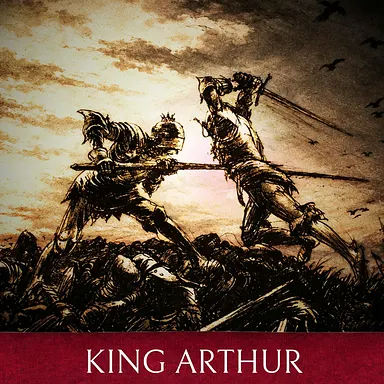
In this first part of a two-part series on King Arthur, Tom Holland and Dominic Sandbrook examine the legends behind Britain's most famous king. They trace how Thomas Malory's fifteenth-century Le Morte d'Arthur, printed by William Caxton, shaped the story of Arthur's last battle, his mysterious departure to Avalon and his promised return.
The hosts compare Arthur with other sleeping kings such as Frederick Barbarossa and Sebastian of Portugal, and explain how medieval writers across Christendom made Arthur famous. Listeners will hear how Geoffrey of Monmouth and Glastonbury helped build the myth, and why Malory's account reflects the turbulence of the Wars of the Roses.
In this episode Dominic Sandbrook, Tom Holland
This episode's transcript on the legend of King Arthur was made with the technology behind HappyScribe's Teams transcription.
Ads in this audio differ from the text. Tap the sentence you're hearing to follow along.
Synced: the text now follows the audio.
Willkommen zu einem Moment nur für dich und zu allem, was du liebst, bei Douglas. Finde einen Duft, der dich nicht mehr loslässt; Pflege, die aus Alltag ein Ritual macht; Farben, mit denen du dich neu entdeckst. Alles für dich am Singles' Day, jetzt 20% auf viele Artikel. Douglas, welcome to beautiful.
Yet some men say in many parts of England that King Arthur is not dead, but had by the will of our Lord Jesu into another place; and men say that he shall come again, and he shall win the holy cross. Yet I will not say that it shall be so, but rather I would say, here in this world he changed his life. But many men say that there is written upon the tomb this: Hic jaquet Arthurus, rex quondam, rexque futurus.
Here lies Arthur, the once and future king. The most stirring, the most haunting epitaph in all of English literature and arguably all of English history. So that comes at the end of the Mort Dartha, the great prose epic that was written by Sir Thomas Malory during the Wars of the Roses, so when 15th-century England was being torn apart by fighting for the crown. And Malory's great work is talking about a mystery that has haunted the British imagination, not necessarily just the English imagination, but the imagination of all the people in these islands, for a millennium or more.
And Malory's epic, Tom, was called The Death of Arthur, the Mort Dartha, for a very good reason. It was mourning a golden age that had already passed into legend, wasn't it?
Yes, the golden age of the Round Table, a time when knights were at their boldest and ladies were at their fairest. And yet throughout Malory's account of it, the knowledge that the Round Table is going to end up broken, and its knights piled up as corpses, shadows the entire story. And it's the death of Arthur? Or is it a death after he's received a mortal wound from his son, Mordred, in the last battle that he will ever fight?
This is what sets the seal on the tragedy. But to repeat, is Arthur actually dead? This is the great mystery. And Malory's account of his fate, which you just read out, you know, it's rich in tantalizing ambiguities. Because on what basis are men saying that he shall come again? And why on his tomb does it have that kind of enigmatic phrase, rex futurus, a future king?
And what does Malory mean when he says that he personally believes that in this world Arthur changed his life? I mean, does that mean that he thinks that he died? Or is he talking about Arthur's translation to some other mysterious dimension, some mysterious realm? And I think it is an incredible passage, because Malory isn't endorsing this really quite widespread hope that Arthur will come again, but nor is he rejecting it.
And it's very eerie and very tantalizing, and I think a huge part about why the mystique of Arthur endures to this day. I don't know whether you agree.
I completely agree. I fell in love with the stories of King Arthur when I was very, very young, because I had a really sort of basic children's version when I was probably five or six or something. King Arthur was my gateway drug into history. You know, my love of King Arthur and the stories of King Arthur predated any historical interest that I had. And of course, one of the things that people always love about King Arthur is this precisely this idea that he's the once and future king, that he's sleeping and will come again to save the people of Britain in their hour of danger, in their sort of darkest hour.
But that's not unique to Arthur, is it? Lots of different cultures have stories like this. So, for example, Barbarossa, Frederick Barbarossa, the German emperor. Now, he was a real, we know he was real, which we don't necessarily know of Arthur. And Frederick Barbarossa, third crusade, right?
Yeah, he drowns, I think in northern Syria, swept away on a river. And he is said to lie asleep with his knights in this kind of mountain chain in Turingia. And brilliant details about this legend, that he sat at this stone table for so long that his red beard, so hence Barbarossa, has sprouted and grown, and the tendrils of it have woven their way through the stone of the table.
And there are ravens flying around the mountaintop in which he is sitting. And when these ravens stop flying, so the story goes, he will emerge and he will save Germany and restore her to her ancient greatness. And of course, we know who loved that story. It was the Nazis, because that's why they gave Operation Barbarossa the name that they did, this idea of reclaiming ancient greatness.
Indeed. But then there's the last Roman emperor, the last true emperor of Rome, Sir Constantine XI. So he falls in the siege of Constantinople, doesn't he? But he's also not dead, am I wrong?
His body is never found, so it's, you know, there's a bit of a mystery there. And so the story is, is that an angel appeared and turned him into marble and hid him in a cave under the Golden Gate, one of the great gates that leads into Constantinople. And it is said that in due course he will awake and recapture Constantinople for Christ. So that's something that is in the offing. And then, Dominic, one that you absolutely loved, because I remember you talking about it in the series that we did on Portugal, is King Sebastian of Portugal, isn't that?
Yeah, Dom Sebastião. Yeah, so he was fighting in Morocco in the 16th century, 1578. And he was very young and dashing. I think he was in his early 20s, wasn't he? 24 or something. And he disappeared. So that's a thrill. And again, the story in Portugal is one day Dom Sebastião would return, you know, sort of riding through the fog to rescue Portugal.
Yeah, the early morning mist, isn't it? I think. And he will save Portugal. So obviously the idea of a kind of sleeping king, hiding in a cave or something, waiting to be summoned to rescue his country is quite a common one. But that's just by way of saying that none of these guys can compare for celebrity, international celebrity, with Arthur. And this celebrity is just mad and huge and dates back to the Middle Ages. So there was a guy around 1200 who was writing an introduction to a book of Merlin's prophecies, and we'll be coming to them in due course in this series.
And he said something on the lines of, "Arthur is famous everywhere. He's almost as famous in Asia as he is in Britain." And I assume he's probably talking there about the Crusader kingdoms. But I mean, he's the celebrity that Arthur has in the Middle Ages is absolutely massive. And you see, you know, in medieval times, romances, folktales, the medieval equivalent of fan conventions across the whole of Christendom. Everybody is obsessed by it. And it's fascinating that the oldest surviving sculptural portrait of Arthur and his knights isn't British.
It appears on the north portal of the cathedral in Modena in northern Italy, dated to, I think, around 1130. And at almost the same time, you have a kind of mad story that is situating Arthur's sleeping place kind of not in Somerset or Scotland or anywhere in Britain, but in Mount Etna. And this is revealed by Groom, who had been chasing a bishop's runaway horse up the slopes of the volcano.
And he'd gone into the volcano where he'd found Arthur reclining on a couch. And the king tells this Groom that he'd been there a long time, suffering from wounds he had received during his last battle against Mordred. I mean, no explanations about how he had ended up in Sicily.
You mentioned fan conventions. So people might have thought that was just a sort of random throwaway remark. But there really are fan conventions, are there? Effectively tournaments. So there's one in Beirut, Crusaders 1223.
Cypress, it's the Lord of Beirut. I mean, such a great title. So it's in 1223. And he stages this very trendsetting tournament in Cypress to mark the knighting of his eldest son. And the jousters dress up as knights from the Round Table. And this establishes a kind of European-wide craze for Arthurian cosplay. And so you have these round table tournaments where everyone dresses up as Lancelot of Gouain or Arthur or whatever.
And I guess it's a kind of mixture of fighting and fancy dress. So very like the Rest Is History festival that we staged at Hampton Court this summer. I guess you'd say it's the kind of the original pan-European kind of sporting institution, kind of the medieval Champions League. It's that kind of sense of a shared sport that people from across Christendom can share in.
But unlike sport, the Arthurian romance, or what becomes the Arthurian romance, has a kind of political and moral dimension, does it not? A spiritual one even.
Yes. So very famously in 1312, there was this French poet called Jacques de Longuyon. And he drew up a list of the nine exemplars of chivalry. And he chose three pagans to illustrate, you know, the nobility of the classical world, three Jews, so these are biblical heroes, and three Christians. And together these constitute the nine worthies. And Arthur is the single British entry, and he is named as the first of the three Christian men.
So he is the greatest of the Christian worthies. As you say, it's a measure not just of his fame, but of his kind of moral stature. And so I think it's unsurprising that when the first printing press is introduced in England in 1476, so again, I get that's against the backdrop of the Wars of the Roses, the merchant responsible for it very rapidly is looking around for something to publish about King Arthur. And this publisher is a guy called William Caxton, and he is a top entrepreneur.
I mean, publishing is just one of the many irons that he has in the fire. And he has a very keen sense of what the public wants. And so he comes across this manuscript called the Mort Dartha, a posthumous manuscript left by a knight called Thomas Malory, who's since died. And he reads it and he says, "Oh, this is brilliant. We've got to publish this." And so because Malory is already dead, Caxton can essentially do what he likes with it. He can trim it, edit it, mark it as he wants. And he does a tremendous job.
And the result is a massive bestseller. And I think the Mort Darther is the book more than anything else that fixes for the English-speaking world the story of King Arthur and the knights of the Round Table as a kind of single sweeping narrative from the birth of Arthur, in fact, maybe even before the birth of Arthur, right the way up to the mystery of his end. And I'm guessing that the book that you read as a child is derived from it. Certainly the books that I read were.
So I had multiple ones. I'll tell you one that I had. It was by Antonia Fraser. It was the first book I think that she ever wrote as a very young woman. It was brilliant. She ended up corresponding with her about it a few years ago.
Oh, I read the Roger Lancelin Green one, which had kind of wonderful woodcuts.
Oh, that was very good.
So that was basically Malory, but it had bits from other romances as well. They were all great. Anyway, Malory is tremendous.
Malory's at the back of all of this. You can't tell this story without Malory.
Yeah. You know, if you think of all the novels that are written about Arthur, all the kind of the TV series, the films, Excalibur, all that kind of stuff, basically it is Malory that is lying behind them all.
Yeah, not just things that are ostensibly about King Arthur, but I mean, Arthur is at the heart of Harry Potter and his wands, Luke Skywalker and his lightsaber, all of those kinds of things. I mean, the writers of these things themselves will often say King Arthur is at the root of them. Aragorn with the sword that was broken.
There's this wonderful comment by Tom Shippey that the Arthurian legends are the most enduring legacy of the Middle Ages. You know, Tom Shippey, the great writer about Tolkien. I mean, I think that's not untrue, because I would say that people who don't have a specialized interest in medieval history, say, will be more familiar with the Sword in the Stone or Camelot or the Holy Grail than they're likely to be with the names of kings who actually ruled in the Middle Ages.
Of course. And there are two reasons why it's so interesting to us doing a history show. I guess now, number one, I mean, Caxton himself mentioned this in the preface, didn't he? He said basically, why I want to publish a history of the said noble king and conqueror King Arthur is to show that he existed. And there are people out there, there are haters, losers, who say that King Arthur did not exist and that all such books as to be made of him be but feigned and fables. And of course, this is the issue that fascinates so many people to this day, right?
In the 2020s, was there a King Arthur? Who was he? Was he Ambrosius or Lilianus or whatever? Was he some warlord? I mean, that is, I mean, everybody is fascinated by that. Even surely, even the most desiccated academic working on Anglo-Saxon England or the fall of the Roman Empire or something.
I mean, it is amazing when you look at books written by academics in that period for the general market, they all have the, you know, the world of Arthur, the age of Arthur, whatever.
Yeah.
And then they'll say, we don't know anything about him, but they put Arthur on the cover.
Of course.
Which I think is the measure of that. And we will be trying to answer the question of whether Arthur existed, you know, who was he, who might he have been in due course in the last episode of the series. But I think before we come to the question of who the historical Arthur might have been, it is reasonable to concentrate on the legends, because I think it is these much more than what, you know, some historical Arthur might have been getting up to in the 6th century or whatever, which actually makes him such a significant topic of historical inquiry.
Because without the legends, to be honest, I mean, who would care? Who would care about this otherwise obscure figure who might not even have existed? And again, just to emphasize how madly popular the stories of Arthur were across Christendom. So around 1200, there's this, again, there's this French poet. French poets are obsessed by Arthur. And this guy's called Jean Baudel. And he referred to these stories as the matter of Britain. There was also the matter of France, which were the stories of Charlemagne. There was the matters of Rome, which is kind of classical stories.
But the matter of Britain was the real obsession of people in medieval Christendom. And it's a Europe-wide addiction. And so this is the second reason in his introduction that Caxton gives for saying why he wants to publish the Mort Dartha. Namely, and the Dartha, and I quote, "Is more spoken of beyond the sea, more books made of his noble acts than there be in England, as well in Dutch, Italian, Spanish, and Greek, as in French." And he might have added in Latin, in Welsh, Cornish, German, Occitan, Catalan, Portuguese, Norse, Swedish, Icelandic, Hebrew, and Ruthenian.
Ruthenian.
The only Slavic language into which the stories of Arthur were translated. But apparently they were massive in Ruthenia.
It's great to get the Ruthenians on the show.
And essentially, in medieval literature, there is no other theme that can compare for popularity with it. And so I think before we come to the, you know, the historical Arthur, the Arthur of early medieval Britain, let's have a look at the Arthur of legend. And so our next two episodes will be looking at Sir Lancelot first and Guinevere, and then Merlin. And people may be wondering, what about the Holy Grail? We have actually already covered that. And if you want to listen to that, it is episode 346.
But today, Dominic, we are looking at the last battle, the wounding of Arthur, the mystery of what happened to him. Did he die? Was he translated to a mysterious realm? Will he come again?
Okay. And these are, of course, drawn on lots of different traditions and wellsprings. And so we'll be exploring all of these, won't we? But as we already said, Malory is the center of this. Malory is the heart of it, the Mort Dartha. It's his account that has informed so many of the Hollywood films in the 20th and 21st century retelling. So it's Malory that actually, even if people haven't read Malory, he's there in your head, whether you know it or not. So let's start with Malory and what he tells us about Arthur, the Arthur in his great tale.
So if you've seen the Sword in the Stone, even if you've seen the Disney cartoon of the Sword in the Stone, you will know that Arthur grew up in obscurity, but he was, in fact, the true born king of Britain. And he grew up under the tutelage rather like Harry Potter or Luke Skywalker or all of these characters.
Luke Skywalker with Obi-Wan Kenobi.
Luke Skywalker and Obi-Wan Kenobi is the absolutely, is absolutely the one, you know. In fact, Obi-Wan Kenobi is referred to in the first film as a wizard, as an old wizard. Anyway, he grows up under Merlin, doesn't he? And Merlin becomes his advisor after he has pulled the sword from the stone and therefore demonstrated that he is the rightful king of Britain.
And it is Merlin who helps him to defeat those who doubt his legitimacy. And it is Merlin who famously helps him to source a magical sword. So to quote Malory, "They rode till they came to a lake that was a fair water and broad. And in the midst, Arthur was aware of an arm clothed in white samite that held a fair sword in that hand. And he also sees a damsel," again, quote Malory, "going upon the lake," which basically means walking.
So very mysterious. And Merlin reveals to Arthur who this woman is. She is the lady of the lake who dwells in a rock beneath the lake in as fair a palace as any on earth. And the lady of the lake gives Arthur a sword. And this sword is, of course, Excalibur. And this is the episode that prompts the famous comment in Monty Python and the Holy Grail about what is it? Women in ponds handing out swords is no basis for government. I disagree. I mean, I think looking at the absolute shower we've had over the past few years, I think this would be an excellent way of getting a good leader.
And Arthur is going to be an absolutely tremendous king. And it's not just Excalibur that the lady of the lake gives to Arthur as a marker of this. She also gives him a scabbard, which Merlin tells Arthur is worth much more than Excalibur, because whoever wears it shall lose no blood, be he never so wounded. The whole episode is incredibly eerie. The lady of the lake is a very mysterious figure in the Mort Dartha. So at one point, she's actually killed by a knight of the Round Table. But before you know it, she's back on the scene.
And, you know, has she been resurrected? Are there multiple ladies of the lake? Do they kind of share the title? Unclear. And she keeps shimmering in and out of view throughout the Mort Dartha. And this sense in the Mort Darther that women are a very mysterious presence on the margins of what the men at the court of Arthur are doing is an absolute constant. And alongside the lady of the lake, you have another very powerful and uncanny woman to whom we're introduced very early on by Malory.
And this is Arthur's half-sister, Morgan le Fay, another kind of very famous name in Arthurian myth. So she's Arthur's half-sister. She'd been sent to a nunnery as a child where she'd learnt necromancy. It's not entirely clear how. She is as fair a lady as any might be. And she is consumed by an abiding hatred for Arthur, which is never explained. But she's the kind of, I suppose, the ultimate nightmare elder sister, maybe about the whole of English literature.
Right the way through the Mort Dartha, she's constantly scheming to have Arthur killed. And this is introduced very early on in the book. And her initial plot is that she's going to steal Excalibur and the scabbard, which she does. And she then gives them to her lover, who is a knight called Ackelon. And Morgan then magics up exact replicas of Excalibur and the scabbard, which she kind of plants in Arthur's chambers so that he doesn't know that the real ones have been stolen. And then Ackelon and Arthur have a battle.
Arthur is startled to find that even though he seems to be wearing this magical scabbard, he's losing loads of blood. The wounds are proving serious to him. But fortunately, the lady of the lake is on the scene. And she comes to his rescue by alerting him to what Morgan has done, the trick that Morgan has pulled. And so Arthur then grapples with Ackelon, wrestles the real Excalibur out of Ackelon's hands, kills him, and gets back not just Excalibur, but also the magical scabbard as well, which is the real prize.
But Morgan, she's not a girl to give up. Let's put it like that. So she promptly steals the scabbard a second time. And she goes out and she just chucks it in the lake. And that's it. It's just kind of imperious malevolence and spite of an absolutely transcendent order. And so from this point on, Excalibur is in the hand of Arthur, but he doesn't have the scabbard. And so he can bleed. And so the kind of intimation of his mortality is set up right from the very beginning.
And there are other sisters, aren't there? Quite a lot of versions, actually, of Arthur, especially for children. The sisters were all conflated into one. So they're basically all conflated into Morgan le Fay, who is the best known. But actually, in the original, there is another sister called Morghors. And she's a nightmare.
So she's married to Lot, who is the king of Orkney. And they've had four sons. And the eldest of these is Gawain, who will go on to become, with Lancelot, the greatest of Arthur's knights. And then you have Gaheris, Agravane, and the baby of the family is Gareth, who has beautiful hands. And shortly after Arthur has come to power, Lot, not realizing who Arthur is and what the relationship is between Arthur and Morghors, sends Morghors to go and spy on him at Arthur's court.
And to quote Malory, "All this time, King Arthur knew not King Lot's wife was his sister." And basically, if you read that in a medieval folktale, you know what's coming. And so inevitably, this being the kind of story it is, Arthur ends up sleeping with Morghors. And just as inevitably, she ends up pregnant. And again, I'm not sure that this is the kind of detail that tended to feature in the children's accounts of the Arthurian legends that I read.
No, I don't remember this at all.
And Merlin, far from being sympathetic when this is revealed, what Arthur has done is very blunt about what, you know, this involuntary act of incest portends. "Ye have done a thing that God is displeased with you, for ye have lain by your sister, and on her ye have begotten a child that shall destroy you and all the knights of your realm. And the name of this child, once he is born on May Day, is Mordred."
Right. The great villain of the stories. And Arthur's kind of arch-enemy.
I mean, talking villainy, it has to be said that Arthur does not behave well towards this little baby, who is, after all, his son. So when he's told that baby Mordred has been born, he has all the children begotten of lords and born of ladies on May Day rounded up, put on a boat, and set adrift on the sea. So basically, it's a kind of marine take on King Herod killing the innocents of Bethlehem. And the ship is wrecked. And all the babies are killed. They're all drowned, except for Mordred, who is somehow, somehow survives and is restored to his mother, Morghors, and then raised by her with his four elder brothers.
So he is now the fifth of Morghors's five sons. And Malory typically doesn't explain how this happens. It's just kind of obedient to the internal logic of the story. And you just have to kind of roll with it. And equally puzzling is that when in due course, Mordred has grown up and, you know, he's attained manhood, he's become a knight, he goes to Arthur's court with his four brothers. And Arthur, you know, acknowledges him as his son and doesn't seem to have any issue whatsoever.
It's like he's completely forgotten Merlin's prophecy. And Mordred is, you know, this guy who Merlin has said, "Oh, he's absolute trouble. He's going to destroy you." He becomes the knight of the Round Table. He's not a famous knight. He's not a star. He doesn't kind of win any famous quests. But he is clearly a ticking time bomb because basically he's a very malicious, vengeful man. And it's plain that, you know, he is trouble. And in due course, this is exactly what turns out to be the case.
Because in the final book of the Mort Dartha, after we've had all these kind of glorious stories of the adventures, the quests, and so on, Mordred's moment finally comes. And what gives him his opportunity is that his father, King Arthur, has left Britain across the Channel and is campaigning on the continent. And madly, bearing in mind the prophecy that Merlin had given him, Arthur had made Mordred regent in his absence. And while Arthur is away in France, Mordred starts spreading fake news.
He says Arthur is dead. And then to quote Malory, "He made a parliament and called the lords together. And there he made them to choose him king. And so he was crowned Canterbury." And the news is brought to Arthur. He returns. He forces a landing. Mordred tries to oppose him. There's a great battle at Dover. Mordred loses and retreats. Then there's a second battle again. Arthur wins. And this is fought at Barram Down, just south of Canterbury. But Mordred has, he's kept his army together. He's retreated towards Wiltshire and the Salisbury area.
Oh, brilliant. Have the Salisbury area back on the show.
And so it was assigned between King Arthur and Sir Mordred that they should meet upon a down beside Salisbury, so Salisbury Plain. And these negotiations are held between the father and the son. And they seem to be going very well. The rightful king, the would-be usurper, it seems that they're going to arrive at terms. And wine was fetched and they drank together. But then there is disaster. And this I always remember incredibly vividly from the children's accounts that I read. So the knights on the two sides are drawn up on opposite sides of this plain.
And they're waiting as Arthur and Mordred kind of bury the hatchet. And while they're waiting, an adder emerges from a heathbush. And it stings one of the knights on his heel. And the knight draws his sword to slay the adder. And when the knights on both sides, so the two armies drawn up facing each other, when they see this glinting of the sword in the sunlight, they all draw their swords in turn. And then the two armies, Arthur's army, Mordred's army, descend on one another.
And Malory writes, "Never was there seen a more dullful a battle in no Christian land."
Craigy, well, the stage is set for that final showdown between Arthur and Mordred. So after the break, we will turn to the last battle. We'll find out what happens to Excalibur. And we will find out the truth behind Arthur's final journey to Avalon. This episode is supported by Anthropic, the team behind Claude. Now, history's biggest leaps, many of them started as hard questions that people didn't want asked.
Yeah, there's a classic example of that, Tom, at the end of the 15th century. And the hard question in particular was, what is out there beyond the Atlantic Ocean to the west? And as you will know, the man who found the answer to that question was the explorer Christopher Columbus, great pioneering voyage of discovery. And it is, of course, the Americas. So, you know, Anthropic knows the importance of questions. And it's why Anthropic is founded on one hard question above all. How can we ensure that the AI revolution really goes well for ordinary people?
Anthropic asked 100,000 people. And what came back wasn't just fear. There was hope as well. People wanted to know, will cancer ever be cured? Can kids have a better future? It turns out that there is hope in hard questions. Ask yours at claude.ai/restishistory. And keep thinking. Welcome back to the Rest Is History.
So all day long, the noise of battle rolled among the mountains by the Winter Sea. And that, of course, is Alfred Lord Tennyson. So that's his first adaptation of the Mort Dartha. And the Victorians adored Arthur. They loved everything to do with knights and chivalry of the Middle Ages and Malory. Tennyson, however, he would disappoint you, Tom. He describes this battle as having taken place among the mountains by the Winter Sea. Now, I've been to Wiltshire and the Salisbury area.
And I don't recall any mountains or any, is there any sea?
No, it's very poor from Tennyson. Very sad. He's erasing Salisbury from the narrative. But I mean, generally, there is a good deal of confusion about where this last battle was fought, as we will see. There are kind of a number of various candidates. But Malory said, Malory is saying it's on Salisbury Plain. So let's go with that. And he also tells us that it lasted all day and never stinted till the noble knights were laid to the cold earth. And by nightfall, 100,000 men are dead.
And only two knights off the Round Table are left. And one of these is Sir Lucan, who is described by Malory as being Arthur's butler, which might conjure up a kind of slight Downton Abbey sense. I mean, basically, he's the guy in charge of the king's table. And the other guy who's survived is Lucan's brother, Sir Bediver. So these are the only guys from the whole of the Round Table who have survived. And Arthur is distraught. And he's mourning the slaughter.
And then looking around, he sees Sir Mordred leaning upon his sword among a great heap of dead men. And he picks up his spear. And this is a tremendous detail, which, again, I don't think featured in the children's books. This spear is called Ram. It's called Ron. It's called Ron.
Yeah. So some people who haven't heard previous episodes will think you just had a stroke at that point. I should explain that what Tom is doing. Tom is ventriloquizing. Arthur is holding Ron, former governor of California and United States president, Mr. Reagan. Mordred, Mordred charges Ron. And Arthur skewers him with Ron. So, and to quote Malory, when Sir Mordred felt that he had his death's wound, he thrust himself with the might that he had up to the burr of King Arthur's spear. And right so he smote his father, King Arthur.
And Dominic, there's a famous illustration by Arthur Rackham, which he did in 1917. So amid the carnage of the First World War. And it shows exactly this scene. And you have crows wheeling overhead. And the battle scene is like the Battle of the Somme or something. Or actually, it's the climax of John Borman's brilliant film, Excalibur. Only in that, it's the other way around. It's Mordred who's holding the spear, I think, in that. And it's Arthur who works his way down the length of the spear. Anyway, kind of terrible moment.
So Mordred falls down dead. And Arthur is left mortally wounded by this last fight. And Lucan, the butler, as a butler does, tries to help Arthur pick him up and move him. But unfortunately, he dies after part of his guts fell out of his body. So that's the end of Lucan. I mean, not a good way to go. And so of all Arthur's knights, now the only one left to Arthur is Sir Bediver. And so Arthur orders him to take Excalibur and go with it to a nearby lake and to throw the sword out into the water.
And Bediver takes the sword as he's been ordered. And he goes down to where the lake is. But then he looks at the sword. And he thinks, this is Excalibur. I mean, you know, it's so beautiful. It's so rich. It's so glorious. Surely its time will come again. And so rather than throw it away, he hides it. And he then writes back to Arthur. And he says, well, I've got rid of the sword. And Arthur says, OK, if you did, what did you see? And Bediver answers, nothing but waves and winds. And Arthur is furious and tells him that he is lying.
And then orders him to, again, to go and throw the sword into the lake. But again, Bediver can't bear to dispose of it. And again, he lies to Arthur. And again, Arthur, who is now, you know, absolutely furious, orders him to go and throw the sword out into the lake. And this time, Bediver does obey. And he throws the sword out as far into the water as he can. And a famous, famous moment, perhaps one of the most famous moments in the whole of our theory and myth, there came an arm and a hand above the water and took it and clutched it and shook it thrice and brandished and then vanished with the sword into the water.
Stuff of so many kind of 19th century paintings and stuff, isn't it? I mean.
Yeah. And Excalibur, it looks ludicrous because the special effects aren't up to it. But it is still such a tremendous moment. I actually watched it before starting this episode to get myself into the mood. And I feel so stirred by it.
Yeah. Well, we can tell.
Bediver returns to Arthur and says, yeah, OK, so I've seen this, you know, this hand rise up and everything. So Arthur knows now that he's telling the truth. And then Arthur says, you know, we've delayed too long here. Help me down to the side of the lake. And so Bediver does and leads him down to the lake. And there, waiting for Arthur, they find a barge with many fair ladies in it, all wearing black hoods. And among them are Morgan le Fay and the lady of the lake.
And Arthur is placed in the barge. And he lays his head on his sister's lap. And then the queen said, ah, my brother, why have you tarried so long from me? And it's completely typical of Malory that he gives no explanation as to why Morgan le Fay, who spent the whole of the Mort Dartha trying to kill Arthur, is now kind of mourning him, caring for him. And I think Malory's refusal to explain things that in a novel you would expect to be explained is a massive part of what the kind of the aura of mystery that surrounds the whole thing.
And I think you get the feeling with this that Morgan has kind of, she's reverted to a kind of older, stranger, weirder register, as though actually she is now in her true dimension because her true dimension are those margins that lie between life and death. And that is why she's come for him.
But once more points about that thing. I remember that very vividly from the children's books. I also remember all the stuff about Mordred and him welcoming Mordred to his court, even though Mordred's going to kill him. And I have to say, in all that time, it never struck me as weird because, you know, young readers just completely take that. They're like, well, fine. If that's the story, that's the story. And I wonder whether Malory's listeners were the same. It's kind of a bit weird, but that's the story.
I think they were. And Malory himself, there is this internal logic. You know, they're in the sources. That's what he's going to do with it.
Yeah, exactly.
And that's the power of it. It's incredibly haunting. And what is also haunting is the fact that the barge now starts to pull away. And Bediver is left alone on the, you know, on the shore. And he calls after his lord. And Arthur answers him by revealing his destination. And it's not a cave. It's not Mount Etna. It is the Vale of Avillon. And he is going to Avillon there to be healed of his wound.
And Avillon, of course, is Avalon. And the way he sails, accompanied by the weeping of Morgan, the weeping of the lady in the lake, all the other ladies. And here is how Tennyson in his unbelievably powerful and beautiful poem on the topic, how he concludes this scene. Long stood Sir Bediver, revolving many memories, till the hull looked one black dot against the verge of dawn. And on the mere, the wailing died away.
I feel tears, manly tears, rising to the eye.
So lots to unpick here. Is there a historical basis for this idea of this last battle, the Vale of Avillon or Avalon? And of course, the question about whether Arthur will come again, where that comes from. So let's start with the last battle, this idea of a Titanic showdown. Now, this is actually one of the oldest facts about Arthur, isn't it? And has clearly a very, well, potentially some kind of factual basis. I mean, I know we'll come to all this. Where does it come from, the idea of a last battle?
Well, it comes from Wales. And just to say, the rest of this series, there is going to be so much Welsh history.
Too much, perhaps.
Fans of Welsh feminism, there's going to be a lot of Welsh women.
This is peak Rest Is History.
Basically, Welsh history, we have got it. So the mention of the last battle, it's originally mentioned in a collection of annals. So details of what happens, you know, year on year out. And these are called the Annales Cambriae, the Annals of Wales. And it's possibly, in fact, I think probably the second oldest source we have for Arthur. And it dates to the mid-10th century. And it's a chronological record of events beginning in AD 447.
And the entry for 537 reads, the Battle of Camulan, in which Arthur and Medred, so that's Mordred, fell. And there was a great dying in Britain and Ireland. And it is predictably enigmatic because nothing about the early sources for Arthur are self-evident. So it gives us no clue as to where Camulan might have been. The literal meaning of it is crooked bank. So presumably, it's by a river. I mean, that would seem a kind of reasonable supposition, I think.
And people will note that it doesn't indicate actually who Medred was, or indeed who Arthur was, whether he was Arthur's ally or enemy, and who, if anyone, won the battle. It just says that they both died in this battle.
But no doubt, Tom, this is Welsh history. It's certainly a Welsh source.
Well, it's a Welsh tradition. Whether it's Welsh history, I mean, we will see. But it's a Welsh tradition. And it definitely, it's in Welsh poetry dating probably a century after this, so kind of mid-11th century, that we get the first illusions to a rivalry between Arthur and Medred. But the really decisive contribution is made by a writer who we will be referring to a lot over the course of this series. And he is also a kind of very Welsh figure because he takes his name from a Welsh town.
And this is a 12th-century cleric called Geoffrey of Monmouth. And Geoffrey of Monmouth writes the book that kind of lights the touch paper of Arthur Mania. And it's a history of the kings of Britain that ranges from Brutus, who is a Trojan, who arrives in Britain and kills all the giants. And it goes all the way up to Athelstane, so the Anglo-Saxon king in the 10th century. And the star turn in this history is the first full-length account of the reign of King Arthur.
And it is impossible to overemphasize what a massive bestseller this book was. And within a generation of its appearance, it had swept the whole of Christendom. And it is this book that basically inspires the Europe-wide obsession with Arthur. And over 200 copies of the manuscript survive, which for a book that is not theological, not a translation of a Latin classic, is mad.
There's no kind of secular text that features in so many manuscripts. And Geoffrey called his book a history, but I think it's fairer to describe it as a fantasy. And he's basically the Tolkien, the J.K. Rowling of his day. He's an author from Britain who creates this entire world of wonder and adventure that is so addictive, so readable, that it makes him an international literary superstar.
And it's Geoffrey in this book, this history of the kings of Britain, who makes two crucial contributions to what would become the canonical version of the last battle and Arthur's ultimate fate.
But when you say he makes these contributions, if you were being skeptical, you would say he's making loads of stuff up.
Yes.
Now, is, yeah, well, obviously the whole course of the series will be exploring whether Geoffrey of Monmouth is basically inventing out of nowhere.
Spoiler alert, he is making it up. I mean, let's be upfront about that. He is making up loads and loads of stuff. Not everything, but he is making up a lot.
So for example, it's Geoffrey of Monmouth who creates the idea, doesn't he, that Mordred and Arthur are related. He's trying to explain the relationship between them. But in this case, in Geoffrey, Mordred is Arthur's nephew, right? Not his son.
Yeah, but there's still a kind of blood relation there. It's Geoffrey who introduces Mordred as the regent that Arthur leaves behind when he goes to the continent. It's Geoffrey who first develops the theme of Mordred trying to steal Arthur's throne, Arthur returning to reclaim it, and then this great last battle. So this is the Battle of Camulan, as mentioned in the Annals of Wales. And Geoffrey is much more specific about the location of this battle than the Annals of Wales had been. He says that it was fought beside the river Camblam, so it's kind of riff on Camlann.
And this is the river Camel in Cornwall, and specifically at a place called Slaughter Bridge, which I visited it. And I have to say, it's an absolutely lovely spot for a battle. You know, if you've got to have your court wiped out, that's a great place to have it wiped out. And it features a sixth-century memorial stone. So again, the kind of right period, although it has absolutely nothing to do with Arthur. So that's a shame. But it is the right period. So there are other places that have been identified with Camlann.
It's the kind of detail that Arthurian scholars love to kind of explore. So one very popular location is Cadbury Castle in Somerset, which stands beside the river Cam.
That's not really a castle so much as a hill, right? It's like an Iron Age hillfort, an Iron Age hillfort.
And we will be coming to this in part four. So Cadbury Castle fans, tune into that. There is a place called Camlann in Gwynid. Maybe that's possible. I mean, it is called Camlann. And then there is a place called Camboglana, which is castle steads on Hadrian's wall. And the idea that Arthur fought battles in the vicinity of Hadrian's wall is very popular again, as we will be seeing in our fourth episode. But it is reasonable, I think, to say at this point, the search for the historical Arthur is basically like searching for a needle that may not exist in a haystack.
So that is a problem with the sources. So we don't really know where Camlann was, is the honest truth, I think. And I don't think we ever will.
Although I want to tempt the listeners. We will, of course, be revealing all in the final episode.
Yeah, we will.
For the purposes of this episode, we don't know. But maybe we can persuade Tom to pronounce a definitive verdict in episode four. What about the other thing that Geoffrey contributes or indeed makes up? The Isle of Avalon, or Avillon.
Yeah, so Geoffrey is definitely the guy who introduces Avalon into the mix. Whether he makes it up from scratch, we will see. So Geoffrey writes in his history that Arthur, our renowned king, was mortally wounded and carried off to the Isle of Avalon so that his wounds might be attended to. And of course, it is, as so often, very cryptic. He doesn't say whether Arthur was healed of his mortal wounds. Doesn't say where the Isle of Avalon was. So these are kind of twin mysteries that he's very happy to leave hanging.
And the fact that Geoffrey doesn't say where the Isle of Avalon is means that over the course of the 12th century, this book has come out. It's going great guns. Everyone's absolutely obsessed by it. And so obviously, people do start to puzzle over where Avalon might be. And this for, well, for some people, starts to present an irresistible opportunity.
So let's move forward from the publication of Geoffrey's history in the late 1130s to 1184, so half a century on. And in this year, a devastating fire breaks out at a 400-year-old abbey at a place in Somerset called Glastonbury.
I wondered if we'd be in Glastonbury.
This abbey stands on elevated land above the Somerset levels. So one of the reasons why it's always so muddy at Glastonbury at the festival is because the whole area is naturally very wet. And back in the 12th century, the Somerset levels are a kind of stretch of fens and marshes that for much of the year turns Glastonbury into a kind of island. And so it's this kind of setting that Glastonbury has amid these misty wetlands, which gives it a very haunting and otherworldly air.
And wherever you have a haunting and otherworldly air, you tend to have pilgrims arriving because it gives you a sense of the, well, the sacral, I guess.
The monks at Glastonbury Abbey, they've got this very ancient church made of wood. It's been a venerable center of pilgrimage. And so the fact that it then burns down is an absolute disaster because it's the oldest and most sacred part of the abbey complex that has gone up in flames. And basically, it removes their entire source of income.
So the monks desperately need to rebuild their abbey. And if they're going to rebuild it, then they need the money to do so. And so they turn to the King of England, who at the time is Henry II, the first Plantagenet king, ruler of an empire that covers not just much of Britain, but also half of France. And so he should have lots of money. And sure enough, Henry says, "Yeah, sure, I'll give you some money." But then unfortunately, in 1189, Henry II dies and is succeeded by his son, Richard I, Richard the Lionheart.
And Richard the Lionheart, he's not really into building abbeys, but what he's really into is crusades. And so all this money that was going to go on repairing this burnt abbey is now being spent on raising an army to go on the Third Crusade. And so the monks are left out of pocket. They need a new source of income. And then miraculously, Dominic, miraculously, in 1191, they find an alternative source of income. And to be precise, they find the bones of an enormous man in a coffin that had been hollowed out from an oak tree.
There is a stone slab. And beneath this slab, there is a cross made of lead. And on the cross, written in Latin, are these fateful words. "Here lies buried the renowned King Arthur in the island of Avalon."
God, it's great that the coffin has that written out to eradicate any possible doubt. And what a moment for it to, at the point when they needed money.
Yeah, incredible stroke of luck.
This is huge for them, right? I mean, they can basically turn themselves into, well, one of the great tourist attractions in Northwestern Europe.
Yeah, firstly, they've got the bones of King Arthur, the most famous king in Europe. And they have now successfully identified Glastonbury with the mysterious island of Avalon. So basically, brilliant. Open up your checkbooks. Ka-ching. So they can start using this to make Glastonbury a kind of massive tourist attraction, which is what they do. But if it's massive for the monks of Glastonbury, it is also massive for the English monarchy because the kings of England can now appropriate Arthur and the stories that are told about him for their own purposes.
And the king who really recognizes the potential for this is Edward I, so the hammer of the Scots, but also the guy who conquers Wales. And in 1278, on Easter Monday, Edward I and his wife, Eleanor of Castile, they come to Glastonbury. And they preside over the formal reinterment of Arthur and his queen, Guinevere, whose bones had been found, inverted commas, by the monks, lying beside the bones of this colossal guy who the monks are saying is Arthur.
Arthur and Guinevere are laid to rest in a great black marble tomb that's been constructed before the high altar of the abbey in Glastonbury. And Edward has wrapped Arthur's bones in silk, and Eleanor has wrapped Guinevere's bones in silk. And the propaganda value of this to Edward is immeasurable because it helps him with a problem that has been confronting his dynasty for almost a century. And basically, Edward, he rules by right of descent from William the Conqueror.
The problem is, though, that he has lost Normandy. His grandfather, King John, had lost it to the French king. And so this means that Edward and his barons are now cut off from their ancestral homeland. And in this context, tapping into the whole myth of Arthur is an absolute genius move because it enables Edward to cast himself as the heir of this kind of ancient, glorious king who had ruled not just England, but a unified Britain. So Wales and Scotland, as well as England.
And actually, it's Wales when Edward comes to Glastonbury to rebury Arthur and Guinevere that is uppermost in his mind. Because the previous year, so that's 1277, Edward had led a massive expedition against Llywelyn ap Gruffydd, who, as events will turn out, is going to be the last independent prince of Wales. And this invasion of Wales, the conquest of Wales, will culminate in 1282 with the death of Llywelyn in an ambush, and then two years later in 1284 with Edward's official annexation of Wales.
He is going to rule as Wales's king from this point on. And so in this context, you can see absolutely how his appropriation of these supposed bones of Arthur is a masterstroke because it helps him by the fact that Arthur's been found. He's not going to come again. He's not waiting to draw his sword and come to the rescue of the Welsh. He can be put in a tomb in Glastonbury, and it scotches this deeply held belief that the Welsh and the Cornish and the Bretons have all had that Arthur isn't dead and that he's going to come again.
And just to say that this particular tradition, like the tradition about the last battle being fought at Camlann, is an authentically ancient one. And we know this because back in 1113, a group of French clergymen from Lyon had come to England to try and raise money for a church. And they'd gone to Cornwall. And while they were there, they got into a massive punch-up with a load of Cornish people who were very offended by one of these French clergymen laughing at the idea that Arthur might come again.
The French found this ridiculous. Cornish very offended. There's a big fight about it. And we know from a poem written in the 10th century in Wales that Arthur's grave was described as a wonder. And it's a wonder because it can't be found. And if it can't be found, then again, there's the hint of the suggestion that maybe Arthur isn't in his grave. And again, you have the sense, I think, reaching back centuries before Edward burying Arthur's supposed bones, of Arthur as this kind of hero who is unbound by the limits of death.
But Edward's reburying has multiple political functions, doesn't it? Because on the one hand, it's, as you say, dispelling once and for all the idea that there's a kind of Welsh hero who's going to return. But at the same time, he's appropriating Arthur for an English monarchy. Like Ptolemy making off with the body, the corpse of Alexander the Great. Edward I is saying, "I have Arthur. He is here. He is mine." And actually, Arthur's ambition to rule, Arthur's supposed ambition, Arthur ruled all Britain.
Well, that's what Edward I wants to do.
Yeah. So he's conquered Wales, and then he goes off to hammer the Scots. And he's consciously framing himself as the heir of Arthur. And so the corollary of that is that the English king starts to appropriate Arthur as an English hero. And so Edward is staging roundtable tournaments in Wales. Then maybe Edward I, maybe his grandson, Edward III, physically constructs a roundtable.
This is the roundtable in Winchester.
Yeah. So I think it gets repainted by Henry VIII, doesn't it? But it's definitely kind of dates from the 13th century. Listeners to the series that we did on the Hundred Years' War may remember how important orders of chivalry are to Edward III and to all the kind of English knights who are fighting in the Hundred Years' War. This notion of themselves as the knights of a new Arthur crossing the sea, as Arthur and his knights had done, is incredibly important in animating notions of English chivalry, notions that England has a kind of romantic history that its kings can draw on in wars with even the King of France, that the King of England can go toe to toe with the King of France.
And so by the time we get to Mallory, Mallory, I mean, there's precious little Welshness in Mallory's Maunt Arthur, is there?
Yeah. It's all England. So the Sword and the Stone, the most famous story in Mallory, it's framed, the lettering on the stone reads, "Who so pulleth out this sword of this stone and anvil is right wise king born of all England." So not Britain, England.
So they've found Arthur. They know that he won't return. He's buried at Glastonbury, and he's become an enormously important sort of propaganda tool for the English monarchy. And yet, the idea of his return, the idea of the once and a future king, does not go away because it's still there in Mallory. So why doesn't it go away if they know that he's dead?
Well, I think a possible clue to that is given actually in the very last sentence of the Maunt Arthur. And that tells us that, and I quote, "This book was ended the ninth year of the reign of King Edward IV by Sir Thomas Mallory Knight." And this equates to 1469 or possibly the early months of 1470, which is a period of immense and escalating political instability in England because it's the build-up to a fresh spasm of violence that will culminate in open war.
And this is part of the English Civil War that is known as the Wars of the Roses. So it's Lancaster against York. The emblem of Lancaster is the red rose. The emblem of York is the white rose. And the Lancastrian king is Henry VI. He has been deposed, locked up in the Tower of London by the Yorkist king, Edward IV, who has usurped Henry VI's throne and is now claiming to rule England and has done so basically for a decade. But fresh instability, Edward IV is going to be cast into exile for a few months, and then he'll come back, reclaim the throne, and end up murdering Henry VI.
And so Mallory is finishing his book in the build-up to this kind of great convulsive moment in the history of 15th-century England. And Mallory, in some sense that is not entirely clear, seems to be implicated in the violence of this period. Unfortunately, the details are quite murky, but we know from the evidence of the Maunt Arthur itself that the author was writing it in prison because periodically throughout the Maunt Arthur, he is saying as much.
There has been, over the past century, quite a lot of scholarly disagreement as to which of the burials Thomas Mallory's, who were kind of kicking around in mid-15th-century England, the Thomas Mallory who wrote the Maunt Arthur was. But I think nowadays the overwhelming consensus is that our Thomas Mallory was a knight from Warwickshire, from Newbold Revel. And this is a guy who, from the court records, clearly did have a certain taste for trouble.
And all of this is laid out in the landmark study of The Life and Times of Sir Thomas Mallory, the title of the book. It's by P.J.C. Field. And it came out, I think, about three decades ago, but it's still basically pretty unchallenged in its conclusions that it is this guy. It's the knight from Newbold Revel. And in the 1450s, this particular Mallory was being kept in a range of prisons in London. So the Marshalsea, the Tower of London, Newgate Prison.
And he's been kept there by the government, which at this point was very popular. Henry I is on the throne. But then Edward IV comes to the throne. And between 1468 and 1470, he is issuing four general pardons in succession. But in all of these four general pardons, Thomas Mallory Knight is specifically excluded. And the measure of what a big deal this is, other people who are excluded in this pardon include Henry VI and Margaret of Anjou, his wife, and Edward, the Prince of Wales, who is his son.
So Mallory is being ranked among the basically the Lancastrian royal family. So it's presumably on Edward IV's orders that Mallory was being kept in prison while he was writing the Maunt Arthur. So the mystery is that in the first decade, he seems to be he's in prison on the orders of Henry VI, the Lancastrian. And then in the second decade, he's being kept in prison on the orders of Edward IV, the Yorkist. And so there's a puzzle as to why this would be. And the explanation that Field gives in his book is that Mallory, as author, is a notably uncensorious person.
And he proposes that Mallory's sympathies were aroused less by causes than by individuals behaving chivalrously in difficult circumstances. So in other words, perhaps he was anti-Lancastrian, and then he feels sorry for Henry VI, so he switches sides.
So he always favors the underdog in such a way as to get himself arrested and incarcerated.
Well, you're sounding cynical, but I think there is a certain degree of evidence to back this up in the Maunt Arthur itself. So Mordred obviously stages this coup against the rightful king in the Maunt Arthur. And I don't think you need to identify this coup against Arthur as somehow a kind of allegory for the Wars of the Roses, the behavior of Edward IV against Henry VI, to recognize that Mallory's account of the Civil War in the Maunt Arthur is, I think, clearly informed by the experience of Civil War that England is going through in the 15th century, the Wars of the Roses, and so on.
Yeah, that makes total sense. I find that very plausible.
The details that we cited at the beginning of this episode of Mordred laying claim to the throne, he holds a parliament, he summons the commons, all this kind of stuff. It's very 15th century. It bears no relationship to what was going on in the 6th century. And Mordred laying siege to the Tower of London, Mallory describes him making many assaults and throwing engines unto them and shooting great guns. So that's amazing, the kind of artillery in the same time as the roundtable. And Mallory writes that the people of England swing this way and that in their loyalties.
So to Arthur, to Mordred, to Arthur, to Mordred. And Mallory complains the people of England were so newfangle. And newfangled in the Middle Ages means fond of novelty.
Yeah, changeable and fitish.
They're very changeable. They no sooner have one leader than they want to get rid of him.
Yeah, like now, frankly.
Yeah. And there's a very haunting description of the last battle that, I mean, it has the faint hint of lived experience. So after the last battle, the knights are lying in great tangles across the battlefield. Looters steal out onto the field by moonlight to strip the dead of their belongings. And Mallory writes, "Who that were not dead all out there, they slew them for their harness and their riches." And I think the point he's making is that the collapse of Arthur's realm into ruin, it's not just Mordred's fault.
Mordred has taken advantage of a fickleness that he sees as being endemic to the English. He kind of laments, "It was the old custom and usages of this land. And men say that we of this land have not yet lost that custom. Alas, this is a great default of us Englishmen, for there may nothing please us no term."
But you can see why he would be writing this in this context, right, in the late 15th century, when it's extraordinarily turbulent. I mean, it's fun to read about, but presumably not tremendous fun to have lived through this period of chaotic leadership, Lancastrian and then Yorkist kings rising and falling, coups, plots, betrayals, battles. So effectively, the Maunt Arthur in that sense is neither a fiction nor a historical record, so much as a kind of work of political commentary almost, a kind of mirror to the woes of 15th-century England.
Yeah. I mean, I think the kind of the collapse of England from the glory days of Henry V to the bloodletting of Towton and Tewkesbury, I think, I mean, is it possible to think that it isn't there in the back of Mallory's mind? And I think that for that reason, you can understand that the notion that Arthur might come again and redeem his country is something that would have had a peculiar resonance, and not just for Mallory, but for everyone in England at the time.
I think today, people think that. People who present the rest as politics think about David Miliband.
Oh God. He's not dead.
Oh, Lordy.
He's only...
No.
He's not dead. I mean, he may seem dead because he's so uninteresting.
Holding his banana like Excalibur.
Yeah.
One day he will return.
I mean, I kind of feel if Arthur's going to come back now, it's as good a time as any.
Surely. Yeah. So that's the Maunt Arthur as a kind of 15th-century mirror. These are the origins in Mallory's own lifetime and the politics of Mallory's lifetime. But there's so much more to explore, isn't there? So we haven't yet really got into the roundtable and its knights. And specifically, the most, well, the most celebrated, but also perhaps the most controversial, perhaps some would say the most overrated of all his knights. And that's Sir Lancelot.
Sir Lancelot is not overrated, Dominic. Sir Lancelot is absolutely banging.
He's a Chauvin. Anyway, right, well, this is setting up nicely, the tension that will be simmering in the next episode as we explore the origins of Sir Lancelot, whether he was quite as heroic as is cracked up to be, and what on earth is going on with Lancelot and Guinevere, and why is Arthur not doing anything about it. So if you want to find out about Sir Lancelot, if you want the truth about Merlin, and if you want us, if you want us the spectacle of Tom Holland throwing Caution to the Winds, identifying the historical Arthur, explaining exactly where Camelot was, all of this, solving a mystery that has perplexed great minds for hundreds of years, that's going to come in the fourth episode.
If you'll remember the Rest Is History Club, so that is our very own roundtable of the best and the brightest, some of the great people of the modern world. They can hear those episodes right now. You can join them. And the way to do that is to go to the restishistory.com, to stare the sword and the stone in the face, to draw the sword, or alternatively to sign up to the club and give us your details. And then you will get the... You will get those three episodes.
You'll get your membership on the roundtable, and you'll get supplementary benefits in the form of the right to join the quest for the Holy Grail. Of all the metaphors with which we've tried to shroud this commercial offer, I think this is probably the most ill-conceived and shambolic. Anyway, that's all to come. Loads to look forward to. We will see you next time. Thank you very much, Tom, and goodbye.
Bye-bye.
What is the historical truth behind the tales of King Arthur, Britain’s greatest myth? When did these stories begin, and with whom? And, is Arthur’s apocalyptic last battle based on an English historical reality from the 15th century?
Join Tom and Dominic as they launch into one of the greatest historical mysteries of all time, and discover the truth behind the legends of King Arthur.
Join The Rest Is History Club: Unlock the full experience of the show – with exclusive bonus episodes, ad-free listening, early access to every series and live show tickets, a members-only newsletter, discounted books from the show, and access to our private Discord chatroom. Sign up directly at therestishistory.com.
To read our new newsletter, sign up at: therestishistory.com/newsletters
_______
This episode is sponsored by Anthropic, the team behind Claude. Try Claude for free today at http://Claude.ai/restishistory.
_______
Advertise with us: Partnerships@goalhanger.com
_______
Twitter:
@TheRestHistory
@holland_tom
@dcsandbrook
Video Editors: Jack Meek, Harry Swan + Adam Thornton
Social Producer: Harry Balden
Producers: Tabby Syrett & Aaliyah Akude
Senior Producer: Callum Hill
Executive Producer: Dom Johnson
Learn more about your ad choices. Visit podcastchoices.com/adchoices