
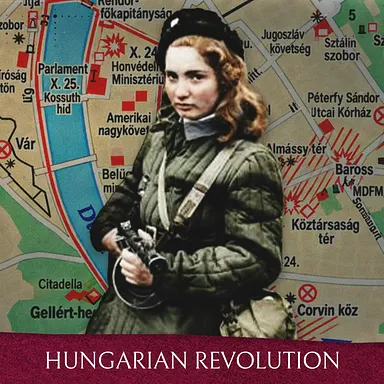
This episode of The Rest Is History covers the final stages of the 1956 Hungarian Revolution, picking up from the previous episode's account of Imre Nagy's rise. Dominic Sandbrook and Tom Holland trace how the uprising spread across Hungary, how Nagy won concessions and announced neutrality and a withdrawal from the Warsaw Pact, and how Nikita Khrushchev and his colleagues, amid the Suez crisis, decided to crush the revolution.
The hosts describe the Soviet assault on Budapest, the casualties and refugee exodus, and the fate of Nagy and János Kádár, who became the new leader and later oversaw a more moderate regime. Listeners will hear how the Western powers responded, and why the hosts argue the revolution damaged the image of Soviet communism.
In this episode Dominic Sandbrook, Tom Holland
This episode's transcript on the Hungarian Revolution's final days was made with HappyScribe's automatic meeting minutes technology, the same tools used to produce automatic meeting minutes.
Ads in this audio differ from the text. Tap the sentence you're hearing to follow along.
Synced: the text now follows the audio.
This episode is brought to you by Revolut. Standing still leaves no legacy; history is written by progress, by revolution. Fighting for independence, dismantling those broken systems, defying injustice. Every revolution begins with a refusal to accept the norm, a demand for more. And Revolut is founded on the same principle. Originally established to push back the frontiers of traditional banking, it puts the power back into your hands.
You can manage all of your money in one app. Plus, you can earn while you spend, with the RevPoints reward system. As a fully authorized UK bank, your money is FSCS protected. Sign up to Revolut today at revolut.com/tryh, that's all lowercase, and you'll get £20 after the first time that you spend. 18+. End date and promotion T's and C's apply, and RevPoints T's and C's apply.
Willkommen zu einem Moment nur für dich und zu allem, was du liebst, bei Douglas. Finde einen Duft, der dich nicht mehr loslässt. Pflege, die aus Alltag ein Ritual macht. Farben, mit denen du dich neu entdeckst. Alles für dich am Singles' Day. Jetzt 20% auf viele Artikel. Douglas, welcome to beautiful.
Since the early morning hours, Russian troops are attacking Budapest and our population. Please tell the world of the treacherous attack against our struggle for liberty. Our troops are already engaged in fighting. Help, help, help. SOS, SOS, SOS. The people have just overturned a tram to use as a barricade near this building. In the building, young people are making Molotov cocktails and hand grenades to fight tanks. We are quiet, not afraid.
Send the news to the public of the world and say it should condemn the aggression. The fighting is very close now, and we haven't enough guns in the building. I don't know how long we can resist. Heavy shells are exploding nearby. Above, jet planes are roaring. A shell, a shell just exploded nearby. Now there is heavy fighting in the direction of the National Theatre, near us in the centre of the city. In our building, we have youngsters of 15, men of 40.
Don't worry about us. We are strong, even if we are a small nation. When the fighting is over, we will rebuild our unhappy country. So those were telex messages sent from the Hungarian newspaper Szobor Nép, which, of course, as all of us who speak Hungarian know, translates as "a free people." And it was sent to the Associated Press newsroom in Vienna on the morning of Sunday, the 4th of November, 1956. And then, just before 11:00 a.m., the line went dead, and the newsroom in Vienna heard nothing more.
And Dominic, just one of the many tragic scenes from the Denouement of the Hungarian Revolution, which is a milestone in the Cold War, of course, a turning point in the history of communism, although, I mean, how much of a turning point is interesting to debate. And we will explore these issues in today's episode. But first, could we have a reminder of what's going on? Because people will remember that our previous episode was dominated by the charismatic—
Swashbuckling.
The great blaze of charisma that was Imre Nagy's— And I looked up and I discovered it actually means "Mister Big," so like in Sex and the City.
Or indeed "Living Let Die."
Yeah, well, that reflects our different perspectives, doesn't it, Dominic?
It does, indeed.
Also, I'll tell you who else it reminds me of is Jog, which is the name that Andrew Ridgely called George Michael.
Really?
Yeah, because it was Jogios, Jog.
Right.
Anyway, that's by the by. Remind us who Nagy is, why he's such a hero, or is he, and what's going on.
All right, we'll come to Nagy in just a sec, just the big context. So last time he entered in was on the 25th of October, 1956, and that was three days into this popular uprising against the communist regime that had ruled Hungary since the end of the Second World War. And the revolution was originally inspired by intellectuals and students, so people with a lot of Polonecs.
You can't leave it alone, can you?
I can't.
Even when they're heroic and fighting for freedom.
It's just a knee-jerk thing now.
I know.
They're protesting against general repression and censorship, but then it became amalgamated with the anger of factory workers and peasants, people who had terrible working and housing conditions, low wages, high prices. And they felt that they were just downtrodden and they weren't being heard. And it shot through with this sense of Hungarian patriotism, fury at their leaders' slavish loyalty to the Soviet Union. And that, of course, was symbolized by the presence on Hungarian soil of so many Soviet troops. So last time, two successive Stalinist leaders, Matyas Rakocsi and Ernő Géra, were kicked out.
And the man at the top, your hero, this sort of walrus, mustached, family grocer lookalike, Imre Nagy, "Mister Big." And Nagy, to remind people, he's a very sort of stolid, dogged man. He's a party loyalist. He wants to save socialism and restore order. He is also a moderate who has been arguing for a kinder, gentler, more authentically Hungarian path to socialism. So Nagy has been pulled in different directions. And spoiler alert, the tension between those two things will have tragic consequences for him.
So as we heard last time, on the morning of the 24th of October, Nikita Khrushchev, the kind of paramount lead with the Soviet Union, ordered the Red Army to move into Budapest and restore order. They ran into heavy resistance on the streets. They lost five tanks and 120 men that first day. And so as night falls on the 25th, the second day, there are massive crowds on the streets. They're singing the national anthem, waving these Hungarian flags with the communist emblem cut out. And they are building barricades in preparation for the Soviet attack.
Now, we've talked almost entirely about Budapest, but actually, this is now a nationwide uprising. So in cities and towns across Hungary, there are big demonstrations. And they unite people of all classes, so workers, peasants, policemen, intellectuals, public officials, army officers, and so on. And in the cities, people are producing independent newspapers. They've taken over radio stations. Workers have taken over factories. They're organizing public transport themselves. They're workers' councils that are kind of taking charge of people's food, all of this kind of thing.
And in the countryside, the peasants in the villages are organizing food supplies into Budapest to support the revolutionaries. So Simon Hall, in his book on 1956, quotes a building worker who was driving through rural Western Hungary on the 26th of October. And this building worker said, you know, wherever he drove, he could see people flying Hungarian flags in the villages. And peasants huddled around, you know, the single radio set in the village to try to find out what was going on. And as he points out in his book, Simon Hall, there are often big differences between the workers in the cities and the peasants in the countryside.
But what seems to unite all of these different people is a single word, "freedom." That's the word that comes up again and again, and it has different meanings: freedom of speech, freedom of assembly, political freedom, or simply national freedom from what they see as the Soviet Jackboot. Now, of course, all revolutions have different sides to them. You know, we've done however many episodes on the French Revolution. There's idealism and enthusiasm, but there's also often a spirit of destruction. And this is true in 1956 as well.
So by this point, there were reports from across Hungary of people destroying statues and war memorials, tearing down the red stars from buildings, breaking into Communist Party or secret police headquarters and things. And this is not a bloodless revolution, far from it. So the most famous incident: on the afternoon of Saturday, the 27th of October, Western journalists were taken across the border from Austria to a little town of, Tom? Mosonmagyaróvár.
Not bad. I mean, well, not good, to be fair. I think it's Mosonmagyaróvár. It's a very long word, but it's got Magyar in it, so I know what that means. That means Hungarian.
Yeah, but you know what? Magyar is actually pronounced Magyar.
Is it? Who knew?
They did. Viktor Orbán knew, I suppose.
Yeah, he'd know.
And indeed, the new leader of Hungary, who's called, we call Peter Magyar, but I think they would call.
Magyar.
Magyar.
Anyway, wow. I mean, you learn a lot on the rest of this history, don't you? People must be astounded how much they're learning. When it's delivered with such authority, that's what people really like about this show.
They can rely on us.
All these journalists are taken to Mosonmagyaróvár, and they're taken to the mortuary, which is crowded with bodies. And the reason it's crowded with bodies is this: the day before, 1,000 people had marched from the secret police headquarters in this little town to demand the removal of the communist red star. They said, "Take the red star down and put the Hungarian flag up." And the secret police commander at first seemed willing to talk, and he was talking to the crowd. Then suddenly, he pulled out his pistol, and he fired it in the air, and this was a signal. And his men opened fire from the secret police building with machine guns and hand grenades.
At least 50 people in the crowd were blown or blasted to pieces, and the ground was strewn with their body parts. The survivors were not enormously pleased, it's fair to say. They went to the local army base, and they persuaded the soldiers to give them weapons. Then they came back, and they laid siege to the secret police building. Most of the secret police had fled, but two of them, two young men, were captured and lynched. And there's a hideous description of what happened to them in Victor Sebastian's book on 1956. The crowd threw itself upon them.
They were beaten until their bodies were bloody objects. Then they were split into pieces as if this had been the work of wild animals. So this is not, you know, it's not just sort of a fun-and-games revolution. But anyway, let's return to Budapest and to our hero, Imre Nagy, who is now established in the parliament building as prime minister. And he obviously has been cast as the national savior in this story. As we said, he's torn between various different impulses. He wants to defend the party. He wants to restore order.
He wants to save socialism. But also, he wants to stand up for Hungarian national dignity, and he wants to unite the country behind a kind of positive vision. And he has been talking to the emissaries from Moscow, Anastas Mikoyan, Armenian, and Mikhail Suslov, the chief ideologue, about what concessions he can make. And they have said to him, "Look, if this is what it takes, tell people that you're going to have non-communists in the government." You know, we'll move almost backwards, as it were, towards a coalition.
So on the 27th of October, that's what he announces: a new cabinet, most of them communists, but some of them from the old smallholders' party. But it's a very familiar story in revolutions. If he'd announced this a week ago, people would have said, "Unbelievable, what a tremendous moment." But on the 27th of October, it's a little bit too little, too late. So there were still huge crowds and no sign of the sort of fighting with the Soviet troops dying down. The next day, the 28th, he offers more. He says, "I will recognize the just demands of the people.
I'll order the security forces to stop firing. I will offer an amnesty to everybody who's been involved in this. And we'll do little symbolic things that will bring back the old national holidays and the old national flag. And on top of all that, I'll abolish the secret police." And now a big thing. He says, "All Soviet troops will return to their barracks, and then we'll have talks with Moscow on the full Red Army withdrawal from Hungarian soil." Because that has become the issue that is the sort of symbolic center of this.
This has become the one thing around which all Hungarians have now united. We want every last Russian soldier off Hungarian soil.
And so there's a parallel there with the Suez Canal and the Egyptian desire to see the British removed from the zone.
Exactly so, yeah. So again, three days ago, this would have been absolutely enormous. Is it enough? Fighting does start to die down the next morning, and Soviet units do start returning to their barracks. But now, outside Budapest, there are lots of kind of provincial councils, the workers' councils that have been set up, and they're keeping up the pressure. And they say, "We want to see the Red Army out immediately. We want elections. You know, we want free elections." So on the afternoon of the 30th, Nagy goes even further.
He says, "Okay, fine. We'll abolish the one-party communist state. I'm going to form an entirely new coalition government. There'll be social democrats. There'll be people from the old national peasants' party. There'll be smallholders and communists. I'm going to start talks with Moscow immediately about withdrawing all of their troops. So basically, I'm giving you everything you want." And it seems to work. By the next day, which is the 31st of October, so now the Suez crisis in Egypt is in full swing.
The Egyptians are fighting to hold back the Israelis in the Sinai, Britain and France preparing to start their air attacks. But in Hungary, there is a sense that the drama is coming to an end now. In fact, on the streets, there is now a sense of national euphoria. They've won almost everything they wanted. They have new political parties. They have new independent newspapers. There is this great sense of freedom. Budapest, the capital, is being run by a revolutionary council, not led by communists, but led by people from the old smallholders and social democratic parties.
And on the 30th of October, the New York Times correspondent begins his report at home with the words, "The Hungarian people seem to have won their revolution." So an extraordinary story, and there's more extraordinary things to come. Because in Moscow, in the Kremlin, the Soviet presidium have been meeting every day to discuss the news from Budapest. And contrary to the sort of stereotype, which is they're all hard-faced, you know, militaristic, imperialistic, repressive, all of this, most of the presidium agree, "We need to play this really carefully.
What we don't want is for everybody in the rest of the world to see us as repressive imperialists."
No, heaven for offend.
But of course, they don't see themselves that way. This is an important point to make, right? They genuinely don't see themselves that way.
Of course not.
So on the 30th of October, when they're discussing it, Marshal Zhukov, you know, Jason Isaacs in The Death of Stalin, the hero of the Second World War, says, "We do not want to go down, quote, the military path of occupation. We should have a negotiated end to all this." Zhukov says to his colleagues, "We should withdraw troops from Budapest, and if necessary, we should withdraw from Hungary as a whole." I don't want to get into a massive war with the Hungarians. If this is the way to keep them in the tent, then this is what we'll do.
And so that evening, the Kremlin released an extraordinarily conciliatory statement. "We want peaceful coexistence, friendship, and cooperation with Imre Nagy's government. We have ordered our troops back to their bases, and we are perfectly happy to talk to the Hungarians about the Red Army leaving their territory."
Again, a slight parallel with the British attempt to get the Arab countries that have been in the British Empire to sign up to this new military kind of Middle Eastern NATO.
Yeah, I mean, I suppose I'd never really thought of it that way, but I suppose you could say it that way if you want it. Yeah, why not?
I do. I'm throwing that into the mix.
Why not throw it into the mix? Brilliant.
This is creative historical thinking happening on the hoof.
Oh, that's great. Yeah, it's a spontaneity. It's so electrifying.
That's podcasting.
It is. And this is elite podcasting. Right, so the next day, the Hungarians feel like they've won. The 31st of October, Imre Nagy addresses crowds in the parliament. He says, "The revolution of which you were the heroes has been won. We are living in the first days of our sovereignty and independence." The next day, the 1st of November, in the White House, the US Secretary of State, John Foster Dulles - who we met last time when we talked about Suez - he briefs President Eisenhower. He says, "As far as we can tell, the Soviet troops have definitively left Budapest and returned to their barracks."
Brilliant. We don't need to worry about this anymore. We can completely focus on Suez and basically give the British and the French a massive kicking. The revolution is over, and the Hungarians have won. But have they? Because even as this is happening, in Moscow, Khrushchev and his colleagues are having second thoughts. On the morning of the 31st of October, they met, as usual, the presidium on the second floor of the Kremlin Senate building.
And they met at this long table, not quite Vladimir Putin's table, a sort of beige table, Khrushchev at the head, everybody sitting around. And Khrushchev has not been sleeping. He later said that Hungary was like a nail being driven into my head. Now, it may seem weird to have sympathy for Nikita Khrushchev. The reason for this is that he's only really been Soviet leader for about a year. He emerged from a power struggle after the death of Stalin. His position is still pretty insecure.
Which, again, is so like Eden, isn't it? I mean, the parallels are quite eerie.
Well, I suppose this is all politicians, though. All politicians tend to be anxious about their rivals, worried about being outflanked, worried about looking weak.
But, you know, Eden has succeeded Churchill. Khrushchev has succeeded Stalin. They're both looking to kind of flex their muscles, to, you know, show that they're strong. They can't afford to allow, you know, fractious provinces to make them look weak.
It's a very fair comparison, because the anxiety about looking weak, which is so often an important thing in politics, I mean, these are both brilliant examples of that, aren't they? And this is what's on Khrushchev's mind. This is why, like Eden, actually, he can't sleep.
That's what made me think of it. That's the spontaneity of top podcasting.
Podcasting gold. So he's had his latest report from Mikoyan and Suslov in Budapest. And when Khrushchev looks at it, he doesn't think, "Oh, brilliant, this has ended wonderfully." He thinks this is terrible. The communist party has basically fallen apart. The factories across Hungary have shut down. Newspapers and radio stations have been taken over by rebels. And I quote, "The political situation in the country and in Budapest is not getting better. It is getting worse." That's not all. At this point, Khrushchev has almost certainly - we can't be sure, but almost certainly - had reports of another massacre, this time in Budapest on the morning of the 30th of October.
And basically, what happened in this massacre, there were a group of revolutionaries that laid siege to the headquarters of the Budapest kind of municipal communist party, which was occupied by secret police and party officials. The secret police started shooting at them, and they hit some bystanders in the crowd, including women. Then there was a massive gun battle. And the boss of the Budapest party, who was a friend of Imre Nagy, a close friend of Nagy, he brokered a ceasefire. But while he was trying to organize a kind of full surrender and the evacuation of the building, insurgents broke into the building, and they shot him, and they shot his bodyguards.
And then there was this horrendous scene where the people in the building, most of whom were young army officers or young secret police officers, were led outside. It was captured by a photojournalist from Life Magazine, a British journalist called John Sadovi. And you can see his pictures online, and they are pretty, you know, haunting. These very young men are led outside. Most of them are clearly absolutely terrified. And they are shot in cold blood, in full view of the cameras, at point-blank range. 23 of them were shot in all.
Their bodies were beaten and mutilated, and then they were strung up, again, in full view of the cameras, from trees and from lamp posts, and people spat on their bodies. As Sadovi, the photojournalist, said, "I'd spent three years in the war, I mean, in the Second World War, but nothing I saw then could compare with the horror of this." So Khrushchev has almost certainly got this report about this massacre happening to kind of party officials. Khrushchev is not a stranger to violence. It's not like he's.
No.
He's a shrinking violet or something. But this plays on his mind, as does the fact that he's getting messages from other communist countries to say, "What on earth is going on in Hungary?" So the Chinese, for example, are saying, "Have you lost your minds? You know, Hungary is in complete chaos. You're doing nothing about it." And even more significantly, the other countries of the Warsaw Pact, you know, Czechoslovakia, Romania, and so on, East Germany, they're very worried. If you open the door to multi-party elections in Hungary, well, people will want them in Poland.
They want them in Czechoslovakia. There are reports already of student protests in some of these places. Most notably, Romania, which has a big ethnic Hungarian minority population. There have been student protests in the city in the west of Romania, not far from Hungary, called Timișoara, actually a city that plays a massive part in the eventual revolution in 1989 and clashes with the security forces and so on. So the Kremlin is under pressure from all these people. And also, when they look at it, they say, they see everything in terms of the wider balance of power.
So Khrushchev now, when they're all assembled there, he says to his colleagues, "If we withdraw from Hungary, this would encourage the American, British, and French imperialists. They would interpret it as a sign of our weakness, and they would go on to attack. And our party would not understand us. Besides Egypt, we would be giving away Hungary too. So we have no other choice but to intervene." So in other words, this goes back to your point, Tom, that as with the British in Suez, the motivation is, "If we don't do this, we look weak, and then we lose the rest of our empire.
What will other people think of us?" We don't want to necessarily get stuck in, but we feel like we have to. And of course, because Suez has kicked off now, that does make Khrushchev's task a little bit easier. The West are divided and distracted. The Americans have basically massively fallen out with Britain and France. So if we were ever going to crack down on Hungary, this is the time.
They would have done it, though, do you think, anyway, even if Suez hadn't been going on?
Yes. I think they might have done it later, but I think they would have done it anyway. So Khrushchev says to his colleagues, "OK, forget what we said about withdrawing troops. Let us take the initiative in restoring order. We will flood Hungary with troops in the next few days. I want this to be led by another Second World War veteran, Marshal Ivan Konev. We will crush the revolution. We'll find a new Hungarian leader. Nagy has wasted space. Let's get someone we can really trust." Now, there is one person who really disagrees with him about all this, and this is Anastas Mikoyan.
Ice cream guy.
Ice cream, Armenian. He flew in that night from Budapest, and he is stunned when he realizes that they have decided to invade. After midnight, Mikoyan rang Khrushchev at home, and he said, you know, basically got him out of bed. He said, "What are you doing? Let's have another meeting. I want to make my case. We should not use force. I'm dead set against this whole thing." And Khrushchev said to him, "Look, we've made the decision. We've established the timetable, and we'd have to rip up the timetable for intervention if we meet again.
Our whole plan would be ruined. I personally think we made the right decision, and you're wrong." And then he hangs up.
Communists, they love a plan.
Yeah, but it's interesting, isn't it? Because I think a lot of people think of the communist leadership as top-down, repressive.
Monolithic.
Monolithic. And here they're ringing each other at midnight, having sort of shouting matches. Even more. Khrushchev gets up the next morning. He lives like so many of them do in the Sparrow Hills above Moscow. He gets up the next morning. He walks to his car, which is a kind of ZIL black limousine at the end of the drive. And who's by the car? Mikoyan, who lives basically next door. And Mikoyan says to him, "Before you get in the car, I'm telling you, this is a terrible mistake. It will undermine the Soviet Union. It will undermine the image of communism. If blood is shed, I don't know what I'll do with myself," Mikoyan says.
Well, I mean, he's behaving better than Macmillan did, or Selwyn Lloyd.
Yeah, he is the Harold Macmillan of this story, but he's behaving much better.
Yeah, that's absolutely true.
Well, actually, there's another candidate to be the Harold Macmillan, which we'll come to in a second. And Khrushchev says to him, "Look, you know, everybody else is telling us we've got to do this. The Poles, the Czechoslovaks, the Romanians, the Bulgarians, even Tito's telling us we've got to do this. Do you think this is easy for me?" Khrushchev says, "We have to act. We have no other choice." And then he gets in the car, and off he goes to work. Now, already, rumors of the decision have started to reach Budapest. So as early as the 31st of October, there were reports that Soviet engineers were building bridges across the river Tisza that motorized units were crossing into Hungary from the border with what's now Ukraine.
And by the next day, the 1st of November, there are more reports. Soviet troops, far from returning to their barracks, are actually moving in to secure the airports. And there are tanks and thousands of reinforcements now coming across the borders from Ukraine and Romania. And that morning, Nagy calls in the Soviet ambassador, Yuri Andropov, and he says, "What's all this? What's going on?" Andropov is totally impassive, not an unfamiliar thing with a Soviet or Russian ambassador. He's totally kind of stone-faced, and he says.
Just troop movements.
Yeah, routine troop movements. Before we withdraw all our troops from your country. And Nagy says, "I'm not sure you're telling me the truth. And if you don't stop this, we will leave the Warsaw Pact immediately." And later that afternoon, they've now got confirmation the Red Army is crossing the border in force. Nagy meets his cabinet, and they all agree, "Fine, we're going to withdraw from the Warsaw Pact. We're going to declare Hungary a neutral country." And they call Andropov back to tell him at 5 o'clock.
What do they think is going to happen? Do they seriously think that they can just slip the Soviet leash like that?
It's really hard to say. So it was often said, you see it repeated often in sort of popular accounts, the Red Army intervened to stop them leaving the Warsaw Pact. That's not right. They only said they wanted to leave the Warsaw Pact after they knew the Red Army were about to attack them. And I think the point of them doing this, I think in an odd way, Nagy thinks this might reassure the Kremlin. Because if he says, "We want to be neutral. We're absolutely going to be neutral," that might reassure them that he's not going to go over to the capitalist camp, which might be their fear.
I think that's mad.
And that maybe they would look like martyrs in the eyes of the world, I suppose. I mean, of course, if you were being really hard-headed, if you were like that American professor, John Mearsheimer, who's always going on YouTube and saying Ukraine should surrender to the Russians or whatever, the realist, then you would say the Hungarians should have known that the Soviet Union was bound to crack down on them, and they shouldn't have provoked them to this extent. They should have done basically what the Poles did and sort of, yeah, made it clear that they would stay in the embrace.
But I think the revolution has now got its own momentum. And, you know, Nagy is a prisoner of that momentum to some degree. Anyway, they've called Andropov in to tell him. It's 5 o'clock in the afternoon. And they say, "We're going to, you know, leave the Warsaw Pact." And the new general secretary of the Hungarian Communist Party, János Kádár, we met him last time.
He is Mercury guy.
Yeah, Mercury. He'd been tortured, exactly. And he's seen as the sort of occupying the center ground of the Communist Party. He's not an ultra-moderate. He's not a Stalinist. He's kind of in the middle. Kádár is very emotional. And he says to Andropov, he says, "I have given my whole life to the Communist Party. But if the Soviets attempt to intervene in Hungary with the use of arms," he says, "I will take to the streets with a pistol myself against Russian tanks, and I would give my life for my country." You know, very sort of stirring.
Stirring, yeah.
Like Churchill, you know. If this Long Island story of ours should end, let us end only when we're all choking our own blood on the ground, all this kind of thing. Andropov says, "I'm going to have to report all this to Moscow." Off he goes. And when he's gone, Nagy sends a telegram to the Secretary-General of the United Nations, who is, of course, Dag Hammarskjöld. And he says, "Can the UN please guarantee Hungarian neutrality? We're asking all the great powers, the United States, the Soviet Union, Britain, and France."
Great to see Britain on that list.
I know. I was just thinking.
Why? Get in. Even as we're behaving badly.
Yeah, but he knows that was just a blip to guarantee Hungarian neutrality. And then that evening, Nagy goes on the radio, and he says to the Hungarian people, "We are now a neutral country. We're leaving the Warsaw Pact." Now, invoking the United Nations is actually never going to work. Of course, it's not going to work because the United Nations is completely distracted. This is the 1st of November, 1956. Britain and France have launched their air war against Egypt. The General Assembly of the United Nations is arguing about whether there should be a ceasefire in Egypt.
And actually, when Britain and France try to change the subject and get them to talk about Hungary, the US Secretary of State, John Foster Dulles says, "This is a smokescreen. I know what the British and French are up to." Quote, "They want the limelight off them. I think it's a mockery for them to come in with bombs falling over Egypt and to denounce the Soviet Union. I want no part of it."
No, the Americans would never bomb the Middle Eastern country.
Of course.
The very idea.
Of course. But actually, even if Suez hadn't happened, the UN would have done nothing, and the West would have done nothing. So the American radio station, American-backed radio station, Radio Free Europe, you know, all this time has been encouraging young people in Poland and Hungary, "Rise up, you know, rise up against your oppressors. One day, the forces of freedom will liberate the captive nations of Eastern Europe." But the truth of the matter is, they're never going to do anything to help them because, you know, the risk of provoking a Third World War is too great.
I mean, we'll maybe come back to this after the break. Meanwhile, in Budapest, the tragic Dénumó is fast approaching. So it's now dawn on the 2nd of November. There are 11 Soviet mechanized divisions inside Hungary. Soviet troops have taken control of the railway stations and bridges and junctions. They've taken control of all the roads leading to Budapest. Nagy is sending these increasingly sort of helpless plaintive messages to the United Nations and the great powers.
Rather pointlessly, he decides to reshuffle his government. So he's going to get rid of more communists, and he's going to bring in more of the opposition parties.
But not the Habsburgs.
Bring the Habsburgs back. Wow, that is absolutely the thing he should have done. But while he is reshuffling his government, one of his aides says to him, "The former Interior Minister, Ferenc Münick, and crucially, the Communist Party General Secretary, János Kádár, have vanished. Nobody has seen them since the meeting with Andropov, the Soviet ambassador, last night. We've been looking for them, but we cannot find them anywhere."
So what's happened to them?
I mean, a lot hangs on that question. So we will find out what's happened to them and the tragic end of this incredible story after the break.
This episode is brought to you by Anthropic, and they're the team behind Claude.
So, Dominic, we have been doing The Rest Is History now for almost six years. We've done over 700 episodes. And one of the things that strikes me is that over the course of that time, certain historical figures have tended to crop up, often in places where you wouldn't expect them.
But you know what? Ask the archive, which is built with Claude, lets you search through the episode transcripts of the whole of The Rest Is History, and you can find where a person or a phrase or a subject has cropped up in the great oeuvre that is our show. So, Tom, I know you love a game. Do you like a game?
Yeah, of course.
Guess how many episodes our great friend, the Kaiser, has appeared in?
Oh, of course.
The ultimate friend of the show.
Yeah.
I would reckon, okay, I reckon 32.
Okay, I'm going to do some live research.
How many do you think?
I think he's appeared in 300 episodes. I think he's all everywhere.
32 plus 300.
So, okay, I'm ashamed to say I was totally wrong. The Kaiser is mentioned in 80 episodes. Okay, so I win.
Love that game. That's a great game.
Is there not a sense in which we're both lost because he should have been in more?
No.
He should be mentioned more often, shouldn't he? He should be in more episodes.
No, I feel that I won, and I think that is the main thing. So that's brilliant. And the other thing that's brilliant is that, you know, we're six years into it, but all the information is out there. It's waiting to be searched, and that is wonderful to know.
Nothing in this show disappears, does it? So, Ask the Archive is built with Claude from Anthropic, and you can find it at ask-the-archives.com. Ask it something that you've always wondered about, and it will find the episodes where we've talked about it. Hello, everyone, and welcome back to The Rest Is History. We ended the first half on a cliffhanger for the ages because with Marshal Konev's Soviet troops surrounding Budapest, poised to strike, two of Imre Nagy's closest colleagues have vanished into thin air.
A case for Chief Inspector Sandbrook with his incredible mastery of Hungarian. Brilliant. Thank you. And a detection, indeed. So one of these men is Ferenc Münick. So he was a veteran communist. He'd fought as a prisoner of war for the Bolsheviks. People might remember him. He's only been a sort of very side character in this. In the first episode, he was the bloke who gave the eulogy at László Rojc's funeral and said, you know, people have been staggering out of the swamp of de-cultured personality or something.
That's Münick. But the other person, more significantly, who's vanished, is the party's General Secretary, János Kádár. So we heard from him just a couple of moments ago, telling the Soviet Ambassador Andropov that he would fight the Russian tanks himself. He'd give his life for his country if he had to. And you will remember him from the last episode, Tom. He was the friend of László Rojc.
Mercury guy.
Yeah, who was smeared with mercury, you know, who had his fingernails pulled out, tortured in prison for three years. And he is the person who is, he's the other person who's vanished. Now, Kádár is an absolutely central figure in modern Hungarian history, and he's a riddle wrapped in an enigma. And he's the key figure in what happens at the end of '56. So it's worth us talking a little bit about him. Who is this guy who's vanished? He was born János Szamanic in Fiume, which is now Rijeka in Croatia, in 1912.
You see, I'm just looking at him.
Yeah.
I think he's a lot better looking than Rojc.
Do you?
He's suave. He looks kind of, yeah, he looks quite suave.
Are you championing the wrong man, though, Tom? That's the question we're going to find out.
Well, good-looking people can be awful. That is possible.
Well, we'll find out. So this guy, he was born Szamanic. His father was a Hungarian soldier in the Imperial Army, in the Austro-Hungarian Army. And his mother was a Slovak servant girl. They weren't married. When he was born, his mother followed his father back to Hungary, and she was trying to persuade his father to do the decent thing and marry her, but he refused. So she ended up living in a little village near Lake Balaton with her son, János. And they were very poor. And at the end of the First World War, she moved to Budapest and got work as a cleaner.
And little János, he left school at 14. He worked as a servant for a pig herder. He worked as a newspaper boy and a delivery boy. Then he was homeless for a bit. And then he became an apprentice typewriter repairer. Then in 1928, János won a chess tournament. He was 16 years old. And his prize was a book by Friedrich Engels called Anti-During.
Oh, goodie, goodie. Mummy, look what I've been given.
And it was an explanation of, I mean, the Anti-During basically tries to establish Marxism as a scientific creed, to prove the scientific truth of Marxism. When he lost his job in the Depression, he became a full-time communist activist, and he was in and out of prison. And his alias, he decided to take the alias Kupa, which in Hungarian is Kádár. So this is how he became János Kádár. And he became very close to this bloke Rojc. They became great pals, and they were promoted together to the Hungarian Politburo at the end of the Second World War.
Now, there's a really interesting description of Kádár. I mentioned already a bloke called Sébrin Cartledge, who was the British ambassador to Hungary and also to the Soviet Union in the '80s, I think. And he wrote, has written this sort of definitive English-language history of Hungary from start to finish, massive book. And he met Kádár, and he was, he's really interesting about him. He says Kádár was a personally very modest man. He was low-key. He spoke quietly and simply. Kádár didn't think of himself as an intellectual.
He genuinely saw himself as the kind of spokesman for the ordinary working people of Hungary. And Cartledge said of Kádár, the key to him was not ideological Marxism. It wasn't his loyalty to the ideology, but his loyalty to the institution, to the party, the true protector, or so he believed, of the interests and well-being of the Hungarian people. So every other consideration, quote, "including those of morality and personal honor, were subordinate for Kádár to the interests of the party."
So this is the guy who has vanished. What had happened to him was this. When he left that emotional meeting where he had said, "I'd rather die, you know, I will die if Russian troops invade our country," the other bloke, Münick, said to him, "I'm going to the Soviet embassy. I think you should come with me, and we can continue this conversation with the Soviet ambassador." They went to the Soviet embassy, and there, Andropov said to them, "Look, I'm going to level with you. We are going to invade your country.
And it's a fait accompli. There's nothing you can do to stop it." Nagy's game is up, and he is done for, he said. And Andropov said, "Listen, I'll tell you what I'll do. I'll fly you to Moscow. You can come with me. You can talk to the presidium yourselves in the Kremlin. You can tell them what you think is going on in Hungary, and you can help us, our Soviet friends, to sort it out." And they said, "Okay, you know, who knows what's going on in Kádár's mind there when he gets on that plane?"
But anyway, he gets on the plane. They fly to Moscow. They land in Moscow. They're driven straight to the Kremlin to meet Khrushchev and the presidium. And as Victor Sebastian says in his fun book, I mean, it's weird to say fun book, but it's a really dramatic book about the Hungarian Revolution. Effectively, what's happening here is the presidium are interviewing him for a job as the new dictator of Hungary. But Kádár doesn't seem to realize this because he's unbelievably honest with them.
They say, "Well, what do you think about the revolution?" He says, "Well, to be honest, I kind of was for it because I'm a Hungarian patriot. And, you know, I felt like we had to make some changes. And everybody in Hungary," he says, "wants to see your troops out. We want to see the back of the Red Army, me included." He said to them, they said, "Well, we're about to invade." And he said, "Well, I think that's a very bad idea. Don't send in the tanks." I quote, "If you do this, the morale of the communists will be reduced to zero. If order in Hungary is restored by force, the authority of the socialist countries will be eroded."
You see how much he cares. Always he's thinking about what's good for socialism, what's good for the party.
And how do the Russians take this?
Well, they're not, I mean, they're not pleased to hear this, right? Because he's telling them that what they're doing is wrong. Khrushchev is still not sure, is this guy the man? Khrushchev speaks to Tito, and Tito says, "Oh, obviously you should pick this guy. The fact that this guy has stood up to you a little bit, you know, that's exactly what you want. This guy, people in Hungary will say he's patriotic. He was tortured. He was smeared in mercury, and people urinated in his mouth. People in Hungary know this, and they won't see him as just a Stalinist puppet.
They know that he has suffered, and they will give him a little bit of leeway because of it." So the obvious question is, why does Kádár himself go along with this? Is this just treachery from him? Lots of listeners may say, "Well, he sounds like a terrible person."
It's a slight kind of Marshal Petar.
I suppose. You could see it that way. Yeah. I mean, both Petar and Kádár would say, I mean, by the way, I despise Petar, but both of them would say, "Well, country's on its knees. We were going to lose anyway. Country's on its knees. Somebody had to step up and do the dirty work to try to bring us back." And I think reading about him, his reputation in Hungary today is very contested. But there are a lot of people, actually, who are remarkably sympathetic to him. I mean, there are lots of critics, of course, but there are lots of people who are also very sympathetic to him.
And they would say, "Listen, he knows the revolution is doomed. He just wants to do the best for the party, and he wants to rebuild his country." So Kádár is in Moscow. Meanwhile, in Budapest, you know, the tension is at fever pitch. So by the evening of the 2nd of November, the Red Army has encircled the city. But the Red Army commanders are still keeping up a pretense that this is going to be solved by negotiations. And in fact, the next morning, on the 3rd of November, senior Soviet commanders arrived at the Hungarian Parliament. They said, "We've just come to chat about the withdrawal of all our troops from your country."
In fact, the talks actually went quite well. And they said, "Well, we'll continue the talks this evening at Soviet military headquarters, at the Tököl base, which is south of Budapest." And the Hungarians sent their military officers, their own commanders, to this base. And of course, you know what's going to happen. They walked in, they started the negotiations.
Clang.
Yeah. Just before midnight, the door opens, and a load of Soviet KGB men walk in with carrying submachine guns. And they are under the personal command of the Soviet KGB chief, Ivan Serov. And these Hungarian commanders are all put under arrest. And just a few hours later, 4 a.m., Marshal Konev issues the signal Thunder 444, which is the code word to trigger Operation Whirlwind.
And this is basically the final occupation of Budapest. So immediately, 60,000 Red Army troops and thousands of tanks begin to move into the city. And within an hour, they are closing in on the city center. They are meeting some resistance, as they did before, but this time they have come in such an overwhelming numbers, and they are absolutely determined they're not going to be taking any prisoners. Now, Nagy could have ordered the Hungarian army onto the streets to resist them, to fight back, but he decides not to.
He decides it's pointless. We're outnumbered, we're outgunned. I don't want to waste people's lives. And at 5:19 in the morning, he goes on the state radio. You can hear the gunfire in the background as he's talking. And he says, "This is the President of the Council of Ministers of the Hungarian People's Republic. Today, at daybreak, Soviet forces launched an attack on our capital with the obvious intention of overthrowing the legal democratic Hungarian government. Our troops are fighting. The government is in its place. I am notifying the people of our country and the world."
So a little bit kind of Volodymyr Zelensky, February 2022, kind of vibe to this, you know, the government is in its place, I'm not going anywhere. But the difference is that Kyiv held out in 2022, but Soviet troops are closing in very quickly on the Parliament in Budapest. So a couple of hours later, Nagy and his family and about 30 of his close colleagues accepted an offer of sanctuary at the Yugoslavian embassy. At 8 o'clock, Soviet tanks entered the Parliament Square.
And at 8:07, Radio Kossuth, the state radio, broadcast its last message. It was a woman's voice, "Help Hungary, help, help, help." And then it went off air. And that's not to say it was all done and dusted right there. So Marshal Konev's men did encounter some resistance from about 15,000 factory workers and students. But this time, unlike a week or so earlier, the Soviet troops were absolutely merciless. So whenever they encounter resistance, they hammer them with their tanks and with their machine guns.
There's artillery that is shelling kind of rebel positions. There are jet fighters strafing the city. And there are Western journalists on hand who are absolutely stunned and horrified by the carnage. So a writer for France Soir, for example, describes tanks aiming at apartment buildings and just blasting them again and again. Six, eight, ten cannon shots. The houses blown apart and crumbled. The inhabitants either killed or lie wounded on the ground.
How do they compare to the British and the French in Port Said?
I think the British and the French are, I mean, there are some civilian casualties, but nothing.
Not on this scale.
Yeah, nothing. They're not, I mean, for one thing, they don't really have that many tanks, and the tanks are not just absolutely pounding people's apartment buildings in the way that they are here. So anyway, by the evening of that first day, Konev's troops control most of the major buildings and intersections and stuff in Budapest. There are some rebels left. They hold on for a few more days, but the Soviet troops just hammer and hammer at them. If you look at the map of sort of central Pest, across a block of about two square miles, there are entire blocks of the city that are effectively destroyed.
Shops, apartment blocks, churches, hospitals, even a children's clinic. The streets are strewn with bodies. Now, one of the reporters there was a communist, a British communist called Peter Fryer, who was reporting for The Daily Worker, the newspaper of the Communist Party of Great Britain. And in his report, he wrote, "For four days and nights, Budapest was under continuous bombardment. I saw our once lovely city battered, bludgeoned, smashed, and bled into submission." And when he sent this and other reports home to The Daily Worker, not only did they refuse to print them, but the editor wouldn't let other members of staff even see them.
And Fryer was so horrified by this that he left the paper and, of course, the Communist Party in protest. And we'll come back to this aspect of the story in a second. So there are loads of heartbreaking appeals. I mean, you read one right at the beginning. "In the final hours," this is another one, "picked up by a Vienna monitoring station on the afternoon of the 4th of November. It was the last message from another rebel radio station. Civilized people of the world, on the watchtower of 1,000-year-old Hungary, the last flames begin to go out.
Soviet tanks and guns are roaring over Hungarian soil. Our women are sitting in dread. They still have terrible memories of the Red Army in 1945. Save our souls." But by the 11th of November, the guns have fallen silent. The revolution is definitively over. So about 2,700 Hungarians have been killed in the Soviet attack. More than half of those are civilians, 200 of them children, and tens of thousands injured. The Red Army lost about 700 men killed. There's also a massive kind of refugee exodus.
So about 200,000 people fled the country across the borders into Austria or Yugoslavia. Some of them ended up in Britain and other European countries, but most of them ended up in Canada and the United States. Now, what's the rest of the world been doing? The rest of the world has been watching in horror and doing absolutely nothing, really. So there are big demonstrations across Europe in most capitals. There are attacks on Soviet embassies in some very unexpected places, in Luxembourg, in Iceland, in Switzerland, and so on. There were lots of offers of help for Hungarian refugees.
So in Simon Hall's book, he describes some nice British examples, heartwarming British examples. So there was a place called Donington Hall in Leicestershire, sort of a big country house that turned itself into a camp for 150 Hungarian children. There was a building firm in Wolverhampton, which built a free house, a semi-detached house for a Hungarian family.
So much Wolverhampton history.
So much Wolverhampton in this, but some would say not enough, frankly. I mean, if you obviously listened to the bonus series, you've had a bit extra, but I think we could have had more. The End of the Year Time magazine picked the Hungarian freedom fighter as man of the year. So the Hungarians fought bravely against the most brutal tyranny on Earth and have shaken history's greatest despotism to its foundations. That actually ended up being Kermit the Frog's voice.
No, that sounded really good.
Really?
That was an excellent impression.
Of a 1950s cold warrior.
Yeah.
Now, the most famous example of solidarity with the Hungarians, the most sort of sentimental story comes at the Melbourne Olympics. So a bit of Australian history on the podcast. And this is actually one of the most celebrated moments in the history of the Olympics. So it's the blood in the water, water polo match. Are you familiar with this match, Tom?
I'm ashamed to say I'm not.
So it's the semi-final of the water polo, and the Hungarians were playing the Soviet Union.
Oh, goodness.
And the crowd, there were loads of kind of Hungarian Australians in the crowd. It was a very, very raucous occasion, and it turned violent in the pool, which is why it was called blood in the water. The Hungarians won 4-0, turned into a massive brawl, including the crowd. And the Hungarians went on to win the gold medal, and half of the team promptly defected, refused to go home. So it's been made into a film, two films, actually, this story, one of which was shown to George W. Bush in the White House.
The obvious question is why, I mean, it's all very well to have these fine words and water polo crowds, but why didn't the West give them any practical help?
Third World War?
Third World War, of course. For the Hungarians, though, this played into a familiar theme. So in 1848-49, they'd risen against the Habsburgs. Their revolution was then crushed by Russian intervention in 1849.
Well, we will be exploring the life of the Tsar who commanded that.
Yeah. Nicholas I, right?
Nicholas I.
The Gendarme of Europe.
Exactly.
So the Hungarians, to some extent, this is a familiar story for them. You know, they try to rise up. People offer, you know, well-meaning sentiments, but they don't offer practical help.
I mean, I suppose the Iranians might say the same.
I think there are probably quite a few people who might say the same, actually, Chinese in 1989, right? So what was Eisenhower doing in all this? Eisenhower actually told his Secretary of State, John Foster Dutt, to send a message to Moscow and tell Moscow, "We do not see the Hungarians as potential allies. Don't worry, we are not behind all this. You know, we're not doing this as a balance of power move against you, all of this." Now, of course, as the Hungarians themselves said, it looked a little bit hypocritical because the Americans, all through the late 40s and 50s, had been talking about how they would help the captive nations of Eastern Europe, and yet when it came to it, they would do nothing.
This is actually what John Foster Dutt himself said in late October. Dutt said to his colleagues in Washington, "It will be said that here are the great moments. And when they came, and these fellows were ready to stand up and die, we were caught napping, and we did nothing." I think it's not necessarily wrong. So the West did nothing. The revolution lost, and what happened next, just to tie up the story. So Cardar and Munich, the turncoats, had been flown into Eastern Hungary on the morning of the 4th after the operation to retake Budapest had begun.
Cardar read a radio address to the Hungarian people. He said, "The revolution began, you know, it's an honest and patriotic thing, but it's been taken over by reactionaries and fascists. So I'm assuming power at the head of an emergency worker peasant government. I've asked the Red Army to help us crush the sinister forces of reaction. And after that, the Red Army will, I promise the Red Army will leave." And he was then escorted into Budapest by Soviet tanks and sworn in as Prime Minister and installed in the Parliament building, which has actually survived relatively unscathed from gunfire.
Now, at first, Cardar's authority and credibility are pretty much nonexistent. So he basically tries to win over people by appearing to be moderate. In his first big speech, he promises them higher wages. He says, "I'll bring in a national holiday celebrating the heroes of 1848." He makes a series of other promises. He says, "Don't worry, I won't bring about the secret police. And there won't be any witch hunt against the people who were in the revolution." And actually, when the dust has settled, Cardar says, "We can have a multi-party system.
And I'd love to have us, I'd love to see us have free elections. I think that'd be really nice."
And what about the Nagy?
The Nagy is still in, he's still in the Yugoslav embassy. He's sheltering in the Yugoslav embassy. And Cardar says, "Listen, you know, I know that the Nagy didn't want this to all go down as it did. He is absolutely free to come out. We won't pursue him. He should just come out and retire to private life. And obviously, there'll be nothing, no one would do anything to him." Now, does Cardar mean this? It's really impossible to say whether this is completely disingenuous or whether he's later reacting to pressure. But what definitely happens is this.
He doesn't fulfill any of these promises. He does bring about the secret police. He begins to crack down on dissidents within weeks. And above all, Cardar agrees to a Soviet plan to winkle Nagy out of the Yugoslav embassy. He sends Tito a letter, and he says, "Look, if Nagy and his friends come out, we will give them a safe conduct back to their families." So on the 22nd of November, Nagy and co leave the Yugoslav embassy, and they get on this big bus.
And to their horror, it turns out the bus has been organized by the KGB. They're driven to a military academy, they're told to get off the bus, and then they're flown to Romania, and in Romania, they're held under house arrest. Meanwhile, so we're now well into the autumn and winter of 1956. Cardar is coming under pressure from other communist governments. "Can you crack down a bit more, please? Crack down harder." In fact, in January 1957, a load of other Warsaw Pact leaders visited Budapest and said, "We've come here to show solidarity with you, but also to encourage you, stamp out all dissent, please."
So he does as he's encouraged. He bans non-communist parties, he bans workers' councils, he shuts down the writers' association.
Oh, he's having a crack at the poets.
He's having a crack at the poets, exactly. And he sets up new people's courts to try people for political offenses with the power of imposing the death penalty. And the most high-profile victim.
No!
I hate to break this to you.
Not Nagy.
Our old friend, Imre Nagy, friend of the show.
Oh, dear.
He's for the chop, I'm afraid. So it was always thought that Cardar moved against him because he was under pressure from the Kremlin. But actually, in his book, Victor Sebastian makes the case that actually Cardar decided to get rid of him himself because Cardar thought, "I will never be secure. Order and stability will never be entrenched as long as the Nagy is out there inspiring people."
With his charisma and his powers of oratory.
So in March 1957, Hungarian police traveled to Romania, and they arrested Nagy and co, and they brought them all back to Budapest. Now, Cardar couldn't quite decide, he dithered for months, couldn't decide what to do with Nagy. Nagy would not confess. He wouldn't admit that he'd done anything wrong. So a show trial was a bad idea. So eventually, they put him on trial behind closed doors for treason. The verdict, of course, is a foregone conclusion, and poor old Nagy is sentenced to death. And he gives a very dignified, moving final statement.
Why don't you read his final statement, Tom, since you're such a big fan of the man?
"My sole solace is my conviction that sooner or later the Hungarian people and the international working class will exonerate me of the grave accusations, as a consequence of which I must sacrifice my life. But I offer it willingly. After all that has happened, it has no value any longer. I realize that there will be another Imre Nagy trial, at which I shall be rehabilitated, and three times as many people will come to my reinterment as went to Rijks. My only dread is that my eulogy will be given by those who betrayed me."
See, I think you could, if you'd done that in a different voice, it would be really moving.
It's quite moving. I mean, he's a, you know, he's a drab guy who has no powers of oratory whatsoever.
Yeah.
But it's still moving.
He's a dogged and decent man who tried to do his best.
Do you want me to give it a bit more zip?
No, I think you've made your choice. You've made your dramatic choice, and you've got to own it.
I think it's great to have a drab, uncharismatic figure at the center of such dramatic events. And I don't think it diminishes the pathos of his end.
Hungarian listeners who are poised to write in and complain, listen to what Tom just said. Tom is saying that this terrible impression that he gave is actually to Nagy's credit, and that that just shows how much we value him.
Yeah. You know, a lack of charisma, in many ways, is an appealing characteristic in a politician, I think.
So Keir Starmer joins us on the show.
It's the charismatic politicians who are always the dangerous ones.
You're not wrong there. So anyway, Nagy and two of his colleagues were hanged on the 16th of June 1958, and they were buried face down in an unmarked grave, very sad. And there were some of 341 people executed in five years after 1956 as Cardar tightened his grip. There were 20,000 people imprisoned or interned. Tens of thousands of people lost their jobs, and some were even deported to the Soviet Union. And yet the paradox is that Cardar did crack down, and he did execute people and put people in prison.
And yet at the same time, his version of communism was much more moderate than what had gone before. So he's trying to win the Hungarian people over. He gives them pay increases. He borrows a lot of money abroad to try to improve their living standards. And by about 1962, so that's about five or six years after the revolution, he's adopted a much more conciliatory line. So for example, you don't have to be a communist in Hungary to hold a sort of senior administrative position.
And Tom, great news for you. In the first half, remember, I said all the, because of your gentry background, all the massive handicaps under which your family would have to operate. No more. Under Cardar, your middle-class children can go to university.
Oh. Well, I'm rallying to Cardar then.
Yeah.
I mean, just to say, I think, I don't think I have a gentry background. I am, after all, of humble mining stock.
Sure. But you're not a Marxist, are you? And Cardar would have wanted to appeal to you because he said in 1962, "I want to appeal to hundreds of thousands of people who are not Marxists, but who respect our party and our government for having created a legal order and a normal atmosphere in the country."
So is Hungary then the best place to be in the 60s, do you think?
Yes, 60s, 70s, 80s. Apart from Yugoslavia, Hungary is definitely the most liberal of the communist countries. So Cardar's ethos, his slogan, his most famous saying, "Those who are not against us are with us."
That's a great slogan.
Which is, you know, basically, you don't have to be a communist, you don't have to like it, but as long as you don't do anything, it's fine and we'll look after you. And this is the ethos, Tom, of something called goulash communism.
Yeah, great.
So if you like goulash, you're laughing. So basically what this involves, if you're Hungarian, you have to accept the communist party's monopoly of power, and you have to accept the alliance with the Soviet Union. And if you just accept those two things, you know, the party's not going to repress you particularly, or I'm not going to force you to live the sort of gray drab life that you might get somewhere else. So you can go to church, you can travel to the West, you have a bit more freedom, there's a bit more free speech, you have more washing machines than other people in the Warsaw Pact.
So it always comes back to washing machines. So right up until the late 1980s, when this all fell apart, Hungary was known as the happiest barracks in Europe because of its more liberal regime. So is this being a terrible story of failure and misery? Not necessarily. So I mentioned Brian Cartledge and his massive history of Hungary. His massive history of Hungary is called The Will to Survive, and it's all about kind of Hungarian resilience. And he sees the revolution as a sort of landmark in that story.
It's actually something to be proud of rather than as a failure.
I mean, it sounds like it was successful if you're getting your goulash and.
Well, it basically gives you, you've had a terrible time. Hungary's had a terrible history in the first half of the 20th century. You know, fascism, the Holocaust, occupation, all of this. And this is something that even though it lost, it gives the Hungarians something to be proud of. They've been able to wave their national flag, sing their hymns. They've rediscovered what Cartledge calls their national self-respect. And actually, the big loser from all this is not Hungary. The big loser is Soviet communism.
Because the Hungarian revolution, you know, you were saying, was it a turning point? This deals an irreparable blow to the moral image of Soviet communism. So until, even in the 1950s, there were people who said, you know, Stalin was an aberration. Actually, you know, don't forget it was the Red Army who won the Second World War. Communism is still the best hope for a more equal, kinder future, all of this kind of thing.
But after 1956 and communist parties across Europe and indeed America, intellectuals walk out and they say, I can't stomach this. You know, the Soviet repression of the Hungarian revolution was the final straw. So people like E.P. Thompson, the great historian in Britain, Italo Calvino in Italy, even Jean-Paul Sartre, who was usually wrong about absolutely everything, condemned the Soviet invasion of Hungary and said that just shows the Soviet Union for what they are. So I think up till 1956, there were loads of left-wing idealists who were still idealizing the Soviet Union, romanticizing it.
But after 1956, never again.
Eric Hobsbawm does, doesn't he? I think.
Eric Hobsbawm does. But of course, the reason that's so well known is that Eric Hobsbawm is an outlier in staying loyal to the party when so many other people say this is intolerable, this is too much.
Yeah.
And I mentioned that guy, Peter Freier, the reporter for the Daily Worker. He wrote a brilliant book, all of which is online, called Hungarian Tragedy. And in the conclusion to that book, he writes as follows. He says, "We British communists who visited Hungary did not admit even to ourselves the truth about what was taking place there. We defended tyranny with all our heart and soul." This is before '56. But now he says, "We should admit what Soviet communism has meant for Eastern Europe. Hypocrisy without limit, medieval cruelty, dogmas and slogans devoid of life or meaning, national pride, outrage, poverty for all but a tiny handful of leaders who lived in luxury."
Well, I think he's being harsh on the Middle Ages there, to be honest.
When is he writing that?
He's been kept there by the curb.
This was great. And actually, let's be honest, it was terrible. And uniquely in the history, the rest is history. I'm going to give the last word to the New York Times. So the New York Times said, "The Hungarians have put a brand upon communism as a philosophy of life and government from which it can never recover." And amazingly, for once, the New York Times was right.
Well, the New York Times is often right. I mean, it does, it runs excellent profiles of British historians.
It does, it does.
It's always right when it does that.
Yeah.
So thank you, Dominic. That was tremendous. And is there a sporting angle on this story, perhaps featuring Wolverhampton?
Yes. So a lot of people may be saying, I'd like to hear more about Hungary, and I'd like to hear it from somebody who leans even more into mad Hungarian names than Dominic did.
Is such a man, is he part of your contact book?
He is. And he's also part of yours. So he's a man you play cricket with. He is the world's greatest football writer, Jonathan Wilson. And Jonathan Wilson has written the definitive history of Hungarian football, using football as a lens through which to understand all kinds of interesting things about Hungarian history. So Jewish, Hungarians, coffee houses, the Holocaust, the Cold War, all of this kind of stuff is there in his tremendous book. And we have done a bonus series with Jonathan Wilson exploring really two stories.
One is the mighty Magyars football team of the 1950s, the greatest football team of the time, and what happened to them and how they were affected by the Hungarian revolution. But also how their most celebrated opponents, so that the Honvéd Army team, played a very famous match in 1954 against then the greatest team in the world, the greatest club side in the world, the champions of the world, some would say, which was Wolverhampton Wanderers. And in doing so, they invented Europe. So this bonus series explores these incredible issues, and only club members can get that treat.
Can get that treat.
Yeah. Incredible scenes.
And you went on location, didn't you?
We did. To Budapest and to Wolverhampton.
And to Molyneux.
Absolutely unbelievable.
The glamour, the exotic glamour of it all. Incredible. Okay, so next time, this past series, we featured the British and the French teaming up and launching a disastrous military expedition. And we have featured the Russians behaving badly. And I'm delighted to say that in our next series, the same themes will be reappearing, but in a slightly more aristocratic ambiance, because we are going to be looking at the charge of the Light Brigade, Lord Cardigan, Lord Lucan, Lord Raglan.
There are a lot of lords. There's a lot of disastrous blunders. It's all going to kick off, and it's going to be great fun.
To the Crimean War.
We're focusing very much on the charge of the Light Brigade.
Okay.
Which is the most glamorous incident in the Crimean War. And it's a total debacle, but a glorious debacle. And club members will be able to get all four episodes on Monday. And if you're not a club member, then go to therestishistory.com. But for now, thank you, Dominic. Thanks everyone for listening. Bye-bye.
Bye-bye.
Three days into the Hungarian Uprising against the Soviet Union, had the revolution escalated nationwide? How did the Soviet leader Nikita Khrushchev respond? And, with the threat of a Red Army invasion, would Hungary abandon the Soviet Pact?
Join Dominic and Tom as they reach the violent denouement of the Hungarian Revolution of 1956, and explain its bloody outcome.
Join The Rest Is History Club: Unlock the full experience of the show – with exclusive bonus episodes, ad-free listening, early access to every series and live show tickets, a members-only newsletter, discounted books from the show, and access to our private Discord chatroom. Sign up directly at therestishistory.com.
To read our new newsletter, sign up at: therestishistory.com/newsletters
Advertise with us: Partnerships@goalhanger.com
_______
Sign up to Revolut at revolut.com/trih and get £20 when you spend. 18+, end date 30/06/2027 and promotion T&C's apply. Revpoints T&C's apply.
_______
Check out Ask the Archives at ask-the-archives.com and get started with Claude at Claude.ai/restishistory
_______
Twitter:
@TheRestHistory
@holland_tom
@dcsandbrook
Video Editors: Jack Meek, Harry Swan + Adam Thornton
Social Producer: Harry Balden
Producers: Tabby Syrett & Aaliyah Akude
Senior Producer: Callum Hill
Executive Producer: Dom Johnson
Learn more about your ad choices. Visit podcastchoices.com/adchoices