
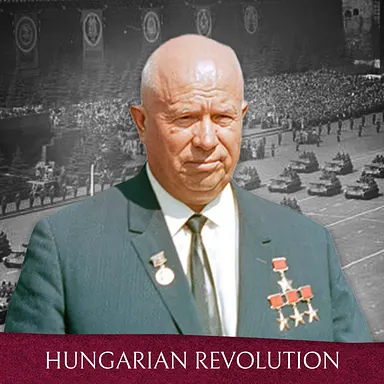
This first part of the Rest Is History series on the Hungarian Revolution of 1956 traces how a Soviet-backed communist regime took shape in Hungary and why it began to unravel. Hosts Tom Holland and Dominic Sandbrook follow the careers of Imre Nagy and Mátyás Rákosi, the Moscow exiles who shaped postwar Hungary, and examine the purges that followed under the secret police.
They look at how Stalin's death and Khrushchev's Secret Speech weakened the regime, and how students, writers and the Petőfi Circle pushed for change. Listeners will learn how protests that began in October 1956 escalated into an uprising that briefly threatened Soviet control over Eastern Europe.
In this episode Dominic Sandbrook, Tom Holland
The transcript of this episode on the 1956 Hungarian Revolution and Imre Nagy was made with the technology behind HappyScribe's AI notetaker.
Ads in this audio differ from the text. Tap the sentence you're hearing to follow along.
Synced: the text now follows the audio.
This episode is brought to you by Revolut. Standing still leaves no legacy; history is written by progress, by revolution. Fighting for independence, dismantling those broken systems, defying injustice. Every revolution begins with a refusal to accept the norm, a demand for more. And Revolut is founded on the same principle: originally established to push back the frontiers of traditional banking, it puts the power back into your hands.
You can manage all of your money in one app, plus you can earn while you spend, with the RevPoints reward system. As a fully authorized UK bank, your money is FSCS-protected. Sign up to Revolut today at revolut.com/tryh, that's all lowercase, and you'll get £20 after the first time that you spend. 18+. End date and promotion teas and seas apply, and RevPoints teas and seas apply.
Willkommen zu einem Moment nur für dich und zu allem, was du liebst, bei Douglas. Finde einen Duft, der dich nicht mehr loslässt. Pflege, die aus Alltag ein Ritual macht. Farben, mit denen du dich neu entdeckst. Alles für dich am Singles' Day, jetzt 20% auf viele Artikel. Douglas, welcome to beautiful.
As I telephoned this dispatch, I can hear the roar of delirious crowds made up of student girls and boys, of Hungarian soldiers still wearing their Russian-type uniforms, and overruled factory workers marching through Budapest and shouting defiance against Russia. "Send the Red Army home!" they roar. "We want free and secret elections!" And then comes the ominous cry which one always seems to hear on these occasions: "Death to Rakocsi! Death to the former Soviet puppet dictator!"
I have been the witness today of one of the great events of history. I have seen the people of Budapest catch the fire lit in Poznań and Warsaw, and come out into the streets in open rebellion against their Soviet overlords. I have marched with them and almost wept for joy with them, as the Soviet emblems in the Hungarian flags were torn out by the angry and exalted crowds. And the great point about the rebellion is that it looks like being successful.
So that was a report telephoned to The Daily Express on the evening of 23 October 1956, by the veteran foreign correspondent Sefton Delma. And Sefton Delma—I mean, he sounds like a racehorse crossed with a serial killer. And I gather that he was, in fact, Australian, but had developed a very clipped British accent. I mean, it's a thrilling scene that he's describing. As he says, it is one of the great events of history, a milestone in the history of the Cold War.
One of the most stirring stories of the mid-20th century, you claim, Dominic. I'm going to put my hands up. I know literally nothing about this.
Thank God you're presenting a podcast on it.
But one thing I do know is that if you think Sefton Delma is a mad name.
We've got a whole lot more for you today.
We do, yeah. So hi, everybody. The master of tongues. I mean, you are going to be equal to the challenge, aren't you?
Well, I hope so. I hope so. We shall see. So last week, Tom, we were at Suez, weren't we, with Anthony Eden, and some great moustache work in last week's episodes. And I'm happy to say there's some more to come, some excellent moustaches. So what Sefton Delma is describing there is this, as you rightly say, this incredibly rousing moment when, after 11 years of repression and show trials and purges, the people of Hungary rise up against what he calls their Soviet overlords, and they fight for their freedom. And so when he files that report on the evening of the 23rd of October, it looks as if they are actually going to win it.
And of course, if they had, then the story of Europe in the 20th century might look very different. Maybe the Iron Curtain would have come down 30 years before it did. Maybe the Berlin Wall, which at this stage hasn't yet been built, would actually never have gone up at all. I have to tell people, big spoiler alert, this is quite a tragic story, the story of the Hungarian Revolution. But it's a story full of amazing twists and sort of intimate betrayals. I mean, it definitely is a story of heroic freedom fighters against kind of repressive imperialists.
But it's a story with a lot of nuances to it, which we will explore. Now, Tom, I don't know, how is your 20th-century Hungarian history, would you say?
Well, I'm obviously very familiar with probably the most celebrated figure from mid-century Hungary, and that is, of course, Imre Nagy.
Right. Imre Nagyh, I think is the.
That's not how you pronounce it, Dominic. It's literally Nagy. I could read it.
Not Nagyh, is it? So it is Nagyh, actually. It genuinely is Imre Nagyh.
God.
I'm guessing that a lot of listeners may not be super familiar with the details of Hungarian politics from the 1950s. So we're going to get into this through this central character, and this is Imre Nagyh. Now, it would be really satisfying if he was a dashing, glamorous, and heroic figure. In fact, he's a man with an enormously round head. He's got a gigantic moustache and glasses. And everybody always said he looked like a bank manager from a small town. So basically, if you're British, if you imagine him as Arthur Lowe, Captain Mannering in Dad's Army.
If you're American, he would undoubtedly be played by Paul Giamatti, the guy from John Adams and Sideways and so on and so forth. So that's who he is. And Imre Nagyh is our protagonist. Imre Nagyh was born in the rural southern kingdom of Hungary, which was then obviously one of the two halves of the Austro-Hungarian Empire, in 1896. And his parents were peasants, and they worked for the local lieutenant general as respectively the carriage driver and the maid. And they're pretty poor. And Imre becomes an apprentice locksmith, and then a metal fitter, and then a clerk.
And he's called up for the Austro-Hungarian Army in 1914. He fights on the Italian front, which we've discussed on the rest of his history, absolute shambles on every side. He was wounded in the third battle of the Isonzo. He then went off to fight the Russians in Galicia, and he was captured by the Russians. And he was sent to a prisoner of war camp in Siberia. And there, a not uncommon story, he discovered communism, and he volunteered to fight for the Red Army during the Russian Revolution and the Russian Civil War.
So he's a card-carrying, paid-up Bolshevik. And then in 1921, Nagyh is sent back to Hungary.
Nagyh.
There's a lot of Nagyh. If you're going to laugh every time we say Nagyh, you're going to be having a whale of a time in this episode.
Can I just ask, is he a goodie or a baddie?
He's the hero of the story, Tom.
Okay. I just didn't want to kind of make a Dr. Valverde-style error.
No, actually. And the Hungarians are very proud people, and they could take great offense if you get this wrong. So just a word of warning.
I just want to be on my guard.
So he's sent back to Hungary in 1921. Now, at this point, of course, the Austro-Hungarian Empire has broken up, forcibly dissolved at the end of the First World War. And Hungary has become an independent state under Admiral Miklós Horthy, Admiral Horthy.
He's a baddie, isn't he?
Effectively, yes. But we don't need to worry about him. So Nagyh is there, and he's meant to be working as part of an underground communist network. The police are always after him. He's always being arrested. And he's got this sort of succession of jobs, working insurance and stuff that he keeps being sacked from because of his communism.
I mean, you wouldn't want a communist running your insurance, would you? Really?
Never. No. I want an insurance man to be giving me money in the event of some disaster. I don't want him to be undermining capitalism.
Appropriating it.
Right, exactly. So 1930, Imre Nagyh emigrates to Moscow, where loads of other European communist exiles have gathered. And there, because he's such a thrilling and interesting person, he works on agricultural policy for the International Agrarian Institute. And he also probably—this is a live issue in Hungarian historiography—he probably acted as an informer for Stalin's secret police, informing on the other exiles.
Oh, he's a baddie then.
Well, hold on. But they're all doing that. I mean, literally all of them are doing that. So I don't necessarily hold that against him. Now, you may say, mid-century Hungarian communist, probably quite an unglamorous figure. But even by those standards, Imre Nagyh is really very unglamorous. So he's a sort of good-humored man. He's mild-mannered. His great enthusiasm is for football. But everybody says he's incredibly uncharismatic. He's a plodder. He's very dogged-in.
And he's just sort of physically a bit charmless. And he just looks like a bank manager. His defining characteristic is probably his unswerving loyalty to the party. He's a massive institution man. He loves the Communist Party. He really believes in the Communist Party. But at the same time, he's very stubborn and sort of obstinate. And I think for people who've seen Dad's Army, the sitcom from the 1970s, he really is Captain Mannering from Dad's Army. That's the way to think of Imre Nagyh.
Sort of a decent man, but faintly ridiculous.
Yeah.
Now, he is, of course, not the only Hungarian exile in Moscow in the 1930s and 1940s. And the other major character in today's episode is another exile. And this is a man called Matyáš Rákosi. So Rákosi was mentioned in Sefton Delma's report.
Yeah. He's the guy that they want out.
He's the guy that they want out.
So I'm guessing that he is more of a baddie.
Correct.
Rákosi, a little bit older than Nagyh, he was born in 1892 into a Jewish family in what was then Southern Hungary, but it's now Vojvodina in Serbia. And his father was a grocer, and they were politically active, the Rákosi family. He's a scholarship boy. He's clever. He serves like Nagyh in the Austro-Hungarian Army. He's also captured by the Russians. He is also sent to a prisoner of war camp. But Rákosi escapes during the Russian Revolution.
Like Nagyh, he was converted to communism when he was in the camps. And he came back to Hungary, fluent in Russian. He was a sort of junior supporting character in a very short-lived communist republic in Hungary, bloody and short-lived in 1919. That's the one that, what's his name, escaped from? Nagyh. He escaped in the Biplane. We did a bonus on it.
Exactly, yes. Rákosi was involved in that. And he became an agent for the Komintern. And he was arrested in Hungary in 1925 and put in prison. And he wasn't released until 1940. And a slightly weird detail, he was released as part of a prisoner swap. He was sent to Russia, and in return, the Hungarians got a load of flags from the Russians.
Oh.
So there were battle flags that the Russians had captured in 1849.
So like when the Parthians returned the captured eagles that they'd taken from Crassus to Augustus.
There you go. Very good. So Rákosi, who is our villain, has gone off to Moscow, and he becomes the leader of the Hungarian exiles at Stalin's court. So Rákosi, he is very different from Nagyh. He's clever. He's got a brilliant memory. He's a brilliant gift for languages. He is totally slavish to Stalin.
So the parallels to you are mounting up.
Thank you. Well, I'm going to continue with the parallels. He is short. He's stout. He's vindictive, vengeful, sadistic.
Goodness.
I think he would be played by Bob Hoskins.
Right.
Whether it's to be a film. So Brian Cartledge, who was the British ambassador to Hungary, and has written this huge sort of definitive English-language history of Hungary, said of Rákosi, "His character was as unattractive as his squat, dwarfish appearance. His assumption of the leadership was an unmitigated misfortune for Hungary."
Goodness. So Brian is not a fan.
Brian is not. I don't think anybody is a fan, to be fair. So anyway, in the final months of the Second World War, Rákosi, Nagyh, and the other Moscow exiles return to Hungary. Because, of course, Hungary has now been occupied by the Red Army. So Hungary at this point, 1940s Hungary. I can't exaggerate what a post-apocalyptic, nightmarish condition it is in. In the Second World War, about a tenth of Hungary's population, that's about a million people, have been killed. More than half a million people are in prison camps in the Soviet Union.
Hungary has lost half of its factories. It's lost half its railways, half of all its sort of farm animals. The Hungarian economy has been totally destroyed. So people always say, well, where was the worst place for inflation? Was it Weimar Germany? The answer is, it was Hungary in 1946, when inflation reached an all-time world record of 42 quadrillion percent.
What?
I know. It's absolutely.
How do you even measure quadrillion? I don't even know what quadrillion is.
I'm trying to remember this fact that the inflation rate was something like 1,000 percent an hour.
Was a million billion trillion.
So basically, money had lost any value.
Yeah. All meaning. And there isn't anything left to barter.
Exactly. Now, the reason Hungary is devastated, Hungary had been a Nazi ally for four years. And then it had basically been taken over by the Red Army. And because they'd been Nazi allies, nobody in the West had any real sympathy for the Hungarians. And so Stalin, whose armies entered Hungary in the autumn of 1944, Stalin can basically do with Hungary whatever he likes. Now, obviously, Stalin's long-term aim is to install communism. The problem for him is that communism in Hungary is very much a minority pursuit.
So we already mentioned how in 1919, there'd been this very short-lived Soviet Republic in Hungary. And this had ended in total chaos. It ended with a red terror, and then after that, a white terror. And it had ended with the country being occupied by their kind of bitter enemies, the Romanians, which for the Hungarians was a terrible scandal. And this rather tarnished the communist brand. So that when these guys rock up in 1944, there are only about 2,500 communists on Hungarian soil.
And Stalin says to these exiles, "Obviously, you're going to have to work quite carefully and slowly with all this to establish yourselves." And the tactic, which is so common across Eastern Europe, Anne Appenbaum describes it brilliantly in her book Iron Curtain, is you pretend to be moderate. You work with the so-called bourgeois political parties. And you basically take power by stealth. Rákosi himself called this salami politics. You know, you're salami slicing, taking more and more ministries, purging people, all this kind of thing, moving slowly.
And then one day, it all falls into your lap. So this is what they do. They enter a coalition with the other non-fascist parties. So there's a party called the Smallholders, a party called the Social Democrats, the National Peasants Party, and so on. But the communists make sure that they hold key roles in this regime. So Rákosi is the deputy prime minister. And Nagyh, the bank manager, is the minister of agriculture. And Imre Nagyh is actually quite important. He pushes through massive land reforms that break the power of the Hungarian nobility and the Hungarian gentry.
And they completely break the power of the Catholic Church. The Catholic Church loses 90% of its estates in this period, the late '40s. And meanwhile, Rákosi and the other communists are actually, you know, their plan is working much more quickly than Stalin had anticipated. So when there were elections in Hungary in November 1945, they only won about 17% of the vote. They were far behind the Smallholders, which was the biggest party. But the cunning of it, they said, "Well, you just have to give us the Ministry of the Interior.
That's kind of all we need, really."
Which controls the police.
Which controls the police.
That's what the Nazis did, wasn't it?
Of course. And the other thing is, the Red Army have occupied Hungary. So if there's ever a dispute, they can rely on the Red Army to back them up. So they've now got the Ministry of the Interior. And they're looking forward to sort of entrenching their power. Now, I mentioned that there were a few communists still in Hungary who weren't exiles. Stalin is always a little bit suspicious of them because he hasn't had them under his thumb. So the two groups of communists are having to work with each other. But the exiles and the homegrown communists, there's a bit of tension between them.
And the exiles need them for the time being. And the leader of the homegrown communists is a guy called László Rojk. And László Rojk is much younger than Nagyh and Rákosi. He is in his late 30s. All the sources describe him as strikingly handsome.
Well, I read that. You don't think? You don't agree? He doesn't look handsome at all. He's got an absolutely massive forehead.
Right.
Huge.
I discussed this with our producer, Elia. She sent me a message to say, "Insane that people thought he was handsome." So there you go.
Okay. Good. I'm glad that's settled.
So he's ruthless, Rojk. Rojk had fought in the Spanish Civil War. He'd been in the communist underground. And he sets up a new secret police that went through various iterations. We'll just call it the AVH.
God, the acronyms.
Yeah.
They're starting. Don't worry. This is the only acronym. This is the only acronym.
So the AVH's job was to bring people before people's courts. And the people's courts have been set up supposedly to punish former fascists. Of course, the communists use them to punish anybody they don't really like. And what follows is this absolutely textbook example of communists seizing power. So in 1946, through the AVH, they purge what they say are ex-fascists from the public institutions, 60,000 of them. Then they start to shut down sort of independent social groups, Catholic Youth Association, the Boy Scouts, for example, farmers' clubs and things, because they say they're riddled with fascism and conservatism.
In 1947, this bloke, Rojk, he says, "Oh, I've uncovered a campaign of treason against the Hungarian Republic, led by," and actually, it's led by some major politicians. And they're arrested, and they're interrogated. And then Rojk and the AVH say, "Wow, this conspiracy is actually even bigger than we thought. We have to arrest more people." And just by a complete coincidence, they're arresting rival politicians. So this is very good for the communists. And by 1949, they have purged so many people that Rákosi can push through a new constitution that establishes Hungary as a people's republic of workers and working peasants devoted to the building of socialism.
And the only functioning legal party is the Communist Party, which calls itself the Hungarian Working People's Party. So communism is entrenched. Now, to sort of step back from this and to play devil's advocate for a second, this will amaze you what I'm going to say now, Tom. I mean, this is a mad thing to say, but you could try really hard. You could make a case for some of the Eastern European regimes in the kind of in the '50s, most obviously Yugoslavia. You could say, "Maybe it wasn't that bad. It could have been worse. Tito kept it together," all this kind of thing.
However, one country that you can absolutely not do that for is Hungary. Hungary is a terrible place in the early 1950s.
Are you only saying that there because you're a running dog of capitalism?
No, as we will see. When British communists went to Hungary and they saw what happened, and we will have one actually in the next episode, there were British communists who went to Hungary, who there in '56, and came back and said, "We have not been telling the truth about Hungary. Hungary is a terrible place."
Right.
The reason it's terrible is this, because of his Marxist dogma, Rákosi says, "We have to turn ourselves into an industrial power. We're very agricultural. Lots of sort of smallholding peasants. That's no good. They have to be collectivized. And every last penny we have to spend on building tractor factories." So as a result, there's literally no money for anything else. Most people's incomes have fallen by a third since the war, but prices have doubled. So basically, you're much poorer and everything's more expensive. There's nothing in the shops. There are no imported goods.
There's no fruit. There's no chocolate. There's nothing like that. The clothes, you know, if you want to buy clothes, they're rubbish. They're the wrong size. They fall apart, and you can't get them anyway. There's no bread. There's no meat. There's huge queues every day. It's a proper police state. So Tom, if you worked in a factory, let's imagine you work in a factory making a tractor, you would have to get, I mean, you get up at 4:30 in the morning anyway, frankly.
So I don't see what the problem is there.
Yeah. You'd go to the factory. You'd have a compulsory briefing, a reading from the daily newspaper, the daily communist newspaper.
What does Comrade Sandbrook say?
Exactly.
We'd all sit there and listen to your thoughts. Oh, God.
Then you'd work all day building your tractor.
Yeah.
And then after work, you would have to go to a compulsory political education class, which might last until 10:00 p.m.
What?
So you don't get an enormous amount of sleep.
Okay. That is terrible.
You're living in an overcrowded flat.
It's awful. I hate it. Bring it down.
There are no independent newspapers. Lots of Hungarian classic books have been banned. And in their place, libraries and bookshops have translations of Soviet classics.
Oh, God. It sounds awful.
Your kids have to do Russian in school. They also have, if they go to university, they have to do Russian in the first two years of university as well. Now, you are not from, I would say, a conspicuously underprivileged background.
Yeah, I am.
No, wrong.
I'm from a peasant background, toiling in the fields of Wiltshire.
Your children would have black marks against them in their school record.
For being bourgeois.
A note to say that they were from a gentry bourgeois family. And what is more, they would not have been allowed to go to university because of their bourgeois background. There's a lesson here for Andy Burnham, I think.
And what is the lesson?
If you're going to do it, go all in.
He just wants to be light, though.
He does. Yeah, he does.
You know, he just wants to get everybody pints and things. Rákosi, he's not buying pints.
No.
What's his favorite pub snack?
The teeth of dissidents pulled out with pliers.
Like, yeah.
Other party members' fingernails.
The teeth of capitalists.
Right. So if you question this, Rákosi and his secret police have no mercy. So Brian Cartledge, in his book, estimates that between 1949 and 1953, three-quarters of a million Hungarians, this is in a country of about 9 to 10 million, are charged with crimes against the state. And of these 2,000 who are executed, 200,000 are imprisoned or interned or sentenced to hard labor, some are deported to the Soviet Union. And Rákosi gets all this from Stalin. He's absolutely explicit about this.
He described himself as Stalin's best pupil. They had posters and slogans saying, "Rákosi is Stalin's best pupil." And like Stalin, he believes that one of the biggest threats to building socialism is the ubiquity of traitors and informers within the party. So he's always looking for enemies within. And this is turbocharged in the summer of 1948, when, and I know people love a bit of communist bulk and geopolitics, the communist world splits.
So up to this point, people thought of communism as a kind of monolith. But in 1948, there is a rift between Stalin in Moscow and Tito in Belgrade. Tito, who's the president of Yugoslavia. In Yugoslavia, uniquely, the communists took power on their own. They basically, the Red Army didn't get involved at all. They won the Second World War. They've taken power on their own. And Tito thinks, "I don't want to actually do what Stalin tells me. We'll do our own thing in Yugoslavia. Thank you very much."
There's a great rift between Stalin and Tito. And this triggers a crackdown across Eastern Europe and a kind of climate of fear because all Stalin's little puppets are desperate to prove their loyalty to Stalin. You know, I'm not going to do a Tito in Poland or Czechoslovakia or Hungary or whatever. And so they want to stamp out any hint of kind of national independence and prove their loyalty. And for Rákosi, who's always branded himself as Stalin's prized pupil, this is a particularly good opportunity because there's a history of tension between Hungary and Yugoslavia.
Rákosi himself came from a place that is now in Yugoslavia.
And does Stalin admire this? Or does he despise Rákosi as a kind of lick's petal?
I think he actually despised Rákosi. I mean, Stalin didn't really like anybody.
But all this kind of, "Please, sir, look at me. I'm torturing people."
Yes. Stalin looks down on this. Stalin's contemptuous of this. Yeah.
You're a little worm. I don't care.
Yes. That's exactly. It's like Saruman and Wormtongue. That's what it is.
Or Sauron and Saruman.
Or Sauron and Saruman. Exactly. I think probably Stalin would want to be compared with Sauron, wouldn't he, rather than Saruman?
I think so.
Yeah. So anyway, Rákosi intends to use this split with Tito to purchase enemies within the party. And he proceeds against his enemies. And one case in particular gets a lot of attention. And this is Elia's dream boat, László Rojk.
Oh, the huge forehead.
The guy looks like Dracula.
Yeah.
The guy who's the leader of the home-based communists.
Yeah.
So Rojk, he's the guy who'd founded the secret police. In a stunningly predictable twist.
He gets arrested by his own police.
Yeah. By the secret police in May 1949, and he's accused of being a spy for Tito. Rojk is tortured, but he still says, "I'm not a spy for Tito. I didn't do it." So they send his closest friend in the party, who is a man who will play a big part in this story, who is called János Kádár. He is sent to persuade Rojk to confess. And Kádár says to him, "Look, mate, if you confess, they will pardon you. They've promised. They'll pardon you, and they'll send you into exile in the Soviet Union."
Are they keeping their fingers crossed?
Right. Exactly. Rojk does confess. But to his surprise, he is put on public trial anyway.
No.
And sentenced to be hanged. And his friend Kádár, who is now the Minister of the Interior, Kádár is made to attend his friend's execution. And when Rojk mounts the scaffold, he sees Kádár, and he shouts at him, "This isn't what you promised. János, you have betrayed me." And afterwards, Kádár, his friend, was seen being physically sick. He was so upset by the betrayal of his friend. And you can anticipate what's going to happen. Next year, he's arrested as well.
And he undergoes some pretty horrible treatment. So he was arrested by the AVH. He was accused of having been a spy for the fascists in the Second World War. He was beaten. He was smeared with mercury. I don't know why that would be bad, but it is bad, apparently.
Mercury is quite dangerous, I think.
I think it is. Yeah, you don't want to be smeared with mercury. His fingernails were torn out. And then the most gruesome, well, not gruesome, but the most, just the most horrible detail, his mouth was forced open and held open while people urinated into it.
Oh, no.
So he, Kádár, was sentenced to life imprisonment. He served three years in solitary, and then eventually, he was let out. Now, in case you're feeling sorry for him, Tom, I know you love a bit of a preview so you know whose side you need to be on.
Yeah.
He turns out to be a massive baddie as well.
Can I just ask?
Yeah.
Is anyone in this a goody?
No.
Maybe Sefton Delma. But I'm guessing we're not going to be hearing much from him.
There's loads of students, Polonet people. You can identify with them.
Oh, the kind you despise.
We had some of them in the Suez. And I'm glad to say they're back.
Okay.
So 1953, Rákosi seems completely and utterly impregnable. He's the head of government as well as the party. He's got an iron grip on the party machine. He's eliminated all his rivals. The communists have just won 99% of the votes in an election.
You say it's 99.3.
Yeah.
So that's actually better than NASA.
Yes. They're more popular than NASA.
Because NASA only had 99, didn't he?
But the difference is that people in Egypt actually genuinely do like NASA, whereas everybody in Hungary absolutely hates Rákosi.
Right.
So anyway, Rákosi thinks nothing could go wrong. But then there's a bombshell, an absolute bombshell. On Sunday the 1st of March, his great model, Stalin, has a massive stroke. And he's found lying on the floor. He's, you know, sawed himself or whatever. And he dies four days later.
So as in the Armando Eunuchi film.
As in the Armando Eunuchi film, The Death of Stalin. And in the next few months, the new collective leadership of the Soviet Union begins to reform Stalin's regime. So they start releasing prisoners and closing some of the gulag. And they actually start to rebuild bridges with Tito and Yugoslavia. So Rákosi is kind of watching all this, and he thinks, "Oh, this is not good." And then June 1953, he's summoned to Moscow, and he's told, "Bring that bloke with the mustache with you. Bring him Ray Naught with you." And the reason is the Soviet leadership are very anxious about their Eastern European empire.
They worry that Stalinism went much too far and is going to provoke a backlash. And so they bring Rákosi in. And, you know, they're all there, all the kind of the big Jesus. And they give him a massive dressing down. They say, "You've gone much too far. You've rushed industrialization. You've been forcing people into collective farms. You've had show trials. You've had a cult of personality." They accuse him of trying to make yourself the Jewish king of Hungary. Of course, they're all massively anti-Semitic. So they say, "Right, enough.
We'll allow you to stay on as head of the Communist Party, but you've got to hand over the prime ministership to Naught, who's kind of standing next to him with his mustache looking kind of drab, blinking through his glasses." Yeah. So from the summer of 1953, the two of them are sharing power. And Naught adopts what he calls the new course. So he says, "Come on, we don't need to build so many tractor factories. We can let some people out of prison. Peasants don't have to work on collective farms if they don't want to. They can maybe do their own thing. We can just be a little bit, you know, gentler and kinder and whatnot."
Rákosi is still there, though. He still commands the party machine. He's determined to get his own back. And two years later, he gets his chance. The Hungarian economy is in a complete mess still. They're dependent on imports. Naught wants to ask the West for loans. The Kremlin says, "No, we don't like that at all." And the Kremlin starts to think to themselves, "This bloke Naught is taking this a bit far, actually. He's tolerating factionalism within the party. He's encouraging counter-revolutionary politics. And he's also too keen on Hungarian patriotism.
This is no good." So there's a massive turnaround in the spring of 1955. It's all change. Naught, having just two years earlier been made prime minister, he's accused of rightist deviationism. He's kicked out as PM. In fact, he's kicked out of all his party offices. And they even take away his professorship and his membership of the Academy of Sciences.
So what does he do?
He just goes home and writes boring essays about communism.
Oh, okay. He doesn't get sent to a kind of tractor factory or something?
No, he doesn't. He just goes home to his villa in Budapest, and he writes, you know, extremely long treatises about the right road to socialism. That's his vibe, really. So Rákosi, a bad man, is back as the top dog with a puppet as prime minister. And he celebrates by organizing another purge of the party and arresting loads of people and killing some of them as an example to the others. So he breathes a sigh of relief. "Thank God that anti-Stalin business, you know, that's all gone away."
Yeah.
But another bombshell follows in 1955. So in the Kremlin, there has been this big power struggle since Stalin's death. And the winner, a man much underestimated by his colleagues, who was the way in Russia, is the boorish, ebullient, ruthless, cunning figure of Nikita Khrushchev, a former peasant, actually. And Khrushchev cements his ascendancy at the 20th Party Congress in February 1955 with something known as the Secret Speech.
So basically, the way this works, they close all the doors. There's no press. And for four hours, I mean, it seems quite a long speech to me. But anyway.
I mean, it's longer than NASA's, isn't it?
Yeah. Exactly.
Nationalization of the Suez Canal.
You don't want to be longer than NASA.
Fewer mentions of Ferdinand de Lesseps, though, right?
No mention of Ferdinand de Lesseps. But more mentions of Stalin. Because basically, what Khrushchev does is he puts the boot into Stalin. He says, "Stalin, you know, we worshipped Stalin for 30 years. Stalin was a terrible man. Stalin was a distrustful and sickly suspicious man. He created a cult of personality. He presided over the cruelest repression of good communists. He tortured people. He executed people. He deported people. He even made a massive horlicks of the beginning of the Second World War."
I mean, he's not wrong, is he?
Well, this is all true. Khrushchev could have gone a lot further. Anyway, when Khrushchev makes this speech, this is an absolutely incredible moment. I mean, we're rushing past it, but it's a kind of landmark in 20th century history. A lot of the delegates there were so shocked they became physically unwell. And the leader of Poland, who was called Borysław Bajrut. Borysław Bajrut is so appalled that he had a heart attack and died because the Secret Speech was such a shock to him.
Now, when word of this reaches Rákosi, he is absolutely horrified. You know, he was Stalin's mini-me, and now the Kremlin is slagging Stalin off. This is terrible. And he said to the Soviet ambassador in Budapest, Yuri Andropov, "Hold on.
Is that the Andropov who then becomes General Secretary and has terrible colds?
Yeah.
And sponsors Gorbachev?
Yeah. Good knowledge. Ran the KGB in the '70s.
Goodness.
Yeah. That's him. So Rákosi says to Andropov, "What you have done at your congress is a disaster. I don't know what will come of it, either in your country or in mine." And he tries to stop the Secret Speech being circulated in Hungary. And they redact a lot of the text. So people mockingly call it the children's version. I mean, it's probably not really suitable for children. Anyway, in the next year or so, Rákosi tries to distance himself frantically from Stalin. He says, "I had nothing to do with all these purges. I was never for them."
I always hated Stalin.
Yeah. And you know the executioner of that guy, László Rojk? "I was never for that." And actually, Rojk was framed by the secret police, and I had nothing to do with it at all. But actually, in Budapest, something has changed. Like his colleagues have turned against him. So by early 1956, so the Rákosi is still in power, people are openly kind of dissing him inside the party. They call him the bald-headed murderer. And a year ago, if you'd called him the bald-headed murderer, you'd have been, you know, murdered, shot, or put in prison.
But now you can kind of get away with it. In fact, you can get away with it so much that in March 1956, at a communist meeting, he is heckled by, of all people, a young history teacher. And the history teacher shouts at him, "Comrade Rákosi, the Hungarian people no longer trust you." And not only is the teacher not executed, he's not even arrested. He's able to get away with this. Now, what all this reflects is the fact that Rákosi's kind of Stalinist experiment is running out of steam and is becoming incredibly unpopular.
So Hungarian newspapers by early 1956 are reporting loads of stories about shortages, low wages, young workers who've basically been promised, "You can have a shiny new flat in one of our lovely new high-rise communist blocs." But the block hasn't actually been built yet. And so, for example, in Simon Hall's book about 1956, he quotes a story in a Communist Party journal about factory workers who said, "Our lives are terrible, and our bosses treat us like dirt.
This is a steel worker in Budapest. I want to be treated as an adult who lives and knows how to think. I want to be able to speak my thoughts without having anything to fear. And I want to be heard as well."
This is bourgeois revisionism, though, isn't it?
It is. Well, this is what Rákosi thinks is bourgeois counter-revolutionary revisionism. But there's a lot more bourgeois revisionism to come because in the summer of 1956, another jaw-dropping moment. In another of the communist satellite states, in Poland, in the industrial city of Poznań, factory workers go on strike in protest against their low wages and high prices and terrible housing and all this stuff. And the strikes escalate into mass protests across Poland. I mean, nobody really knows about this, actually, in the West, but it was a massive deal in Eastern Europe.
And the Polish authorities at first tried to quell them with troops and tanks, but it didn't really work. And over the summer and the autumn, it escalated into this sort of Polish October, all these demands for political reform. And there were huge crowds, and they were demanding a change of leadership. And they had a bloke that they wanted to come in, who had the excellent name of Władysław Gomułka. And they wanted him in as a new sort of reforming leader of Poland. Anyway, Rákosi is watching all this from Budapest, and he can't believe it.
He says, "This is absolutely terrible." He issues a public statement. He says, "You know, Hungarian, good patriotic communist Hungarians should ignore this business in Poland. It's terrible. It's counter-revolutionary. Don't listen." But of course, nobody's listening to him. By this point, even loyal communists hate him. Khrushchev in the Kremlin said later, "Rákosi's very name had the connotation of something despicable." And if Khrushchev's saying that, and he's supposedly your kind of patron, you're in trouble.
It's not good, is it?
So the question is, who is going to strike the first blow to bring Rákosi down? And Tom, you undoubtedly are expecting.
Yeah, I think it's going to be Naught.
So the blow will come from the most unlikely person imaginable with his mustache in retirement. Looks like a grocer Imre Naught. And that would make it a brilliant story.
Is it? Is it him?
It's not him.
Oh.
He has been writing all these essays about kinder, gentler communism. And in fact, there have been streams of people coming to his villa in Buda to pay their respects. But the truth is, Naught at this point is 60. He's not really a populist. He's not a natural leader. He's just happy hanging around in his armchair talking about socialism.
So who is going to strike the first blow? Which ruthless, gimlet-eyed killers are going to step forward and save Hungary?
Do you know what? This is going to amaze you. And this is a first. This is a first in the rest of history, and possibly in all history. Because the people who are going to strike the first blow and to do something really useful are a group of idealistic bien-pensant intellectuals.
No way.
This is unheard of. It would never happen in Britain. So in Budapest in 1956, there is a debating club called the Petőfi Circle. And this, as you will undoubtedly know from the name, has been named after the great Hungarian poet and national hero from the 1840s, Sándor Petőfi.
Of course.
And this debating club, they meet and they chat about history and art and stuff. But over the course of 1956, they're having more and more sort of outspoken meetings. They're talking about politics. And that summer, they hold a series of public debates and sort of panels and stuff, challenging the Rákosi regime. And on the 18th of June 1956, they have a debate on socialism that attracts a thousand people. Now, what makes this so incendiary is that one of the speakers is László Rojk, the guy who was executed.
For a bloke.
His widow, Júlia, and she herself has just been released from prison.
Goodness, that is dramatic.
She was a very striking woman. She was regarded in her heyday as one of the great beauties of Budapest.
Oh, so that's why she married the Hunk Rojk.
Completely. Dream boats. Secret police founding dream boats. Exactly. So she's 44, but she looks a lot older. She's really haggard. But she's incredibly kind of compelling in her gaunt way. And she takes the microphone, and she says to the audience. She says, "I stand before you deeply moved after five years of prison and humiliation. Not only was my husband killed, but my little baby was torn from me, for I received no letters and no information about the fate of my little son." And then she says, "Rákosi and his fellow criminals not only murdered László Rojk.
They have trampled underfoot all honesty in this country. I shall never rest until those who have ruined the country, corrupted the party, destroyed thousands, and driven millions into despair receive their just punishment. Comrades, help me." It is electrifying stuff. People jump to their feet. They're all shouting and cheering and clapping. And Tom, the touch paper has been lit.
Wow. OK, that's incredible. So unbelievable drama. Before we leave for the break, though, Dominic, can I just ask one question about her?
Yeah.
What had happened to her son?
He had been taken away and sort of put into care in some way, I think.
Did she reunite with him?
Yes. We'll be meeting him in the second half.
Oh, great. OK, so there's drama, and there is a heartwarming reunion between mother and son. So so much to look forward to. We'll see you after the break. This episode is supported by Anthropic, the team behind Claude. Now, history's biggest leaps, many of them started as hard questions that people didn't want asked.
Yeah, there's a classic example of that, Tom, at the end of the 15th century. And the hard question in particular was, what is out there beyond the Atlantic Ocean to the west? And as you will know, the man who found the answer to that question was the explorer Christopher Columbus, great pioneering voyage of discovery. And it is, of course, the Americas. So Anthropic knows the importance of questions. And it's why Anthropic is founded on one hard question above all. How can we ensure that the AI revolution really goes well for ordinary people?
Anthropic asked 100,000 people. And what came back wasn't just fear. There was hope as well. People wanted to know, will cancer ever be cured? Can kids have a better future? It turns out that there is hope in hard questions. Ask yours at claude.ai/restishistory. And keep thinking. Hello, everyone, and welcome back to the Rest Is History.
We are in Budapest in Hungary. It's June 1956. And Júlia, who is the widow of László Rojk, the guy with the forehead who founded the secret police and who I guess we now vaguely meant to think is a sympathetic figure, kind of.
Yeah. He's on the side of the angels now.
It's been rehabilitated. She's just given this electrifying public speech, and she's denounced the communist regime under Matyás Rákosi. So what's going to happen next, Dominic? Is there going to be a convulsive train of events that will attract the attention of the entire world?
Yes, there is. I'm delighted to say that there is.
So her speech is the talk of Budapest, Júlia Rojk. And everyone is very excited. They're saying, well, what will the Petőfi Circle be talking about next? I can't wait for their next debate.
I mean, if you're an intellectual in a Polonez, the notion that the entire country is waiting for your next debate, I mean, it's a dream, isn't it?
Yeah. This genuinely is a dream.
It's like us with the Athelstands.
Yeah. I mean, it's even better than a Rest Is History club gathering because such massive interest, actually, it's very similar, such massive interest, they have to move it to a bigger venue, the next meeting. They move it to the Offices Club in Budapest. The hall meant to hold 800 people, but they managed to get 1,600 people in there. And there are 6,000 people in the streets outside listening to the event on loudspeakers. And they're not just intellectuals at this point. So they're not just people in corduroy jackets and Polonez.
They are army officers and young professionals and all the cool people of Budapest are there. And there's a succession of speakers whipping themselves into a lather, attacking the Rákosi regime. There are communist officials there who keep saying to them, could you please stop attacking the party? We're meant to be affiliated with the party. And the crowd starts shouting at them, we are the party. You know, it's great stuff. It goes on for nine hours. Again, I think it's quite long. I don't think I'd ever go to any debating event or anything.
I mean, I wouldn't go to one anyway, frankly. But I definitely wouldn't go to one that lasted nine hours. And then at the end of the nine hours, somebody says, you know, we should get back. Imre Naught.
Because the memory of him is socialism with a human face, that kind of thing.
Socialism with a human face. Exactly right. Exactly. There's a seven-minute standing ovation. Everyone starts chanting, long live Naught. Get Naught back in the party. They're all very excited. Now, Rákosi, when he hears about this, is horrified. He says, OK, well, I've been much too indulgent with these people. Time to crack the whip. He condemns the Petőfi Circle for bourgeois and counter-revolutionary views. Kind of communist bingo. He says Naught is behind all this. He's been plotting against the party and the people's democracy. He draws up plans to shut down the debating club, to shut down the writers' union and other groups.
And he draws up a list. He loves doing this. He draws up a list of 400 people, Naught among them, who he's going to put on trial and hopefully execute. But Tom, it never happens because Rákosi's comrades in the Communist Party have had enough of him. And one of them rings the Soviet ambassador, Yuri Andropov, and he says, Rákosi is planning a crackdown, and we're not in favor of it. We've decided he's got to go. He's become a liability. Andropov reports this to Moscow. And so Khrushchev in Moscow says, OK, well, I'm going to send someone to Budapest to look into all this.
We can't have it all kicking off in Hungary. And the bloke he sends, now we have a top mustache. He sends his effective number two, who is an Armenian called Anastas Mikoyan. And Mikoyan is a veteran Bolshevik. He's a great survivor. So he's been around since the Russian Revolution. He's now in charge of foreign policy. Mikoyan, he's a foreign policy specialist. But in the 1920s, he was in charge of food. And Stalin always said about him, he cares more about ice cream than he does about Marxism.
Was that a criticism?
Stalin tolerated it because I think he thought that people probably at Workers' Paradise would have ice cream.
Yeah, communists should have ice cream.
They would be hanging around and trying to talk about Marxism. And Mikoyan kept saying, well, I've got a hold of Mr. Whippy. I fell down a bit of a rubber hole reading about him. The other thing he was absolutely massively into was sausages.
Oh, really?
He was really interested in supplies of sausages in the 1920s and '30s, this guy.
I like the sound of him.
I mean, there's probably a dark side to him, Tom, because I mean, he was at Stalin's court and didn't get killed. So what does that tell you? So on the 14th of July, Mikoyan reports to Moscow, to Khrushchev, and he says Hungary is in total meltdown. Party discipline is falling apart. The party is losing the war of ideas. Day by day, the comrades are losing their grip on power. And Mikoyan, he convenes a meeting of the Hungarian Politburo. And he says in front of everybody to Rákosi, I'm afraid you've got to go. We've all lost confidence in you.
And Rákosi is horrified because his comrades, who he thought were going to support him, they say, yeah, we didn't like him anyway, frankly.
God. So it's like Ceausescu suddenly realizing he's lost power.
Suddenly realizing, yeah, that everyone hates him. Rákosi rang Khrushchev in Moscow, and he said, if I go, everything will collapse. And Khrushchev said, listen, comrade, too bad. You're out. You're done. You're finished. So four days later, Rákosi announced his resignation on health grounds. And then he was flown to Moscow for urgent medical treatment. And he was sent to Kyrgyzstan, you know, the most remote of all the Central Asian republics, kind of mountainous yurts on the Chinese border.
This is one of the ways in which I honestly think the West is better. Because Anthony Eden, in a similar position, he has bad health. He goes to Jamaica. And I just think Jamaica is a nicer destination.
Is it, though? Kyrgyzstan, I think, is quite a cool place to go these days.
Yeah, but not then. I mean, it was like everywhere. It was kind of asbestos factories and things.
He lived there for 15 years in total obscurity. I mean, he's Hungarian. What's he doing there? And then he died in 1971, and that was the end of Rákosi. I mean, it was kind of a shame that he wasn't executed in a hideous way because I think that would have been a more fitting end.
With piano wire.
Yeah, correct. So now he's out, and Moscow has a fateful choice. We love a fateful choice. So they have to choose someone to succeed him.
Naught.
Yeah, well, that's who I would pick. You and I are very much on the same page on this. They should pick Imre Naught and move towards a kind of gentler kind of socialism. And if they had done, there would have been no Hungarian revolution. We'd be doing something else this week. You know, we'd be doing maybe a deeper dive into the Costa Rican Civil War. But no, they didn't choose Naught. They made a terrible choice. They chose another former Stalinist, another Moscow exile, a man who's very dull and austere, who's called Ernő Géra.
And Ernő Géra is austere. He's humorous. Everybody dislikes him. And he's also got a massive ulcer. So it's a stomach ulcer, so it's not quite Henry VIII. But it means he's in constant pain and is therefore very irritable and impatient. So I think a mad choice, but anyway, that's the choice they've made. So Géra comes in, and he's inheriting quite a tough situation because the literary dissidents of Hungary have the bit between their teeth now.
Not the literary dissidents.
They are pouring out.
The Soviet Empire is quaking.
It's quaking because they're pouring out plays, operas, ballets, poems, mocking the party and the system. My favorite one. I can't remember which book I read this in, but I just thought this is such Central European literary bingo. I mean, this is beyond parody. The fate of an innocent man suddenly imprisoned, seen through the eyes of his dog.
Yeah.
I mean, that's like, are not all Hungarian, Czech, and Polish books about that? Anyway, so everyone's very excited. The Journal of the Writers' Union, its circulation goes up 10 times in the summer of 1956. Issues are changing hands for 50 times the cover price. And there are claims, I cannot believe this is true, but anyway, that the Writers' Union Journal, when it came out, people would be waiting at the newsstands. They'd physically be fighting each other to get copies.
I mean, that's great, isn't it? I mean, honestly, that's great.
Well, you may think, Tom, if you're a skeptic, this is just a load of poets in corduroy jackets who cares about them.
Dominic, I'm not like you. I'm not skeptical.
OK, good.
I approve of poets and dissidents.
OK, well, real people are involved in this as well. Because there are reports of peasants pulling out of collective farms. Very worrying for Géra, there are reports of factory workers in Budapest downing tools, smashing shop windows because they can't get goods, you know, all of this. A local communist committee in Budapest reported party headquarters. Everyone feels there is something fateful in the air. And all the time, people are thinking, well, you know, Naught is still the man of destiny.
So he, with his nice mustache, is going on walks every day through Budapest. And he would take his children for ice cream, ice cream again, maybe Mikoyan's ice cream. He's taking them to a place called Zserbo. And listeners will be thrilled to hear that this is the very café that Elia managed to allow us to record there when we went to Budapest with Jonathan Wilson to talk about Wolverhampton Wanderers. So it all connects. And when he was going to get ice cream, people would stop him, and they would say, Prime Minister, when are you coming back?
When are you coming back to run Hungary? And he would just smile enigmatically and say nothing and then go off to get the ice cream. So August and September pass off without event. People have gone on holiday, and then everyone's following the news in Poland, where it's all been kicking off. But then on the 6th of October, something dramatic happens. Géra, to demonstrate his commitment to de-Stalinization, he has agreed to allow a state funeral for László Rojk and three of his executed comrades.
They've been buried in unmarked graves. So the bodies are dug out. They're put into the iron coffins, and they are going to be reburied at Kerepesi Cemetery, which is the grandest cemetery in Budapest where all the national heroes are buried. And they're going to hold the ceremony at the mausoleum to Hungary's greatest hero, the martyr of the 1848 revolution, Lajos Kossuth. Anyway, this is a huge public occasion. So they close all the factories in Budapest.
All the shops are closed. There are black flags on the public buildings. They bring out the coffins, and they're kind of draped in Hungarian flags and stuff. Géra is away on holiday, the new guy running Hungary. But all the big communist names are there. And who is also there is Júlia Rojk, the widow.
Who'd been separated from her child.
And do you know who's there standing next to her holding her hand? Seven-year-old son.
At last, something good has happened.
A great moment. And Imre Naught is there as well. So all the stars. And Imre Naught embraces Júlia and says to her, soon we will be burying Stalinism. So that's nice. So one of Rojk's old Spanish Civil War comrades, a guy called Ferenc, Munich gives a eulogy for him. Munich says, you know, Rojk should have died a hero's death. What a great man he was setting up the secret police. Brilliant. But he was murdered by sadistic criminals who crawled into the sun from the stinking swamp of a cult of personality.
Then they all sing the Internationale. And then 200,000 people, so that's factory workers, it's school groups, it's all kinds of people, file past this mausoleum. It's pouring with rain. It's bitterly cold. But they're all, you know, they all want to say farewell to this tremendous man. And Júlia Rojk said later, I could see the hatred in the people's eyes. We all knew it meant a turning point in the political life of that country. Now the new boss of Hungary, Ernő Géra, has been on holiday, so he missed this.
Where do you go on holiday if you're a communist boss? The Black Sea or something?
No, I think you would go to Lake Balaton, which is the largest lake in Central Europe. Very nice. And it's ringed with spa towns, Austro-Hungarian spa towns.
Oh, God, you go for a spa town. Medicine balls.
Or, depending on your relations with Tito, you could go to the Adriatic, to the Croatian coast.
OK, that would be nice. Yeah, that's lovely.
You've got great options. Géra gets back from holiday. He's very worried about the situation in Hungary. And he says to the Soviet ambassador, Andropov, this business with reburying that bloke has caused serious harm to the party leadership. You know, there's a lot of discontent. I've made a few gestures. I've released some political prisoners. I've started to be nice to Tito. But I think I'm going to have to go further. I'm going to have to let Naught back into the Hungarian Working People's Party.
And this hopefully would defuse things. So Naught is formally readmitted. The bad news for Géra, however, is that everything seems to be going wrong. So there's been a terrible harvest. It means there's empty shelves, high prices. They don't have enough oil. They don't have enough coal. They've got massive problems with the trains, so presumably reliant on rail replacement buses. And there are signs of a growing anti-Soviet feeling because the Red Army is still stationed in Hungary, and people have had enough of it.
Géra is due to go for a meeting, actually, with Tito on the Adriatic. So he misses some sort of warning signs in the next few days. There are public meetings in provincial cities, people saying, we want political change. Get the Red Army out of Hungary. Why are they still here? And the key moment comes on the 20th of October in the southern city of Szeged. And there, there's this big student meeting. It's always the students, isn't it? The students vote to break away from the Communist Youth Organization and set up their own group.
They want to have freedom of thought, and they want to banish the legacy of Stalin and Rákosi.
Oh, this is great, isn't it? Students wanting freedom of thought.
Yeah.
Times have changed.
Times have changed. So they want an end to censorship and to press control. They want free elections and no more Soviet troops. So that was on the 20th. On the 21st of October, news arrived in Hungary from Poland. Remember I told you that, you know, there was all this sort of reform movement in Poland?
Poznan.
Poznan. Started in Poznan. It's now spread to Warsaw. Nikita Khrushchev and basically the entire Soviet top brass have just turned up in Warsaw. And everybody thought, oh, no, this doesn't presage anything good. This is the preface to a massive military crackdown on Poland. But the absolute opposite has happened. Khrushchev has listened to the people of Poland and to the Polish politicians. He's come round, and he said, you can have that bloke, Władysław Gomolka, as your leader after all.
And so people in Hungary think, wow, what happened in Poland could happen here as well. Maybe it can happen here.
Yeah.
So the next day, the 22nd of October, the students at Budapest's Technical University meet in their huge main auditorium. Now, the irony of this, it was actually the communist student leaders who called the meeting because they thought, well, if we call the meeting, we can get ahead of things, and we can use it to kind of, you know, forestall dissent. But it completely backfired. Far more students turned up than they expected, 5,000 of them. They're all absolutely pumped because of the news from Poland. And also there is a student leader from the southern city of Szeged.
And he makes a passionate speech. He says, you know, we in the south want to cast off the kind of communist yoke. Why don't you join with us here in the capital? And everyone says, oh, brilliant, love it. They vote to split with the communist sort of umbrella organization, and they draw up a list of demands, which they call the 16 points, which become the manifesto of the Hungarian revolution. Now, these are a mixture of kind of symbolic, patriotic things and then more sort of profound things. So for example, there's a massive statue of Stalin in Budapest.
They want that to come down. They want all their old national holidays back, their kind of patriotic Hungarian holidays. They want the Kossuth coat of arms, as it is called, back as their national emblem in the middle of the flag, not the kind of communist symbol in the flag.
So this is a kind of 1848 legacy kind of thing?
1848, exactly right. They want to rekindle the spirit of 1848 when they'd risen up against the Habsburgs.
Yeah.
And they also want freedom of speech. They want proper democratic elections. They want Imre Naught to come back as prime minister. And they want, and I quote, the immediate withdrawal of all Soviet troops. So great moment for the students. Now, obviously, the state media is not going to report this. So the students do it themselves. They get a mimeograph machine, and they crank out copies of this manifesto. Then they go out into the city, and they hand them out on trams and in factories. They post them on the walls and lamp posts of Budapest.
And this, too, is a deliberate echo of 1848, what people did back then. And above all, they say, we want to have a massive demonstration tomorrow. And it's going to be a demonstration to show solidarity with the people of Poland. We're going to march along the embankment of the Danube on the Buda side. And we're going to march to a memorial there to a Polish general called Józef Bem, who had fought for Hungary in 1848. And we'll all meet there. We'll sing songs about Poland, and it'll be great.
I mean, isn't this the classic illustration of the risk that the moment you liberalize in one satellite communist state.
Yes.
It just spreads like wildfire. And this is exactly the mistake that Gorbachev is going to repeat, that you should crack down hard and be brutal.
Well, he might have drawn a different lesson, I don't know. But yeah, there are definite echoes of 1989. Absolutely, there are. So we come to the morning of the 23rd. Géra, the leader, arrives back from Belgrade just before 10 o'clock, and it's a lovely sunny autumn day. He's in very good spirits. He's had a wonderful time, you know, holidaying with Tito. And when he gets to the party headquarters, his staff say to him, things are not good here. Do you know what they describe it as, Tom? They describe it as.
What?
A tinder box. Budapest is a tinder box. They literally call it a tinder box.
God.
And Géra says, well, obviously, you've banned this student march. And they say, no, we haven't. We thought we'd let it go ahead. So just before 1 o'clock, Radio Kossuth, the state radio station, says, all public meetings are banned. Yeah, we're going to ban that march. At this point, the police chief in Budapest says, hold on. That's mad. The students are already gathering outside the Technical University, and there's a lot of them. I don't have remotely enough men to contain them. If we try to ban this march and fail, we'll look ludicrously weak.
It's much better to actually let it go ahead. So just before 2:30, Radio Kossuth again interrupts its programs, and it says, actually, the ban's been lifted. The march is back on. So at 3 o'clock, about 10,000 students set off from the Technical University in Buda, and they're marching north along the River Danube. And they're wearing armbands and rosettes in red, white, and green, the Hungarian colors. They're singing patriotic hymns, and they're chanting, we want Imre Naught.
Now, meanwhile, on the other side of the Danube, on the Pest side, another 12,000 students have set off from the Faculty of Arts. They're going to sort of march in parallel. The Pest ones will cross the river, and they'll meet at this bloke's statue. And as they pass, loads of people are cheering them and clapping, and lots of people are actually joining the march. There aren't students, so school children. There are hundreds of army cadets who join the march, kind of office workers coming off their shift and so on. And as more and more people join, the mood changes, and it starts to become more aggressive.
People start chanting, let's throw Géra into the Danube. And they start cutting out the communist emblems from Hungarian flags. They call the communist emblem the Rákosi badge, and they're waving these communist flags with a big sort of hole in the middle, which is a massive provocation to the authorities. So by 5 o'clock, there are 50,000 people in this square. They lay a wreath by the statue of this general. There are some sort of identicate boilerplate speeches. And then people shout, to the parliament, to the parliament.
Now, if anyone's been to Budapest, they know what an incredible building the Hungarian parliament is, kind of slightly inspired by the Palace of Westminster, but bigger. Like, if you think the Palace of Westminster is not grand enough, the Hungarian parliament is the one for you. It's this enormous kind of gothic wedding cake of a building. They all stream back over the bridge to the Pest side towards this building. And as dusk falls, they're camped outside the parliament. There are now 200,000 people. Loads of workers from the factories have joined them.
It's a much more militant edge. They're calling for Imre Naught, but they are also chanting, Ruski Koszo, Ruski Koszo. And Tom, I know you know what Ruski Koszo means.
Yeah, Ruskis go home.
Ruskis go home, exactly. Yeah. You hide your Hungarian language skills under a bit of a bushel, I think.
I'm out of mystery.
Yeah. Well, you like to play it down, don't you? So at last, Imre Naught appears at a window of the parliament building. And this is a thrilling moment, right? The hero of the hour.
Yes. The hodgester.
The hodgester is there. People sobbing with joy. There he is. And in keeping, really, with his conduct throughout a lot of episodes, he falls ludicrously short of the moment.
Does he? Does he take off his spectacles and polish them, blinking myopically?
All your.
Clouds of dandruff. Oh, he hasn't got any hair, has he?
No. All you can see from that is these glasses and this massive mustache. So Victor Sebastian, who wrote a really good book about 1956, says, you know, he basically looked like the family grocer turned up and is at this window. And the thing is, Imre Naught has just come back. He's come back from a wine festival at Lake Balaton.
Oh, that's very us.
So is Rest Is History.
We love a wine festival.
So Imre Naught just turned up. He's been to the wine festival.
Oh, right, right, right.
No, he's not. I think he's just been relaxing. I don't think he's hammered. He's a bit stunned by all this because, of course, he's a communist. And Imre Naught still believes very much in communism and in the Communist Party. He's frightened by all this chaos in the streets. He doesn't like it. He wants to calm everything down. He says, you know, we should do things through the proper channels. So his first word to the crowd, he says, comrades, boo. Yeah, everybody boos. And he's visibly shocked by this. And he goes on to make a really tone-deaf speech.
He says, I'm very pleased to see your commitment to democratic socialism. But of course, the best way to resolve this crisis is through negotiations in the bosom of the party. So you should probably all go home now. And it ends with a lot of heckling from the crowd. And there's a general consensus that he's had an absolute nightmare. He's had a shocker. However, the good news for Imre Naught, he hasn't misjudged it as badly as Ernő Géra, the leader of Hungary. Because that evening, Géra goes on the radio, and he says, I'm absolutely appalled to hear that people have been rude about the Russians.
You know, the glorious Communist Party of the Soviet Union and the Red Army, these are the people who liberated us from the yoke of fascism. And those demonstrators slagging them off are Boris Rea reactionaries who've given international chauvinism.
God, so it's communist bingo.
This is communist bingo. There's a lot of communist bingo in these episodes. When the crowd hear this, they are whipped into a frenzy, and they start, you know, laying into the buildings and tearing the red stars down and stuff. And thousands of people head for Heroes' Square, as it's called, which is a sort of patriotic pantheon of Hungarian history on the edge of the city park. And there stands this giant bronze statue of Stalin. And a load of people turn up with welding gear, and they start cutting the statue at the legs.
And at 9:37 p.m., the statue kind of falls down, and hundreds of people attack it, sort of trying to hack off bits of souvenirs. They cut off the head of Stalin, and they drag it through the streets, and they dump it outside the National Theater. And very famously, insofar as Hungarian history is famous, all that is left are Stalin's boots on the plinth, and each of them is the height of a man. So Stalin's boots are still there. And actually, there's a statue park on the edge of Budapest where, I have to say, when they discovered we were visiting from the Rest Is History to do socials clips, they gave us a free brochure, which is very kind of them.
Did they still have the feed?
It's a replica of Stalin's boots in bronze on this plinth.
Oh.
But it's nice to see it. It's very nice to see it. So dramatic scenes at Stalin's statue, even more dramatic scenes at Radio Kossuth, because there, state radio, protesters have gone to demand they broadcast this manifesto, the 16 points. The protesters went inside. There were rumors that the protesters had been arrested by the secret police. The crowd went berserk. The crowd started trying to break into the building. They started using a truck to try to break through the doors. The AVH, the secret police, started firing tear gas at them and then charged them with bayonets, and then shooting broke out, and three demonstrators were shot dead.
A load of troops arrived on the scene, conscripts. The crowd argued with them. They persuaded the conscripts to give them their guns. So now you've got complete kind of chaos in the square. There's like gunfire. People are shooting at each other. Some of the secret police are turning in their own officers. Then a load of trucks turn up, and the trucks have been commandeered by workers from the local factories, and they've picked up a load of rifles from some munitions factories, and they're handing them out to the crowd. So all night, the fighting continues.
16 protesters and five secret policemen are killed. And by the small hours, the revolutionaries have taken over the radio station. So this is now not a protest anymore. This is feeling like a proper revolution.
Or counter-revolution.
Or counter-revolution, depending on your perspective. So Géra rings Nikita Khrushchev, and he says, I need Red Army support. I'm afraid I've lost control. You're going to have to send in the troops. And the Russians have a big decision to make. So at 11 o'clock that night, Moscow time, Khrushchev convenes an emergency meeting of the Presidium in the Kremlin. They're now getting very melodramatic reports from all over Hungary. Mobs in the streets of Budapest, cities in flames, people attacking communist headquarters, all of this kind of thing.
The Soviet Union is not a dictatorship. Their leadership is still pretty collective, although, you know, Khrushchev is the top dog. And the Presidium is split. So on the one side, you have Mikoyan, the ice cream guy from Armenia, and the Defense Minister Marshal Zhukov, you know, the victor, basically, of the Second World War.
Yeah. What's his name in Death of Stalin? Tremendous entrance.
Jason Isaacs.
Jason Isaacs, yeah.
And Mikoyan and Zhukov say, you know, I don't know, I think we should not get stuck into this. Let's just put Imre Naught in charge. Let him sort this out. And I quote, if our troops intervene, we will only make things worse.
And can I just ask, what's happening in Suez at this point?
So we are the 23rd. So the Israelis have not yet made their move. In fact, the Sev Protocol has not yet been signed, but the British are gearing up to sign it.
Okay. So that's not kicking off. So that's not a consideration for them.
Not yet. No. Now, on the other hand, you have a load of hawks. So a prominent example of a hawk, for example, is Molotov of Molotov-Ribbentrop Pact fame. And the hawks say, no, no, no, no. We should shut this down now. Send in the troops. And Khrushchev at this stage decides he'll go with the hawks. Fine. We've got two divisions in barracks near Budapest. We'll send them in. We'll send in two more divisions into Hungary from Romania. But while we're doing that, I'm going to send a delegation to talk to the Hungarians. Mikoyan is going to go, and also the head of the KGB, who is called Ivan Serov, and the chief communist ideologue, who is Mikhail Suslov.
So he's kind of head of ideological conformity. We'll send these three guys to Budapest to talk to the Hungarians and see exactly what's going on. So that's the Russian decision. Now, meanwhile, what's happened to Imre Naught? He has gone to Communist Party headquarters in Budapest, where everybody's in a massive funk. They don't know what to do. He's in a funk as well. He's given this speech, and it went down really badly. They meet all night, and they finally agree after a lot of talking that they'll give Naught the Prime Ministership. Géra will stay on as head of the party, but Naught is going to run the government.
And basically, Géra is thinking, I'm going to use Naught to restore order. And of course, this means that Naught now kind of owns the crisis, so it's on him to sort this out. But it's slipping away from them all the time. So by dawn, the situation in the streets has taken this dramatic new turn. So the government have announced, we've asked the Red Army for assistance because counter-revolutionary gangs and bandits are running amok in the capital. And at about 3 o'clock on the morning of the 24th, two divisions of Soviet troops begin to move into the city from the southwest, and they are accompanied by hundreds of tanks and armored personnel carriers and artillery units.
But right away, they meet resistance from Hungarian street fighters. Not the students. The students have gone home, probably wisely. But there are about 10,000 factory workers from the poorer districts of Budapest, and they've got these guns from the arms factories, and they've also taken guns from police stations and things. Now, of course, these guns are largely just rifles, and they're facing the Red Army, so you'd expect them to be massively overpowered. But the Soviet troops are a bit out of their depth. They didn't expect much resistance.
They definitely didn't expect loads of street fighting. They're not familiar with the layout of Budapest, so they get kind of lost. Their tanks get stuck in small streets, and they become sitting ducks for kind of Molotov cocktails.
How does Molotov feel about that?
He's probably gutted, yeah. I mean, if you're giving your name to a cocktail, you want it to be one that you can drink, I think.
Well, I don't know, unless you're a bloodthirsty foreign minister who went to spacks with the Nazis. I think that might be slightly different.
That's true. Naught gives a broadcast that afternoon, 2 o'clock. He begs people, please get off the streets. If you get off the streets, there'll be a general amnesty. Order, calm, discipline. These are now the slogans. Stand behind the party. Trust that we have learned from the mistakes of the past, and we'll find the right way for the prosperity of our country. But of course, the fighting now has its own momentum, and people aren't really listening. And as the day wears on, the Red Army become increasingly bogged down in fighting against the insurgents. The most famous place where this happens is a place called the Corvin Cinema.
And this is this quite cool Bauhaus building in downtown Pešt, and it's near a major traffic junction, and it's surrounded by five-story apartment buildings. And this becomes a rebel stronghold, and the Red Army are trying to get through to this cinema and get them out, but they can't do it. Now, amid all this fighting, the Soviet delegation, that's Mikoyan, Suslov, and Serov, have flown into Budapest. They landed at an airfield that morning. They were met by Soviet troops, and they were driven to the Hungarian Ministry of Defense with a tank escort.
Now, as a result of this, they haven't seen the fighting for themselves because they've been kind of insulated from it. And of course, the Hungarians tell them kind of what they want to hear.
Yeah, it's all under control. It's all brilliant.
Yeah. Mikoyan cables Moscow, he cables Khrushchev in Moscow, and he says, I think it's going to be fine. The Hungarians assure us all the hotbeds of the insurgency have been crushed. And that night, Khrushchev briefs other Eastern European leaders who are, of course, very anxious about this. They don't want to lose their power. And Khrushchev says, don't worry, it's fine. Everything's under control. By morning, there will be total calm. And so we come to the 25th of October. Dawn breaks, and there are more deluded proclamations on the state radio.
The counter-revolutionary gangs have been liquidated. Workers must resume work. Let factories produce and offices and enterprises function. But by 10:30, there's an enormous crowd in Kossuth Square outside the parliament. Tens of thousands of people singing the national anthem, chanting, "Down with Géra," "We are not fascists," and all this kind of thing. Soviet tanks close in on them. But the Soviet tanks don't fire. The protesters actually start chatting to the Soviet soldiers, and they start giving them cigarettes and giving them leaflets in the Russian language.
And the leaflets say, "Russian friends, do not shoot. They have tricked you. You are shooting not at fascists, but at workers, peasants, and university students." And actually, the Russian tank crews seem quite receptive to all this. Some of the protesters climb onto the tanks, and they sort of drape them with Hungarian flags. It's all quite jolly. It's all quite heartwarming, actually. And then just after 11 o'clock that morning, the first shots ring out across the square, and they were almost certainly fired by secret policemen on top of the Ministry of Agriculture overlooking the square as a kind of deliberate, cold-blooded, lethal provocation.
The crowd scream. They start to scatter. There's kind of stampeding, total chaos. And in the chaos, some of the Soviet tank commanders started shooting as well. There's all kinds of gunfire. Everybody's shooting at everybody. About 100 people are killed in the crossfire. I mean, possibly hundreds more, actually. There's no definitive death toll. So there's all kinds of fire from the rooftops. There's fire from the tanks. It's a horrendous scene. A reporter for The New York Times, John McCormack, said he saw the square littered with dead and dying men and women.
There's one eyewitness who said they saw a woman in a fur coat who'd obviously been a protester. Her head and arms had been blown off by bullets, and she's lying there in a pool of blood, and around her, her three children in floods of tears. So a terrible, terrible scene. Now, meanwhile, the Central Committee of the Hungarian Communist Party is meeting just, you know, seconds' walk away. And they can hear machine gun fire, and then the machine gun fire starts hitting their building, and plaster starts falling from the ceiling while they're in the meeting.
It's clear that this is now completely out of control. And partly under pressure from Mikoyan and the other Russians, they say, "Okay, we've got to make drastic changes now. We've got to do something massive." So at half past 12, state radio announces that Géra has been sacked as General Secretary. We've got a new guy to replace him. We've got a man called János Kádár.
That's the guy who tricked... what's his name? Big forehead guy.
Well, it was made to trick him and had his fingernails pulled out.
Oh, and then was sick.
Yes, exactly.
And people urinated in his mouth and covered him in mercury.
Yes, exactly. I think the mercury has now been washed off, or what if you can wash off mercury.
Good. Well, I'm really glad to hear that.
He's now General Secretary of the Party. So he's now, and we'll have more about him next time. Don't worry about him. By the way, what happened to Géra? He was flown out to Moscow. He was given a job as an economics professor. And then he came back to Hungary in the 1960s. I always think this is such a weird thing when this happens. He came back to Hungary, the man who had briefly led Hungary, and he lived in total obscurity as a translator for more than a decade.
What did he translate? Russian?
Russian to Hungarian, I think. And then just died in 1980, and everyone forgot he'd ever existed. So he's out. The guy who basically does own this now is Imre Naught. He's got to try to fix this. He makes another broadcast from party headquarters. He's much more conciliatory this time. He says, "Clearly, the Communist Party has made massive mistakes. You know, our young workers and our young people have shown the way, and we will show them the spirit of reconciliation. Please lay down your arms.
I promise all Soviet troops will be withdrawn from the streets. I promise you all embracing reforms to build a better, more beautiful socialist future." But on the streets, nobody is listening to him. The Hungarian troops in the main Budapest barracks have mutined. The senior officer who was sent to discipline them, who's a guy called Colonel Paul Molytier, he had served with the Soviets in the Second World War, but he's a tank commander. He's now gone over to the revolution. He's organizing their defenses.
There are thousands upon thousands of people in the streets. There are people shouting against the Red Army. They're singing the national anthem. Everywhere you look, you can see Hungarian flags with the communist emblem cut out. There is a thrilling sense now of possibility and excitement. But that night, they've already begun to build barricades because they know that the Soviet Union are not going to take this lying down.
So I suppose, Dominik, the huge question is, what will the Kremlin do now? Is Khrushchev going to give in to the Hungarian revolutionaries? Say, fine, whatever, do what you like? Or is he going to order the Red Army to crush the spirit of freedom? So unbelievable drama, and Rest Is History club members can find out what happens right away. And if you are not a club member and you would like to join them, then you know where to go, the rest is history.com.
But for now, thank you, Dominik. Thank you, everyone, for listening. Bye-bye.
Viszontlátásra!
What triggered the Hungarian Revolution in 1956? Was Stalinism still the major political force in Hungary, even after the paranoid dictator’s death? And, how did the revolution almost bring down the Soviet Empire during the peak of the Cold War?
Join Dominic and Tom as they delve into the tragic, dramatic story of the Hungarian Revolution, which brought the seemingly indomitable USSR to the brink of disaster…
Join The Rest Is History Club: Unlock the full experience of the show – with exclusive bonus episodes, ad-free listening, early access to every series and live show tickets, a members-only newsletter, discounted books from the show, and access to our private Discord chatroom. Sign up directly at therestishistory.com.
To read our new newsletter, sign up at: therestishistory.com/newsletters_______
Advertise with us: Partnerships@goalhanger.com_______
Sign up to Revolut at revolut.com/trih and get £20 when you spend. 18+, end date 30/06/2027 and promotion T&C's apply. Revpoints T&C's apply.
_______
This episode is sponsored by Anthropic, the team behind Claude. Try Claude for free today at http://Claude.ai/restishistory.
_______
Twitter:
@TheRestHistory
@holland_tom
@dcsandbrook
Video Editors: Jack Meek, Harry Swan + Adam Thornton
Social Producer: Harry Balden
Producers: Tabby Syrett & Aaliyah Akude
Senior Producer: Callum Hill
Executive Producer: Dom Johnson
Learn more about your ad choices. Visit podcastchoices.com/adchoices