
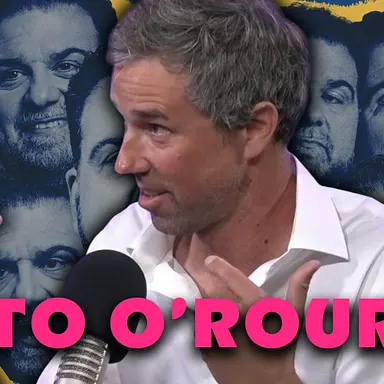
In this Best of South Beach Sessions episode, Dan Le Batard speaks with former Texas congressman Beto O'Rourke about grief, empathy and hope. Days after Le Batard's brother died, the two talk about losing loved ones, including O'Rourke's younger sister Aaron, and about how to keep going through pain.
The conversation then turns to gun violence in Uvalde, migrant deaths at the Rio Grande, voting rights in Texas and the history of civil rights activists. O'Rourke argues that persistence and organizing can change laws, while the discussion also weighs how hard that fight is.
Listeners will hear personal reflections on family, politics and purpose.
In this episode Dan Le Batard, Beto O'Rourke
The transcript of this Beto O'Rourke episode on grief and democracy was made with the technology behind HappyScribe's automatic meeting notes.
Ads in this audio differ from the text. Tap the sentence you're hearing to follow along.
Synced: the text now follows the audio.
You are listening to Draft Kings Network.
Ab jetzt wird's günstig, und zwar richtig. Flaschenpost ist jetzt größer, günstiger und liefert wie gewohnt bis an deine Haustür. Mit über 4.000 neuen Produkten bekommst du Lebensmittel, Getränke und noch viel mehr für deinen kompletten Wocheneinkauf. Alles so günstig wie nie zuvor. Und noch besser: Spare jetzt mit dem Code SPAR15 ganze 15 € auf deine erste Bestellung. Jetzt App öffnen, riesiges Sortiment entdecken und deinen Einkauf günstig liefern lassen. Flaschenpost.
Du suchst eine günstige Autoversicherung? Spar dir Vergleichsportale und geh direkt zu HUK24. Das lohnt sich richtig. Jetzt wechseln und 15 € Rabatt sichern mit dem Code SPOTIFY auf huk24.de/spotify. HUK24: digital, einfach, günstiger. Teilnahmebedingungen auf huk24.de.
If we're going to confront climate change, if we're going to reduce gun violence, if we're going to make sure that people can earn enough to survive, pay rent, and feed themselves and medicate themselves so they can survive to keep going, it's going to take our democracy. It's going to take the wisdom and the genius of people coming together to get this done. And nowhere is this democracy under greater attack than in Texas.
Welcome to South Beach Sessions. We've got Beto O'Rourke. I did not know that I would be doing this, a politician selling a book. We've got to try. I am very disappointed with politics now and leadership in general, but I have been an admirer of your work from afar because even though I don't know very much about your policies, you do give off a fundamental decency with some of the things that you are saying. So I am happy to be talking to you. I also think you can be helpful to me at this particular time in my life because my brother died a few days ago.
My little brother. I don't particularly want to be talking to a politician who's selling a book right now or working in general. I'm making I've got some questions about the life choices I've made right now because of how much pain I'm in. And so I'm grateful for your presence here, even though that introduction didn't sound like it.
Well, I'm grateful to be here. And I got to tell you, I'm so sorry about David. And I had a chance to listen to you the day after he died. And first of all, I was just impressed, amazed, confused by the fact that you were actually working so soon after he died. But it made sense to me in what you said about this last year with him and having this almost this timer. You have this set amount of time within which you have this opportunity to connect with him, to talk to him, to receive whatever he wants to give back to you.
And I could tell that that meant a lot to you and it meant a lot to me. I was sharing with Matthew earlier, my mom is sick with cancer and a very tough cancer that's in many parts of her body right now. And we're in that. We're in this time where we don't know how much time we have, but we know that it's not going to be forever. And I find myself and my sister Charlotte as well spending so much time, so much more time with my mom and so much more meaningful and powerful.
And what you said yesterday, man, if it connected with me, it connected with millions of people across this country who are living through or have lived through or will live through very similar situations. And then I just got to say this. At first, I was kind of shocked by the way that those around you responded, bringing laughter into this, giving you a hard time. But that was also very beautiful. It was clearly what you needed. You lit up in a way with these people who are so close to you, giving you love in this way that only a really good friend or a family member can do.
So really sorry about your loss.
Thank you for all of that. And thank you for paying attention to what it is that was happening around me because my wife didn't want me to come into work. And one of my rationalizations beyond me and my brother always work. That's sort of the exile way. I appreciate how you're fighting for migrants because work was the way to freedom. And this America was going to give us a freedom that nowhere else in the world could give us because I believed in that growing up. And the work probably killed him.
And I hope it can rescue me because I felt like I had to come say something because I didn't know who I would reach with whatever it is that I had to say. But it meant me being broken vulnerably in front of a public that historically can't be trusted with that vulnerability. And so I feared it. I've been sobbing all week. But I'm pretty sure Matthew, the aforementioned Matthew, South Beach Sessions producer, he is pushing me to be more publicly vulnerable.
And this one is as broken as I can be in front of people. But you experienced similar loss recently, right? I mean, you were very close to your sister who was eight years younger than you. Aaron?
Aaron, eight years younger. Our little sister, Charlotte, is four years younger than I am. So we're spaced by four years. Aaron, who just an extraordinary human being, talked to her every single day, multiple times a day, born with significant intellectual and learning disabilities, was in the special ed classes at our public schools, lived with me for a while, lived with my mom for a long time, lived in an assisted living community towards the end of her life in Carlsbad, New Mexico, an amazing place.
And had progressively gotten less healthy over the course of her life, had diabetes, had some other issues, and towards the end of last year fell and fractured her hip. And so my sister Charlotte and I drove up to Carlsbad. It's about a three-hour drive from El Paso. We're there for what we thought was going to be a fairly routine surgery. And over the course of that surgery and the time in the hospital, she got sicker. She got fluid buildup in her lungs.
And we watched her over the course of really a matter of days die. And we didn't know it at the time. And I wouldn't allow myself to know it, honestly. Whatever my sister, who is a nurse, and the doctors were telling us, absolutely not. There's got to be a way. She's 42 fucking years old. There's got to be a way that we're going to save her life. She's not ready to die. We're not ready for this. The thing is, towards the end, she wanted to go. And she was fighting us.
She was fighting the nurses and the doctors. She had bruises up and down her arms from thrashing against her hospital bed when she'd have to do a breathing treatment. She was so tired. And she could not fight this anymore. And my mom made this extraordinarily courageous decision to move her to hospice from University Medical Center in El Paso. And literally that night, that next morning, Aaron died.
And my mom was there, which was amazing that my mom got to be there. My sister Charlotte and I were there shortly after. And it's strange. This happened in December. And it is not something that I've in any way come to terms with. And I appreciate you asking me about it because this is clearly cathartic for me. But I don't understand it. It wasn't something that we were prepared for. The way that you described that time with your brother, the way that we have this time with my mom, we didn't have that with Aaron.
But I'll say this on a positive note. I feel so incredibly lucky to have been her brother and for her to have been in my life. Pure, unfiltered love and emotion and whatever the fuck she was feeling at the time, you were going to know it. She didn't have the ability or the desire to parse her words or to filter her sentiment. It just came out. And I told you I talked to her every day, sometimes multiple times a day.
Most of those calls were, "Hey, Beto, I love you. I hope you kick this guy's ass. Fuck him up. Aaron, bye." Just amazing. And that is still with me and part of my life, even though she physically is not. And I hope at some point I come to terms with this, although I don't know how you do that.
I hope I do too. I've spent the last year living aggressively, I would say, because the watching of that deterioration and still having hope, so much hope that you're totally stunned when someone who is ill dies, leaves, no matter their age, 50 in the case of my brother, 42 in the case here. I don't know how stunned we're allowed to be, given that the warning was here plenty from doctors. You can hope all you want, but he's going to die in a year or two.
And at the end, they told me four to six weeks, and he ended up dying on the sixth week. So the clock was that loud for our remaining days. And I didn't realize when you talk about the anger, I did not realize that my brother the Sunday morning before he passed that because the medicines had him disoriented because he was on so many medicines and it was screwing with his mind. When I came in, he said, "I'm done with the back and forth, Dan."
Like really angrily spit it at me. And I was just arriving. I hadn't even said hello. And I couldn't be clear that at the time, it wasn't clear to me. It is now that he was telling me he was done.
Yeah.
I thought he was being just like delirious and fighting at me. At the start, I didn't realize he was telling me, "No, I'm going now. I'm done fighting."
It's hard to listen. It was hard for me. When Aaron was trying to tell us verbally, I mean, and Aaron, again, didn't hold anything back, but also physically, she was done. And I wrongly, in hindsight, was fighting her back. No, we're going to save your life. You got to do this next breathing treatment. You got to sit up in your bed. I know this hurts. I know it's painful. I know you don't want to do this anymore. I know it's not fair, but you got to do it. You got to live. And she was done.
And I'm grateful for my sister Charlotte who could see that. My mom and for a mother, I can't imagine. I can't imagine for her to accept that and make that decision to move over to hospice and to stop with the needles and the interventions and the waking her up and pumping drugs into her body and hoping that she was going to be okay. That was what Aaron wanted. And ultimately, my mom was able to honor that.
But my dad, I was telling Matthew this, and I'm sorry that we're talking so much about death, but my dad died suddenly 21 years ago, 22 years ago. And like you, I was a young guy at the time, but like you, I went to meet with my mom. I went to go identify the body. And I met with my dad's best friends and we mourned for a bit. And then I went back into work. I didn't know where else to go. I didn't know what to do with myself. I wasn't married at the time. I just needed to be in motion again.
It's a great place to hide, isn't it?
It is. It is. And you can do those things that in some ways have become automatic or you have such great muscle memory that you can just fall into that rhythm and it's safe. And yes, you're to some degree in hiding. You don't have to reveal a whole bunch. But the only point I want to make with this is just after two decades, that is still with me. He is still with me, at least. And I know from your dad, from Poppy, our dads are in our heads forever, for good or for bad.
And I try to think about how to be good with my kids. But my dad is in my head. His death is in my head. It's never something that goes away. It's something that over time we gain perspective on and understand. And there's context in the life that we've lived beyond that. But it will always be a defining moment and event. And I've got to think that's going to be the case with David.
We will talk about some of the things in your book, but I do want to stay here for a while. And I don't think you need to apologize for talking too much about death because I didn't consider it enough. And even when the clock got here, I hadn't given any thought before a year ago. Well, where's my love going to go for him? Well, I'm not going to lose my love for him. I hadn't considered the idea that I could lose someone who's a bit of a son and a little brother and that I will always look at as a little kid who I had to take care of.
Some of the hardest parts in enduring what the last year has been is how helpless I felt. And I want to talk in the context of your book, how helpless you must feel to be somebody trying to do decent things in today's America and you're losing to Guns in Texas. Like you can't beat Ted Cruz or Dan Patrick because Guns in Texas. And it doesn't matter how decent you are, you lose, Beto, because you got to believe in Guns in Texas. The last year of my life has had so much learning in it because I could simply go and be present daily next to him as he lost the use of half of his body.
And I'm seeing the life squeezed out of him, but I'm going and revisiting the greatest love I've known with an appreciation for, "Oh, I'm going to lose this soon." I've never lived in a way like this is something that can be lost. This is going to be with me forever. I hadn't considered the idea that that would only be a cliché now, that the people listening to this who aren't feeling it are saying, "Yeah, yeah, sure, right, whatever. His spirit is with you, whatever, forever, Le Batard." If you're not emotionally ready to receive this, the people listening to it are going to say, "Dan, you're full of shit."
What do you think David was feeling over this last year about you in that same way? If the love was just as great and strong and present for him as it was for you, what was he feeling?
Well, this is the thing. My family has never been good at receiving love. I've come to understand that. Like to really receive it, I think probably in protection of to really receive love is to welcome the pain that comes with the greatest of loss, right? So even as this is happening, my brother, I'm not sure that he wasn't still testing my love to see that I would show up every day, but I would because I loved him like that. And at the end, everything that had plagued whatever our younger brother, older brother dynamics melted away because I kept showing up for him.
And I wouldn't let him not receive it.
And that's what he took with him.
And so in that, there is the learning involved in whatever my family patterns are that I feel so loved by my wife inside of that because she has brought me here. She has taught me. She has had a lot of grief in her life. She describes it as like vines that climb up your legs and never leave the bad parts of it, the haunting parts of it, the parts that don't come with appreciation and gratitude for having had it.
But yes, to love most deeply risks at every turn feeling like this for the rest of my life where my heart hurts and the rest of me is broken too.
I love the way that you describe it as the price we pay for loving fully. It's impossible to open yourself up in that way to give and receive love without also opening yourself up to the pain that will absolutely come with it. It may not come in the form that you're describing and I'm describing, but there will be pain. It will be a part of it. And I don't know the words to describe that bargain or deal or just it is what it is.
But I've certainly found that to be true in my life and my relationships with my sister and with my dad, with my family, and with other people that I've experienced loss with or great love with. I'll tell you that there's something in what I have been able to do over my time in politics that has exposed me to so much of this. To be in Uvalde, for example, where in May of last year, as you know and your listeners know, a gunman armed with an AR-15 and hundreds of rounds of ammunition slaughtered 19 kids and killed two teachers who were there to defend them.
Being with those families and meeting these mothers and these fathers and staying in touch with them now more than a year later, what so impresses me is that so many of them are in this fight to make sure that it doesn't happen to anybody else's kids. So one dad, his name's Brett Cross, literally set up a sleeping bag outside of the school district headquarters to try to get accountability for what those cops did or didn't do for over an hour while that gunman was in there with their kids.
He's done the same thing at the state capital, joined by other parents. And what gets me is they know full well they'll never get their kids back. There's no amount of work or devotion or suffering or pain that they can put themselves through now that's going to get them back.
Oh, they're just protecting others from that pain.
But they're doing it for us. They want to make sure. It is such a hell that they're living through that it has produced within them a desire to ensure no one else has to go through this hell or they'll do everything they can to prevent it. And they do and they are. And that's really inspiring to me to see how some people channel that grief and that pain into action and are able to avoid the worst depths of despair.
And I don't blame people who go there who just say, "I just can't anymore. I give up. I just give up. I can't work."
But it must be so I've just seen in the people who love my brother in the last couple of days, purpose. It gives you some purpose. Otherwise, I mean, it's already so senseless to lose a child that way.
Right.
How can you go on hopeless, senseless, and purposeless after that? Yes, you've got to try for others not to feel that pain. The point that I was trying to make to you about the last year of learning around my brother is that I felt so helpless as his bigger brother. So very helpless as the guy who always protected him. He's rotting in a bed, can't get up. I can't help him. I don't know how you when you say we've got to try as your book title, I don't know how daily in today's America you don't feel helpless because you're saying, "Let's not."
I mean, it's not a controversial stance. Let's protect kids from being killed in schools. It's not even a better America that you want. Let's not be more awful than any country in the world who can't protect its children. It's not a controversial take, and it is a losing one in Texas, as far as I can tell, because you can't beat guns in Texas.
So much of writing and researching this book, which is really the retelling of stories about other people who faced seemingly insurmountable odds, was in some ways to buck myself up and to avoid that very real temptation to despair of, "Look at the odds we're up against," the ones you just described politically in Texas. Let's not even talk about banning the sale of weapons that were originally designed for use in a battlefield to kill people.
Let's just talk about raising the age from 18 to 21. The kid, the young man who killed those 21 people in Uvalde waited till he was 18 years old to legally walk in and buy not one, but two of these weapons of war. Raise it to 21. At least we've purchased a few years, hopefully for some intervention in this troubled young man's life to stop him before he does that. That, for whatever reason, is not a winning proposition in the state of Texas. But I'll caveat it with this. It may not be a winning proposition with the current electorate.
And I think that's important because it is harder to vote. It's harder to register to vote in Texas than in any other state in the union. And I'm convinced that the electorate, those who participate in these elections, those people who vote, are not fully reflective of the population at large. No one would settle for leading the nation in the number of school shootings, of not having changed our laws more than a year after these 19 children and their two teachers were slaughtered in Uvalde. No one would stand for $7.25 an hour minimum wage, leading the nation in childhood diabetes deaths, maternal mortality, total abortion ban.
You name it. It comes to a head in the worst possible way in Texas. That's not a reflection of who we are or our values, Republican, Democrat, or Independent. I think it is a reflection of government that's been captured through a very intense form of voter suppression and voter intimidation. That doesn't explain everything, okay? I'm not here to say that I didn't win this race for governor last year because of voter suppression and voter intimidation. Certainly, it was a factor, but there were others.
But the stories in this book are about people, Lawrence Nixon, who anchors this book. Black man in El Paso, Texas, 100 years ago, 1923, the Texas legislature outlaws voting by Black people. And not euphemistically, not how many jelly beans in the jar, not recite the state constitution, just if you're Black, you can't vote. And this guy, nonetheless, pays his poll tax, stands in line to vote, gets to the front of the line, and they're like, "Dr. Nixon," because he's never missed an election before this, "How are you? Good morning to you. You know we can't let you vote."
And he says, "I know you can't, but I've got to try." And this guy, for 21 years, fights the loneliest and I think in the eyes of others, craziest battle that he possibly could have. I mean, folks thought in some cases that he was a joke. Like, "What are you going to do? This is Texas. You'll never beat the machine. You'll never be able to vote. Just give up and get back to your life. You're a doctor. You've got a wonderful practice. You've got a beautiful wife, these amazing children. Focus on that. Just be happy in your own life." This guy would not give up. Absolutely tenacious.
Wins two Supreme Court victories and ultimately by 44, integration in our elections have become fact. And by 20 years later, you've got the Voting Rights Act. That guy didn't despair. And he had every reason and possibly right to, and he just would not. So whether it's Nixon or these Uvalde families, when I see people who have faced much worse than I hope I will ever know in my life and nonetheless keep moving forward, I am so fucking inspired.
And I think to myself, "Who am I? Who am I not to do my part? Who am I to give up or to give in? No way." And so this book really was for me gathering these stories, trying to find others that were just as amazing, and being able to fill a book's worth of them that I hope give other people some inspiration about whatever challenges they're facing in their lives.
Delivered by Little Caesars, the official pizza sponsor of the NFL. Right now, score two baves just for you with Detroit-style slices and sticks. It's the biggest duo since Monday nights and football. Two pieces of Detroit-style deep dish pepperoni pizza and four pieces of Italian cheese bread and crazy sauce for just $4.99 only at Little Caesars. Make your game day delicious with Little Caesars. Officially delicious.
Ab jetzt wird's günstig und zwar richtig. Flaschenpost ist jetzt größer, günstiger und liefert wie gewohnt bis an deine Haustür. Mit über 4.000 neuen Produkten bekommst du Lebensmittel, Getränke und noch viel mehr für deinen kompletten Wocheneinkauf. Alles so günstig wie nie zuvor. Und noch besser, spare jetzt mit dem Code SPAR15 ganze 15 Euro auf deine erste Bestellung. Jetzt App öffnen, riesiges Sortiment entdecken und deinen Einkauf günstig liefern lassen. Flaschenpost.
We'll talk about your dad in a second and his political career and how much it or how little it has to do with what you're attempting to do. But I did want to go back to where it is that you presently are emotionally with your mother. The details that you're willing to share on that that have come with learning include what?
My mom is just the strongest person I know. Been there for me, always trying to support me, boost my confidence, which I struggled with, maybe not unlike a billion other people. As I came of age, everything, the way I looked, whether I was good enough or smart enough or able to take on this or that challenge or come back from this or that rejection, always in my corner, just absolutely unconditionally loving me and my sisters and my dad.
And probably so much so, Dan, that I mean, I probably took that for granted. It's just always been there. It's always going to be there. I don't even recognize how lucky I am. And last year, we learned, she learned that she has cancer that is starting out in her kidneys, has progressed into her liver and to other parts of her body. And doesn't smoke, doesn't drink, eats incredibly healthy, is out walking and exercising, just has led a really good life and really kind of a saint's life.
The more you know about my dad and our family and just the stuff that she's been through, not that my dad was a bad person, but he was tough, right? And she raised my sister Erin, who was really, really, really hard to raise. Any parent of a special needs child knows what I'm talking about. And for this to happen to her just didn't seem in any way logical or rational, certainly didn't seem right.
And it's been really scary for her. And that's a fucked up thing to see when this person who's been a rock in your life, when they look scared. And they've never looked I've never seen her look scared before. But I've also seen her not so much overcome that fear, but accept to a degree what is happening to her and to her body, understand the ways in which she can fight it. She's been through different kinds of chemo.
She's on her third kind right now, which she seems to be tolerating it well in terms of the side effects and the symptoms of it. We don't know what it's doing to stop the growth of that cancer in her body. She'll get a full screening checkup before too long and we'll know a little bit more. But in this time, we, Charlotte, my mom, and me have certainly become closer, literally spending more time together, going a little bit deeper in what we talk about.
I think understanding, as you described on the show the other day about David, that you've got a set amount of time to work with. I don't happen to know what that time is. Nobody does. But it's certainly shortened from what we thought it was before.
What a blessing to know, by the way. I didn't realize it at the time, right? It's the worst news you can possibly receive. One year ago, your brother has late-stage lung cancer. Clock's ticking. And you can be as hopeful as you want, but here it is. You must live daily with the knowledge that the clock is ticking. And I don't think many people listening to this who haven't experienced loss are walking around with that clock ticking that forces you to be present with life in a way that you couldn't be without hearing that clock ticking all the time.
And people will listen to you right now and you could go on and tell them like, "You don't know when you're going to lose this person, so every moment is precious." Effectively, functionally, we just can't live our lives that way. We can't live knowing that every moment is precious with everyone around us. We just, I don't think, have the capacity or the focus or the attention or the discipline to do that or the forcing mechanism of knowing that someone's time is limited. And you're right. I think we've gone from fear and anger to something that is, in its own way, beautiful, of knowing that we have this time together, that we're very focused, that we want to spend every moment that we can, that this person that I've leaned on my entire life selfishly and maybe not unlike lots of sons with their moms, she can lean on me right now.
I want her to lean on me. It is so opposite to her character and to what she's been doing for I'm 50 years old, the last 50 years of her life, that it's hard for her a little bit to do that. "Hey, mom, I'm going to be coming by your house today. What can I get you from the grocery store?" "Oh, no, it's okay, Beto. I've got it." And I know she's not well enough to get in the car and drive herself there. Somehow, she thinks that she's going to figure this out on her own. She doesn't want to ask me to do the most simple things, but she's opening up to that now.
And I'm just really, really grateful for that, really grateful for the time. I mentioned my dad died suddenly. He was hit by a car when he was out on his bicycle one day.
He was 58?
Yeah, he was just a little bit older than I am now in the scheme of things. The thing is, he and I, again, maybe this happens in a lot of families, we were super close when I was young, alienated when I was a teenager, almost not talking to each other when I'm in my early 20s. I moved back to El Paso from New York, and we connected again as adults, almost as friends. And the night before he died, of course, we didn't know he was going to die the next morning. For some reason, my mom and my sisters were out of the house doing something.
And I came over and we ate leftovers out of the fridge and drank a bottle of wine together and had just the most beautiful conversation about everything, about life, the life he'd led. "What do you think your sisters are going to do? How do you think Erin is progressing? Who created the universe? How close do you think that star is over there as the sun starts to set?" Just a beautiful, sprawling, untrammeled, open conversation that went on all night.
And the next thing, I'm at work the next morning, I get a call from my mom. She says, "Your dad is dead." And I feel very fortunate for that, that I got that moment with him. We'd been so disconnected. And I don't know how he felt about me, but at times I thought I did not like him. And of course, I loved him, and I love him so much to this day. But for us to come back together again in that moment and for me to know in his presence that he loved me, that I loved him, that we connected in this beautiful way.
I don't want to be religious about this, but it felt like there was some bigger plan that I was lucky enough to be a part of to spend that time with my dad. And I feel that now in a very almost a bigger way with my mom that I get to spend all this wonderful, wonderful time with her. And I want to make the most of it.
What happened that you and your dad weren't aligned? You followed his career path, right? I don't know if it's as simple as my dad was a politician. I'm going to be a politician. No?
No, no. I mean, I wanted nothing to do with politics, nothing to do with the life that he had led. I was into punk rock music. I was playing in bands. We were touring. We were putting out records. I was an English major. He was so pissed off. I was lucky enough to get into Columbia. I took out student loans. He took out personal loans. And I come home my sophomore year and I said, "Hey, Dad, I'm going to major in English." And he's like, "What the fuck are you thinking? You don't realize how much money you're going to have to pay back.
And you're going to do that to read books all day and to talk about the stories that you read in a classroom." I remember how disappointed he was in me and how disconnected I felt from him. He totally doesn't get me and understand anything that drives me in my life and that I'm excited for. And of course, as an adult now with kids of my own, I can understand where he was coming from. He was worried about me. He wanted to make sure that I'd be okay, that I was set on a path that would pay off, first of all, the loans that I'd taken out and that would be rewarding for me, that he wanted me to be happy in my life.
But we just had so many points of conflict. And he was a dominating personality, fucking charisma for miles. I can't tell you after he died how many people approached me and said, "Your dad was my best friend." He just never met a stranger, was intuitive with people, was whip smart, told me that he never read a book cover to cover until after he left college, kind of just charmed his way through school and then became this autodidact of just diving into Chinese history and the purges during Stalin's years and economic policy.
He loved life, loved learning, loved people. But if you were his son, you were always in his shadow. And I was this ungainly awkward, too tall, too skinny, too uncoordinated kid who just didn't want that world of politics and socializing and wanted to be into music and books and storytelling and be with my friends in the band.
And I thought that was my life. And somehow, as I moved back to Texas, as I started a small business building websites and later doing online software development for businesses, and I had to hustle to develop clients and I had to go work to bring people in and make sure that they were happy with the work that we were doing, I realized I too like to be around people. I like to build something. I like to be involved in the future of my community.
And from that path, it was city council, running for Congress, serving there for six years, and then doing the work that I've been doing statewide over the last six years. So it was never inevitable, at least in my mind. But he certainly gifted me, us, his kids, with this love of community and civic participation, fighting for what's right. I mean, he was very often on the wrong side of things popularly. He rarely cared if he pissed anybody off to his detriment, and it really kind of spiked his political career.
But man, his integrity, his ethics, his honesty, the balls he had in the way that he did what he did is so inspiring to me. At the time, it's too much. When you're 17, 16 years old, you're like, "Holy shit, it's too powerful." It's like being too close to the sun.
But on top of that, you're insecure. And on top of that, you're probably feeling, if not unloved by him, that you've disappointed him now with your choices.
Totally. And I'll never match him. I can never be that smart. I'll never be that gregarious or that popular or that loved. Yeah. And he totally disapproves of everything. I had long hair. The clothes I was wearing, the way that I talked. Again, as I say this, it sounds stereotypical of a teenage boy in America and their dad. I mean, how often has that story played out? But for each of us, it's deeply personal and very powerful and very shaping of who we ultimately become.
And the thing is, as I tell you all this and as I rethink this over the course of my adult life with three kids, I really have to try to be mindful of not doing the same thing to my kids and giving them their space and accepting who they are and the choices that they make and just making sure beyond anything else, you know that I love you regardless. And there's nothing you could do that would make me love you more. There's nothing you could do that would make me love you less.
I love you with everything that I've got. And that's all that I want you to know, Henry, Ulysses, and Molly. And yet, sometimes in our actions and the way that we respond and react to our kids, we send a different signal. And so got to be mindful of that.
What do you think that he would think of you now?
I think that he would, at some level, be impressed. I hope that I would have met his expectations. And I say met them because I hope that he had high goals and high aims for me. I think that was part of the friction with us is he expected a lot out of me and I didn't maybe always deliver to what his expectations were.
It's such an interesting friction, right? Because this is my father. My father, imagine this. And I do want to talk about the work that you're doing with migrants because I don't believe that I have any more utopian, naive image of what America is. But my family members were from a place in time where you will jump into the ocean and die and literally throw your life to the wind in order to get to America and freedom.
My parents left their families at 15 and 16 years old to come and bring us a greater life. And with that freedom came the freedom to choose my own path. But when he was trying to get me to engineering, which would have made me unhappy, and I had scholarships to Georgia Tech and big engineering schools, and I told him I wanted to be a sports writer because some people in high school told me I was good at that, his disapproval was so withering and went back. He was trying to build a life for me.
He's going to take me to a private school, a school he can't afford with a car, the dashboard, the glove compartment opens when we hit a bump. There are holes in the floor. He's trying to build a life for me so I can get these engineering scholarships. And I come and tell him I want to be a sports writer. That was crushing to me, debilitating, that I would not meet his standards. The disapproval of that, it didn't feel like unconditional love. But I don't blame him for being scared. What else would they know?
They came to this country, and what got him closer to freedom was an engineering degree. And so that was his perspective. But he didn't talk to me for a good amount of time. And our relationship could have broken up in there if I had been a rebellious teenage kid who was more confident about breaking away from what my father or my parents wanted me to be. But I was a Cuban kid. So I wasn't an adult. I'm like a child. I believe Cuban kids mature, Cuban men mature much slower because we just get coddled by exiles who have been fearful.
You must see this at the border. You must have your heart broken at every turn by the idea that they have an image of what America is, and they have to look at it through a chain-link fence that is cruel because they can't get in, and America is now treating them like toys.
Especially in El Paso, which is connected with this city in Mexico called Ciudad Juárez. El Paso's the metro area, roughly a million. Ciudad Juárez, 1.5 to 2 million, 3 million people in the Chihuahuan Desert, in the Rocky Mountains, in the Rio Grande River Valley. And then there's nothing for hundreds of miles in every direction in terms of big cities, big population centers. And just the interplay between those two cities and culture and trade, we see that day in and day out.
There are millions of crossings between our two cities every year. So that dynamic is at play there. And so many El Pasoans started in Chihuahua or started in Ciudad Juárez. Many Mexican, but many came here from other countries, came here from Cuba or Lebanon or Syria. It's a large Lebanese population in El Paso. And so many of those stories from my friends who are Lebanese Americans are of their grandfathers who came here from Juárez in 1912 and were rag pickers and then slowly were able to confer that into a small little bodega, grocery store, and then into that, into some real estate holdings.
And every generation just has that hammered into them that you are going to work because your grandfather started from nothing and built this up. And you look at those who are coming over today, we just learned that a second body has been recovered in this floating barrier, which is this drowning death trap that our governor, Greg Abbott, has deployed in the middle of the Rio Grande River. I mean, imagine you've traveled 2,000 miles from Honduras or Guatemala or El Salvador. You've come over from Haiti or Cuba to the mainland, and then you've made your way up those 2,000 miles.
You're now at the Rio Grande River. You're at the front door to the United States of America. You cannot go back to Cuba. You cannot go back to Haiti. There is only one direction that you can move. And unfortunately, and though I'm a Democrat, I feel like I've got to say this, our current president has made it too hard for people who want to lawfully, legitimately claim asylum to do so in the right way, which means that you go to a port of entry at a bridge that crosses a river and you say, "Hey, my name is Beto O'Rourke. I want to claim asylum." And you go through that process.
Folks who can't do that feel like they have no other choice but to go into that river. And when they go into that river, whether you can swim or not, you're going to try to get across. And for those who can't, we've lost 28 people just in one county. There are 254 counties in Texas. One border river county, Maverick County, 28 people. These two are the last two of the 28 have drowned. They're kids, they're infants, they're fucking mothers who would do what my mom, what your mom, I bet, would do, did, which is sacrifice everything, potentially her own life, to give you a better one in this country.
And to do what? Not to get free healthcare or to steal some kids' place in school or to take a benefit that they didn't earn, to work the fucking hardest jobs that America has available today that most people who are born in this country won't take on for whatever reason. And those are the people that we are killing. And I don't think we can traffic in euphemisms and couch this in terms that make people comfortable. That is a conscious decision that we made to make it far more likely that you will drown and die and get caught up in that river barrier.
They've put concertina wire, razor wire under the water level. People are becoming ensnared and trapped in that. A pregnant woman was found tangled up in this concertina wire, which means that it cut and dug into her body, and she couldn't extricate herself from it. And she miscarries there. Imagine how painful and humiliating that public suffering on the banks of the Rio Grande River in 105-degree heat is. And we are doing that. And now that we know about this, it is on our conscience, and it is on all of us until we do something to change it.
And so these people who come here to do better for themselves, but to your family story and my family story and the stories of tens of millions of our fellow Americans, they also come here to make this a better country. And by their very presence, they have and they will. These are the people that we are doing this to right now. And I'm so disappointed and angry in our country. And not just Greg Abbott. It's just too easy to say that Greg Abbott did this. He did. And I want to be clear about who the perpetrator is.
But Joe Biden is the most powerful man on the planet right now. And that river boundary is under his purview, constitutionally, legally, in any way that you want to look at it. And for whatever reason, he has not intervened yet to save the lives of these people who will lose their lives unless somebody, and that's got to be President Joe Biden, does something right now. And I don't know why more people aren't raising this alarm or calling for the president to act.
But until he does, this is going to continue to happen. Because to expect Greg Abbott to change his spots or to suddenly grow a heart and empathize with those who are coming here is to expect too much. We've got to count on the person who can do it. And to the little I know of Joe Biden, having spent time with him on the campaign trail in 2019 and 2020, he is a good man with a conscience. He wants to do the right thing. He just needs to come through and do it now.
Out on the road, it's nice to have a partner who can help you make the most of your journey. A partner like the Love's Rewards app. With Love's Rewards along for the ride, you earn points on fuel, food, drinks, and more every time you scan. Then you can spend those points at Love's just like cash. So every stop is even more rewarding. Download the app today and watch the points roll in mile after mile. Love's Rewards. Save and earn it every turn. Terms apply. See website for details.
Ab jetzt wird's günstig, und zwar richtig. Flaschenpost ist jetzt größer, günstiger und liefert wie gewohnt bis an deine Haustür. Mit über 4.000 neuen Produkten bekommst du Lebensmittel, Getränke und noch viel mehr für deinen kompletten Wocheneinkauf. Alles so günstig wie nie zuvor. Und noch besser, spare jetzt mit dem Code SPAR15 ganze 15 Euro auf deine erste Bestellung. Jetzt App öffnen, riesiges Sortiment entdecken und deinen Einkauf günstig liefern lassen. Flaschenpost.
You must be exasperated by the leadership in this country or the results produced by a lack of leadership when the things that can win now seem deeply indecent. And obviously, Democrats have failed. I don't even say this as disparagement. It's just a party that doesn't know how to win against the most brazen and overt of tactics that are now criminal, getting indicted, and threatening democracy.
I cannot tell you how helpless I feel with America's leadership at the moment because I simply assume, perhaps naively, that everything at the top is bought and paid for by corporate interests, and it's just a swapping of power, and that people like you who seem to be fundamentally principled can't do anything tilting against that windmill, even though you say in your book, we've got to try.
Yeah. I think the past is the greatest source of strength for me going forward because if I just look at the scenario as you and I are describing it right now today, it is hopeless. And you are going to succumb to that temptation to despair. But when you go back in time and you see what Nixon and anyone else who had black skin in Texas and anywhere else in the Deep South was up against, the fact that not only did they not give in or give up, but they literally forced the change in America that everyone thought was impossible.
How in the world will a white majority country, which at the time is led by a Southern president, LBJ, the first Texas president, how will they ever confer power to a minority that has in recent memory been enslaved and been persecuted under Jim Crow? This is just never, ever going to happen. And yet, people like John Lewis, 24 years old, beaten almost to death, crossing the Edmund Pettus Bridge in March of '65, Septa McClark with her citizenship schools that helped people navigate the intricacies of voter registration in these Southern states, they just never gave in.
They never gave up. And their persistence, the will, the courage, the strength that they had, that's what purchased the democracy that we have today, this multiracial democracy. Prior to '65, we were a democracy in name only. If that, post-1965, we really begin to move towards these foundational ideas that we're all created equal, we'll be treated equal under the law, we'll all have a say in those who represent and guide the direction of this country. It started to become true after that.
But here's a big lesson for me, and this one right between the eyes after the Trump election. No victory is final, and no fight that matters will ever be over. And just the concept of that can be exhausting. Wait a second. We have to keep fighting even after we've won? The answer is yes. But the sooner you accept that and realize that, or I'll just say the sooner I accept it and realize it, the better I will be at making sure that we win these fights.
Because you have what these brave civil and voting rights leaders purchased in 1965, the right to vote, by 2013 in the Shelby versus Holder decision, that Voting Rights Act is absolutely gutted. States like Texas and Alabama and Georgia and Mississippi once again begin to actively disenfranchise voters, and not voters who look like you and not voters who look like me, but primarily African-American voters, voters who are poor, voters who are very young, and they're excluded effectively from the franchise.
And we're in this fight now that's lasted more than 10 years to regain that, voting rights for everybody, the ability to have free and fair elections in America. And not only are we trying to regain that lost right, at the same time, and you just alluded to this, you have one party and one person within it in Donald Trump who is actively trying to destroy this democracy that Maso Menos for 246, 47 years has been making progress towards realizing this ideal. How in the world will we ever succeed?
I have to keep going back to those who put their lives on the line and lost them to get us to that courthouse in Appomattox in 1965, those who put their lives on the line and lost them to get the Civil Rights and the Voting Rights Act. I don't know that people have to put their lives on the line and lose them again right now for us to overcome this challenge, but we really do have to give everything that we've got. And each of us must ask ourselves, what are you willing to give and to sacrifice to make sure that we come through? Because those soldiers, those union soldiers did it back then.
Those civil rights heroes did it back then. We've got to be able to do it right now.
Why do you care so much?
I love this country. I love people. The more time I spend traveling Texas, the more people I meet. And they can hate my guts, and a lot of them do. They can be as red and Republican as nature will allow. I love them. I want them to have a voice and a say and a life in this country that is a good one. And even more importantly, I want their kids and grandkids to have a shot at success. And yes, economic and financial success, but I want them to be able to live in the greatest democracy that the world has ever known.
I want them to freely and fairly choose their own future. And I'm convinced that our form of government, it is the exception, not the rule, in human history, it's the exception even on the planet today, is uniquely positioned or capable of taking on the greatest challenges we face. If we're going to confront climate change, if we're going to reduce gun violence, if we're going to make sure that people can earn enough to survive, pay rent, and feed themselves and medicate themselves so they can survive to keep going, it's going to take our democracy, it's going to take the wisdom and the genius of people coming together to get this done.
And nowhere is this democracy under greater attack than in Texas. And that attack, that challenge to this thing and these people that I love so much inspires this fight in me. So whether it's as a candidate, whether it's as an advocate, a volunteer, I just want to be in this fight. I want to do everything that I can. And I will.
I meant actually, and that was a very good answer, but I meant care about others. Where does it come from? Why are you taking up these specific causes that, again, I will tell the audience, because now at this point, anything I do with someone like you is I'm in the echo chamber, I'm a liberal, I'm a libtard, and I just want to talk to you about being decent. And part of being decent, fundamentally, it's not a political principle, is care about others.
Yeah.
And that's not politics. And so I'm just curious, why do you care the way you do about others?
I don't know, but I'll tell you, and it may just be because of the way that we started this conversation, but growing up as Aaron's older brother and seeing the way kids would lay into her and make fun of her, she was on the retard bus. She was somebody that others would mock. She would grow up with friends who would continue to develop intellectually, and she would not.
And I don't know that there's anything sadder that I've seen in my life with someone that I love. And she was such an underdog, and she was such a fucking fighter. I mean, literally a fighter. Literally getting in fights at El Paso High, literally coming home with busted up face and her hair pulled out because she'd just gotten it in with someone who had tried to put her down.
Because she had disabilities.
Because she had disabilities. She was just such an easy target. And Charlotte and I and my mom and my dad, we'd do everything we could to protect her, but you can only be around her so many hours of the day. And that had to have inspired something in us that makes us super sensitive to people who are getting fucked with or put down or who are being beaten on in an unfair fight. This immigrant mother with her two-year-old child crossing the river right now is up against the governor of the state of Texas who has deployed Department of Public Safety troopers, concertina wire, a floating barrier that will trap her and drown her.
I'm on her side. I want her to win. I want to make sure that she can get here safely and legally in an orderly way. I want our laws to change so that she never has to go through that again. But her story calls to me. Those parents in Uvalde who could only identify their kids by the shoes that they were wearing, I'm on their side. They are my heroes for the work that they're doing right now. I'm going to do everything I can to make sure that they are successful.
And I tell you, again, maybe because of the way we started this, but being in Aaron's presence and knowing what a fighter she was and what an underdog in life that she was, I'm sure inspired something in me. And I'd just like to say this as a tribute to her. Maybe it is my fight that is her fight, the fight that comes through me, my willingness to stand up to bullies and take on these incredible odds, sometimes successfully, very often not so much, and to be with those who are suffering.
I think that comes from her, and she is coming through me right now in this work that I do. I mean, that's my best understanding of where this comes from.
Off the top of your head, this is a complicated question. I don't know if you've considered it, but the failure that has hurt the most, and how did you overcome it? Because there's a lot of losing in your family in politics, trying to fight for things that seem fundamentally, hey, don't bully someone with disabilities.
Yeah. I tell you, personally, it has to be Aaron. And I know all of us, my sister, my mom, and I wonder what we could have done in the final years of her life to make sure she was healthy enough to take on some of the challenges that she was facing.
I'm sure, or I hate to say this about you, and I hope it's not true, but there are so many conversations with Aaron that run through my mind where she's like, "Hey, when are you coming to Carlsbad to visit me?" Oh, you know what? It's super busy. I'm running for governor right now. I'd love to come do that. After the race, I'll come see. Why the hell couldn't I take two days and go spend that time with her in Carlsbad? When she fell and cracked her hip, why didn't we take that surgery more seriously and realize that she could have gotten flu and pneumonia in her lungs?
That is one that is most painful to me. And honestly, I know there are things I could have done better, wish that I had done better, and will never get the chance to do again. Professionally, I really don't I know you didn't ask me about regrets. I don't have many regrets. It's always painful when you lose. Losing the Senate race to Ted Cruz, we were so close. In fact, I was convinced, I would have bet everything I had that we were going to win on the eve of the election.
I just could feel it in my bones traveling that state, going to every one of the 254 counties, killing ourselves on the road, and seeing the size of the crowds grow and grow and grow, the number of volunteers knocking on doors grow and grow and grow, the number of people who are responding positively, I am going to vote for you. The polling that showed that not just that we had caught up, that we were surpassing him, and to come up two and a half points short, it was a loss that was hard to accept and understand.
Every part of my being knew that we were going to win, and the opposite happened. This last race for governor, maybe even more aware of the consequences of losing, spending all that time with those families in Uvalde, meeting so many people who can't literally see a doctor and know that they're going to die of diabetes because we didn't expand Medicaid.
Oh my God.
Knowing.
That one recently, just being in the hospital, knowing how much I was paying for things just to try and make my brother have the last days of his life, be nice. I couldn't help but think, how do people who don't have money do any of this?
They don't. And I'd ask people, this guy, a young man with diabetes, had glaucoma because the diabetes is untreated. And I said, "So what are you going to do?" And he said, "What do you want me to do? I can't see a doctor. I've been able to get into a free clinic where they basically told me unless I get consistent care and am able to be prescribed the insulin that I need to treat my diabetes, I'm dead at 35." And that's just his life unless we make a change.
Those deaths that I talked about in the river, that is going to be their future and fate unless we change course. And I knew all that. And many of us who are part of this campaign for governor last year knew all of that. And there was an urgency to it. In the Senate race, there's an urgency to stopping the threat of Donald Trump and making sure that we had another seat in the Senate and ensuring that there's a balance there that will hopefully help this country come through. And certainly, I had plans for great things that I wanted to do for Texas and the country in the Senate.
But the governor of the state of Texas is able unilaterally to decide these issues of whether you can go to a hospital, whether you're going to drown in that river, whether your 12-year-old kid will have their head blown off in a school shooting because we've done nothing to address the availability of those weapons or the fuel that we add to the fire when we talk about invasions and Hispanics and Haitians replacing us as white people in this country, all the racist tropes that they traffic in.
So much was on the line and still is. And I don't know what my role is now beyond leading this organization called Powered by People that focuses on voter registration and trying to address the imbalance in voting rights and suppression and intimidation. But I'm going to do it. I'm going to do whatever I can at whatever turn to make sure that ultimately we come through. I think it's a matter of time. It's a matter of effort. It's a matter of smarts. And we've got to employ all of that to shorten the amount of time between now and whenever we're able to get some kind of rational, sensible, humane leadership in the state of Texas.
No matter your politics, I imagine if you're listening to this, we can come to the agreement that kids need to stop dying in schools from gunmen, and that needs to stop being such a uniquely American problem. What did you learn about Uvalde that you think people need to hear? And how were you changed by just the horror in the details of how can America not stop this from happening?
You and I are talking on the fourth anniversary of the Walmart shooting in El Paso. 23 people were slaughtered in my community that day. The governor came down, press conference, this is terrible, we can't allow this to happen again. I can't count the number of funerals I went to, the number of times I went to the makeshift memorial at the Walmart on El Paso's east side, the number of people that I talked to, the number of hours that we spent agonizing, crying, talking about this with our kids and our family.
And to be in Uvalde the day after that shooting last year and to be at a press conference with the governor is saying the same things and knowing it's like the depth of horror and despair to hear the person in charge uniquely with the power to change this, to essentially say nothing will change. And to also know that since the El Paso shooting, Texas has made it not harder, but easier to get a firearm.
No universal background check. No license required anymore to carry a firearm in public. That mixed with this toxic mix of racism and white replacement theory and fear of invasion of brown people coming to this country to take our stuff or to kill us or to give us drugs, it's not a matter of if this will continue to happen, but when the next one will take place. And in Uvalde, I felt that to my bones that this will continue to happen.
I just know too many people who lost their kids in school shootings or church shootings or shopping center shootings or Walmart shootings, it's going to continue to happen. Einstein's definition of insanity is doing the same thing over and over again and expecting a different result. And I learned that the best time to stop the next one is right now. It's too late to get there after the fact, as the governor consistently does. And a lot of other well-meaning people who offer thoughts and prayers, those Uvalde parents, the reason they are my heroes is they're out there to stop the next shooting before it happens.
And they are the biggest lesson that I have learned. We would forgive them if they buried their heads, locked the door, never showed their face in public. If they gave up you talked about your cynicism or your difficulty with politics right now in this country, which a lot of people share. If anyone has a right to, it is those parents who are the victims of a system that so badly failed them that it killed their kids, and yet they are as engaged in this political system as anybody I know.
With no political experience, I don't know how many of them voted before or whether they voted Republican or Democrat, it really doesn't matter. They're out there to make a change. In fact, Kim Rubio, who lost her child, is now running to be mayor of Uvalde, and I sure hope that she wins. Others are doing everything they can to push Republican and Democratic lawmakers alike to change this. And in much the same way that I talked about John Lewis and Septa McClark and Dr. King and Andrew Young and others giving President Johnson the power to pass the Voting Rights Act, forcing him to pass the Voting Rights Act, these Uvalde parents, ultimately, they're going to be part of this coalition and movement that forces those in power to do the right thing.
Whether they want to or not, it will be politically impossible to ignore them. And so it shouldn't have taken this suffering to produce this change, but it has. And they will make this a better state, a better country for it. They will save lives by their leadership.
Intellectually, how do you do the gymnastics on the following? I love Miami. It's the only city I have ever loved. I right now am embarrassed by the state of Florida. What surrounds you in Texas at the height of racism and some of the things that you're talking about that has people waving guns, how do you serve Texas, speak on behalf of Texas without being embarrassed by what Texas is?
I'm embarrassed by Greg Abbott and Dan Patrick and Ken Paxton, our indicted attorney general who's been impeached and is now on trial in the Texas Senate. But they are in no way reflective of the 30 million people that they purport to serve and represent. And that includes Republicans and, again, folks who would never in a million years vote for me. I've been in these intimate town hall settings that very often become very confrontational with people who don't like the fact initially that I'm in their town, that I come to Spearman, Texas, or to Junction, Texas, and they want to tell me.
And yet they also tell me, you know what? You're the first guy to show up in this town. I mean, the governor has never been here. A statewide candidate has never. What the fuck are you doing here, O'Rourke? And they'll yell at me about guns. They'll yell at me about transgender kids. They'll yell at me till they're blue in the face. But if I stay long enough, and this may be one of the gifts I have, just being dumb enough to just stay there and I just listen and I do, I very often find there's a tremendous amount of common ground.
I'll give you an example. I'm leaving the town hall in Junction. If there were 30 people to see me, there were 100 people there to oppose me. And they're literally yelling and shaking the building that I'm in and banging on the doors and scratching at the windows. And they've all got AR-15s on and guns. And I'm going to intimidate you, O'Rourke. I'm leaving the town and I stop to get a cup of coffee and my vehicle is surrounded. My truck is surrounded by these opponents. They've pinned me in. It's a very hostile move.
They're all armed. They come out and they're just yelling at me. And the team around me is like, how do we get him out of here? They're like, Jesus Christ, Betsel, why the fuck did you have to stop? We told you to get out of this town as soon as the meeting was over. And I just listened. And there's this one guy, Vietnam Air Vet, and those guys are my heroes for serving in a war that nobody understood, coming back to a country that didn't understand or love them when they most needed it, and yet putting their heads down and just getting to work and being amazing human beings. This guy's in my face and he's like, do you even know what an AR-15 looks like?
Well, let me show you. And his buddy next to him has a T-shirt that says, guns don't kill people, Hillary Clinton does. And they are just wanting to get all this stuff off their chest. But again, nobody ever shows up in Junction, Texas. They have nobody to yell at or to share their point of view with. I've shown up and they're getting to do that. And I understand that. And I'm listening to them. And I said, okay, I hear you. You don't like my views on AR-15s, that we shouldn't be selling these. Let me ask you this. What if we raise the age from 18 to 21?
I can get behind that. Okay, I got one more for you. What if we had a universal background check? In Texas right now, you can legally buy an AR-15 out of the trunk of someone's car and no background check is required. All I ask is that we have a universal one. And the guy says, you know what? I went through a background check. I bought my gun from a federally licensed firearms dealer. Everybody should do that. I said, look, what if we just start there? We're going to save some lives. The shooter in Uvalde, if we'd raise it to 21, that massacre wouldn't have happened.
The shooting in Midland, Odessa that happened in 2019, innocent people slaughtered in both of those cities by a guy who bought a gun from an unlicensed gun dealer after he was rejected for the background check at a licensed gun dealer. We could have stopped that killing as well. He's down. There's more I know is going to just sound corny as hell to you, but there really is more that we agree on in Texas and in America than we disagree on. There are multiple industries whose bottom line is dependent on making us hate each other's guts or think that we hate each other's guts and think that there's no common ground and absolutely highlight and focus on the points of difference instead of the points of commonality.
And there's a bunch of other things in this country that further exacerbate that. But traveling the state of Texas will renew your faith in humanity. It has mine. And we just need to have a government that lives up to the good people of that state. And I'm not saying that government has to be Democrats. I'm not saying it has to be Republicans. It just has to keep faith with people who are trying their best and shouldn't have to live under these conditions.
And the way that our elections are rigged or made unfair through the suppression and intimidation and the laws that we have on the books right now, the cynicism that that engenders where people are like, you know what? Why the hell should I get involved? The same guys keep winning every single time. They clearly don't want me to vote. The line is six hours long outside of Texas Southern University, a black neighborhood in Houston, Texas. I don't have six hours to wait. All of that compounds to produce the situation that we're in right now.
So I'm very proud of Texas. I'm very proud of Texans. I'm very ashamed and embarrassed of my government. And I'm going to do everything I can to change it, to make sure that it is reflective of the people that we are.
I interrupted you a couple of times mid-thought, and I don't know if you fully answered the question on how you or if you got to expound the way you wanted to on what your dad would think of where it is that you have arrived in your career.
I think he'd be proud of me. I don't know that our politics would align. He was a Republican at the end of his life. Somewhat mysteriously to me, after being a very successful Democrat in El Paso, Texas, by the late '80s, had switched parties and left politics for a while, came back, tried to run for Congress first and lost, run for county judge after that and lost, and may not totally align with me on some policy positions, but such a good human being.
He would describe himself, and I think he did, as very fiscally conservative, very socially liberal. And he was very socially liberal. And I think by and large, he would be moved by the same things that I'm moved by and would be glad that I'm in the fight. So yeah, I'd like to think that he'd be proud of me.
Would you articulate for my Miami audience, Cubans, why and how the migrant fight, and you've pointed out some of it just in terms of fairness, but why it matters to you that Ron DeSantis shouldn't be taking migrants and shipping them somewhere else in a political move because those are human beings?
Yeah. Just on that point, I think the way we're able to do some of the things that we're doing to other human beings is by treating them and talking about them as less than human beings. So when Trump effectively, very effectively, talked about immigrants as animals, that was a term he would use as an infestation. An infestation, that's cockroaches, that's rats, that's something that I want to exterminate and I want to kill.
When he talks about the people coming from a given country as rapists and criminals, it really sets the stage not just for him, but for the machinery of federal government to begin treating people as less than people. So you don't put people in cages. You don't take their screaming babies away from the mother's breast and literally separate them. And there are, I think, more than 1,000 kids who we have not reconnected with their families years after they were separated by force at the border. We don't allow people to drown in the Rio Grande River when we are the most powerful, the wealthiest country on the face of the planet with every capacity to help them get across without dying and to process them legally and to send them back to the country from which they came if they should not be here and to accept them here if they should.
You don't do any of that stuff unless you have set the stage by dehumanizing the people that we're talking about. And that's exactly what's happened with this rhetoric of invasion that is being employed right now. But these are people to state the obvious. These are your parents. These are my great-great-grandparents who, if they had stayed in Ireland in the famine of the 19th century, they would have died. More than a million Irish met that fate. The O'Rourkes somehow lucky enough to get on a ship to come to this country.
And to the point you made earlier, to take on some of the toughest jobs that no one else was able to or willing to work. And yes, they gave their kids a better life, but they gave this country a better life as well. And that is the immigrant story. And that's exactly what those who are coming to this country right now want to do. They want to do better for themselves. They definitely want to save their kids' lives. But they want to come here and do great stuff in America. And economists, and I know this probably doesn't matter to most people, it's just not emotional and it doesn't resonate, but economists have just shown that immigrants are just a massive boon to the economy, to the hundreds of billions net positive, including undocumented immigrants like dreamers whose status should be legalized in this country.
So much of the inflation that we have right now, so much of the supply chain issues have to do with acute labor shortages and lack of immigration. We don't have too much immigration in this country, I would argue, and most people who look at the numbers would argue. We have far too little of it. And the challenge, of course, and so that I'm not flippant about this, this is the responsibility of Democrats and Republicans alike. The challenge is to rewrite immigration laws so that there are safe, legal, orderly pathways for people to come to this country.
Ronald Reagan was the last president to preside over a comprehensive rewrite of our immigration laws. That's been more than four decades ago. You know how much the world has changed in that time, nearly half a century, and yet our immigration laws have not. Nobody wants to take it on. It's a losing issue. It's so much easier to say, build the wall, send them back, let them drown and die. They shouldn't have tried to come here in the first place than it is to articulate a meaningful change to our immigration laws that would allow us to live up to our values.
So these immigrants are going to make us better by their very presence. El Paso, more than a quarter of those who live in my hometown were born somewhere else. I think probably very similar to what Miami is. El Paso, one of the safest cities in the United States of America, a beautiful place. I want you to come there, Dan, and I want to introduce you to the people there and show you this city. And it's so successful, so beautiful, so safe, not in spite of, but because of the people who chose to come here. They could be anywhere in the world and they chose us.
We are so lucky. And I just want to make sure that we're able to get past this moment of inhumanity that is certainly going to embarrass us. So many times in American history, we've done things that at the time were so popular, like let's lock up all the Japanese because they're inherently dangerous since we're fighting Japan in World War II. Makes sense, right? Well, now none of us with a straight face could support that policy. Too many people did at the time. In the future, our kids and grandkids will look back at 2023 and they'll say, you literally let this fucker put up a barrier of buoys in the middle of the Rio Grande River, which is the fourth largest river in America.
That current is moving through swiftly. That mom latches onto those buoys. She slips off. She becomes entangled in the mesh that interconnects them. She gets cut up by the razor wire and she dies. And you guys just sat there and let that happen? No way. No way. So this is our moment of truth. And we have got to come through. And I know how politically difficult it is. And I'm assuming that explains in part why this president and past presidents haven't taken it on. But we've got to.
And I'm going to keep pushing until we do.
I don't mean to turn you as a last question into a trained circus monkey, but I did notice that with a flourish, you really did hit some of those Spanish words and you were proud of yourself the way that you hit them because your Spanish is very good. Do you wish to sell your book? We've got to try in Spanish. Is your Spanish that good? Because I've been told that you speak both languages, but it's hard to be eloquent in a second language.
I'll give it a shot. Pues tengo un libro aquí que se llama Necesitamos Tratar y adentro tenemos las historias de gente en Texas que han tratado contra fuerzas muy grandes en la política, en sus vidas, el racismo, por ejemplo, y las leyes que previenen gente a votar y participar en su gobierno.
Y ya estamos en un momento donde estamos en contra de fuerzas muy grandes, pero sabemos sobre la historia de este país y de Texas y las historias en este libro que tenemos el poder para vencer y ganar. Y yo pienso si todos tenemos la fe necesaria que vamos a ganar.
Spanish is an inefficient language. I will translate that for those who don't speak Spanish. He just hopes. He just hopes. Thank you, Beto. I appreciate the time.
I'm grateful to you. Thank you.
Ab jetzt wird's günstig und zwar richtig. Flaschenpost ist jetzt größer, günstiger und liefert wie gewohnt bis an deine Haustür. Mit über 4.000 neuen Produkten bekommst du Lebensmittel, Getränke und noch viel mehr für deinen kompletten Wocheneinkauf. Alles so günstig wie nie zuvor. Und noch besser, spare jetzt mit dem Code SPAR15 ganze 15 Euro auf deine erste Bestellung. Jetzt App öffnen, riesiges Sortiment entdecken und deinen Einkauf günstig liefern lassen. Flaschenpost.
Beto O'Rourke walked so James Talarico and Gina Hinojosa could run... and win in Texas.
This powerful conversation isn't about politics though - it's about humanity, empathy, and the hope that connects all of us. Recorded on August 3, 2023, days after the passing of Dan's brother, David "Lebo" Le Batard, Beto O'Rourke opens up about the recent loss of his younger sister, Erin, and seeking solace in their shared struggle to navigate through their grief. How do we say goodbye to those we love so deeply, that have shaped who we are and continue on through the pain to honor? The two also reflect on the startling fight for survival all around us, from migrants rights on the border to the relentless strength of parents and families of tragic gun violence.
Learn more about your ad choices. Visit podcastchoices.com/adchoices