
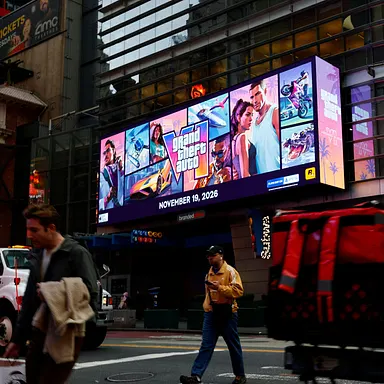
In this episode of The Daily's Sunday edition, Times reporter Zachary Small joins Michael Barbaro to explain how Grand Theft Auto grew from a controversial 1997 game into one of the most profitable entertainment franchises ever. They trace the series' satirical take on American life, its sandbox design, and the moral panics and sales records that followed.
The conversation also covers the rising costs of game development, layoffs across the industry, and what the upcoming GTA VI could mean for the future of big-budget video games. Listeners will also hear the hosts play part of GTA V on air.
In this episode Michael Barbaro, Zachary Small
The transcript of this episode on Grand Theft Auto was made with the same technology behind HappyScribe's AI note taker.
Ads in this audio differ from the text. Tap the sentence you're hearing to follow along.
Synced: the text now follows the audio.
Hey, how are you doing?
Oh, and look who's back.
Thursday will mark the release of an entertainment blockbuster, arguably the biggest of the year. It's not a movie, it's not an album, it's a video game.
Maybe some morning next time?
What should I tell you to put in your calendar? Friday morning, bank run. Come on.
Grand Theft Auto 6.
This could be the start of, uh, something good. Keep your phones on.
The latest edition of a franchise that has become a cultural phenomenon and a financial juggernaut. Consider this: the last installment, GTA V, racked up around $11 billion, making it one of the most profitable pieces of entertainment of any kind ever.
Might not feel like it, but these are your glory days.
This next installment is expected to be even bigger.
The salad years, you know? Nothing is going to beat who you are now.
Today, Zachary Small, who writes about video games for The Times, explains how a game devoted to breaking the law became an American institution, and why Grand Theft Auto 6 might be a high watermark in the history of video games. It's Sunday, November 15. Zachary Small, welcome to the Sunday Daily.
Thank you for having me.
The last time that I played Grand Theft Auto was, I'm going to guess, eight years ago? In my cousin's living room. And so my memory of it is very faint. For those who have that kind of faint relationship to this franchise, which we'll hereto forecall GTA, give us a fresh, up-to-date picture of it. What makes a GTA game a GTA game?
So I'm imagining you, Michael, opening this game and you are in some fake version of Los Angeles.
This is Mad Dog on your radio. You're listening to Radio Los Santos.
And you're leaving your wife, who is obsessed with social media and is taking selfies to go to a drug deal to fuel her buying sprees.
Mm-hmm. You got the grill. President and counterpart.
And you're going to go to a strip club and you're going to spend some money.
Hey, baby. Want a private dance?
And then maybe you'll see a trash truck driving down the street and you'll say, "I want to drive the trash truck." And you will push the person out of the driver's seat.
Come on. You got the day off, homie.
And take it and mow down people on the boardwalk.
I'll hijack a garbage truck and I will use it to be extremely destructive.
I mean, if you wanted to, I guess you could follow the traffic rules, but I don't think you're going to. You have all these unlimited options. You can go commit a crime, you could steal a truck, you could play basketball.
So you can pursue a Tony Soprano-like version of, you know, a seemingly placid, normal domestic life and then go off into the, you know, the world of a city for crime and prostitution and the rest.
You have, you know, the ability to be an absolute psychopath. You're often incentivized to, but it's kind of in this drama of, like, a South Park or Family Guy. It's quite satirical about what the American dream is and American life.
Scratch. Who do you trust to get this state back on track? A drug-addled, philandering former stuntman with multiple concussions? Or a successfully divorced schoolteacher who knows how to talk down to normal people like a real liberal? Sue Murray has been.
So there's, like, on one hand this, you know, what someone who probably hates this game would call a crime simulator. But on the other hand, it is this sort of, like, virtual sandbox of America.
What do you think about the American, Nico? Tell me straight. You love it, no?
I don't know, Roman. It is the same as any other place, only louder. People don't know how to.
And what exactly is the storytelling infrastructure of this scenario you're describing? Are there stories that you're following? Are you creating the story in real time? Are there characters? Do you become the character? How does this work?
Oftentimes these games have a much more complex story than you would imagine. There's one specific game where you play a recent immigrant to a city like New York, and it's all about how difficult it is for an immigrant to obtain the American dream. So you have a game that is giving you criminals, but they want you to understand the complexity of these people, the reasons why they're doing the things they are. And so I think having that complexity and allowing people to explore the satire of crime and greed is really why people are pulled into this world.
The last time one of these games came out was 13 years ago. People are still playing this consistently. It's a juggernaut in terms of the market and in terms of how people sort of relate to video games and the industry as a whole.
So I'm starting to get a feel for what makes this game that I haven't played in many, many years. So special. But tell us the story of how GTA became this juggernaut. Where does that story start?
Would you believe if I told you that the story of the American dream starts in Scotland?
I would be surprised.
Because this story starts in Scotland in 1997.
You're basically driving in the city, stealing cars, running over pedestrians.
You have a group of pretty young developers, including two brothers, Sam and Dan Houser, who are trying to create this game that's essentially like Cops and Robbers. And as they're developing this game, they realize, you know what? Nobody wants to play as the cop. It's much more fun to commit crimes. And so the first Grand Theft Auto is like, it almost feels like an arcade game. And you get points for running over pedestrians and killing people.
Wow.
There wasn't really a lot of depth in terms of the story.
Or autonomy.
Right. And so they're creating this game and they hire a PR person to spread to the British tabloids that this is a scandalous game and that this is a game that glorifies violence. So it becomes this controversy in the UK.
But this new game could be in many Christmas stockings. Called Grand Theft Auto, it's been widely criticized for its violent content.
This is the legacy of Grand Theft Auto. Like, if you've never played Grand Theft Auto before, you think of it as the crime simulator. And that's a little bit to the company's own fault for introducing.
Poor credit.
Fault and credit for introducing the game that way.
And what happens when this pre-marketed as illicit-rated X thing emerges in 1997?
Well, everyone wants to play it and a lot of politicians are very angry about it.
Under proposals being considered by the Home Office, a health warning would be flashed up on the screen at the start, reminding players.
The game is still selling well, though. They quickly spin out another sequel in 1999 called Grand Theft Auto II. It is much of the same. It sells well. It sells better than the first one, but the reviews are kind of middling. Where things really start running, where Grand Theft Auto becomes a zeitgeist of the culture, is Grand Theft Auto III.
The Ferrelli brothers have owed me money for too long and they need to be taught some respect.
Grand Theft Auto III comes out in 2001 and this is around when you're starting to see really, like, fully 3D worlds you can explore.
Tonight, a light aircraft will pass over the bay. It will drop several packages into the water. Make sure you pick them up before anyone else does.
You're in a city with different zones and you're given full control.
Well, remember, just watch your back in Chinatown. It's triad territory.
I think a lot of the details are really what sold this game, though. You can drive your car and listen to a radio station.
Of your choosing.
Of your choosing. And the radio stations, the voice actors behind it, are sometimes real radio jockeys. And you're listening to real radio music.
This is Tony on Flashback FM. Liberty City's home for the best in disco, electro, and new wave.
This was not done in games. Developers were not spending the money and spending the effort to get these licenses that really make you feel like you're in a fully immersed world.
Mm-hmm. This sounds really far from Super Mario Bros. where it's like ding, ding, ding. Like, getting from one, you know, chapter of the story to the other. But you're living in a very confined space in that old version of video games.
Yeah. And you're not going from left to right in this game. You're going anywhere you want. You're creating this new genre of game called a sandbox game where you're given full rein. You can follow the story missions if you want, but you could also just go off on your own.
It's your sandbox.
It's your sandbox. You can build your own castles if you will. Your castles of crime.
And I believe we've made this point, but it's really worth emphasizing. Everything that's happening in this game, it sounds like almost definitionally, is criminal or not good.
Well, let's not oversimplify things, Michael.
Okay.
But I would say that, like, it's coming at you from this, like, hobbesian idea of freedom where, like, everyone is their worst selves.
Their basest self, yeah.
And I can't overstate. Like, that was really strange in 2001 to play a game where, like, you would be walking down the street and this game is your character and a non-playable character would be walking by you and just automatically say, like, you're fat.
Back of your neck look like a pack of hot dogs.
Like, it was shocking. Like, and then, of course, you have the ability to respond.
With force.
With force. Exactly.
I recall that when this game became part of the American zeitgeist, that dimension of it became very controversial very quickly.
Yes. But it was also coming at a moment of moral panic, right? This is after the September 11 terrorist attacks. This was during a time where there were a lot of questions of sort of violence among us. There was a domineering perspective, although the research didn't support it, that playing violent games.
Would inspire violence.
Exactly.
Right. It doesn't take a massive leap of the imagination to think of the school council board president who says, "I don't like this."
Exactly. And certainly a lot of them did. I mean, in 2002, when Grand Theft Auto Vice City came out, which was set in this fictional version of Miami, there were multiple lawsuits. But if you want to talk about controversy in Grand Theft Auto, you have to talk about the hot coffee incident.
Take me back to my place.
Okay. I will bite. Tell me about the hot coffee incident in the history of GTA.
Well, can I just tell you in terms of my own personal history with Grand Theft Auto, I learned about this when I was, like, I must have been 11 or 12 and I was sitting with my grandfather, who was reading the Wall Street Journal and just placed the newspaper in front of me and said, "Look at this. You play video games. This is why they're bad and will turn you, like, violent."
Mm-hmm.
You want to have some coffee?
The hot coffee incident came from a part of the game that developers had put in and into Grand Theft Auto: San Andreas. The developers had created this simulated sex scene for the game. And then last minute, they decided, you know, better not to put that in. So they took it out of.
Even for us, be on the pale.
Even for us, let's not do it. And they took it out of the official game, but they left the code in the game.
If you have hot coffee, your DADC matrix number is.
You know, skilled gamers who understand code could still find the simulated sex scene in the game and they could figure out how to play it. And once they did, they spread the word around.
How could you not?
How could you not?
Everyone knows about the hot coffee controversy involving Rockstar Games, the unofficial mainstream.
And so suddenly you have all these people playing a scene that was not intended in the game and it.
Or maybe was because the code was left.
Well, at one point.
Who can say?
At one point was certainly intended, yes. This is sort of like alights with already these fears about violence in video games. Now you have sex in video games and now you have the Federal Trade Commission asking you questions.
Also, politicians are using the hot coffee scandal as a way to renew calls for legislation to regulate the sale of games to minors and potentially even have the government.
But Congress was upset about and what senators like Hillary Clinton were upset about was that they felt like the companies had misled the ratings agencies. That was the important part. The fact that you could access a simulated sex scene meant that the game should have had a higher rating.
But last week, Hillary Clinton introduced legislation that would fine retailers up to $5,000 if they sell an AM or AO rated game to a minor. Now, in addition to Clinton, California.
What does this controversy do to the sales of a game whose developers seem to know quite well the power of the illicit?
Well, what do you think? The sales go up. They do have to settle some lawsuits. They make an undisclosed settlement with the FTC through Congress. But the sales are going through the roof. Every single game in the Grand Theft Auto series makes more money than the last.
And how much money are we talking about for these games?
So why don't we look at Grand Theft Auto IV, which came out in 2008.
God bless this city.
It sold 3.6 million copies in one day.
Wow.
And then the sales hit 6 million globally in the first week for a total haul of $500 million. That's one week.
That's extraordinary.
The trend continues. Later on, Grand Theft Auto V comes out.
I always thought I was the good guy.
This is more successful than anyone could have predicted. In 24 hours, the game made more than $800 million. In three days, it hit the billion-dollar mark.
It's a video game that is shattering sales records.
That is to say.
Never has there been an opening like this in the entertainment industry.
Bigger than movies, sporting events, and concerts. Here's a little look at GTA V.
What you're describing sound like the ingredients for a very successful game. But put your finger, if you can, on why you think this is a transcendent blockbuster of a video game, which it clearly is.
I think to answer that, you have to understand that the tone of this game is so unique. The idea that the whole series has its roots in controversy. It wasn't just controversy for controversy's sake. They were really trying to say something about America. And you can see that in Grand Theft Auto V. You can see it with the characters' relationships to their own phones. You know, they might not have Facebook, but they have an app called Life Invader. They might not have X, but they have something called Bleeder. There's this real attempt to, like, get a genuine satire of American life right now in a way that, you know, allows you to follow protagonists who are greedy and cynical.
And in going into that world, though, you're not just asked to accept them. You're asked to reckon with them, which is a very different thing. It's something that's special to video games as well. It's an arena, especially if you're trying to understand American culture today and say, like, how did we get here? It's an arena for you to explore those feelings. And I think viewers have rewarded them over the years of consistency saying, we're looking to you to tell us what this crazy time we're living in is like.
What it means.
Exactly.
That feels like an unexpected level of cultural insight and criticism to get from a video game.
It's something special and I think that's why the series has become so popular.
So as compelled and intrigued as I am by everything you're describing here, I think there's no substitute for playing GTA. And so in front of us is a PlayStation where we are going to play GTA V and you're going to show me how it is that I hijacked that garbage truck.
It's my honor.
We'll be right back. So Zach, I couldn't think of a more perfect snack for us than Oreos. So I think we should have an Oreo as we start to play.
Do you know Oreos are vegan?
No.
Whenever I made a vegan, I go, well, you can eat Oreos. Is usually where the conversation ends because then they get angry and hungry.
Yeah, well, maybe I should come up there and practice my backhand on your face.
So as you can perhaps hear in the background, our crack team of engineers here at the Sunday Daily have wired up this room so that we can play GTA V. And I wonder if you can just describe exactly what's on the screen.
We are driving across a bridge into downtown Los Santos, which is this game's version of Los Angeles. And I have just committed Grand Theft Auto. I am driving a stolen car and looking for trouble. I'm looking for your trash truck.
Ooh, your cell phone's ringing.
Someone just called me.
On the screen.
I also just jumped out of the car by accident while trying to answer the cell phone. And now someone is.
Has pulled a gun on you.
Someone has pulled a gun.
Ooh, a cop.
I just killed the cop. And I'm going to steal the car, his cop car.
We should have given people a warning.
This is the thing. Like, we started this game a couple minutes ago and it already has gone into.
It's so intense.
There's a helicopter above me.
There's so much adrenaline.
Someone's shooting at me through the overpass. Well, I was just killed. I was wasted. So this is like in every game. When you die, you're wasted.
So, Michael, this is where dead men come back to life.
So we start all over again.
Kind of. They'll pick up with him. Like, I think he's probably coming out of the police.
Yep. He's coming out of jail. Michael's coming out of jail.
The medical? No, I'm coming out of the medical center.
And Amanda's calling.
Don't touch me.
Oh, you don't have the call to tell me that.
Not you. The Deedor Sax store.
So there you go. This is part of the story.
I need you to help clear it up.
Okay, so we have the option to go to Amanda.
Yeah.
All right, I'm coming.
So this is trying to get us back on track with the story after we've committed something.
Yeah. Amanda sounds like maybe an ex.
Amanda is the wife who's just, like, really obsessed with becoming an influencer.
Got it.
Let's see where she is. Yeah, so she's up there. She's up sort of out of the main city in the burbs. So I need... I don't have a car with me. What do you think I should do?
What to do? Oh, you just suddenly you're brandishing up like an AK-47.
Oh, see, that's just someone who randomly got their car with a gun themselves.
But there's just a shootout now.
Yes. And so now I'm trying to get in the car.
You're in the car.
So don't you hate it when you go to Ground and Pound and they don't have your smooth latte. So you have to pull out your.
This is a radio call.
And chop off the weight of hands.
Oh, my God.
Don't you hate it when you go to Cool Beans and they don't have your strawberry.
I'm trying to take you to go shopping now. Actually, sorry, I thought we were going shopping, but this is a strip club.
But some of the satire in the background is about, like, overpriced LA life that a criminal encounters.
You know, my parents never thought I would be on the daily explaining to you that we're outside of Horny Girls.
The streetscape is very vivid.
Yes.
Like, it really looks like Los Angeles.
Yes. And they do a lot of study to make these, like.
Like the scale of everything.
The scale. Yeah, they have urban planners that they'll consult. They'll also try and, like, faithfully recreate as much as they can. But you see how the neighborhoods also changed?
Yeah, yeah, it's becoming a little bit more fancy.
Yeah, we're kind of getting into, like, a Beverly Hills adjacent space. The neighborhoods in this game, they're all based on Los Angeles neighborhoods, but they have different names, oftentimes some puns.
Such as?
Vinewood, which is Hollywood. They also have, instead of Venice Beach, they have Vespucci. There's also, instead of Westwood, they have a neighborhood called Morningwood.
Meet me behind the pawn shop in Morningwood. We on the wrong side of Vespucci Beach. You should know a block makes a difference.
Well, what do you need?
Just a few Vinewood souvenirs for my museum.
Look, look, look. Look at this guy.
He just smashed a really nice Lamborghini into, like, a 1975 Oldsmobile and now into another one. You're a terrible driver.
Do you want to try?
Yeah, I think, I mean, I might need a little bit of coaching on this.
It's complicated, but once you start going, you'll figure it out. So the triangle button is to, like, get into a car. So, like, if you want to try and get into it, you can get into that one. It might say Mission Field, though.
That's... I've just stolen a... Oh, wow. The console is vibrating.
Yeah.
How do I steer?
Famous last question.
Ooh, jeez. That took 10 seconds to drive into a tree.
That took out your windshield and mission failed. So let me... Amanda was arrested again. There's your trash truck.
Oh.
I know. After that, if you crash into it and then you can press triangle to get out of your car and then triangle to steal his car.
Oh, amazing.
Yeah, triangle.
Triangle?
Yeah.
Go.
Yeah.
Go, go, go. Tremendous.
The trash truck's name, by the way, is Dumping in Your Street.
No, oh, wait. No, I just got thrown out of it.
So you got to throw him back. You got to hit him. You got to knock him out. Yeah, there you go. You're a natural at this.
Oh, wow. This is tremendous. Oh, my God. You see the blood spurting out of them?
I don't know. You're catching on to this pretty quickly.
Here we go. I got myself a garbage truck. Okay, I got to slow down because I'm just going to... Oh, I'm just going to crash into all these. All right.
But this is what a lot of people's, like, first hours with this game are, is just, like, getting used to the controls, but also, like, being shocked by how interactive the world is.
Completely. But I just do want to describe how my basest instinct is coming into play. Like, I...
You just hit a motorcycle.
For no reason at all, I just decided to take out this motorcyclist because I could. I mean, like, I could not have, but I could.
That's really funny because I might be in the minority here. I really do try and play this game and abide by the traffic rules.
That says a lot more about you than it does of... Yeah. It says a lot about both of us, I suppose.
But you can see how people play like this for hours without, like, doing any mission.
Oh, jeez. I'm going to spend 10 minutes just figuring out how to get this dump truck out of this intersection.
Everyone plays this differently, but you're kind of playing it like the parallel parking simulator.
I'm out of here. I'm out of here.
Yeah, okay. You can see the trash falling out of the truck as you make your getaway.
I've totally mastered the driving part now. Oh, jeez. I just flipped the truck over.
So this is like a day in the life of Grand Theft Auto. Just to give you the global view here, this is like an early mission. It's only going to get weirder from here. And so for the new game, like, you know, people are just imagining, if this is how crazy fake LA is, how crazy is fake Miami?
And now that I've got a sense of how good and mesmerizing GTA V is, I can only imagine what this next version that has been developed over 13 long years must be like. And I bet it's rather impressive.
Let's talk about it.
I just feel like I'm in my parents' basement in, like, 1996 eating Oreos, playing video games with you.
I'm so glad I became an investigative reporter at The New York Times to do this.
Okay, Zach, I'm a lot more familiar with GTA. I now truly understand why it is such a hit. It's immersive. It's a sandbox. It's a choose-your-own-adventure romp. It's a delicious parody of American life. I get it. We just played GTA V. The big question I have is, why on earth did it take 13 years for this next generation of this franchise, GTA VI, to come out?
In a sentence, everything's really expensive and hard to do. The reality here is that to make a video game, even in 2013, let alone 2026, the technology is so advanced and so expensive and requires thousands of people to work on it that any major game today, the development timeline is usually six to seven years.
Wow.
That's become accepted. What we just played, like, just think about it. You got in a car and you sped off.
There's an auto repair place by the airport where we can get a tow truck.
How much work do you think goes into getting in a car and speeding off in a game?
I have no idea.
Once you start parsing it out, though, you're thinking, okay, what are the physics? What's the physics engine in this game? Who developed the physics engine? Who decides what speed that car is going? Who makes the animation? What if the character's getting in from the right side versus the left side?
Tow truck is at the lot.
Already, I've given you an overwhelming number of options. And each one of those, of course, has about a thousand other things that a developer and animator would have to do. That requires hundreds of man-hours. And today, because we expect or the consumer expects realistic, sophisticated games, I mean, this is a AAA game.
And by AAA, you mean what?
It's like a blockbuster movie. It's like the biggest budget production.
And you get to 13 years.
You get to 13 years and you get to a budget that people estimate to be around a billion dollars.
Just for this latest version of GTA.
Yeah. It's like, you know, video game's Cleopatra budget.
What have you come to know about GTA VI in so far as you've either been able to play it or glimpsed it or it's been described to you? What has all that time and money given us?
You know, as someone who reports on video games and also plays video games, I've seen a few in my day. What I have seen both in previews and sort of in firsthand demos has actually been astonishing, the level of detail that goes into these places. We were just on the beach in Grand Theft Auto V. We didn't see a lot of people.
No.
Grand Theft Auto VI has, like, a true Miami beach stuffed with people of all shapes and sizes having individual conversations. They're playing fetch with their dog who runs into the wave and the wave splashes against the dog. They're throwing the beach ball and it makes an imprint in the sand. Like, the amount of work, once you start thinking of how hard it is to make anything in a video game, really blows your mind.
I think of what I just played as something that artificial intelligence would really accelerate. It seems like precisely the thing that the AI coding world would catalyze. It's not?
Not yet. Many companies, because of how expensive it is to produce games, are hoping that AI can help them cut some corners. In my reporting, a lot of the places where that's going to happen, though, are not necessarily on the big development costs. You know, maybe instead of hiring playtesters to find all the glitches in your game, you can have an AI agent run through things, for example. But the cost of production has skyrocketed. So even if you have a game that's super successful, a bestseller, the studio may still shut down because they haven't made enough money.
Which leaves everyone in this sort of trap. I mean, the industry has had over 30,000 layoffs in about two years. They're calling it a crash. Executives are calling it a crash. And yet we're here on the brink of one of the biggest game releases or truly anticipated to be the biggest entertainment release ever.
What happened to the rest of the non-GTA video game industry that means there have been all these layoffs?
So on average, AAA game, you could imagine the budgets are around $200 million. It's like you're producing a Marvel movie and you're taking six years to make it. In those six years, you have to anticipate what viewers will want. Oftentimes, that gamble does not pay off. And we've seen that in these stratospheric mistakes.
Would you just give me an example?
So, for example, Sony had a game called Conquered and it was a shooting game, let's say. It came out. It had a budget of hundreds of millions of dollars. They shut it down in about two weeks.
Wow. That's how badly the sales were.
They took it off because the sales were so bad and they didn't want to pay for it to be... It was like a live service game to be streamed. So it was taken off the air. They ate that loss.
They missed the mark.
They missed the mark.
What about Conquered? Didn't work.
It's the competition in that space. I mean, these games, like, if they don't pop off immediately, there's not really such a thing as, like, steady growth, right? You can have a cult game, you know, that becomes popular.
But it's not going to make back the $300 million budget.
Exactly. So it's easier for them in some cases to just cut the cost completely. Competition at the same time, which is coming from other studios or countries such as China, they're creating games that are free to play. So, like, they're not technically amazing games. You could play it on your phone, but they're community games. So there's things like Roblox you might have heard of or Fortnite. And you don't have to pay to get into it. You pay for, like, character costumes or weapons, whatever.
That's how they make their money. But it's pulling so many players. So the audience has decreased. The audience for these prestige games, let's call it, has also gotten older. So there's a narrowing, there's a mature market that's happening where they've lost the audience, the product is too expensive to produce. And AI, while it has some promise to cut costs, is not so significant. AI has actually built another challenge, which is that to create these games or to even develop the machines to play the games, they use the same hardware that AI companies need for their servers.
So the cost of all of that hardware has gone up. Consoles have increased their prices by hundreds of dollars when usually within the lifespan of this product, the price is supposed to go down.
So we should see GTA and the expected success of GTA VI as an outlier and perhaps maybe, am I overstating this, the marking of the end of an era in video gaming?
It really could be the last of its kind.
Just say more about that.
It's the last of its kind in that it's perhaps the last true prestige game where the developers have sought to create something worthy of an Oscar, you know, that has all of these different elements that are artisanal, right? Like artisanal...
Shadows.
Artisanal shadows and lighting. It just requires such an immense amount of effort that it's unclear to developers who I've spoken to that their own studios could make the same thing and make enough money to make it worth it.
So will there be a GTA VII, VIII, IX, X, XI?
It's unclear is the truth. It might be the only one of this scale to continue on, but that's just because, again, this is sort of in a league of its own. The industry is hoping, as right, the saying is that the rising tide can lift all boats. They're hoping that Grand Theft Auto can sort of be a salvation to the industry.
But does that seem likely?
You know, you can't just bet on, like, one game to do this. We're also in an affordability crisis where the consoles and games have gotten more expensive. You know, games used to be $60 just a couple of years ago. Now most games, most new releases are priced around $80 or $70. People are choosing not to buy them.
I'm sure many people listening to us will think that if video games of this sort wither away, it's not going to mean all that much to them. They may not spend that much time playing these games. As you could tell from my driving, I don't spend a lot of time playing these games. So for them, explain what in your mind is lost if video games of this kind go away.
Well, economically, you're losing billions of dollars, quite literally. It's hurting a major sector of the economy and an industry that's bigger than music and movies combined.
Wow.
Culturally, you will be damaging an art form that people spend hours and hours and hours with. So even if you don't play it, you're talking to people that could spend 100 hours in a given game. We've talked a lot about Grand Theft Auto and the controversies, but also some of the merits of the story that it tells. And so to lose that, you know, it's a similar thing as people are looking at Hollywood and the budget crisis is there. You know, where do artists get an outlet today?
Right.
Can't all be painters.
Some of them are going to be designing that shadow against the wall in that video game.
Some of them will be, yeah.
And it sounds like a lot of them have lost their job over the last few years.
Yes. But in terms of Grand Theft Auto and its studio, Rockstar Games, I mean, this game has probably had close to 10,000 people working on it and they've been very steadily working on it over 13 years. Like, the size and the scope here is really significant. And I think the question for a lot of people will be, will, you know, can the studio sustain itself off of the sales of this game?
Well, just to end our conversation here, let's talk about the game itself, GTA VI. What do you know about this game? Have you played it?
I have watched people play it.
That's as close as they'll let you get?
That is as close as they'll let you get in the Rockstar Studios. The way this is handled is as if they had the Pentagon papers. You walk in, they want you to sign an NDA to see it. I, as a New York Times reporter, did not sign the NDA.
Did you just kind of, like, broadly move your hand across that piece of paper as if you were signing it?
I said, "That's really interesting, but I can't."
Because then you couldn't talk to us about it.
Exactly. You know, in terms of what I saw, though, it's what I can speak about is what is also seen in some of the trailers as well is just, like, they understand that Grand Theft Auto, as much as it is a game that you play, is also a zeitgeist. And they've tried to live up to the expectation of Grand Theft Auto as being sort of like a second life, you know, you in the virtual world. If you go to a convenience store, there's going to be, like, 45 options of different food and drinks that you can get.
Maybe you start vaping while you're in there and you open up one of the magazines in the kiosk and there's, like, a full magazine for you to read through with fake articles inside of it. No New York Times, I did check, but their own magazines. So I think it's just, like, this game is going to show people what is possible when you have what is essentially an unlimited budget.
Earlier in our conversation, you mentioned that GTA V felt like a cultural commentary. From what you've been able to see of GTA VI, what is the comment it's making about America, about Florida?
Well, you know, there are alligators and nudist colonies in the game, which you can experience yourself. You know, they're playing around, certainly, with the stereotype of the Florida man, for example, in the game. But I do think it, Grand Theft Auto VI, it's really a Bonnie and Clyde story.
Jason, we'll see ya.
Here.
Yeah.
We got to go.
Go?
Yeah, go, like, right now. What'd you think I needed to live for?
You control these two characters, a man and a woman, who can be in a relationship if you want them to. And these, like, two criminals that are just trying to make it, you know, in a situation that's incredibly difficult to. I think there's also elements of the game that lean heavily into surveillance culture. You know, in previous games, if you robbed a store, like, you just got to get away from the cops. Here, there are cameras.
There are a lot of surveillance cameras. There are people with their phones taking videos of you as you're committing a crime. So, like, in a way, I think that feels really true to the moment today.
Totally.
Wait, you stole my friend's car?
Yeah.
Holy shit. What do I do?
Jesus.
If cynicism and greed and crime were the bywords of GTA up until now, is there a new word to add?
That's a great question. Cynicism and greed are definitely still in play. I think this game, in terms of it feeling more grounded, also has a little bit of hope in it.
Of what sort?
Of making it.
This could be the start of something good. Keep your phones on.
Does this mean we're in his crew?
Yeah, I think so.
You think he can help us?
We don't have any better ideas, do we?
You know, I think, again, where the country is right now of people being worried about affordability or prices, having a game where they fantasize about being these criminals in Florida trying to make a big score, there is something there. As tainted as it might be to talk about crimes this way, there is an element of hope.
Well, Zach, thank you very much.
Thank you so much.
Appreciate your time. This episode was produced by Alex Barron with help from Lena Richards. It was edited by Wendy Doer, contains music from Dan Powell, and was engineered by Sophia Landman. Special thanks to Wilder Barron. That's it for the Sunday Daily. I'm Michael Barbaro. See you tomorrow.
Thursday, Nov. 19 will see the release of one of the biggest, most anticipated entertainment properties of the year: The video game Grand Theft Auto VI.
The first Grand Theft Auto game was released in 1997, and immediately stoked controversy with its aggressively satirical portrait of amoral, criminal American culture. Over the past 30 years, the franchise has continued to keep a sharp satirical eye on American society, and its often unpleasant excesses. The sixth installment promises to touch on hot-button issues like the war on drugs, police violence, conspiracy theories and influencer culture. And yet, even though the game has already made one billion dollars in pre-order sales, it might be the last time we ever see one of this scale.
In this episode of “The Sunday Daily,” Michael Barbaro talks with reporter Zachary Small, who covers video games for The Times, about Grand Theft Auto and how it became one of the biggest video game franchises of all time.
On Today’s Episode
Zachary Small is a New York Times reporter writing about the art world’s relationship to money, politics and technology.
Photo credit: Jeenah Moon for Reuters.
Background Reading
The Grand Ambitions of Grand Theft Auto VI
Miami Is Crime Ridden in ‘Grand Theft Auto.’ Should It Market the Myth?
Get Ready for Grand Theft Auto VI and 11 More Games to Play This Fall
For more information on today’s episode, visit nytimes.com/thedaily. Transcripts of each episode will be made available by the next workday.
Subscribe today at nytimes.com/podcasts or on Apple Podcasts, Spotify and Amazon Music. You can also subscribe via your favorite podcast app here https://www.nytimes.com/activate-access/audio?source=podcatcher. For more podcasts and narrated articles, download The New York Times app at nytimes.com/app.
Hosted by Simplecast, an AdsWizz company. See pcm.adswizz.com for information about our collection and use of personal data for advertising.