
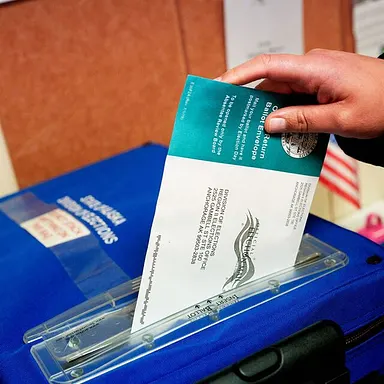
Nate Cohn, The New York Times chief political analyst, joins The Daily on election day to explain how to read the 2026 midterm results as they come in. He reviews the final Times polls, which show Democrats ahead in seven key Senate races, and the Alaska and Michigan developments that may have shaped them.
Cohn then lays out four scenarios, from a Republican hold on heavily Republican districts to a Democratic tsunami, describing what each would mean for the House and Senate and which early signs to watch. The conversation also covers the risk of polling error, including the argument that Republican voters may not turn out as their poll answers suggest, and the adjustments the Times made to reach Trump supporters.
In this episode Michael Barbaro, Nate Cohn
This transcript of the election night guide with Nate Cohn was made with the same technology HappyScribe uses for Teams transcription.
Ads in this audio differ from the text. Tap the sentence you're hearing to follow along.
Synced: the text now follows the audio.
Hi, this is Carolyn Ryan, managing editor of The New York Times. At The Times, we strive to help everyone stay informed, and at this critical moment, we're making all of our election coverage free in our app. We have more than 100 reporters out there talking to voters, seeing what drives them, helping you figure out what's going on. On election night, we are the place to go for race results. Our maps are updated minute by minute.
Come experience all of our election coverage for free right now in If you could describe how you are feeling about this election in a single word, is there a word that comes to mind?
Hopeful. Anxious. Scary.
Important.
Consequential. Needed. This whole administration is a shit show.
I'm relieved that it's over and I don't have to listen to the advertisements anymore.
Optimistic-ish. From The New York Times, I'm Michael Barbaro. This is The Daily.
Can I ask who you voted for today in the Senate race?
Oh, Abdul El-Sayed! Of course, yeah. Absolutely.
I'm not the biggest Paxton fan, but to me it was kind of the lesser of two evils.
I voted for James Talarico.
Nothing against Talarico, but I think voting for him is a vote for Chuck Schumer.
I did pretty much go Democratic. I don't always do that, but I did today.
I did vote for Mary Paltrow.
I'm voting for Susan Collins.
Definitely voted for Troy Jackson, of course.
Yeah, I'm gonna hold my nose and vote for the dope. I'm gonna vote for Troy Jackson. The Senate's full of idiots. At least he's our idiot.
After 2 years of campaigning, more than $11 billion of advertising, and last-minute dramas in Alaska and Michigan, the 2026 midterm election is now in the hands What's the number one issue you're voting on today?
Oh, to stop the current regime.
The stakes are very high because of Trump. Everything else pales in comparison.
We want to keep our country American.
We don't want Sharia law in here at all.
The biggest issue on my mind is the economy. Everything just done double, triple. I mean, dang, $4 for a bag of chips? That's ridiculous.
Yeah, there's so many issues. How can you think of just one? I'm worried about everything.
Today, as the ballot counting begins, my colleague, chief political analyst Nate Cohn, offers a guide for how to understand tonight's results.
After the election, when you wake up, what are the headlines that you are hoping to see?
A red wave.
That there is no big blue wave.
Good God, I'm hoping that this predicted blue wave is actually a real thing.
The blue wave that everyone's predicting. I would love to see that headline.
It's Tuesday, November 3rd. Election Day.
Nate. Michael.
Happy Election Day.
Happy Election Day.
To you, and to all who celebrate.
To every American voter. Happy Election Day.
So Nate, we are here today to do something we started doing with you a few elections ago, which is to offer our listeners a roadmap to election night. Because starting around 7:00 PM Eastern tonight, everyone's screens are going to be bombarded with projections and breaking news alerts. This person won. this House seat, this person lost that Senate seat. And it's always cacophonous, a little confusing. And so we want to give people a user's guide to the entire night with you as our guide, our captain, whichever— do you have a— My preferred metaphor. Preferred metaphor?
Captain will work.
And you come armed, Captain, with a new round of polling that The Times completed over the weekend. So it's as up to date as imaginable. So start with that new data.
Stepping back briefly, as we've said on the show before, the Democrats are overwhelming favorites to take the House. The big question in this election is whether they can win the Senate, where they need to win at least 2 seats that Donald Trump won by double digits. That's a tough feat. Our final polls of the 7 states likeliest to decide the Senate show the Democrats ahead, even if sometimes only narrowly, in all 7 of those races. All 7. Wow. Those are— that's Michigan, Maine, Texas, Ohio, Kansas, Iowa, and Alaska. 5 of those states, by the way, voted for Trump by double digits.
Wow.
If the polls are exactly right, and they never are, of course, but if they are, that would be enough for Democrats to take the chamber and have an election that they wouldn't have even imagined a year ago.
Right. And this was, we should just say, polling largely conducted before 2 pretty dramatic political surprises Over the past week, we had a Times investigation into the Alaska Senate race that showed that the Democratic nominee, Mary Peltola's campaign, played a role in recruiting a spoiler candidate, a second Dan Sullivan. And then after that, as if that wasn't dramatic enough, we had the losing Democratic primary candidate in the Michigan Senate race, Haley Stevens, snub the Democratic nominee, Abdul El-Sayed, and cross party lines and endorse his Republican rival, Mike Rogers. Did the polling tell us anything about whether either of those 2 soap operas might matter in those 2 races?
In a certain sense, the poll in Michigan found Dr. El-Sayed up by 11 points.
Wow.
Which is his largest lead of the cycle, a 6-point gain from our last poll in September.
Seemingly undentable perhaps by— And that would seem undentable. Haley Stevens endorsing his rival.
That's right. In this political environment, with Donald Trump as unpopular as he is, it seems like Michigan Democrats and Democratic-leaning voters are going to get behind Dr. El-Sayed if our poll is right. Alaska? Alaska is a pretty different story. That's a race where Mary Peltola only led by 1 point, and that was a—
In our final poll. In our final poll.
That was a decline from a 7-point lead in our penultimate poll. She has had other issues in this campaign. About a month ago, The Times reported that she had potentially mistreated staff members. So the trend line there is sort of working in the wrong direction. And now here's what maybe a final push that could potentially help her Republican rival get over the top.
Got it. But still, Peltola is leading in that poll, just not by much at all.
Not by much. I think that race is a true toss-up if you take our data on its face.
Okay. But all in all, a very positive poll for Democrats across these 7 key Senate races that could determine which party controls that chamber. Let's now incorporate that into our roadmap for election night.
Okay. Well, you know, as I mentioned, it's sort of inevitable that the Democrats are gonna take the House this year. And one way to think about that is in terms of a metaphor that people love to use in midterm elections, and that's the idea of a blue wave. There's no formal definition of a blue wave.
You know it when you see it.
You do know it when you see it. But some kind of blue wave is inevitable in this election. That's the reason why a Democratic House seems essentially inevitable in this election. But the big question is whether that wave will be big enough to yield major Democratic breakthroughs, even in districts and states that voted for Trump by double digits, to give them that feeling of a sweeping victory.
Mm-hmm. In potentially both chambers.
Absolutely. So in that sense, Michael, I see 4 basic scenarios for what might unfold on election night. All 4 involve blue waves, but they're of different heights, and they will leave Democrats or Republicans feeling very differently. when all the votes are counted.
Okay. Let's talk through these 4 wave-ish scenarios. Let's start with the first one.
I think the first scenario is that the Republicans in heavily Republican districts stay dry.
So you're really gonna commit to the—
I'm gonna commit to the metaphor. You're a Republican on a cliff. The big blue wave crashes ashore. It's as big as any wave you've ever seen. But it doesn't reach you way up at your height, way in these Trump-plus-10 districts.
How? How does that not reach them?
Well, one factor is that the Republicans have redrawn the nation's congressional maps to their advantage over the last year. You can think of that as Republican mapmakers evacuating their members away from the shoreline into high ground. So they would've been knocked out if it weren't for redistricting. Now they're way up above the wave. Maybe they can survive this year. The Senate's a little bit of a different story. There just aren't that many seats up for grabs in any particular year. Only one-third of the seats are at stake. And it so happens that this year, there aren't very many vulnerable Republican seats up for grabs. So, as I mentioned earlier, the Democrats will have to flip at least 2 states that voted for Trump by at least double digits. They'll have to win at least 2 states that are on high ground.
Right. The map was inherently challenging for Democrats to begin with. Gerrymandering helped make it even more challenging. I just want to make sure I understand what the results of scenario 1 look like in the House and in the Senate?
In the House, the Democrats win, but maybe only by a modest margin, a handful of seats. In the Senate, they don't really come all that close to flipping the chamber. Some of the states that we've been talking about as potentially competitive, like Kansas or Iowa, South Carolina, they don't end up that close on election night.
They just go to the Republicans.
They just go to the Republicans. And that could be clear pretty quickly. Yeah.
What would be the signs of That as the clock starts to tick into the evening hours on Tuesday.
With one big caveat that I'll get to in a second. When the polls close in Kentucky and Indiana at 6:00 PM, and then later across the Southeast at 7:00 PM, there will be over a dozen of these districts that are either highly competitive or that voted for Trump by double digits that we'll be watching, where we'll quickly get a sense of whether the Republicans really are vulnerable in these heavily Republican seats like the polls have suggested all cycle.
Give us some examples of these places.
The first one would be Kentucky's 6th District. It's around Lexington. It voted for Trump by 15 points. That race is considered a toss-up.
Wow.
And it's a Trump-plus-15 district. So all Republicans need to do to win this is just get Republicans to come back on board. And we'll know pretty quickly whether Kentucky 6 is a real race or whether actually Republicans are going to show up, vote, and vote Republican. Later on, there's a whole slew of those gerrymandered districts in North Carolina and Florida that the Republicans have redrawn to be around Trump-plus-10. Democrats are hoping to hold some of them. We'll see it soon after 7:00 PM whether the Republicans succeeded in flipping those districts or not, and whether they did so with room to spare. And then we'll also have the Senate races in South Carolina and Florida. Republicans are expected to win those races. Hmm. But if they win them comfortably by, say, nearly 10 points like they usually would, that would be a sign that Republicans have come home and that the worst-case scenario for Republicans in this election might not materialize. I do need to have one big warning, though, here.
Which is?
Which is that although we'll know relatively quickly whether the Republicans have held these seats—
Whether they're dry.
Whether they're dry, we are going to have a moment just before then when it looks like this election could be really, really blue. And the reason for that is the early vote. It is very clear that the Democrats have done exceptionally well in the early vote. It is also possible, however, and we've seen this happen before, like in 2020 or 2016, that Republicans just show up to vote on Election Day. In most of the states we've been talking about, the early vote gets counted first. The Democrats could be looking really, really good, and then the Election Day vote could come in and leave them disappointed. So this is a blue mirage. Don't be surprised for 45 minutes for Democrats to be leading in Florida and South Carolina, even if they're actually going to lose.
Mm-hmm.
So we have to wait at least a little bit to see that Election Day vote before we can determine the direction that the night is heading.
Fascinating. Nate, if Scenario 1 comes to pass, it will have inevitably meant that there was systemic polling error of some kind. And you're our chief in-house pollster. So just help us understand a world where the polls are so off that you get Scenario 1.
Yeah, it's important to be clear about this. At this point, scenario 1 would absolutely require a polling error on the scale of 2016 or 2020, and maybe even beyond that, Michael. Hmm. I do think that it is conceivable. We know in general that Trump supporters are less likely to respond to polls. Pollsters try and do things to adjust for this, and in some cycles it seems to work, and in some cycles it does not. The other factor here that I think raises the potential for a polling error even more is that we're really focused on heavily Republican states and districts. And this creates a risk to pollsters where even if they're right about what voters are thinking now, there's this possibility that in the end, Republicans just do what they usually do. Come out and vote. Come out and vote and vote Republican. And look, I don't doubt that there are millions of Republican voters today who are deeply dissatisfied with President Trump and don't even like the Republican nominee in their state. And they are expressing that dissatisfaction to pollsters. But it remains to be seen when they show up in a voting booth whether they're really going to vote for a Democrat like they say.
If they do not, which I think in today's polarized era just can't be too surprising, you would quickly see these Republican-leaning districts snap back to the right. And I think that's the biggest risk to pollsters in this election.
Right. It's not that they will have misled pollsters. In a certain sense, they may have misled themselves momentarily, and once Election Day rolls around, They come home to the familiar home of the Republicans.
I think that's a real possibility.
Huh. Okay. That's scenario 1. It's extremely good for Republicans. They'll be thrilled. And it's, by the way, extremely bad for pollsters. Let's talk about scenario 2.
Scenario 2 is where the Republicans don't stay dry. They get really wet. The wave reaches them high up on the cliff. The wave is every bit as big as the pollsters said it would. The Democrats win the House, and they win it big. But in the critical states where Donald Trump won by 10 points or more, the Republicans hold on. So in the first scenario, a race like South Carolina's Senate may not even be close at all. That's the race where Darlene Graham, Lindsey Graham's sister, is running in what seems to be a surprisingly close race in a state that is never really competitive in federal elections. In this one, it really is close.
Hmm.
But in this scenario, Darlene Graham wins. And the same story would play out in Iowa. and in Kansas, and maybe in Ohio, and enough states that the Republicans ultimately retain control of the Senate.
Mm-hmm.
In this scenario, we will have to wait much longer on election night before we understand that the Republicans have retained control of the chamber, because unfortunately, most of the key Senate states do not close their polls early on election night.
Mm-hmm.
So it might only become clear that the Republicans are favored by maybe midnight. And worse still, if it's really close, there are 2 states, Maine and Alaska, where I'm not sure we're gonna know the answer for days in this scenario. Why? Both states take a really long time to count their vote. Maine counts their vote in much of the state by hand, and in recent elections, 20% of the vote is still uncounted at noon on Wednesday. Alaska, I think, has a better excuse, which is that it has this huge, far-flung population that's voting by mail. But that takes them a week to count. And as if all this isn't enough, there's then a second wrinkle in both of these states. They both have ranked-choice voting. So once they've counted all the votes, then they have to do the ranked-choice vote if no one reaches 50%, which in this scenario is quite possible. Essentially a second round of counting. Yeah. And so, like, in Alaska, I think that's November 18th. So in this scenario—
I just want people to see the pained look on your face right now.
You said happy election day. You should really be saying happy race call day. Because in this scenario where the Republicans narrowly hang on, it would be a really long time before they had run the table in each of these critical states that they're endangering.
So basically, in scenario number 2, Democrats get very close to winning the Senate, but the cards just don't break their way in enough of these red states. Too many Republican candidates win these seemingly competitive Senate contests. And at the end of the day, they keep control of the Senate.
That's right. And I wanna note, scenario 2, by historical measures, could still be an extraordinary night for Democrats. It could be the best performance that the party has had in red states in decades. Like, I think it's conceivable Democrats could win Texas in this scenario, or maybe it's Kansas. And any of them, by historic standards, would really be impressive. But the critical thing about this scenario is that just doesn't add up to 51 seats for them, which is what's ultimately gonna determine whether they're thrilled by the ultimate outcome or not.
And ultimately, given the expectations, I suspect Democrats would be deeply disappointed. And regardless, it would be an incredibly late night. So let's, Nate, move on to the 3rd scenario.
In a lot of ways, scenario 3 is a lot like scenario 2. The wave is basically as big. The Republicans are all wet. But in scenario 3, the Republican sandbags fail. The wave swamps them. And in these critical Senate races, the Democrats do flip the seats they need to take control of the Senate.
Okay, so key difference between 3 and 2 is that the Democrats do take the Senate, but by how much?
To me, what's unique about scenario 3 is that these states are all really close, and the difference between scenario 3 and scenario 2 could be tens of thousands of votes in Alaska and in Ohio and so on. And in one, they break one way, and the other, they break toward the Democrats. I think that the best case for Democrats in this scenario might be something like 53 seats in the Senate, maybe even 54, though I think that would be pretty lucky. But it could be as little as 51. They could just barely scratch by with the bare minimum necessary to take the chamber. As long as they do that, I think the Democrats will ultimately feel elated by the night, even if it is a disappointment compared to polls that have raised even higher expectations than that.
What will be the indication that a Scenario 3 is unfolding versus a Scenario 2? Because as you say, the waves may not feel all that different in scale.
They may not.
So when would we know the difference?
I think that there are really 2 paths for how we could feel the difference. One of them is where Democrats win on election night in enough of these states that do count their votes quickly enough. Texas, Ohio, Iowa, Kansas. If the Democrats are winning those states, we could have a decision on election night, maybe late on election night, but—
We'll know that the Democrats are taking the House and the Senate.
Taking the House and the Senate.
Right.
If the Democrats depend on Maine or Alaska to do it, we're still stuck waiting. So from a purely selfish point of view, let's hope we have resolution quickly.
If it's gonna happen, let it happen fast.
Exactly.
Okay. Let's take a quick break, and when we come back, come to the 4th, final, and I believe the most dramatic political scenario—
That's right.
—of Tuesday night.
It would be something that we haven't seen in American politics in a long time.
Okay. We'll be right back.
This week on The Wirecutter Show, you don't need to be afraid of a pressure cooker.
We are We are in the second-generation phase of stovetop pressure cookers. So if you walk away and you leave it over too high of a heat, it's gonna vent itself.
We're talking about one-pot meals and all the ways to make them. Find The Wirecutter Show on the New York Times app or wherever you like to listen.
Nate, the fourth scenario.
The 4th scenario is the tsunami. It's where the life jackets and the sandbags never really had a chance. You're on the cliff and the wave is way over your head. They're probably completely washed away. They are inundated. Let me describe what the extent of the damage for Republicans could look like in this sort of scenario. In the House, the Democrats could win the popular vote by double digits and claim 250 seats, maybe. In the Senate, the Republicans wouldn't merely lose in some close battles in a few critical states. The Democrats might win the Senate with room to spare. In a place like Michigan, where the Democrats have a candidate in Dr. El-Sayed that maybe could have lost in a different election, like, maybe he cruises to that big double-digit win that our poll showed this weekend. Maybe Democrats win Texas, and they don't just win Texas by a little bit, but they win it big. James Talarico wins by 5 points or more. With Hispanic voters surging 40-plus points toward the left. Maybe the Democrats win Kansas, a Senate state that hasn't voted Democratic since 1932. Again, not just by a little bit, but by 5 points or more.
And maybe a whole extra tier of state that we haven't really considered top-tier battleground, like South Carolina, which I've alluded to a few times, but also add to that Florida or Mississippi, maybe. The Democrats are spending money there. And maybe those are the states that wind up being the closest on election night, states that we haven't even really considered to be top-tier contests.
Mm-hmm.
Stepping back, this is a generational victory. This is the largest victory for either party in decades. The Democrats would win more Senate seats in heavily Republican territory in this scenario than both 2008 and 2006 combined, and then more. I think you'd have to go back maybe to 1974, the election right after Watergate, to come up with something that felt this big.
Another major victory for Democrats.
An enormous victory for Democrats. We just haven't seen an election like this in a very long time.
Scenario 4. Well, at this point, which of these scenarios seems most likely, most plausible, given the polling we've done, given the political environment we're in?
I will find it hard to ever say Scenario 4 is likely in this polarized era. And when all Republicans need to do to avert Scenario 4 is show up and vote Republican. But I do have to be honest with you, and that's that the polls, if anything, say that scenario 4 is the single likeliest outcome here. Maybe scenario 3.7 is the likeliest outcome based in the polls. Mm-hmm. And I mean, the polls don't show Republicans losing in South Carolina, for instance, to take a case that I had in scenario 4, but they do show Democrats winning all of these critical Senate states, as I mentioned at the beginning of the episode. They also show them winning in these red states with room to spare sometimes, like Texas. The final polls show James Talarico ahead by a comfortable margin, not just our polls, but other polls. Same story in Kansas. And I want to note that it's not just the polls that say this, it's the behavior of both parties. Mm-hmm. We've already talked about how Democrats are spending in places like Mississippi and South Carolina. The Republicans have spent hundreds of millions of dollars in Texas this cycle.
It's not because they think it's the state it's been in the past. Donald Trump has been to South Carolina 3 times in the last few weeks.
And not just because he likes Charleston.
And not just because he loves Charleston, but because they appear to be in really serious trouble here. Now, maybe those efforts are going to work. Maybe hundreds of millions of dollars and Donald Trump going to the right place during the final stretch gets enough of those Republicans back on board to avert this. But that is just not what the polling says today, even if it is conceivable that the polls will be wrong as they have been before.
I'm hearing you say that even though you don't want to say scenario 4 is the likeliest, you kind of just did say that it's the likeliest. Look, it's my job. Basically, you're saying that this 4th scenario would seem to be staring us in the face.
That's a great way to put it, Michael. If we were standing beside these Republicans in these Trump-plus-10 states, this wave that we are staring at looks big enough to wipe us away right now. Now, if you've been on the beach before, you've seen that the waves crash in unpredictable waves, and the wave that you think is going to be the biggest breaks early and so on. So we can't make a perfect prediction about what it's going to look like once this wave breaks on this Republican cliff of ours. But that's what it looks like.
This is the point in the conversation where I feel it's incumbent to return to the question of polling error. We mentioned it earlier, but we didn't really talk about it with much granularity.
Yeah.
And as we talk about how big a wave might look to us, we're basing that almost entirely on polling. Let's talk about why we don't think, or the steps you have taken to mitigate against the risk, that this longstanding trend of Republicans being less likely to answer the phone for pollsters, Democrats more eager to talk to pollsters, why that isn't influencing this understanding that we've arrived at.
So essentially every pollster, is going much farther to try and adjust their samples to properly represent Trump supporters than they did in 2020 or 2016. They, in particular, simply just give more weight to the Trump supporters who take their polls. So let's take an evenly divided state like Pennsylvania. If I take a poll of Pennsylvania and Trump voters are 40% of the sample, when we know they were 50% of the vote, the typical pollster will make them 50% of the vote right now.
Got it.
It's a heavy-handed approach. I will also note that if the turnout is very blue for Democrats, you can at least talk yourself into a scenario where that's an overcorrection potentially. So it's not a panacea, but it is a reason to think that the risks could be lower than before. Though I should caution that just because pollsters are doing more than before doesn't mean that the underlying problems facing pollsters didn't get worse.
Well, what specific steps have you all taken here at The Times to feel good about reaching enough Republicans, enough Trump supporters, enough of the people who might ultimately show up on Tuesday and essentially wipe out some of these Democratic advantages?
Did you use this word feel comfortable right there? Mm-hmm. So first, I just have to reiterate, although we've taken steps that I'll work through in a second, there's no one can tell you that they know whether the polls are going to be right heading into an election. But to answer your question, there are a couple of things that we do differently, both from other pollsters and in some cases than what we've done in the past. First, that we do everything we can to make sure we reach as many Trump voters as possible, including by ensuring that in any given state, we reach the correct number of registered Republicans. This is a guarantee that other pollsters don't make. It doesn't guarantee that our polls are right either, but I think it's helpful to have as many of these voters as possible so you can do the best job you can at trying to make sure that the sample is representative. Mm-hmm. The second thing is we really do try pretty hard and in ways that I think are pretty unique to try and make sure we have the right kind of Trump supporter. This is something that's different in this election, but basically for every respondent, we try and guess how likely they were to vote for Donald Trump.
And so with that in mind, we try and distinguish between the kind of Republican who maybe did vote for Nikki Haley, maybe they live in a college-educated neighborhood, maybe they have a professional degree, maybe they have a doctor license, or conversely, maybe they're a Trump donor, which would be a pretty good sign they're a Trump supporter. Mm-hmm. And we use that data to try and make sure that we don't merely have the right number of Republicans or the right number of Trump voters, but the right kind to the extent that we can.
Got it.
So again, none of this is a guarantee of anything, but these are the kind of things that we've done that we hope give us a better chance. And I'll note that our final polls, as blue as they were, would've been 3 points bluer.
3 points bluer?
On the survey methodology we used in 2024 and 2022.
Hmm.
And our polls weren't that bad in 2024 and 2022.
They were pretty accurate.
They were pretty accurate. More than accurate enough for the Democrats to take the Senate with room to spare if they were off in the same way they were that time.
Hmm. Are you suggesting that you could be, in that sense, overweighting Republicans and underweighting Democrats, even in these results that are extremely good for Democrats?
I think that could is the important word here. As I mentioned, we really don't know. I know that's frustrating, but there have been elections, again, where the polls underestimate Democrats, and there have been elections where they overestimate them, even in the Trump era. And in this tsunami scenario, yeah, I think people would look back and say, you know, the steps that the pollsters were doing to try and reach more Trump supporters, at least in this particular election, went too far. That in every effort to get as many Trump supporters as you can, you actually missed that a lot of them just weren't voting in this election.
I think people hearing us talk about polling, potential polling error, steps we're taking to avoid it, will be curious what the actual early vote already is telling us and how much that may be supporting or not the emphasis we're placing on something like the 3rd or 4th scenario here.
The early vote looks really blue, Michael. You should be prepared, as I mentioned earlier, for the Democrats to be leading in states like Florida and South Carolina in the 7:00 PM hour, even where they're ultimately expected to lose. But if the Republicans don't vote on Election Day in enormous numbers to counter that, then those states may not be leaning Republican.
It may not be a blue mirage.
It may not be a blue mirage. It may actually be the first sight of that real wave. Or take Texas. 2/3 of the vote has already been cast in Texas. It's a big proportion. And in our data, it looks really Democratic. Not only are young, Latino, and nonvoters showing up in significant numbers in Texas, but at least in our data, the people who are choosing to show up are just systematically likelier to be Democratic or James Talarico supporters. So none of this proves anything. On Election Day, Republicans can counter, and they have before. In 2020, they did. But at least to this point, I don't think the Democrats could have asked for too much more in terms of the turnout they have.
Obviously, scenarios 1 and 2 would be a huge disappointment to Democrats, but it would, to some degree, be a reversion to the norm.
It would be a typical— It would be a typical midterm year where the party out of power does well. But it still looks a lot like our usual polarized country.
Right. 3 and 4, 4 especially, those don't feel familiar.
They don't. They're something that we haven't seen in a long time. It's been 16 years since a party won even one seat that voted for the other side by double digits in the prior presidential election. In our polls, the Democrats are leading in 5.
Right.
So—
It defies our understanding of our polarized era. That's right.
And this— and it's worth, again, coming back to the voters who will decide this election. And they're not the voters who usually decide. our elections. For the Democrats to have the kind of night the polls say they will, Republican-leaning voters have to decide either to stay home in enormous numbers or decide to vote for Democrats in sufficient numbers in states like Kansas and Texas, Iowa, and so on, where in many cases they may never have voted for a Democrat for federal office before. In our polarized era, this is a tough thing to really imagine.
Yeah.
The consequences of a Democratic landslide or tsunami, to keep our wave metaphor going, would be really significant. It would be a repudiation of the Trump presidency right at the beginning of a presidential primary campaign. It could give Democrats control of state governments that they haven't thought of controlling in a long time. We may look back and say that it was sort of a turning point in the Trump era.
The beginning of the end.
This could potentially be clearly the moment when Trump's influence on American politics began to wane, and it was clear that he had gone too far and had broken too many promises for him to be able to preserve the coalition that had brought him and his populist politics to power.
All right. I think we're going to leave it there. I do want to give listeners, Nate, a little bit of a sense of what comes next for you. You're going to walk out of here. You're going to head into these screen-filled rooms. that are loaded with soda and candy to sustain you and your colleagues as you count the votes and you feed them into these models and these prediction needles that we produce throughout election night. And that will consume you for the next 20-something hours until you return to us at, I hope, 2:00, 2:30, 3:00 AM.
That's what it's been in the past.
Wednesday morning to record our next episode, because this is the first of a series. And I don't know how you do it. And I'm extremely grateful to you for doing it.
Thanks for having me, Michael.
For a limited time, The New York Times is making all of our election coverage free in The New York Times app. There, you'll find in-depth analysis, poll trackers, and live updates throughout the midterms, including on Election Day. Plus, if it's your first time downloading the NYT app, You can access all of our journalism free for 30 days. So, give it a try. We'll be right back.
Hi, Sarah Koenig here, asking you to check out my new show from Serial Productions and The New York Times. It's called Metro with Sarah Koenig. Stories about New York City and its most fascinating raw material. New Yorkers. The sheer size of New York means that every kind of person is here. Every kind of American weirdness, every kind of American conflict, every concern. So many stories. Each episode, Metro takes the bigness of New York and makes it human-scale and relevant, no matter where you live. Find it wherever you listen to your podcasts.
Here's what else you need to know today.
As you know, this is the last day before the midterm elections, the most important Midterm, I believe, in our lifetime.
On the final full day of campaigning across the U.S., President Trump tried to rally Republicans with a speech in front of the Lincoln Memorial reflecting pool, where he denounced this year's Democratic candidates as extreme.
The Democrat Party has nominated the most extreme and dangerous slate of candidates in American history. These are the most dangerous, Candidates ever put up.
But many of those Democratic candidates reminded voters that Tuesday's election was, in their telling, a referendum on Trump. In Michigan, the Democratic candidate for Senate, Abdul El-Sayed, mocked Trump for his repeated efforts to portray him as a radical.
For his part, Donald Trump can't seem to figure out what my actual name is, to be fair.
Abdul. He always says it with a rasp.
Muhammad. At some point, I'm gonna teach him how to say my name properly, but after tomorrow, he could just call me Senator.
Meanwhile, the Times reports that about 50 million Americans have already cast ballots, a surge of early voting that is outpacing the last midterm cycle in every major Senate battleground. Polls will open this morning for in-person Election Day voting starting at 6:00 AM. Today's episode was produced by Asli Chaturvedi, Ricky Nowitzki, and Caitlin O'Keefe, with help from Diana Nguyen, Lexi Diao, Carlos Prieto, Anna Foley, Olivia Knatt, and Eric Krupke. It was edited by Rachael Quester and Liz O'Balen, contains music by Dan Powell and Marian Lozano, and was engineered by Alyssa Moxley. Our theme music is by Wonderly. Special thanks to Michael Cruz, Maya King, Baylis Wagner, Ryan Patrick Hooper, Patrick Cooley, Kevin Williams, Ilana Erogeti, Kristen Bayrakdarian, Ishani Desai, and finally, to Eleanor McKinnell-Cohn, Nate's daughter, for lending us her father. That's it for The Daily. I'm Michael Barbaro. See you tomorrow for the results of the midterm election.
I'm MJ Franklin, and this week on the Book Review Podcast, Switzy by Emma Cline.
Hands down the novel with the most impressive control I've read this year.
Someone is losing their mind, and they're approaching their death.
Completely moving, elegantly written.
I just got lost in the prose of it, which sometimes feels like poetry to me.
What does a life add up to? What does it all mean?
Listen to the book review wherever you get your podcasts.
After two years of campaigning, the 2026 midterm election is now in the hands of the American voters.As the ballot counting begins, Nate Cohn, the chief political analyst for The New York Times, offers a guide for how to understand the results.Guest: Nate Cohn, the chief political analyst for The New York Times.Background reading: Here are four scenarios for how the midterms could go.The final polls show a blue surge. Can we trust them?Here’s what to know about the fight for Congress.Photo: Erin Schaff/The New York Times
For more information on today’s episode, visit nytimes.com/thedaily. Transcripts of each episode will be made available by the next workday. Subscribe today at nytimes.com/podcasts or on Apple Podcasts, Spotify and Amazon Music. You can also subscribe via your favorite podcast app here https://www.nytimes.com/activate-access/audio?source=podcatcher. For more podcasts and narrated articles, download The New York Times app at nytimes.com/app. Hosted by Simplecast, an AdsWizz company. See pcm.adswizz.com for information about our collection and use of personal data for advertising.