
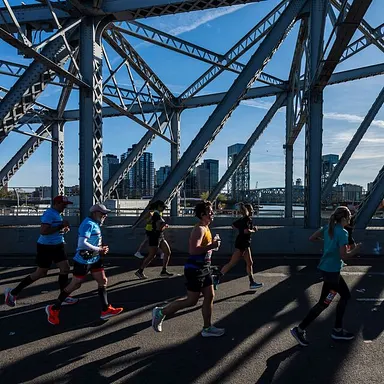
In this episode of The Daily, music critic and former New York Times writer Ben Ratliff talks with host Rachel Abrams about how running changed the way he listens. After years of hearing music as background, Ratliff describes what he calls running the song, using motion to get closer to a recording.
The conversation covers his early career, a studio visit that left him unmoved, and his analysis of an Eric Dolphy solo that he says only made sense while running. The episode closes with Ratliff's five-hour New York City Marathon playlist, with songs chosen for each borough along the route.
In this episode Rachel Abrams, Ben Ratliff
The transcript of this conversation about running to music with critic Ben Ratliff was made with the technology behind HappyScribe's AI tool that takes meeting notes.
Ads in this audio differ from the text. Tap the sentence you're hearing to follow along.
Synced: the text now follows the audio.
Hey, everyone. It's Rachael. If you are not yet a Times subscriber, we have some news for you. You can enjoy full access to The Times without a paywall for 30 days, and all you have to do is download the app to get your first month completely free. And if you're already a Times subscriber, I want to say thank you. Okay, here's the show. From The New York Times. I'm Rachael Abrams, and this is The Daily on Sunday.
Hi, can I ask you guys something?
Last week, producer Laina Richards went to Central Park to ask runners a question.
You need a question? I do.
What are you listening to?
Everyone's preparing for the marathon, and I'm stopping them. It's my 25th. Your 25th marathon. Can I ask what you're listening to?
Oh, it's Tony Bennett with Norah Jones.
Time is so old.
And their answers were This is it. Paradis Bleu. All very different.
I am listening to The Strokes. Why are Sundays so depressing?
Radiohead. Optimistic.
Believe it or not, Bad Religion. Their Christmas album.
I'm dreaming of a world. Jimmy Eat World. Why did I know the name? The little girl, you're in the— yeah, yeah. The middle, the middle. There you go.
Eric Thomas.
You might be smarter, your family might come from privilege, your daddy might own a company, but you will not outwork me.
He's not a musician, he's like a motivational guy.
He's the best. Eric Thomas. He's the best.
Keep me moving, right?
Yeah, they'll take his words and like chop them up and put a beat behind it, you know.
Some of you need to give up your cell phone.
It is not surprising that people like to listen to music while they run. And for the most part, people told us that it basically just takes the edge off.
It just relaxes me.
It helps them set the pace.
It's just like a fast-running mix. It's not like a song you know? Just like fast BPMs, no. Just to help me, like, feel motivated.
So I had to sort the BPMs from, like, the slowest songs to the fastest songs at the end of my run so I'd save my energy towards the end.
Makes things more fun.
I probably look like a weirdo sometimes because I'm going crazy to my music.
Or... It helps them pretend, maybe just for a minute, that they actually aren't running.
Anything to really distract me from, like, where you're at in the run.
I guess it just gives me something to think about that's not running.
Right. But Ben Ratliff, a former New York Times music critic and author, thinks of running to music completely differently. He runs to make the music better, not the other way around. And the fact that he could do that was such a profound discovery to him that he wrote an entire book about it. It's called Run the Song: And so today, on the day of the New York City Marathon, my conversation with Ben Ratliff on how running can make you a better listener. It's Sunday, November 1st. That's after the break. We'll be right back. Ben Ratliff, thank you so much for coming to The Sunday Daily. Thank you. So, we are here to talk about running and music, 2 things which I think a lot of people think go together. First, I want to talk a little bit about the backstory to what brings you in here today. You are a longtime music critic.
Yes.
Including for The New York Times. So, how did you get into that to begin with?
I saw Miles Davis when I was a teenager, and I had so much— to say about it afterwards that the only response that made sense to me was writing. So I wrote an article for the high school newspaper. He did the things that people all know that he did, which was play very short melodic phrases on his trumpet and then leave long silences. and just sort of wander around the stage and sometimes turn his back to the audience for long periods of time and put, like, a whole open— the heel of his hand down on a keyboard.
He just mashed his hand on the keyboard? Is that what you're describing?
Yeah. To get a— one of those strange chords.
Okay.
And I thought, I don't know what's happening here. It was so mysterious.
Did you like it though? Like, did you like what you heard?
Loved it.
Loved it. So, tell me about kind of going from there to actually doing criticism professionally.
I took one writing class in college with a writer I really admired, the jazz critic for the Village Voice at that time, Gary Giddins. And this sort of set me on my way. I mean, I just started pitching things to little magazines and Getting a job doing it professionally was something I never dreamed would happen. And I couldn't believe that the New York Times was trusting me to choose to write about whatever I wanted to. Because that really was what it was like when I started. There was great faith in the music critics that we knew our way around the scene and knew what was worth writing about. And that didn't necessarily mean what was popular. It just meant what was interesting to us. Mm-hmm.
I wonder if there's a show that stood out to you where you were like, I can't believe I get to do this for a living.
I would say that there were some nights at— the Village Vanguard was a club that I went to a lot.
Still around, I think.
Yes. It's been around for 91 years, I think. Wow. I saw many, many things there. Because you're below the ground, it's a little bit like the experience of being in an airplane where you're just like, you're in some other sphere, and the concerns of what's happening on the planet Earth seemed far away. I saw so many groups perform at the Village Vanguard and reach a moment in this improvised music where you as a listener actually didn't know what was going on. And I loved that feeling. I loved the feeling of getting lost. I think about that a lot.
You know, you're describing a job that I think a lot of people would consider like a dream job, right? Getting to go listen to music, see music, and write about it.
It was.
It was. I mean, I know you don't do that anymore, but I sort of— I'm wondering about that past tense. Like, was there a point that it stopped being what it was at the beginning for you?
No, it always was. But after a little while, the opportunities to review performances in the Times grew less and less through editorial decisions that the paper had made. And I found myself a little bit at a crossroads because I realized that this was the thing that I loved best, was being at a performance, seeing something happen in real time, and using that as a pretext for an essay. So when I couldn't do it so much anymore, I think I began to wonder about what comes next.
So you were at this crossroads, and in your book, you talk about this moment when you also realized that you were having a hard time even listening to music. You took a trip to Maine to a recording studio to visit a recording engineer, I believe.
Yes, that was Bob Ludwig, who people who have spent time looking at the back of record covers will recognize his name because he's been the mastering engineer for thousands of well-known records. So he has very precise ears, and he put me in his special studio in his chair where he does his important work, you know, and he put on So What from the Miles Davis record Kind of Blue. And, you know, I know this piece of music really well. And I wasn't blown away.
And you thought you would be?
I thought that I was gonna get closer to this piece of music than I ever had before. And that didn't happen.
Why did you think you were gonna get closer?
I thought I was gonna get inside it.
Inside it. What does that mean? Can you translate what that means for a person who maybe isn't super fluent in music?
Well, Audio specialists, audio people, of which I am not one, use the language of space, of atmosphere to describe how something sounds. They talk about recorded sound as being like a place that you can inhabit, like a stage almost. And I thought that I would be able to do this to a degree that had never been possible for me before. Mm-hmm. And it might be akin to the feeling of actually maybe being in the studio with that group in 1959, et cetera.
So, I was trying to understand if you meant, like, that you can feel it in your— the music sort of, like, in your body almost, or you're just talking about, like, wow, I feel like I'm actually in— this music is so present around me. I feel like I'm actually in the recording studio. Like, the energy. Is it like a—
No, I think that's a great question. I think I meant more of the former. But the idea of the music being inside my body, I suppose I wanted that too. And that also wasn't happening. It made me think about that. Like, it also made me realize my desire that— well, what do I want? I think I want to be the music, essentially. What does that mean? Well, as you said, I want to feel it in my own body. And this might be different from dancing to it.
But just so I'm understanding this, the issue here is that you're in this special room, this special chair, you've got all this special audio equipment, and you're listening to the song expecting that all of your surroundings are basically going to elevate elevate it. And they didn't. And that caused you to think what exactly?
I think it just made me feel that I need to figure out a new way of listening. And I'm not quite sure what it is. You know, there must be a way to listen better than I have before. Weirdly, that was the same weekend that I went running, really, for the first time with a friend of mine.
And you went running not trying to seek out some solution to it? No, no. And we weren't—
we certainly weren't listening to music. It was— there were just— there were 2 unrelated things that happened on the same weekend.
So you leave the session with this engineer... Yeah. ...unmoved, and perhaps a little bit unmoored by how unmoved you were. And you think, I need to figure out a different way to listen to music. And then you go on your first run. What was that experience like?
I had memories of running from, you know, high school— being on a high school team or something, and just always hating it and thinking, I don't— I'm not good at this. I don't see the appeal.
Relatable.
It seems like punishment, really. boring, etc. And I just thought, well, you know, people can change. Here I am, an adult. Maybe I'll like it this time. And I think that's when I realized, oh, okay, this is what I'm going to do every day.
Why? What was it about it?
Well, because I felt like a million bucks after I came back every time. I thought better. I wrote better. I had crazier thoughts, which I was dying to articulate.
What kind of crazy thoughts?
Crazy sentences, crazy syntax, crazy vocabulary.
There's this wonderful scene in First Wives Club— Oh, I love it! —where Goldie Hawn talks about how exercise gives her the best inspiration.
I tell you, I get my best ideas when I'm working out. You?
You get ideas? You're reminding me of that.
Yeah. I think that thinking is one of the greatest parts of running.
And just so I'm clear, during this early period, are you still not listening to music after this initial time?
No, not really. I didn't have the setup for it. I wasn't even sure how to do it.
I'm sorry, sir, you didn't own headphones?
Oh, yeah, but I had the kind like I'm wearing right now in the studio.
Like these big over-ear? Yeah. This is what people wear to the gym when they want to lift weights, though.
Yeah, I couldn't see taking these out outside and, like, holding the phone. And yeah, I didn't— I didn't really think that through.
I just think most people are gonna be like, the music critic didn't listen to music when he was running?
No, it was— it was a way to empty my head, I suppose, and get me in a kind of mental position to begin writing when I got home.
And then something changed for you. So tell me about that.
So then the pandemic came, and time got all weird. I could run in the middle of the street in the Bronx. And I went running for much longer times. And I remember going out running one day listening to music and coming back and thinking, I think I've just listened better than I've ever listened in my life. It was a weird feeling. I just— I felt like something had happened.
What were you listening to?
I wish I could remember.
Oh, no! Yeah, I know.
I wish I could remember.
But you said you felt like something had happened.
Yes.
So what happened? What changed?
The easiest way to put it is that I think most people, when they listen to music as they run, they're listening to music in order to be a better runner. In other words, they're listening to music to set a pace, a certain tempo, or maybe to—
Pump themselves up. Keep them going.
Pump themselves up, or take their mind off of things, or take their mind off the fact that they don't really like running or whatever. And I guess I thought, well, what if you turn that around and you run so that you could be a better listener.
What does that mean? What happened to you that you thought that on this run?
I realized that I could actually run into the heart of the music itself, and that running could be a way of taking the measure of music in a way that I really hadn't done before. So I started it just in my own mind. I started calling this running a song. Like, if I found a song interesting in any way, the next thing for me to do would be to run it and see how it felt. So music was not just about music anymore. Music was about place, and music was about motion. Mm-hmm. I realize now that one thing about what running with music does for me is it essentially makes all music live music. Like, whatever I'm running to, it doesn't matter whether it was a live performance or not. It becomes one through the process of running with it. It, like, enlivens it. It turns the music into a sort of performance moment in which I am, you know, I'm in there somewhere.
The experience that you're describing of, like, feeling that the music is in you and around you, you're in the world with it, It sort of reinvigorates the way that you are hearing the music itself. Like, I'm wondering if that is a translatable experience other people could have when they put on their headphones and they go out for a run.
Mm-hmm. I would say that increasingly these days, and this has something to do with earphones, I mean, the fact that we are an earphone culture now, many of us treat music as a means to an end, essentially. Like, it's something that can help us accomplish something else that isn't really about music per se.
Like, it could help me with my workout.
It could help you with your workout. It could help the day go faster. It could set a pace, etc. And what if music were not a means to an end? Hmm. What if the music itself is actually what you want to be paying attention to? And then what are you paying attention to? What should you be listening for?
Well, just to be fair, I do think a lot of people would say that they listen to music for the joy of listening to music. But I hear what you're saying as somebody who listens to music to get herself through exercise classes, including running. I hear what you're saying about music for music's sake. So I just sort of wonder what— in this scenario, what should I be listening for?
You could think about the music as a space. And if it were a space, What would you see in the space? What's to the left? What's to the right? What's behind you, et cetera? You could think about what's at the bottom of this. Is it drums? Is it singing? Or you could just think about what critics do, which is, what is the essence of this thing? And that could be a sound, but it also could be an intention or a philosophy or something. Like, what is actually at the center of this enterprise such that if you took a pair of tweezers and extracted it, that the whole thing would fall apart? Hmm. What is that? And I think that pursuing that question is fun. And I think, you know, Once you're really engaged in that question, I think you're listening to music as such rather than as a means to an end.
I wonder if you could give an example of a song that really came to life for you through this, or maybe even just a piece of music that maybe you understood better once you ran it?
Sure. This is a jazz record that I have listened to lots in my life. And the record is Eric Dolphy at the Five Spot. And it was made in 1961. It's a thrilling record. It's a quintet, and each of these 5 members has a distinct personality, not unlike the Beatles, so that, you know, you feel this sense of, like, wow, completely different people. Here on stage, and they will often solo one after the other.
Okay.
So it's this song called The Prophet, written by Eric Dolphy. And in The Prophet, first you hear Eric Dolphy's saxophone solo. Then you hear Booker Little's trumpet solo. And then you hear a piano solo by Mal Waldron. And that was the thing that I never really understood.
Why? What didn't you understand about it?
First of all, it's about 4 minutes long, so it's sizable. It always felt kind of oblique. I knew it was smack in the middle of this music that I loved. I just didn't get it.
It was a part of the song that you just didn't really care for, basically, and didn't understand why they had included it?
Something like that. And when I would listen to the record, I think I would just, you know, think of something else for 4 minutes and not really pay attention. It was like a blank spot for me.
Oh, that's so interesting.
So it was— it was running to this record that I really loved that I could finally hear this solo for what it was.
And what was it?
He's tentative at the beginning. You don't really know where he's going, and perhaps he doesn't know where he's going. And then, as you can hear right here... It's mad repetitive. He focuses on phrases and repeats them and repeats them and repeats them and just changes them slightly. And you get to a point listening to it where, if you're really listening, you draw closer and you think, what is he doing? Mm-hmm. What is he doing? And it becomes interesting rather than What I've understood finally by running with it, he doesn't necessarily need to know where he's going. That's the amazing thing. With the other soloists, there's so much of a sense of forward motion and resolution, and there's high points and low points, and he's just kind of steady. I think that's the beauty of the piece. And he's persevering. And it's this spirit of non-virtuosic perseverance that really appealed to me as a runner. And it gave me the feeling of like, I think I could probably run forever. If this solo lasted forever, I think I could probably just keep going with it. This is the way to move into the future.
Why? What about it made you think you could listen to it forever?
The spirit of perseverance. You know who you are, but you don't need a desired outcome. And actually, I think proper listening means not desiring a particular outcome. You don't know what's going to come next. You're just paying a lot of attention to the moment, to each And I felt that that's what he was doing.
So, do you think you actually had to be in motion in order to appreciate these 4 minutes?
That was my conclusion. I mean, it certainly helped. I was running alongside Mal Waldron as Mal Waldron was making these adjustments and having all these ideas.
Well, Ben, it is marathon day here in New York City, and we had an idea based on all of this. The New York City Marathon is run through the 5 boroughs of Manhattan, and you made us an entire 5-hour marathon playlist, which we will link to in the show notes for this episode.
Yes.
But from that list, you brought in today 5 songs that represent each of the 5 boroughs that thousands of people will be running through today. And so after the break, we are going to talk about how those songs might be eminently more enjoyable if experienced while running them.
Mm-hmm.
And if you can't run the race today or you don't live in New York City, you can vicariously go there through these songs. We'll be right back. So just to set the scene, if you were running the marathon today, you're at the starting line.
New York City. You'll be conquering 5 beautiful boroughs here with all of—
Verrazano Bridge on the Staten Island side. There's a lot going on, tons of energy. People are really amped up.
Athletes, are we ready?
The Star-Spangled Banner comes on through speakers at various points. You're taking it all in. One more time.
I wanna make sure they can hear you up in the boogie-down Bronx. Athletes, are we ready?
Don't put in those headphones yet. Enjoy the scene. Listen for the starting cannon. Take in whatever New York-themed send-off song they play this year. And now that you're on your way crossing that bridge, Ben, what are we listening to?
The instrumental version of It's Yours by the Wu-Tang Clan. Wu-Tang is Staten Island. Staten Island is Wu-Tang. It just sort of seems like, well, it's sort of got to be that. I thought about a piece of music that was, first of all, repetitive because, you know, you're getting into the flow, but also that does not have words. When you're beginning the race, you don't really need somebody rapping in your ear. There's a huge crowd around you, You need to be aware. Also, the song is called It's Yours, whether you know that or not when you're listening to it. I think the whole point of this marathon experience for you should be like, you're doing this for yourself. This is not for social media. This is not for Strava. This is not for the person you want to impress. This crazy experience that you're undertaking should be entirely for you.
Okay, so Wu-Tang Clan, Staten Island. Where are we going next?
Well, after you come across the Verrazano Bridge, you're in Bay Ridge, Brooklyn. And one of the most famous things about Bay Ridge, Brooklyn, is that it was the setting for Saturday Night Fever, the movie, based on the fictional story written by Nick Cohn. And I believe that the film scenes actually used the disco 2001 Odyssey, which was, you know, a functioning disco in Bay Ridge in the late '70s. Okay, so like, why not have a song that they might well have played around that time in the disco in Bay Ridge? So, a song by Chic, the great disco band called Chic Cheer. Chic Cheer. Which has a kind of, like, high school sports team cheer thing going on in it. Okay. And very naturally gets you sort of pumped up and excited.
Come on, everybody! Give me a C! C!
Give me an H! H! I mean, it's such an incredible rhythm section. Also, Nile Rodgers from Chic, before Chic, used to play in a bar band in Staten Island all the time. So he can be our Verrazzano Bridge connecting Staten Island and Brooklyn.
What does it feel like to run to this?
A song like this really does establish an atmosphere. It's long, it's open. There's a lot of instrumental sections in it. It has texture. It has amazing rhythm.
It has a whistle.
It has a whistle. Also, it's quite repetitive.
It's great.
But, you know, when you think about it, so much music in the world is repetitive. Maybe the only music that is, like, noticeably not that repetitive is some classical music from the European classical tradition where, like, the idea of variation was so important. But, like, outside of that, music repeats. That's just what it does. And running is repetitive. But as we all know, there's some kinds of repetition that's really great.
I'm sensing a theme here. Repetition, persistence, basically like music Running just kind of keeps you going without maybe a destination in mind.
Yes, thank you. I think it's heroic, this kind of thing. If you don't mind, would you please get up off of your seat and remain seated?
Although for the marathon, I suppose there is very much a destination, which is the finish line. But, like, the thing about the New York City Marathon is that it is a party. Like, when the runners turn onto Lafayette in Brooklyn and around the 9-mile marker, There are huge crowds. There are people with signs who are cheering. Move your ass! Come on! So again, good to take your headphones out sometimes, take in the scene. But when we put them back in, we keep running. Now we're in Queens. What are we listening to?
In Queens, you can think about Run-DMC, who came from Queens. And by that time, you will have been running for long enough that you have to moderate yourself. You know, unless you're a champion runner of the world, you have to slow down a bit. You have to find a pace that is agreeable, that's going to carry you through.
Because at this point, you've been running for something like 13 miles.
Yes.
This is the part where you get tired.
Yeah. And you have to reconcile yourself to not being fast, but just being persistent.
Is that why you picked a song called Walk This Way? Is that what we're gonna listen to?
No, that would've been perfect. No, I picked Slow and low.
Okay.
Let yourself go. Slow and low, that is the tempo. When this is being repeated in your ears over and over, it makes the idea of going slowly but consistently seem really appealing. Sometimes I find myself going too fast, and I start to wonder why I'm feeling uncomfortable. And then I realize, oh, I'm going rather fast. And I have to tell myself, it's okay, slow down. Where are you going so fast? You know, cool it. And so to have Run-DMC tell you that might make you listen.
Okay, so after Queens, technically you go through Manhattan, but then you get to the Bronx.
Welcome to the Bronx, Michelle! Welcome to the Bronx, Jeffrey!
Yeah. And so the song I chose for the Bronx is by a group that existed for a short time in the '70s called Grupo Folklórico y Experimental Nueva Yorkino. And it was a group of New York-based musicians, some American-born, some from Cuba, et cetera, who all convened for these kind of intense practice sessions and listening sessions in the basement of 2 musician brothers, the González brothers, in the South Bronx. And it was a kind of like a laboratory. And out of this laboratory came this fantastic record. So there's a song from that record called Canto Ebioso. The Cuban rumba. But rumba in general, rumba music in general, I find to be about as good as it gets for running.
Why?
Because it's relentlessly energetic. It's full of life. It's ecstatic. And it's also like, there's so many things happening at once between the interplay of drums and voices. And also the drums and voices aren't perfectly in sync. So there's lots of, like, jostling going on. And especially running through a city, it's sort of perfect.
Because the city is so busy and it kind of matches the music?
Yeah, exactly. If I'd spent a whole day in the newsroom and I left at the end of the day, especially if it was dark, I loved to walk around the Times Square area listening to rumba records because, like, all around me was— is, like, you know, flashing lights and—
It's such a sensory experience.
Oh, it's amazing! You know, it's coming from all directions. And the music seemed like a perfect counterpoint to that.
Yeah. Okay, well, we have one more borough: Manhattan.
Well, Manhattan, I mean, it's like the upward mobility capital of the world. It's almost funny sometimes how Manhattan is this place that's just built on dreams of having the perfect apartment and the perfect job and being famous and all that. It's been that way for so long. So I thought of this song by Ashford and Simpson called Bougie Bougie. Which is Again, like the Wu-Tang song, it's an instrumental and it's quite long and it just keeps developing and growing and growing. And because it's an instrumental without lyrics, both of them great singers, but you can put yourself into it as a listener or as a runner. It's a glamorous song. And I think that by the end of this enormous tour through the boroughs, you finally arrive at a part of New York that is almost objectively quite glamorous.
You know what this music reminds me of, as the non-music writer? May I?
What's that?
Okay. I can imagine this music playing over, like, a montage of glamorous city life at the beginning of a movie about the young woman coming to New York City with all of her dreams. And you see her coming out of her apartment building all excited before she gets crushed by whatever it is that happens in the second act.
Yeah. No, I agree with you. It is kind of a beginning— it's a beginning song. Yeah. Like an opening montage kind of thing. Yes. And there was a great DJ named Larry Levan who was sort of— who presided over this great disco in the '70s and '80s called Paradise Garage. And he would use this song sometimes at the beginning of a set to sort of, like, tenderize people, get them ready.
I like the idea of new— of this song helping with new beginnings. I think we're talking about a lot of new beginnings.
I think we are. And it's funny that this would come at the end of a race.
Well, Ben Ratliff, this has been a pleasure. Thank you so much.
Thank you. This is the finish line!
Before we go, we have a special treat for all of you about to run the marathon. Ben made us a playlist for the entire run, all 26 miles. You can find a link to it in the show notes. And Ben Ratliff's book is called Run the Song: Writing About Running, About Listening. It was longlisted for the 2025 National Book Award for nonfiction. This episode was produced by Laina Richards and Alyssa Dudley, with help from Alex Barron. It was edited by Wendy Doerr and contains music from Dan Powell, Diane Wong, and Marian Lozano. Field recordings by Dan Powell, Marian Lozano, Nick Pittman, Sofia Lanman, Alicia Batitup, and Pat McCusker. We had production assistance from Dalia Haddad and Tina Antolini. It was engineered by Rowan Nemisto. That's it for The Sunday Daily. I'm Rachael Abrams. See you tomorrow. Bye!
Ben Ratliff, a music critic and avid runner, always ran in silence. Then he discovered how music opened up to him — while running. It changed his entire approach to criticism and listening. He calls it “running the song.”Today, for the New York City Marathon, Ben talks with our host Rachel Abrams about how his listening sharpens when he runs to music.Then, he goes through highlights from his five-hour New York City Marathon playlist, which is designed to complement a run through the five boroughs, featuring various styles of music connected to the places on the route.On Today’s EpisodeBen Ratliff, a former New York Times music critic, a music professor and the author of “Run the Song: Writing About Running About Listening.”Background ListeningBen Ratliff’s New York City Marathon playlistPhoto: Karsten Moran for The New York Times
For more information on today’s episode, visit nytimes.com/thedaily. Transcripts of each episode will be made available by the next workday. Subscribe today at nytimes.com/podcasts or on Apple Podcasts, Spotify and Amazon Music. You can also subscribe via your favorite podcast app here https://www.nytimes.com/activate-access/audio?source=podcatcher. For more podcasts and narrated articles, download The New York Times app at nytimes.com/app. Hosted by Simplecast, an AdsWizz company. See pcm.adswizz.com for information about our collection and use of personal data for advertising.