
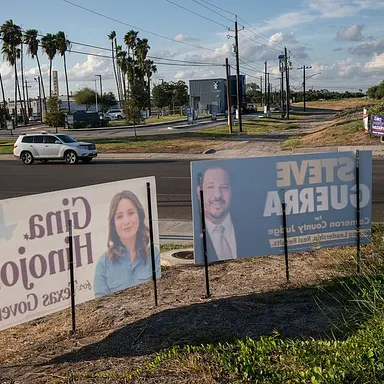
This episode of The Daily examines how immigration raids in the Rio Grande Valley of Texas have reshaped life and business there, and why the region may swing away from President Trump in the midterm elections. Producer Lindsay Garrison follows Mario Guerrero, a developer leading the South Texas Builders Association, and a framer known as A, whose arrest leaves job sites short of workers.
The episode covers the area's history, local frustrations over crime and fairness, the builders' lobbying trips to Congress and ICE officials, and the founding of a trades school. Listeners will hear competing views on labor shortages, workers' rights and the American dream, and how the Trump vote is being reconsidered.
In this episode Michael Barbaro, Lynsea Garrison
This episode's transcript on the Rio Grande Valley raids was made with HappyScribe's AI meeting minutes generator technology, the same tool used across this page.
Ads in this audio differ from the text. Tap the sentence you're hearing to follow along.
Synced: the text now follows the audio.
Hi, this is Carolyn Ryan, managing editor of The New York Times. At The Times, we strive to help everyone stay informed, and at this critical moment, we're making all of our election coverage free in our app. This election has an expansive battleground map. States that hadn't been in play before are suddenly competitive. We have more than 100 reporters out there talking to voters. I wonder if I can just call Will to get the actual numbers. Hey. Hey, how are you? How many voter interviews do you think we've done?
Our plan is to talk to 30,000 voters this year.
Okay. You're awesome. Thank you very much. Thank you. Don't you love The New York Times? On election night, we are the place to go for race results. Our maps are updated minute by minute. Our data team can show you what votes have come in, what votes are yet to be counted, and how that might affect the overall results. Come experience all of our election coverage for free right now in The New York Times app.
From The New York Times, I'm Michael Barbaro. This is The Daily. In tomorrow's election, few regions of the country are expected to swing harder away from President Trump and toward Democrats than the Rio Grande Valley of Texas, where life has been transformed by the president's crackdown on immigration. For the past year, my colleague, daily producer Lindsay Garrison, has been reporting on that shift and the unlikely group leading the charge. It's Monday, November 2nd.
When the raids first started in the Rio Grande Valley in early 2025, People were confused. Sure, some people with criminal records were getting picked up, but so were people who weren't criminals, people who had lived along this stretch of land near the Mexican border for years. So people were scared. Some stopped going to work or going to church. And then ICE agents started showing up at job sites. Videos began to circulate. Some showing an ICE agent tapping a worker on the back while he and his crew were in the middle of laying a concrete driveway, continuing to work until the moment they were handcuffed with puzzled looks on their faces. But compared to many places across the country, the raids and the reaction to them seemed to be happening fairly quietly. And then one day, someone spoke out.
What's going on, Rio Grande Valley? It's Mario Guerrero here.
A developer named Mario Guerrero posted a video sounding the alarm.
Because this is gonna ruin our economy. It's gonna ruin the housing market, the American dream.
At that time, it was the only thing I'd seen like it. Someone from the construction industry loudly speaking out about these raids. So I called him.
Hello, it's Mario.
Hey, Mario, it's Lindsay Garrison. Thank you so much for your time talking with me. I'm, I'm really grateful. I'm sure you're very busy.
I think busy's an understatement right now. I'm running around like a headless chicken.
Mario owns a construction company and runs the business side of his parents' construction company. Plus, he owns a brokerage, but he's also the executive director of the South Texas Builders Association. The STBA. It's a group of 159 construction and real estate businesses, mostly across the Rio Grande Valley. So he's got a bird's-eye view of things.
Right now, what is happening in the Rio Grande Valley, I mean, it's scary. We've had multiple builders that have been pouring driveways, and, you know, immigration gets there and they just take everybody and they don't leave anyone behind. And it's not just 1 or 2 or 3 builders, it's like more than 10 construction companies. I wanna say we're up in the 15, 20s, Where it's happening more and more. So it's putting a lot of fear on people.
Mario told me he started noticing more and more raids in the spring of last year. He started talking about it privately with other members of the STBA.
Like much of the Valley, they were also confused.
So they started using group text threads to compare notes and alert others if ICE was seen at a job site. But beyond that, No one initially knew what to do, and they felt their local leaders weren't speaking up enough about it.
Where are our leaders?
So in November, Mario and the board at the STBA called a meeting for anyone in the construction community of the Valley to open up about the impact of the raids. And days later, in an airy event center normally used for weddings and quinceañeras, with wrought-iron chandeliers drooping from its high ceilings, Dozens of people from the Valley's construction industry shuffled in to share stories.
It was definitely a cry for help. That's all it was. It was a cry for help. I mean, and we're still crying for help.
Business in the Valley was hurting, and they were perplexed, wondering if maybe a mistake had been made and whether they were the ones who made it.
Man, what did we do?
Because many, if not most of them, had voted for President Trump.
What the fuck did we do?
The Rio Grande Valley isn't really a valley at all. It's a mostly flat floodplain that hugs part of the Rio Grande River. Desert willows dot the terrain here. Palm trees rattle in the wind. People here call it the RGV, or just the Valley. And its 4 counties have some of the highest Hispanic concentrations in the entire country. ¿Cómo está? Bien, bien. Most people here slip in and out of Spanish without a second thought.
Cómale, cómale, provechito.
As someone put it to me, it's like coming to another country between 2 larger ones. For generations, the Valley voted Democrat, but it's more of a purple place than a blue one. It's a deeply Catholic part of the country, where attending church is a weekly rhythm. Most people I've talked to call themselves conservative or moderate. Cross-border commerce and small businesses help fuel the economy here. So does Border Patrol, a huge employer in the Valley. This close to the border, immigration is not a slogan or a platform. All of the complexities and intricacies of the issue are layered on top of one another. It's just a part of life. So it's the kind of place where a reverend of a small church happens to also be a Border Patrol agent preaching to his undocumented congregants. A place where a popular restaurant gives breakfast discounts and deals to law enforcement like ICE, even though some of the employees taking their order or cooking their food in the back may not have legal status. It's all tangled up and knotted together. So when there's some big change in immigration policy nationally, it hits the Valley first. And it can often feel like a seismic weather event, changing the topography of a place.
And in 2021, a big one came. The largest immigration surge in U.S. history which peaked during the Biden administration, had landed in the Rio Grande Valley.
We saw it because it was happening here in our backyard. We saw it. We saw it here. We're the front lines.
Oh, man. I remember even seeing, like, the caravans of people.
Thousands of people were making their way to the border.
Daily, we would have 100 buses coming into there and out of there for almost 4 years.
At one point, 10,000 immigrants a day were crossing into the United States along the southern border.
You would see the border full of immigrants just laying there. Like, oh my God, where are all these undocumented people going to?
People told me it rocked the valley and put a strain on so many here.
The Border Patrol here were overwhelmed.
Like Border Patrol.
And everybody here knows Border Patrol agents.
Right.
There's so many of them.
You could see the stress.
2 Border Patrol agents in the Valley killed themselves in the span of a week.
All of a sudden, there's more break-ins, there's more robberies.
Some business owners told me they sensed a rise in crime.
I mean, I saw it as a business owner.
One man told me he'd opened up his hardware store to find his chain-link fence had been cut into. A wheelbarrow had been stolen. And he assumed who took it.
They just got here from some random country and just— they need a couple bucks. They need to eat. So it's understandable. Not condonable, but it's understandable.
But the frustration went beyond a stolen wheelbarrow. The whole situation inflamed deeply held perceptions of unfairness.
My wife's a nurse.
There was occasions where she would say there was illegals in one of the rooms because they're pregnant and that's gonna have a baby here in the United States.
People told me they felt the new arrivals were getting preferential treatment.
And she's got a guard in the door. And then she's getting all the medicines because the government's paying for it. Yet I have American citizens in the next room that can't afford to have that type of care because she's a citizen.
And cutting the line in front of people who had been trying for months or even years to become a citizen.
Because of all the pressure with all the refugees coming over here, the illegal aliens, whatever you want to call them, all the people that had submitted their paperwork, they don't have enough personnel. ...to handle all this new processing.
Like an administrator of a local school who told me that a dean of students had a work visa that was about to expire. He submitted the paperwork to renew it on time.
They're like, sorry, we're so backed up, we haven't gotten to your file.
It wasn't processed in time, and it expired.
Then you need to go back to Mexico.
His lawyer advised him to return to Mexico so that he wasn't in the country illegally and jeopardizing his citizenship process.
And so, Here we are almost 3 years later. He still has never gotten his visa to come over.
These accounts were sometimes second and thirdhand, and they often painted an incomplete picture. For example, according to the McAllen Police Department, property crime did rise slightly in 2022, but overall crime was actually down in the city during this period. And that backlog at the border? It predated the surge under Biden. And while undocumented immigrants are guaranteed care in emergency medical situations, so are American citizens. But still, it all added up to a feeling.
So I see that that's not fair, you know? That has nothing to do with them being Mexican or us not wanting them to try to get a better life. That's why our parents came to this country, to try to give us a better life. And I understand it. But it's just impossible when you have so many people.
Hey, even heaven has borders, right? Not everybody's gonna make it in.
Over at the STBA during this period, people told me the construction business was humming along.
Well, yeah, we were— we were building just fine.
But that didn't mean they didn't have their own complaints about the influx of people.
Well, that's why I believe a lot of people here locally were voting for Mr. Trump. Like, Okay, yeah, we're gonna take all the immigrants out. Well, great, dude, great. You should take them back because the way that they came in was not right.
But there was another reason the Valley turned red the last election after so many years of voting for Democrats. President Trump was a businessman, and a lot of the builders at the STBA were too. So many saw a piece of themselves and their aspirations in his story.
I'll tell you this, I believe that Donald Trump is the epitome of the American dream. His dad started something, right? His dad started something. And then what did he do? He passed it on to his son, and people want to hate on him for that. Why would you hate on him for that? If his dad built something and now his dad was able to give it to him, that's the American dream.
It feels like in other parts of the country, the American dream is talked about as almost a relic of the past. But in the Rio Grande Valley, it's alive. It's real. So many of these builders I've met at the STBA were sons who took the mantle of their parents' construction company, or they were fathers hoping to pass their fortunes onto their own children. And what was shameful about that? That was everything their own families had come here to do. So when the raids started at the job sites, And when things came crashing down, it was the first time, probably in their lifetimes, that that idea was in danger.
So anyway, the irony here is that we all voted for Trump. We all voted for Trump. We all voted red. We were the guys on the Trump wagon, dude, on the Trump train, like for real.
Because that's what Mr. Trump and his administration said, that they were going to come after the murderers and the rapists.
You know, you promise criminals, rapists, murderers, molesters, sure, get them all out.
The worst of the worst. But I mean, right now you're going after everybody. Everyone is a criminal.
We didn't know you're talking about These people that I've known and been here for 10 years, and they're working every day and adding value.
So it just— it's kind of hard because you're like, dude, like, it doesn't make any sense. I mean, now it's like— now you start to wonder, was it the correct choice? If that was the right decision to make at the time, you know?
Are you the foreman, sir?
The raids just kept ramping up. By winter of 2025, more videos swirled around of ICE agents climbing on tops of roofs to question workers.
No.
Or shouting up at them, telling them to put down their tools and climb down the ladder. Security cameras captured ICE vehicles speeding across subdivisions, chasing men who were sprinting away.
Every day there's a raid. Every day. Oh my Lord, every day. We just got hit yesterday.
This year alone, we've been hit 9 times.
Just right now on my other private chat groups, Right now at 12:09, ICE is in Laguna Heights subdivision here in Edinburg. So it's like, Jesus Christ. It's every day. Every day they're hitting job sites, picking up people.
Many workers were too scared to show up at work. And those who did were taking a big risk.
I mean, I had to— what can you say? Just swallow the panic and go out and do the money. That's what we needed to do. And, I mean, that's what we did.
Like A, who asked to remain anonymous for his safety. He's a framer and has lived in the Valley almost all his life. His parents brought him here from Mexico when he was a small child. When the raids started, a friend warned him.
Hey, Gabe, be careful. They started the raids. And I'm like, no, they didn't. No, they did. And he said, they just raided my job site. I'm lucky to even be calling you because they chased me down, but they couldn't catch me. And I'm calling you because you're one of my closest friends and I don't want you to get raided. And that's when we, we knew things were serious.
He was worried, but A has kids at home who rely on his income, so he didn't feel he had a choice.
There's no other option. You have to do it.
Nationwide, the construction field employs the highest percentage of immigrant labor, nearly 30%. And in Texas, those numbers are even higher. Studies suggest anywhere from 40 to about 50%. Official numbers on the Rio Grande Valley are hard to come by. But if you ask people in the industry, which I have, some wager as many as 80% are undocumented.
I had one guy that was a jokester, and he'd get up and he'd say, I hate those undocumented workers.
It's almost a joke here.
And then you'd get one or two. They'd say, why? What's wrong with us? What's wrong with being an immigrant? Then he'd say, 'cause there's too many of us. I'm undocumented too, and you're taking my job, you know?
People in the Valley's construction industry will also tell you that the trades that have some of the most undocumented workers are the foundation and framing crews. A has worked as a framer for around 7 years, and his father has been doing it for more than 25.
When he got here, I mean, those were all the only jobs, because for other jobs you need a social, and only the hard labor jobs are the ones that don't require one. So he got into— I think he was pouring concrete at first. Then he saw there was a little bit more money on the construction side, and that's when he started doing construction.
So when A was about to have his first baby and was working at a taco restaurant for $7.25 an hour, he decided he needed something more lucrative like that. And he asked his father to teach him the craft.
I mean, it's— it could be overwhelming because, uh, you can't stop learning from this. You find something different every single day. You learn something different every single day.
What was that like to have your dad as your boss?
Hard, because, uh, dads usually want the best for their kids, and if something didn't go the right way, would get upset and he would get after me in a hard way, right? But I mean, thanks to that, we know what we know now.
He started out as an apprentice. Every crew has them. They sweep the floors, clean up.
Took me about a year and a half, 2 years to learn the basics. Just the basics.
Just absorb the fundamentals.
About cutting, measuring, the speed square, the 45s.
Then he became what they call half a spoon.
When you start on the framing, The cuts had to be precise, and your main issue is holding the saw, because if you don't hold it right and it kicks back, you could cut your leg, you could cut your arm.
Now he works with his father—
Now I know the majority of it.
—who's a master framer, a maestro, as I call them. At the job site where we were talking, his father was framing a large pantry. So will he finish the framing of the pantry closet today, like, in— In the next couple hours? Is that the goal? 10 minutes. In 10 minutes? No.
Yeah.
I stood with A and watched.
Looking at the pantry, that's the one he's building.
Okay. A pulls up the blueprint and shows me what we're looking at.
The refrigerator.
His father wore a heavy tool belt with tools on both sides of his hips. He would swoop down to the floor, measuring the angles for the cuts, and then marking them with a short pencil. He's so fast. He's fast. Like, it's— And every time he bent down, his sweat droplets fell onto the cement slab floor. It's just dripping with sweat. But just as quickly as they would darken the cement, they would evaporate again in the Texas heat. The walls are up. He'd make the cut, then he'd fly up the ladder and reach behind him for his nail gun on his tool belt, which he'd always find without looking, and bolt the board in its place. He was so graceful. It was as if he defied gravity.
That's the second plate.
A builder once told me that there are 9,000 components to building a house. And if you take a trade like framing, it requires math, a lot of geometry to understand how to cut a stud, how to take the line or not take the line, calculating the correct pitch of a roof. And the only way to become a maestro was by doing it thousands of times, in the sun, in the rain, for years. Just like A's father. That's pretty much it. Is that it?
And you'll just put the 2 2x4 jacks, and that's it.
And sure enough, in just a little over 10 minutes, the pantry was done. He didn't know that we were timing him. I bet if he knew, he'd be really fast. So when a maestro like this gets detained, who is actually going to replace him?
How do we get rid of an entire workforce and have no way of replacing it?
You're going to tell me that we're supposed to get the labor from an American citizen that's never swung a hammer?
And that question wasn't just a theoretical one for A. He told me a while ago his father was detained, and all of a sudden, A became the head of the crew. But he never replaced his father. He just tried to do the work himself. And that was happening all around the Valley, too. Wives filling in for husbands, sons covering for fathers. It was a complicated reshuffling of a rapidly disappearing workforce. And then it was A's turn.
It was just a common day. So we got to the job site, we got off the equipment. Compressors, the generators, everything. And, uh, I saw like 5 or 6 cars just parked, and I didn't think too much about it. I'm like, nope, I don't know what it is, I don't know what's going on.
They're not like marked cars?
No, nothing. They're just regular cars. As soon as we started working, I just saw 2 Rams in front of me, like full speed.
Coming at you?
Coming at me, yes, full speed. And when they stopped, they opened the doors, 4 guys out of each truck, all ICE. And I panicked.
A told me the officials asked for his ID.
I'm like, why do you need to see my ID? They go, oh, no, we just need to see IDs to make sure y'all are legal.
He explained to him he had an NTA, a Notice to Appear document. It's what the DHS gives immigration court to begin a legal case that a person should be removed from the country.
I'm doing everything, I'm complying with the law.
A told them he complied with the law.
I'm doing everything y'all are asking me to do.
He said he attended all the court hearings.
I have my final court hearing.
In fact, the final one was coming up soon, where an immigration judge would decide whether A could stay in the country or not.
So I gave him my ID, and he looked at me and he looked at the ICE officer. And the ICE officer, he just nodded no. So what's going on? And the guy's like, oh, no, you're gonna come with us.
They arrested him.
So, I mean, they put me in handcuffs, and as soon as they got me on the truck, my wife called me. And she's like, what happened? I'm on my way over there. But she was crying. She was crying really bad.
They took him to Port Isabel Detention Center, where he'd be given a choice.
If you want to sign the voluntary departure, you'll be in Mexico tomorrow. And I was like, oh, why am I going to sign a voluntary departure if I feel this is I have my family, I have kids. What are they gonna do? And he said, I mean, that's not my problem. That's your problem. And that's your parents' problem for bringing you here illegally. I'm like, oh, okay, all right.
Pouring a foundation and framing are some of the first steps to building a house. Nothing can happen until the foundation is laid. Roofing, plumbing, painting, unless those jobs are finished first. So when those crews go missing, it pushes timelines out for subcontractors. I talked to one small builder who told me in a normal year he'd build around 25 houses. By the end of 2025, he'd only built 12. And going into 2026, he only had contracts for 3. If fewer homes are being built, less materials are needed to build those homes. So lumber and cement suppliers would tell me they were experiencing less sales and more cancellations. And with less orders, some companies I talked to had to start laying off employees to stay afloat. A big cement company told me that around this time, he'd laid off more than 100 workers. And a few months later, he filed for bankruptcy. All of this is particularly problematic when the Valley, and the rest of the country, is in the midst of a housing crisis.
Where are we supposed to get the labor from?
It's often said that if you remove immigrants from these jobs, Americans will take them. Americans will fill the void. Even President Trump has argued this. But that wasn't exactly happening.
That's stupid. That is dumb. All of a sudden, everybody's gonna, like, wake up and Oh, let me go do framing today. You know, let me go pour concrete.
I know nothing about it, but I'm really excited to go do it and work in the 110-degree weather. No, of course they're not going to come.
But the argument from the perspective of the STBA and even college instructors in the Valley who teach construction is the same as the one so familiar to the rest of the country.
It's easy for somebody to say, well, just hire Americans. Well, Americans don't want to do the work, flat out.
Americans don't want these jobs.
Like, when people are like, oh, it's because you guys don't want to hire. Dude, people are telling you that they'll hire you on the spot. The thing is, United States citizens don't want to work in construction.
And Mario argues it's not because they're not paid well. He points out that an apprentice starts out making $15 an hour.
That is not— that is more than minimum wage.
That's more than double the state's minimum wage.
So I think to myself, like, No, it's not that it's slave labor pay. It's that the work is hard.
But even if citizens did want these jobs, they're not qualified.
We need plumbers. We need HVAC workers. We need electricians. We need framers. And we don't have any of that in our high schools. At least not here where I come from.
Zero cement workers, framers, masonry, drywallers, painters. There's zero. That skill is not being taught anywhere.
It would take years of training like A's to build a workforce as skilled as the one that was disappearing. And that was a workforce the Valley didn't have.
What we need is the blue-collar worker. I believe the system has failed to prepare us.
We didn't prepare anybody. We prepared nobody. We made these decisions as a country and prepared ourselves zero. In an industry that is so critical for a society, I mean, come on, this is shelter. This is not, you know, luxuries. This is people having a place to live. And we'd fumble through that like some country that doesn't know shit.
I wish we had American workers. I would hire them on the spot. As a matter of fact, they're already working. Everyone that's available in South Texas is and wants to work. They're already there. They're already working. But that's not enough. That's nearly not enough. No more. We have nobody to replace him.
So now, all around the Valley, there are quiet job sites everywhere.
The guy that was working on it just never came back.
And with more and more workers disappearing, it was starting to feel like a crisis.
We've called over 35 framers just to find one. This is how unpredictable daily life is. You know, we show up and it's like, shit, are they gonna show up today? And if they don't show up, well, fuck, hopefully they'll show up tomorrow. And if they don't show up tomorrow, then you're hoping they didn't get picked up or— you don't know.
The STBA felt like the industry was about to go over a cliff.
At this point, if they raid my job site, my business is going down pretty Pretty much.
I can guarantee you this: the Valley's construction economy will not last another year if this continues.
So someone, maybe even one of them, was going to have to do something about it.
We'll be right back. 33 presidents.
I called the president at 4:30 in the morning, and he answered.
7 decades in space.
We want to see what's beyond the next 60 Super Sundays.
They were probably the best team in the league every single year.
53,500 puzzles. I use a different starting word every day.
25,000 recipes.
And I love a one-pan recipe because I don't love washing pans.
The New York Times, celebrating 175 years of helping you understand the world. Subscribe now for a special offer at nytimes.com/subscribe.
For many of the builders of the STBA, what was happening in the Rio Grande Valley was about more than just an empty job site or a failing business. It was about a way of life, a dream they'd inherited. It's the story of their lives. And over the past year, I've gotten to know a lot of them.
Can you, uh, park on the north side of the house? There's a little driveway there.
Like Julio Carranza. He's the vice president of the group and works alongside Mario. He knows A, the framer, too. A sometimes does work for him.
Come on in, Lindsay. How you doing? Good to see you.
Good to see you too.
I met him at his roughly 6,500-square-foot home he had just built on the perimeter of a golf course. A Cybertruck sits parked outside in one of the driveways. You, um, literally live on a golf course?
Yes. Well, I just moved in. I'm moving in, so Julio is charismatic.
He treats you like an old friend, his bro. He wears a big smile. He knows he's come a long way from where he first started. And to always remember that, he's got a picture hanging in his office of him as a pudgy toddler in Mexico.
And I remember still, like, we weren't from Mexico, but we weren't from America either, you know?
He was born in 1985 in McAllen, Texas. But the first 5 years of his life, he lived in Reynosa, Mexico, just over the border. And every day, his dad would commute across it for his job in the food court at La Plaza Mall in McAllen.
They worked and then they went to Mexico. So that's what they did.
Julio told me that's just what people did. Live in Mexico, work in Texas. But Julio's mom was a citizen. And eventually, his family crossed the border for good. His parents bought a house.
We lived in a tiny home. It was 3 brothers in 1 bedroom, in 1.5 bath. 6 people.
Imagine that.
What kind of house was it? Can you show me? I think I got a picture.
Yeah. And that's it.
Okay.
Carport.
It's a little house with beige bricks and a carport. Understated. Julio says his memories there are vivid.
Yeah, a lot of good moments, a lot of violence also. You know, poverty, bro. It was like textbook Hispanic household, you know? Your family lives together close by. Barbecue, corridos, beers, gunshots, you know?
Typical.
Was it fun?
It was fun. It was so fun. So those are the, the music we would listen to.
We still do. They're called corridos.
So you're just jamming out, drinking your beers, smelling the mezquite in the air, right? And just hanging out with your sombreros, your caps, and we're just chilling.
I remember that. Yeah. Julio told me his dad didn't drink much. Nor did he smoke. But he was a workaholic. He eventually got a job at the H-E-B, a local grocery store. He worked all the time. Money was tight. They relied on food stamps at times.
I always hated having to go school shopping because I know I would never get what I wanted.
Julio's mom would get him 5 shirts, one for each day of school, and no more.
And I get 3 pants because you can mix and match.
That's it. Yeah.
Because we couldn't afford anything.
But clothes weren't the only way Julio felt different.
So when I came into the school system—
He only spoke Spanish when he started school in the Valley. So he said he was in bilingual classes only. Kinder, first, and second. But in third grade, his teachers moved him up to his first English-only class.
So now you get jumped up to an English class. Now you get a different level. of students' parents are teachers. One of them, his parents was an attorney. Another one, principal, owned a restaurant, you know, stuff like that. Here I come, first generation. They're already second or third. Hmm. And I remember we were in a culture class and the counselor's like, hey, what do your parents do? Well, my dad's this, my dad's that. And I was so nervous and I said, oh, they're gonna fucking laugh at me. I was so self-conscious. Sure enough, I said, my dad works at H-E-B. Oh my God, everybody started fucking laughing. Yeah, because he worked at a grocery store. He was a cashier. I felt horrible, bro, and embarrassed, right?
The teacher said, don't laugh, guys. Not everybody, you know, is a professional and stuff like that. And we moved on. So I always got that chip on my shoulder, right? I had to fucking make it out. Fighting out of Culiacán, Mexico, weighing in at 139½ pounds, Julio César Chávez.
So back then, Julio César Chávez, one of the greatest boxers in the world, was at his top. And every time there was a boxing match—
boxing was huge in our culture—
you'd have the whole neighborhood, a few neighbors, all in one house. Barbecuing, listening, and then pitching in to rent that HBO. And you'd go to the house of the person that had the cable, right? Back then we would do it. And then we would party. And then— and I'm a little kid hustling, being a bartender. Hey, a beer? And they'd give me a tip.
Here's a beer. And they gave me a tip. I always hustled like that. That's what I would do.
Right now, and that's Chavez.
Julio found lots of ways to hustle.
Okay, let me clean your car. How much? Boom.
He'd clean his uncle's '96 red Corvette. He loved that car. He gave people haircuts. He earned $5 a week picking up husky poop. Always worked. Until he earned enough money to buy his first pair of new Nikes.
Okay. And I got the Anfernee Hardaways when I was in 6th grade. They were $100. Back then? And they were Yeah, $90 plus tax. And they were a size too big for me.
I went to Kids Foot Locker and I got them.
Did you feel, like, triumphant?
Like when you got the $90? Oh yeah.
Julio got married and became a special ed teacher. What'd you like about it?
Kids, poverty, low economic status. I related to them. There's a lot of talent here. A lot.
He loved the work, and the job paid $40,000 a year.
Could you live like that?
Hell yeah. I made it. I fucking made it.
But one day, a new opportunity came.
My brother convinced me to start working for him.
His brother asked him to join him in selling houses.
And I said, if you supplement $60,000 a year, I'll leave and I'll show you what I can do.
So Julio took a leap of faith, and in his words—
And I scaled.
He banked it. 34 years old. Yeah.
Millionaire? Started from the bottom? Like—
He's now a developer and owns his own mortgage company.
Like, these right here, they're Ferragamos. What do you think?
His closet is full of his financial successes.
Shit like this, I mean, you're talking about a $70,000 watch, a $1,500 shirt.
And I have a thing for that now because I remember.
He says his banker is one of those kids who laughed at him when he was a child.
He sees my cash in the bank. He sees my wealth account, you know? Do you—
how do you feel when he sees them? I feel badass.
He holds nothing against him, but still, he's proud.
It feels good.
The Rio Grande Valley's counties are among the poorest in the nation. So Julio's never far from where he came from. When he drives around the valley, he passes colonias, small, often impoverished communities that sometimes lack basic infrastructure, like paved roads and sewage systems. A lot of them were established decades ago when farmworkers and laborers came from Mexico to work in the fields and needed a place to live. But in pockets of poverty like these, that's where Julio sees possibility. So for years, he's been creating gated communities and subdivisions.
So this will have a sliding gate so I can go to the golf course.
Wait, so did you build this house? Yes, of course.
And homes like the one he lives in now.
So I did all this myself, artificial turf.
Do all your kids have their own bedrooms?
Yes, they have suites.
So the raids weren't just an attack on their livelihoods. They were an attack on them. An attack on everything they'd worked toward. Everything their parents and grandparents had worked toward, too. But this generation of builders They weren't just gonna roll over in silence. So Mario and Julio and the rest of the board at the STBA started to strategize.
Well, we were confused. What the fuck do we do?
We need meetings, dude. What do we do?
They started looking for help.
Who do we talk to? And I said, dude, you need to make some noise, dude.
They told me they went to local law enforcement and local city leaders.
You know, mayors, commissioners.
But they were told sorry. This is a federal issue.
You don't write the laws, but you're our voice. And you have access to that shit, right? That's what a true leader does. That's pretty weak, you know? So we decided we need to fight this politically. We need to call our congressman.
That's the only way to fucking do this.
The member of Congress who represents Mario's district is Republican Congresswoman Monica de la Cruz.
We called her directly.
He actually had her direct contact.
Yeah, because my mom and my dad built her house. She was no help.
They talked to other Democratic members of Congress, like Vicente González and Henry Cuellar, and candidates for Congress like Bobby Pulido and James Talarico, too.
And like this morning, I tried to go to—
Mario even tried White House officials, like then-Secretary of Homeland Security, Kristi Noem, who had come to talk to a local group of farmers.
They're like, you need to get out. This is a farmers' meeting.
But he was quickly kicked out. And they took me out. It wasn't about a party. For the board at the STBA, They felt they hired these officials for the job.
I mean, at the end of the day, we need to remind our elected officials that we put them there. We put them there. And they need to understand that just like we put them there, we can take them out.
Builders also started to take action themselves.
Putting a perimeter around our work sites.
They started to put up fencing around the job sites.
Locked. gates at all times.
Workers were asking for it.
Put up the fences in all the job sites every day. Make sure they're locked. They're locked with the chain.
And we're about to install high-voltage electricity fences.
Oh, no.
No, I'm kidding, dude.
That was a joke. I was like, what?
I'm actually building a house for an ICE agent.
Right now?
Yeah, right now. His project was one of the last projects to get fenced up. He's like, I just saw that you fenced it up. And I was like, yeah, we had to. But he just nodded. He's just like, yeah, that's what you need. Then that's it.
His project hasn't been raided, right?
His has not.
Many builders invested in security cameras.
Through my phone, record 24/7, even at night.
Big 10-foot 4x4 poles with cameras, solar power. Look, we saw what happened with that lady up in Minnesota. God forbid something like that happens to one of our workers. Whatever, one of us, we get into some kind of scuffle and they're probably gonna shoot us out here. You know, John, we need to put cameras.
Many instructed their crews that if ICE shows up, don't talk to them. But whatever you do, don't run.
That's the key. Do not run away. Just go inside the house, the job site, ignore.
That must be such a hard thing to do. Like— It's so tough.
I preach it. I say it to my subs. But I can imagine, like, being in their shoes when— if that happens.
But they knew all of this was only a stopgap. It wasn't fixing the problem.
People are really concerned about what our actual rights are.
They were confused. Because weren't these job sites private property?
Where do we as landowners stand? We don't know that.
They told me they felt agents were taking advantage of workers who didn't know their rights. But here they were citizens, and they were puzzled about their rights too.
So it's like, what are we doing? I mean, shit, the racial profiling when you don't have a warrant, they're using the bare minimum to say, hey, let me go in there. And what's the bare minimum? They're brown and they're working construction?
To some builders in the STBA—
It's not right.
It was all starting to feel racist.
I mean, it's fucking racist. Like, let's be real. It's racist.
Which, for many in the Rio Grande Valley, It was almost unbelievable.
Yeah, we have a little shell around us.
Many of them told me that because the Valley is mostly Latino—
You're used to not being racially profiled. You're used to not being called slurs or—
They never really had to think much about racism.
Here in the Valley, like, racism is not a thing here.
And it wasn't just directed toward undocumented workers.
Do you— are you ever afraid to just walk around, live your normal life? Do you have any fear?
Um, I, I mean, it's crossed my mind. That's why I'm like carrying my, my ID with me.
So many builders started carrying around their driver's licenses, their passports.
It's sad to, to have that state of mind as a United States citizen, to have a fear that potentially you could be questioned. But at the moment, that's the reality that we're facing, especially down here.
Some of them got pulled over themselves.
And I was like, why are you stopping me? You know, I stopped my work truck. I don't know why they stopped me, but he asked me for papers. I'm like, I'm a US citizen. I just came from work, bro. That's it. And he let me off.
And it's like, oh my God, what the hell is this?
You know, it pisses me off.
Say it loud! Say it clear!
It was now January, and while the entire country was reeling from the ICE killing of Renée Goode in Minneapolis, the STBA did something different. They held another meeting on Martin Luther King Day.
When I set the date for the meeting, I didn't even know it was Martin Luther King Day.
The day didn't mean much to Mario before, but when the meeting was set, he started to look into it.
When I realized it, I started listening to Martin Luther King's speeches because I had never really paid attention to him as a child of what he was talking about. Now as an adult, I was listening to him and I'm like, man, this resembles what we're going through. It feels, it feels very targeted, like our rights are being taken away. I mean, it feels like that, like that's how it feels to our culture.
May we rise and bow our heads, please?
They invited members of Congress.
I want to thank you, Father God, for every person that's here.
And after a quick prayer, the STBA played a video of Martin Luther King.
...in China or even Russia or any totalitarian country, maybe I could understand some of these illegal injunctions.
Next to footage of recent ICE raids in the Valley.
I'm gonna keep this very brief. We as a community are going through some really hard times. Over 9,000 people have been deported just out of our area. We are a peaceful people. We work really hard. Nowhere did you see disruption like you've seen in other areas. I'm gonna keep this very brief. we simply do what we do. We fix that concrete slab that didn't get poured and we move forward. Thank you for being here. I appreciate y'all. And, uh, let's talk.
Thank you. Good morning. Uh, good morning everyone, and thank you for having me here today. I am Congresswoman Monica de la Cruz.
And after the members of Congress introduce themselves—
Good morning to all of y'all. My name is Henry Cuellar. Congressman, District 28.
Julio gets up and asks some questions about their rights.
We want to know the law clearly. What can and what can't be done on worksite enforcement? Who is the law?
And then he sends his own message.
Shit, you got people up in Minneapolis, all the white people are up in arms. Then you come here to la raza, We mind our business. We're working. We don't fight. No one's fighting.
Imagine if we get up in arms and we go on social media and we rile everybody up. We don't need to do that. We're beyond that. We're a powerful bunch down here. We're quiet. But just don't wake up that tiger, man, because we get crazy and we get down, right? Sorry, that's the album with me. But let's, let's start some solutions. So if you guys can give us some feedback, Mr. Cuellar, Ms. De La Cruz, we can start a roundtable discussion. Thank you.
So I'll begin this discussion. Number one, thank you everyone for being here today.
Congresswoman De La Cruz takes a stab at an answer.
We're legislators.
By discussing legislative options, maybe creating a new work visa program.
There's certain pieces of legislation that we are looking at.
And Congressman Cuellar talks about his work on appropriations.
We've gotta find some sort of oversight for ICE.
Put guardrails on ICE.
Details we'll find out in the next couple hours.
And before the meeting adjourns, another STBA board member makes a final plea.
There's many people, and I have many workers that haven't been able to see their families for many years. They've been here for 10, 20, 30 years, and their parents are dying, their grandparents, and Some of them left children behind and they haven't been able to go see their children. And that's what they want. They just want to be able to cross across the border, see their relatives, see their families. Citizenship is good, but at the end, that's not what they're looking for. They just want to be able to work. And we as builders, we just want to be able to finish our homes. We want to be able to move forward. This is the only way of life that we know. This is the only thing we do. And we just want to be able to continue working. Well, I think that what we're—
well, all we can certainly do is— After the meeting, I asked Mario about whether he thought they got a clear answer about their rights.
Oh, no. No, no. I mean, that's the thing. We weren't able to get an answer.
And why don't you think you were able to get a clear answer on that?
Because I don't believe that they know it. And I don't believe that they want to lie to us. I believe that they understand that it's a very interesting moment in time we're at right now. And that's very frightening.
But Mario and the board felt they were owed an explanation. So they asked those members of Congress whether they could arrange a meeting in Washington to talk to leaders in the Trump administration, maybe even President Trump himself. And that's exactly what happened. They flew to Washington and walked into the Capitol. Had you been there before?
Never.
What was that like to see?
I couldn't believe that I was there. I was like, wow. Like, I couldn't believe it. And I was there with my dad because he's part of the board. Like, he's one of the board members.
And we go in there and it's— so we show up, a bunch of Mexicans show up, and we're like, wow, man, we can build this. So we're looking around and everything, and it's— and we see how great everything is.
I just stood there and I soaked it in. You know, even my dad said, like, not one of us would have ever been here if it wasn't for you. It was really cool. And I just felt like it was game time. It was just game time to me. I was like, all right, bro, like, you got your one shot. This is your one opportunity to step the fuck up.
Congressman Cuellar had arranged 2 days of meetings with other members of Congress.
And it was a full day of meetings.
Full day of meetings.
Including the chairmen of the Homeland Security and Agriculture subcommittees.
Like, crazy meetings.
We talked to people, and we are who we are. We will tell people the truth.
We'll tell you what we need. And we told everybody, we're not politicians. We are here asking for help.
Did you at that point feel hopeful that—
Yes, big time. Super hopeful. Patriotic.
To the board, it was a powerful opportunity.
Like, oh shit, okay, this is the US. Like, awesome. If you speak up, you can get things done. Yeah, this is democracy in action. We— we're labor guys. Like, proud moment for sure. Goosebumps for sure. Yeah.
The board threw out policy ideas.
We're knocking on doors.
While walking the halls of Congress.
Yeah, I mean, we were throwing around the idea of, hey, don't get rid of our maestros.
What if you leave our maestros alone?
Use their talents and the asset that we've created over the years as a society. Let's use them, teach our kids, and like, okay, now we start a bunch of trade schools that are going to benefit the rest of the United States and all came from labor hands that believed in the American dream. Because in South Texas, the American dream is alive and well. Wouldn't that have been a better idea? That would have been great for everybody. Where are we gonna get a 25-year experienced framer? You shipped them out.
But as the STBA went to meeting after meeting, they couldn't tell if any of this was gaining traction.
Why is it that we're the best country in the world and we can't help people? Why? But we can have billionaires like Elon Musk shooting rockets to the sky? Come on, bro.
At the very least, though, they could get some basic answers about their rights. And that's when they met with several ICE officials.
We get into the meeting with ICE.
I called Mario after that meeting.
And we're going at it back and forth. Hey, you guys—
He said one of the first questions they asked them was—
Hey, you guys are coming into our job sites.
Aren't our job sites private property?
The ICE official says, well, the United States government doesn't consider any property to be private property unless it is fully enclosed. No law enforcement needs to show any warrant, is what he said, because there's nothing that is stopping a civilian from walking your job site. So we were like, okay, okay, okay. I was like, okay, sir.
Mm-hmm.
So if I go to your neighborhood where you live and I stand on your grass, Am I trespassing? He goes, it's not time to be smart.
In September, about 7 months after this meeting, a federal court in Alabama actually weighed in on this. It agreed with the builders. The judge ruled that warrantless searches of construction sites were, in fact, illegal.
And that's another thing, is the ICE official—
The STBA board moved to another topic. Why are agents arresting people with valid paperwork? One of the officials answered.
If a person with proper documentation that was given to them prior to the Trump administration—
Yeah.
This administration is not going to consider any paperwork valid, not that was given by Biden's administration, Obama's or Bush's or anyone's prior to Trump. I'm telling you, that's what he told us. And we were like, what do you mean? So I asked the guy, I was like, so what's the difference between this government and that government? It should be the same government. It should just be a different person that's running, you know, I guess talking to us through a freaking TV.
At some point, the board told one of the ICE officials, the people you're arresting in the Valley, many of whom have this paperwork that's still valid, they're the wrong people.
Why are you not going after the people that the Biden administration came out? You're going after people that have been here for 15 years, 20 years. Like, what, what are you doing? Why is it that you're terrorizing hardworking people? It is a terroristic attack on society. And he just stayed quiet.
Huh.
It's all a lie. It's all a lie. And I told him, I was like, look, I flew all the way to DC so that you can hear it from somebody that has no political ties. I'm not a politician. I'm a businessman. My thing is, I came to tell you as a Trump voter, as somebody who supported Trump, and I voted for him all 3 times, and I've gotten death threats for admitting that because of what I'm doing. I told him, just so you know, you're gonna fucking lose. You fucking tricked us. What you guys are doing, you're gonna fucking lose, bro. And I can guarantee you, the valley will never be red again. There was dead silence in the room.
We checked with Congressman Cuellar's office about this meeting, as well as others who were there, and were able to confirm Mario's account and the issues discussed. I also asked ICE about the meeting and Mario's account of the answers the officials gave to the STBA. But never received a response.
As soon as we got back from Washington, D.C., a client of mine works for ICE. He actually texts me and he goes, hey, can I call you? And he's like, I don't know what the hell you did in Washington, but we just got strict orders that we need to stop attacking job sites. Whoa. That's what he told me, is that we need to stop terrorizing job sites.
Mario said the raids did seem to slow down. But the quiet didn't last long. A few months later, in June, Congress passed the Secure America Act, and ICE and Border Patrol were given an additional $70 billion in funding, leading to a surge of arrests. And in July, more than 200 people were arrested in the Valley in a single day. In that same month, an ICE agent shot and killed Lorenzo Salgado Araujo, a framer. 5 hours north in Houston.
When they killed Lorenzo Salgado in Houston, they killed the American dream.
He wasn't carrying. He wasn't running from the police. He was going to work in the morning like a person that believes in the American dream was taught to do. Wake up, get up early, do your job. Earn an honest pay, feed your family, put them through school, you know, the American dream, right? And we shot that guy. Yeah.
I could hear builders struggling. What does it mean to build a life in a country that can take it away in an instant? A, the framer, was A was living that question daily. He heard about the killing, too. But in some ways, he was less surprised by what he was seeing. A knew there had always been these invisible lines separating people in the Valley, even if people didn't talk about it much before ICE arrived. A had no idea he was undocumented until he was around 13 and a friend invited him on a fishing trip. The next county over.
And when my friend's mom went to pick us up, she asked me if I had an ID. And I'm like, why? She's like, because there's a checkpoint, just in case they stop us.
Border Patrol operates checkpoints along highways in the Rio Grande Valley.
And I was like, what? I'm sure I have one. So I asked my mom and she said, oh no, then you can't go. And I'm like, why? She said, because you were not born here. You were born in Mexico. And I was like, what? And she's like, yeah, I mean, I hadn't told you because you wouldn't understand, but you were not born here, so you can't be crossing a checkpoint. So that's the moment I found out I was born over there.
Wow. And what did you think? Like, what did you— how did you process that?
I mean, it was like a hard hit to take, right? But I mean, eventually, we can't change anything.
A had to figure out a future that fit within the boundaries set for him. And when he became a framer, he found others doing the same. He told me that at least in the beginning, no one he worked with had papers.
Never, no. No, people with papers don't usually do this type of work. They don't.
But he really felt his legal status when a couple of years ago, He wasn't paid.
And how much money do you think you lost or weren't paid?
$8,000, more or less.
Just to you or your whole crew?
No, just to me.
I've heard a lot of stories like A's, of undocumented workers not being paid, and stories where the workers take revenge, like break into a house they built and cut the sheetrock or spray paint the walls. But A said he didn't do anything like that.
But I mean, we're tied up, you get me? If we start an argument or conflict with them, we'll lose eventually at the end of the day. Well, we just left it like that because we win some, we lose some. Eventually they'll get their karma. We'll just leave it to God's hands and he'll take care of it.
When A was in detention, he prayed a lot.
You go to bed starving, your stomach burns because you're hungry. First week, 2 weeks, you lose 15, £20. I mean, it's incredible.
What was the food that they would feed you?
Sometimes they would just give us 2 chickens and a little bit of rice and just water. That's it. Just so you don't die, I'm guessing. It's just to keep you alive.
He told me his kids were confused to see him there.
My son, my only boy, he started becoming really aggressive. When he would come see me, he would just hug me and he wouldn't want me to put him down. He would just be hugging me and he would be crying and hugging me. And when the officers would be like, hey, your time's up, it's time to leave, he would start crying. He would start, I mean, pushing himself towards me, pulling me, that he didn't want to leave. But I mean, being in there and— It's tough. It's a feeling of helplessness. It's humiliating. It's someplace I wouldn't wish my worst enemy to be in.
Many weeks later, he was granted immigration bond. He said a friend loaned him the money to pay for it.
My kids, they were crying. I hugged them. I hugged my wife too. It was a really nice feeling. I knew I was free again.
And the very next day, he was back on the job site.
The very, very next day, because I was late on rent. I was late on my truck payments. I was late on the light, the water, the phone bills. I was late on everything, every single thing. So I had to get to work.
Since he's been out, he's high in demand. With the worker shortage, he says he gets 10 to 12 blueprints a day. And like much of the Valley, he's also looking for workers.
Trying to recruit people.
Workers who are legal, are citizens.
Tell them straight up, like, hey, not being mean, but do you have a Social Security?
Still—
We've had a couple trucks pass by.
He thinks he's already seen a few ICE vehicles drive by.
I was on the roof, so as soon as I saw them come, I felt scared. Yes, I— a lot of things went through my mind. Like, What if they start asking me to get off? What if they arrest me again? What if they don't actually take me to Port Isabel and they take me directly to the port of entry and they just kick me out? I mean, a lot of things go through your head. But Julio, he's the owner of all this, so he kicked them out and he locked the entrances. So we feel a little bit more safe with the fence. That was pretty scary.
A doesn't really get why so many builders were caught off guard by what's happened since Trump took office.
Because, I mean, he did say he was gonna do this. He did say it. And what bothered me a lot, the majority of contractors here in the Valley voted for Trump. The majority of them, Julio being one of them.
Do you feel, like, angry about that?
I don't feel angry. I just feel somewhat betrayed because if it wasn't for the foundation guys, if it wasn't for the framers, if it wasn't for the guys that do the houses, they wouldn't be who they are. They're in that wealth they have because of the immigrants, because of people like us that frame their homes, that do the a hard job with, uh, cheap labor. I mean, they're, they're, they're taking care of their pockets. So I'm guessing they thought they were— the economy was going to be better and they were going to make more money and this and that. But I mean, it backfired on them. And now they're going to Washington to talk and to do this and to do that, to speak up supposedly for the people. I'm guessing they don't even care about the people. They just care about their pockets.
That's You really feel that way?
Yes.
A used his current job as an example of how the raids have affected builders.
Just to frame this house, let me give you an exact amount.
He pulls out his phone and does some quick math. The home we were standing in was 2,900 square feet. Normally, A would charge $4.50 per square foot to frame it. That's $13,050 for the job.
But right now, there's no competition. He's in a really tough position and he needed this frame ASAP. And I told him, hey, I'm not going to charge you $450. I'm going to charge you $580.
Now he's charging nearly $4,000 more. For A, it's not personal. It's just supply and demand.
I mean, that's what you voted for. And I mean, you don't have any more framers. I'm one of the few framers that are left. And if you want me to do it, that's my price.
Did you tell him that, that's what you voted for? Yes.
Yes. Because he said he was going to go for all the immigrants. He said he was going to go for all the criminals. And for him, we're all criminals. So you knew he was going to do that. And whenever I tell another contractor the same thing, they stay quiet because they know they messed up.
So you just kind of roll your eyes at the kind of Builders Association—
I'm not with them. You're not with them? I'm not with them because Because of them, a lot of good friends of mine, framers and all that, got deported. I mean, they deported a lot of my close friends. And I'm kind of upset with it. I really am.
But he also hoped it would all be over soon.
And this coming week, I have my final court.
His final court date was coming up, where a judge would determine if he had to leave the country. And he was feeling optimistic about his case. So you'll know.
Yes. And with God's will, we're gonna win the case. With God's will. So my lawyer said it's a home run. You're gonna get it. Okay.
But are you nervous at all?
I'm nervous, yes. I'm nervous, but I'm trusting in God. If he put me in this country, it's because of something, not just to get deported 24, 25 years later. I know everything's gonna A's dreams are big. I want to be someone in life. I want to be a developer as well. I want to be a builder. And I can't do anything of that without them granting me my Social Security, because for credit, for loans, for bank loans, for everything, you need a Social. So I'm trying to get it over with to get my Social ASAP and to start doing these homes.
Does this hold you back?
Yes, it's holding me back a lot. And since I was small, I've always wanted to build homes for a living. Build them and sell them. Just like Huli does. That's what I've been wanting to do since I was small. So I'm looking forward to that.
A builder once told me that the Valley has role models everywhere. And their last names aren't Smith or Johnson. Their last names are Garcia or Cantu or Carranza, like Julio. I asked Julio about what A said. He said it was complicated. Yes, he cared for the workers, but A was right.
If it wasn't affecting my wallet, I really wouldn't make any issue about it.
He wouldn't be doing any of this if it didn't affect him financially.
But it's not strictly just about my livelihood. Yes, that has something to do with it, It's both, you know?
I asked SDBA board member Ronnie Cavazos about A's assessment that none of the builders would be who they are without immigrant laborers like him.
I don't know why he thinks we don't appreciate that. I mean, I know me and I know my heart, and the words that I've been using are specifically to stand up for our immigrants.
A son of a framer himself, He said no one in the Valley would be who they are without workers like A.
What I would tell this framer is that, you know, from the chairman of STBA, I consider you a giant. Yeah.
Many builders at the STBA have signaled to me that they're going to change their vote in the midterm elections this week.
Yes, it's changed the way I'm going to vote this time around. I'm going to vote with my immigration hat on and money hat on, right?
But they're taking action in other ways too.
I've done everything that I could to look for and search for help. And in result, I just was like, all right, I gotta do this myself. I'm gonna take matters into my own hands and I'm gonna figure out how I can start a school so that we can save our workforce in South Texas.
The STBA is starting a school. To teach Americans the trades most affected by the raids. Classes will be quarterly to get workers out into the workforce as soon as possible. And they'll begin, the board hopes, this month.
And I know it's like, some people are like, dude, that's super fast. And I'm like, bro, we don't have time. Like, we need to start putting labor out into the workforce. We don't have time, bro.
With a planned starting class of 28 students, Mario knows it's a drop in the bucket, but at least it's something.
So we're just trying to create a pathway to let people know that, hey, yes, these trades are hard, and yes, it's not easy to be out in the sun framing houses. It's not easy to be in a dark restroom laying, you know, shower tile. It's not easy, and nobody said it would be. But you know what? You won't be in debt. You won't be in debt if you decide to drop out, baby. You know what I mean? You won't be in debt. And you'll be your own boss. We are gonna create some of the best framers, some of the best concrete workers, some of the best carpenters. They're gonna come out of our school. You're gonna see that. Wow.
What's up, Israel? In the past couple of weeks, they've been setting up the classroom.
Boys got me a couple extra tools, but—
Organizing tools for students and dragging the shop tables in.
I don't think we're gonna fit that one in there.
Well, maybe this one will fit straight in.
Even if Mario knows it's not going to be enough, he'd rather do something than do what Washington's done: ignore the realities in the Valley and destroy a decades-old system of immigrant labor without any attempt to replace it.
It's always gonna be here. We are Mexico. The only difference is, is that There's a small, tiny river between the imaginary line of Mexico and the United States, and we have people in our government that have not been able to set rules to establish a proper way of people coming into this country. And if we are the United States of America, where we give people the opportunity to be something out of nothing, we should honor that and we should protect that.
So these days, Mario is just as busy as the day I first called him, if not more so. He runs around the Valley— Well, I'm about to build this one. —managing new projects—
Mira, esta.
—attending builders' functions—
Let's do it, bro. Let's set up a badass car launch.
Political rallies. Hello?
Hey, Talarico will be there or what? Yeah. Are you going right now? Yeah. I'll see you there. Bye.
Voter registration gatherings. Your voice and your vote matter. Shaking hands, taking photos. Dude, how you doing? I've been doing good. Good to see you. I wanted to catch you because— What are you getting here? You want to go? Yeah. Come on. And somehow finds time to swing into his favorite Mexican market to pick up cucumbers and tortillas. tortillas to have lunch at his mom's.
Let's go.
He's expanding the STBA statewide.
We create jobs. We build homes for young families.
He held another rally of builders over the summer, calling out politicians.
Where are our elected officials?
And watching him, it seemed Julio's premonition about waking a tiger had come true. We need to start making better choices as a Mario's thinking of running for political office one day. Hey, can you tell me what happened?
I mean, I got— I got denied. It was me against the judge, technically.
The prosecutor didn't say a word. He even spoke up To defend me. So he just— I don't know, the judge, he said I was just going to get deported.
The case that was supposed to be a home run, where A was sure he would get his green card, it didn't go his way. His wife was waiting outside the courtroom, eager to hear the news.
She was smiling. She said, did we win?
And I told her no. And automatically she started crying. She questioned my lawyer, why? And they didn't even know what to say because everything was there.
A says they're appealing his case, but that could take years.
The thing is, when people appeal, they lock them up.
And in the meantime, if A is arrested again by ICE, he fears he will be deported.
That's a possibility, so I'mma try not to get locked up, right?
So...
How are you feeling?
I'm scared.
I feel worried.
I don't know.
We're good people. We're doing things the right way. We've built houses for state troopers. We've built houses for a lot of people of the government. And I mean, I don't think it's right.
I don't know how they see it, but me personally, I don't think that's That's a fair treatment.
So A can feel the world around him getting even smaller. His oldest daughter has been asking to go to the San Antonio Zoo lately. It's a 3-hour drive away.
You drive in and you can touch the animals and they walk up to you and you feed them. And she's been wanting to. She tells me every weekend.
But he can't take her. It's past the checkpoint.
I explained to her, I told her that I'm not from here, and she said, why? And I told her, I'm like, it's because I'm not from here, baby. I'm from Mexico, and technically I'm breaking the law. And I tell her, baby, it's because if I go and they decide they want to arrest me, they will, and they'll lock me up, and I won't see you again for a couple months. And this time it's going to be longer, maybe even a year, baby. Okay, papi, no, then I don't want to go anymore then. I just want to have you here with me. I go, okay.
Instead, he keeps going to work every day at a job site. And he knows if ICE comes again, to keep his promise to his daughter, to make sure he can be there for his family, this time for certain, he will run.
The latest polling from The Times, which concluded over the weekend, shows that the Latino vote in Texas Is poised for a historically large shift on Tuesday. In the 2024 presidential election, Latino voters in Texas split their votes evenly between President Trump and Kamala Harris. Just 2 years later, the polling found Latino voters favor the state's Democratic candidate for Senate, James Talarico, over his Republican rival, Ken Paxton, by nearly 10 points. Nearly 40 points. We'll be right back.
I'm MJ Franklin, and this week on The Book Review Podcast, Switzy by Emma Cline.
Hands down the novel with the most impressive control I've read this year.
Someone is losing their mind and they're approaching their death.
Completely moving, elegantly written.
I just got lost in the prose of it, which sometimes feels like poetry.
What does a life add up to? What does it all mean?
Listen to the book review wherever you get your podcasts.
Here's what else you need to know today.
I am endorsing Mike Rogers for the United States Senate today. I don't belong in Abdul's campaign.
In a stunning last-minute snub, Congresswoman Haley Stevens, who lost Who lost the Democratic primary race for U.S. Senate in Michigan to Abdul El-Sayed, endorsed El-Sayed's Republican opponent on Sunday. Her endorsement of Mike Rogers followed days of growing tension between Stevens and El-Sayed over their differing approaches to Israel. Democratic leaders reacted to the endorsement with fury. Democratic Senate Leader Chuck Schumer Schumer called it, quote, a despicable betrayal.
I'm just gonna tell you guys, guys, guys, listen, listen.
She did not notify either one of you of her decision.
Does this change the outcome of the race? Yes or no? None of this matters.
But for his part, El-Sayed shrugged off the endorsement at a campaign stop.
So I have a sense that you all are here today because of the decisions of somebody who's not here right now. Am I right about that? But I'm just gonna tell you, this is a state of 10 million people who deserve a lot better from their government. I'm a lot more focused on the 9,999,998 that are not the ones you guys are talking about. Okay?
Today's episode was produced by Lindsay Garrison with help from Carlos Prieto. It was edited by Mike with help from Paige Cowett and Patricia Willems. Fact-checked by Susan Lee and Andrea Lopez-Cruzado. Contains music by Marian Lozano, Pat McCusker, Dan Powell, Elisheba Ittoop, Sophia Lanman, and Chelsea Daniel. And was engineered by Chris Wood. Our theme music is by Wonderly. That's it for The Daily. I'm Michael Barbaro. See you tomorrow. See you tomorrow.
Warning: This episode contains strong language.In the midterm elections, one of the regions expected to swing away from President Trump and toward Democrats is the Rio Grande Valley of Texas, where life has been transformed by his administration’s crackdown on immigration.Lynsea Garrison, a producer for “The Daily,” has been reporting on that shift and on the unlikely group leading the charge.Guest: Lynsea Garrison, a senior producer on “The Daily.”Background reading: Hispanic voters on the Texas border have soured on Mr. Trump.Opinion video: How Texas border voters feel ahead of the midterms.Photo: Tamir Kalifa for The New York Times
For more information on today’s episode, visit nytimes.com/thedaily. Transcripts of each episode will be made available by the next workday. Subscribe today at nytimes.com/podcasts or on Apple Podcasts, Spotify and Amazon Music. You can also subscribe via your favorite podcast app here https://www.nytimes.com/activate-access/audio?source=podcatcher. For more podcasts and narrated articles, download The New York Times app at nytimes.com/app. Hosted by Simplecast, an AdsWizz company. See pcm.adswizz.com for information about our collection and use of personal data for advertising.