
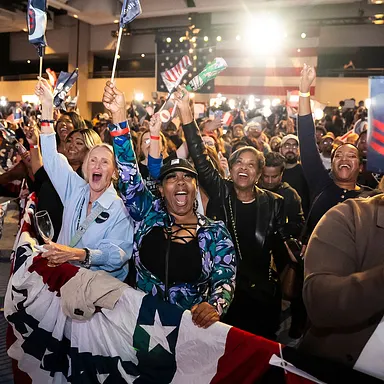
This episode of The Daily features Nate Cohn, the New York Times chief political analyst, reviewing the results of the midterm elections. He explains which voters turned out and which stayed home, arguing that Black and Hispanic turnout rose while many young Republicans did not vote.
Cohn also discusses why progressive Democratic candidates underperformed moderates, whether heavy Republican spending changed outcomes, and what the Alaska and independent Senate races revealed. The conversation closes with how accurate the final polls were.
Listeners will get a detailed picture of the shifting coalitions behind the Democratic wave.
In this episode Michael Barbaro, Nate Cohn
This Daily episode on the midterm voters and Nate Cohn's analysis was transcribed with the same technology HappyScribe uses for video to text conversion.
Ads in this audio differ from the text. Tap the sentence you're hearing to follow along.
Synced: the text now follows the audio.
From The New York Times, I'm Michael Barbaro. This is The Daily. Today: Chief Political Analyst Nate Cohen is back to pore over the results of the midterm election and figure out which voters showed up, which stayed home, how much $10 billion in campaign spending mattered, and whether this time our polling got it right.
It's Thursday, November 5.
Hello, hello.
Hi. Uh, how's the coffee?
I think you know the answer to the question.
Utterly mediocre. Um, Nate.
Michael.
So good to have you back. This is your third day in a row on the show, I believe.
Do I get, like, a trophy for that or something?
That's what we call a series.
A series.
This is part three.
Part three.
Of that series. The first was you describing the results of our final poll and laying out the scenarios for the outcome on Tuesday. Tuesday night, you came in and explained that scenario four was playing out. And today, we're summoning you to deliver a final batch of insights that have come from you all being able to marinate with the results for a full day on two hours of sleep.
So that's what we want to do. And I think in particular, Nate, we want to talk through the detailed demographic data that you have gleaned about which kinds of voters bolted from the Trump coalition in this midterm and voted for Democrats and perhaps are fashioning what could be a new Democratic coalition, if it makes sense. To start there?
Let's start there.
But I think.
But I think.
In classic podcast form, we just really need to start with a quick update on where things stand as of this recording, 3:11 p.m. Eastern time in the House. In the Senate, where I know a couple races have yet to be called, but I'm sure you can tell us which way they're leaning, and with governors' races across the country.
At this time, the Democrats have won 54 seats in the Senate. Two seats remain to be called. That's Alaska, where we're going to have to wait a long time before they count mail-in ballots coming from all over the state. And Mississippi, where the race is essentially tied with a handful of extraneous ballots and provisional ballots left to be counted. These races are so close and/or there's so much left to be counted that it's hard to be too confident. But I have to say the Democrats appear to have the edge in both of those races.
Meaning that.
Which would give the Democrats 56 seats in the Senate, an extraordinary performance in Red America that we just haven't seen in decades.
Right, because the vast majority of those seats were picked up and flipped in red states that Trump won.
All but two of those states that the Democrats flipped voted for Trump by more than 10 points.
Yeah, unheard of.
Unheard of. In the House, the Democrats are up to 237 seats, which means we're already reaching and eclipsing what they won in the 2018 midterm elections, which we called a blue wave at the time. There are a lot of districts yet to be projected, and that could take the Democrats up over 250 seats, which would give the party its largest congressional majority since the end of the party's hold on the South a generation ago.
Wow.
The governors' races, there aren't too many left to be called. I think Kansas is the only race that's still outstanding. But at this point, that means the Democrats have managed to flip Ohio, Iowa, Georgia, Texas, and Nevada, which gives the Democrats a hold on governorships in a majority of the nation's states and an overwhelming majority of the nation's population.
Right. I think I read that something like three-quarters of Americans will be waking up to.
Democratic government.
Democratic governorships.
That's right. And it was just a few years ago at the end of the Obama era when Republicans not only had an overwhelming majority of governorships, but they also controlled state legislatures in what we now consider to be relatively blue or purple states, like Pennsylvania or Michigan. Now the Democrats have full control of state government in states that are worth a majority of the electoral vote. I don't know if we want to do some foreshadowing here.
The Electoral College of particular.
A majority of the Electoral College vote. And I don't know if we want to do any foreshadowing here, but it's led to speculation that those states could pass laws that would award their states' Electoral College votes to the winner of the National Popular Vote, something called the National Popular Vote Compact. We may be getting ahead of ourselves here, but the implications of Democrats having this much control of government are only beginning to emerge.
Yep. Okay. We will track all of that really closely because it is a huge change. Could affect future presidential elections. Okay. Now on to that promised set of insights that you have gained from your close study of the voting on Tuesday and, of course, in the weeks before.
What's beginning to come into focus, Michael, is that this electorate was more diverse than a typical midterm electorate, even more diverse than a presidential election. And, you know, many people may not know this, but if there are any rules of how turnout works in politics, it's basically that the midterm electorate is older and whiter than a presidential election. That's not what happened. According to our estimates, the Black share of the electorate increased yesterday.
How substantially?
It depends on the state, but in many of the southern states where Black voters represent an outsized share of the electorate, we think that the Black share of voters ticked up by at least three points played a critical role in how Democrats managed to compete or win in states like South Carolina and Mississippi, which few people had on the map at the beginning of the year.
Because they have such a sizable Black population.
That's right. Those are two of the states with the largest Black population in the country. Mississippi is number one. Some of this data won't be final for a little bit, but to give you one hard anecdote from the early vote in Georgia, this is a fact. More young Black voters turned out in the early vote in Georgia than young white voters. That's just not something that we see in American politics usually. But it should be noted that Black voters are a minority of young voters in Georgia. You would not expect them to outnumber white voters in the early vote. And that strength among Black voters is a crucial part of what allowed the party to win big in North Carolina and Georgia and compete in states like South Carolina and Mississippi, where the party usually isn't competitive at all.
How much does the data you're looking at on Black voters tell you about why they came out in bigger numbers and came out in bigger numbers for Democrats?
I don't think that the data tells us too much about the why, to be honest with you, Michael. But I want to make an observation, which is that we see this pattern more in the South than anywhere else in the country. And as you've covered on this show, this year, the Supreme Court essentially neutered the Voting Rights Act, which had guaranteed majority-minority districts across the South. Those districts were subsequently dismantled in many states. There was plenty of on-the-ground evidence.
By Republicans in state legislatures.
Yes. There was plenty of on-the-ground evidence that this was motivating Black voters. These are exactly the states where we're seeing the Black share of the electorate tick up in a way that we haven't really seen it since the Obama era. Something else that I think has to be on the table is that the president's immigration policies sparked a major turnout among Hispanic voters as well. This is particularly obvious in Texas, which of all the battleground states, is the one where Hispanic voters make up the largest share of the electorate. According to our estimates, the Hispanic share of the vote went up over the 2024 presidential election in Texas.
Once again, Michael, this might not seem like much, but this is very unusual. The Hispanic vote almost always drops as a share of the electorate in midterm elections.
In the midterm elections.
And the data doesn't merely show, of course, that the Hispanic vote was really vigorous, but that it overwhelmingly broke for James Talarico by more than 40 points and helps explain why he managed to win by double digits in a place where Democrats haven't won in a generation.
Right. And there, the policy that we feel pretty confidently was animating, especially in a place like the Rio Grande Valley we just did an episode about this on The Daily, was the perceived overreach of the president's crackdown on immigration, which in many cases destroyed businesses and deported people who had no criminal background beyond being in the country legally.
And we see this not just in Texas and not just along the border, but also in the handful of majority Hispanic places that are farther afield, southwest Kansas. Not a place that you think of as having a large Hispanic population, but in some of these agricultural towns, there are majority Hispanic counties that usually vote very Republican. For Trump by 30 points. They swung 50 points towards the Democrats last night.
Right. I mean, collectively, what you're describing is Trump's decision to pick fights with several of the key constituencies that constituted the coalition that elected him in 2024 and repelling them in this midterm.
That's right, Michael. These voters helped give the president his majority in the popular vote in the last election. They're what made his coalition seem so formidable and raised all the talk of a realignment. And he did not reward them for that. And if anything, he pursued policies that assured that he would lose all of the gains that he made and more. It's also worth talking about the voters who didn't show up. In the states where we have data, there's a lot of evidence that white Republicans were less likely to vote in this election than they have been in the past. It's even true in states like Florida, where the Republicans fared relatively well.
And in particular, there's evidence that young white Republicans just really didn't show up at all. And stepping back to where we were two years ago, remember how the Republicans seemed to make extraordinary gains among young men who, by our estimates, voted for Trump by a wide margin in the last election, like more than 10 points. We have the Democrats getting more than 60% of young men in this election. And yeah, that's partly because there are people who flipped their votes who thought, you know, they wanted Trump for low prices and this isn't what they got. But it's also because a lot of young Republicans just did not turn out and vote in this election.
Perhaps because what they imagined as the promise of him improving their economic lot just didn't come to fruition. So they say no.
Or the war in Iran. I mean, fundamentally, this is another group of voters that didn't get what they thought they were going to get from the president.
Okay. So a more diverse electorate that favored Democrats is a real learning from the results of this midterm. Let's turn now to the candidates, because, Nate, on Tuesday night, your second of three appearances on the show.
How could I forget?
You started to posit the theory that progressive candidates on the Democratic side were performing worse than some of their moderate counterparts. And sometimes these progressives were still winning, but by meaningfully less than the moderates. In the light of day, with more results now in, more time to study them, how sturdy is that theory feeling to you?
That theory seems even more sturdy. It's worth noting, by the way, that there's a big chunk of the country that's still counting votes in California. Maybe the progressives will have some exciting victories there that show real strength. But in the places where the vote is done, it is very hard to find a race with a high-profile progressive who is not underperforming in this election.
Just give us some examples. And as you're doing that, let's define that word.
Yeah. Underperformance is a real. Oh, well those.
Or both of those words.
Both of these words are worth talking about here.
Go ahead.
Progressive is a hard word to define. It's a category that people could use to define anyone from a Democratic socialist to a mainstream Democrat like Barack Obama could be called a progressive. But what I'm really talking about here is a narrower group of progressive candidates backed by progressive activists who campaigned against the Democratic Party's establishment, who wanted the party to move towards the left, who don't merely support Medicare for All or oppose Israel, which a majority of congressional Democrats do, but are the kind of people who stake their campaigns on the issues that progressive activists care about most.
They're the kind of candidates who prevailed in closely contested primaries this year.
Right.
Like Abdullah El-Sayed as one example in a high-profile Senate race.
Or Angie Nixon in Florida.
Or Angie Nixon in Florida. And across the board, these candidates are doing worse than you would expect in this national political environment. And I think it's worth dwelling on this point too here, because it's complicated in an election where the Democrats have won big. But because the Democrats have won so big in this election, many of the progressive candidates in question here, including Dr. El-Sayed, won. But they did not do as well as you would expect given the national political environment or as well as the other Democrats on the ballot in their same state.
Yeah. Just specify that map.
So let's look. Michigan's a good one. I mean, that's a state that is an easy one because Michigan voted for Trump by one and a half points, just like the country did. The country voted for Democrats by 13. We would thus expect Democrats to win in Michigan by 13. El-Sayed won by 7. It's also worth noting that Democratic candidates for House, in our view, are on track to win by about 11. So that's, you know, a six or so point underperformance for El-Sayed in Michigan compared to what you would expect given what we know about what happened nationwide.
Got it.
And when you roll that story across all the high-profile progressive in this election, Angie Nixon in Florida, staying in Michigan, Will Lawrence in Michigan's 7th District, Matt Dunlap in Maine's 2nd, I mean, it's just every case at this point in a high-profile contested race where there was a big primary, the progressive candidate in the general election has gone on underperforming. And it's just hard to find counterexamples.
I want to latch on to Angie Nixon in Florida, who got really close, I think, within about two points.
Yeah. Three points, I think, in the end.
Of winning that Senate race as a Democratic Socialist of America candidate. To the untrained eye, by which I mean me, it would appear that her candidacy, how close she got to winning, seems like a shining example of how well a progressive candidate did on Tuesday night. You're saying, no, you simpleton.
No, you simpleton.
That's a case study of how badly that candidate did, because in a wave election where across the country Democrats are winning by something like 13 points, Florida should have been a place where a Democrat who was more moderate probably would have won. That's what you're saying?
Yeah. In short, Michael, I mean, think about this. Florida voted for Trump by 13 points. What are the other states like Florida in that range? Well, there's Texas, which voted for Trump by 14 points. Democrats won that by double digits. There's Ohio and Iowa and Alaska, which the Democrats have all won or are on track to win. We can go even further down the list. Kansas is at 16. That voted for the Democrats. Next on the list is South Carolina. Mississippi is in this range. When you go down the list of states from blue to red, Florida stands out as the most Democratic state in the country.
In the last election, the Democrats didn't win.
Right. And so inevitably, you have to ask, what is it about that candidate? Why didn't that Democratic candidate do what the Democratic candidates did in all these other places? They were far more progressive.
That's right. And I think that the Democratic candidates who ran broadly appealing moderate campaigns, who, you know, maybe ran as, you know, full-throated Christians with religious trainings of their own, those are the candidates that look like they did the best in this election. And some of the results are extraordinary. John Ossoff in Georgia won by nearly 20 points. And again, I mean, imagine if I had told you a few years ago that the Democrats could win Texas, Kansas by more than Democrats would win in Michigan and that they wouldn't even win Florida.
It wouldn't make any sense if I told you that. And the answer is the candidates.
Okay. Let's take a quick break. When we come back, talk about what we have learned in this midterm about the impact of money or the lack thereof. We'll be right back. Nate, Michael. Welcome back.
Yeah. Great to see you again. It's been minutes.
I want to talk about money. We've talked a lot on the show about the financial advantage Republicans had in this midterm. Two to one. They had and have spent twice as much money as Democrats in all these races. A huge cash advantage. Did you detect any impact in the results from that financial advantage?
It's pretty hard to find one. You know, we don't have the final results yet. Maybe once we have every last bit of data and we look at it with a magnifying glass, we'll see some little bit of an effect there. But it's hard to see. Republicans spent, what, $500 million in Texas and they've lost by double digits.
Right.
Republicans outspent Democrats in most of the crucial Senate states.
Right. Can I give you some examples? Because our colleague Shane Goldmacher has this incredible spreadsheet.
Let's see it.
Kindly shared it with me. In Ohio, Republicans spent $100 million more than Democrats. In Michigan, $84 million more. In Texas, $200 million more than Democrats. I mean, those are huge numbers.
They're huge numbers.
They're like GDP numbers.
They are like GDP. There are small countries that couldn't afford these ad campaigns. And again, it's hard to see the effect. And one way to look at that is to consider the races where maybe there was less spending. You know, you can find some examples of a state like maybe Mississippi or Louisiana, or an example of a state where the Democrats outperformed by more than a state that was more hotly contested like Texas. But even there, the Democrats seemed to outrun their prior benchmarks as much in Texas despite all the money as they do just on the other side of the state line where no money was.
How is that possible that this money has no influence? We've been trained to believe and understand that money in politics is extremely influential.
Well, first, I think it's worth saying that money in politics is still really influential in important ways. And I think that even if money doesn't affect electoral outcomes in a given election, that doesn't mean it doesn't affect what our politicians support and what policies they vote for. It's a big deal. Nonetheless, I do think it's possible for money to have relatively limited effect, especially in a midterm election which is dominated by highly engaged voters who often have well-informed views about the candidates and the issues, and most of all have clear feelings about the president and what's happening in Washington.
And midterm elections tend to be referendums on the party in power. If there is any takeaway from this election, it's that the public wanted to send a message to the president and do what they could to impose a check on him. And while the advertisements may have succeeded in raising legitimate or illegitimate, for all I know, concerns about the Democratic candidates in these races, it didn't change that these voters couldn't vote for a Republican in this election.
Right. You could attack James Talarico all you wanted over something he said in the state legislature in a committee meeting however many years ago. You're saying it wouldn't have mattered in the Texas race because people were so mad at Trump.
When you see the same thing happening everywhere in the country, that tells you not only that the money doesn't matter, but like that oftentimes the candidates and the campaigns don't matter unless there's something really extreme. Like when you have candidates who are Democratic socialists or something, that appears to be the kind of thing that crossed the line for a critical sliver of Republican-leaning voters. But if you didn't cross that line, it seems that voters just weren't willing to vote for a Republican or a critical chunk of voters weren't willing to vote for a Republican in this election.
I do wonder if the billionaires prone to spend this kind of money in elections will see this midterm as a turning point, because it doesn't seem like a stretch to say that Elon Musk essentially flushed that money down the toilet.
I don't think he saw a great return on that investment. And it's worth also remembering that it is now the Democrats who control government in much of the country. The Democrats have an overwhelming majority in the Congress. And I think anyone would have to say today that the Democrats are at least reasonable favorites to win the 2028 presidential election. And a significant reason, not the only reason, but a significant reason why Republicans have benefited so much from big money in this election is to curry favor with the president. And I'm not sure that that calculation is as clear when the president is going to leave office in two years and when they might be staring down a Democrat in the White House.
Makes some sense. Okay. I want to end our conversation or start to end our conversation by tying up a few loose ends and pursue a few of my own lingering curiosities from this election. So if that's okay with you.
Yeah, let's do it.
Let's start with Alaska and the impact of the second Dan Sullivan on the ballot, the one who was encouraged to run by Democrats and who is not the Dan Sullivan, who is the incumbent Republican candidate in that Senate race. The last time I looked at that race, it was so close that the vote count of the second Dan Sullivan was potentially decisive. And that made me wonder if that strategy did ultimately matter.
It's a good question. There's a lot of vote to count left in Alaska, and in particular, it's early and mail vote, often from the far-flung outlying regions of the state. And we expect that vote to be pretty good for the Democrat, Mary Peltola. And while, again, it'll take a long time before they've counted that vote, I would expect Peltola's lead to keep growing and potentially even grow large enough that it would be bigger than the vote cast for the other Dan Sullivan. At this point, I think it's unlikely to represent the difference in the outcome.
And speaking of loose ends, one loose end that I've had my eye on is the fate of the independent candidates who ran for Senate in Nebraska, South Dakota, Idaho, and Montana. This was also part of a deliberate Democratic strategy. In many of these states, the Democrats withdrew from the ballot. Three of the four states the Democrats withdrew from the ballot to set up a one-on-one contest between a Republican and an independent.
Because they figured the Democratic brand wasn't strong enough in those places.
In those very Republican states. And in the end, the independent candidate didn't do that well. In fact, I would say that compared to like the pre-election polls and expectations, there's a case that those were some of the most disappointing results of the night for not exactly the Democrats, but at least for the Democratic voters of those states.
Should the Democrats have just run Democratic candidates?
Quite possibly. Though I don't know that we can assume the Democrats would have done better if they had done that. These are very Republican states, after all. And they're also pretty white states where maybe there aren't enough of those young and non-white voters who drove Democratic gains elsewhere. But it's hard to see a clear sign that this was some miraculous strategy that offers the way forward for the party in Red America, too.
Okay. Finally, I want to ask you about polling itself, our polling, I guess your polling. We always remind listeners that polling is a snapshot in time, not a forecast, but we know it's a quite imperfect science even in that context. And it has failed in the past decade a few times, most notably in 2016. And there were times in this midterm election cycle, I'm not going to lie, when our polling that showed Democrats opening up leads, sometimes meaningful leads in these red states, felt kind of hard to fathom.
It felt like perhaps we were going out on a limb.
It did.
And of course, here we are, a couple of days removed from a blue wave, maybe even a tsunami. So let's talk about how accurate our polls in the end were or weren't. How do you grade yourself, my friend?
Well, I don't like giving myself any pats on the back, Michael, but I do think that the final polls that we released were basically spot on. And, you know, I came on the show Tuesday or Monday, I don't remember when it was. We said it looked like a tsunami, and that's what happened. Our final poll said that the Democrats were tied or ahead in all seven of the key Senate battlegrounds and leading by an average of five points. And today, the Democrats are tied or ahead in all seven states with an average lead of five points. So that's about as good as we can do.
Mazel.
Thank you, Michael. Now, I do think there's one interesting thing that maybe helps tell the story of the election, though, in this, which is that although our final polls were as good as we can ever hope for, and we really can't do better, polls will never be perfect, it's just not possible. The polls we took like three weeks ago.
I remember those.
They weren't quite so perfect. They weren't bad. They're better than a lot of the other polls still. But they did underestimate the Democrats a little bit. And if you go back to September, even bigger underestimate.
Were they underestimating the Democratic votes or were the Democratic votes themselves not ready to declare themselves to pollsters?
I think the latter is probably the better explanation. And thank you for bringing up that possibility. We didn't change our polling over this period, but we saw that the results kept getting better for Democrats. I think we called it a surge in our final polls. And I think the likeliest explanation is that this big group of voters, traditionally Republican voters who were dissatisfied with the president, or alternately in some states, the traditionally Democratic voters who were dissatisfied with their Democratic nominees in a place like Maine or Michigan, that as they got down to decision time, they all sort of resolved on the same answer, which is, I have to vote Democratic to be a check on the president.
This helps me understand why we poll as frequently as we do, given how expensive and cumbersome polling is. We keep polling.
And how we still don't know if it's right, even when we do it.
But we keep polling because people keep making up their minds.
They do. And, you know, again, these election results are extraordinary and they are results that you would never have predicted. I at least would have never predicted that Texas could be easily for Democrats and so on without the polls to say it.
Well, Nate.
Michael.
Congratulations.
Oh, thank you.
On those polls, because in some future conversation about some future election, it won't be this good again.
That's right. They will be wrong again. I've been on that side before. The losses will happen, and so we have to take our wins when they come.
Exactly.
Because we really take them when the losses come, don't we?
We sure do. Take the pat on the back that I am offering you from a 5 or 6 feet away.
Thank you.
And go get some sleep.
I will gladly do it. I am ready to crash.
I appreciate you so very much, Nate.
Thank you, Michael.
We'll be right back. Here's what else you need tonight. On Wednesday, Vice President J.D. Vance blamed heavy Republican losses in the election on President Trump's decision to start a war with Iran. It was a remarkable public break from the president, which highlighted the vice president's disagreement with the president over the war.
In a long post on social media, Vance wrote that, quote, "The reason we lost is the war." Adding, "Agree or disagree, that's at least honest." Vance is widely seen as a potential Republican candidate for president in 2028, and his attempt to distance himself from the unpopular war in Iran appears to be an early attempt to escape what could prove a major liability in that campaign.
Today's episode was produced by Michael Simon Johnson, Shannon Lynn, and Eric Krupke. It was edited by MJ Davis Lynn and Devin Taylor, contains music by Dan Powell and Mary Lozano, and was engineered by Chris Wood. Our theme music is by Wonderly. That's it for The Daily.
I'm Michael Barbara. See you tomorrow.
The midterm elections were an electoral tsunami for Democrats: a complete collapse of the Republican coalition and a landslide victory.Nate Cohn, the chief political analyst for The New York Times, examines the results to figure out which voters showed up, which stayed home and how much billions in campaign spending mattered.Guest: Nate Cohn, the chief political analyst for The New York Times.Background ReadingThere’s no modern precedent for this Democratic tsunami.Trump is confronting an identity he would rather not: a lame duck.Photo: Nicole Craine for The New York TimesFor more information on today’s episode, visit nytimes.com/thedaily. Transcripts of each episode will be made available by the next workday.
For more information on today’s episode, visit nytimes.com/thedaily. Transcripts of each episode will be made available by the next workday. Subscribe today at nytimes.com/podcasts or on Apple Podcasts, Spotify and Amazon Music. You can also subscribe via your favorite podcast app here https://www.nytimes.com/activate-access/audio?source=podcatcher. For more podcasts and narrated articles, download The New York Times app at nytimes.com/app. Hosted by Simplecast, an AdsWizz company. See pcm.adswizz.com for information about our collection and use of personal data for advertising.