
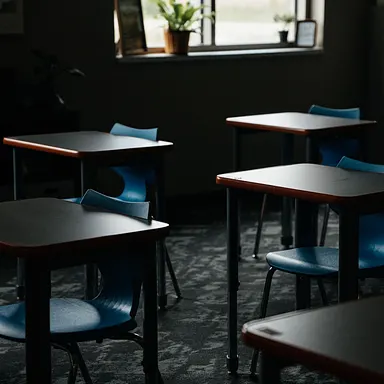
This episode of The Daily looks at the enrollment crisis facing American public schools, where shrinking student numbers have left districts with empty classrooms, budget cuts and debates over closing schools. Sarah Mervosh, an education reporter at The New York Times, focuses on Pittsburgh, where the school board voted to close 12 schools, redraw boundaries and scale back magnet programs.
Listeners hear the district's argument that closures will free money for art, music and algebra, along with parents' concerns about trust, school quality and segregation. The episode also reports that some families have already left for private or charter schools, though the reasons behind those departures remain hard to pin down.
In this episode Natalie Kittroweff, Sarah Mervosh
The transcript of this episode on Pittsburgh's school closures was made with the technology HappyScribe uses for video to text conversion.
Ads in this audio differ from the text. Tap the sentence you're hearing to follow along.
Synced: the text now follows the audio.
Hi, I'm Andrew Osorkin. I cover business and policy for DealBook, a daily newsletter at The New York Times. On November 18, I'm going to be interviewing some of the most consequential leaders in business, politics, and culture, including JD Vance, Elon Musk, Christine Lagarde, Zohran Mamdani, and many others, live on stage at the DealBook Summit in New York City. You can watch some of these unguarded, unfiltered conversations as they happen. We're going to be live-streaming select interviews for anyone to watch, free, at nytimes.com on November 18.
If you're not already a subscriber, you can download the New York Times app to watch and get a month of free access to all of our journalism. I hope you'll tune in; you won't want to miss it.
From The New York Times, I'm Natalie Kittreleff. This is the Daily. American public schools are in the middle of a crisis: there aren't enough students to fill their classrooms. In some cities, enrollments have been shrinking so dramatically that officials say they have no choice but to close schools en masse. Today, my colleague Sarah Murvash on one city's radical plan to save its public schools, and the parents who think it will only doom them.
It's Wednesday, November 11.
Okay, this is Michael Simon Johnson, Daily producer. I'm here with New York Times reporter Sarah Murvash here in Pittsburgh, Pennsylvania.
Hi.
We are outside of a middle and elementary school arsenal.
Yes. Today is the first day of school in Pittsburgh, and at the end of this school year, a bunch of schools in Pittsburgh public schools are slated to close. Arsenal's Elementary School is one of them. And so this is sort of the last first day of school at this building as it is today, and next year everything is changing.
Hollow! How was summer?
Awesome.
Awesome. Glad to be back. Can't wait for recess?
Yeah.
Hello! Are you excited for the first day?
No.
No.
Oh, I am.
I'm so happy to see you.
What's up, our new fifth graders?
I think she wants to what do you want to say to them?
My first day.
Do you have a child who goes here?
Yes.
She's seven years old.
You like Arsenal?
Yes, I love it, Arsenal.
What do you like about Arsenal?
So I like science, reading, math, art, science, and soccer and football.
That sounds like most of school.
And do you know that the school is going to be closing at the end of the year?
Yeah, it's closing this year. Sucks, because she has all her friends in here and, uh, I don't know.
We actually need this school. In particular, my daughter's autistic. We're worried: is there going to be enough staff? Is there going to be enough goals met?
And you don't know where she's going to go to school next year, is that right?
No, I don't know yet.
I've been here for 21 years, social studies teacher. So I was here when it was just a middle school. We had five sections of each grade. Now we have two sections of each grade, so.
So you've watched the decline.
Yeah, I've been here. It's a solid decline. I mean, this whole school used to be just a middle school. Now it's half middle, half elementary.
So you don't know where you're going to be working next year.
I don't even know if I'm going to have a job, because there's so many schools that are closing. It's just so tough.
It's bittersweet, and it's an end of an era. There's a level of sadness, but also, like, I'm not letting my mind get there, because we want this last year to be one that's super special.
Happy first day of school. It is day one of our cycle. We have art, gym, library, and science. Today is Monday. Hello, Monday. You are a fresh start, a new page, and a beautiful opportunity to shine. Make sure you're shining today.
Sarah, welcome back to the show.
Thank you.
So let's dive right in. Help us understand the scope of what we're talking about here, the enrollment problem in public schools today, and why this problem matters or should matter to us.
Well, just to give you a few stats. Since about 2014, over the last decade, enrollment in K-12 public schools in the country has fallen in 30 states, and it's a problem that's affecting a lot of major school districts. So over the last decade, Los Angeles public schools enrollment down 20%, Houston down about 17%, Chicago 17%.
Geez.
Dallas 13%, Philadelphia 10%. I can go on and on and on. And one reason it matters how many kids are going to school is because schools and school districts get funding based on the number of students that they have. So they get money from the government, and it's all allocated per student. And in some cases, districts have to actually pay if they lose a student to, say, charter schools. So there are real financial consequences for schools. And one thing I think people don't realize about running schools is if your school shrinks by, say, 20%, you have fewer students, but you still often need the same number of teachers, because the class sizes haven't shrunk so much that you can just eliminate a class.
You still need a principal, for example. You have a whole building to run. So the costs don't necessarily scale down with the number of students.
Right, and as you start losing kids, you start losing money. I'm assuming that means you're starting to have to make some choices about what to cut. You have to cut something, right?
Yes. And over the last year or so, we are really seeing a lot of districts starting to confront this problem and painful budget decisions, cutting bus routes, cutting substitute teachers, cutting the central office. And more and more, they're doing something that is politically explosive, which is deciding whether to close schools.
And what does that look like, that politically explosive decision-making?
I think closing schools is one of the most unpopular things you can do in education. No one likes it. No one ever wants it to happen to their school. As I was watching this debate play out in districts across the country, I kept seeing the same fight happening, which is parents saying, "We don't want this," and districts saying, "We have to do something." But on top of all of that, there's also this other question at play, which is about equality, because our schools in America are quite segregated by race and class.
They still are today, and especially in these big cities with lots of kids and lots of different kinds of kids in the same school system. When you start to ask, "Are we going to close schools? Which schools are we going to close?" you're actually asking, "Who's going to be affected? Which kids get prioritized? Who are we going to serve?"
Interesting. So declining enrollment and constrained resources end up forcing people to engage with these really big questions, it sounds like, about race, about class, about who they want their school systems to serve.
Right. And in my hometown of Pittsburgh, they were actually a little further along in the process than some other places. And so I wanted to see, how does that actually play out?
And what has it looked like in Pittsburgh?
Well, just for some context, Pittsburgh is a place where the population has been on the decline for many decades. The population in the city of Pittsburgh peaked in the 1950s. The rise of the steel industry--my grandfather was working in steel mills in Pittsburgh at this time--it was basically a city with, like, lots of Catholic families, Irish, Italian, Polish, immigrant, working-class families. They had lots of kids. The public school system is thriving. And back then, there weren't tons of options. You kind of went to the public school, maybe you went to the Catholic school, and that's about it.
But that has changed. Over the last 70-some years, the population has declined. And over the last decade or so in particular.
What started as a temporary school closure due to the coronavirus extended through the end of the academic year for Pennsylvania families.
Like lots of other places around the country, Pittsburgh public schools were closed for a long time during the pandemic.
Since the beginning of the pandemic, Pittsburgh public schools have managed to provide only a few weeks of in-person instruction. Parents I spoke with say they've lost confidence in the district and are voting with their feet.
They did lose a good number of kids.
Cyber charter schools are seeing an enrollment spike that has them approaching capacity.
There is more choice. There's charter schools. There's a little bit of homeschooling.
It's a generation of women choosing to wait or not have children at all.
And then there's just the fact that people are having fewer kids. In the U.S. broadly, the fertility rate peaked in 2007, and it's pretty much been declining since then. And if you kind of do the math, babies that were born in 2007 graduated high school in 2025. And so all of a sudden, those kids are out of the public school system, and now districts are facing down this possibility of having fewer and fewer kids going forward. And over the last decade in Pittsburgh, that meant that all of this combined, they've lost about 25% of their enrollment.
Which is just huge.
Yeah, this is something very real that has to be contended with.
And how does Pittsburgh choose to contend with it, with this enrollment problem?
Well, what they decide to do is actually pretty controversial, even beyond the regular controversies of school closures. They decide to not only try to solve their enrollment crisis, but they also are trying to use this moment to revamp the school system and try to fix some of the inequalities in the school system.
How? How so?
So you have to think about who goes to the Pittsburgh public schools. The student body is about two-thirds economically disadvantaged. These are largely from poorer families. About half of the students are Black. About a third of students are white. And there's a smaller share of Hispanic and Asian students. And in this plan, they don't only propose closing the most under-enrolled schools or the lowest performing schools, in part because they don't want the most vulnerable kids in their school system, kids who are mostly lower income or Black, to bear the full burden of this plan.
And so what they do is they also propose reconfiguring schools, reconfiguring grade bands, redrawing school boundary lines across the city, which means that they also are closing, for example, a school for gifted and talented kids, a high-performing elementary school in a wealthier part of town, both of which serve higher shares of white families. But one of the most controversial parts of this plan is that they're getting rid of magnet schools at the elementary school level, and they're dramatically scaling back from them at the middle school level.
And just say what magnet schools actually are.
So magnet schools are public schools in the school district. They're part of the Pittsburgh public school system. But you can apply to them through a lottery. So you can live anywhere in the city, more or less, and you can apply to these schools. Often, magnet schools have some sort of specialty, like a foreign language or arts and performing or science and technology, and that can be a draw for families. And so the fact that they're doing this is really interesting, and there's a lot of debate about what this is going to do to the school system, because some people feel like magnet schools are one of the best things about the Pittsburgh public school systems.
Families have options. They actually draw people from different neighborhoods, and so it can be a more economically and racially integrated environment. But some other people feel like magnet schools are kind of a way of doing white flight within the school system, where families don't have to go to their neighborhood schools. They can do this magnet school option. And so by getting rid of magnets, the district is saying, "We're going to take away that lever of choice. We're going to compel you to go back to your neighborhood school, and we're going to put more resources and invest in all of our neighborhood schools."
But that does feel like a pretty bold move to, like, in the interest of equalizing this system, close these schools that aren't actually necessarily under-enrolled and are places that many families are specifically choosing to send their kids to.
Yes. And when this process started a few years back, almost immediately, you have lots of feelings about this, lots of debate.
Good evening, ladies and gentlemen, and welcome to the November 25, 2024, Board of Public Education for Pittsburgh Public Schools.
So the school board starts opening this proposal up for comment.
Wednesday, July 30, 2025, special. May 26, 2026.
And there's public hearing after public hearing.
Each speaker has 3 minutes to speak.
Where parents and teachers and students.
My name is Erica Gidley. I'm a parent and community member.
I'm also a Pittsburgh resident and a 33-year veteran teacher.
Hello. I'm a child in Pittsburgh Montessori.
I am back tonight to implore you all to vote no on November 25.
All sorts of people are coming out to say what they think of this plan and how it's going to affect them and their families and their kids.
My kids are at home crying about their schools. I don't want Allegheny to be closed or Manchester.
Saying all the reasons why they shouldn't close schools.
Moving it to London makes nothing better. In a matter of fact, it makes things worse.
Many people say they like the magnet program.
I was deeply upset when I learned that the district plans to remove all magnet students and send them to their home schools. If I felt like my home school could provide a quality education for my child, I wouldn't be standing here today.
The gifted program and the magnet programs, quite simply, are the best thing about Pittsburgh public schools.
One of the reasons we chose a magnet school for our kids is because it includes kids from all over the city. It was important to me and my husband that our children would learn and grow up alongside kids from backgrounds different from their own.
And many say this change could actually drive families away from the public school system entirely.
We parents should not have to seek out alternative cyber or charter schools when we want our children to continue at their current locations.
This will only increase the problem for low enrollment and deter families from moving or staying in our city and the neighborhood.
All of this, in my opinion, will lead not to resourced parents integrating into public schools, but to them choosing private schools, continuing the downward spiral of students and funding loss.
And they're mad that they're not being listened to.
Don't make any real changes until you start talking to us, work with us. We are here to help.
Do you even care about all the good arguments that you've heard?
We are screaming at the top of our lungs every month.
Thank you for your testimony.
Now, these parents who are coming out to talk, lots of them are white. Not all of them are, but they do come out in disproportionate numbers. The school board is majority Black. And throughout this entire process, they're saying they are listening.
Yes, people are upset. Yes, change is difficult. But yes, change has to be made. It has to be made.
Everybody agrees that we have to close buildings. Nobody wants to pick the buildings. I know. It's hard. I don't want to do any of this.
We are trying to expand for all of our students to receive the same education that a few schools are getting right now. And I am speaking for those who have not come out, who have not come out to speak at public hearings. <spk:31> I always keep a very clear eye on the kids who have the most challenges in our district. If we center them and we stop centering the kids who have the most opportunity, if we center the kids who have the most challenges, we will create a better system.
Mr. Wise, can you please call the vote? <spk:32> Reg Barker? <spk:33> Yes.
And finally, in May of this year. <spk:34> Register Walker? <spk:35> Yes. They vote 6 to 2, with one school board member abstaining, to close 12 schools. <spk:32> And the resolution is approved.
Thank you all. I would now like to, before we move on to announcements.
And the closures will happen at the end of this school year. So this is the last school year of status quo. And next year, everything's going to change.
So this is all coming to a head, basically.
Yes. Hi, Gene. <spk:33> Hey, sir. How are you? I'm good. Can you hear me? <spk:33> I can hear you perfectly. So I talked to the guy who ran all of these meetings, the school board president, Gene Walker. <spk:33> Currently serving as the school board director for District 9, which is our Upper Northside and West End neighborhoods. And he is, like all school board members in Pittsburgh and Pennsylvania more broadly, he's unpaid. He's there in a volunteer capacity. He is elected, but he's not paid. And I wanted to understand, like, why do this?
Why put yourself on the line? Why be yelled at like this? So in order to understand that, you kind of have to understand who this guy is. <spk:33> Yeah. I graduated from a school formerly known as Peabody High School in the mid-'90s, 1994. So Gene Walker is 50. He's Black. He was born and raised in Pittsburgh. He has two kids that went through the school system. And his son is now a public school teacher. <spk:33> And my son is currently a teacher at that same building, just a different name, that I graduated from. So he has a lot of personal investment in the Pittsburgh public school system.
But also, Gene Walker told me that both he and his kids had this experience of not having the most robust academic offerings in the Pittsburgh public school system and feeling the consequences of that when they got to college. <spk:33> I think the thing that stuck with me most is watching my kids struggle when they got to college. My son ultimately was successful. My daughter decided that college was not for her. But I realized that even though we had them in one of our higher-performing schools, they just weren't ready for the rigors of college.
And what's his argument for why it's important to close these schools? <spk:33> There are two reasons.
So I think his argument is twofold. One, he's arguing that there's a financial benefit to doing this. <spk:33> When you have schools that are inadvertently small, they are really expensive to operate. And so by consolidating, closing buildings, you're able to take that money that you would otherwise spend on that building and redistribute it to schools that are staying open. So there's a fiscal reason to it. The other is just from a pure people standpoint. But then there's this other argument, which is about the resources and the quality of the schools.
<spk:33> When we have schools that are so small, they have a minimum faculty and staffing that needs to be in those schools. And that puts a strain on the rest of the system. They feel like in the current setup, where enrollment is down and some schools are getting smaller and smaller and smaller, it's just too hard to offer these services that families want and need. So, for example, I visited a middle school that has seen its enrollment decline a lot over the years, and it isn't able to offer 8th grade algebra. And why that matters is if students take 8th grade algebra, they can go on to take more advanced math in high school, maybe calculus, and then be better prepared for college.
All right. So Walker's saying that the district needs to close schools and consolidate kids into fewer buildings. Otherwise, they're not using their resources wisely, and they can't actually provide the programming that they need to.
Right. And he defends the decision to close almost all of the magnet schools, to move away from that strategy, because he believes that that is one of the reasons that these neighborhood schools are struggling to begin with, that they don't have enough kids and they're not getting the resources that they need. <spk:33> You know, one of the things that always broke my heart was going to the bus stop when there's a school within walking distance of my house. And then I would go to the bus stop and watch 50 kids get on 10 different buses to go all over the city. When in reality, I think what we would all hope as parents is, you know, we want our kids close.
What the Pittsburgh public school system says is that magnet schools were creating a lot of inequality in the system. <spk:33> You know, the magnet school system, at its core, was designed to keep middle-class white families in the school district by creating these schools of choice. And their perspective was, look, we shouldn't just offer Spanish at the Spanish magnet school. Every elementary school should have Spanish. We shouldn't just offer science and technology at the magnet school. Every school should have that.
<spk:33> We need to look at, like, how do we create a school in that community that folks want to go to, right? If I'm looking at a school where we can't provide gym full-time because we don't have a full-time gym teacher or there's no art or there's no music, right? So the promise of the plan is that by closing schools and taking on some temporary short-term pain, that the district and the kids ultimately are going to be better off in the long term, because every elementary school will be able to offer art, music, STEM, which is science, technology, engineering, math kind of things, and a foreign language starting in third grade.
So they want every student to have that. And then every middle school will be able to offer things like 8th grade algebra. That's the argument from the district.
The argument is this is going to lift all boats, basically.
Right. <spk:33> Even though there seems feels like there's a lot of taking away, we're really working hard to make sure that there's something added to every building when the students walk in on the first day of next year. One thing that I think is really interesting that I've observed is what they're asking families to do is kind of make a bet that the district is going to deliver on its promise. And if you're a family at a neighborhood school that you don't like all that much and you don't think is that great, this could be good news for you. You could say, oh, my school is going to get better.
But if you're one of these other families who goes to one of these magnet schools or to a high-performing school you really like, what they're asking those families to do is basically trade something they're happy with for potentially an equal or worse option that they might not be happy with. And that is the rub.
So for those families who don't have a lot of confidence that this bet is actually going to pan out for them, who think, look, I don't like what's happening here, what are they actually doing? It sounds like they're making their voices heard. Are they taking action?
That is the choice that families all across Pittsburgh are faced with right now. So they have to make a choice pretty much this school year what they're going to do next year. And they have a few options. They can go along with this plan and say, I'm going to try what Pittsburgh is suggesting. They can consider leaving the school system. They can try to go to a charter school, which is a public school outside the district school system. They could enroll in a private school if they can afford it. Some are considering, do I homeschool my kid? That is the big question.
How many parents will leave because of this and how many will stay to see it through? And we reached out to a bunch of parents to really try to understand how are they thinking about this? How are they thinking about the trade-offs? What are they planning? What are they going to do? We'll be right back.
I'm Jonathan Knight, and I'm the general manager of New York Times Games. Our puzzles are human-made every day with the standards you'd expect from the New York Times. And this matters because when you choose to spend time with our games, it should be time well spent solving puzzles handcrafted for you. We think that's something worth investing in and something worth paying for. If you think so too, download New York Times Games from your favorite app store or go to nytimes.com/playgames.
So, Sarah, tell me about the conversations that you've had with parents, what their plans are and how they're thinking about all these changes to their schools. So I, along with two daily producers, Michael, Simon Johnson.
Can you just tell me your name and.
And Stella Tan.
Would you mind introducing yourself? So your name and.
Talk to more than a dozen parents.
My name's Sean Mann.
I am Emily Sawyer.
Shannon Schreiner.
Naomi Chambers, single mother.
Jasmine Worthy, born and raised in Pittsburgh, Pennsylvania. I graduated from Pittsburgh Public Schools. All my children are in Pittsburgh Public Schools.
I have a 7-year-old and a 10-year-old.
I have four in public schools. And this might be surprising, but one of the reasons closing schools has been so explosive is that even in schools that are under-enrolled.
It's known as an under-resourced school.
Or even when parents acknowledge that their kids don't have everything that they should have in their schools.
A lot of them don't have books that they should have.
Lots of families are still pretty happy with their school.
I feel safe there. I know my children do.
I just let my kids roam in the school. I don't even be caring. I know they're safe.
We're an economically strained community, and there's a thing where my children will come home with bags of food and things like that. And it's not just them that'll come home with the bag. So it's never a moment where they're ostracized. It's like, as a community, we're taken care of. It's like kind of a family.
These are families that they've built strong relationships at these schools, with other students, with their teachers.
My son, he's been there since he was 4, and they know him very well. He is a little rambunctious sometimes, but they know how to talk to him and get him back on track. They've seen him grow. They know what he's into. They know he loves Pokémon. Like, there's certainty.
And according to parents, this support has had a huge impact on their kids.
My 10-year-old, Sienna, has Down syndrome. She attends our neighborhood public school, Fulton. They were the only school that ever made us feel that school wanted her to be there.
What have your conversations been like with Sienna about the changes coming up?
She doesn't grasp it, and I don't think that she will fully grasp it until we're at her new school. I have a feeling that the anxiety will creep up on her right as we start. So I'm not putting too much attention on it now. I'm trying to enjoy our last year at Fulton. In fact, she has the same teacher she had last year. And this morning, before she left for school, her teacher sent home a book, and she read.
She read a book to me before she went to school today. And it was, like, one of the most amazing things to witness. And so we're just living in the joy of moments like that right now and making the best of this last year at Fulton with these amazing teachers and kids. The kids at Fulton are so welcoming and loving, and they make her feel like she belongs there. And for us, that's a gift.
So these families are feeling a real sense of loss right now, a real sense of grief around these closures. And they're also feeling anxious that their kids may have to go to bigger schools.
You know, if our kids are coming from relatively smaller class sizes and you put them in a big class, and then if the teacher is overwhelmed, then the students become overwhelmed. I mean, it just is a trickling effect that I don't think was thoroughly thought about.
They're feeling worried about their transitions.
And then for me as his mom, to not be worried about my baby, is he anxious? Is he scared? What if he's breaking down and these teachers don't understand him? Because he has had behavioral issues in the past. And it's like, all right, well, we know Elijah. We know he's my emotional one, so we deal with it accordingly. But a different teacher will just be like, he needs to go sit in a corner somewhere and isolate him.
Will their kids regress academically? Will they have the sense of belonging? Like, what is going to be the situation in these new schools? And will their kids be able to make it through that and still learn and thrive?
Right. It makes sense that they would be anxious about such a big change. But they were sending their kids to schools that were presumably suffering under the previous system, right? Like, they were under-enrolled. They were resource-starved. So I'm just wondering, do these parents believe in the idea that there might be real benefits here, improvements for their kids?
Well, we asked them that question.
So the promise from the school board is that at the new schools, everyone is supposed to get art, music, STEAM or STEM, PE, foreign language, all these different programs that not every school has. How do you feel about that promise?
I feel.
Excited?
No. I feel numb. I'm very apprehensive that that's going to actually be the case with this.
And some of them are pretty skeptical of what the school board is promising and whether it can deliver.
Yeah, I don't believe them. I just don't. If they've neglected SI Miller, I don't think they're all of a sudden going to start pumping resources to wow. They just keep telling us to trust them, and they've given us no reason to.
Interesting. So the families that you spoke to who stand to benefit from getting more from the district, it sounds like they're not sold. What about the families whose kids are already in relatively high-performing, well-resourced schools, including some of those magnet schools? I'd have to imagine they're even more skeptical of this plan.
Definitely. And one thing we heard from them was a concern that all of these changes could erode the quality of education at some of the more desirable, higher-performing schools in the district. So several parents talked about this one school in particular, SI Tech, which is a premier magnet school in Pittsburgh. It's focused on science and technology. It draws kids from all over the city. They apply to go there. They want to go there for this curriculum. But under the new system, it's going to be merged and kind of become partial magnet, partial neighborhood school.
And the kids who are going to be coming in from the neighborhood are coming in from a school where very few students at the school are proficient in math and reading. And so current and prospective SI Tech parents were worried about this.
If you look closer into the SI Tech neighborhood school, you'll understand that that program is specific to very high-performing science and math-based programs. Yet they're going to go just throw a bunch of kids that live in the neighborhood into that school. Well, they're not going to keep up the standards that they were expected to have.
And so the question for some parents is, how do you maintain the academic rigor that we came here for? And also for other parents, how are you going to support the new kids coming in? Are you going to set everyone up for success?
Right.
And fundamentally, many parents just aren't bought in. They don't have enough evidence yet to believe that the school board's plan will accomplish what it was meant to accomplish, which was keeping students in the public school system and making it more equitable.
Can you say more about that? Like, beyond their fears that academic standards could go down at some of the more sought-after schools, why don't they believe that the system as a whole would become more equitable with all these changes?
I think the best argument we heard came from this one parent.
My name is Abigail Folds, and I have two boys and one girl.
Who actually thought that magnet schools played a big role in offering equity and access to opportunity in the district.
You know, people love to say that that was the thing to keep the white kids in the district and everything. But also, you know what it does? It gives an opportunity for some kids that can't afford to live in a richer area to have an education at maybe a different school, and that will no longer be an option.
And she speaks to her own personal experience going to magnet schools and sending her kids to magnet schools.
I grew up going to Pittsburgh Public Magnet Schools, and it was freeing to go and meet other people across the city. Neighborhoods are stifling in a lot of ways. You know, this whole notion of being able to be free and reinvent yourself and being able to decide who you are and not be pigeonholed into a certain type of kid, that is very much the experience my family members have had.
Basically, she says that magnet schools can be a way out. Your zip code doesn't have to be your destiny. And she actually thinks that getting rid of magnet schools runs the risk of reinforcing housing segregation and making schools more segregated.
How? How so?
Because if you get rid of the magnet schools, she thinks the affluent families who already mostly choose affluent neighborhoods will 100% choose affluent neighborhoods.
I live in a quote-unquote "undesirable neighborhood," and I think people would not move to my neighborhood if they knew they had to go to the neighborhood school, which is.
They're not going to consider living in neighborhoods that maybe they would have if they knew that they could go to school somewhere else. This is what makes education and education policy so complicated, because you have school segregation and you have housing segregation, and it all interplays and intermixes.
Right.
But even if you buy the district's argument that basically we're going to funnel resources into these schools, we're going to give students art, music, STEM, algebra, we're going to give them all the same access and opportunities, some parents are saying that's naive.
Yes, you might get an algebra teacher at the school, but how many more kids will be prepared for algebra? Do you know what I mean? Like, will we have improved our education system at large? I just don't have any reason to believe that's true.
I think it's hard to make a good school. If you take one of the schools that's struggling and you just build a band room, is that going to do it? Like, is the art teacher going to fix it? Or is it something else?
We have made all kinds of educational changes and adjustments, and we're just constantly tinkering with the education system, and the same kids continue to get left behind. And I just don't see the district with strong plans to make those improvements.
And the whole plan basically requires families to go back into their neighborhood schools. But some of them are just saying, like, this doesn't make a lot of sense because there are other choices that we have outside the public school system.
One, there's charter schools. People can still leave, and now they just don't have an option within the Pittsburgh Public School system. People already are leaving, and people will just flee and flee and flee, and it'll be a race to the bottom.
So you've closed one teacher, so.
Well, I'm.
Was perhaps contributing to an equality. But then there's this other lever over here, charter schools, homeschooling, maybe private school, that you're not even addressing.
And how many of these parents are actually going to leave?
Well, there's some preliminary enrollment data from this school year that suggests that some number of families, several hundred families, primarily families of means, left the school system this year. Was that because of this? Was that because of something else? It's hard to say definitively, but the fact that it was primarily families who are more economically better off suggests that families who do have choices to make are using that choice. And I talked to one mom who is one of those parents.
So I have a third grader. We actually pulled him this year to go to private school. The word on the street, and we've seen it, is that private schools in particular are expecting a huge exodus of kids from this area to go to private schools. So we decided to get a jump on that this year as opposed to next year. In fact, his class size at the private school has doubled since last year.
Wow. She pulled one of her children out to go to a private school and is planning to pull her second child out to go to a private school. And she was pretty torn up about it. So tell me a little bit about your decision to already take your third grader out, and you have plans to take your sixth grader out. Yeah, tell me more about that.
I mean, let's hear you. Since the beginning of this process, which started two summers ago, or three, maybe three summers ago at this point, it just feels like no matter what the parents say or try, our input is not being taken part of.
She is someone who was extremely involved in her kids' public school, but she just felt like it was too disruptive for her family.
Me and my husband, I'm sorry. It's a little.
It's okay. Take your time.
Because we both come from both of our mothers were teachers. My sister's a teacher in public school. It's a hard decision to not send our kids to public school, but our philosophy is this is how we take it. We did not give up on public school. Public school gave up on our children.
But there are a lot of parents who are staying, even some of the parents who were showing up at those public board hearings, so critical, so upset.
I am a white middle-class mom. I do think white and privileged people have a responsibility to stick, to stay, and be in these schools. I have white boys who don't need to be centered in at least one aspect of their life. I mean, we're sort of in the bullseye of the hegemony. So I think it's really important for them to have an experience where they are off-balance and learning to get along with different people.
I just think it's one of the most important things that I could do as a parent of white boys is give them an experience like that.
I deeply believe in the idea of public schools as important to the democracy of our people. And I just could not give up on public schools. I just theoretically have to commit to the good of Pittsburgh Public Schools and public schools for all.
Some of them have just decided, like, I'm a public school parent and I'm staying. I'm going to see this through.
Did you consider private or charter?
Yeah, I can. Unfortunately, like, I'm sad to admit that. Yep. Yep. I've considered it. I didn't give it too much thought. I want to say, no matter where my kids go, they'll be fine because they got me. But there's also a weight with that because there's that tug-of-war. If I take my kids and put them somewhere else, it's either going to be charter or it's going to be private. And being a public education advocate, then I'm a hypocrite.
But then also, is it better for my kids? Yeah, it's tug-of-war over here. It's exhausting.
Also, I think there's just, I've observed some level of shame around, like, if I make a different choice in this moment, am I abandoning the public school system? Like, what is okay for me to do in this situation?
We moved here for the public schools, and so I kind of don't want to just bail. But like, everybody kind of moved up one notch on the how willing are you to bail spectrum, you know? And so for some people, maybe they kind of already felt like they were about ready to send their kids someplace else, and so they just did. And I think that there's going to be a bunch of people for whom the district is kind of on probation. We'll see how that first year goes.
I think it is your duty as a, like, a lot of my friends are educated, privileged. It is your duty to participate and send your kid to Pittsburgh Public Schools. And I was very adamant about that and probably annoyed lots of my friends. But I don't say it anymore because too much is up in the air.
It's hard for me to imagine totally pulling out of the district. But I mean, I'm more committed to my kids than I am to the public school district. So if I felt like that's what we needed to do, then I would definitely leave.
And others are going to try it before making a radical change.
But whether parents are staying or going for now, the common theme that I'm hearing you talk about through all this is just an extreme skepticism on the part of these families and a sense that trust has been lost. And if that kind of continues and if that pushes more parents to ultimately decide to take their kids out of the system, that would make this whole plan backfire, right? And make the enrollment problem that produced this in the first place even worse.
So I'm wondering, how does Gene Walker, the kind of spokesperson for this plan, respond to that?
Well, he acknowledges that this is a possibility, but he still believes that it's the best option. We've heard people say that school closures could actually drive families away, that this is not going to save the district, but actually be its demise or worsen your problem. What do you make of that?
Yeah, I mean, that's a tough one. It is kind of like a chicken and an egg conversation, right? Which comes first? People leaving or needing to close schools? But I think ultimately it will be up to us as a school district to fulfill our promise. And we can't let the threat of people leaving be the reason why we don't make the decision that's necessary. Because if we make the decision, people might leave. If we don't make the decision, people might leave. And so I think there's always that risk.
But if and when we are done with this process and we've done it successfully, the quality of education that we will provide will be the thing that brings people back to Pittsburgh, not the buildings.
But he is very aware of what he's asking of families.
This is a really hard thing to ask parents to do because our kids are in school for such a short period of time that a change like this is massive. But ultimately, as a school board, we have an obligation not just to the students that we have currently, but to the students that we will have 10, 15, 20 years from now to create a system that is durable enough to take care of their needs long after many of us are done in these positions.
Sarah, you've been covering education in America for years now. And I'm just wondering, after going deep on this case study of Pittsburgh and how it's dealing with this national problem of declining enrollment in public schools, what is your takeaway about how the rest of the country should be dealing with this?
Well, Pittsburgh has chosen to deal with this in a pretty specific way. And I think one takeaway is the way that they're dealing with it is trying to raise the floor for all students, and specifically for the more vulnerable students that make up the majority of their school system. But the way that they decided to confront it, in focusing on trying to lift the floor, they weren't paying as much attention to the ceiling. The students who maybe were higher achieving, maybe wealthier, have more agency and options in their family.
And there might be a leak at the top. There might be a leak through the ceiling. And that's a gamble, I think, that Pittsburgh Public Schools is making. That is how they're doing it. Other districts might take a different path. And either way, you kind of have some risk to that. Because as I look around the country, the typical pattern that I see is districts have this problem with enrollment. They kind of put it off year after year. There's controversial meetings. They don't do it. They don't do it. And then finally, you have to start doing something. And districts are often faced with a few different choices, none of which are good.
So you could do the Pittsburgh path. You close schools. It's very controversial. There's another option where you actually try to rightsize your staff for your shrinking student population. So you try to really intentionally lay off teachers, which is very unpopular and in some cases is not even possible because of different union negotiations. No easy solution here. But what I think is clear is that districts around the country are increasingly facing the reality that they can't put their heads in the sand.
And I look around the country and Philadelphia voted to close schools. Austin voted to close schools. LA, Portland, they're having these discussions. And so in some ways, this is a bigger societal problem, all now coming to roost for public schools. And I think increasingly school districts are realizing we have to face it.
Well, Sarah, thank you so much.
Thanks, Natalie.
We'll be right back.
This week on the Wire Cutter Show, we're getting ready for hosting Over the Holidays. Tune in for tips on making your guests feel at home.
Are they a blackout sleeper? I don't mean, do they blackout to go to sleep? I mean, what kind of light do they require? Because that is a very specific thing. Do they have allergies, food sensitivities? Are they coffee tea drinkers? What time do they like to get up?
Find the Wire Cutter Show on the New York Times app or wherever you like to listen.
Here's what else you need to know today. On Tuesday, House Republicans banded together to shelve an effort to impeach Defense Secretary Pete Hegseth on eight separate charges, including violating the Constitution to wage war in Iran. The House voted 211 to 204 to refer the articles of impeachment to a committee, which allows Republicans to slow the process, at least until Democrats take control next year. Only one Republican, Representative Thomas Massie of Kentucky, who spearheaded the effort, voted with Democrats against doing so.
And House Republicans elected Representative Jim Jordan of Ohio to be their leader in the next Congress, elevating a firebrand who's been a close ally of President Trump. Jordan, who's the current chairman of the Judiciary Committee, will replace Speaker Mike Johnson next year. He'll play a critical role in his party's efforts to chart a path back to the majority, as well as to shield Trump and his administration from Democrats' congressional investigations.
Today's episode was produced by Michael Simon Johnson, Stella Tan, Alex Stern, and Claire Tennis-Sketter. It was edited by Lisa Chow. Fact-checked by Andrea Lopez-Crusado. Contains music by Marian Lozano and was engineered by Alyssa Moxley. Our theme music is by Wonderly. Special thanks to Paige Cowett.
That's it for The Daily. I'm Natalie Kittroweff. See you tomorrow. For decades, the Brooklyn Democratic Party operated as a tightly controlled machine until this summer. When elections ushered in a bunch of self-described reformers. Ever since, the party has been in the grip of a bruising, chaotic, and sometimes thrilling fight.
In the latest episode of Metro with me, Sarah Koenig, stories of people trying to maintain their influence and losing control along the way. Metro. Listen wherever you get your podcasts.
The number of students in America’s public schools is shrinking. In some cases, the declines have been so drastic that districts are facing empty classrooms, painful budget cuts and angry debates about whether to close schools.
Sarah Mervosh, an education reporter at The New York Times, discusses what the enrollment crisis looks like, why it’s happening and how one school district hopes to fix it.
Guest: Sarah Mervosh, an education reporter at The New York Times.
Background reading:
American schools are facing a crisis as the number of children drops.
Why U.S. test scores are in a “generation-long decline.”
Photo: Erin Schaff/The New York Times
For more information on today’s episode, visit nytimes.com/thedaily. Transcripts of each episode will be made available by the next workday.
For more information on today’s episode, visit nytimes.com/thedaily. Transcripts of each episode will be made available by the next workday.
Subscribe today at nytimes.com/podcasts or on Apple Podcasts, Spotify and Amazon Music. You can also subscribe via your favorite podcast app here https://www.nytimes.com/activate-access/audio?source=podcatcher. For more podcasts and narrated articles, download The New York Times app at nytimes.com/app.
Hosted by Simplecast, an AdsWizz company. See pcm.adswizz.com for information about our collection and use of personal data for advertising.