
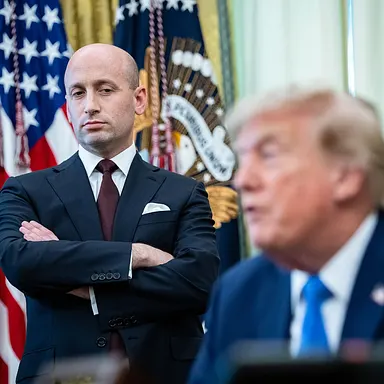
This episode of The Daily features White House reporters Maggie Haberman and Jonathan Swan discussing President Trump's decision to elevate Stephen Miller to chief of staff after Republicans suffered heavy losses in the midterm elections. They examine why Susie Wiles was pushed out, how Miller's appointment may shape immigration policy and efforts to rally the Republican base, and what it signals about the administration's approach to Iran and bipartisan deal-making.
They also discuss Trump's focus on legacy, the private polling that warned of defeat, and political future of Vice President J.D. Vance.
Listeners will hear the reporters' reading of the president's priorities for his final two years in office.
In this episode Rachel Abrams, Jonathan Swan, Maggie Haberman
This episode's transcript on Trump's chief of staff pick was made with the technology behind HappyScribe's automatic meeting notes.
Ads in this audio differ from the text. Tap the sentence you're hearing to follow along.
Synced: the text now follows the audio.
What's amazing about the Neo frame is, like, if you look at it, it's actually easier to read than any other watch out there.
100% is. This one, to me, is that. It's a very classy piece, it's very sleek.
I was just sitting here, you know, kind of thinking while you were speaking, like, the 1920s, that's 100 years ago, right? 1929 or ish. And that looks effectively the same as the one from 1929.
Listen to Reframers from Audemars Piguet now, on your favorite podcast platform. See, I'm excited to say that my voice got a little higher just now.
From The New York Times, I'm Rachel Abrams, and this is The Daily.
We gotta make— we gotta make moves. Sometimes, sometimes in life you have to make moves.
In response to a historic rebuke last week at the polls, President Trump has announced that he is elevating White House adviser Stephen Miller, the person responsible for some of the most aggressive and controversial policies of Trump's second term.
Stephen's been with me from the beginning. He gets it very good politically, and he's a very good man. He'll do a great job, great manager.
And so today, White House reporters Maggie Haberman and Jonathan Swan explain what Miller's appointment as White House chief of staff tells us about Trump's priorities for his final two years. It's Monday, November 9th. Jonathan, Maggie, thank you both so much for talking to us on a Sunday morning.
Thanks for having us.
So after what has been described as an extinction-level result in the midterm elections for Republicans, the obvious question has been what, if any, changes President Trump would make in response to this kind of defeat. And on Friday, we got part of an answer, which is that Susie Wiles, chief of staff, she is out, and her replacement would be Stephen Miller, who is one of the president's most trusted and most controversial aides. Just to start off, I want, Jonathan, for you to tell us what the promotion of Miller shows us about the agenda moving forward.
Well, the first thing it shows is that the president's comments directly after the midterms, that he wants to work with Democrats, that he wants to compromise, that he thinks, you know, there's lots of potential to do deals with them. I think we can completely discount that. Stephen Miller is a signal that he really has no interest in this type of governance. Stephen Miller is the most deeply ideological of his senior staff, is someone who's described the Democratic Party as not even a political party, but rather a domestic extremist organization.
He is going to put this administration on a war footing, not just defensively, you know, they were already preparing for investigations and subpoenas and oversight, but offensively. Stephen Miller is going to be looking at what can they be doing proactively to re-energize the Republican MAGA base, get them excited again about this president, about this administration, not just immigration, where he's very well known for being hard, right, but other culture war issues.
So I think we can expect a base, base, base strategy and no interest really whatsoever in even a gesture towards bipartisanship.
And the other piece, Rachel, that I would just note is most people believe this was Stephen Miller's ultimate goal for this term, was to be the chief of staff. It was still surprising to a lot of people that the president pulled the trigger on it, because the president does know what it means and how it will be taken as a symbol of massive aggression.
Well, okay, so let's drill into that appointment a little bit, because Susie Wiles, the woman that Stephen Miller has replaced, she had largely been seen as kind of a force of stability for a president who, in his first term, just sort of churned through chiefs of staff. So explain to us why exactly he felt that she needed to go.
I mean, the reality, Rachel, is that in any midterm cycle, if you have this level of sweeping losses, a chief of staff is going to get replaced in any administration, especially with a president who does not ever blame himself for anything. She came in, you know, very loyal to him. She also brought with her a group of people who were loyal to her, but who also believed in the president and wanted to see him succeed. And she primarily did not see her job as changing him. She did not see her job as, you know, protecting the country from him the way a number of his first-term aides did.
But she was somebody who is not particularly ideological. You know, she was fairly flexible on a bunch of these issues and willing to go along with what the president wanted. She was somebody who the business community believed that they could reach out to, particularly when they were upset about Stephen Miller's push for aggressive crackdowns on immigration, especially after what you saw in Minnesota. But she was taking on a lot of incoming. The president did not like stories that he was seeing about people close to her making money in different respects.
You know, our colleague Ken Vogel broke a story about two of Trump's top political advisers who were aligned with her taking a trip to the Balkans three weeks before the midterms elections after something completely unrelated. The president never likes that. And so all of these factors combined to make it a pretty destabilized environment. And the president was very angry after the midterm losses. And he, you know, Jonathan and I reported on this last week, he was pretty brutal to her in front of a bunch of people about the losses.
Brutal how?
Just blaming her, including on election night in the East Room in front of other people at his watch party.
Is it fair that the president is blaming Susie Wiles for this massive loss? What can we say about that, Jonathan?
Well, she's the chief of staff, but the way people understand that role usually rests on history, where the chief of staff means a gatekeeper, it has a particular function in a White House. The role doesn't actually really exist for Donald Trump. It can't. Donald Trump doesn't allow gatekeeping, proper gatekeeping. He has people like Natalie Harp who give others a direct channel to him. He likes to pick up the phone himself and, you know, give orders, which his aides may or may not know about.
You saw recently he hired a new press secretary. It was a complete disaster. She lasted five days.
Katie Zachariah, right?
Susie Wiles had no role whatsoever in that, and it was given to her as a fait accompli. So a normal chief of staff would have absolute authority over such a decision. It's a key appointment on the staff that she is supposedly the chief of. So yes, she had influence, yes, she had a big role in policy, but the notion that she steered all of the policy, it just doesn't comport with the facts. And if you talk about the biggest decision that he made that polling shows had the biggest effect on the midterm results, the decision to go to a war in Iran, she had absolutely no role in that decision.
In fact, almost absented herself from having an opinion in these big meetings that led to the war in Iran.
There is no question that the war was the huge factor, but it was certainly not the only one. The tariff policy was something that the president had wanted to try for a very long time. He insisted on going to war with the entire world on trade. That was something that the chief tried fulfilling his wishes on, and it was calamitous because of how the president wanted it to go. So, you know, things tend to end only one way with the president for his staff, and it's not really a surprise that this is how this went.
And look, Stephen Miller has much more experience in the West Wing than Susie Wiles has at a senior level. He is much more knowledgeable about where the levers of power are inside the government. He knows more about policy than her. So it's very possible that he could exert more influence over a wider range of policies, particularly national security. Stephen Miller spent a lot of time thinking about what he wants to achieve. Trump is a vehicle for his own vision that he's had in some respects since he was a teenager, and so he has much more of a vision for what he wants to accomplish in government than Susie Wiles ever did.
So tell us more about that vision. Like, what was Stephen Miller's pitch to the president insofar as there was one to become chief of staff about what he wanted the agenda to be or thought the agenda should be these next two years?
So Stephen Miller wanted the job, and he lobbied for it, and he allowed his allies to advocate for it. And the pitch they made to senior officials and others who would be influential in helping him get the job was that he would help get the base back together. You know, this midterm elections was a calamity for the Trump team because you look at the breakdown of the data, every single part of their coalition left in big numbers.
Men, younger people, white non-college educated, this is the core of the Trump base, and they moved away from the Republicans. They either stayed home or they switched their vote to Democrats. And so Stephen Miller made the case that he was best placed to reassemble the MAGA base, the MAGA coalition, getting back to the policies that got Trump elected in the first place in 2024.
I want to make one point, Rachel. The coalition that elected Donald Trump back into office in 2024 was a combination of MAGA, hardcore base Trump folks, and then people who the Trump team seemed to have confused as being MAGA when they were just not happy with Joe Biden. And that includes some Black voters, some Hispanic voters, some Arab voters in Michigan, for instance. And those are people who are not actually part of the coalition.
Those are voters who have been, in many cases, flipping back and forth in elections for more than a decade. And so the policies that Stephen Miller is looking at, primarily more immigration crackdowns, because that is Stephen's agenda, that is overwhelmingly unpopular in the country. And doubling down on immigration is going to appeal to probably about 40 percent of the country, but not the rest, and if that much. So it's just important to bear in mind how narrowly tailored what Stephen Miller's policies are likely to be in terms of their appeal.
And it goes without saying that having Stephen Miller in there tells the base that they're going to go in a more hardline direction on immigration. Another area where Miller made a big pitch is the MARHA agenda, Make America Healthy Again, the Bobby Kennedy agenda, skepticism about vaccines, skepticism about Big Pharma, about Big Ag. And there is a sense within the MARHA movement that the Susie Wiles-run White House was much too open for business, much too open to industry and lobbyists.
And what Stephen Miller and his allies are trying to convey, trying to put out there, we'll see if it actually happens, is that they will be much less beholden to special interests and lobbyists. That's part of the pitch. And the other thing that he said and his allies have conveyed is that Stephen Miller understands that they need to end this war in Iran.
Well, explain that, because that is obviously the major point that Republicans have been focusing on in the records of the midterm is the war in Iran. So what is his proposal exactly?
Well, it's not entirely clear, and I'm not sure how thought out it is. I mean, the first thing to know is Stephen Miller has not been a major player in any of the Iran war discussions. He was not a significant part of the planning for the war. He has been a huge promoter and booster of Pete Hegseth, who has been the closest thing to a cheerleader for this war. And Stephen Miller has helped defend and protect Hegseth from a lot of people who wanted him out of the job.
So on one hand, he doesn't really have a track record on this issue that would suggest that he has major concerns about it. He defended the war vociferously in public, but so did many of the others. And we do know that just about everyone in Trump's inner circle had serious doubts about this war before they went to the war. The only person, however, that actually raised those doubts in an aggressive way in meetings with Trump before the war was the Vice President J.D. Vance. The rest largely kept them to themselves.
But what Maggie and I have learned in our reporting is that Stephen Miller has been conveying to people, and his allies have been conveying to people after the midterm election, that he understands that the war has been a disaster politically and that getting out of it is very important to start the process of rebuilding and reassembling the base.
Okay, but given all of that, I wonder if we can read Stephen Miller's appointment as Trump also wanting to wind down the war.
I think the president quite knows what he wants to do with Iran right now. He recognizes it's a mess, whether he will, you know, explicate that or not publicly. But what comes next, I think, is not clear. And I wouldn't overread Miller's ascension based on that. Trump, at the end of the day, is the driver of all of this, and he is going to do what he wants.
And President Trump, more than at any other point in either of his terms, is operating on pure gut and instinct and his belief that he knows best.
We'll be right back.
33 presidents.
I called the president at 4:30 in the morning, and he answered.
Seven decades in space.
We want to see what's beyond the next star.
1,000 consumer product guides.
Today I am testing seven mattresses.
60 Super Sundays.
They were probably the best team in the league every single year.
53,500 puzzles.
I use a different starting word every day.
25,000 recipes.
And I love a one-pan recipe because I don't love washing pans.
The New York Times. Celebrating 175 years of helping you understand the world and make the most of each day. Subscribe now for a special offer at nytimes.com/subscribe.
So, Jonathan, Maggie, you've been talking to us about these massive shakeups that have happened in the last week. But I feel like in the run-up to the midterms, I just read story after story about how all the polls showed that there was either going to be a blue wave or a blue tsunami. Obviously, polls are not always right and can often be unreliable, but it does make me wonder how much any of this drubbing that we've seen that Republicans got in the midterms was anticipated, and in particular, how much Trump himself actually expected what we saw on Tuesday.
Well, Maggie, myself, and our colleague Shane Goldmacher did a lot of reporting behind the scenes of this midterm elections. And as part of that reporting, we got access to quite a few private polls and private focus groups from the Trump team. Back in December last year, they knew they had a problem. Trump's polling was softening. He was losing ground on some of his top issues. Voters were starting to question his handling of immigration. And the economy, handling the economy, which has always been Trump's strong suit, voters were starting to question him on that as well.
So this is last December. That's before the war. The war made everything worse. And when it got into the summer, their polling started to really sound the alarm that this could be a terrible election. You were seeing his approval rating fall apart, and people were unhappy about the war. They wanted Trump to get out of the war. When they did polling of 2024 Trump voters who were defecting, what was the thing that they could do to bring them back? Ending the war was the top issue. The other thing we did was we got inside these private video calls that the Trump team was having in the lead-up to the election.
What our reporting showed, particularly in the last two calls they had before the election, was that Trump's top aides were starting to get very, very nervous about the prospect of a wipeout. They were talking about making funeral arrangements. They were talking about taking cyanide. So there was a lot of that type of gallows humor. This is all to say that the loss was not unexpected. Obviously, historically, presidents have done very poorly in midterm elections, but also all of their polling was showing that this could be a very bad night for Republicans.
Trump himself, he had been shown this polling. It wasn't a surprise to him. He'd seen the public polls. He'd seen the commentary. You know, he watches not just Fox, but he watches CNN and MSNows. So it's not like Trump hadn't been exposed to this information, but he's also someone who lives by the power of positive thinking.
But in the middle of all this sort of terrible prognostication, is Trump giving any indication that he's doing anything because he wants to try to turn the election results around?
No, he ended up doing a lot of rallies because essentially the entire Trump political ecosystem is built around the idea that if there is a problem, that more Trump is the answer. There was even this press conference that was essentially the president's closing message right before the election, literally the day before, although he would deny that that's what it was, but it was. He held this event.
Today I'm thrilled to announce the official opening of the Lincoln Memorial.
Right in front of the reflecting pool.
The pool is now better and more beautiful than it's ever been before.
Which has been a source of enormous derision and a sense of waste and of hours spent on matters that don't matter to the American public.
Now we're giving serious thought to changing the name to the Trump Reflecting Pool.
And here was the president announcing that it was reopening.
I'm only kidding.
And it was like if you could have done anything to underscore for voters that the president's focus was on things that he cares about as opposed to what the voters cared about, I don't know what you would have done differently. And then pretty similarly the day after the election.
It'll be the most beautiful ballroom, I think, anywhere in the world, and they've been trying to get it for 150 years.
He brings the press corps to an event for the ballroom that he has been incredibly focused on.
You'll be able to have dinners for as many people as you want. We had King Charles here, and we couldn't. We were very restricted.
And again, this is another item that his advisors have all known privately was problematic, not just symbolically, that a lot of people in Washington were very worried about it, but that it was something that donors were being leaned on to give toward, that it was something that the president wanted to spend hours and hours of his week on. And that was his immediate aftermath message as opposed to anything else.
And then we're doing the arc, the beautiful, like the arc to triumph, but better, more beautiful, actually, much more beautiful. And as you know, we're doing the National Garden of American Heroes, which will be something beautiful.
Right. Basically, everything that we saw is not what you would expect to see from a president who is either trying to turn the Titanic around or react to the fact that they have just hit the iceberg.
It's definitely, Rachel, a president who goes by the ethos that Jonathan and I have written about and that the president actually put out on social media a couple of weeks before the election, which is, things are going to be fine. They always are. And he operates in this world where things work out for him one way or the other.
So, look, in public, you've seen Trump almost in a disassociative mode, right? This is not someone who you've seen, right, we're down to business, here's the plan. But in private, he's been very angry, very angry about the results, wondering where the money went.
Meaning the money, all the money that was spent to try to elect Republicans. He thinks it's like gone to waste.
Exactly. Trump had all of his money in a super PAC, about $400 million-ish, and he didn't want to spend it. He sees it as, quote unquote, my money. And his team had to really work hard to persuade him to spend it on Republicans. Eventually, they wore him down and he agreed to spend it. And so now, from Trump's point of view, all of this money was wasted for a terrible result. And so he's angry. He realizes he needs to make changes, as much as anything, to interrupt this terrible news coverage that he's been getting since the election, where this is about a repudiation of Donald Trump and the Trump administration and moving on from Donald Trump.
You're seeing lots of chyrons about a post-Trump Republican Party. Well, Trump doesn't want a post-Trump Republican Party. As long as he's alive, it's the Donald Trump show. So he is trying to reassert control, reassert command, and everything that he's doing should be seen through that lens.
Well, just to that point, Maggie, you have talked to us a lot about how much Donald Trump cares about his legacy. And that's what I'm kind of hearing from Jonathan's answer, right? Like how much of what everything that you have just described to us has to do with Maggie, what you have explained to us, is at the core of what drives Donald Trump and what he cares about.
Yeah, what he cares about, Rachel, just to be clear, is not the future of the Republican Party, which is what Jonathan is pointing to. He cares very much about a personalist view of this, monuments that reflect him, monuments to reflect that he was here, that are durable, that his name will not be taken off of, as he saw happen after he won the 2016 campaign and after his calamitous exit from his first term in early 2021. He cares about his personal financial situation. He and his family have made a massive amount of money during this term, just, you know, $2.2 billion in crypto alone for the president last year.
Staggering.
Right. He cares about dominance. He cares about not being ignored. As Jonathan said, the focus of attention on him is very important, and so is the perception of him as strong. But he's made no bones about the fact that he considers it, I think his word was honor, an honor that Republicans don't do as well when he's not on the ballot. But that's the legacy he is concerned about.
In his mind, it's pretty clear that the goal is for him to be remembered. You know, we've talked about this before, but when Maggie and I saw him in March and he handed us a sheet of paper that compared his power to the great figures of history in his mind, Hitler, Stalin, Mao, Alexander the Great, Genghis Khan, Tamerlane, a lot of these figures are known by just one name. And it became very clear to Maggie and I that Donald Trump's one of his biggest goals is for Donald Trump, or just Trump, to be the defining historical figure of his lifetime, of our lifetime, maybe of the last 100 years.
That's the goal. It's not how do Republicans do in the 2032 elections. You know, nothing could be further from Donald Trump's mind than that.
Right. To that point, Jonathan, the rest of the Republican Party has to actually care about the future of the Republican Party, right? Even if the president does not. And so I would imagine that a lot of the responses that we're starting to see from Republicans about what led to the midterm losses have to do with goals and things that they want that are certainly not on the president's mind.
Yeah. And the challenge they've got for all of them is he's still around. He's not going anywhere. He's here for the next two years. And, you know, as long as he lives, really, he's still going to be a kingmaker in the party. He still is the most popular figure in the party with the base. People forget that, but it's just a fact. And so you're going to have all of these Republicans you already do trying to map out a, quote unquote, post-Trump future, but the post-Trump era doesn't actually exist yet. And it gets even more complicated when you're someone who is serving in the Trump administration, planning a political future for yourself, J.D.
Vance, the vice president, being the most significant there. He has to make a decision. Do I run for president in 2028? And what does that look like, running for president in 2028? J.D. Vance has one of the most difficult tasks in political history. He has to reassemble a shattered coalition, people who are completely disgusted, in many cases, by this administration. He has to reassemble them while he's the sitting vice president.
Oh, and by the way, good luck distancing yourself from Donald Trump. That's not an option.
Well, let's talk about that distance that you mentioned, Jonathan, because I personally was very surprised by this tweet J.D. Vance put out right after the midterm results, basically blaming the war in Iran for the midterm losses. And the reason why that felt striking was because it felt like here is a Trump loyalist, here's somebody who's still working for the president, putting more distance, more daylight in between himself and a man who does not seem to tolerate any kind of what he considers to be disloyalty. And so I just sort of wondered, what is their relationship and what are we to make of that?
Well, it's a very fraught moment. We'll see how much more of that he can get away with. I don't think Trump is completely upset by the notion of acknowledging that the Iran war had an effect politically or on gas prices. He's said as much himself, but he does want his aides and advisors publicly to say, but Donald Trump was correct. He made the correct decision to go to war. Trump wants people to say that. That was conspicuously absent from that social media post. So we'll see how much more of that is tolerable.
So it's not a matter of the president cannot fire the vice president, obviously. It's really what is on the line here is whether or not J.D. Vance for 2028 can get the president to stand behind him. That's what he's risking with these kinds of statements.
Yeah. And that's still, again, we're not in a post-Trump era. Trump is still the president and his endorsement is still the most decisive endorsement in the party and the most important factor for anyone who wants to be the nominee in 2028.
Yeah. I think this matters more for the people who are looking at careers in the Republican Party and possibly running for president, among them a number of senators, outside the White House than inside it.
Okay, so the two of you have just told us that it looks like Stephen Miller, Donald Trump, they are about to double down on what the base might want. But we had Chuck Schumer, expected Senate Majority Leader, on the show on Friday. And one of the things that he said to us was that if Trump keeps doing what he's doing, Democrats will easily win the White House in 2028. And I just sort of wonder if there's anything at this point that helps us understand which side's strategy is correct.
Well, look, I mean, it's hard to look at what Trump is doing right now and say, wow, that makes a lot of sense. But I will say, Rachel, that one of the mistakes that both parties have made for many, many cycles now is continuing to say what just happened in the last, you know, 72 hours, therefore portends XYZ going forward. Democrats are not particularly popular either nationally. They're just slightly more popular than Republicans right now.
Right.
Neither party has been popular for some time. And I think what the results of these elections tell you is that there are a group of voters who want to see government work for them. That doesn't mean that they fell in love with one party or the other. And candidate quality does matter. So who the nominees are will have a role. And what Democrats have accomplished in the next two years will have a say too. So I don't think we can say right now what any of this means for two years from now.
It means that there's a lot of voters who would like their lives to be better and don't feel like either party has done that yet.
Maggie, Jonathan, thank you both so much.
Thank you.
Thanks, Rachel.
Do you think immigration hurt you in the midterms? Do you think the crackdown hurt you?
I think it both helped and hurt.
On Sunday night, President Trump recognized that his administration's crackdown on immigration, led by Stephen Miller, has been too aggressive.
When you go into a hotel and you have a woman that's worked there as a, you know, as a maid, as a cleaner, as a this, as a that, as a waitress, a lot of good things, great jobs, and all of a sudden they're being taken out of the country, it's tough. It's a tough thing.
In an interview with 60 Minutes recorded on the same day he promoted Miller, President Trump said he would like to work with the incoming Democratic Congress on an immigration reform that offered status to undocumented migrants without a violent criminal record.
Do you think the Democratic Party right now has people in it who would be interested in this kind of deal?
I think so, yeah. People have already called me.
We'll be right back.
Hi, I'm Solana Pine. I'm the director of video at The New York Times. For years, my team has made videos that bring you closer to big news moments, videos by Times journalists that have the expertise to help you understand what's going on. Now we're bringing those videos to you in the Watch tab in The New York Times app. It's a dedicated video feed where you know you can trust what you're seeing. All the videos there are free for anyone to watch. You don't have to be a subscriber. Download The New York Times app to start watching.
Here's what else you need to know today. The chipmaker Nvidia said on Sunday that it was opening an investigation into Jensen Huang, its chief executive and co-founder, after he acknowledged to the company's board that he had been intimate with a business executive who U.S. intelligence determined to be a Chinese spy. Huang's relationship with the woman became a security concern after surveillance revealed that she was feeding information directly to Beijing. The revelation raised concerns in part because Huang is one of the most powerful figures in AI, as well as an influential ally of President Trump.
Multiple sources told The New York Times that Secretary of State Marco Rubio had drafted a secret memo warning top officials about the relationship last spring. And Israeli President Isaac Herzog officially gave opposition leader Gadi Eisenkot the green light to try to form a coalition government. Eisenkot will now have six weeks to decide who amongst a fractious group of political parties can come together to oust incumbent Prime Minister Benjamin Netanyahu. If Eisenkot fails to form a coalition, the president will pass the baton to someone else, likely Netanyahu.
Today's episode was produced by Carlos Prieto, Rochelle Bonja, and Claire Tennis-Getter. It was edited by Maria Byrne and contains music by Pat McCusker, Dan Powell, and Marian Lozano. It was engineered by Alyssa Moxley, and our theme music is by Wonderly. That's it for The Daily. I'm Rachel Abrams.
See you tomorrow. For decades, the Brooklyn Democratic Party operated as a tightly controlled machine until this summer. When elections ushered in a bunch of self-described reformers. Ever since, the party has been in the grip of a bruising, chaotic, and sometimes thrilling fight. In the latest episode of Metro with me, Sarah Koenig, stories of people trying to maintain their influence and losing control along the way.
Metro, listen wherever you get your podcasts.
After a stinging rebuke last week at the polls, President Trump announced that he would elevate Stephen Miller — a driving force behind some of the most polarizing policies of Mr. Trump’s second term — to chief of staff.
Maggie Haberman and Jonathan Swan, White House reporters for The New York Times, explain what Mr. Miller’s appointment reveals about the president’s priorities for his final two years in office.
Guests:
Maggie Haberman, a White House correspondent for The New York Times.
Jonathan Swan, a White House reporter for The New York Times.
Background reading: After midterm election losses, the Republican Party has entered its most uncertain moment in years.
The new chief of staff is poised to push the limits of the president’s power.
Photo: Haiyun Jiang/The New York Times
For more information on today’s episode, visit nytimes.com/thedaily. Transcripts of each episode will be made available by the next workday.
For more information on today’s episode, visit nytimes.com/thedaily. Transcripts of each episode will be made available by the next workday.
Subscribe today at nytimes.com/podcasts or on Apple Podcasts, Spotify and Amazon Music. You can also subscribe via your favorite podcast app here https://www.nytimes.com/activate-access/audio?source=podcatcher. For more podcasts and narrated articles, download The New York Times app at nytimes.com/app.
Hosted by Simplecast, an AdsWizz company. See pcm.adswizz.com for information about our collection and use of personal data for advertising.