
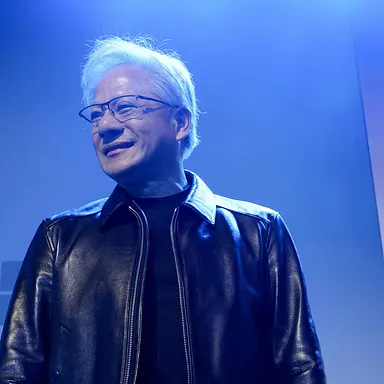
This episode of The Daily examines the scandal engulfing Nvidia, the chipmaker at the center of the artificial intelligence boom, after its chief executive, Jensen Huang, admitted to an affair with a woman U.S. officials have determined is a Chinese spy. Times correspondent Tripp Mickle traces how the reporting began with questions about Megaspeed, a Singaporean data center firm that bought billions of dollars in Nvidia chips, and how U.S. intelligence came to surveil a executive tied to Huang.
Listeners will hear why the White House was reportedly never warned, why the company's denials unraveled, and why the board has opened an investigation. The conversation also weighs what the affair could mean for Nvidia's leadership, U.S. chip policy and the broader economy, and the guest argues that the damage may be lasting regardless of what she learned.
In this episode Natalie Kitroeff, Tripp Mickle
This episode's transcript on the Nvidia scandal and Jensen Huang was made with the same technology HappyScribe uses for AI meeting minutes.
Ads in this audio differ from the text. Tap the sentence you're hearing to follow along.
Synced: the text now follows the audio.
What's amazing about the Neo frame is, like, if you look at it, it's actually easier to read than any other watch out there.
100% is. This one, to me, is that. It's a very classy piece, it's very sleek.
I was just sitting here, you know, kind of thinking while you were speaking, like, the 1920s, that's 100 years ago, right? 1929 or ish. And that looks effectively the same as the one from 1929.
Listen to Reframers from Audemars Piguet now, on your favorite podcast platform. See, I'm excited to say that my voice got a little higher just now.
From The New York Times, I'm Natalie Kittroff.
A real-life spy thriller?
This is The Daily.
Sounds like a honey trap and a really good movie.
Sex and spying scandal engulfing one of the U.S. technology giants.
We need to talk about Nvidia. This story is incredible.
Today, the extraordinary story of how the head of Nvidia.
That's right, the biggest name in semiconductors, the man driving the AI boom, was possibly.
The company at the center of the AI revolution.
To put it crudely, Jensen Huang was apparently honey trapped by China.
Came to admit that he'd had an affair with a woman that U.S. officials say is a Chinese spy.
It sounds like Mr. Huang has explained to do to his wife, his company, and the government.
I speak with my colleague, Trip Mickle, about what the growing scandal means for the CEO, Jensen Huang, for his $4 trillion company, and for the global battle for supremacy in artificial intelligence.
What a mess. I mean, what a mess.
It's Tuesday, November 10th. Trip, welcome back to The Daily.
Thanks so much for having me.
Okay, so I and I think everyone else have been completely glued to this story, which is honestly something out of a movie, it feels like. This spy, working on behalf of the Chinese government, infiltrates one of the most valuable companies in the world by having an affair with its founder. You and many of our colleagues here at The Times have been leading on this reporting, and I want to know absolutely everything, starting with why this matters at the highest level.
Well, the story has a little bit of everything, right? It's got sex and spies and semiconductors. Like, what can be more engrossing than that combination? But when you think about why this story matters, you have to look at what has changed in the world at large over the past three years. And the biggest fundamental change is artificial intelligence and the increasing belief that artificial intelligence is going to be an industrial revolution. And the company behind that industrial revolution, the company that's enabling it, is Nvidia.
Nvidia has a 90% market share in the artificial intelligence chips that are used to build and run AI systems. So every time you go to ChatGPT or Claude or Grok or anything, Gemini, anything else, and you put in a query, odds are some portion of that response that you get is powered by Nvidia's technology. And so this has ramifications for everybody. It has ramifications for policymakers in Washington.
It has, you know, geopolitical ramifications for the U.S.-China relationship. And it has ramifications for you, me, and everybody else who has a 401(k) because Nvidia is such a big company in terms of its value and in terms of its prominence in the S&P 500 and in terms of what it means to where artificial intelligence is going, that the stock market literally moves up and down based on how Nvidia is trading.
Okay, so this story matters a lot, and not just because it is filled with incredibly tantalizing details, twists and turns, but because a lot of our economic health is riding on this industry and on this company.
And on this one man, Jensen Huang. And so it's hard to begin to wrap your head around how important Jensen Huang is to artificial intelligence and this company itself. He has a flat structure with 60 direct reports. There's no clear indication of who his successor might be if he were to get hit by a bus tomorrow. And now he's become enmeshed in arguably the most explosive geopolitical controversy in corporate history.
Okay, so how do we get to this place where one of the most powerful CEOs in the world gets tangled up in such an explosive, high-stakes mess? Like, where does this story begin?
You have to back up to last August when Ana Swanson and I got a message from a tech industry contact of ours who said, "Hey, you really need to drop everything and look at this company called Megaspeed." It's a Singaporean data center firm. I mean, it's literally a company that buys chips from Nvidia and builds data centers. And there's nothing about that on the surface that says this is something we should drop what we're doing and devote time and resources to figuring out what this company is and why it matters.
But Nvidia was selling chips to this company at a time of increasing controversy over where AI chips go. The U.S. government has been concerned for years about the arms race, so to speak, between the U.S. and China over who's going to achieve supremacy in artificial intelligence. And when the AI revolution started in late 2022, the U.S. had restricted China from buying Nvidia's best chips and best technology because it wanted to stop China from being able to build technology that was as sophisticated and comprehensive as what U.S.
companies were building. But there was a big loophole. And that loophole was that Nvidia could sell chips to companies in Southeast Asia and that those companies could then provide access to that technology remotely to Chinese companies. And as we began to examine Megaspeed, it was pretty clear they're kind of the poster child for exploiting this loophole.
How so?
How so? I mean, in the span of roughly two years, they had purchased more than $4.8 billion in chips from Nvidia. I mean, they went from being a company that nobody knew of overnight to a company that had become one of Nvidia's largest customers in the region. And I mean, this was a company with clear ties to China. So we wanted to learn more about those ties and dispatch our colleague, Paul Moser, from Taipei to Singapore to visit the Megaspeed office.
And when he showed up, he found that there were only two employees at the office. And when he spoke to them, they said that most all of their customers were Chinese and most of the executives were Chinese and rarely came to Singapore. In fact, most of them stayed mostly in China. This was significant because at the time, Nvidia was telling us that Megaspeed didn't really have ties to China. Paul also went and found that Megaspeed was owned by a shell company, and he visited the shell company and found that it was based in an accounting firm, almost like a shell company mill.
All of this was mystifying for us.
Unusual just because why would such a big company be housed with an accounting firm?
Right. You're buying $4.8 billion of chips. You would think you could spring for your own office space, right?
Right. So it sounds like you're finding there are a lot of questions to be asked about this company's connections to China and how it became such a major buyer of these chips, basically out of the blue.
Yeah, absolutely. I mean, and as we dug into this company and looked at it, we found that they had aroused the suspicions of the Commerce Department and commerce officials who are supposed to track where chips are going around the world. And so they dispatched investigators to visit one of the data centers. And when they showed up in September of 2024, they found that Megaspeed still had a lot of the Nvidia technology in boxes, which raised suspicion that that technology was being shipped into. And then onward to potentially China.
It really raised the prospects that this was a smuggling operation, not just a data center operation.
Fascinating.
And at the center of all of this was this woman named Alice Wong, or Wong La, a Chinese citizen who claimed to be the company's chief executive officer on her LinkedIn and who had a biography that detailed that she used to be a TV journalist. And this just made us question, how did she get all this money? How did she come to be in charge of this company? And then most of all, and most mystifying, how did she get so close to Jensen Huang, the person who is at the forefront of artificial intelligence?
How close a relationship are you aware that they have at this point? Like, what do you know about that?
We don't know a lot, but she's been photographed with him on a few different occasions and videoed with him at various industry gatherings. And so we do some reporting. We speak to a man who took a photograph of them at an industry party at a bar in Taipei. And there's a photograph of Jensen sitting beside Alice as they prepare to toast whiskey. And the gentleman who took the photograph is a tech executive named Parker Schmidt. And Parker got on the phone and he said, you know, the wild thing about that photo is we were hanging out with Alice at this party and she said something to the effect of, "I bet I can get Jensen here."
And sure enough, a few minutes later, Jensen showed up.
An indication that, I mean, she may have him on speed dial or something like that at least.
Right. That was the way it was perceived by others at this party. And you got to remember, like, this is in Taipei. This is where he is rock star among rock stars. And this is the industry that he is building and leading. So to be able to, in moments, summon the most important figure in the industry really catches people's attention.
All right, so you drop this reporting. What happens?
Not much. It's quiet. Nvidia keeps doing business with Megaspeed and we don't hear a lot for a while. And then about a month ago, we hear that our colleagues in Washington on the national security beat all of a sudden are hearing things about Alice Wong and she's resurfaced in our universe. And we start to do some reporting and it turns out that she has been under U.S. surveillance for about a year, if not longer.
And in the course of surveilling her and her communication, U.S. intelligence services have determined that she's a Chinese asset funneling information to Beijing.
A spy.
A spy, basically. And lo and behold, who do they find out she's in touch with? Jensen Huang.
We'll be right back.
What's amazing about the NeoFrame is, like, if you look at it, it's actually easier to read than any other watch out there.
100% is. This one, to me, is that. It's a very classy piece. It's very sleek.
I was just sitting here, you know, kind of thinking while you were speaking, like, the 1920s, that's 100 years ago, right? 1929 or ish. And that looks effectively the same as the one from 1929.
Listen to Reframers from Automobile Brigade now on your favorite podcast platform. See, I'm excited to see how my voice got a little higher just now.
I gave my brother a New York Times subscription.
She sent me a year-long subscription so I have access to all the games. We'll do Wordle, Mini, Spelling Bee.
It has given us a personal connection.
We exchange articles.
And so having read the same article, we can discuss it.
The coverage, the options, it's not just news.
Such a diversified gift.
I was really excited to give him a New York Times cooking subscription so that we could share recipes. And we even just shared a recipe the other day.
The New York Times contributes to our quality time together.
You have all of that information at your fingertips.
It enriches our relationship, broadening our horizons.
It was such a cool and thoughtful gift.
We're reading the same stuff. We're making the same food. We're on the same page.
Connect even more with someone you care about. Learn more about giving a New York Times subscription as a gift at nytimes.com/gift.
All right, so you learn that the U.S. intelligence community has, for the past year or so, been surveilling this woman that they suspect is a Chinese spy. They know this woman is talking quite a bit with Nvidia's CEO, Jensen Huang. What have they come to know about the nature of the relationship between these two?
They know that they have a very close relationship, that they've obviously been doing business together, and that some people in the intel community suspect that the relationship is intimate.
Hmm.
And this obviously sets off alarm bells within the U.S. government because.
Right, you'd think.
Jensen Huang, over the course of the past two years, has gone from somebody who did not even know President Trump to one of President Trump's closest allies who has a huge voice and influence over U.S. AI policy and who has regular phone calls with the president.
Right.
They're in touch all the time.
I mean, we saw recently Jensen Huang was on stage at an event and he got a call from the president and took it live. So.
Correct.
They're clearly very close. And I assume that the worry or the question on the minds of these intelligence officers is, what is Alice Wong trying to get out of Jensen and what has she managed to glean from him?
Right. And the U.S. intelligence community determines that she's working on behalf of China's Ministry of State Security, which is essentially their CIA.
Wow.
And they determine that she is trying to learn more about American AI chips, in other words, you know, Nvidia's magic, and potentially trying to influence U.S. policy on AI chips for China. In other words, encouraging Jensen to try to advocate for China to get more AI chips. And the concern and the worry here is she's incredibly close to him, which means she could have access to his devices.
She could be communicating with him at all times. She could be weighing in on issues in real time. We don't know. We haven't seen the surveillance. But you can imagine the type of questions that the intel community was agonizing over as it was reviewing the surveillance.
And so what do they do when they find this out? Like, how do they respond to this information?
They take it to the top. They briefed the president on this about a year ago, and they let him know that Jensen Huang has a relationship, a close relationship, with this woman who they've determined to be a Chinese spy. And the president chooses not to do anything.
And when you say he decides to not do anything, what do you mean by that? Like, what exactly does that look like?
Well, usually in circumstances like this, what happens for a U.S. citizen that surfaces in surveillance in an intelligence operation like this is that the FBI would provide a defensive briefing for that individual, essentially notifying them and saying, "Hey, you need to be aware. You have come up in surveillance. We know the person you're talking to is part of an intelligence operation. We suggest you probably, presumably, distance yourself from them." In this instance, that is not what happened.
Jensen was not notified about this. Nothing happened. Literally, the president took no action.
Why? Why wasn't he notified? What's the justification for that?
It's unclear to us in that time, in that moment last fall, why the president didn't take action. We don't know if that's because they didn't want potentially Jensen Huang to say something to her and then that kind of pollutes the surveillance or, you know, creates a situation where they're no longer able to surveil her. If, like, that was a priority or if there was something else going on, there's some other dynamic. I mean, there are many variables at play. And we have to remember he's a close ally of Jensen Huang, and this is a president who is very aware of how the stock market is performing and the economy is performing.
And what is the one thing driving both of those things? Artificial intelligence and Nvidia.
Okay, so Trump knows about it. The U.S. government knows about it. What happens? What happens next?
I know we've said this once before, but not much.
Huh.
Fast forward to the spring and Marco Rubio asks for an update on the intelligence about the surveillance. And he drafts another memo and he makes it more clear that she is a Chinese spy, that she is working for China's intelligence services. And the timing of this memo is shortly before President Trump took off for his summit in Beijing with Xi Jinping. And when the U.S. government pulls together its list of executive delegates to go on that trip, you have Tim Cook, you have other chip executives.
It's a 17-person list, but there's one name that's omitted, and that is Jensen. He's not invited.
Hmm. But if I'm not mistaken, Jensen Huang does end up going on this trip to China. So what happened?
Yeah, I mean, in the run-up to the trip to Beijing, there's media coverage about Jensen not being there. The president decides to extend a last-minute invitation to Jensen, and Jensen flies to Alaska, meets Air Force One on the tarmac, and boards, and they take off together to go to Beijing.
Okay, so I think that brings us to a couple weeks ago when you and our colleagues published this bombshell report saying that Jensen Huang was the target of this Chinese spy plot. Is this when he first figures out that he's been caught up in all this surveillance?
Yeah. The day before we went out with publication, we went to Nvidia and asked them for comment. And one of the things they said was that they were confident that if the U.S. government believes that any person is a threat to American industry, it would let us know. In other words, the U.S. government has not told us about this surveillance. It has not told us about this U.S. intelligence conclusion that she is a spy. All of this is news to them when we go to them and ask them to comment on the story.
Did you talk to Jensen Huang himself?
He didn't respond to our inquiries directly. His company spokesman spoke to us on his behalf. But Bloomberg News spoke to him a day after our story published. And one of the things that Jensen said in that interview with Bloomberg News was he said that his interactions with Ms. Huang had been related to Megaspeed, quote, "and it was all completely normal and not unusual," end quote.
Basically, the company and Jensen Huang himself are saying, "Nothing to see here. There's nothing unusual about this." The company's saying, "Look, if this was a problem, we would have known about it."
We would have been told. And by the way, this is just a chief executive having a relationship with a customer like he has relationships with thousands of customers. It's not unusual. But their position doesn't hold because as more and more press comes out, the news begins to tighten, and Jensen Huang decides that he needs to confess. And so over the course of this past weekend, he let the board and every employee in the company know that he'd been having an affair with this woman.
And one of the things he says is, "I was unfaithful to my wife. My actions hurt her and our children. There is no excuse for what I did. I am deeply sorry."
And does he say in that email whether or not he knew that this woman was a spy?
No, he doesn't address that dimension of it. In fact, what he actually does and what the company does is that they say he's going to continue to lead this company, you know? It's both a note of apology, but then also a note of reassurance to the people who work there, who really look up to him and idolize him and know that he is absolutely critical to what that company does.
Well, and also to the stock market, presumably, right, which is so dependent on the health of this one giant company.
Right. And which all of a sudden has to make sense of this new fresh doubt about whether or not Jensen Huang will be leading this company going forward. And while the board tried to reassure the market by saying that it doesn't think, once again, that there was anything problematic, that no classified information was shared with her, et cetera, what the board has decided to do is open an independent investigation into the relationship. And this whole concept of Jensen's leadership of Nvidia being open to scrutiny raises fresh doubt about the leadership of the company.
So in this investigation, I have to assume that part of what they're looking at here is the question that we all have, which is, how successful was Alice Wong? Was she able to influence Jensen on U.S. AI policy? And in general, how much information was she able to glean from him? What do we know about those two things?
This investigation is going to have to run the gamut from the micro questions to the macro that you just raised. And the micro ones are, what was the nature of Nvidia's business dealings with Megaspeed? All of a sudden, that needs to be investigated by the company itself. And then on the macro side, it's how successful might she have been in influencing Jensen Huang's policy position and his advocacy in Washington, because that's something that the company has also had a stake in and been invested in as well.
And on that issue, we know that Jensen's position on selling chips to China has not changed. Jensen Huang has been consistent in advocating to sell more chips to China throughout this kind of AI boom period.
Right.
He really believes that in order for the U.S. to remain preeminent in artificial intelligence, that the only way to do that is to prevent Chinese companies from developing competing chips that they may sell for less or that may outperform what Nvidia and AMD and others produce, which are right now by far and away much better in terms of, like, the power they consume and the performance that they offer compared to what the Chinese offer.
Right. You've talked about this on the show before, that Huang has long wanted to remain dominant in this market and that he believes the way to do that is to sell chips to China so they become reliant on U.S.-made chips. And what you're saying, it sounds like, is that it's hard to parse whether Alice Wong was influencing Huang when this is something that he kind of already wanted to do, sell to China.
That's completely right. But there's a caveat here, right? Now we have to look back at this entire two years of advocacy and lobbying, and we have to look at it through a new lens with a new piece of information. And that is that while he was pushing for this, he had a Chinese mistress with a vested interest in those same objectives.
Trip, you told us earlier that this company, Nvidia, is really run by this one man, Jensen Huang, that he has a ton of control, maybe more than most CEOs over this one company, which I'd imagine puts the board in a pretty tough spot as they go to investigate this. You'd think there are a lot of incentives there to not want to rock the boat, to disrupt the company's leadership.
Correct. This is a board that has been very deferential to Jensen, and they've been deferential for a reason. I mean, this guy took this company from being worth less than a trillion dollars a few years ago to being worth more than four trillion dollars. In the process, he's made a lot of these board members really, really wealthy as well.
Right.
Because a number of them were early investors in Nvidia. They bankrolled it at the outset. Nvidia is set up with a single point of failure. I mean, he has 60 direct reports. There's no clear successor, and there's no real plan B. So the repercussions, like, could he be fired? Could he be suspended? We could kind of puzzle over, like, those outcomes, but it's really hard to think that that's where this ends up, given the nature of this board and given the importance he holds for the future of that company.
What about for President Trump? Has any of this had a visible impact on Jensen Huang's standing with the president?
At this moment, it seems like water off a duck's back. I mean, he spoke on Sunday after Jensen Huang revealed that he'd had the affair, and he defended Jensen. He said that he would probably take him on the next trip to China.
Oh.
And he also said, quote, "I haven't heard he's done anything wrong. He dealt with somebody, but, you know, so does everybody else."
Meaning this kind of stuff just happens. That's what the president is saying.
I guess so.
I want to ask about the timing of all of this because now we have these new Democratic majorities coming into Congress in January. That seems as though it could lead to a more aggressive approach in Washington toward all of this. What should we expect?
I mean, the timing of this couldn't have been worse if you're Jensen Huang. I mean, the Senate just flipped, and that means that the Democratic senator from Massachusetts, Senator Elizabeth Warren, is going to be taking over the Senate Banking Committee. They have responsibility for export of chips abroad, and she will have the gavel. And there's almost, I don't know, 100% chance that she asked him to testify. She's already asked him to come in and brief the Senate Banking Committee earlier this year, and he declined.
I mean, we may be at a point now where he doesn't have a choice. And then if you step back even further before she even gets the gavel, we just had a midterm election where most of America sent a strong message to Washington that it was fed up with Silicon Valley's influence over Washington policy, particularly on AI. And Jensen Huang's the face of AI. So anybody looking to score points right now, whether it's Republicans or Democrats, on tech before the end of the year, they have somebody they can bring in.
And we've already seen three Republicans say that they want a briefing from Jensen. So this is coming fast, and it's changing and taking shape in real time.
All right. I have what may seem like an intentionally provocative question here, Trip, but bear with me. If it turns out that this woman that they suspect is a Chinese spy didn't actually glean all that much from Huang, and that Huang pushed for a more lenient U.S. policy toward selling chips to China because he wanted to, not because of her influence, what then would be the damage that has been done from all of this?
He's been compromised. How can lawmakers, people in the Trump administration, listen to him and not have this in the back of his mind? It sows doubt for everyone about what he says, whether he's being honest. And it also shows that he's vulnerable, right? I mean, this is a guy that hadn't minus touched. He could do no wrong in the last three years. And this is a major misstep.
A major misstep that could wind up forcing him to spend time in the coming months and next year testifying about the past rather than focusing on deciding and designing the artificial intelligence chips and the artificial intelligence changes of the future. This is a real inflection point for the company, for the U.S. economy, for artificial intelligence, because we don't know what lies ahead after this point.
The way we see Jensen Huang has changed forever.
Well, Trip, thank you so much. It's been a pleasure.
Thanks for having me.
We'll be right back.
What's amazing about the NeoFrame is, like, if you look at it, it's actually easier to read than any other watch app.
1000% is.
This one, to me, is that. It's a very classy piece. It's very sleek. I was just sitting here, you know, kind of thinking while you were speaking, like, the 1920s, that's 100 years ago, right? 1929 or ish. And that looks effectively the same as the one from 1929. Listen to Reframers from Automobile Brigade now on your favorite podcast platform. See, I'm excited to see how my voice got a little higher just now. Hey, it's Vaughan Freeland from New York Times Cooking. Baking season is here. Almost any cake can be turned into a one-ball cake.
There's nothing better than a freshly baked croissant from my oven. Oh, my God. I could eat five billion of these. That is a brownie. Don't be afraid. This is so forgiving. These are deluxe cookies. Bake with New York Times Cooking this season. Find all the recipes at nyccooking.com. Subscribe now for a limited-time offer.
Here's what else you need to know today.
Impeaching Peter Brian Hegseth, Secretary of Defense for High Crimes and Misdemeanors.
On Monday, Representative Thomas Massey moved to force a vote on impeaching Secretary of Defense Pete Hegseth. Massey, the Kentucky Republican who's set to leave Congress after losing his primary in May to a challenger backed by President Trump, introduced eight articles of impeachment against Hegseth. The resolution said that Hegseth had abused his authority on many fronts, accusing him of violating federal law by carrying out the war with Iran without congressional authorization and carrying out unlawful strikes against drug traffickers in Latin America.
Hegseth has rejected the allegations, calling the impeachment effort a political sham. If the House approves the charges, the measure will go to the Senate. And California voters rejected Proposition 40, killing a measure that would have created the nation's first wealth tax. The proposal would have imposed a one-time 5% tax on the personal assets of billionaires in the state and devoted most of the revenue to health care.
But it suffered from having a weak coalition of supporters who couldn't compete with the well-funded ad campaign attacking the measure. Today's episode was produced by Olivia Natt, Lexi Dio, and Eric Krupke. It was edited by Paige Cowett and Lizzo Balin. Contains music by Dan Powell, Rowan Nimisto, and Marion Lozano, and was engineered by Alyssa Moxley. Our theme music is by Wonderly. Special thanks to Ana Swanson.
That's it for The Daily. I'm Natalie Kitroweff. See you tomorrow.
What's amazing about the NeoFrame is, like, if you look at it, it's actually easier to read than any other watch app.
1000% is.
This one, to me, is that. It's a very classy piece. It's very sleek. I was just sitting here, you know, kind of thinking while you were speaking, like, the 1920s, that's 100 years ago, right? 1929 or ish. And that looks effectively the same as the one from 1929. Listen to Reframers from Automobile Brigade now on your favorite podcast platform. See, I'm excited to see how my voice got a little higher just now.
Over the weekend, Jensen Huang, the chief executive and co-founder of Nvidia — which makes the chips that power artificial intelligence — admitted to having an affair with a woman who has been determined by U.S. officials to be a spy. That revelation came after The New York Times broke the story of how U.S. intelligence officers uncovered what they say was a plot by Alice Huang to use their relationship to funnel information to Beijing.
Tripp Mickle, a White House correspondent for The Times, explains how Beijing tried to compromise one of the tech executives closest to President Trump, and what the scandal could mean for a company with enormous influence over the future of A.I. — and the entire American economy.
Guest: Tripp Mickle, a White House correspondent for The New York Times.
Background reading:
Jensen Huang’s tight grip on Nvidia presents a challenge for the company’s board, which is investigating his affair with a woman believed to be a Chinese spy.
Mr. Huang acknowledged having had an intimate relationship with a business executive who U.S. officials determined was working for Chinese intelligence.
Photo: Manuel Orbegozo/Reuters
For more information on today’s episode, visit nytimes.com/thedaily. Transcripts of each episode will be made available by the next workday.
For more information on today’s episode, visit nytimes.com/thedaily. Transcripts of each episode will be made available by the next workday.
Subscribe today at nytimes.com/podcasts or on Apple Podcasts, Spotify and Amazon Music. You can also subscribe via your favorite podcast app here https://www.nytimes.com/activate-access/audio?source=podcatcher. For more podcasts and narrated articles, download The New York Times app at nytimes.com/app.
Hosted by Simplecast, an AdsWizz company. See pcm.adswizz.com for information about our collection and use of personal data for advertising.