
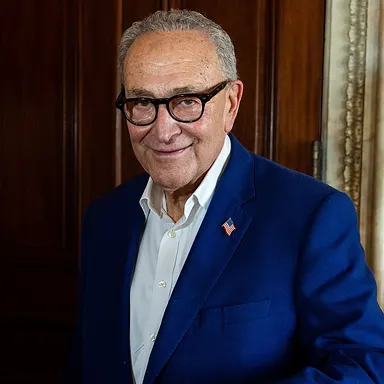
Recorded days after the midterm elections, this episode features an interview with Senate Minority Leader Chuck Schumer about the Democratic comeback that is poised to give the party a Senate majority. Schumer credits a focus on costs, corruption and chaos, along with recruiting candidates in swing and redder states, for the results.
The conversation covers his plans to investigate the Trump administration, pass legislation to lower health care, housing, gas and grocery costs, and his bid to lead the new majority. Listeners will also hear his views on the filibuster, the party's image problems, and how he will measure success.
These assessments are Schumer's own, and the episode presents them as his perspective.
In this episode Michael Barbaro, Chuck Schumer
This episode's transcript, covering Chuck Schumer's plans to govern with or without Trump, was made with HappyScribe's technology to convert video to text.
Ads in this audio differ from the text. Tap the sentence you're hearing to follow along.
Synced: the text now follows the audio.
What's amazing about the Neo frame is, like, if you look at it, it's actually easier to read than any other watch out there.
100% is. This one, to me, is that. It's a very classy piece, it's very sleek.
I was just sitting here, you know, kind of thinking while you were speaking, like, the 1920s, that's 100 years ago, right? 1929 or ish. And that looks effectively the same as the one from 1929.
Listen to Reframers from Automobile Brigade now, on your favorite podcast platform. See, I'm excited to say that my voice got a little higher just now.
From The New York Times, I'm Michael Barbaro. This is The Daily.
Hello. We've met before.
Hi, Michael.
Senator.
Let's see.
On Thursday afternoon, my colleagues and I traveled to Washington, D.C., to meet with the Senate Minority Leader, who is now poised to become the Senate Majority Leader.
Chris, Rachel, Afim.
Afim, nice to meet you.
Who is bringing in this rather elaborate contraption.
Well, I know The New York Times is very pro-tech, so.
Exactly.
Yeah.
Yeah, we've been on quite a journey from the printing press.
Today, my conversation with Chuck Schumer about his role in Tuesday's sweeping Democratic victories, his plans to rein in President Trump, and the policy agenda that Democrats will pursue now that they're back in power. It's Friday, November 6th.
I've given you the tour of this office, right?
Yes, but it.
That's the only Norman Rockwell of Lyndon Johnson?
Um.
That is, I told you that one. When the hooligans took over the Senate, took over the Senate.
You mean January 6th?
Yeah, on January 6th.
Just describe what you're pointing to.
It's the tabulation of the electoral votes as they came in.
The certification of Joe Biden's victory.
Exactly. And the hooligans, we went. The leaders were put in a secret place. Five o'clock, we gathered, and this is McConnell and McCarthy, as well as Pelosi and me, and said, we're going back to the Capitol. We're not letting these bastards take our democracy away. The police said, don't go there, maybe people there. We went, and at 3:00 a.m., that was completed, and it certified Joe Biden as president.
They never made it. The writers never made it into this office.
Mm-hmm.
Did the writers.
They never made it here.
Make it into your office.
But one of my police guards may have saved my life. We walk out the Senate door when they invade. We make a right turn, we open another door, and we're within 30 feet of him. And one of them said, there's the big Jew, let's get him.
Wow.
And he blocked the door. I went away, and he caught up, and here we are, still here.
All right.
Okay.
Let's sit. Well, Senator, thank you for making time for us. Thank you for letting us come into your office and.
Thank you.
Outfit it with all this audio tech. We really appreciate it. I just want to start with an observation. 18 months ago, you can correct me on the math, the situation for Democrats was extraordinarily bleak. Your party was arguably in the political wilderness. You had lost the White House by a lot, lost the Senate. Democratic activists were calling for your head, arguing that you had been insufficiently combative in your approach to President Trump and the way he used power in the second term.
Today, fast forward, Democrats have regained control of both chambers, and by a lot. You have won a 54-seat majority in the Senate. It could end up being 56, depending on what happens in Mississippi and Alaska. And you are poised to be reelected the Democratic leader. That's quite a roller coaster.
Yes, it is.
I mean.
Yeah, well, look, you're right. When in January of 2025, right after we had lost the presidency, we had lost the Senate, I said we're going to take it back in 2026. And everyone rolled their eyes. Now here we are.
Mm-hmm.
It happened, really, for two reasons. The first thing we did is we focused on what the American people wanted, not what we wanted, not what someone else wanted, but what they wanted. And we focused on the three issues they cared most about: costs above all, the high cost of living; corruption, you had the most corrupt administration in, I think, in history; and chaos, chaos on the streets here, chaos at the war.
Right, you talked about this, the three C's.
Three C's, yes. And we were talking about that since a year ago, a year and a half ago. And we were relentless. The House and Senate, I worked with Hakeem on this as well.
Jeffreys.
And my North Star was winning back the Senate, and that was number one. Everything we did was focused on cost, chaos, and corruption, and relating it to people. The second thing we did, and really important, we recruited candidates in reddish and purple states. My goal has been for decades, a decade since about 2006, is to expand the map. And so we looked at states where we might win, where people never thought we'd win before. When Trump did the tariffs and it affected soybeans, we can win Iowa.
Mm-hmm.
When he fucked around with the northern border, we said we can.
We can bleep that out, Senator.
Okay, if you want. I don't care. I'm from Brooklyn, you know. We looked at Maine, and we looked at Alaska. We can win there. When Ohio went way overboard on these data centers, we said we can win there. But second, and I got to give credit here, we recruited the best candidates, not who some political leader said we want them or this. We found candidates who fit their state. And just every one of them was actually motivated by patriotism.
Every single one. So when I recruited Peltola and.
In Alaska.
And Touareg in Iowa, Sherrod in.
Ohio.
Ohio, Cooper in North Carolina, it was motivated by patriotism. Can I tell you a quick story about Sherrod?
Please.
So I flew out to Columbus three times to see Sherrod and Connie. That's his wife. She's a Pulitzer Prize winner, but they're a team.
Sherrod Brown had been out of office at this point.
He had just lost election the previous November by about three, four points.
Presumably he was retired.
Yes, he was retired. And that's just what I said to him. I said on the third visit, when they hadn't said yes yet, I said to them, Sherrod, Connie, look, you can have a great retirement. You've had a great legacy because you've had a terrific career. But if you don't run and you're the only one who can win in Ohio.
You were recruiting him.
Yes. And we lose the Senate by one vote, you're not going to enjoy your retirement that much. I was.
You were just.
I really wanted to get him to run.
You were working him over.
I was. But he's my friend, and, you know, we did it in a.
You guilt-tripped him.
We did it in a.
Into running for U.S. Senate.
In a friendly way.
Mm-hmm.
Yeah. A day later, they called up and said, we're running.
Hmm.
And, you know, I tried to recruit in places people never thought.
Like where?
Well, Scott Caloom in Mississippi. I was always eager to win in the South. We had won in Georgia two years before.
Mm-hmm.
No one thought we could do that. And Scott had been rejected by the incumbent Senator, Hyde Smith. He had been nominated to be the first African-American federal judge in Mississippi in a century. And she blocked him.
Mm-hmm.
And I went to him and said, you got to run. I actually had he and his father, I served them lunch in my house in Brooklyn. And, you know, they haven't declared his election at this point, but they're counting the votes. He's ahead by 1,700. A lot of the remaining votes are provisional ballots, which usually go Democratic. And he may make history.
Right.
And be our A seat.
You had a few misfires.
Yes.
If you're bringing up recruitment.
Yes.
You wanted Janet Mills, the governor of Maine, to be.
I did.
The nominee.
Yep.
The Democratic primary voters in Maine did not want that. Same with Haley Stevens in.
Michigan.
Michigan.
Yeah.
I mean, in the overall math, do you feel good about your recruitment, or.
Oh, yeah.
Do you have some regrets?
And look, no. I feel very regretful.
You don't even regret Haley Stevens now?
No, the bottom line is.
After she turned and endorsed Mike Rogers, Republican.
Well, look, we knew from the beginning we had to win Michigan. And Michigan hates Trump because of the tariffs and with Canada in particular, et cetera. And once Haley Stevens lost to Abdule, we put $60 million in to help Abdule. And he's very, he's very appreciative of that. We had to win Michigan. And my North Star is winning the Senate.
Okay. Let me zoom out just a little bit.
Okay.
I appreciate you talking about your very hands-on approach to recruitment, the three C's, that strategy. I want to talk about what just happened on Tuesday and how much you think the actual candidates mattered and how much of an affirmation we should think of this as for Democrats. Because every analysis I've seen of this midterm election concludes it was a referendum on Trump, his party, on tariffs, on deportations, on the war in Iran.
And let's just be really honest.
Yeah.
The Democratic Party in the weeks leading up to this election, deeply unpopular. Our polling showed only 28% of voters were satisfied with the party. My colleague put it this way: the only people less popular than President Trump are Democrats. So did you win this election, or did he lose it and you were just a receptacle? And all these candidates you recruited were a receptacle for the fury.
It's a combination. But here's the amazing thing to me. As bad as Trump was, and almost everything he did was either irrelevant to the American people's main concern, costs, or made it worse, what he did with healthcare, what he did with energy, what he did with tariffs.
Not what he did on the ACA.
Yeah. And here's the amazing thing, and it's a little bit of a slight difference in what you said. It's that the Senate Republicans embraced him.
Hmm.
And on the issues, by the way, they said, do you like the Democrats? No. Who's doing more for you on costs? Democrats. Who's doing more for you on going after corruption? Democrats. So we did create a division. Even that shutdown, which, you know, we didn't want to do on healthcare, showed who was for them on healthcare and who wasn't. So the amazing thing to me is the Senate Republicans, who are savvy people, they just follow Trump over the cliff. And I always thought the way they can deter us is break from Trump.
And they didn't.
Not until the very end, some of them.
So it's certainly Trump. The upsetness with Trump helped. It's a combination of the three. If we would have had lousy candidates, I don't think we would have won. If we wouldn't have focused on the issues, I don't think we would have won. And if Trump wasn't so bad, I don't think we would have won. You needed all three to come together.
Well, why do you think the Democratic brand is what it is? I'm asking this because, obviously, a big part of your job coming up is to fix that and to turn it around, the perception. Obviously, winning the midterm is an important first step. But why do you think the Democratic Party's brand is as bad as it is? And let me offer you a few possibilities. I mean, you have, under President Biden, under Kamala Harris, under you, growing unpopularity of Democrats' approach to the border, to illegal immigration, to the approach you all took on social issues, trans rights, DEI, so on, which was a big priority under the Biden administration.
So when you look back at all of that, just as a starting point, do you wish you all had done things differently? Do you accept that the party really erred?
I would hang my I would try to address the words, what about moving forward?
But wait.
Well, because we didn't do it right. But this year, it's.
That's important. We didn't do it right.
Right. But this year, we've done it much right. You don't hear the same thing. I don't.
No, the three C's are very different. Cost, chaos, and corruption are very different.
And debating what people wanted.
And decriminalizing the.
Instead of.
Illegal immigration and talking about.
And look, they.
Diversity.
What they used this year. They couldn't use defunding the police because I don't think any of our candidates said that this time. But the one thing they did try, because they always pull in their horrible things out of their hat, was.
Who's they in that sense?
Was trans.
You're talking about they being Republicans.
Yeah, yeah, yeah. Trans operations. And our candidates rebutted it in each in his own way, and it didn't hold.
I think this is important. You're saying there was an error in emphasis, and to some degree in policy, that preceded this decline in the Democratic Party's reputation. And you sought to change that in this cycle.
What we had to do, above all, is not play on their field, but let them play on our field.
I mean, arguably, they were playing on your field. Maybe they were exaggerating it, but they were playing with a field that Democrats had created.
No, but what I'm saying here is we shouldn't spend our time responding to them and all of that. We should spend most of our time on what people want. And that's what we did in these two years that was probably different than in '23, '24.
Mm-hmm.
Okay? You know, the political climate was much different now.
Yes. So I think that brings us back to the strategy you adopted.
Mm-hmm.
In this election and the candidates you picked. Let's talk about, broadly, the candidates you both recruited and then ultimately won. And how you think about them and their success and whether it was about them. How do you describe these candidates who won? Because they're ideologically speaking, they're not all the same.
No.
But they have some commonalities.
Exactly. You're very.
In a couple of minutes.
Nail on the head. Yeah, you're good at this. The advantage was each candidate spoke to cost, chaos, and corruption, but each candidate spoke in their own way. So you don't talk about it the same way in Maine as you do in Kansas. But what did happen is there was a broad theme of these three things resonating from one end of the country to the other. And it sort of magnified each other.
Give me an example of what you're talking about.
Well, okay. You look in Michigan, they hated the tariffs because of automobiles.
Mm-hmm.
In Kansas, they hated the tariffs because of what it did to soybeans. And different states took different approaches. We didn't say there was one size that fits all. But the three issues just resonated. And our candidates, when I interviewed them, were all for these things.
Is what you're saying that there is a real consensus among Democrats right now about policy and strategy if ultimately you're.
Here's our strategy is simple. This job has just begun. If we don't deliver, we're going to be screwed.
But are you talking about a commonality in style and message or an actual commonality in.
It's really getting things done for people, fulfilling our promises. And if we can deliver, not on everything, but on some things, it's going to make a huge difference. And we can, you know, my goal is to expand the map because I want a durable majority.
We're going to get to the policy, but I just want to be clear on this.
Okay.
For example, there's a Talarico and then there's an Abdul El-Sayed.
Yeah.
People perceive those two as being pretty different. Are you saying, actually, they're not very different when it comes.
On the policy, on cost, chaos, and corruption, they're quite the same.
And elsewhere they may have differences.
Yeah.
But on the core.
Yeah.
Okay.
I was doing the Morning Joe. Am I allowed to mention a competitor?
Of course you are.
Thank you. I was on the Morning Joe Show in the waiting room. And right before me were two Democrats who had just won, Cory Booker, progressive, New Jersey, and Hamilton, a moderate from Kansas. And when you heard them answer the questions sitting next to each other, they were remarkably similar answers when it came to cost, chaos, and corruption. There's not that great a divide on that wing in the party. And we ought to spend our time working with each other, not shooting at each other.
That's the way to beat Trump, beat the Republicans, and expand our majority.
We'll be right back.
I think Singapore has a can-do attitude. Oh, yes, let's try this. Let's try that. We have a lot more support here and a lot of respect in the working culture.
Because it is such a great hub and access to the region, I think that Singapore could be for everyone.
Can everyone thrive in Singapore? Professionals discuss if the city is a good fit for expats. Watch the video at nytimes.com/singapore-ready.
Hey, it's Vaughn Rieland from New York Times Cooking. Colder weather is here, and I'm no meteorologist, but I think the forecast says you should bake with us.
Almost any cake can be turned into a one-bowl cake.
There's nothing better than a freshly baked croissant from my oven.
Oh, my God. I could eat five billion of these.
That is a brownie. They look so chocolatey and delicious.
Don't be afraid. This is so forgiving.
These are deluxe cookies.
Do you guys want to try this?
Bake with New York Times Cooking this season. Find all the recipes at nycooking.com. Subscribe now for a limited-time offer.
Let's bring ourselves to the present moment. Democratic Senate majority now exists. It needs a leader, has to make a lot of decisions about how to use its power in Congress. And let me put this very simply to you. Do you expect to face any kind of challenge in the election for Senate majority leader?
No.
You do not?
No. I mean, look, our caucus is focused on now moving forward. Everyone's very happy with what we all did unified in the last two years. But the focus has to be, as I said before, and I'll say it again and again to my caucus, to the country, to everybody, if we don't deliver, all this will go away. This is just the first step. But I think we're united together to do that.
Do you think it's good that there's no one running against you? And let me just put this in perspective. I've covered you for a long time. You have been in the Congress, in the Senate for 27 years. I say this with lots of respect. You're 75 years old. You're about to be 76.
I feel a little younger than that.
Later in the month. Happy almost birthday. What responsibility do you feel to make way for younger leaders in the party?
When I say I'm the leader, I'm sort of the conductor. You know, we make sure we stay on the same tune. But there's talented oboist, and they should be highlighted on their things. There's talented drummer, they should be highlighted. So you got to try to make it into one tune, but let everybody shine. Because I am so impressed, really, almost out of breath impressed by how good these people are. And now we have to make sure their talents can be used productively. That's a very important part of my it always has been an important part of my job as leader, but now more so than ever.
Let me ask you one more, no doubt slightly uncomfortable question because.
Okay.
People are interested in this.
That's your job, as they say.
You're up for reelection in two years. Does running for majority leader, the intent of which you just established, mean you're running for reelection for a sixth term?
No.
Almost why it doesn't mean that.
It means simply what I'm thinking of now as leader is focused on 2027, delivering what we promised.
The agenda for the first year of the majority in the Senate.
Yes. Delivering it, creating unity, helping these new younger members, talents shine. I mean, look at Ossoff.
But you've established no time left.
Ossoff came later. I worked with him. He's great. I was like a little bit of a teacher for him. The student has surpassed the teacher.
I only ask this question because I think there's fascination in succession. There's a lot of interest in how old the Congress is and whether or not folks are making room for the next generation. And that's why I'm pushing you on that.
Yeah, it's the talent. If you look at our people, you know.
But you are sidestepping me. Are you going to be running for reelection?
I'm focused on 2027.
I'm going to let you give that answer if you don't want to answer my question, but I will note for the record that you didn't answer my question.
That's okay. That's what you're I'm used to that.
Let's turn to your agenda and what you think your mandate is now that you have this majority and presumably will be its leader.
Yes.
How much is it reigning in Trump? That seemed to be a huge message from this midterm. How much of it is investigating his administration? And how much do you think voters want you all to focus on that?
Okay, good question. I've thought a lot about it.
I assume you have.
First, start off with the premise. This is the most I'm going to curse again because I'm so angry at this guy.
Okay.
He is the most fucking corrupt, not only president, but leader in America we have ever had. That slush fund?
You're talking about the fund for those who were, in his mind, the victim of government weaponization.
But it's not just them. It's his own pocket. He's president, but he sues the government for $10 billion for defamation as a citizen. Then, as president, he shakes hands and settles and gives himself $2 billion. Some of it would go to those people, but some of it is going to end up in his pocket. It's outrageous. So we cannot just turn away and say we're not investigating it. So we have to look into the most egregious examples of corruption and of going against his bad people. I would be for them kicking Hegseth out tomorrow.
You would be for him kicking Hegseth out tomorrow. In your mind, Hegseth should be.
And impeaching him. Yes.
Should be fired and impeached.
Yes. Okay. But number one, costs. The corruption is important, but cost is number one, meaning focus on reducing the cost for the American people and doing some if we just did corruption, we'd be a loser. If we didn't do any corruption.
Well, I'm glad you raised that because in my mind.
You got to do some, but not let it overshadow and take away what we can do on the ground.
Democrats impeached President Trump twice in the first term. That, in combination with the prosecutions of him in the period between his presidencies, seem to only fuel his and Republicans' popularity. You're saying, though, that you think Democrats can walk and chew gum. They can work to lower costs and investigate the president. Do you want to see him impeached?
That's going to be up to the House. I'm not going to prejudge them.
I don't see you as the man who just cursed at him and called him the most corrupt president in American history. I don't see you sounding averse to the possibility.
Let's see what the House does.
Okay. I almost think I know the answer to this because the tone of your relationship with him seems clear. But have you spoken with the president in the past few days since the midterms? Have you called him as he called you?
No. Thun has called me.
If he calls you, will you take it?
Of course I'll take the call. I'll listen to him. But look, the bottom line is I've said this to my caucus members, okay? We are going to push our agenda, what we believe in, with him or without him. He's, in a certain sense, irrelevant to us. No matter what he does, we're going forward. If he joins us, I doubt he will. Great. If he doesn't, we're still moving forward.
With legislation that he may veto.
He may veto it. And if he vetoes it, it will show the divisions, you know, as much as we didn't want to shut down. When we shut down the government for a month over health care, people knew we were on their side.
Right. We talked to you about that shutdown.
Yeah, you did. Same thing here, okay?
That sounds like potentially a winning argument politically. But if you want to lower costs, if you want affordable care acts subsidies to be restored, if you want life to be more affordable, you're going to have to legislate in a way that the president would sign a law.
I don't trust this guy. I don't think he will. But if he does, great. I don't think he will.
If he doesn't, how do you lower costs?
Take the Affordable Care Act.
The subsidies.
I think we're going to get Republicans who voted no in the past and saw how badly it affected their states and their electoral prospects. There are 15 or 20 Republicans who are Trump acolytes. Anything he does, they do it. And then there are two or three who had the courage to resist him, Tillis, who lost his job, Cornyn, who lost his job because of Trump. But most of them really dislike him, but have been afraid to buck him. But this election should be the handwriting on the wall. You don't buck them.
Should be. But are you hearing these lawmakers say that they will cross party lines and work with you on legislation to lower costs on housing gas?
We will see. They're never so definitive. But yes, I am getting initial signs that way on certain issues, not on every issue.
What piece of legislation do you want to see get passed, no matter what the president does or doesn't do with it, no matter whether Republicans join you to get to 60 votes or not?
If I have my one wish.
On costs.
Oh, on costs.
Well, good. Start with your wish, but then let's get.
My one wish is that we undo Citizens United and the horrible amount of money in politics. And if we could get Republicans and Trump, you know, this is just a wish.
But law that overrides the Supreme Court decision.
It doesn't override it. There are ways to curb it in line with the Supreme Court decision. And it relates to costs. The things are intertwined more than, you know, people might think.
That's a somewhat abstract argument for the average American, getting rid of money in politics, lowering their costs. When it comes to lowering costs legislatively, do you want to see rat-a-tat-tat that you guys with a huge House majority in the Senate?
We laid out five areas that we want to go after. They were health care, electric costs, groceries, and tariffs related to the tariffs and how much you pay, child care, and housing. Those five.
Are these subsidies?
There are four or five points under each, but things we would do to lower the costs on each of them.
Are you going to try to legislatively get rid of the president's tariffs?
Yes, and we can.
You think you can?
Well, he can veto it, but yes. And I think we'll get good Republican support for that.
How do you deal with gas prices? The number one issue.
End the fucking war.
How do you end the war?
Well, power the purse.
You deprive the Department of Defense of the money required to conduct the war.
Right. The founding fathers gave the power of the purse to the Congress to stop the president from wars that the public didn't want. I think that was in the Federalist Papers somewhere or other.
Congress has continued to fund the war.
We needed five Republican votes. We got three, then four. We'll get more now.
You will. And you think you can bring this order in that way?
Well, we hope so.
Okay. So we covered health care. We covered gas. Are you going to do anything on housing?
Yes. We're going to do more in terms of both making it easier to build housing. And we realize you got to figure out new ways for cheaper housing to build it quicker and easier. And we have some proposals on that.
You're going to try all these things, Senator Schumer. But if Trump scuttles them, if he rejects them, if he vetoes them, if Republicans don't give you the votes to override them, you're going to be held responsible. I believe the words you used.
Well, the bottom line is that this year, when we fought hard, people saw it. Look, when you have an overweening president, the founding fathers, the Federalist Papers, you know, when they were worried about a king, this guy's like a king. The first way was the Congress to stop them. With the Republicans in charge, they didn't. The second way was the voters, and the voters did. And if Trump blocks everything and we are clear and united and relentless, we don't just do it once and go home.
Then voters will see you fighting.
Correct. And 2028, we get the trifecta, and we can do a lot. I'd much prefer to get it done now, but we will keep at it. And I believe it will hurt the Republicans even worse. If they keep doing those things.
You will win the White House.
The night of 2026 elections look like a good night to them compared to what will happen in 2028.
If they keep fighting you tooth and nail.
Right. On the things people do.
And ways that are unpopular in your mind.
Yes, yes, yes.
They will lose the White House on a scale even more meaningful than they lost these midterms.
I don't want to call it a win-win because I'd like to do things that people are in such anguish.
You win either way.
But you could put it that way.
Huh. I hadn't thought of it that way. I don't think a lot of voters will see it that way, though.
Well, they may not now, but we'll make those arguments.
How much do you feel this burden? And let me just frame the burden for you. Trump ran as the America First President.
Yeah.
And in two elections, a lot of Americans believed he was the America First President. On Tuesday night, the coalition behind him began to collapse.
Yes.
And the question for so many voters is, are Democrats here to simply slow and try to stop the president or to genuinely replace that broken vision now?
Yes. And I think people are beginning to believe in it. And I think the election showed that people are willing to take a gander on us for that. But I would also say, if we don't produce, then we could lose it all. But it's not the lack of where we want to go. We've made that clear. The key for me is getting it done. And it's not easy, but I'm a legislator and I'm somebody who fights, fights, fights. That's the Brooklyn in me. And we got to get it done.
There's something I wish I'd asked you earlier. When I interviewed James Talarico, still candidate, not yet winner, he said.
There's an example of such a great candidate who's going to help us keep Texas Democratic, I think.
He would like the legislative filibuster to go away because, in his mind, in many Democrats' mind, the filibuster prevents the ability of even a majority of, say, you get 56, from being able to get its will accomplished. If you get rid of the filibuster, you don't need 60 votes. The obvious risk is that the other side gets that and passes the Save America Act, does things you don't want around elections. Have you given deep thought to this question? Several of the incoming freshmen in your caucus will want the filibuster to go away.
Some want it, some don't want it. But I would say this. Our focus has to be on reducing costs, and we'll see the best and quickest way to go.
The best and quickest way. If that means ending the filibuster, are you even open to it?
What I would say is I'm looking at everything through the prism of succeeding on our cost issue, as well as chaos and corruption.
Let me just ask a final question here. What metrics do you think we should judge you by in the next year, in the next year and a half? What metrics will you be judging yourself by when it comes to accomplishing what you and this new Democratic majority?
First and foremost, getting some real accomplishments on cost, chaos, and corruption. Second, keeping our caucus, our Democratic Senate caucus, which has so much talent, making sure those talents are highlighted, but also keeping us unified.
I didn't hear specifics, though. And I imagine you have them in your head when I asked you how you will measure yourself. Is there a cost? Is there a gas price? Is there a I'm not trying to do this to be clever.
No, I know you're not, but it's a question that you can't really answer at the moment. We'll know over the next few months. And you got to know, is there a war? Is there not a war? You know, so look, you fight hard, you get things done, and you know the people are going to be the ultimate judge, not me or not you. And we want to show the people that we have made their lives better and actually make it better. And I am given the success we had on election night because of two years of hard work, because my North Star was always winning back the Senate.
Everything I did is seen through that prison. It worked. But now there's a new prison, Produce.
Well, Senator, as always, thank you. And I should just point out for the listener that somehow, mysteriously, this fire that was not started, that went out when we got here, I don't believe it to be any kind of metaphor, but it is roaring now next to us, producing a lot of heat and a lot of sound.
It is a metaphor.
For?
For our success.
Well, Senator, I always appreciate your time and your candor. I did not expect the profanity, but it is what it is.
You know, I'm from Brooklyn. I always used to have to I wanted to say those words, but I couldn't. And the world's changed for the better. You know, if you want to say them, you can. And it doesn't offend people the way it used to.
Yeah. It's a little bit maybe 16 Pennsylvania rubbing off on the Capitol.
I hope not. I hope not much rubs off out of there.
Thank you again.
Take care.
On Thursday night, The Times reported that an analysis of outstanding ballots in the Alaska Senate race showed that the Democratic candidate, Mary Peltola, is on track to win that election. Meanwhile, the latest count in Mississippi showed the Democratic candidate for Senate there, Scott Caloum, with a lead of 1,800 votes. If both Democrats are declared winners, it would give Schumer and his party a 56-seat majority in the U.S.
Senate. We'll be right back.
Hey, it's Anna Martin from The New York Times. What if I told you you'll never have to hear this line again?
Wherever you get your podcasts.
Yeah, no, I actually can't tell you that. But you know what I can tell you? A place I think you might want to go. It's the Shows tab in The New York Times app, the place to listen to and now watch full episodes of New York Times shows. The Shows tab. Find it in The New York Times app. Explore the Shows tab and follow a show today.
Here's what else you need to another day. As vote counting from Tuesday's election continued, the Democratic House majority surged past 250 seats, its biggest majority in nearly two decades. One of the latest Democratic victories declared on Thursday was in bright red Montana, where Sam Forstag won a seat long held by Republicans by running on a pro-Labor message that earned him an endorsement from Senator Bernie Sanders. And the U.S.
stock market suffered its worst day in nearly two years on Thursday, as Democratic victories in Congress raised fears about new regulations on artificial intelligence and as investors balked at the growing debt levels at big tech companies. The stock market sell-off erased trillions of dollars of value from some of the country's biggest tech companies, including Nvidia, Meta, and Amazon. Today's episode was produced by Asta Chatterjee, Chris Benderive, Eric Krupke, and Afim Shapiro.
It was edited by Rachel Quester, with help from Paige Cowett and Liz O'Balin. Contains music by Dan Powell, Marian Lozano, and Alicia Baitu, and was engineered by Chris Wood. Our theme music is by Wonderly. That's it for The Daily. I'm Michael Boularo. See you on Sunday.
This week on the Wire Cutter Show, you don't need to be afraid of a pressure cooker.
We are in the second generation phase of stovetop pressure cookers. So if you walk away and you leave it over too high of a heat, it's going to vent itself.
We're talking about one-pot meals and all the ways to make them. Find the Wire Cutter Show on the New York Times app or wherever you like to listen.
Warning: This episode contains strong language.
Last spring, the political picture for Senator Chuck Schumer, the minority leader, was downright bleak. President Trump was back in the White House. Schumer’s Democratic caucus was largely powerless to stop him. And restless Democratic activists were calling for Schumer to resign.
Fast forward to this week. Democrats have roared back to power in both the Senate, where the party flipped seven Republican seats, and the House. And now Schumer, who personally recruited several of the winning candidates, is poised to become the next Senate majority leader with an unambiguous goal: reining in Trump.
On Thursday afternoon, I visited Schumer’s office in the U.S. Capitol to talk about all of that during a 45-minute interview. In between profanity-laced descriptions of the president, Schumer laid out his plans for Senate Democrats over the next two years, including investigations into the Trump administration and legislation seeking to lower Americans’ cost of living.
Guest: Chuck Schumer, the Senate Minority leader.
Photo: Alex Kent/The New York Times
For more information on today’s episode, visit nytimes.com/thedaily. Transcripts of each episode will be made available by the next workday.
For more information on today’s episode, visit nytimes.com/thedaily. Transcripts of each episode will be made available by the next workday.
Subscribe today at nytimes.com/podcasts or on Apple Podcasts, Spotify and Amazon Music. You can also subscribe via your favorite podcast app here https://www.nytimes.com/activate-access/audio?source=podcatcher. For more podcasts and narrated articles, download The New York Times app at nytimes.com/app.
Hosted by Simplecast, an AdsWizz company. See pcm.adswizz.com for information about our collection and use of personal data for advertising.