
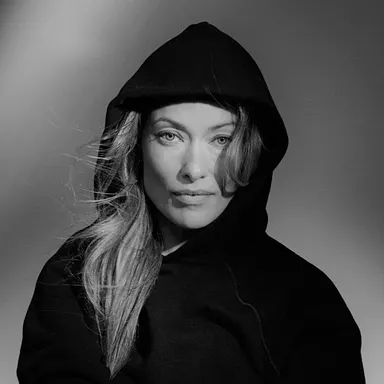
In this episode, David Marquezi talks with actor-director Olivia Wilde about her comedy The Invite, a film about a strained marriage, and how she has rebuilt her career after the difficult period surrounding Don't Worry Darling. Wilde discusses turning 40, the stress of pivoting from acting to directing, and why she believes creating your own roles matters.
She reflects on shame, regret and co-parenting after her separation, and on the tabloid attention around Don't Worry Darling, which she attributes partly to media habits and partly to sexism. Listeners also hear her views on Hitchcock, auteur theory and the collective nature of filmmaking.
In this episode David Marquezi, Olivia Wilde
This transcript of Olivia Wilde's conversation about The Invite and her comeback was made with HappyScribe technology, the same technology behind its note taker for online meetings.
Ads in this audio differ from the text. Tap the sentence you're hearing to follow along.
Synced: the text now follows the audio.
You know, I used to go around being like, "I don't have any regrets." I regret nothing. And it's like.
You get to a point where you're like, "Yeah, I regret things."
I'm David Marquezi, and today I'm in London to talk to Olivia Wilde. Wilde is having a big year. The invite, the third movie she's directed, is a grown-up comedy about a couple on the rocks and their sexy neighbors upstairs.
I think that in a relationship, it is not the aggressive rage. It is the indifference that is truly terrifying.
The movie is funny, sharp, and affecting, and it feels like a reset after Wilde's previous film, Don't Worry Darling, generated a ton of tabloid attention.
I think that every story needs a villain. And I was cast as said villain.
She had recently split from her longtime partner, Jason Sudeikis, and was then in a relationship with Harry Styles, who also starred in Don't Worry Darling. Four years later, Wilde has not only pushed past all that with The Invite, she's also delivered memorable roles in two other films. Director Gregg Arakis' I Want Your Sex.
As a younger actress, you don't think that you're going to turn 40 and play a dominatrix.
And the upcoming Behemoth. So how did Wilde not only survive an extremely difficult career moment, but also come out stronger from it?
It is by far the most difficult, painful decision I've ever made in my life.
Here's my conversation with Olivia Wilde. Olivia, hi.
Hi.
Thank you for being here.
Oh, my pleasure.
I just want to say, at the beginning, earlier today, when we were setting up, the very lovely crew were debating whether or not the couple at the end of The Invite stayed together or not.
I love that they were. That's great. That's my favorite argument to hear about.
Wait, so they did, right?
Oh, interesting.
No, the couple stayed together.
But it's interesting that that's your position?
Yeah. Yeah, yeah.
I will tell you, when we shot the film, I felt very strongly that they did not stay together. And Seth had the opposite opinion. He was sure that they stayed together forever. And as we've now watched the film with a few, a bunch of audiences, I've started to actually shift. Like, my feeling about the story has been affected by the conversations I've had with audiences afterwards, where I'm like, "Wait, you're, you know, you might be right. There's hope for them."
I think I've just kind of softened.
But I really like a happy ending. So can you please confirm for me that they.
Oh, yes, they stay together forever and ever and ever. They should make it work. They can make it work.
Yeah. You know, I was also thinking about the three roles you played this year. And in The Invite and I Want Your Sex and Behemoth, which I just saw last week.
Oh, great.
And all the characters, to me, were very, they're like kind of very tightly wound in a way.
Yes.
And I just wondered if now being a director changed how you saw yourself as an actor or like what.
Yeah.
Yeah, so tell me about that. How so?
I think that being a director freed me up to not feel this kind of pressure to be the ideal ingenue growing into the idealized female character in any film. As an actress, I felt, I think, probably wary of playing characters who could be thought of as kind of undesirable, unlikable.
And then something about not needing acting to be my profession, but rather doing it for fun because my job very much feels like it is directing. I think that now I choose roles from a much more curious place of a playful place that is allowing me to play people who I think I'm not overly concerned with whether they are someone I would necessarily want to be. But you're so right.
I hadn't put together that these three characters are like extremely high-strung in different ways.
Yeah.
My character in I Want Your Sex sort of felt like she was on the opposite end of the spectrum of femininity as my character in The Invite. And they're both movies dealing with the idea of sex and sexuality and desire and eroticism from two completely different perspectives. But you're not wrong that they are both pretty uptight.
Why do you think it is that you're interested in exploring questions of sex and identity at this point in your life?
I think, you know, it's funny. I turned 40 a couple of years ago now. I'm 42. But when I turned 40, I suddenly was, I felt more kind of present in my body and more connected to my sense of confidence and sexuality than ever. And I think I.
What do you think it was about turning 40? Because I mean, there's something arbitrary about that, right?
There is completely, it's completely arbitrary. You're 40, so things have kind of, we were at least told for a long time that that's when things start closing in, shutting down, less is available to you in terms of your career, in terms of your exploration of your own identity, sexuality certainly. And yet every woman I know from like 40 to 70 has told me my entire life like, "Oh, no, that's when you really understand yourself. You're so much more honest with yourself."
And there's a like really awesome blossoming that happens at that point. So I think I was curious about that. And then I was like, "Well, I want to find a bunch of stories that are maybe inspecting that in different ways." And particularly comedies, because it's good to laugh at this stuff.
Yeah. I mean, also, there is something we don't really think about it this way, but there is something often like inherently funny about sex.
Oh, completely. That was hilarious. I think there's something funny about everything that we don't talk about. I think there's something really funny about stress. People white-knuckling things in life. I remember when we made Book Smart, I found it so funny to remember, to reconnect with the stress we felt in high school about what we had accomplished and, you know, where we were going to go to school and what we had done.
And like the intensity of that stress is very funny to me now. And I think that that was a big part of The Invite as well. The idea of like high stakes in a low stakes situation really makes me laugh.
Yeah.
High emotional stakes.
You know, so Book Smart was the first film you directed.
Yes.
And you know, for people who haven't seen it, it's about these two friends who are girls in high school and kind of they're sort of wrestling with expectations about how girls are supposed to behave or what they're supposed to want.
Yes, yes.
And what do you think those girls would make of Angela from The Invite?
Yeah.
Because it seems to me like Angela is sort of, you know, like I said, high-strung and maybe overly concerned with projecting a certain kind of like competence or like social awareness or prowess. It's like exactly who the girls from Book Smart don't want to be.
Yes, yes. I love that. I think they'd be really disappointed in her for giving up her career for marriage and kids. Even though she doesn't really think that she did it for those reasons. It's a slow kind of erosion of self that happens through the sense of duty. And, you know, she has subtly kind of assigned responsibility for that erosion to her husband. But really, it was a decision Angela made on her own to sacrifice her own dreams as an artist.
And I think the girls, Molly and Amy from Book Smart, would be horrified by that. I think that they never could imagine that they'd be capable of that. But of course, they'll get older and confront what a lot of people do, which is this kind of negotiation one goes through at a certain point in life where they feel they must make sacrifices and they must choose. And there is this sense of what you're supposed to do. And it happens so slowly.
It's a bit of the frog and boiling water concept. It's a slow realization that you have given something up and you're not even quite sure when or how.
Have you gone through that?
I didn't go through a sudden realization of like, "Oh my God, what have I given up?" But I certainly have pivoted. So specifically, at 35, I started directing movies. And it did feel like I was suddenly turning the ship in a different direction. And the panic of, you know, I studied acting. I didn't go to film school. So I had a lot of insecurity about that lack of traditional education. And I felt that it would be fraudulent to do that.
I couldn't possibly. But the anxiety that everyone confronts when they consider pivoting is about this sense of, "But am I allowed to do this? Do I have permission?" There's that great Nora Efron commencement speech where she says, "Just remember, you can always change your mind."
"Don't be frightened. You can always change your mind. I know. I've had four careers and three husbands."
And I remember being so liberated by that one comment. It's very true.
Trying something different and the potential risks of that can be very scary. I just think not everyone is comfortable making that leap.
When did we decide that you had to figure out your whole identity by 24?
Yeah.
Like, pick your partner, pick your career, pick your identity. And if you change, it's a little bit suspicious. It's a little bit, a little chaotic. I mean, what would people do with their lives if they felt like they were allowed to change careers and change, you know, versions of themselves?
Yeah.
Past college.
You know, I can find myself thinking skeptically about the idea of change. You know, in the abstract, it can be easy to say like, you know, "I need a change," or "we in a relationship need a change."
Yeah.
But then you're like, "Where is the line between, you know, selfishness and making changes that also like other people can adapt to?" Do you know what I mean?
I do, except that we can't deny we are changing. You are changing.
Yeah.
So it's not a decision to change. It's a decision to acknowledge the change.
Yeah.
Like in a relationship, you're not saying like, "Now I'm going to allow for my partner to change and I'm going to, it's okay if that happens. I will love you if you change." No, they're changing. You're changing. It's the acknowledgment of that and the awareness of that you can either embrace or resist.
Yeah, yeah. I was thinking like if I showed up at my house on Monday, it's like I'm like a leather jacket guy now. Everyone gets used to it.
Get used to it. This is the new me.
Yeah.
I'm leather jacket Dave now. I think that it's funny. Like, you know, in school, every year you start a new school year and you're like, "I'm going to be different this year."
Yeah.
This is the new, my new look. Different music, different vibe. And there's this excitement of that creation and exploration of identity. I don't know why we stop allowing it.
Yeah.
It becomes something we don't like. We don't trust it.
And I think, you know, just to try and tie some of this into The Invite, there was, you know, that movie does such a good job of acknowledging kind of like the ebb and flow of dynamics within a relationship.
Yeah.
And, you know, how someone could have a, you know, a desire for more or just a desire for different needs. But I want to know for you, like what were the aspects of the film specifically to do with relationship dynamics that you felt most connected to?
Oh my God. I mean, I think that the kind of resistance to changing your life because of how it will affect others.
Yeah.
And the pain of that. I think also just the difficulty of relationships because like it's fucking hard. It's impossible. I'm going to try to link lives and cohabitate with somebody over a long period of time and co-pilot this life and this child if you have one or many. And I think people are eager to release some of that shame and laugh at the ways that it is just obviously really difficult.
I mean, the movie is obviously heavily influenced by Mike Nichols and Who's Afraid of Virginia Woolf. And one thing I love so much about that play in that movie is George and Martha.
Georgie boy didn't have that stuff. Maybe he didn't have it in him.
Stop it, Martha.
Like hell I will.
They fight and they fight, but they are so codependent. They follow each other around the house. They won't be in separate rooms. They want to be really near each other. And it is a funny thing. It kind of reminds me of my kids. My kids are bicker and bicker, but they love each other.
Oh my God, yeah.
Like they don't, they hate when one of them goes away even for a sleepover. They get like really sad. And I think that in a relationship, once people reach contempt, it is not the aggressive rage. It is the indifference that is truly terrifying. That is the sign that you may be beyond repair. I mean, these are all things that I've experienced at different points in my life. And I felt like, man, what's the point of going through all this stuff if not to be able to tell a great story about it and to help other people feel a little bit less alone in it?
You had referred to shame a second ago.
Sure.
What have you felt shame about in your life?
I mean, it feels like a failure when you can't make a relationship work, particularly if it's with the person you have children with. You know, I think we talk about a lot of different things in the film that are kind of, you know, racy in different ways. I think the most subversive part of the movie is a moment where Penelope's character says, "You think you're doing something noble by staying together for your children as if they don't notice, as if they don't feel this anxiety that they're marinating in."
And I think that it is by far the most difficult, painful decision I've ever made in my life to understand that it was not better for my kids to live in a house where their parents were not aligned. My parents are still together and have an incredible relationship. They worked together for many years. They're both journalists. And I always thought that would be me.
And I think the shame also comes from that when you feel like you haven't, you know, nailed this thing that we're supposed to nail. We're told like if you're good at it, you'll stay with someone forever. As if it's like, and if you're not so good, if you're like, you won't, it's a little bit of a disappointment.
Yeah, I know. The idea of, you know, needing to stay together for the kids is obviously like a hugely sympathetic one and a common one. But, you know, my parents divorced when I was very, very young.
How young?
I was four or five.
Wow.
My brother's two years older.
Wow.
I think I can't, like I cannot imagine a world in which those two, like my mother and father, had stayed together. It was clearly the right decision, you know? But I'm sure, particularly from my mother, like incredibly fraught.
Very, very brave.
Yeah.
I think that I really take pride in how good we are at co-parenting our kids in my family because we have reached this really healthy equilibrium. It's so hard. Anyone who pretends like it's easy and like, "Oh, you just like consciously uncouple and then you find a way." And like, "Oh, it's, that's bullshit. It's so hard."
Yeah.
And yet, man, I feel so relieved that I'm able to give them a life with parents where there's a real sense of authenticity in terms of how everyone's feeling and how everyone's doing. I think what happens is when you're trying to hide it from your kids, obviously they sense it.
Yeah.
They're the most intuitive people in the house. And then people start to feel this sense of like, "What is real?" Because I can tell that something's being performed for me, but I can sense it's not real. And that I don't, I wouldn't wish that on anyone.
I want to ask a question about your character in I Want Your Sex. And I had read somewhere that, you know, so she's sort of like this art world provocateur.
Yeah.
And seems like very confident about herself and is like a force to be reckoned with.
Yeah.
And I had read that for your performance, you drew on aspects of it from Madonna.
Yeah.
In the Truth or Dare documentary.
Yes.
Can you tell me more specifically?
Most incredible documentary. I think it's my favorite music doc. It's so great. There's the famous scene where I think she was in Toronto performing and they were told right before the show that if she performed one lewd act, which was just a part of her performance, that they would shut the show down and it would be this huge problem. Oh, no, they said they'll arrest her. And she's like, "Great, put me in jail."
All you have to do is go out there and tell them, "I am not changing my show. I am an artist and this is how I choose to express myself."
There's this kind of like complete fearlessness.
Yeah. I mean, she knew she was on camera, right?
She did. She knows her power. And I think that was exactly how it related to Erica Tracy, the character from the film. There was, it's this awareness of one's ability to provoke and a fearlessness to do so. I think for the character in the film and not Madonna, the character in the film was a narcissist. And it's a, there's an almost sociopathic tendency to see what she can manipulate others into doing.
I found that kind of terrifying and fascinating. I also, I appreciated being able to be really kind of just very comfortable in my body in that film in a way that I knew was, you know, something that just. As a younger actress, you don't think that you're going to turn 40 and play a dominatrix.
That's the second time in this interview you've referred to getting older and feeling comfort in your body.
Yeah.
When, so there were periods, I guess, earlier in your life when you felt a lot of discomfort in your body.
Sure. Yeah. And I feel like it's been a pretty smooth kind of exponential evolution towards being comfortable. I think having kids made me feel more comfortable in my body. Again, there's a lie we're told to like, and then you have kids and you're done and just put you at the pasture and like shoot you in the head because your body means nothing. It is the opposite. Once you're aware of what you're capable of in having kids, I think suddenly you're like, "Wait a minute, am I a superhero?
Like this is insane. What else can I do?" And then watching your body repair itself from this insane endeavor of making a human, and then you're like, "Wow, respect." I mean, I had my first kid at 30 and then 32, and then so it's been 10 years and I feel like I've just become more and more comfortable. And I don't know, I mean, I think that it is the part of me that is contrarian. It's like, "Tell me I'm not supposed to do that thing at that time." And it is inherently what I will veer towards.
Not to suggest I'm like, "I'm so punk rock." Like I'm obviously not, but I think that there's.
Obviously not.
Clearly not. But I think that there's, I like the dare to do something that's sort of like, it's not done. That's not something we do. And it's like, "All right, well, watch me."
Obviously, the last time you were making the big press rounds was for Don't Worry Darling.
Yes.
And that whole thing kind of like got, I don't want to say derailed, but like it got wrapped up in a lot of.
Derailed is a fair word.
Okay. Extracurricular stuff about like, you know, your personal life and like.
Sure.
You know, rumors of stuff, you know, tension on set and things like that. But in a way that seemed like, you know, from the outside, like wildly.
Disproportionate.
Disproportionate. Disproportionate. And how much of that, I mean, it's hard, you can't say it's like 17% this and 22% that, but how much of that do you think was because you were a woman and had to do with sexism?
It's interesting. I don't know. I mean, a lot of it I think has to do with where we are today in terms of a society and the way we receive information, right? Like I don't begrudge a populist who is inherently distrustful of public figures because of the way that our country has run itself into this very dangerous rut of fascism or nearing fascism.
And it's happened because we have lost track of, I think, certain skills of critical thinking, but it's been fed to us with this onslaught of information that is impossible to unwind and organize. I know that it seems crazy to kind of like take your question about like, you know, a tabloid storm and relate it to something like fascism, but, you know, I come from a family of journalists who, beyond my parents, I mean, my grandfather was a wonderful journalist who's famous for this saying, "Believe nothing until it is officially denied."
And I think that's healthy. So I didn't blame people for feeling curious about this kind of insanity of what became this media storm around that movie. What happens is when there's a lack of information people are provided with, they inherently kind of supplement, they fill the void with assumptions. Even though some of it has to do, of course, with the way the media talks about women, I think it was much, it's broader than that.
Yeah, I just want to make sure I'm understanding your argument, which is, and so you tell me if I'm getting it wrong, but your hypothesis is kind of that, you know, there would be like dribs and drabs of information, maybe inaccurate information would come out about the film, like, "Oh, there was, you know, there's a fight on set or like, you know."
Right.
And you're saying like in that absence of actual, like factual information.
Yes.
People were like, then became attracted to the story because they were filling in the blanks?
Yeah, they become storytellers. I think we all do that. And so, yes, my hypothesis is that because there was something kind of titillating and mysterious about what people felt they knew about that whole, that movie and everything around it, they created a narrative that was so far from the truth. And I think that every story needs a villain. And I was cast as said villain. And it is, it's something I don't have any sort of like rage about.
I think that it took me a few years of zooming out and thinking about lots of other things to kind of realize like, "Oh, that really had very little to do with me." And it taught me a lot. I also grew a lot from it. I'm a very different person now than I was. Anything that forces you to do a bunch of therapy and think deeply and read a bunch of books and like travel and like anything that throws you off is actually potentially very, very good for you.
How are you different?
I think that I'm way less concerned with how I am perceived. It's sort of like the saturation point. You go outside with an umbrella, but you're already wet and you're like, "I don't need this umbrella. I am already soaked."
I'm just in water now.
I'm just in water. And the umbrella would just be cumbersome. And so I think that I approach things without a real fear of being, whether or not I'll be like adored. Because like I don't, I don't know. I didn't even realize I had that before, but I did feel this kind of like heartbreak of like, "Oh, no, I've been misunderstood. It's so destabilizing." And I've lost that. There's a certain amount of vulnerability that I feel now I'm able to express in my work that before was locked away.
And so it broke me, but in a way that actually was necessary in the end.
You know, I don't want to put you in a position where I'm asking you to like unpack the worst moments of your life.
That's okay.
And yet.
That's what I do.
When you say something like, you know, "It broke me."
Sure, sure. It's a very dramatic thing to say.
Well, no, but it could, it sounds dramatic. It could also be true, but you know, earlier this year you were on Alex Cooper's podcast and.
Yes.
You talked about that moment around Don't Worry Darling. It's like when you hit rock bottom, like very few other people have had the experience that you're talking about. So can you help us understand like what is it like and what, yeah, I'm just restating the question in different ways, but like why does that make you feel broken? What is going on there?
I mean, it's interesting. You say like very few people have had the experience, maybe at that scale, but I think that I think people are going through ruptures in their life all the time. You know, for me, the real heartbreak has nothing to do with public scrutiny or anything in the media. I went through a rupture in my own life. I mean, I went through a separation that was incredibly heartbreaking.
So to go through that and then to launch, to avoid dealing with the real pain of what was happening there, to then launch into a movie in COVID, like that's an insane thing to do, to be like, "We're going to shoot this movie despite the nation being on lockdown." But privately, I was going through this really difficult thing. In terms of then, all of that personal stuff being kind of like warped and twisted and used in this public way, yeah, that's the part that's specific to this industry.
Right.
And I mean, the crazy thing is like all of that stuff, everything, I mean, that was six years ago or something, four years ago. And it is the least interesting thing about me. And yet I do find myself having to talk about it over and over again. And the annoying thing is like we could have a conversation about so many things and the pull quotes in the headlines will be about the past.
Yeah.
And that's the part that bumps me out. So that's the only part that still gets me like, "Ugh."
Yeah.
It's not the experience itself. It's like, "Oh, God."
Having to rehash it.
Having to rehash it.
Which I'm asking you to do.
Which you did, but I get it. I understand. I also think like if you're going to make a movie about relationships and pain and like identity, you kind of have to be willing to say like, "I'm not coming from a place of complete ignorance."
Right.
I have been through some shit that gives me, I think, a little bit of authority on some of these topics.
Yeah. You know, I'm thinking about your hypothesis from a second ago, and I'm sure it's correct. I also wonder if, you know, on just like a more base level, there's, you know, it's like you were dating a pop star. People since like the 1920s have, you know, been hungry for stories about like potential, you know.
Sure.
Backstage or off-screen drama in Hollywood.
Yes, yes, yes.
And like that, you know, it had the elements of the things that people like, you know, tabloid readers and tabloid makers are really into. Like maybe it was also just like sort of a more straightforward reason why people were so into it.
Yeah, I think that.
Or they'd all work together.
It all worked together. A perfect storm. I mean, it's funny. Sometimes this business reminds me of, you know, the scene in Galaxy Quest when Sigourney Weaver and Tim Allen are running down that tunnel on the spaceship with all the big slicers.
Yeah.
And Sigourney Weaver's character just goes, "This is a terribly written episode. Why is this on the spaceship?"
Right.
And sometimes this business feels like a terribly written episode.
You are living in a terribly written episode.
But then, you know, that episode ends. It was just for sweep sweep, you know? I thought I was done acting forever. I was like, "Well, that's it. I will never put myself in front of a camera."
After Don't Worry Darling?
Yeah, no, just after all the shit storm, I was like, "I'm never going, I don't want to ever be."
You'll never see me again.
Yeah. And Seth Rogen asked if I would come be on the studio. And I didn't know what the studio was going to be. I knew that Seth and Evan were brilliant. And I was excited about the opportunity to laugh at myself and play.
Don't do that, girl. I have to. I have to. I have to.
And I had such a good time. It was like two days. By the end of it, I was like, "Oh, oh, I love acting with you. Will you come be in the invite?" And he did. And yeah, so he's one of those people that I will always be deeply grateful towards.
And you know, you love comedy.
Yeah.
You're obviously someone with a very, you know, live mind. And something that I was curious about, and I'm really trying to think through how to ask this question and not sound skeevy, but like earlier in your career, much earlier, you know, you were on the cover of GQ, right? Like posing in a swimsuit.
Sure, yeah, yeah.
And you were on, you know, Maxim's.
Yeah.
You're number one on their Hot 100 list.
So weird.
And I did wonder if, you know, oh, am I holding, I'm worried I'm holding my questions in front of my face.
No, it's good.
As someone who like clearly is an intellectual person, being just sort of in a position where you're like primarily being appreciated publicly for your appearance. Like I think, I would think that'd be a weird thing. I mean, maybe there's some part of you that's like, "No, that's actually pretty cool."
I.
But what, did you have ambivalence?
Totally.
What was that?
Yeah, I think I feel so relieved to no longer be, to feel pressure to be that.
Right.
That it is now so clear to me that I'm only here, I'm only still working because of my brain. Like it's so fun when you get past the point where your physical self is the valuable thing or could even be misinterpreted to be the valuable thing. I mean, the Maxim thing is so insane. Can you imagine if they did that today? People would be like, "What?" Like ranking women based on looks and like having it be this like open thing that you participate in.
I mean, I hate to tell you.
It's okay. You're like, "Have you seen the internet?" I think that, I think though that like there's this, oh God, I mean, it's why I love directing so much, because my only purpose as a director are the decisions that come from my mind. It has nothing, I don't have the physical ability to move the lights, to run the cables, to shoot the cameras, to lift the sets, to build this. I don't, and my brain is the only valuable thing on set.
And my heart, because it has a lot to do with respect and compassion, you know, for your actors and for everyone. But I feel so happy to be in this place where like I get to enjoy aging in a way that actresses don't. Some actresses, that was a huge generalization. There's a lot of actresses who are very evolved.
I understood what you meant.
You know what I mean? It's a weird thing, acting is a profession where in general, you are valued less when you have more experience. There aren't many professions where like the more experience you have, the less valuable you are. But acting is one of them.
Did you, like earlier in your career, you know, some of the roles that you were able to get, they're kind of thankless roles, some of them.
For sure. Yeah, yeah, yeah.
But did you have concerns that like you were about whether you were going to ever be able to get the opportunities to do the kinds of work that was inspiring?
Oh, yes. So much.
So when did you realize that like it was possible to you to do the work that you wanted to do and not just be like, you know, fourth lead in a big movie?
How dare you? No, I'm kidding.
You know what I mean.
No, I totally get what you're saying. You know what's weird is like I really want to say recently, I really want to say that this past year and specifically making the invite, it feels like a beginning to me. I gave myself a role. I didn't want to. I wasn't going to play the part in the movie and the actors asked me to, which I'm very grateful for. But I'm really aware that I then gave myself a role that no one else was going to give me.
And when I meet young actresses who are struggling a bit with exactly what you're talking about, because it's really common, they're like, "Man, I want to be cast in better things. I'm not getting those roles. What do I do?" No, I'm like, "You're going to have to make your own film and you're going to cast yourself and you're going to give yourself that role." Because guess what? The guys have been doing it for a long time. For some reason, we haven't done it as much. There have been great people who have, but it doesn't happen as much.
There's this sense of, "How dare we? Oh, if I'm directing the film, I can't possibly give myself a great role in it. That would be too much. That's too much. That's very greedy."
You know what that reminds me of? To bring things back to truth or dare, there is a line Madonna says that I think about often.
Yeah.
Particularly in the context of my kids. And she said, it's, I'm just going to paraphrase, I can't remember it exactly, but she says something like, you know, basically like you can't sit around and wait for people to give you things.
Yeah.
You have to ask for them.
Yeah.
You know?
She's a great example of that.
Yeah.
Yeah.
But it's like what you're saying, people are going to have to, they have to.
You have, yeah.
They have to take, they have to take it because it's.
Yeah.
Unfortunately, it's not going to be given to them.
It took me a long time to learn. And it is actually advice I got when I was 18 and it took me like a hundred years to listen to it.
What was the advice?
Was that I should create a role for myself that demonstrated what I was capable of and stop waiting for someone else to magically tell me what I was capable of. But I don't think I knew. I feel like I took a long time to feel like I understood what I was actually able to do and say. And I now feel that it's very clear to me that I have a lot more to do and say.
And it's exciting because I finally feel like I can give myself permission to do that.
Who gave you that advice? Do you remember?
Yeah, it was my first boss, Mally Finn, who was a casting director. And I was her intern assistant.
I read somewhere that just on the subject of advice that Esther Perel was actually your therapist in your 20s. Is that right?
I revealed that and then realized that I wasn't supposed to.
Oh.
It's not cool. You know, the great thing about Esther is like she doesn't talk about that stuff. She doesn't reveal who her people are. She's so real and so brilliant. And I should never have revealed it. I think I was just like.
Well, I was just curious if there is a piece of guidance or advice that she gave you back then that you were like still carry with you. And I should just clarify that Esther Perel was a consultant on the invite.
I think she's given me advice more recently as a friend and as a colleague that, I mean, a lot of it's in the invite. But the idea of taking responsibility for your own happiness and understanding the value of your choices, it seems so simple, but it's very easy to accidentally blame your unhappiness in life on your profession, you know, people, on your partner, on your parents.
And like taking responsibility for your own happiness is a worthwhile endeavor.
Well, also it's hard because that requires you to look critically at yourself sometimes.
Oh, yeah.
And people don't always like to do that.
They don't. You know, I used to go around being like, "I don't have any regrets. I regret nothing." And it's like. You get to a point where you're like, "Yeah, I regret things."
Yeah.
I've fucked up. The idea that it somehow makes you stronger and better to be like, "I have done nothing wrong and I feel no shame." Like, why is that strength?
Yeah. Well, it's like there's a way of thinking about it that involves holding like two opposing things in your mind at the same time, right?
Yes, true.
It's like, you know, the idea that like you have no regrets is sort of a way of saying like, "Oh, no, everything now is as it should be and as I want it to be."
Yes, how exciting.
But of course, it's like the thing, the sort of opposing ideas that can both be true is like, you know, you can still be happy with your life now and have regrets about how things went. And I think people sometimes can have a hard time like reconciling that.
I think so, too. But I think that if people know that there is a way to push through times in their lives where they will maybe feel like they failed and that potentially that's going to be something that won't end them, you know, I am very happy to be open about having felt that feeling, having felt that sense of failure. And I think when you're admitting like, "Sure, I have regrets," it's like I have confronted that like darkness and it's okay.
And I think we have to start framing life as an inevitable series of failures. Like acknowledging that the definition of success is not avoiding regrets. It's just like learning from everything.
You know, so you connect with comedy. Your first film was a comedy.
Yes.
The invite is a comedy.
Yeah.
"Don't Worry Darling" was like, you know, I guess there were some like darkly funny moments that was like deeply not a comedy.
Fair point.
And do you.
What if I was like, "No, it was meant, you didn't laugh?"
I mean, but like film artists can have their, you know, their, it's a word I always struggle to say, their metier.
Sure, very good.
And do you like, do you think "Don't Worry Darling" was like in your wheelhouse or do you feel like maybe it was a little outside or how do you, like how do you think about that as a piece of work now?
Oh, I'm really proud of it.
Yeah.
I'm really proud of it. I think that, you know, while you can be deeply interested in and fascinated by something, it doesn't mean you're immediately going to be an expert in it.
Right.
And I love psychological thrillers. I love Hitchcock. I've always loved Hitchcock since I was a kid. And I hope to make more psychological thrillers. They're really hard and really, that's why they're so fun to watch. I'm very proud of the fact that it made a lot of money because movies directed by women don't tend to hit those numbers. Obviously, there are exceptions to the rule. My good friend Greta Gerwig changing the game for all of us.
You mentioned Hitchcock.
Yeah.
And you know, I love Hitchcock.
Yes.
But then there's a line of criticism about Hitchcock films that they can feel like overdetermined.
Oh, yeah. And he said many things that sort of lean towards that.
And once that got in my head, when I would go back and watch his movies, I have a hard time getting out of the thing where it's like, "Oh, I see how like kind of the gears are turning in this movie in sort of overt ways."
Yeah.
Do you ever have that problem with Hitchcock movies?
Well, it's interesting. Have you ever read the Hitchcock Truffaut interview?
No.
It's fascinating. But Truffaut is saying, you know, as this kind of representative of like the new wave and verité and the idea of approaching filmmaking in such a different way that Hitchcock had been sort of the system, the idea of like big Hollywood and the standard from which this new wave of directors was kind of bucking against. And Truffaut was like, "No, but I have so much respect for what you can do and the effect you can have with the camera." And it's an amazing conversation about mutual respect to very different kinds of filmmakers.
And I think that you can admire a filmmaker while having such a different process. And you're right, there is that predetermined kind of controlled and designed way of making films that Hitchcock was a master of. And he famously said he wished actors he could just like put a script into a computer. And guess what?
We can.
Now he can. He would have loved AI, but very, very different from the way that I make movies.
Well, I think also part of the reason the young, at the time, French filmmakers like Truffaut loved Hitchcock so much was because it was like when the auteur theory was really rising.
Yes.
And with Hitchcock, you can so clearly see like his fingerprints are on every aspect of those films, every, you know, frame of the movie. And I think for young filmmakers who are interested in themselves as like.
Yeah.
Directors, they were particularly drawn to being able to see that in his work.
You know what's funny about that though, is I think there's a problem with the hero narrative around directing when it comes to auteurs, because I think it stops a lot of people from trying to direct. Because I think that if you've ever done it, you have to admit that it is in fact entirely collective as an experience. You are a curator of great artists. Your responsibility is to create an environment conducive to the best work of many, many people. And at best, you are very good at hiring very smart people and then shepherding that work into something valuable that works.
You are an architect of tone. And it's not easy, but it is not something that requires expertise of every single part of the process, which I think stops people. They think, "Well, if I am not a trained cinematographer, I can't direct. If I haven't ever built a set, I shouldn't direct." And I try to remind people that we have to kind of break through that narrative and just acknowledge the collective nature of making a film. You know, I was never good at sports, so I was never on like team sports, but I really enjoy this feeling of connecting to a group of people operating at their highest frequency.
So I get off on the collective experience. A lot of those directors get off on the auteurship.
I know we just have a couple minutes left, but what can you tell me about the movie you're making now? Which my understanding, it's a holiday movie.
It's a Christmas comedy. Yeah.
Called "Naughty"?
It's called "Naughty."
Is it also about the psychosexual exploration of.
What if it was? What if it was the same plot and like four people?
But on Christmas Eve.
On Christmas Eve. It is, it's actually similar in that it's about a very difficult part of life in a way, told in a way that should make you laugh at that part. It's about a woman fighting for custody of her child. And in.
So it is a comedy?
And that's it.
Kramer versus Kramer.
Kramer versus Kramer.
But funny.
Such a knee-slapper. No, I love making movies that make you laugh about really painful things. And this movie is, in a way, it's very much like a 90s comedy because the plot is so crazy. Like I always wonder about like how they pitched like "Weekend at Bernie's" or like "Don't Tell Mom the Babysitter's Dead," which I showed my kids the other day and they were like, "What on earth is happening?"
Yeah.
Why isn't there an investigation into the dead body of that babysitter? I'm like.
There are some logic flaws in "Don't Tell Mom the Babysitter's Dead." It's true.
Masterful cinema.
Would you stop ordering us around? You're not the babysitter.
That's right, Kenny. The babysitter is dead. Now just do it.
No, but I think that people used to make comedies in a way that was, studios were investing in big spectacle comedies and it was about letting great actors play and be funny and do outlandish things and to create a fun experience for the audience. And this movie is very much a love letter to that.
So just to wrap up, like, you know, when you were last promoting a movie, it kind of turned into like a weird hot mess. And now.
Fair enough.
But now it does feel sort of like a, you know, like a celebratory moment of accomplishment for you. And I just wonder if like, does that feel like it reflects something about who you are right now? Or maybe it reflects the fact that like the public reception to you or your work actually has very little to do with how you feel about yourself.
That's so interesting. You would think I'd have given that some thought. I only know that it does have a certain amount to do with who I am now. I think that I'm showing up more authentically than I ever have in all parts of my life. And people pick up on that. People are smart. If I had tried to make the invite right away, I don't think that there would have been this kind of reception. I don't think people would have accepted it from me.
I think that I needed to go and like do the work and take space and get smarter and better. And I don't know, people have, I don't know, maybe the world moved on to someone else and they're like, "Whatever." It's hard to like, you know, it's hard. In high school, you know, the bullies end up getting sick of like picking on the same kid and they're like, "Well, he didn't die. Move on to the next." I made myself a man in that metaphor. Interesting. Unpack it. Unpack it.
Aging Dr. Freud.
But yeah, no, I don't know. But I do think, you know, that to like full circle on this conversation, the concept of change and pivoting, it's not like I'm like, "And now I'm whole and I'm evolved and I've reached it and I'm here and this is me." What this experience has shown me is the capacity for change and the potential. And I can't wait to figure out who I get to grow up into next. It's like now understanding like, "Oh, whoa, there's so much more to learn."
I'm very curious about what's next, what else I have to learn and say and be. So acknowledging the change as the good part.
But you have a movie you got to go make. So thank you for.
Yes, yes. I got to go to work.
For taking all the time.
My pleasure.
Prior to that to speaking to us. I really appreciate it.
I'm so honored.
Yeah. That's Olivia Wilde. "Behemoth" is in theaters December 4th. To watch this interview and many others, you can subscribe to our YouTube channel at youtube.com/@symboltheinterviewpodcast. This conversation was produced by Paula Neudorf. It was edited by John Woo. Mixing by Sophia Landman. Original music by Dan Powell and Marion Lozano. The rest of the team is Seth Kelly, Priya Mathew, Joe Bill Munoz, Wyatt Orm, Eddie Costas, Jeremy Rocklin, Gabby Contreras, and Kathleen O'Brien.
Our executive producer is Alison Benedict. Next week, Lulu talks with Democratic House Minority Leader Hakeem Jeffries, who is on track to become the first ever Black speaker. I'm David Marquesi and this is "The Interview" from The New York Times.
The actor-director learned a lot about shame, regret and failure — and then made a hit movie.
Thoughts? Email us at theinterview@nytimes.com
Watch our show on YouTube: youtube.com/@TheInterviewPodcast
For transcripts and more, visit: nytimes.com/theinterview
For more information on today’s episode, visit nytimes.com/thedaily. Transcripts of each episode will be made available by the next workday.
Subscribe today at nytimes.com/podcasts or on Apple Podcasts, Spotify and Amazon Music. You can also subscribe via your favorite podcast app here https://www.nytimes.com/activate-access/audio?source=podcatcher. For more podcasts and narrated articles, download The New York Times app at nytimes.com/app.
Hosted by Simplecast, an AdsWizz company. See pcm.adswizz.com for information about our collection and use of personal data for advertising.