
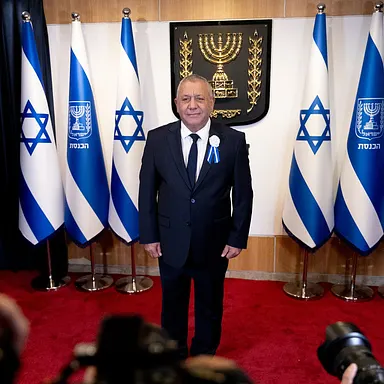
Israel's election produced no clear winner, leaving opposition leader Gadi Eisenkot with a limited window to assemble a governing coalition. David Halbfinger, the New York Times Jerusalem bureau chief, walks through the options and the compromises each one demands.
He explains the coalition arithmetic, why a unity government with Benjamin Netanyahu seems unlikely, and the demands of the ultra-Orthodox parties over military service and subsidies. The conversation then turns to the Arab parties, which won a record 19 seats, and the political and security fears that complicate any partnership with them.
Halbfinger also describes what happens if talks fail, including a possible minority government or new elections.
In this episode Rachel Abrams, David M. Halbfinger
This episode's transcript on Israel's coalition talks and Gadi Eisenkot was made with the technology behind HappyScribe's AI notetaker.
Ads in this audio differ from the text. Tap the sentence you're hearing to follow along.
Synced: the text now follows the audio.
From the New York Times, I'm Rachel Abrams, and this is The Daily.
The situation here—it's bad situation. I was born here. I never saw a situation like this.
More than 2 weeks after one of the most consequential elections in Israel's history, there is still so much uncertainty among voters about who will lead the country.
20 years. I think I have to go home, maybe.
It seems like the longest-serving prime minister, Benjamin Netanyahu, could be on the way out.
I don't really know if I'm in favor or not of Eisenhower, because it's very difficult for me to believe in anyone nowadays in Israel.
And so the spotlight has fallen on opposition leader Gadi Eisenhower, who is trying to make all kinds of deals with disparate political parties who have different wants and different needs in order to actually build a coalition that could run the government.
What I would like is the Israeli society to get unified and get together once and for all.
But the choices about who to partner with and how they are just not simple.
No, he has to compromise. You know, he has to go either with the religious or with the Arabs.
And so today on the show, Jerusalem Bureau Chief David Halbfinger explains the kinds of compromises that Eisenhower will need to make if he wants to run the country.
It's Israel's last chance to become a country with some sort of sanity. It's an insane place at the moment.
And what will happen if he can't pull it off? It's Friday, November 13. David Halbfinger, welcome back to The Daily.
Great to be here.
The last time we spoke, you had prepared us for an election that a lot of Israelis thought of as existential, and one whose results were going to be kind of messy and unclear. That seems to have borne out we're talking to you more than 2 weeks after the election. We don't have a clear answer, and the path forward, from what I can tell, is going to be not just complicated, but also, as you prepared us for, have seismic political implications for a country that has been so long dominated by one guy. So catch us up, David, on what has happened since election day.
So the election was huge. There was an incredible turnout in this election, but there was no clear winner. Gadi Eisenhower, the leader of the opposition, was given the chance to form the government because he heads the largest coalition. But who will be in that government remains unclear and very much in doubt. He would have to put together a coalition that is incredibly diverse and, in some cases, at odds with itself. That's an incredibly difficult thing to do, but he can't afford to fail.
So he's got a month, a maximum of 6 weeks, to try to put together a government that can lead this country.
What happens if at the end of that 6 weeks he is unable to get a government together?
So if Eisenhower fails, it's likely that Netanyahu would be given the next chance to form a government. He would then get 4 weeks, and then it could go to the Parliament itself. The Knesset would have 3 weeks to choose a candidate. But if all of that fails, the Parliament would dissolve, and we'd have 3 months until new elections are held. Netanyahu is the caretaker prime minister. He's the incumbent. And if he remains the incumbent while we go to new elections, that gives him an enormous advantage and a much stronger shot at winning again.
So what does Eisenhower actually have to do over these next 4 or, as you said, 6 weeks to build a coalition?
So with the 4 parties that are squarely in his coalition right now, he has a total of 48 seats in Parliament. Ideally, he comes up with a coalition that has 61 seats out of the 120 in Parliament behind it, at least. That's a simple majority, a real majority in Parliament. And, you know, that's what he would love. But in this case, it seems really difficult to imagine how he could do that because the parties that are available to him are really at odds in important ways.
They're ideologically diverse. They're ethnically diverse. You talk about Congress as herding cats. Imagine herding lions or tigers. That's what we're talking about. These are people who are, in some ways, fundamentally at each other's throats.
Okay, basically what you're describing is a really serious uphill battle to get people to come together to support him.
Yeah, and he has to both negotiate with all of them and then figure out a coalition that he wants to govern with from among them and work out the most favorable deal possible to allow him to achieve the goals of him and his core coalition partners. So that's not an easy task to do. And, you know, it might seem like a month or 6 weeks is plenty of time, but, you know, I think you could easily blow through all of that time and come up with nothing.
Okay, so then, David, tell us about some of the different options that he actually has. Like, who could he potentially partner with?
So first, we have to remember that in his campaign, Eisenhower made a lot of, well, he made several really serious promises to the voters. And every one of those is going to make his life complicated. His options, you know, one of his options is something he ruled out in the campaign, working with Netanyahu himself. He could form a unity government. You know, so he could go in with Netanyahu after having campaigned against him.
For obvious reasons, that seems like a nonstarter.
Yeah. I mean, it's frankly impossible to imagine now, not only because he campaigned against it, but because, you know, I think it would be just seen as the ultimate betrayal of the voters. I mean, the entire opposition coalition, probably the top priority is getting Netanyahu and this government out. So bringing him back in or giving him a new lease on life would be just unforgivable. Moreover, it's hard to imagine Netanyahu agreeing to terms that Eisenhower could accept.
And nobody trusts Netanyahu to live up to those promises that that would entail. He had a unity government once before. He promised to step aside and let his partner take over. You know, he broke the government apart before that happened. And, you know, nobody believes that he would live up to it again.
Also, though, I just sort of wonder what incentive Netanyahu actually has to pretend or try to form a government. Because if Eisenhower can't form a government, if Netanyahu can't form a government, if the Parliament can't form a government, then everything gets dissolved, right? And then there's a new election, which, as you explained, probably breaks Netanyahu's favor. So it really just feels like the logical thing, the thing that's in his actual interest, would be to sit back and just let everything fail.
Yeah, no, I mean, like, the clock is Netanyahu's friend here, right? So if anybody takes the bait and really takes him seriously, even to get into negotiations in earnest with Netanyahu, is to burn time, right?
Okay, so I understand why partnering with Netanyahu is unlikely and potentially untenable. What about the other options that Eisenhower has?
So one option, which he appears to be pursuing right now, is to work with the ultra-Orthodox parties. There's two of them. You know, this is fraught with peril too. After all, the ultra-Orthodox have some asks that Eisenhower has vowed to reject. Above all, they want to keep their young men from having to serve in the military and protect them against being arrested for draft evasion so that they can continue to study in yeshivas, religious schools, throughout their adult lives.
They also want to preserve the very generous government subsidies that allow them to have a lot of babies and raise them and live their lives basically with government funding, often not really working, you know, private sector jobs or any kind of jobs other than studying in these schools. And Eisenhower and his allies have promised to correct this because, you know, after all, they have run on representing soldiers and reservists who serve in the military and pay the taxes and hold down jobs and whose money they feel is being, you know, shifted to these people who don't share in that burden and sacrifice.
So to go into a coalition with the ultra-Orthodox would require Eisenhower presumably to have to give up on some or all of those campaign promises, which, again, was hugely important in inspiring voters to come out in large numbers.
One other thing, though, David, that I think is really important that you told us in our last episode was that Eisenhower himself is a former Israeli military chief. He lost a son and two nephews in the war in Gaza. And so his platform that everybody should serve, it's not just really a platform. It is also very much sort of central to who he is. And so the idea that he would suddenly be willing to say, okay, you know, I'm going to give up on the central tenet about service and sacrifice, it doesn't feel like he would be very eager, just as a person, what we know about him, to do that either.
No, it doesn't. I mean, but you're getting at something that's really interesting. First, yes, he sacrificed. He believes that all Israelis should share in the sacrifice. And it's very personal to him, as you said. However, of all the opposition parties, Eisenhower's campaign left more wiggle room open to doing some kind of a deal with the ultra-Orthodox, which is very interesting when you think about it. He left room for, like, having a small number of ultra-Orthodox who were exempt from the draft, much smaller than the exemption is now, but still some.
He left room to phase in a shift of, you know, that would require the ultra-Orthodox schools to teach core curriculum subjects like math and English and science, which their students are.
Which they are not currently doing.
That's right. So that these people, when they grow up, can be productive members of society if they want to get out of the yeshivas. But he, you know, he was a little bit more lenient about doing that, not so abruptly. There were other ways in which he kind of seemed to be extending, you know, a slight olive branch to them. You know, he's in this campaign, he says, to save Israel. And it seems to suggest that he believes that the priority now to save Israel is get Netanyahu out at all costs, even if that means waiting or lowering the expectations or the aspirations for how to correct what he sees as the problem with the ultra-Orthodox sector.
It's just more urgent. The emergency is greater to get Netanyahu and this government out.
Is there also any chance, David, that the ultra-Orthodox could make a concession on their side about not serving? Like, is there any glimmer that they are willing to compromise on that point?
Look, I mean, in the things that people have been saying publicly so far, it's very absolutist. You know, they're setting as their conditions for going into a government everything that they want. But given the choice that is before them, there could be a government that does not include them, formed by Eisenhower, that passes laws that they really don't like. They could be facing a loss of a lot of money in subsidies come a few months from now. I mean, there's a lot of ultra-Orthodox who are exempt from the draft but don't really spend time in the yeshiva.
Not every one of the thousands of ultra-Orthodox men who are in yeshivas is the next great rabbi. You know, there's degrees of devotion and degrees of talent. And, you know, it's not impossible to imagine room for some compromise there. The question is how much. There is also danger in negotiating with the ultra-Orthodox parties because that could take quite a lot of time in a limited calendar. And I've heard, you know, skeptics worry that whatever promises the ultra-Orthodox political leaders get out of Eisenhower during this process, they could just run back to Netanyahu to see if he'd match or beat them because, after all, he's been their partner forever.
So that's really interesting. So basically, like, whatever concessions Eisenhower might be able to get, at the end of the day, he can't trust those either.
Yeah, I mean, you know, if he gets them in writing, maybe he can. But just as there's risk in even trying to talk with Netanyahu, there is risk in talking to the ultra-Orthodox.
So far, David, all of these possibilities that you've laid out seem extremely remote.
Yes, and we haven't even talked about the one that is, like, perhaps the most tantalizing. The Arab parties, the two predominantly Arab political parties, won 19 seats in this election. That's a record. By all rights, to outward observers at least, they should be the kingmakers in forming a government. And yet they are by far the most complicated option of all.
We'll be right back. So, David, I want to talk about this possible path forward toward a coalition with the Arab parties. Can you just explain who those parties represent? Who are the Arab voters that we're talking about here?
So people might not realize it, but 20%, fully 20% of Israel's population are Arab citizens. They share an ethnicity, a heritage, in many cases a religion, with Arabs across the broader Middle East. Yet they're citizens of Israel, this Jewish state. They have been a minority throughout its history. They've been oppressed at times and to different degrees, but they do have full citizenship rights. And, you know, they go to universities. They're educated. They're, in many cases, middle and upper middle class.
You go to any hospital. You go to any pharmacy. You'll find them caring for Israeli patients, providing very good care. And they provide a lot of good care to soldiers in the Gaza war. They're like everybody else. They want safer streets in their communities. They want affordable housing. They want lower prices. They want a better life for their kids. It should be noted that they do not have to serve in the Israeli military. Many do, but they aren't required to because, after all, and this is a historic thing, to serve in the military could force Arab citizens to have to fight against their brethren, their extended families, certainly their fellow Arabs and fellow Palestinians.
So they haven't been made to do that. Historically, they also haven't had much representation in Parliament. They've never voted proportionate to their share of the population.
And just explain why that is.
Many Arab voters for years chose to opt out of the political system, in many cases for political reasons. But in recent years, and particularly under this government, which has pursued some policies that Arab citizens find really bad, particularly turning a blind eye to violent crime in Arab communities and also pursuing very discriminatory housing policies that often lead to homes being demolished. Because of these things and other aspects of this government, including its rhetoric, very anti-Arab and often racist rhetoric, they've gotten more and more involved in government.
They've been galvanized.
They have. And the parties have also shifted. Arab political leaders historically, they ran for office and they got into Parliament, and then they chose to sort of opt out of government. They sat on the sidelines. They preferred to protest and criticize and use their platform in Parliament to be the opposition and in particular to sort of speak for the disenfranchised Palestinians in the West Bank and Gaza. The Palestinian national cause was often the most important thing for Israel's Arab politicians.
And what's happened in recent years is that Arab citizens and their leaders have started to say, you know what, we're going to, like, put the Palestinian cause maybe not to the side, but lower down on our list of priorities at least. And we're going to focus on improving the lives of the people who live here and get to vote here.
Okay, so tell us about the Arab parties that got seats in this election.
So there's a joint list, which consists of three smaller parties. They are secular and focused largely on the Palestinian cause to some degree, but also on the civil and political rights of Palestinian citizens of Israel. And the joint list is, as I said before, has really focused on protesting Israeli governments from within Parliament as opposed to participating or trying to get hold of the leaders of power. Interestingly, it's the Islamist party, Ra'am, led by Mansour Abbas, that has become more and more interested in getting into government.
Mansour Abbas would love to be a minister. He's worked very hard to say and do the things that he thinks are necessary for him to be acceptable to the Zionist and Jewish parties in the opposition. He's worked very hard to basically make himself kosher, if you will, to the Jewish parties so that he could be part of the next government.
You're describing what sounds like a moderate, I guess, to an American listener maybe.
Yeah, that's right. You know, when you talk to Abbas, he explains, listen, there was a long period of time in his career when he was not interacting with Jewish Israelis. And when he got into political life and started working with them and started listening to them, you know, it changed his view and his outlook. And it also affected where he stands on things. He has come so far as to say he recognizes Israel was born a Jewish state and always will be one. You know, he was one of the first on October 7th to condemn the October 7th attack by Hamas.
He's condemned violence and terrorism and said it's only hurt the Palestinians. I mean, I think he's done everything he can to kind of sand off whatever edges might seem threatening to Jewish Israelis about working with somebody who's from an Islamist party.
Right. Okay, I can see the problem with going into a coalition with the joint list because they are seen as sort of politically untenable because they are more hardline, as you have described it. But with everything that you've told us about Abbas and Abbas's party, explain why partnering with them would be a problem for Eisenhower.
So Eisenhower laid down four conditions, four principles that he requires anyone joining his government to embrace. Three of them are pretty easy. You have to say that you recognize Israel as a Jewish and democratic state. You have to say that you embrace the values of the Declaration of Independence, which includes equality for all. You have to agree that everyone in Israel should be subject to a requirement for national service of some kind, military or civilian.
But you now also, he added this under pressure in the campaign, you now also have to say that you believe that Hamas is a terrorist organization that must be destroyed militarily and governmentally. Now, you might say, what's wrong with that? Who can't get behind that? If you're an Israeli, why would you disagree? And there's something to that. But to many Arab citizens of Israel, it's almost like one more step down a very, you know, I'd say it's a slippery slope, but it's a painful slope.
And what you hear people say in explaining why they resist this is the feeling that they're being called upon to take a kind of loyalty oath with every one of these questions. And this would presumably not be the last. So, okay, today you say that you believe that Hamas is a terrorist group. Tomorrow, do you have to get called upon to say that you endorse everything that Israel has done to destroy Hamas? And do you have to say that you're behind everything that they might do to destroy Hamas?
I mean, I think for Arab citizens, it's important to be able to, on the one hand, reject and condemn Hamas's terrorist acts without wanting the October 7th massacre to be then used to justify the killing of thousands, tens of thousands of Palestinians, many of them civilians. So that's the problem. It's this sense that this question won't be the last. Now, having said that, I don't think the joint list would change on this, but there's a lot of indications to suggest that if Mansour Abbas were given a coalition agreement to sign and he was required to say those words, I think he could find a way to say the words that Hamas is a terrorist organization.
And I think there's reason to believe that Eisenhower would welcome that. The question is, can Eisenhower bring Mansour Abbas into a coalition and have the rest of the coalition stay with him? That's the problem.
Well, explain that dynamic a little bit, David. What are the coalition members objecting to in that scenario?
Well, okay, so several of his coalition partners, as part of their campaigns, rejected the idea of going in with the Arab parties. Chief among them is Avigdor Lieberman. He's the head of the Israel Beit HaNou Party. And he has, since the election, declared repeatedly and fairly adamantly that under no circumstances would he go into a government with either of the Arab parties, really no matter what they say or do. So Eisenhower can't just do it. He risks losing Lieberman's seats in Parliament.
The challenge is, how can he bring people on board without alienating other parts of the coalition?
That's right. In every one of these cases, he's trying to bring people on who represent something that's objectionable to somebody else on his team. So how do you grow this team, let alone hold it together?
Okay, well, that's really interesting, David, because you're describing a political risk, of course, but let's talk about what's underneath that political risk, which is an objection from voters who do not want to see some of these leaders partner with the Arab parties. What is behind that objection? What are those voters afraid of if Eisenhower actually joins up with any of these parties that you've described?
Okay, so part of it is clearly racism, but that's not all of it. You know, people imagine all kinds of scenarios, you know, involving national security. So let's say Israel has a military confrontation or wants to with Hamas in Gaza or with militants in the West Bank or on its borders in Lebanon or Syria. Let's say this is a matter of some debate. And let's say that the Arab parties are the swing vote.
That's something that makes people deeply uncomfortable, at least the Jews in Israel. And frankly, I think it makes the Arab parties uncomfortable to some degree. They've said, for example, that they would sit out some of those decisions, that they wouldn't seek to be in the security cabinet that makes those decisions. But it's not just decisions of whether to send troops into battle or not. There's the policy towards the Palestinians. And if a government has a slim majority and those Arab lawmakers could decide things one way or the other, I think for Jewish Israelis, for them to potentially see decisions on those national questions get decided or tipped by the Arab lawmakers, I think is a little bit too much for many of them to bear.
It's a fear of divided loyalties. And, you know, the best way to summarize the view from the Israeli right wing about this is just to describe one of the campaign commercials that Netanyahu put out. He did an AI video showing a future government led by Eisenhower, and he had all the parties around the table. And at the end of the table was Mansour Abbas with his feet up and basically saying no, no, no over and over again in Arabic to all the proposals to crack down on the Palestinians in one way or the other.
And then, you know, when there was talk of a Palestinian state, he perked up and said yes. And that's the fear that many on the right and some, you know, across the spectrum would have about Arab lawmakers holding a swing vote in the government.
And even if they don't believe it, they're certainly fomenting it, that fear.
Yeah, yeah. I mean, and the truth is, even on the left, there's many people who really are uncomfortable with this among the Jewish opposition. Otherwise, we wouldn't be talking about this. They'd have done it already.
Right.
On the flip side, there are not a small number of people in Israel who think that it's time and necessary for Eisenhower to form a government that brings in the Arab parties, or at least Ra'am. There are people who see that Mansour Abbas could be, you know, a representative of Israel to the wider Arab world or to the wider world at large. Maybe he could help expand the Abraham Accords to other countries in the region. Maybe he could help Israel restart a process with the Palestinians closer to home.
I do hear people talking about the idea that there's this almost psychosis about Arab citizens that needs to be overcome. The issue is whether you can overcome something, this animosity, this hatred in many cases that has existed for so long between these people who share the same land and this mistrust that was compounded so egregiously so recently.
What happens if the Arab parties and therefore the Israeli Arab voters are basically ignored? Like, what if at the end of the day, Eisenhower figures out some way to put together a government that doesn't include any Arabs? Like, what does that say about Israel being a democracy?
That's a great question. And it's one that I know is weighing heavily on people's minds because, you know, for years, for decades, whenever Israel has been accused of being an apartheid state, you know, of repressing Arabs, whenever it's basically its treatment of the Palestinians in the occupied territories has been used to indict Israel writ large, it has pointed to Arab citizens as its get out of jail free card.
They can vote. They can serve in the government. That's the line you hear.
They can serve in the Supreme Court. They can serve in Parliament. So what happens when they get 19 seats and could, you know, make a government, but the government doesn't form because they're afraid to? Yeah, how do you answer those who, you know, say that their votes don't count inside and outside the country?
So the options for Eisenhower seem to range from non-starter to radioactive. And I wonder, David, if you have any sense of which at this moment looks most likely.
It's very hard to know. And I've been warned many times not to take what's said publicly as any real indication and that these things will take a long time and may look very different at the end from where they looked early on or along the way. But Rachel, there's one option that we haven't talked about, and that's what's called a minority government. He's got 48 votes to Netanyahu's 46 right now. So he could form a government just like that. I mean, he has the ability, but that would be seen as a very unstable government.
And everybody thinks that it's a lot likelier to fall apart in a short time than if a coalition is bigger. So that's not a great option. And what we have to remember is that there just are no good options here. Eisenhower has to figure out which of all of these bad options is least objectionable to the largest number of Israelis. And answering that question really comes down to what you think Israel should be and who it should be for. And if he bets wrong, we could be looking at a lot more time with Benjamin Netanyahu as Israel's prime minister.
David Helfinger, thank you so much.
Thank you, Rachel.
We'll be right back. Here's what else you need to know today. President Trump called former Nvidia chief Jensen Huang on Tuesday and urged him to keep fighting for his job, according to two people briefed on the conversation. The call was the latest example of the president defending and protecting Huang, one of the most important people in America's race for AI dominance. The call came after it was revealed that Huang had had an affair with a woman who U.S. intelligence believed was a spy for China.
And a doctor who was unhappy about repair work in his condominium shot and killed one person and wounded four others in and around his building on Thursday in Washington, DC. The shooting began before 8:00 a.m. at a gym in the gunman's building in the busy Logan Circle area, where the shooter killed the building manager, police said. The shooter then returned to his unit on the seventh floor and shot four people on the streets below from his balcony before shooting and killing himself.
Today's episode was produced by Ricky Nevetsky, Michael Simon-Johnson, and Claire Tennis-Sketter, with help from Jack DeSidoro and Alex Stern. It was edited by Maria Byrne and contains music by Marian Lozano. It was engineered by Chris Wood, and our theme music is by Wonderly. Special thanks to Aaron Boxerman and Yonatan Rees. That's it for The Daily. I'm Rachel Abrams. See you on Sunday.
More than two weeks after one of the most consequential elections in Israel’s history, there is still uncertainty about who will lead the country.
The spotlight has fallen on the opposition leader Gadi Eisenkot, who is trying to make all kinds of deals to build a coalition that could run the government.
David Halbfinger, The New York Times’s Jerusalem bureau chief, explains the compromises that Mr. Eisenkot will need to make, and what will happen if he can’t.
Guest: David M. Halbfinger, the Jerusalem bureau chief for The New York Times.
Background reading:
Who is Gadi Eisenkot, the Israeli tasked with forming a government?
Here’s how Mr. Eisenkot is seeking to oust Prime Minister Benjamin Netanyahu.
Photo: Amir Levy/Getty Images
For more information on today’s episode, visit nytimes.com/thedaily. Transcripts of each episode will be made available by the next workday.
Subscribe today at nytimes.com/podcasts or on Apple Podcasts, Spotify and Amazon Music. You can also subscribe via your favorite podcast app here https://www.nytimes.com/activate-access/audio?source=podcatcher. For more podcasts and narrated articles, download The New York Times app at nytimes.com/app.
Hosted by Simplecast, an AdsWizz company. See pcm.adswizz.com for information about our collection and use of personal data for advertising.