
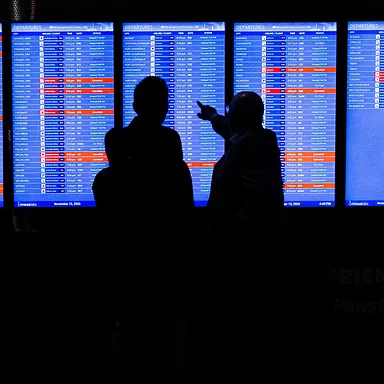
Three New York Times reporters, Karoun Demirjian, Dustin Volz and Zolan Kanno-Youngs, explain a run of technology outages that grounded flights, froze bank access and disrupted email. They describe the FAA's nationwide ground stop, which followed a router problem during a fiber upgrade in Arkansas, along with the banking and Microsoft disruptions.
Dustin Volz argues that AI tools finding long-hidden software bugs may be pushing companies to patch systems quickly, and he says officials have not found evidence of a cyber attack. The conversation also covers the White House response and the political blame that followed.
Listeners learn what officials know so far and why the reporters expect the disruptions to continue.
In this episode Rachel Abrams, Dustin Volz, Karoun Demirjian, Zolan Kanno-Youngs
This episode's transcript on a week of tech outages was made with the technology behind HappyScribe's note taker for online meetings.
Ads in this audio differ from the text. Tap the sentence you're hearing to follow along.
Synced: the text now follows the audio.
From The New York Times, I'm Rachel Abrams, and this is The Daily. In recent days, After Anthropic warned us that one of the risks to its business model included wiping out humanity. A cascade of mysterious technical glitches.
Southwest 2179, just a heads up.
Have grounded planes.
We went into a national ground stop.
Are you saying national like Reagan National, or national for the whole country?
Closed bank accounts.
So right now, if you have Chase, you literally cannot access anything.
There's more trouble in cyberspace this morning, at least.
Shut us all out of our email.
Microsoft Outlook experiencing major disruptions as.
Marriott, the National Weather Service, Charles Schwab.
Expecting at Apple, Google, and the National Security Agency.
And generally created a sense that the world is either falling apart, or getting hacked, or maybe both.
I mean, if this is all a coincidence, it's like the greatest coincidence in the history of the world.
And so today, we turn to our colleagues, Carwin Demurjian, Dustin Boltz, and Zolan Kano Youngs, to explain what we know about what's actually happened, what we might expect going forward, and maybe they can give us just a little bit of reassurance. It's Thursday, November 19th.
Wow, there he is.
There he is.
Right on time.
The man of the legend.
I'm so sorry, I, uh.
Dustin, did you run the last two blocks here?
I did, yes.
Oh my God. That is how committed New York Times journalists are to The Daily, ladies and gentlemen.
There was, there was a lot of traffic, and, you know, the, uh, the internet is exploding or whatever, so.
If there was ever a day to use that excuse, it is today. Um, so, Zolan Kano Youngs, White House correspondent, hello, welcome back.
Hey there, Rachel. Thanks for having me.
Carwin Demurjian, you cover aviation, among other things. Welcome to the show.
Hi, Rachel.
Dustin Volz, welcome.
Hello, hello.
So, Dustin, I want to start with you because you probably have the broadest overview on your beat of just everything that's happened in the last few days. When did you first realize that you had a huge story on your hands?
You know, people always assume I find out about these things in advance because I'm a reporter, but the truth is that's not, uh, often the case. Um, I first found out about the Microsoft outage, which I think was the first big one that sort of kicked off this spree of technology failures that we've seen in recent days. I learned about it from my wife. I don't use Microsoft, but my wife does. She's a lawyer, and, uh, I recall her telling me early.
Microsoft Outlook, yeah.
Microsoft Outlook, yeah. And I recall her telling me, "Well, I guess I'm not working today. Uh, seems like Microsoft's down." And that was actually the first time I had, uh, heard about it. And I honestly didn't think anything of it. You know, these things happen. Again, this was like kind of the first one that we saw over the past few days that was like a technology outage. And Microsoft's had issues in the past. Other major platforms have had issues in the past. It's not unusual. Even though it persisted for, you know, a couple of days. I think what clued me in that something more significant was happening, or seemingly something more significant was happening, was the next day when there was a nationwide ground stop ordered by the FAA of all flights in the United States.
And I immediately started getting a lot of messages from sources and friends and, uh, people I haven't talked to in years saying, "Oh my gosh, what's going on? This happened. Microsoft happened. Is there a cyber attack? Is it Iran? Are we under attack?" And I had no idea at the time. I was at a cabin in the woods with my family and some friends trying to get ready for a chili dinner. And I sort of sprang into action and started asking people, "What's going on here? What do you know?" And so the folks I reached out to in the government, uh, and other people who are, you know, sort of familiar with what's going on, are basically saying, "Hey, we have no idea what's going on, but we have no indications, no intelligence pointing to a foreign threat, a cyber attack.
This doesn't look like it's Iran. It doesn't look like it's something that someone's pulled off."
Right, right, right. And then on Monday, of course, we start seeing all these banking outages.
Right. So the bank outage was interesting. And then, you know, the same day, on Monday, there's a United outage.
Right.
And this is when I start kind of trying to reckon with myself, like, "Okay, this United outage is interesting, but is this perception biased? Like, are people just freaking out because there was the FAA outage a few days ago and now we're noticing things that we normally wouldn't notice?" So I'm trying to balance, like, "Okay, maybe that's what's going on," versus, you know, "Okay, there are a lot of people who are really concerned. This is seeming like maybe a little bit more than a coincidence."
Perception bias meaning, like, we're all seeing all these crazy things and starting to assume a conspiracy, basically.
Yeah. And then on Tuesday, that's when it got really interesting for me. The National Security Agency, which is an organization of tens of thousands of people who are very, very important to the nation's cybersecurity, had their own outage of their internal classified network that they use to communicate classified information, which is most of what they do business in. It was down, and they could not operate, and staff were being told to stagger their arrivals to the headquarters in Maryland as the agency worked to process what was going on.
Wow. And we're talking about, just to be clear, we were talking about the secretiest of the secret government agencies. So if they are having this problem, it is really making you sit up straight.
Yeah. I mean, NSA, the joke in Washington for decades is they're no such agency, um, because, you know, their existence used to be secret, and they don't talk, uh, publicly very often. And really, it was only after the Edward Snowden revelations of 2013 they were sort of forced into public. But yes, these are sort of, you know, the spooky types that hack your computers or I guess they would say they don't hack American computers, but they hack the computers of, you know, foreign spies and terrorists, and they have a very, very important national security mission, uh, to the United States government.
Mm-hmm. You know, it's, I think it's going to sound quite validating to a lot of people to hear that you at least somewhat shared some of those questions because, you know, a lot of people's reactions, at least in my life, I don't know about your lives, Carwin and, uh, Zolan, were asking me similar things. I got at least two questions about bug out bags.
Yeah, particularly, like, earlier this week when even if there wasn't evidence that all of this was linked by the same perpetrator, like, the public does notice a trend here, right? They're noticing that there are widespread digital outages happening seemingly in various aspects of the private sector and even impacting government institutions. And it was both questions also of, like, what is going on, but also where is the federal government here to.
Right, and how scared should I be?
Right.
But also, just to be clear, it's not just sort of theoretical fears, right? We have seen a number of, like, technological malfunctions and even hacks of varying degrees. So can you just walk us through those quickly, Dustin?
That's right. We've seen cyber attacks happening in the U.S. that have been linked to Iran on water systems. We've seen recently refrigeration attacks in France and throughout Europe. So the idea that, like, major cyber attacks are happening and disrupting essential services is something that we've seen happen very recently. And we also, at the same time, are seeing these top-shelf AI models discover unknown computer bugs in software that's ubiquitous throughout the internet. We were just a few weeks removed from the discovery of, uh, vulnerability in a programming language called PHP, which is used by 70% of websites on the internet.
And that came out, and the NSA, which has been dealing with its own disruption now, at the time said, "Please immediately fix this. Uh, and if you can't, you should basically take your website offline." And we're seeing a number of episodes like that where, thanks to AI, enormous bugs that seem to really have significant impact or could have significant impact if they're not addressed are coming out essentially every day now.
So, okay, so this sort of leads me to my next question because one of the big questions that people have that they're texting you is, are these events related in some way, right? And so I wonder, like, what are your sources telling you about the answer to that question?
They're saying, essentially, it's complicated. The short answer is none of them seem to be directly related, but the longer answer is most of them are somewhat related.
In what way? Just explain that a little bit.
Yeah. A lot of them, putting the FAA outage aside because that seems to be a different issue.
Mm-hmm.
Most of the other issues seem to be dealing with software updates that the banks, the airline, uh, United, and the NSA were pushing through their system. And I think we've all been in a situation where, you know, you have to close your Chrome browser to make sure that it installs the update, or you have to restart your iPhone and essentially, you know, turn it off and turn it back on again. And so because of the issues that these AI-discovered vulnerabilities are presenting, a lot of these recent episodes appear to be linked to AI discoveries of bugs.
Basically, companies trying to get ahead of problems by patching things and then crashing everything.
Right. And again, these are not cyber attacks. These are not the bad guys doing something bad. These are the good guys trying to get ahead of something before the bad guys have a chance to act. And so that appears to be what's going on in most of these other cases is that basically AI is finding exponentially more bugs than it's ever found before that humans could ever possibly uncover. Part of the problem here is something that a lot of experts refer to as technical debt. And that is essentially the concept that the internet was not ever built with security in mind. It sort of was an afterthought from the beginning. And, you know, sort of the bill is coming due now as we are realizing that a lot of old code, you know, in some cases decades old, like this bit of Java code that I just wrote about, contains problems that have never been spotted before by human eyes, but AI is now identifying.
And it does remind me of sort of like a stack of Jenga blocks where the further down you go, the harder it is to pull out a block and replace it because if you do that and you're not careful, the whole thing will come tumbling down. And I think that's what's going down is the deeper down the technology stack you go, the more likely it is that you're going to have a slip-up and everything's going to fall apart.
Sure.
And in addition to that, some of the bugs they're finding are extraordinarily severe. Things that could allow hackers to do all sorts of crazy things that could take systems down entirely. And so there's sort of a rush to fix things as soon as they're discovered. And there's a level of exhaustion as well, dealing with so many problems at once. And I think what you're seeing is, historically, a business might say, "Okay, on Saturday, we're going to take systems offline. No one's at work. Don't log into, you know, whatever app that you need to because we're going to fix it." But instead, now we're seeing these happen on Monday, Tuesday, Wednesday, Thursday because there's a feeling, a sense of, "We need to get this out right away, right now because we can't wait."
We can't afford to wait because what if somebody, like, attacks one of our critical vulnerabilities? So basically what you're saying, in order to avoid that, the entire country has basically been turning it off and turning it back on again.
Yes. We're going through both a mass psychosis episode and a national turn it off and turn it back on episode. I think that's sort of what's happened.
Wow. Okay. That is both, like, deeply sort of reassuring and also extremely disconcerting. Zolan, one thing that I thought was notable, at least when all this news was coming out about the outages, was that we didn't really hear a lot from the White House. It felt like the president was a little bit absent when people were, I guess, panicking a little bit. I'm not saying he should have made a comment or should not have made a comment. I'm just sort of wondering, as a White House correspondent, did you feel like he was a bit absent or just give us your take.
Yeah, because in some ways he was absent, right? He left the country and went on this diplomatic trip to Asia, which we know is of great importance to him, where he's expected to meet with President Xi Jinping. But the fact that he left at a time where you're seeing this rising concern from the public, rising anxiety from the public, was notable. And the president did comment on this when he landed in Asia, but he didn't exactly provide a clear explanation or sort of fact-check for the public what was happening and what wasn't happening.
He more so was dismissive. And I believe one quote was, "That's life."
Mm-hmm. It's life, yep.
This is going to happen when you're a powerful country. That certainly didn't quell the anxiety of members of the public. Since the president's comments, we have seen what I would describe as a scramble by the administration, though.
So, Carwin, I wonder, as you're hearing what the issue has been at the heart of a lot of these tech outages, I wonder if that explanation rings true to you in your coverage of aviation specifically, this idea that it was some kind of proactive attempt to get ahead of a problem that sort of lingered for a while in the face of all these threats.
Well, look, there are parts of the FAA story that also have to do with trying to make fixes. But what happened on Friday with the national ground stop really left us with more questions than answers because it just didn't seem to fit the rest of the pattern.
We'll be right back.
Carwin, for the last week, we've been hearing words like circuit failure, L3 heroes, pinging, router, and part of the reason we summoned you here is for you to explain in plain English what actually happened with the planes over the weekend. So could you do that for us?
So on Friday, there was a upgrade that was being done in El Dorado, Arkansas. And basically, the FAA has been trying to pursue this program of switching over the copper wiring that has been holding up the air traffic control network for decades over to fiber optic cable. They're about 70% of the way through, and that means going into these various facilities across the country and making these upgrades. They tend to do the big hubs overnight, quiet periods, but this was a Friday afternoon, fairly remote facility. They figured nothing's really going to go wrong.
Mm-hmm.
We need to switch over from copper to fiber, and we need to add a new router to support the new network capability. And then shortly after that upgrade was made, they started to see that it was sending out a lot of pings. There was also an issue that they noticed at a radar facility in Amarillo, Texas, and this overactivity started basically, like, flooding the system. And so the officials looked at this, they saw these errant things happening, decided that they couldn't figure out how to shut it down quickly and that they were going to just issue a nationwide ground stop to make sure that the technical glitches that they were tracking would not turn into actual accidents.
Right, right. Can I just pause here, though, Carwin, because I want to understand, I think I'm going to need you to dumb this down a little bit more even. You mentioned that the system was getting pinged a lot. Can you just explain what exactly a ping is? What kind of information we're talking about?
So to understand how this all works, you kind of need a basic map of how the air traffic control network is laid out. There are a number of different components. There are air route traffic control centers. There's 22 of those. They handle the high-altitude traffic. There are regional facilities that manage the flow towards airports and away from airports. And then there's the towers at the airports themselves and the command center in Virginia. They are all connected by a network that needs to be able to transfer in real time information about where planes are, what the traffic is, and other data about weather and other inputs that are important for both the controllers and the pilots to make sure they are flying safely.
Mm-hmm.
But when you start to have a router overload the system, when one facility or two facilities in this case start to just flood the system with too many data pings, with too many efforts to connect to a variety of different places that normally they might not be doing, you start to basically crowd out the space and it becomes unreliable.
And the net effect of that is basically if you're an air traffic controller who needs to see any one of many things in order to make the planes not come too close to each other, you're not going to be able to actually, like, see a map or see the weather or see the distance or any of that other data that's trying to get through.
This was not a total blackout, let's make that clear. But the issue was that it was becoming unreliable, and they were not sure where they were going to have the next glitch or the next slow-to-load issue, that they needed to be able to get it. And because you really do need to be able to have that real-time data flow, they figured, "This isn't safe. We don't know what's going to be the next shooter drop here."
Mm-hmm.
And we've got to just shut it all down before it becomes an actual situation of trying to avoid a real-life accident where lives would be at stake.
Basically, there was a nationwide ground stoppage because the FAA didn't know what information it was getting and what information it might not be getting. And so therefore, the safest thing to do was to tell everybody, "Don't fly."
Yes. And look, for days after, I mean, it was several hours, a few hours that this ground stop was in place. But for days after that, you really had the whole airline industry struggling to recover because there were crews that got stranded in certain places or timed out because they hadn't slept overnight. And that created real backups for people who were trying to travel. My parents got stuck in that. Their flight got canceled. I mean, it was just a very widespread travel issue. And it made people extra nervous because it happened a week before the Thanksgiving travel season was going to kick in.
Carwin, you had said earlier that we have a lot more questions and answers about what exactly caused the system to be overloaded. And I wonder, we're nearly a week out at this point, what have we learned about what happened last weekend?
Well, we've learned where things went wrong. El Dorado, Arkansas, and Amarillo, Texas, a radio facility and a radar facility. We've learned that there was a single contractor that was working on this particular upgrade in Arkansas and that they were being physically supervised by an FAA technician through it. We know that the FAA did not expect anything to go wrong, and we know that they have figured out that what did go wrong is that the router in question started multicasting.
When you say router, are we talking about a router that, like, what I have in my living room, basically, or?
I mean, sort of, right? I mean, we're talking about a different sort of a system, but a router's job is to take the flow of data that's coming in and make it available to other devices, other parts of a network, potentially. And so there's a predictable flow. And when the router does something that is not predictable, it becomes a potential situation where it's flooding a system. And that apparently happened based on a configuration that the FAA says neither they nor the contractor changed or set. I don't want to get too much into the technical details, but.
Thank you.
They are at a loss right now still, and they don't know if that was human error or if that was faulty equipment or if there was something that went wrong with the way they did the installation. And those are still all open questions, even though we're basically a week out from when it actually happened.
Dustin, I do wonder, though, about all of these questions people have about the hacking because the way that Carwin is describing getting sort of flooded with pings, right, and requests and stuff like that, I just sort of wonder if that looks like suspicious activity. And from your reporting, have the authorities ruled that out in this particular case when we're talking about the ground stoppage?
The authorities have continued to say that they do not think a cyber attack is responsible for the FAA outage or any of the other episodes. Certainly, when you talk about anomalous router pinging, that can resemble perhaps a cyber activity, and that is something that I think could lead people to believe certain things. But numerous senior administration officials on the record, in public, in televised briefings, and folks that I'm talking to, you know, in these agencies who are not speaking on the record but sort of speaking anonymously or on background are saying the same thing, that they don't think there's any evidence that that is what's going on here.
You know, that doesn't mean the investigation's over. Things can change.
Right. To that point, though, Zolan, I got the impression, at least from a distance, that everyone, including the White House, was really scrambling to try to figure out what was going on. Tell us what you have learned about their response in sort of the early days of all of this.
So they definitely were scrambling to figure out what was going on and at the same time trying to figure out a message on this. And it's the latter point that seemed to take a while. Yes, there were officials that came out and held a press conference, the Secretary of Transportation and Homeland Security, but the message initially was mainly blaming the Biden administration and saying, "We need more money from Congress," right? But then in recent days, I think that the White House and the Trump administration has heard that these concerns are not just coming from Democrats.
Mm-hmm.
You've had Senator Josh Hawley, who's a Republican, say that they need a more clear briefing from the Trump administration. You had former White House Press Secretary Caroline Leavitt seldom to criticize the Trump administration, who was saying that greater transparency was needed at this time. And what they're speaking to actually gets to sort of the point for some of these federal agencies and really the role of the federal government in a time like this. I've now spent really most of this day talking to national security officials, former national security officials, and they were describing how, you know, at a time like this when there's a void of information.
Mm-hmm.
It really is up to the federal government to fill that void because if you don't, then the public is going to fill it with their worst assumptions, right?
Right.
It must be a hack.
Right.
It must be a cyber attack, particularly in the void of any more information coming from the administration at this time. So it seems like they've started to notice that. You saw Secretary of State Marco Rubio come out, acknowledge the anxiety of Americans, and provide at least an attempt at an explanation of what was going on. You saw that there was a late addition to the administration officials that were going to appear at a congressional hearing on threats to the United States. Jay Clayton ended up appearing, who's sort of President Trump's new SAR.
Is that right? Like, when it comes to artificial intelligence.
That's right.
Yeah, he does love SARs. And then you also had the Homeland Security Secretary Mark Wayne Mullin answering from different lawmakers, but it has not calmed the anxiety at this time.
And to your point, Zolan, there is an overwhelming sense of anxiety. The cumulative effect of all of this is a deep sense of paranoia. I am definitely not the only person whose parent texted them, "Are you still sure you want to fly home for Thanksgiving next week?" And the only reassuring thing I have to say, it feels like, in the absence of information for so much of this week is, "Dad, get off the Internet."
I cannot recall a time where I have received so many messages from just a wide range of people from all walks of life, people that are just worried, right?
Yeah.
Going about their every day that are asking me, "What is going on? Will I be able to rely on critical infrastructure like hospital systems in our electric grid?"
Right.
As of now, it seems the government is saying, "Yes," but that has not calmed the anxiety that is so apparent right now.
You know, when I was watching this press conference that you've talked about between Mark Wayne Mullin and Sean Duffy, not only did they seem to be blaming other people, other agencies, but they also seemed to have kind of turned on each other a little bit.
Mm-hmm.
You know, I got a general sense that Mark Wayne Mullin was blaming things that had happened under Duffy. And I think the cumulative effect of all of that is you look at that dynamic, and when you get the sense that there's sort of other dynamics at play beyond just getting information to the public, it makes sense that that might, I don't know, underscore people's nerves.
I mean, look, blaming the Biden administration is a common refrain.
Sure.
With this administration, but picking a real fight with Congress and accusing them, you know, of being stingy is not going to win you any friends and admirers in Capitol Hill.
When you're trying to ask for more money.
Correct. And the way he went about it has really turned off Republicans and Democrats. And so that is just sowing a little bit more chaos, whether some of it was inadvertent or some of it was just real bad judgment. It doesn't really matter because the net effect was that it really did not calm the nerves of the viewers and did not leave them with the sense that the government's got this and that they're going to actually be able to forge ahead with a fix.
Mm-hmm. Given everything that the three of you have told us about what has been driving these issues, this warp speed attempt to prevent any vulnerabilities from breaking out into the open because of AI, AI is not going away anytime soon, it does not appear, right? And so I just sort of wonder if we might be in this period right now where what we've seen the last week is kind of the new normal. And Zolan, unless you have a big thought you want to add here, I'm going to go to Dustin for a final word.
Go to Dustin. I've given all good.
Dustin, I agree. Skip Zolan's big thoughts. You know, this whole thing has been so fascinating because on the one hand, the only way you're going to fix these problems that we're all talking about is by sort of seizing public attention, and typically it only happens after a major catastrophe. Thankfully, that hasn't happened in the past few days. No one has died. And so I have the simples to tell people to calm down, you know, that put things in perspective. Like, you know, you're able to still access your banking accounts. The flights are still leaving. Maybe sometimes they're delayed.
Mm-hmm.
But the truth is that these problems are going to persist. And with the rapid acceleration of advanced AI, we're probably going to continue to see more issues like this where bugs are being found and fixed, and while they're being fixed, systems are taken offline. And that even gets before, you know, the question of, you know, what are the hackers going to do with these tools that they discover? So there is going to be a bumpy ride ahead of us, I think. The folks I talk to who are really smart say, you know, the next 12 to 18 months for technology could be extremely difficult.
And what they mean by that is AI is surfacing and identifying all of these problems in ancient code in the technical stack of modern computer infrastructure that we've neglected for years or decades because we have not addressed security. The Internet was not built with security in mind. And so AI is going to be able to find these problems and hopefully fix them. And at some point on the other side of that is going to be hopefully a much more secure Internet with fewer problems.
Now, the one caveat to that is people who are really smart have been telling me, "Look out for the next 12 to 18 months for at least the last 8 to 10 months." And the time horizon doesn't change. But if you're an optimist, that gives you something to hold onto is that, you know, think of it like a pandemic. You know, we're going through this pandemic of technology failures right now as we're discovering all of these new problems. And hopefully, on the other end of that is a much more inoculated, technologically safe Internet.
Dustin, thank you so much for ending this episode on an optimistic note. And Zolan and Carwin, thank you both so much for being here.
Thank you.
Thank you so much.
Thank you, Rachel.
We'll be right back.
Here's what else you need to know today. President Trump, Xi Jinping of China, and Russian President Vladimir Putin greeted each other with smiles and handshakes on Wednesday in Shenzhen, China, hours after President Trump received a personal airport welcome from Xi that included a hug. The show's of friendliness by the three world leaders on the eve of a trilateral summit contrasted sharply with their divergent stances on some of the world's most pressing issues, including nuclear arms control, China's access to advanced AI chips, and the future of the war in Ukraine.
And an overwhelming majority of House Democrats voted to nominate Hakeem Jeffries, the New York representative, to be speaker when the party assumes control of Congress in January. The move puts him in line to become the first Black lawmaker to hold the House's top leadership role, which is second in line to the presidency. Jeffries has faced some resistance from progressives who have been fed up with the Democratic establishment, but no one emerged to challenge him. Today's episode was produced by Jack DeSidoro, Chris Benderev, and Arab Krupki.
It was edited by MJ Davis-Linn and Michael Benoit. It contains music by Marian Lozano and Dan Powell and was engineered by Alyssa Moxley. Our theme music is by Wonderly. That's it for The Daily. I'm Rachel Abrams. See you tomorrow.
In recent days, a series of technical outages have grounded planes, closed bank accounts, shut us out of our email and generally created a sense that the world is either falling apart or being hacked, or maybe both.
The New York Times reporters Karoun Demirjian, Dustin Volz and Zolan Kanno-Youngs explain what’s really going on and whether we can expect it to continue.
Guest:
Karoun Demirjian, a breaking news reporter for the The New York Times.
Dustin Volz, a cybersecurity and intelligence reporter for The New York Times.
Zolan Kanno-Youngs, a White House correspondent for The New York Times.
Background reading:
Widespread technology outages put a focus on President Trump’s national security cuts.
A ground stop for flights came as Transportation Secretary Sean Duffy pushed to rapidly upgrade aviation systems.
Photo: Alex Kent/The New York Times
For more information on today’s episode, visit nytimes.com/thedaily. Transcripts of each episode will be made available by the next workday.
Subscribe today at nytimes.com/podcasts or on Apple Podcasts, Spotify and Amazon Music. You can also subscribe via your favorite podcast app here https://www.nytimes.com/activate-access/audio?source=podcatcher. For more podcasts and narrated articles, download The New York Times app at nytimes.com/app.
Hosted by Simplecast, an AdsWizz company. See pcm.adswizz.com for information about our collection and use of personal data for advertising.